Showing posts with label The House of Israel. Show all posts

Tuesday, July 28, 2026

Has Hitler’s Order for the Holocaust Been Discovered?

 From It Can Always Get Worse:

To summarise briefly: why the Holocaust happened is straightforward—because Adolf Hitler wished it to—but how and when the decision was taken is debated. The debate turns largely on whether there was a Führer Order for the Holocaust. While no such document has ever been found, this is not surprising. There was extensive destruction of Nazi documentation, and Hitler routinely conveyed orders verbally anyway, so, if there was a Führer Order, it was almost certainly never written down in the first place. Accentuating the difficulties, the surviving records are written according to a euphemistic official Nazi discourse that leaves room for interpretation, and Hitler—like Lenin—deliberately cultivated uncertainty within the regime about his role in the worst crimes.1

Historians are broadly divided into two camps, those who argue for a moment between July and December 1941 when a Führer Order was issued, and those who argue there was no “moment”, but rather an iterative process between Hitler at the centre and various lower officials in the occupied territories, where the Führer endorsed, rather than originated, the escalatory steps of the Shoah.

In assessing the evidence historians are working with in coming to these divergent conclusions, one aspect I highlighted was:

SS operatives involved in implementing the Final Solution … have uniformly testified that their orders came directly from Hitler. There is no reason to doubt the SS men were substantially correct, that Hitler stood behind the fundamental decision for the Holocaust and every decision of significance as it escalated. But it does not settle the question of a Führer Order because none of the SS officials heard Hitler’s verbal instruction(s) personally; they all heard of Hitler’s will through [Heinrich] Himmler. And Himmler did not specify to his subordinates whether, during his increasingly frequent face-to-face meetings with Hitler from the summer of 1941 onwards, the Führer had approved or initiated genocidal measures. (Read more.)


Will there be another genocide? From Welcome to Absurdistan:

Fourteen years ago I published a book one chapter of which entirely dealt with the forests fires curently raging across Canada choking the lungs of Americans from Maine to Chicago. It was published by Harper Collins in New York, and received a good old fashioned push by their PR department.

I woke up at 4 am to get on drive time in Texas and Atlanta. I must have spoken to 30 million people - in theory - the PR kept me up on the numbers each radio host had, I spoke to the big names, including the sainted Dennis Prager which pleased HC no end. In each interview I hit the major highlight of the book - the most shocking crime against people and nature - outlining how “natural regulation” installed by the UN FAO (Food and Agriculture Organization) had made the forests thick, desiccated: visualize a whole bunch of unthinned little trees leaching all the water from the soil, fire ladders growing up the trees, just waiting for a lightning strike or stupid “activist” kid to trigger conflagration.

All over the world, these policies, these regulations had been forced in a series of iniquitous meetings where entire nations were placed under the rule of weedy, stupid, vicious idiots who called themselves “scientists” employed in Turtle Bay, who had, courtesy of the Rockefellers and a bunch of other malignant families - basically the ones holding the debt of the New York Federal Reserve - crowned themselves Lords of Nature. And, as I began to understand, planned to take it all from us. (Read more.)

Share

Sunday, June 28, 2026

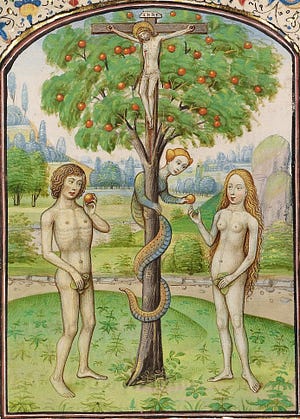
Meditation on the Tree of Knowledge


 From Justi Andreasen at Reclaiming the Biblical Worldview:

What if the fruit in Eden was never meant to remain untouched, and the transgression lay in the manner of its taking?

Most readers approach Genesis 3 as a simple account of disobedience. The command is given, the boundary is crossed, and the punishment follows. Yet this familiar reading leaves one question largely unexplored: What was the Tree of the Knowledge of Good and Evil for? In other words, why would a good God place a forbidden tree in Paradise?

St. Ephrem the Syrian offers a different vision. He describes the Tree as a veil, a living boundary akin to the curtain separating the Holy Place from the Holy of Holies. Its presence did not signal permanent exclusion. It marked a space into which one must be worthy to step. Adam and Eve were not barred forever. They were being formed for a gift.

“He planted the Tree of Knowledge, endowing it with awe, hedging it in with dread, so that it might straight way serve as a boundary to the inner region of Paradise.” -St. Ephrem, Hymn III, 3

A boundary implies not absolute prohibition but ordered approach. The Temple clarifies the pattern. The veil did not exist to enforce distance but to protect what was holy until the priest was ready to enter. Entry required preparation. When King Uzziah (a ruler who unlawfully entered the Temple to perform priestly rites reserved for consecrated priests) forced his way past the boundary, his presumption disfigured him. The Tree functioned in the same way. It stood as a threshold within creation, a sign that maturity unfolds in time. The fruit was to be received when the creature had grown into obedience.

This holds true in ordinary situations as well. Consider claiming a driver’s license without undergoing formation. You would place yourself and others at risk, because you would be exercising responsibility without the formation required to carry it safely. Or consider falsifying your CV to obtain a high position. The title might come quickly, but the strain would follow just as quickly. You would find yourself overwhelmed, and the team around you would feel the instability of leadership that has not been earned. Had the role been the fruit of your labour, had you been promoted through recognition of real competence, the weight of it would rest on something solid, and the order of the group would hold. (Read more.)

Share

Sunday, June 7, 2026

Victory of the Leper King

 From The Collector:

In his short 24-year life, Baldwin IV celebrated many victories against his long-standing rival, Saladin. But his victory at the Battle of Montgisard is undoubtedly his most famous victory. Still recalled by witnesses 80 years later, Baldwin faced impossible odds. Yet his courage and fortitude ensured the 16-year-old Leper King delivered a crushing blow to his opponent.

King Baldwin IV came to the throne in 1174, a mere 13-year-old boy following the death of his father, King Amalric. Like the other Crusader States, the Kingdom of Jerusalem was a frontier kingdom, surrounded by hostile Muslim enemies. Warfare and conflict were a fundamental part of life, and kings were required to lead their troops into battle regularly.

King Amalric had offered the kingdom strong leadership and had been, in many ways, an ideal king. The accession of a boy untested in warfare was a huge blow to the kingdom. But youth was not the only hindrance to Baldwin’s reign. Shortly after his coronation, Baldwin was diagnosed with leprosy, his illness discovered by his tutor and friend, the chronicler William, Archbishop of Tyre. (Read more.)


The Fall of the Kingdom of Jerusalem. Also from The Collector:

Crippled by leprosy since his teens, Baldwin IV had been a surprisingly effective king. His illness elicited compassion from his subjects, and their loyalty to their sick king was a key factor in the success of his kingship. In 1185, Baldwin finally succumbed to his illness and died. He was buried close to his father in the Church of the Holy Sepulchre. Within two years of Baldwin’s death, the kingdom he had striven so hard to defend had fallen into the hands of his longstanding Muslim rival, Saladin. Events leading up to the Leper King’s death help explain why, after his passing, the kingdom fell, and the city was lost to Christendom forever.

Baldwin IV, the Leper King who defied a death sentence, was diagnosed shortly after his coronation in 1174. It was understood that he would not father any children to succeed him. His elder sister, Sybilla, and his younger half-sister, Isabella, were therefore central to the succession.

Sybilla married William of Montferrat in 1177, and by him she bore a son named Baldwin. Montferrat died shortly before the child’s birth, and Sybilla later married a second husband, Guy of Lusignan. By 1183, Baldwin became too ill to rule and needed a regent to govern alongside him. Guy, as his brother-in-law and the husband of the heiress to the kingdom, was the natural choice. Guy proved to be a poor military commander whom the nobles refused to follow, and Baldwin removed him from his post within weeks of his appointment.

Guy’s unpopularity meant that the prospect of him succeeding to his brother-in-law’s throne was deeply contentious. Most vocal amongst those in opposition to Guy was Raymond III of Tripoli, a cousin of Baldwin IV and a man who served as his regent on several occasions. To ensure Guy would not succeed him and thus tear the kingdom apart, Baldwin attempted to have Guy’s marriage to Sybilla annulled. But Guy’s disobedience, along with Sybilla’s refusal to leave the husband she loved, thwarted Baldwin’s plans. (Read more.)

Share

Wednesday, April 15, 2026

The Fiery Sword of the Prophet Elias

 Picture 

From TFP:

In the words of Saint Bernard to Pope Eugene III, by vindicating the rights of God, Elias was the model of justice, mirror of holiness, example of piety, champion of truth, defender of the faith, doctor of Israel, teacher of the uneducated, refuge of the oppressed, advocate of the poor, an arm of widows, eye of the blind, the tongue of the dumb, avenger of crimes, dread of the wicked, glory of the righteous, rod of the mighty, hammer of tyrants, father of kings, salt of the earth, the light of the world, the prophet of the Most High, forerunner of Christ, the anointed of the Lord, terror of the Baalites and thunderbolt of idolaters.3

Elias fulfilled the threefold mission God had entrusted to him at Horeb. The time was approaching for him to leave the earth. For an ordinary person, this necessarily means passing through the threshold of death. However, divine Providence had other plans for Elias, the prophet of great exceptions. Some scholars believe the angels took him on a chariot of fire4 to an unknown place on earth; others, that he went to the earthly paradise. As he was taken up to heaven, he threw down his cloak to Elisha, his disciple and successor.

Thus, from his place, “consumed with zeal for the Lord God of hosts,” the prophet Elias follows the unfolding history of salvation.5 He contemplates the extreme decadence of modern times, when the laws of the Lord God are trampled upon like never before. He despises the idols which twenty-first century men have erected to Moloch, the God associated with child sacrifice, through the unspeakable sin of abortion; or to idols of sensuality with the increasing number of sexual immoralities added and accepted by society at large; finally, he can scarcely hold back his fiery sword when he witnesses the corruption and betrayal of members of the One True Church of Christ.

We pray to Saint Elias for the grace of perseverance and fidelity to the Lord of Hosts in these challenging times and we join our supplications to Ecclesiasticus . . .

“And who can glory like to thee? Who raisedst up a dead man from below, from the lot of death, by the word of the Lord God. Who broughtest down kings to destruction, and brokest easily their power in pieces, and the glorious from their bed. Who heardest judgment in Sina, and in Horeb the judgments of vengeance. Who anointedst kings to penance, and madest prophets successors after thee. Who wast taken up in a whirlwind of fire, in a chariot of fiery horses. Who art registered in the judgments of times to appease the wrath of the Lord, to reconcile the heart of the father to the son, and to restore the tribes of Jacob. Blessed are they that saw thee, and were honoured with thy friendship” (Ecclus. 48:4—11). (Read more.)


Share

Monday, March 16, 2026

Trump’s Epic Fury Strategy Is Working Even If Critics Cannot Yet See It

 From Amuse on X:

Public debate about military action often suffers from a simple problem. Many observers evaluate the present through the lens of the past. The United States fought long wars in Afghanistan and Iraq. Those wars produced exhaustion among American voters and deep skepticism toward any new military engagement. This skepticism is understandable. It is also sometimes misleading. When people assume that every use of American military power will automatically lead to a generation long occupation, they may fail to see when a different strategy is unfolding.

That is the background against which Operation Epic Fury must be understood. A joint US and Israeli campaign has conducted one of the most effective air offensives in modern history. In roughly ten days more than 5,000 major targets inside Iran have been struck. Entire layers of Iran’s military leadership have been eliminated. The infrastructure that sustains the regime’s ability to threaten its neighbors is being dismantled piece by piece. Analysts across the defense community describe the speed and scale of the campaign as unprecedented.

The operation has been driven by unusually deep coordination between two highly capable militaries. American and Israeli forces are not merely cooperating in the loose sense typical of coalition warfare. Their command structures have been integrated to a remarkable degree. A US three star general and full staff operate inside Israeli headquarters, while an Israeli general and staff work inside US Central Command. Intelligence flows continuously between the two commands. Targeting information is shared in real time. Decisions that once required slow diplomatic coordination now occur within a unified operational framework.

The results speak for themselves. Iranian missile launchers, drone factories, underground weapons depots, transportation networks that move missile units, and command and control facilities have been systematically targeted. Hardened underground facilities have been penetrated. Launch infrastructure has been destroyed. Communications networks that coordinate attacks across the region have been degraded or eliminated. According to current assessments, more than 90% of Iran’s ability to conduct large retaliatory missile attacks has already been destroyed.

To understand what that means, consider the opening phase of the conflict. Iranian planners attempted to launch massive missile salvos designed to overwhelm defensive systems. Early waves involved 25 to 50 missiles fired in coordinated strikes aimed at Israel, US bases, and allied facilities. Such attacks depend on volume. If enough missiles arrive simultaneously, some will inevitably slip through.

That strategy has collapsed. Today Iran is often able to launch only two to five missiles at a time. Occasionally a volley of 10 to 12 missiles occurs, but even those are well within the capacity of layered US and Israeli missile defenses to defeat. The offensive capacity of the Iranian regime has not merely been reduced. It has been structurally crippled. (Read more.)


Share

Sunday, March 8, 2026

The Three Tongues on the Cross and The Inheritance of Christianity

 From Jared Selim:

When Our Lord hung with outstretched arms upon the tormenting Cross of Golgotha, Pilate fixed a titulus above His Head. It declared before the world in the three great languages that resounded through Judea: “Jesus of Nazareth, King of the Jews.”

These languages were Hebrew, Greek, and Latin. In the scornful inscription of the Romans, they declared despite themselves what the Jews who delivered their Messiah to death would not: the true and universal Kingship of the Logos made flesh, Filius Dei—the Son of God. As St. Jerome said, “the voices and writings of all nations proclaim the passion and the resurrection of Christ. […] the Jews, the Greeks, and the Romans, [were] peoples which the Lord has dedicated to His faith by the title written on His cross.”1

If these three peoples represent all nations, then every Christian, by our baptism and life in Mother Catholic Church, enters into the Hebraic, Greek, and Roman expressions of Christ.2 The Messiah shines in the particular forms and manners of these nations.(Read more.)

Share

Sunday, March 1, 2026

USA and Israeli Forces Attack Iran

 From CDM:

The attack on Iran is large-scale and is expected to continue for at least several days, reports NYT. First wave of Iranian ballistic missiles launched toward Israel. 30 missiles reportedly fired. Yemen's Houthis will resume attacks on shipping in the Red Sea corridor. IRGC: In response to the aggression of the hostile and criminal enemy against the Islamic Republic of Iran, the first wave of large-scale missile and drone attacks by the Islamic Republic of Iran toward the occupied territories has begun.

Israel's Defence Minister says Israel has launched a preemptive strike against Iran to remove threats to the state. A missile and drone attack on Israel is expected in the immediate timeframe. Defense Minister Israel Katz has declared a nationwide special state of emergency and urged the public to follow Home Front Command instructions and remain in protected areas.

IDF spokesperson says that starting Saturday at 8:00 a.m., the country will shift from full activity to essential activity only. Schools, gatherings, and most workplaces are suspended, except for essential services. Israeli opposition leader Yair Lapid on airstrikes in Iran: There is no coalition and opposition — there is one people and one army, and we all stand behind it, reported Clash Report.

About 30 targets across Iran have been struck so far, including the Iranian President’s residence and an intelligence headquarters, Israeli reports claim. Iran closes its entire airspace as strikes hit Qom, Khorramabad, Isfahan, and Tehran. (Read more.)


Share

Friday, February 27, 2026

Why Do Bagels Have Holes?

 From Mental Floss:

The toughest bagel question might seem like what cream cheese to choose, but there’s a bigger mystery baked right in: Why the hole? It can feel like wasted real estate; prime carb territory that could easily hold more dough—or at least stop your toppings from falling through. As it turns out, that empty center isn’t an accident, and it’s not just a stylistic flourish. The bagel hole has been linked to medieval monarchs, religious restrictions, and some surprisingly practical kitchen science. In other words, there’s a lot more to that little circle than meets the eye.

Marie Antoinette may not have actually said “Let them eat cake,” but Queen Jadwiga, a powerful Polish monarch, might well have said something like “Let them eat bagels.” Jadwiga, whose reign shifted the balance of power in 14th-century Europe, is credited with popularizing obwarzanek—a traditional Polish ring-shaped bread and the precursor to today’s bagel. The story goes that she chose this simple bread over decadent pastries during Lent, and her people followed suit.

Another possible origin story takes place in 17th-century Poland, but with different key players. The country was a cultural melting pot, and Jewish immigrants faced restrictions, including bans on making bread, a holy Christian food. Once legally allowed to bake again, Jewish bakers had to find a way to distinguish their loaves from Christian bread. Their solution? Boil the dough and put a hole in the middle. (Read more.)

Share

Wednesday, December 31, 2025

Victor Davis Hanson Debunks Tucker Carlson’s Claims About Israel

 From The Daily Signal:

I would like to say it pains me to say this, but the Tucker that is talking is not the one that I had a seven-to-eight-year relationship every Monday after the monologue. But to be frank, everything he just said is demonstrably untrue. It’s not an insignificant country. Let me not just say platitudes but let me be precise and offer examples and data. 

First of all, Israel is the home of half of the Judeo-Christian, and you can argue the whole home of the Judeo-Christian tradition. It’s the protector of Jerusalem. Does Tucker really believe that Jerusalem in the hands of the Jordanians was better than under the Israelis? Does he really believe that prior to the existence of Israel, the Middle East was a better place? So, it’s got historical and cultural value.

He’s talking about Qatar, which is an autocracy. And I have always said that there was no strategic point in demonizing Saudi Arabia in the way that Joe Biden did. Said it was a rogue nation, then he turned around and begged it to pump oil.  

Tucker, there’s not one constitutional government there. When you say they have three million people in Qatar, there’s only about 20 % are citizens. The rest are helots. That is, they are laborers with no civil rights. (Read more.)


Share

Sunday, December 28, 2025

The Score

 From Blacklisted:

The women of the West became the stenographers for the rapists who did this to our sisters. Jewish women have been silenced. Our rapists are the “doctors” and “journalists” that performative professional feminists of the West spend their days advocating for. They fight for these Palestinians who are “just following orders”, right? We will never forgive the women who sided with rapists for power and popularity. Who lionized, celebrated, deified, and glorified this Islamic cult of rape.

Everywhere I look today are posts about Jeffrey Epstein’s victims. Don’t get me wrong. Epstein’s victims deserve to be spoken about. But why is the rape cult of Epstein more palatable in the public discourse than the still active rape cult of Jihad that continues to be a threat in the present moment? Is it more comfortable to be angry at the past? What about the almighty Hamas of now? What about the current power of ISIS? Courage is not selective. Decency is not discriminate. Upholding the truth is not picky.

If you purport to be an advocate for women, rape should make your blood boil. You should understand what rape is. You should recognize it when it is being described by a survivor. And that recognition should overtake any of your own personal need for attention, validation or recognition. That is what it means to speak up for women. Unless, of course, that was never what it meant for some of these self-congratulatory women’s rights voices. Unless, of course, these posers were using other women’s trauma to advance their own “fame”. (Read more.)

Share

Thursday, December 25, 2025

Merry Christmas!

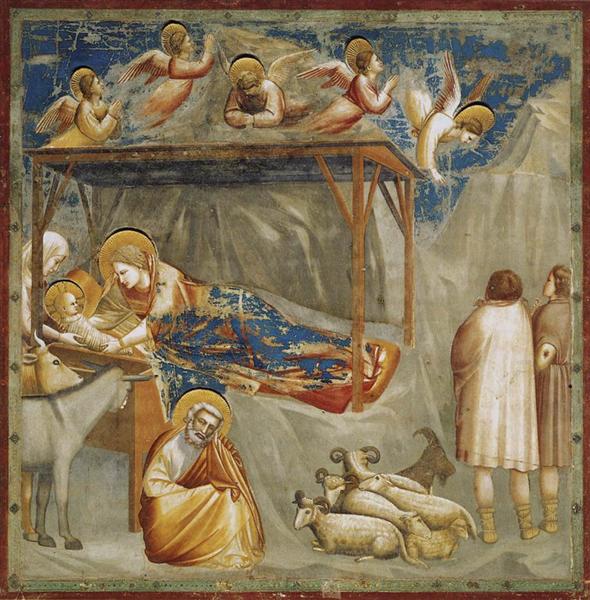
The Nativity by Giotto
And a Happy New Year! Thanks to everyone who has visited this blog in 2025~ I will pray for you all this Christmas Day in the morning. Please pray for me.
Welcome, all wonders in one sight!

       Eternity shut in a span;

Summer in winter; day in night;

       Heaven in earth, and God in man.

Great little one, whose all-embracing birth

Lifts earth to heaven, stoops heav’n to earth.
 ~  from "In the Holy Nativity of Our Lord" by Richard Crashaw

Share

Saturday, December 20, 2025

Defense of the Traditional Date of Christmas

From Dr. Taylor Marshall:
Now we move on to establishing the birthday of Christ from Sacred Scripture in two steps. The first step is to use Scripture to determine the birthday of Saint John the Baptist. The next step is using Saint John the Baptist’s birthday as the key for finding Christ’s birthday. We can discover that Christ was born in late December by observing first the time of year in which Saint Luke describes Saint Zacharias in the temple. This provides us with the approximate conception date of Saint John the Baptist. From there we can follow the chronology that Saint Luke gives, and that lands us at the end of December. 
Saint Luke reports that Zacharias served in the “course of Abias” (Lk 1:5) which Scripture records as the eighth course among the twenty-four priestly courses (Neh 12:17). Each shift of priests served one week in the temple for two times each year. The course of Abias served during the eighth week and the thirty-second week in the annual cycle.[ii]However, when did the cycle of courses begin?
Josef Heinrich Friedlieb has convincingly established that the first priestly course of Jojarib was on duty during the destruction of Jerusalem on the ninth day of the Jewish month of Av.[iii]Thus the priestly course of Jojarib was on duty during the second week of Av. Consequently, the priestly course of Abias (the course of Saint Zacharias) was undoubtedly serving during the second week of the Jewish month of Tishri—the very week of the Day of Atonement on the tenth day of Tishri. In our calendar, the Day of Atonement would land anywhere from September 22 to October 8.
Zacharias and Elizabeth conceived John the Baptist immediately after Zacharias served his course. This entails that Saint John the Baptist would have been conceived somewhere around the end of September, placing John’s birth at the end of June, confirming the Catholic Church’s celebration of the Nativity of Saint John the Baptist on June 24.
The second-century Protoevangelium of Saint James also confirms a late September conception of the Baptist since the work depicts Saint Zacharias as High Priest and as entering the Holy of Holies—not merely the holy place with the altar of incense. This is a factual mistake because Zacharias was not the high priest, but one of the chief priests.[iv]Still, the Protoevangelium regards Zacharias as a high priest and this associates him with the Day of Atonement, which lands on the tenth day of the Hebrew month of Tishri (roughly the end of our September). Immediately after this entry into the temple and message of the Archangel Gabriel, Zacharias and Elizabeth conceive John the Baptist. Allowing for forty weeks of gestation, this places the birth of John the Baptist at the end of June—once again confirming the Catholic date for the Nativity of Saint John the Baptist on June 24.
The rest of the dating is rather simple. We read that just after the Immaculate Virgin Mary conceived Christ, she went to visit her cousin Elizabeth who was six months pregnant with John the Baptist. This means that John the Baptist was six months older that our Lord Jesus Christ (Lk 1:24-27, 36). If you add six months to June 24 you get December 24-25 as the birthday of Christ. Then, if you subtract nine months from December 25 you get that the Annunciation was March 25. All the dates match up perfectly. So then, if John the Baptist was conceived shortly after the Jewish Day of the Atonement, then the traditional Catholic dates are essentially correct. The birth of Christ would be about or on December 25.
Sacred Tradition also confirms December 25 as the birthday of the Son of God. The source of this ancient tradition is the Blessed Virgin Mary herself. Ask any mother about the birth of her children. She will not only give you the date of the birth, but she will be able to rattle off the time, the location, the weather, the weight of the baby, the length of the baby, and a number of other details. I’m the father of six blessed children, and while I sometimes forget these details—mea maxima culpa—my wife never does. You see, mothers never forget the details surrounding the births of their babies. (Read more.)


More HERE.

Share

Tuesday, December 16, 2025

O Christmas Tree


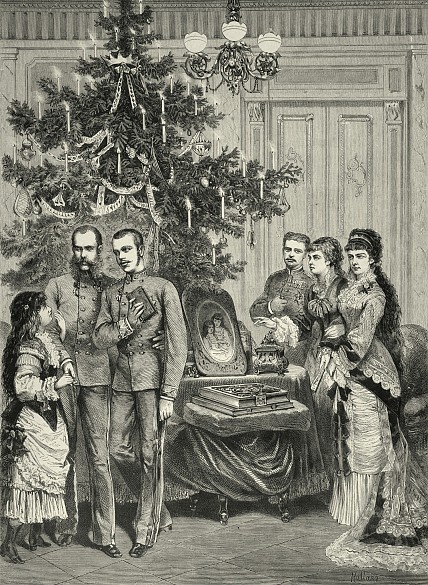
Kaiser Franz Josef with Empress Sisi and family

The Habsburgs and the Christmas tree. From the World of Habsburgs:

A festively decked tree with candles is today the foremost symbol of Christmas. However, this has not always been the case. It was not least the Habsburgs themselves who were responsible for introducing this custom in the lands of the Habsburg Monarchy.

Christmas trees as we know them today first arrived in Vienna during the Biedermeier, evidently from northern Germany. In Protestant countries Christmas had long been celebrated as a festivity of the middle-class family, as an intimate, emotional experience of the birth of Jesus – in contrast to the publicly celebrated, convivial church festivity of the Catholic tradition. The ‘new’ tranquil Christmas celebration round the Christmas tree came to epitomize a pious sense of family and bourgeois domesticity in the Habsburg monarchy during the Biedermeier era.

This rapid change of emphasis and its ready acceptance in Vienna can be explained by the profound social changes taking place in the capital during the reign of Joseph II and the Biedermeier era: the new economically flourishing patrician class began to assume a leading role during the time of the industrial revolution and was seeking new modes of expression for its sense of family values.

In 1814 reports compiled by Metternich’s state police contain the first mention of a Christmas tree festivity held in the salon of the Arnsteins, a Jewish banking family. Those attending were given lavish gifts, a custom that was not usual on Christmas Eve in Vienna at the time. The mistress of the house, Fanny von Arnstein, was from Berlin and had brought the custom with her from her native city.

However, it was via court circles in Vienna that the Christmas tree spread rapidly to the living rooms of the middle classes. The wife of Archduke Karl, Henriette of Nassau-Weilburg, who came from a Protestant family, brought the custom from her German home. Christmas 1816 saw the first Christmas tree, festively decked with candles, in the Habsburg family. Emperor Franz I attended this celebration and was so taken with the magical aura of the Christmas tree that he ordered a tree to be put up in the Hofburg at Christmas from then on. Subsequently it became the norm in Catholic families to celebrate Christmas round the tree: contemporary accounts record that while it was still almost impossible to procure a Christmas tree in 1821, by 1829 there were already street vendors selling trees at the Schottentor, the city’s north gate, and in 1851 the Am Hof square is said to have resembled a forest in the run-up to Christmas. (Read more.)

Share

Monday, December 15, 2025

Hanukkah Under Fire: Global ‘Intifada’ Brings Terror to Jewish Families From Sydney to D.C.

 From Overton News:

On December 14, 2025, during a community Hanukkah event called “Chanukah by the Sea” at Bondi Beach in Sydney, Australia, two gunmen opened fire on a gathering celebrating the first night of the holiday. At least 12 people were killed, and nearly 30 were wounded, including police officers, as families and children enjoyed the festival. Authorities quickly classified the massacre as a terrorist attack deliberately targeting Sydney’s Jewish community. Australian leaders denounced the violence as an “act of evil antisemitism.” ABC News

This was not random violence. New South Wales Premier Chris Minns said the shooting was designed to target Jews on the first night of Hanukkah, and Prime Minister Anthony Albanese called it an evil act against Jewish Australians. ABC News The attack shattered the sense of security that Jews in Australia had long taken for granted, even as antisemitic incidents had been rising there in recent years amid heightened tensions tied to the Middle East. Reuters

The brutality of the Bondi Beach massacre, where even a well-loved rabbi was among the dead, should force all of us to confront a painful truth: antisemitism is surging globally, and it is spilling over from rhetoric into deadly action. The echoes of this tragedy reach far beyond Australia.

Earlier in 2025, another horrific act shook the Jewish world at its core. On May 21 in Washington, D.C., two **Israeli Embassy staffers, Yaron Lischinsky and Sarah Lynn Milgrim, were shot and killed outside the Capital Jewish Museum after attending a Jewish community event. The alleged shooter, identified as Elias Rodriguez, reportedly declared “Free, free Palestine” and expressed ideological motives tied to the Gaza war. AP News Investigators and prosecutors have charged Rodriguez with hate crime and murder, stressing the antisemitic motivation behind the attack. Department of Justice

This attack in the U.S. capital where Jewish life and American political life intersect sent shockwaves through both Jewish and broader communities. Law enforcement authorities called it terror and hate-motivated violence, and leaders across the political spectrum expressed horror. The Guardian For many American Jews, it was a grim reminder that hatred long fought against abroad can find fertile ground at home.

These events in Australia and the United States are not isolated. Jewish communities in Europe, Canada, and beyond have reported spikes in antisemitic graffiti, assault, and harassment, especially since the October 2023 conflict in Gaza reignited old hatreds and unleashed new ones. Antisemitic rhetoric on social media and at protests has normalized language once considered fringe. What was once coded hostility has, in some circles, transformed into explicit calls for violence against Jews.

As we light the menorah this Hanukkah, we do so in a world where Jewish existence is again under threat not only in distant war zones but in our neighborhoods, our streets, and our places of worship and celebration. The lit candles symbolize hope and endurance, but they also remind us that light alone cannot safeguard us from the darkness of hate. True protection requires vigilance, political will, and moral clarity. (Read more.)

Share

Wednesday, December 3, 2025

The Tree of Jesse in Sacred Art


 From The Liturgical Arts Journal:

The season of Advent is synonymous with many things; Advent wreaths, Advent hymns and so on, but another symbol that is strongly associated with this liturgical season is that of the Tree of Jesse. This is manifest in the scriptural readings associated to this period of liturgical time, and it is also manifest in the O antiphon, O Radix Jesse. To understand what "Tree of Jesse" intends to refer to, we need to back up and consider the following passages from sacred scripture:

"There shall be a root of Jesse; and He that shall rise up to rule the Gentiles, in Him the Gentiles shall hope." (Romans 15: 11-13)

"On that day, a shoot shall sprout from the stump of Jesse, and from his roots a bud shall blossom. The spirit of the Lord shall rest upon him; a spirit of wisdom and of understanding, a spirit of counsel and of strength; a spirit of knowledge and of fear of the Lord, and his delight shall be in the fear of the Lord. Not by appearance shall he judge, nor by hearsay shall he decide, but he shall judge the poor with justice, and decide aright for the land's afflicted. He shall strike the ruthless with the rod of his mouth, and with the breath of his lips he shall slay the wicked. Justice shall be the band around his waist, and faithfulness the belt upon his hips. Then the wolf shall best a guest of the lamb, and the leopard shall lie down with the kid; the calf the young shall browse together, with a little child to guide them. The cow and the bear shall be neighbours, together their young shall rest... There shall be no harm or ruin on all my holy mountain; for the earth shall be filled with the knowledge of the Lord, as water covers the sea. On that day, the root of Jesse, set up as a signal for the nations, the Gentiles shall seek out, for his dwelling shall be glorious." (Isaiah 11: 1-10)

In essence then, the image of the tree relates to a family tree; that is to say, the genealogy of Christ coming from the line of David and born in Bethlehem. It is within this context that we can understand why there is an association between the "Tree of Jesse" and the season of Advent which leads us up to the birth of Christ.

The Tree of Jesse is something we have frequently seen depicted within sacred art. It shows Christ and the Virgin at the top of this tree (or in some instances, the Virgin holding the Christ-child) with Jesse reclining at the bottom and trunk proceeding forth from his side; proceeding upward to Christ are various Old Testament figures, including King David and often King Solomon. This imagery has appeared in various forms through the course of two millennia, from stained glass to manuscripts, icons, murals, sculptured carvings and more. (Read more.)
Share

Tuesday, November 25, 2025

Darker Shade of Pale

 From The Conversation:

When I started writing this book I was so ignorant about Jewish history. I often asked myself: why, as a Jewish scholar of South Africa, had I paid absolutely no attention to Jews? Why had my intellectual peers also not done so? I had never considered questions about how you write Jews into South African history.

So I had a steep learning curve too, reading as much as I could find, and spending lots of time in South African archives, to produce a social history intertwined with my grandfather’s story. I tried to make sense of him, and his individual Jewishness, as made and unmade by his wider society.

It started with life in the shtetl (the name for a small town with a predominantly Jewish population in eastern Europe). I deliberately started there because most migration stories start when people get off the ship, as day one of the new life. But what did they come with? What was the headspace? What were the psyches that landed, and how well equipped or not were they psychologically to cope?

And I must say that I found the world of the shtetl staggeringly unexpected. Even the smallest shtetl was status-obsessed; failure was deeply shameful, even there. (Read more.)


Share

Tuesday, November 18, 2025

Is ‘Nuremberg’ About the Wrong Psychiatrist?

 From Forward:

Douglas Kelley, the real-life U.S. Army psychiatrist portrayed by Rami Malek in the recently released motion picture Nuremberg, wrote a book titled 22 Cells in Nuremberg that came out in 1947, a year after he finished his five-month stint at the Nuremberg trials.

Nearly 60 years later, interviews conducted by Leon Goldensohn, a Jewish psychiatrist who replaced Kelley at the historic war crimes trials, were published in The Nuremberg Interviews: An American Psychiatrist’s Conversations with the Defendants and Witnesses. Goldensohn who spent more time with Nazi prisoners than Kelley did, and this book, translated into 16 languages, arguably sheds more light on the Third Reich criminals.

Goldensohn and Kelley were responsible for monitoring both the physical and mental health of the Nazi prisoners, and both their lives ended tragically: Goldensohn died of a heart attack in 1961, five days after his 50th birthday; Kelley died by suicide in front of his family at the age of 45. (Read more.)

Share

Sunday, November 9, 2025

Why Conservatives Must Draw a Line

 From Direct Line News:

Conservatives have long prided themselves on intellectual seriousness and moral clarity. Movements succeed when they are confident enough to police their boundaries. They falter when they mistake silence for strength. Tucker Carlson’s recent interview with Nick Fuentes, in which Carlson failed to challenge Fuentes’ antisemitism and even more bizarre Stalin nostalgia, marks one of those defining moments. Fuentes’ public record is not vague. He has trafficked in Holocaust denial, praised Adolf Hitler, and spoken approvingly about executing “perfidious Jews.” In the interview itself, Fuentes described “organized Jewry” as an obstacle to national unity and expressed admiration for Joseph Stalin. Stalin, a dictator responsible for mass famine, purges, forced labor camps, and millions of deaths, is now a figure of praise for a young right-wing influencer. That alone is disturbing. More troubling is that he received little pushback from Carlson.

Some commentators on the right have attempted to justify Carlson’s passivity by invoking a mirror-image of the old socialist slogan, “no enemies on the left.” Historically, that doctrine excused extremism in the pursuit of left-wing solidarity. Now, the argument goes, conservatives should refrain from criticizing those on the right, no matter how objectionable their views. This is not principled loyalty. It is moral abandonment.

Initially, the Heritage Foundation’s President declined to criticize Carlson, suggesting that calling out the broadcast might infringe on Carlson’s First Amendment rights. That is a misdirection. Free speech protects citizens from government punishment, not from accountability and rebuttal. Silence here was not neutrality; it was tacit approval. Heritage’s Kevin Roberts has since appropriately acknowledged his mistake, but he’s still damaged his institution.

This is not the first time the American Right has confronted this issue. William F. Buckley Jr., building a credible post-war conservatism, explicitly rejected antisemitic and conspiratorial factions. He understood that a movement unwilling to distinguish mainstream ideas from toxic fringe rhetoric would marginalize itself. That choice strengthened conservatism for a generation.

Today, both sides of the political spectrum are wrestling with a rapidly expanding Overton window — where fringe rhetoric and once unthinkable positions are aired as if they merit equal standing in serious debate. That makes responsible gatekeeping more critical, not less. (Read more.)

Share

Saturday, October 18, 2025

The Modern Democratic Party Is Now Functionally Anti-Israel

 From Amac:

Today’s Morning Jolt concludes by noting that New York City Democratic mayoral candidate Zohran Mamdani insists he has no opinion about the future of Hamas, but he is adamant that if Bibi Netanyahu ever sets foot in New York City, the NYPD will arrest him on war crimes charges.

Needless to say, there are some gargantuan legal questions about whether the NYPD could arrest a foreign leader who has diplomatic immunity over a charge that the U.S. federal government does not recognize as legitimate; also note that the U.S. government does not recognize the International Criminal Court, which issued the arrest warrant. In other words, even if a Mayor Mamdani ordered the NYPD to “arrest that man!” the cops wouldn’t have any legal authority to do so.

But there are two other developments this morning between the Democratic Party and Israel worth noting. First, from the Washington Free Beacon:

Socialist New York City mayoral candidate Zohran Mamdani said there is no room for pro-Israel voters within his coalition, arguing that fellow Democrats should not make “an exception” for people who are “progressive except Palestine.”

“That exception is one that I believe we should not only take issue with because of what it means for Palestinians and Palestinian human rights,” he told the New York Times in an interview published Tuesday. “But also, whenever you are at peace with the making of an exception, you make it easier to make another exception — wherever, whenever.”

Then, over at Axios:

Top Democrats in Pennsylvania are maneuvering to run against Sen. John Fetterman in a 2028 primary contest, threatening to tear the party apart in the biggest battleground state in the nation.

Democrats who could run against Fetterman include Reps. Brendan Boyle and Chris Deluzio and former Rep. Conor Lamb, according to multiple political insiders in Pennsylvania.

(Read more.)


Share

Tuesday, October 14, 2025

Trump's Vision For Middle East Peace

Are we finally on the brink of the era of peace promised by Our Lady of Fatima? Yesterday was the anniversary of the great miracle. From Overton News:

Then President Trump brought the entire Israeli Knesset to its feet as he touted the most ambitious peace deal in modern history.

He turned to the bigger picture, sharing what this peace deal means for the region.

This will be remembered as the “Dancing in the Streets” address.

“With this week’s cease-fire, we’ve achieved the most challenging breakthrough of them all...the most challenging breakthrough maybe ever.”

“I’ve never seen anything like it. I’ve been involved in a lot of success. I’ve never seen ANYTHING like what’s going on today all over the world.”

He painted a picture of celebration and relief spreading across countries.

“People are dancing in the streets...not just in Israel. They’re dancing in the streets of countries that would’ve never danced in the street about what’s happening today.”

“They’re dancing in the streets!”

Trump reminded the room how long and brutal the conflict had been.

“This long and difficult war has now ended…some say 3,000 years, some say 500...whatever it is, it’s the granddaddy of them all.”

“In an unprecedented achievement, virtually the entire region has endorsed the plan: Gaza will be immediately demilitarized, Hamas will be disarmed, and Israel’s security will no longer be threatened in any way, shape, or form.”

The chamber was electric for the man who made it all possible. (Read more.)

Share