Showing posts with label Spain. Show all posts

Sunday, September 13, 2026

Our Lady of Scherpenheuvel


Marie de' Medici had great devotion to Mary under her title of Our Lady of Scherpenheuvel, giving a reproduction of the statue to her daughter Henrietta Maria for one of her chapels in London where it was used by the Confraternity of the Most Holy Rosary. From Wikipedia:

Even before the official approbation of the cult of Our Lady of Scherpenheuvel, pilgrims took particles of the oak tree with them as pious souvenirs. Several stories of miracles attributed to the intercession by the Virgin relate of the thaumaturgic power of this Scherpenheuvel or Montague wood. Following the approbation, Archbishop Hovius ordered the tree to be cut down. It was divided in several parts. Some remained with the sanctuary; one particularly large piece was given to Albert and Isabella. Most of this Montague wood was used to make images of the Virgin Mary. Distributed as gifts among princes, nobles and clergy, they helped to disseminate the cult of Scherpenheuvel.[13]

Quite a few Belgian churches and convents came to possess an image carved in Montague wood. Well known examples remain in the Church of St. Charles Borromeo in Antwerp, the Church of St. Hilonius in Izegem and the chapel of the Capuchins in Enghien. In the Grand Duchy of Luxembourg, the statue of the national patron saint, Our Lady Comforter of the Afflicted or Our Lady of Luxembourg, is believed to contain Montague wood. A smallish statue of the Virgin and Child in Montague wood was taken by St. Marguerite Bourgeoys to Montreal and stands presently on her tomb in the Notre-Dame-de-Bon-Secours Chapel.[14]

Some places of worship became closely associated with the cult of Scherpenheuvel. In the vicinity of their château of Mariemont, Albert and Isabella founded the priory of Montaigu in the present day municipality of Morlanwelz. In the town of Gray a statue of the Virgin made out of Montague wood became the object of a regional devotion. Likewise in the Franche-Comté, the statue donated to the priory of Bellefontaine in Brussey came to attract many pilgrims.[15] In the proximity of the Spanish Court, the Convent of Las Descalzas Reales obtained an altar dedicated to Nuestra Señora de Monteagudo.

The House of Lorraine had a particular devotion for Scherpenheuvel. Cardinal Charles of Lorraine, prince-bishop of Strasbourg, founded a chapel dedicated to Our Lady of Scherpenheuvel in the noviciate of the Jesuits at Nancy. After his death in 1607, his sister Antoinette completed the project with an altarpiece depicting the ducal family venerating Our Lady of Scherpenheuvel. The chapel served as the repository of the embalmed hearts of the members of the House of Lorraine until 1720.[16] The cult was also greatly favored by the French Queen Marie de' Medici. During her regency, the Discalced Augustinians obtained a statue in Montague wood at their church of Notre-Dame-des-Victoires. During her exile, she donated one statue in Montague wood to the city council of Cologne and another to the monastery of the Discalced Carmelites of that city. While serving the Catholic household of her daughter, Queen Henrietta Maria, the Queen's Chapel of St James's Palace likewise had an altar with a Madonna in Montague wood.[17] (Read more.)


(Image Source) 

A history of the original statue, HERE.

Share

Thursday, August 13, 2026

Isabel and Her Daughters

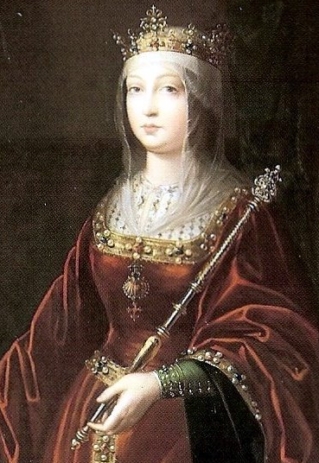
Queen Isabel of Castile was a conscientious and vigilant mother. To quote:
Isabel was highly preoccupied with her daughters’ moral and religious education and, if her library is a guide, they would have spent time studying the lives of saints and other devotional works. The Carro de las donas, by the Franciscan monk Francesc Eiximenis, was one of a number of “how to raise your daughters” manuals that sat on the royal bookshelf…

In Isabel’s fastidious court, men and women stayed apart. Catherine slept in Isabel’s chamber, along with her sisters. Doctors and other men were not allowed into the quarters until all of them, and the ladies-in-waiting who also slept there, were up and dressed. The women also ate apart in the intimacy of Isabel’s chambers. The infantas and their mother emerged from this feminine bunker only to eat with others when there were important visitors, in which case the full spectacle of the public court went into action…

Segregation did not mean that there was no fun to be had at her mother’s side. Tales of chivalry were told or sung after dinner with Isabel herself sighing at the tragic bits. Among other things, Catherine would have heard the retelling of old battles from the war in Granada. She must also have heard the famous romantic legends of the land she was destined to travel to. Arthur, the Round Table, the Holy Grail, Lancelot and Merlin were all characters in the rich chivalrous imagination of the Spanish court. They were there in Isabel’s books and on her tapestries too…

Board games, chess, word games and cards were played. There was music too, at the table. This may have been devoted to chivalry or courtly love when Isabel was there… Musicians were always on hand. They were, indeed, among the best-paid people at court. Spain already boasted a long tradition of troubadours and popular songs coming especially from north-west Galicia and the Moslem territories of al-Andalus. (Read more.)
Share

Sunday, August 9, 2026

The European Death Wish

 From The New English Catholic:

There is a particular kind of death a civilisation can choose for itself — not conquest, not plague, but a quiet, voluntary letting go.

Europe is in the grip of it now. You can see it in the birth rate, in the open border, in the bishop who will not speak, in the historian who will not defend. This is not, at root, a crisis of policy. It is a crisis of the soul. And it begins with a simple, uncomfortable fact: there seems to be no capacity left for saving our society, for valuing our society as it is. Instead, it's being overcome by a whole series of different forces and different people.

We were in immense shock when we saw the way in which 60,000 Moroccans invaded Spain. Now, the word invasion is hugely contested. The left hate it because, of course, it is so powerful and so descriptive, and we could find some more sophisticated words — mass incursion.

But the fact is that governments exist in order to defend their people. And the kind of incursion that we’ve been experiencing, both in Spain and above all in the UK, means that there are demographic changes taking place in which the people the government are elected to defend become somebody else’s people. In other words, they’re demographically replaced.

But let’s not slip into what will appear to some people to be non-left-wing rhetoric — Let’s try to avoid the trap of right versus left. (Why should we use a political structure that grew out of which side of the French king you sat on in the 1770s in order to describe our politics?) It;s hard to know what ‘right’ is when there is nothing left to conserve.

Our politics are effectively of what we call the left, which are progressive, revolutionary, utopian: based on the fallacy that human beings are perfectible, and conformity can be enforced when refused.

What is then the non-left? Does non-left just mean everything else? There is no right or far right, as the left-leaning commentators insist, as they create a kind of opposing ‘extremist’ bogeyman fictionally in order to justify their struggle against anybody who questions their progressive values. So: left, utopian left, and non-left.

What is the real diagnosis of where we have been brought to? (Read more.)

Share

Tuesday, August 4, 2026

What the Midterms Are Actually About

 From Batya Ungar-Sargon:

It’s less than a hundred days until the midterm elections decide who controls the House and the Senate—and whether President Trump and his Cabinet spend the next two years enacting his agenda or fighting impeachment, which will certainly be the Democrats’ first order of business.

But this week gave us a number of stark visuals representing what your choices actually are when you go into the voting booth in November.

One of them came by way of Spain, which was invaded this week by tens of thousands of men from Morocco, who streamed across the border after the border “totally collapsed” as one official told the AP.

The border collapse comes after Spain gave amnesty to more than a million illegal migrants, the largest migrant amnesty in European history. Naturally, when news about the amnesty program spread, thousands more decided to take their chances at achieving European residency.

Because that’s what amnesty for people who cross your border illegally does: It incentivizes people to cross your border illegally, because it is a reward for crossing your border illegally.

But if you think this can only happen in Europe, I urge you to think back to 2022. Remember these scenes? This isn’t Spain. This is Texas. (Read more.)

Share

Sunday, August 2, 2026

The American Revolution in Louisiana and West Florida

From Fellowship and Fairydust:

A few years ago, I was having lunch with my uncle when he said he had joined the Sons of the American Revolution. “But in the 1770s, our ancestors were already in Louisiana,” I said. “It belonged to Spain. How did we have an ancestor who fought for America?”

It turns out, we didn’t. We had an ancestor—a French immigrant to Louisiana—who fought for Spain. From 1779-1781, Spain aided the American cause by ousting the British from their holdings in West Florida, which included Pensacola and Mobile as well as the eastern bank of the Mississippi River from Manchac to Natchez. The name of the colony still resonates today in the “Florida Parishes,” the eight parishes of the State of Louisiana that were once part of West Florida. 

After the outbreak of the American Revolution in 1775, the fledgling United States campaigned to secure the support of European allies, especially Britain’s longtime enemies, France and Spain. Though the King of Spain was unwilling to form an alliance, the Spanish governor of Louisiana, Bernardo de Galvez, privately supported the American cause. He granted loans to American traders shipping military provisions northward from New Orleans and provided covert support to their convoys, which had to pass the British-held settlements on the eastern bank in order to reach American territory.

In 1777, the U.S. Congress rejected a plan to launch a full-scale assault against West Florida. But the Committee of Commerce (formerly the Secret Committee, the first American organization devoted to espionage) knew they had the tacit support of Governor Galvez in New Orleans. So they decided to send a small party of men down the Mississippi under the command of Captain James Willing, ostensibly to convey “public dispatches” to officials in Louisiana.

His real mission was to secure the river. (Read more.)

Share

Thursday, July 30, 2026

'The Sun Also Rises' at 100

 From First Things:

The Sun Also Rises shows men and women trying to salvage a life they can call “good” from the wreckage of their own hopes, and the ruin of an entire civilization. Those aureate obscenities now proscribed had meant a great deal before Verdun and the Somme and Passchendaele. They had defined the things men owed to Caesar and to their comrades and to themselves, and decreed what was worth killing and dying for. After the war’s pointless carnage, the vocabulary of the moral life shrank to the bare essentials.  

Hemingway offers his own definition of the good under the new dispensation—the word that his narrator, Jake Barnes, uses dozens of times to connote the union of physical pleasure and moral rightness: You feel what is good, you know it without thinking about it, as though simple sensation were the only guide to right living. “It felt good to be warm and in bed”; “It was a good dinner. Food had an excellent place in the count’s values. So did wine. The count was in fine form during the meal. So was Brett. It was a good party”; “You paid some way for everything that was any good. I paid my way into enough things that I liked, so that I had a good time.” A good time, for this expatriate crowd attending the fiesta in the Spanish town of Pamplona, means good fishing, good bullfighting, a good hotel room, a good meal, lots of good drink, and good drinking companions.

What it emphatically doesn’t mean, at least for Jake, is good loving. The beautiful Brett, Lady Ashley, loves Jake, and Jake loves her; but Jake suffered a war wound that disqualifies him from sexual pleasure, so she takes up with several perfectly wrong men one after the other, including a superb matador fifteen years younger than she, who takes a bad beating from a previous lover of hers adept with his fists. (This jilted and jealous lover, once the middleweight boxing champion of Princeton, is an anti-Semite’s dream so odious that the poisonous caricature nearly spoils the novel.) Brett is feeling quite virtuous, between spasms of self-hatred, after she decides to leave the love-besotted torero for his own good. “You know it makes one feel rather good deciding not to be a bitch,” she says. “It’s sort of what we have instead of God.” “Some people have God,” Jake replies. “Quite a lot.”  (Read more.)

Share

Saturday, July 25, 2026

Isabel of Castile and Chess

From Nobility:
Today, the Queen is the most powerful piece on the board, but it was not always this way. Nor was this piece always called “Queen.” It was the King’s “adviser,” so in the Kingdom of Bengal (India), it was called the mantri (minister); in Persia, the Vazīr (vizir); in the Arabic world, Wazīr/Firz (vizier); in Turkey, vezir; but an improvement was made when chess was brought to Catholic medieval Europe. Players began referring to this piece as the “queen,” since its initial position was right next to the king, making them the royal couple. The queen was one of the weaker pieces though. She moved just one square at a time, diagonally at that, making her less powerful than today’s bishop.

All this changed with Isabella the Catholic’s dramatic intervention in the siege of Baza, in 1489, seven years into her ten-year war of reconquest of the Muslim Kingdom of Granada.

Her husband, King Ferdinand of Aragon, was one of the best generals of his time and he had excellent generals helping him in this siege, but it all seemed “a bridge too far.” The city was too powerful, defended by a strong, 20,000-man garrison, and well provisioned to withstand the longest siege. The Catholic troops and artillery seemed woefully disproportional to the task and after six months of siege warfare, the King called his generals to a council of war, and they recommended lifting the siege and withdrawing. Before striking camp, however, Ferdinand sent a messenger to Isabella who was then at Jaen, 90 miles away. She sent back word that a retreat would demoralize all Spain. They should continue the siege and she would go herself to their assistance.

The Queen’s arrival at the camp sent the Crusaders into transports of joy and enthusiasm, while inside Baza, the Muslim garrison despaired, seeing in her arrival the fatal seal of impending doom. Three weeks later they surrendered and were given all the honors of war.

As the news of Baza’s fall was carried everywhere, the Crusaders’ enthusiasm at Isabella’s arrival at their camp reverberated throughout Spain, and among the manifestations of joy, the rules of chess were changed, with the Queen becoming a most powerful piece, sweeping and majestic in her moves. A few years later, Luis Ramírez de Lucena enshrined the new rules in Repetición de Amores y Arte de Ajedrez, the oldest printed book on chess we have today, and the new rules were here to stay. (Read more.)
Share

Wednesday, July 1, 2026

The Challenge of the Eucharistic Heart of Jesus

 From Charles Coulombe at 1P5:

But as with everything Catholic in the Americas, devotion to the Sacred Heart long predates the United States.  Although Spain opened up the Evangelisation of the Western Hemisphere, it was in New France that this devotion took root, with the arrival of St. Marie de l’Incarnation, who founded the Ursuline Order in Canada in 1632, half a century before Our Lord began appearing to St. Margaret Mary Alacoque.  Nine years later, Catherine Symon de Longpré, Mother Catherine of Saint Augustine in religion, brought devotion to the Sacred Hearts of Jesus and Mary to Canada, along with her veneration for Marie des Vallées, with whom she was in contact.

On March 17, 1727, King Philip V of Spain, grandson of Louis XIV, wrote to Benedict XIII, asking him to approve the Office and Mass of the Sacred Heart for the kingdoms and states of the Spanish  Crown – the bulk of these were of course Spanish America and the Philippines; from this time on, the cultus of the Sacred Heart had official approbation in the Viceroyalties of the Americas.

In the newly independent United States, the Jesuit Mission at Conewago, Pennsylvania was renamed in honour of the Sacred Heart in 1787, when a new church was built.  A minor Basilica to-day, it was the first parish church named after the Sacred Heart in the United States – and possibly in the Western Hemisphere.

Inspired by the French Voeu Nationale, Gabriel García Moreno (1821-1875), President of the Republic of Ecuador, consecrated his country to the Sacred Heart of Jesus.  He was assassinated two years later, as he left the cathedral of Quito where he had just completed his customary adoration.  But he established what became the template for National Consecrations to the Sacred Heart across the globe.  In keeping with St. Margaret Mary Alacoque’s request to Louis XIV, it was done by both the Head of State, the Legislature, and the Bishops of the Country.  This emphasises that the Faith ought to encompass both Church and State.  Following Ecuador’s example, several Central and South American countries undertook this national consecration in the following years – the first being the Republic of El Salvador in 1874. (Read more.)

Share

Tuesday, June 2, 2026

Legendary Crown Jewels

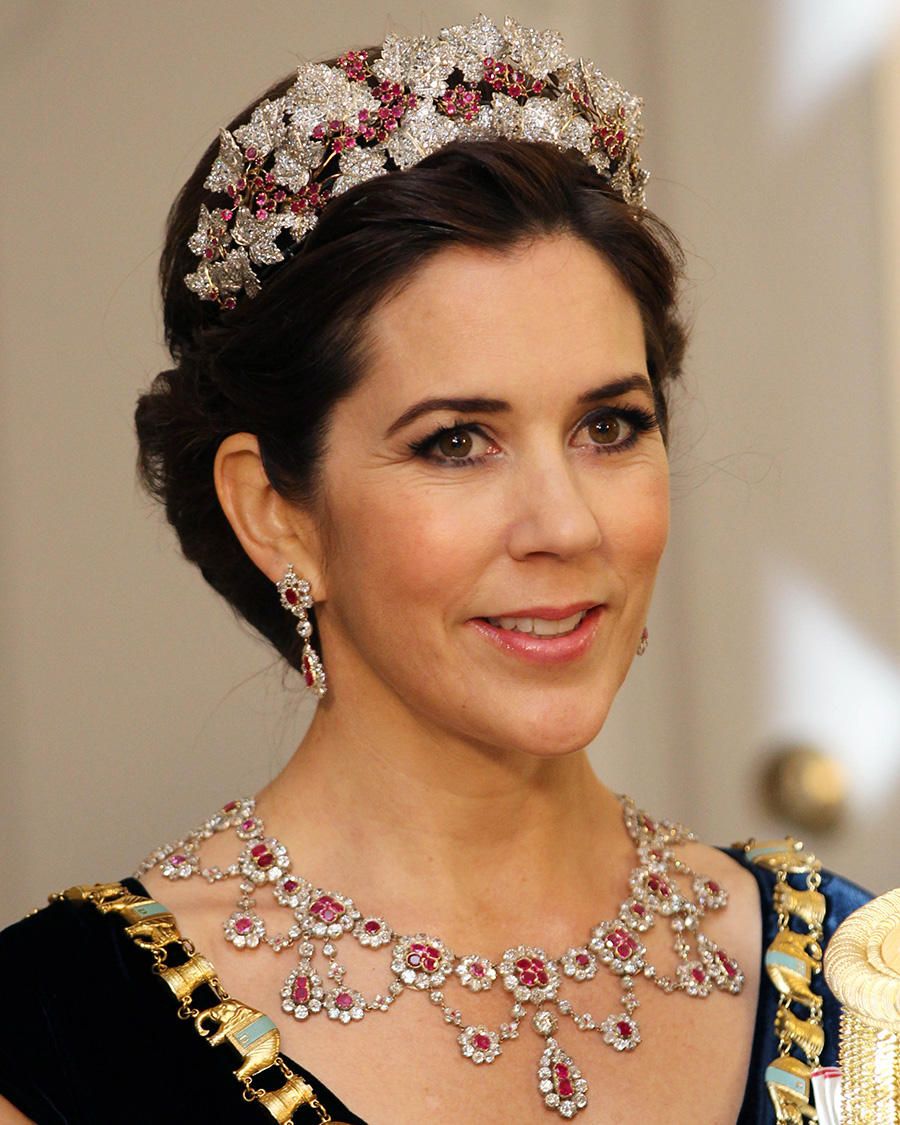
Princess Mary of Denmark attends a Gala Dinner to celebrate Queen Margrethe II of Denmark’s 40 years on the throne at Christiansborg Palace Chapel on January 15, 2012 in Copenhagen, Denmark. (Photo by Chris Jackson/WireImage)
 

From Only Natural Diamonds:

According to Daughters, the Danish Crown Jewels came very close to taking the top spot because they are among the clearest examples of uninterrupted monarchical continuity in Europe. The collection remains remarkably intact and exceptionally well preserved, offering a rare glimpse into how royal regalia can survive centuries of political and cultural change while remaining deeply tied to national identity.

Daughters notes that the Danish Crown Jewels are especially significant because of their extraordinary continuity and preservation. “The British and Danish crown jewels are perhaps the strongest examples of monarchical continuity in Europe,” he says. While Britain’s regalia reflects both continuity and reinvention following the destruction of the original Crown Jewels during the English Civil War, Denmark’s collection “has remained almost entirely intact,” creating what he describes as “a rare sense of unbroken cultural identity.”

He also explained that Denmark’s regalia functions differently than many other royal collections in Europe. “In Denmark, the regalia feels more closely tied to national heritage and cultural continuity, serving as an enduring public symbol of Danish history,” he says. That connection between the monarchy and national identity has helped transform the jewels from historical treasures into living cultural artefacts still woven into modern royal life. (Read more.)

Share

Wednesday, May 27, 2026

DNA Analysis of Christopher Columbus

 From Bored Panda:

Christopher Columbus may not have been who we thought, as researchers are closer to unraveling the mystery of his true identity. According to the widely accepted story about the famous explorer, he is a man of humble Italian origins. But a new genetic study has challenged this, saying he may be from a powerful and influential family elsewhere.

For centuries, history books have painted Columbus as a navigator of modest Italian origins.

Despite not being the first to make it to the Americas, he was the man credited with discovering the “New World” after convincing the Catholic Monarchs to finance a voyage that changed the course of history.

On August 3, 1492, he and his crew of nearly 100 people set sail from the port of Palos in southern Spain in three vessels: The Niña, Pinta, and Santa Maria.

To find a route to China and India was Columbus’ mission.

But after 35 days at sea and growing frustration among his crew, he nearly turned back. But the cry of land being spotted was heard at around 2 a.m. on October 12. And thus, Columbus had arrived in the Americas. (Read more.)


Share

Sunday, May 17, 2026

Salvador Dalí, the Nuclear Mystic

 From Word on Fire:

Salvador Dalí was born on May 11, 1904, in Figueres, Catalonia, Spain, and baptized in the Church of Sant Pere (St. Peter). His older brother, also named Salvador, died nine months prior and haunted Dalí throughout his life. He created many paintings and drawings inspired by his brother, writing, “[My brother] was probably the first version of myself but conceived too much in the absolute.” Dalí’s father was a staunch atheist and his mother an ardent Catholic. His father’s nonbelief and his mother’s sincere faith formed the foundation for Dalí’s lifelong, complex connection to God and Catholicism. When Dalí was sixteen years old, his mother died of uterine cancer, which he described as “the greatest blow he had experienced in his life.” 

A year later, he moved to Madrid and began studying at San Fernando Royal Academy of Fine Arts, where he met future surrealist director Luis Buñuel and modernist poet Federico García Lorca. Dalí began studying the old masters, particularly Velazquez, and experimenting with cubism. He also became acquainted with contemporary avant-garde movements like Dada and futurism, which, along with the cutting-edge psychoanalytic theories of Sigmund Freud, were to have a profound influence on the young Dalí. In 1926, he met Pablo Picasso and later quipped about their similarities and differences, “Picasso is a painter, so am I; Picasso is Spanish, so am I; Picasso is a communist, neither am I.” 

From 1927, Dalí became increasingly “surrealist” in his work. The poet Apollinaire coined the term in 1917. The word was adopted by André Breton, who penned The Surrealist Manifesto (1924), defining surrealism as “psychic automatism in its pure state, by which one proposes to express—verbally, by means of the written word, or in any other manner—the actual functioning of thought. Dictated by the thought, in the absence of any control exercised by reason, exempt from any aesthetic or moral concern.” (Read more.)

Share

Sunday, April 19, 2026

The Last Aztec Princess

From The Collector:

 When the Spanish arrived in Tenochtitlan, the Aztec were ruled by Motecuhzoma Xocoyotzin, better and less accurately known as Moctezuma II, the powerful huey tlatoani who had expanded the empire to its greatest extent. Chroniclers marveled at his many wives, lesser wives and concubines, as well as his numerous children, with one claiming he had at least 100. History recorded just a few, however, including two sons who died during the conquest and one legitimate daughter, often called the last Aztec princess: Isabel.

Little is known for certain about Isabel’s life before the arrival of the Spanish colonizers. Her birth year, which of Moctezuma’s many wives was her mother, or even the correct translation of her Nahuatl name, are unknown. Some contemporary records and documents kept by the Spanish give her birth year as 1510, which would have made her just 9 years old at the time the conquest began in 1519, and when she first married. Others describe her as a maiden, suggesting she was not a child but a girl of marriageable age, while still others indicate she was born before Moctezuma became huey tlatoani, which occurred in 1503, making her a young adult when Hernán Cortés and his contingent of conquistadors arrived.

Contemporary accounts are equally unclear about her lineage, with some suggesting she was the daughter of Moctezuma’s first wife and others indicating she was born of one of his secondary wives. Marriages were often undertaken to cement alliances with neighboring groups, while marrying within family groups to preserve the noble or semi-divine bloodline was also common, ultimately making either wife an equally likely candidate for a child considered his heir. The ruler also had many concubines, though records do seem to agree that Isabel was not the result of any of those unions; some half-siblings who would later come to challenge her status as Moctezuma’s heir were. (Read more.)


Share

Friday, April 17, 2026

Spain Gave the Death Penalty to the Victim, Not the Rapists

 From Celina's Substack:

This is how broken the West has become. On Thursday, March 26, 2026, in a clinically sterile room within an assisted living facility in Barcelona, Spain, the government executed a twenty five year old paralysed rape victim. Her name was Noelia Castillo Ramos.1 Noelia did not die of a terminal illness, nor did she pass away from natural causes. Rather, she was administered a lethal injection by the Spanish state that had dismantled her family, forced her into a hostile and horribly dangerous environment, ignored her horrific violation, and ultimately deemed her broken existence too inconvenient to maintain.2

While Noelia Castillo’s heart was stopped by a cocktail of state-sponsored chemicals, the unvetted migrant men who gang-raped her, shattered her mind, and drove her to fling herself from a fifth-floor window continue to walk the streets of Europe, entirely shielded from justice. They faced zero consequences. She faced the death penalty.

The fate of Noelia Castillo stands as a single almost perfect, undeniable illustration of everything that is broken, evil, and actively suicidal about modern Western society under progressive, woke, open-border, and secular-left governance. Progressive Europe has functionally and legally decided that native European women and girls are a disposable commodity, just collateral damage in the grand suicidal project of multiculturalism. (Read more.)

Share

Thursday, April 16, 2026

Galician Genes

 From EuroNews:

The official version reflected in the history books is that Columbus was born in Genoa, the seafarer of humble origins who convinced the Catholic Monarchs to finance what no one thought possible. This origin story has been questioned for decades by historians, linguists and, more recently, geneticists.

The latest chapter in this debate comes from a crypt in Gelves, a town in Seville where at least seven direct descendants of the explorer are buried. A team of researchers from the Citogen laboratory and the Complutense University of Madrid has published a preprint in 'bioRxiv' with the results of the third phase of a project that began with an exhumation in March 2022.

Its conclusions, not yet peer-reviewed, point to the Galician nobleman Pedro Álvarez de Sotomayor, known as Pedro Madruga, as the direct ancestor of the Columbian lineage.

It all started with a piece of information that did not add up. On analysing the DNA of 12 individuals exhumed from the family crypt of the Counts of Gelves, the researchers found that two of them shared genetic material without the historical documents justifying this relationship.

One was Jorge Alberto de Portugal, third Count of Gelves and great-great-grandson of Columbus. The other was María de Castro Girón de Portugal, a 17th century countess consort who had entered the family by marriage and whose lineage was Galician, she was the daughter of the 9th Count of Lemos.

That two people with no documented relationship share DNA can only be explained in one way: they have a common ancestor that the records do not show. The team applied a computational model on 16 generations of genealogies to identify that individual.

The analysis pointed, unequivocally according to the authors, to Pedro Álvarez de Sotomayor. To corroborate this, they resorted to the so-called Virtual Knock-out technique: when they virtually eliminated Pedro Madruga from the family tree, the genetic link between the two individuals disappeared. No other ancestor, among the hundreds analysed, was able to produce the same effect. (Read more.)

Share

Tuesday, March 31, 2026

Spanish Euthanasia Case Triggers Worldwide Debate

 From The European Conservative:

The euthanasia of 25-year-old Noelia on Thursday, March 27th in Spain has made headlines around the world. Not because of its legal exceptionalism—it was upheld by all judicial instances—but because of what it represents: the shift of euthanasia from extreme cases of terminal illness into far more shaky territory, such as psychological suffering.

In just a few days, her story has spread across national and international media. Noelia’s life was marked by institutional neglect, episodes of violence and sexual abuse, severe depression, and a fractured family environment. And there is a lingering sense, shared by many, that things should have gone differently.

Noelia’s death  was the result of a series of events that led to grave emotional and physical suffering.  Her parents lost  custody of her and she spent time in state care. According to her own account, it was in that context that she suffered abuse and episodes of violence that were never investigated judicially.

Years later, those traumatic experiences led to a suicide attempt in 2021, leaving her with  partial paraplegia. From that point on, her situation worsened. She was diagnosed with borderline personality disorder, underwent multiple psychiatric admissions, and lived with a persistent sense of isolation.

Medical reports—central to the process—concluded that her suffering was “serious, chronic and incapacitating,” and that there was no prospect of improvement. On that basis, the Catalonia Guarantees Commission authorized euthanasia in 2024. Formally, the procedure met all legal requirements. But the case was never as closed as it appeared. (Read more.)


Share

Thursday, February 26, 2026

The Madrid Codices

 From Euro News:

Every year Spain celebrates one of the most significant discoveries of the 20th century for studies on Leonardo da Vinci. On 13 February in 1967 the National Library of Spain conserved among its collections two original manuscripts of the Renaissance artist and engineer that had remained unnoticed for more than a century. The so-called Madrid I and II codices (source in Spanish),identified as Mss. 8937 and Mss. 8936, are part of a set of scientific notebooks written by da Vinci between the end of the 15th and the start of the 16th century. They were rediscovered when the American researcher Jules Piccus, who was working on the revision of the inventories of the institution's manuscripts, identified the relevance of some volumes that had not been correctly attributed.

According to official information from the National Library, the codices contain hundreds of pages of annotations and drawings devoted to statics, applied mechanics, gear systems, hydraulic machines, geometry and fortification studies. Unlike his paintings, these manuscripts allow us to observe Leonardo's intellectual process:calculations, diagrams, hypotheses and corrections that show his experimental method. Codex Madrid I, dated mainly in the 1490s, is considered one of the most important treatises on mechanics by Leonardo, with detailed studies on the transmission of motion and the functioning of mechanisms. Codex Madrid II, dated slightly later, brings together research related to civil and military engineering, as well as topographical studies and hydraulic projects. (Read more.)

Share

Wednesday, February 18, 2026

How the Kingdom of Aragon Built a Mediterranean Empire

 From The Collector:

In the 9th century, the County of Aragon was part of the Frankish dominion, ruled over by the Carolingians. Its people had weathered the storm that accompanied the fall of the Roman Empire and the ensuing chaos afterwards. In the 900s, Aragon came under the rule of the Kingdom of Pamplona (also known as Navarre). The county’s capital was located in the small city of Jaca in the northeast of the Iberian Peninsula.

After the death of King Sancho III of Navarre in 1035, his kingdom was partitioned into multiple territories. One of the territories contained Sobrarbe, Ribagorza, and Aragon, all of which went to different nobles. However, the rulers of Sobrarbe and Ribagorza both died, enabling Sancho’s illegitimate son Ramiro to annex both territories into his realm. Despite being nominally linked to Navarre, Ramiro’s expanded Aragon now became one of the larger states in the region.

Ramiro never personally called himself the King of Aragon, although his subjects referred to him as king, and he is known to history Ramiro I of Aragon. His rule was brief and focused on expanding the kingdom’s borders. In 1063, he died while unsuccessfully besieging the city of Graus from the Castilians. He was succeeded by Sancho Ramirez, his eldest son. (Read more.)

Share

Tuesday, February 10, 2026

The Myth of Stolen Land and the Erasure of Indigenous Agency

 From Alexander Muse at Amuse on X:

By the time Spanish missionaries and soldiers established a sustained presence in California in the late 18th century, indigenous California had already been transformed by forces internal to the continent. Disease, resource pressure, and intertribal conflict had reduced populations and altered political structures. Spain claimed California as a colonial possession, governed it for just over half a century, and integrated it into a broader imperial system. When Mexico gained independence, it inherited Spanish sovereignty. California then passed from Mexico to the US in 1848 through the Treaty of Guadalupe Hidalgo, a treaty negotiated between two recognized states following a declared war, and ratified under the international law of the era.

One can condemn the war. Many did, even at the time. But condemnation does not erase the legal fact of transfer. Mexico ceded California in exchange for $15M and the assumption of $3.25M in debt. That is not theft in any coherent legal sense. It is state succession, a mechanism by which sovereignty has changed hands throughout recorded history.

At this point, critics often shift the argument. The land may have passed legally between colonial powers, they say, but it was never theirs to give. It belonged to the tribes. This objection deserves careful treatment, because it raises the hardest questions.

The US government itself recognized these questions. In the early 1850s, federal negotiators entered into treaties with California tribes, treaties that involved the cession of land in exchange for reservations, goods, livestock, and federal recognition. These agreements were not symbolic gestures. They were attempts, however flawed, to regularize sovereignty through consent rather than extermination. Some treaties were shamefully mishandled, delayed, or ignored by Congress. That failure remains a stain. But the existence of the treaties matters. It shows that tribal leaders were not treated merely as obstacles to be cleared, but as parties capable of bargaining, choosing, and surviving.

To insist that these agreements were meaningless because tribes were too weak to consent is to deny indigenous agency altogether. It implies that native leaders were incapable of understanding tradeoffs, incapable of acting strategically, and incapable of making binding decisions for their people. That view is not morally enlightened. It is condescending.

The moral record of the US in California is mixed, and often dark. Violence, displacement, and broken promises occurred. None of that is in dispute. But moral wrongdoing does not automatically negate sovereignty. If it did, nearly every nation on earth would be illegitimate. Borders everywhere are the product of conquest, negotiation, succession, and compromise. To single out California as uniquely stolen is to apply a standard that no historical society could meet. (Read more.)

Share

Wednesday, February 4, 2026

Should Queen Isabella I of Castile be Canonized?

 From The Catholic Herald:

Cardinal Carlos Aguiar Retes, Archbishop of Mexico City and Primate of Mexico, has publicly defended the cause for the beatification of Queen Isabella I of Castile during a formal visit to Spain.

Speaking in Valladolid during a meeting with the diocesan commission overseeing the cause, Cardinal Aguiar said that sustained historical and spiritual study had led him to a firm conviction about the personal sanctity of the Spanish queen and the importance of making her legacy better understood. “We want the essential facts of her life and spirituality to be known,” he said, stressing that the process required time, seriousness and balance rather than polemic or nostalgia.

The Mexican cardinal highlighted in particular Isabella’s Royal Decree of 1503, which stated that the indigenous peoples of the newly encountered territories in the Americas were to enjoy the same rights as subjects of the Spanish Crown. He described the decree as “an extraordinary position for its time”, arguing that it reflected a deeper moral vision rooted in Christian anthropology rather than political expediency.

The meeting in Valladolid brought together senior figures from the Spanish and Mexican Churches. Cardinal Aguiar was received by Archbishop Luis Argüello García, who is also president of the Spanish Bishops’ Conference, alongside members of the commission for Isabella’s cause. The gathering was held at the Archdiocese of Valladolid’s spirituality centre and was described by participants as both cordial and substantive.

Archbishop Argüello said that Isabella’s life was marked by fidelity to Christ and the Church’s missionary mandate, which in turn shaped her political vision and her concern for unity rooted in shared faith. The Valladolid visit also formed part of the Intercontinental Guadalupan Novena, an initiative launched in 2022 to promote devotion to Our Lady of Guadalupe while encouraging renewed reflection on evangelisation and social renewal across the Ibero-American world. (Read more.)

Share

Thursday, January 29, 2026

What Europeans Found on the Most Isolated Island in the World

 From Literary Hub:

Europe came late to Rapa Nui, two centuries after Magellan led a pioneering Spanish expedition across the Pacific in 1521. Many of the statues were probably carved in those eight generations. When ships finally arrived—eight in all between 1722 and 1786, from Holland, Spain, England, and France, bringing a total of around 1,400 men—the visitors saw things they found hard to believe. There was a long tradition in Europe of representing named individuals realistically in stone, whether known persons or mythical beings or gods. The statues on the island were much larger, and far more numerous, than any standing at typical installations in Europe. And they seemed identical, anonymous, stylized, and alien. From the Islanders’ point of view, the visitors were equally strange, as they appeared and vanished overnight, over sixty-four years spending a total of no more than a week ashore. We may imagine that Islanders found it hard to stop talking and thinking about what had happened. But there must have been many who never saw a European.

Such brief and intermittent encounters had profound consequences, for the Islanders and for our understanding of their story, even now. It began on the Easter day when the Africaansche Galey signaled land. The Dutch West India Company had sponsored an expedition to search for a southern continent, which was thought necessary to balance all the land north of the equator. Jacob Roggeveen, a lawyer turned explorer, had wandered about the Pacific with three ships and found nothing. His crews were beginning to lose faith till they spotted a turtle and floating vegetation, and birds overhead. There was great joy, Roggeveen wrote in his log: They were about to discover Southland. But the imagined continent soon revealed itself as no more than a low, flat island. Rising plumes of smoke showed it was inhabited. Weather marked the occasion: They waited at a distance for thunder, lightning, heavy rain, and winds to clear.

The pioneer encounter occurred 3 miles offshore. The Dutch, spotting an old man approaching in a canoe, sent out a sloop to investigate. This unceremonial meeting was the first contact between people whose ancestors had parted tens of millennia ago in Asia, and whose experiences, cultures, and beliefs separately reflected that distance. It was an innocent event played out repeatedly around the world in various forms. A marker of unity. A harbinger of change and loss.

The naked man put up a good fight, but was overpowered and brought to the Arend, Roggeveen’s flagship. Curiosity trounced the Islander’s fears, and he seemed delighted by what he saw, taking a special interest in the ship—how it was made, the masts’ great height, the sails and the thickness of the ropes, and the guns, to which he gave particular attention. The sound of the ship’s bell and the sight of himself in a mirror scared him, and he appeared to be ashamed of his nudity. Offered a glass of liquor, he poured it down his face and tried to rub it out of his eyes. He put his arms and head on the table, and repeatedly raised them toward the sky, shouting loudly as he “addressed his gods.” (Read more.)

Share