Showing posts with label Holy Russia. Show all posts

Friday, July 17, 2026

Death of a Family


image

July 17 is a sad anniversary. To quote author and historian Gareth Russell:

It had been a horrible, violent, lawless death - carried out in secret, without a trial or without justice. It was a fate that was to befall millions of ordinary Russians in the years under Communist rule - a system of government which has still, inexplicably, managed to escape the historical condemnation it so richly deserves. The Soviet Union was a depraved and genocidal regime, which even on its best days bore all the qualities of a sociopath. It was devoid of morality or respect for human life. It was infinitely worse than any regime in Russian history. And although it had technically come to power in October 1917, it was the events in Yekaterinburg on 17th July 1918 that should arguably be seen as the Soviet Union's true birth-date. Everything that defined it and everything that it was prepared to resort to was contained in how it executed the Romanovs. As Trotsky so rightly pointed out, with his chilling disinterest in human suffering - it proved that there was no going back. It defined what was to come. (Read entire post.)

 image

Share

Sunday, July 5, 2026

Be Careful Whom You Trust

 From Chronicles:

Rasputin’s arrival in the Russian capital came at a moment of acute vulnerability both for the Russian nation and the Romanov dynasty. Timid, insecure, and stubborn, with an unbending belief in his God-given right to rule, Tsar Nicholas possessed neither the temperament nor the vision to govern a sprawling empire of 175 million subjects at a time when the chancelleries of Europe were sleepwalking towards the cataclysm of world war. His German-born wife, Alexandra, was even more problematic. Not only was she politically naïve, but she became psychologically unbalanced by the hemophilia of the royal couple’s only son, Alexei.

Within days of meeting the family, Rasputin was advising the tsar on family matters, Beevor writes. The mystic’s influence at court took another significant step forward when he appeared to “heal” the young tsarevich after a leg injury caused a life-threatening hemorrhage. The doctors believed that Rasputin’s calm demeanor may simply have relaxed the boy, lowering his blood pressure and thus slowing the bleeding. But to Nicholas and Alexandra, it was proof that the dipsomaniac, sexually profligate traveler in their midst was in fact God’s instrument on earth.

Inevitably, there were rumors that he was the tsarina’s lover, which Rasputin himself never actively discouraged. Such a development would not have been inconsistent with his relations elsewhere in high Russian society. On the other hand, Beevor’s research extends to the discovery that “while Rasputin was content to lie naked with many women, he had sex with very few of them.” The author further doubts that Alexandra, a loyal and devoted wife and mother, whatever her other shortcomings, would have yielded in this way. Nor does he credit the rumor, widespread in the feverish atmosphere surrounding the Romanov court, that there had been anything improper in Rasputin’s relations with the four royal princesses, then aged between nine and 14, even if his late-night conduct in their bedchamber might have raised eyebrows in our own, more morally vigilant times. (Read more.)

Share

Thursday, July 2, 2026

Wedding of Marie of Edinburgh


The three wedding ceremonies of the future Queen of Romania. From Royal Musings:

The bridal party arrived at the Stadkirche at 4:30 p.m, for the first religious wedding, a Roman Catholic ceremony. The "picturesque church" was overflowing with guests.  Kaiser Wilhelm II, dressed as an imperial Field Marshal, entered first, escorting the bride's mother, the Duchess of Edinburgh.  They were followed by the Duke of Connaught  with the Princess of Hohenzollern, Grand Duke Alexis and the Duchess of Connaught,  Prince and Princess Leopold of Hohenzollern,  King Carol of Roumania, Crown Prince Ferdinand, and the bride and groom's brothers and sisters. Princess Marie and her father, the Duke of Edinburgh, were the last to enter the church.

The marriage was conducted by the parish priest, and the nuptial address was given by the Abbot of the Benedictine Monastery at Beuron. Crown Prince Ferdinand's "Ja" was "heard distinctly all over the church," but Princess Marie's answer was "quite inaudible to those placed at any distance from the chancel." After they had "exchanged rings and clasped hands, Prince Ferdinand and Princess Marie, "rose as man and wife to the strain of the beautiful chorale "Laus tibi Domine." (Read more.)

Share

Wednesday, June 17, 2026

The Bolshevik Sale of the Romanov Jewels

 From Nicholas II:

There is no greater example of such a large-scale criminal sale in history, than that of the jewels of the Russian Imperial Court – perhaps, the finest collection in the world. The Bolsheviks inherited an impressive legacy, and wasted little time in profiting from the sale of many pieces to eager buyers in the West during the 1920s.

Interesting testimonies have survived to this day about how the jewels were sorted and catalogued, and how the fate of these historically important treasures was determined. They are today preserved in the RGASPI (Russian State Archive of Social and Political History) in Moscow.

The Bolsheviks made their first attempt to sell the Romanov jewels in May 1918. Then, in New York, customs officers detained two visitors with jewels (worth 350 thousand rubles) that belonged to Grand Duchess Olga Alexandrovna (1882-1960), the youngest daughter of Emperor Alexander III.

The following year, the founding congress of the Third Communist International was held in Moscow. From that time, the agents of the Communist International (Comintern) regularly exported gold jewellery and precious stones from Moscow. At first, there was practically no control over the agents, so many items were stolen rather than helping to “finance a world revolution”. (Read more.)


Share

Saturday, June 13, 2026

Garden Party at Trianon


 As has been described before on this blog, Marie-Antoinette loved gardens and nature. She wanted her domain at Petit Trianon to be like a natural landscape, albeit a fabricated one. As consort of the most powerful monarch in Europe, it was expected that the queen entertain foreign visitors in grand style. Entertaining heads of state was an expensive enterprise, however, even when they visited incognito, as did Emperor Joseph II and the Grand Duke Paul and Grand Duchess Maria of Russia. The French government was nearly bankrupt due to the help given by King Louis XVI to the American colonists in their war for independence from Britain. To save money, Marie-Antoinette would use her private gardens as the site of the entertainments by illuminating the gardens and having everyone wear white. She would have musicians playing amid the shrubbery, so that it seemed that the music was wafting through the gardens in an ethereal manner.

In May, 1782, the Russian Grand Duke and Grand Duchess visited as the "Comte and Comtesse du Nord." Madame Campan wrote of their visit in her Memoirs:
They were presented on the 20th of May, 1782. The Queen received them with grace and dignity. On the day of their arrival at Versailles they dined in private with the King and Queen.

The plain, unassuming appearance of Paul I. pleased Louis XVI. He spoke to him with more confidence and cheerfulness than he had spoken to Joseph II. The Comtesse du Nord was not at first so successful with the Queen. This lady was of a fine height, very fat for her age, with all the German stiffness, well informed, and perhaps displaying her acquirements with rather too much confidence. When the Comte and Comtesse du Nord were presented the Queen was exceedingly nervous. She withdrew into her closet before she went into the room where she was to dine with the illustrious travellers, and asked for a glass of water, confessing “she had just experienced how much more difficult it was to play the part of a queen in the presence of other sovereigns, or of princes born to become so, than before courtiers.” She soon recovered from her confusion, and reappeared with ease and confidence. The dinner was tolerably cheerful, and the conversation very animated.

Brilliant entertainments were given at Court in honour of the King of Sweden and the Comte du Nord. They were received in private by the King and Queen, but they were treated with much more ceremony than the Emperor, and their Majesties always appeared to me to be very cautious before these personages. However, the King one day asked the Russian Grand Duke if it were true that he could not rely on the fidelity of any one of those who accompanied him. The Prince answered him without hesitation, and before a considerable number of persons, that he should be very sorry to have with him even a poodle that was much attached to him, because his mother would take care to have it thrown into the Seine, with a stone round its neck, before he should leave Paris. This reply, which I myself heard, horrified me, whether it depicted the disposition of Catherine, or only expressed the Prince’s prejudice against her.

The Queen gave the Grand Duke a supper at Trianon, and had the gardens illuminated as they had been for the Emperor. The Cardinal de Rohan very indiscreetly ventured to introduce himself there without the Queen’s knowledge. Having been treated with the utmost coolness ever since his return from Vienna, he had not dared to ask her himself for permission to see the illumination; but he persuaded the porter of Trianon to admit him as soon as the Queen should have set off for Versailles, and his Eminence engaged to remain in the porter’s lodge until all the carriages should have left the chateau. He did not keep his word, and while the porter was busy in the discharge of his duty, the Cardinal, who wore his red stockings and had merely thrown on a greatcoat, went down into the garden, and, with an air of mystery, drew up in two different places to see the royal family and suite pass by.

Her Majesty was highly offended at this piece of boldness, and next day ordered the porter to be discharged. There was a general feeling of disgust at the Cardinal’s conduct, and of commiseration towards the porter for the loss of his place. Affected at the misfortune of the father of a family, I obtained his forgiveness; and since that time I have often regretted the feeling which induced me to interfere. The notoriety of the discharge of the porter of Trianon, and the odium that circumstance would have fixed upon the Cardinal, would have made the Queen’s dislike to him still more publicly known, and would probably have prevented the scandalous and notorious intrigue of the necklace.

In June of 1784, King Gustav III of Sweden arrived under the alias of the "Comte de Haga." Marie-Antoinette did not care for him, because of what she had heard concerning his private life. As Madame Campan relates:
The Queen, who was much prejudiced against the King of Sweden, received him very coldly.All that was said of the private character of that sovereign, his connection with the Comte de Vergennes, from the time of the Revolution of Sweden, in 1772, the character of his favourite Armfeldt, and the prejudices of the monarch himself against the Swedes who were well received at the Court of Versailles, formed the grounds of this dislike. He came one day uninvited and unexpected, and requested to dine with the Queen. The Queen received him in the little closet, and desired me to send for her clerk of the kitchen, that she might be informed whether there was a proper dinner to set before Comte d’Haga, and add to it if necessary. The King of Sweden assured her that there would be enough for him; and I could not help smiling when I thought of the length of the menu of the dinner of the King and Queen, not half of which would have made its appearance had they dined in private. The Queen looked significantly at me, and I withdrew. In the evening she asked me why I had seemed so astonished when she ordered me to add to her dinner, saying that I ought instantly to have seen that she was giving the King of Sweden a lesson for his presumption. I owned to her that the scene had appeared to me so much in the bourgeois style, that I involuntarily thought of the cutlets on the gridiron, and the omelette, which in families in humble circumstances serve to piece out short commons. She was highly diverted with my answer, and repeated it to the King, who also laughed heartily at it.
As Baroness Oberkirch relates in her Memoirs, the Swedish king was charmed with both Louis XVI and Marie-Antoinette, in spite of various misunderstandings. Especially he was enchanted by the illuminated gardens of Trianon, which he thought resembled the Elysian fields. A Swedish scholar once told me that the because of Louis and Antoinette, Gustav was seriously considering becoming a Catholic; I have not yet substantiated that information myself, but it would not surprise me. He certainly did all he could to save their lives, especially through his delegate, Count Fersen. Gustav said of the French king: "Louis XVI is the best and most benevolent prince in existence. His soul radiates serenity. I am filled with admiration."

(Sources: Vincent Cronin's Louis and Antoinette, Madame Campan's Memoirs, Nesta Webster's Louis XVI and Marie-Antoinette before the Revolution, Baroness Oberkirch's Memoirs and Antonia Fraser's Marie-Antoinette:The Journey) Share

Monday, May 25, 2026

Marie-Antoinette's Mantilla

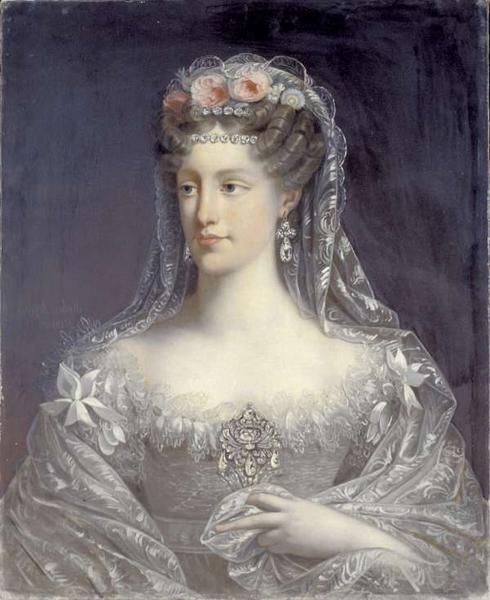
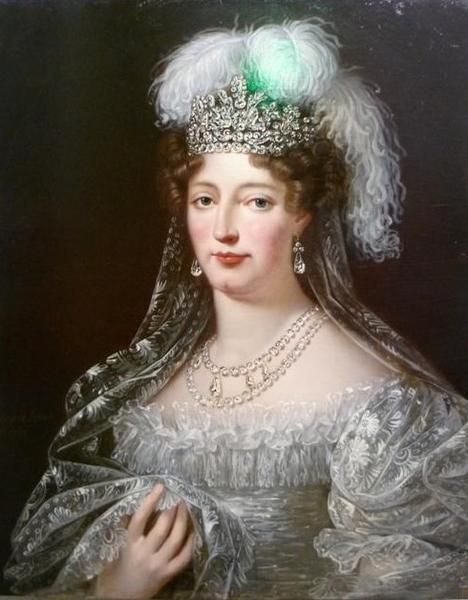
Here is the veil the Queen wore at Mass, particularly on feast days when she received Holy Communion. It is kept at the shrine of Notre-Dame de Bétharram near Lourdes. 

Is the Duchesse de Berry wearing it, here?

And is Marie-Antoinette's daughter wear the same veil, here?


This may contain: an old black and white photo of a woman in a wedding dress sitting on a chair

Here is a picture of the last Tsar's niece Princess Iryna Alexandrovna in her wedding dress. It is said her veil belonged to Marie-Antoinette. Share

Tuesday, April 28, 2026

Chinoiserie in Architecture

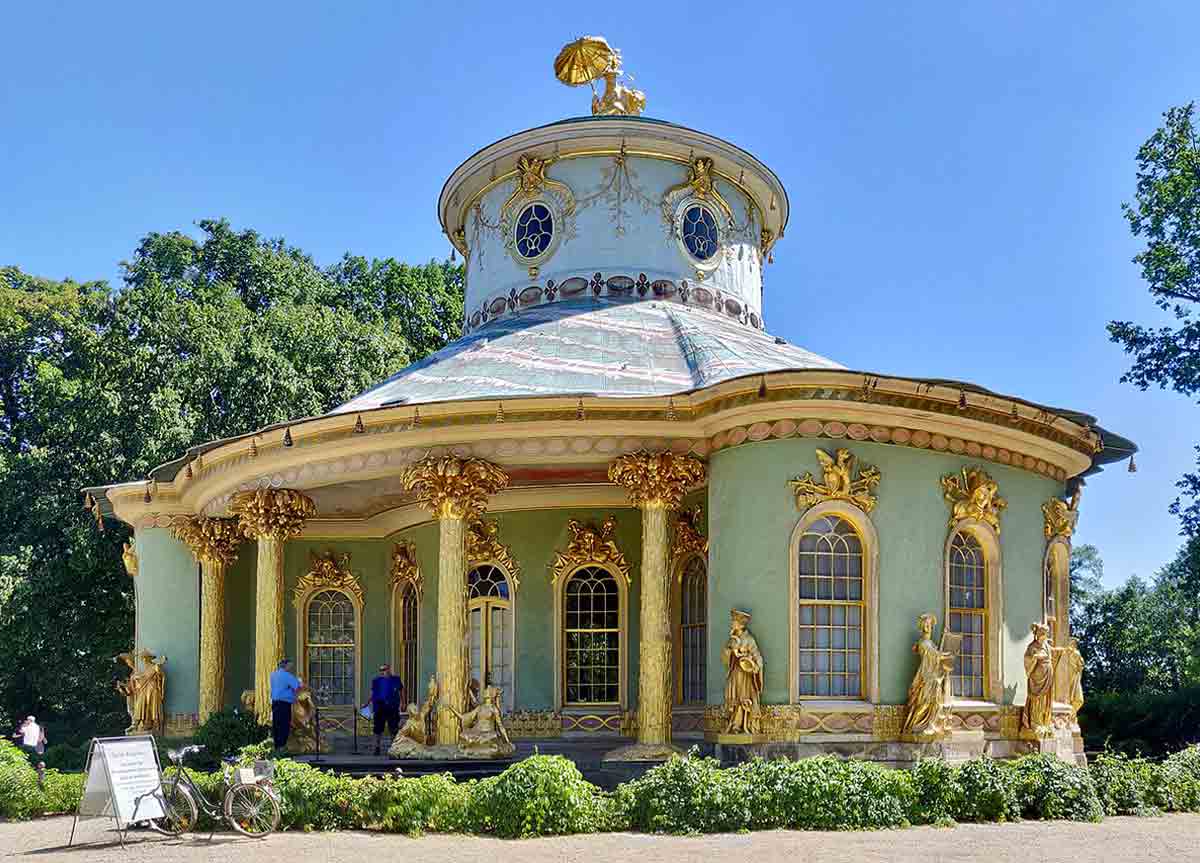
chinesisches haus chinese house sanssouci park potsdam 2019 

From The Collector:

Located in the Sanssouci Park, the Chinesisches Haus (“Chinese House”) in Potsdam, Germany, was built between 1755 and 1764. Commissioned by Prussian king Frederick the Great, the project was headed by German master builder Johann Gottfried Büring. The Chinese House is characterized by its trefoil shape, which was inspired by the Maison du Trèfle at the Palace of Lunéville in Lorraine. Its exteriors feature four prominent gilded sandstone columns alongside several playful, life-sized gilded sculptures of Chinese musicians and tea drinkers. These were the works of German sculptors Johann Melchior Kambly, Johann Gottlieb Heymüller, and Johann Peter Benckert.

The Chinoiserie style continues in the building’s interiors with a vast collection of 18th-century porcelain and a large fresco depicting a whimsical gathering. It features numerous Chinese men standing behind a balustrade, some glancing around and others engaged in conversation. In the surroundings, there are peacocks, parrots, monkeys, statues of Buddha, and many other Chinoiserie motifs. Frederick the Great, as a fervent admirer of Chinoiserie, would later follow up with two additional Chinese-style structures. One was the Chinese Kitchen, located just a stone’s throw from the Chinese House, and the other was the Drachenhaus (“Dragon House”), located at the northern part of the Sanssouci Park. (Read more.)


Share
Thursday, April 23, 2026

The Second Partition of Poland

 From Charles Coulombe:

THE First Partition of Poland was a dreadful blow, not just to Polish morale, but that of the Lithuanians, Belarusians, and Ukrainians with whom they shared the Commonwealth. The Allied Powers — Russia, Prussia, and Austria — that had undertaken the First Partition were watchful over any signs of independence that the Polish King and government might exert. Russia in particular supervised both the meeting of the Sejm and the Permanent Council made up of pro-Russian nobles and now deputed to carry on most of the business of governing. Stanislaus’ royal prerogative was restricted, so that he lost the right to confer noble titles, and military promotions and to appoint ministers and senators. Provincial Governorships, and Crown lands would be auctioned off. With the King reduced to seeming impotence, and the government firmly in pro-Russian hands, it seemed that the Commonwealth was now a complete puppet.

But King Stanislaus was a wily man. There was strong Conservative opposition to the Council, made up of nobility who feared loss of their own powers to a resurgent central government. The King became adept at playing the two sides off against each other and creating his own King’s party. Moreover, although his own powers had been severely clipped, his ability to influence and cajole became if anything ever stronger. He became very adept at mitigating or frustrating the worst of legislation that the Russians favoured. In secret, with trusted advisers, he created a reform programme. But while the King was able to slow the rate of decay, his opponents in the Sejm were able to block his reforms.

This standoff would continue for almost two decades. But on the wider world, things were happening. In 1781, Austria and Russia allied as a means of countering — and, they hoped, eventually conquering — the Ottomans (Catherine the Great had one of her grandsons named Constantine, in hopes that he would reign over a new Byzantine Empire). Stanislaus attempted to join this alliance, reasoning that it would strengthen Poland-Lithuania, and buy the country some independence. They were unable to agree on terms, but in 1787, the two Christian Empires went to war with the Muslim one. In response, Stanislaus convoked the “Great Sejm” the following year, which would sit for four years. Then in 1789, the revolution in France began, and that country created a constitution. (Read more.)

Share

Wednesday, April 8, 2026

Easter Eggs


Meat, as well as dairy products and eggs, were at one time renounced by all Christians during the Lenten fast. Among Eastern rite Christians, the discipline is still observed. Decorating and exchanging eggs at Easter have long been a sign of rejoicing. According to Wikipedia:
The egg is widely used as a symbol of new life just as a chick might hatch from the egg. The Easter egg tradition may have celebrated the end of the privations of Lent in the West, though this is speculation. Eggs were forbidden during Lent as well as other traditional fast days; since chickens would not stop producing eggs during this time, a larger than usual store tended to be available at the end of the fast, which had to be eaten quickly to prevent spoiling. Likewise, in Eastern Christianity, both meat and dairy are prohibited during the fast, and eggs are seen as "dairy" (a foodstuff that could be taken from an animal without shedding its blood). It was also traditional to use up all of the household's eggs before Lent began, which established the tradition of Pancake Day.

  Basket of Flowers Egg

Among the most famous of Easter eggs are those made by Fabergé for the Russian Imperial Family. More HERE.

 Mosaic Egg Objet

Share

Tuesday, March 31, 2026

Baptism of St. Olga

From World History Connected:
It is a strange historical twist that the first "Russian" woman to be canonized in the Orthodox Church was a Viking warrior princess who spent much of her life as a pagan. Olga earned her sainthood by becoming the first member of the house of Riurik, the dynasty that ruled European Russia and parts of Ukraine and Belorus for more than seven centuries (860s – 1598), to convert to Christianity. But the role of this battle maid in the spread of Christendom to the eastern Slavs is only part of her remarkable contribution to the history of Eastern Europe. 
 
     Olga is the only woman for whom we possess significant biographical details in the written sources for the Kievan Rus period of Russian history (860s – 1240). In contrast with Western Europe and the Byzantine Empire, medieval Russian women did not participate in literary culture aside from the occasional inscription or letter of the type found on birch bark in the excavations of medieval Novgorod. The laws of the period reveal that women enjoyed few legal protections compared with their male peers. Women could inherit property from their parents or husbands, but only in the absence of brothers and sons. If the sons were young, the widow managed the family's estate until the sons reached their majority.

     Olga is in this way typical of the free elite women of Kiev.1 For nearly two decades (945 to 962) Olga ruled the rapidly expanding kingdom of Kievan Rus,2 which received its name from its capital Kiev on the middle Dniepr River, as regent for her young son Sviatoslav. And she did so in stunning fashion despite significant obstacles. Olga assumed power at a time when the realm was shaken by tribal violence and administrative disorder. She bloodily pacified rebellious tribes and replaced tribute taking with a regular system of taxation. Olga's decision to convert to eastern Christianity instead of Catholicism was also a fundamental step in the spiritual and political alliance of Kievan Rus with the Byzantine Orthodox world rather than with Latin Christendom. In short, it took the will and perspicacity of a barbarian widow to begin the transformation of the Rus lands from a loosely knit pagan chieftaincy into a more stable and centralized Christian kingdom. (Read entire post.)
Share

Saturday, March 28, 2026

Russia after Putin

 From Paul Gilbert:

Despite Western predictions of Russia’s pending economic collapse, the country appears to be adapting to sanctions imposed by the United States, Great Britain, and European Union. Growing demand for Russian energy imports has helped keep the country’s besieged economy afloat. China and India, Asia’s biggest and third-biggest economies, respectively, have been the biggest drivers of the trend. This includes crude oil, pipeline gas, liquefied natural gas and coal.

According to Fareed Zakaria: “Russia’s performance in the war has been poor, but it is doing better, especially at holding territory. Russia has also been able to stabilize its economy, which the IMF projects will do better this year than the UK’s or Germany’s. Russia is trading freely with such economic behemoths as China, and India, as well as neighbors like Turkey and Iran. Because of these countries and many more, outside of the advanced technology sector, it has access to all the goods and capital it lost through the Western boycott. There is now a huge world economy that does not include the West, and Russia can swim in those waters freely.”

In addition, the Russian ruble has gained against the dollar after collapsing immediately after the Ukraine invasion.

While Putin remains unpopular in the West, his popularity among his own people remains high. In January 2023, over 80 percent of Russians approved of activities of the Russian President Vladimir Putin. The popularity level saw an increase compared to September 2022, when it stood at 77 percent.

Contrary to Western media hype, President Vladimir Putin, now 70, looks remarkably healthy and shows no sign of stepping down any time soon . . . but, “what if” he decided to step down as president, “what if” he was forced from office or “what if” he died in office, who would succeed him? Would Putin repeat Franco’s historic decision, and restore the monarchy in modern day Russia? (Read more.)


Share
Friday, March 27, 2026

Under House Arrest

From Paul Gilbert:

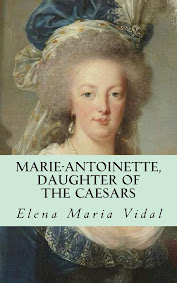
On this day – 22nd March (O.S. 9th March) 1917 – the Provisional Government decreed that Emperor Nicholas II, his wife and five children should be held under house arrest in the Alexander Palace at Tsarskoye Selo.

At eleven in the morning, the Imperial Train pulled into the Imperial Railway Pavilion at Tsarskoye Selo. Nicholas emerged wearing a Caucasian fur cap and soldier’s greatcoat. Behind him the members of his suite began to jump off the train – like rats abandoning a sinking ship – and run down the platform. Not looking back – they fled.

According to Count Paul Benckendorff (1853-1921), the Emperor’s motorcar arrived at the gate of the Alexander Palace and was stopped by the sentry, who summoned the Commandant. The Commandant went down the steps and asked in a loud voice who was there. The sentry cried out, ‘Nicholas Romanov’. ‘Let him pass,’ said the officer.

During his captivity, the Tsar was subject to constant harassment and humiliation from the soldiers – most of whom were thugs – stationed in and around the Alexander Palace.
According to Pierre Gilliard: “The Emperor accepted all these restraints with extraordinary serenity and moral grandeur. No word of reproach ever passed his lips.” (Read more.)

Share

Saturday, February 7, 2026

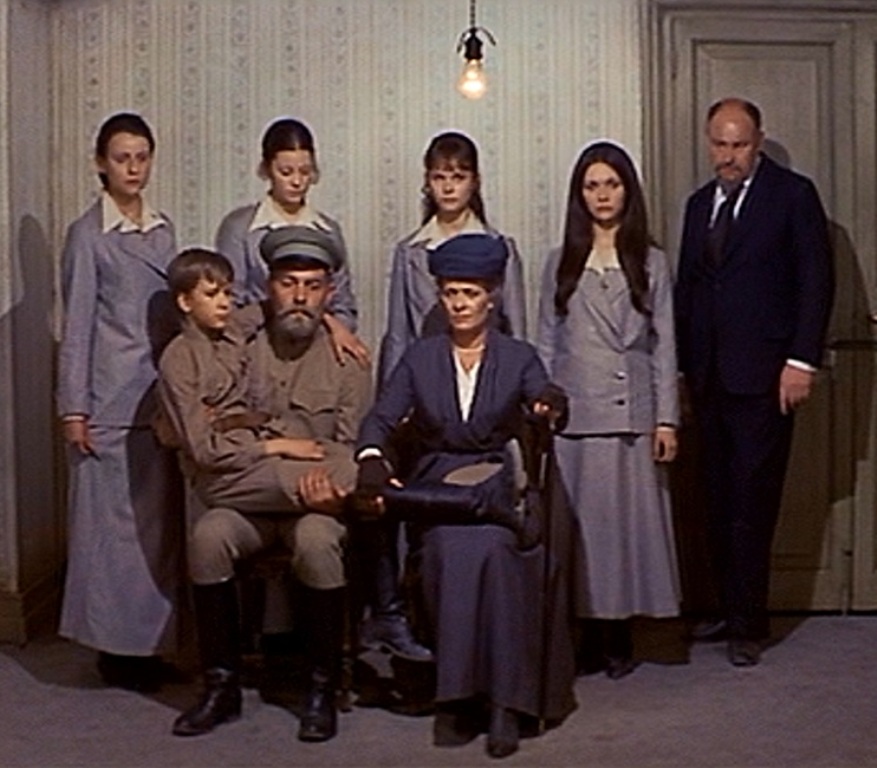
Nicholas and Alexandra (1971)

 Nothing is Written: Nicholas and Alexandra 

The portrayal of the chief murderer of the Imperial Family, Yakov Yurovsky, as a reluctant and humane executioner, has always disgusted me. From Paul Gilbert:

The year 2021 marked the 50th anniversary of the release of the film adaptation of Robert K. Massie’s (1929-2019) classic book Nicholas and Alexandra. Published in 1967, it remained on the New York Times Bestseller List for 46 weeks, and has never gone out of print! Selling more than 4.5 million copies, it is regarded as one of the most popular historical studies ever published. Praised in The New York Times as a “long-needed and balanced account” of the last tsar and his family. In Massie’s study, Nicholas comes across not as the “stupid, weak or bloodthirsty” monarch, as he is often been portrayed by his Western counterparts.

The film version was released on 13th December 1971, and nominated for numerous awards. At the 44th Academy Awards (1972), Nicholas and Alexandra won two awards of six nominations; at the 25th British Academy Film Awards (1972), Nicholas and Alexandra received three nominations; at the 29th Golden Globe Awards (1972), Nicholas and Alexandra received three nominations; and at the 15th Annual Grammy Awards (1973), Richard Rodney Bennett was nominated for Best Original Score Written for a Motion Picture or a Television Special.

The film featured a star-studded cast of notable British actors and actresses: Michael Jayston (1935-2024) as Nicholas II; Janet Suzman [b. 1939] as Alexandra Feodorovna; Irene Worth [1916-2022] as the Dowager Empress Maria Feodorovna; Tom Baker [b. 1934] as Grigori Rasputin; Jack Hawkins [1910-1973] as Count Vladimir Frederiks, the Minister of the Imperial Court; Timothy West [1934-2024] as Dr. Botkin, the court physician; Jean-Claude Drouot [b. 1938] as Pierre Gilliard, the children’s Swiss tutor; Laurence Olivier [1907-1989] as Count Witte, the Prime Minister; Michael Redgrave [1908-1985] as Sazonov, the Foreign Minister; Eric Porter [1928-1995] as Pyotr Stolypin, the Prime Minister after Witte; John McEnery [1943-2019] as Kerensky, leader of the Russian Provisional Government; Michael Bryant [1928-2002] as Lenin; Martin Potter [b. 1944] as Prince Felix Yusupov; Richard Warwick [1945-1997] as Grand Duke Dmitri Pavlovich; among many others.

Personally, I greatly disliked this film for a number of reasons. It is due to the popularity and cult-like status of this film which compelled me to address some of the many factual errors of this film, and that it will serve as a resource for those who have viewed it for the first time. (Read more.)


Share

Wednesday, February 4, 2026

Petrushka


Stravinky's 0riginal costume design for Petrushka


Original 1911 set design for Petrushka

When I was a child my grandmother gave us a record with stories from famous ballets, including musical excerpts from Petrushka. We were entranced by it; my sister and I tried dancing to Petrushka when we were very small; from what I have read since, we were not alone in being swept up into the drama. Composed by Igor Stravinsky (1882-1971) for Sergei Diaghilev's Ballets Russes, Petrushka debuted in 1911 at the Théâtre du Chatelet in Paris. The mysterious, magical tale of love and revenge unfolds at a Russian Shrovetide fair, centering around a puppet called "Petrushka," who in Pinocchio-style comes to life. To summarize:
Petrushka ("Petey") is the story of three puppets - the forlorn and homely Petrushka, a beautiful ballerina, and a mysterious and gaudily dressed Moor - brought to life by their showman master at a Russian Shrovetide fair. Petrushka tries to express his love for the ballerina, but she has eyes only for the Moor. The frustrated Petrushka is subdued by the scimitar-wielding Moor, but the puppet's ghost has the last laugh by thumbing his nose at everyone. All this takes place within the context of the fair, full of dances by nannies, coachmen, masqueraders, crowds and even a dancing bear.
In Russian culture, the puppet character of "Petrushka" was rather like "Punch," a rude, comic Everyman, the butt of every joke. Stravinsky endows him with human feelings; as Petrushka attempts to rise from his baseness, his strivings lead to his destruction, only to gain immortality in the end.
Stravinsky's music captures the carnival atmosphere of Maslenitsa, the Russian version of Mardi Gras, with all its color and passion. As one commentator describes:
Subject and music appear to reflect the Russian nature. Gogol and Mussorgsky are there. Everything is reflected in the score with a sure and reckless mastery —the movement and tumult of the crowd; the gait and aspect of each leading figure; and the grotesque agonies of the helpless one. A shriek of...trumpets in different keys is the motto of Petrouchka's protest. The composition is permeated with Russian folk-melodies and also street songs marvelously treated.
"Fair"
In his day, Stravinsky was considered avant-garde since his music was a bit different from what had gone before. His work was part of the explosion of creativity that brightened the last days of imperial Russia, called the "Silver Age." On one level, Petrushka is an echo of a time that is gone; on another, it conveys the spirit of the Russian people which Communism was not able to destroy. I enjoy listening to Petrushka more than ever, especially during Shrovetide. 

Listen HERE.

Share

Saturday, January 31, 2026

The Transformation of the Roman Empire Into Byzantium

 From The Greek Reporter:

The transformation of the Roman Empire into what modern historians call Byzantium was not a single event but a gradual process, reaching a profound turning point in the 7th century. By this time, the Roman state had changed in territory, culture, language, religion, and political structure, becoming something new—yet it continued to call itself Roman. The 7th century marked the moment when the Ancient Roman world evolved into the medieval Byzantine Empire, which had previously been known as the Eastern Roman Empire.

Although Hellenistic culture had long prevailed, cemented by the founding of Constantinople in 330, the Eastern Roman Empire retained the core elements of imperial Rome. Its administration remained rooted in Roman institutions, its cities preserved Classical urban culture, and its emperors regarded themselves as heirs of Augustus and Constantine. Latin was in decline, however, even as it remained the official language and the emperors claimed dominion over the entire Mediterranean.

 The transformation was inevitable: Constantinople was emerging as the center of the empire while Rome’s influence waned. As historian Peter Brown observed, Byzantium represents continuity: “The Roman Empire did not fall in the East. It was transformed.” Centered in Constantinople, the Eastern Roman Empire remained a powerful and sophisticated Roman state but with a distinct Byzantine character—while still seeing itself as Roman. (Read more.)


A Byzantine princess in Kyivan Rus. From History of Royal Women:

As the sister of the Byzantine Emperor and as a princess born in the purple, Anna was a highly desirable bride. In 972, the Holy Roman Emperor, Otto II, married Theophano, a relative of the Byzantine Emperor, after requesting an imperial princess. Sometimes Theophanu is thought to have been a sister of Anna, but she was probably related to her more distantly. It is possible that Otto may have wanted to marry Anna instead. In 986, a Bulgarian prince appears to have asked Basil for his sister’s hand in marriage, but this was rejected.

In 988, the new French king, Hugh Capet, sent a letter to Basil, asking him to find a bride for his son, the future Robert II, of equal rank. It was likely Anna, who he was asking for. This arrangement did not go through either. It is believed that all of these proposals were turned down because, at the time, Byzantine princesses born in the purple were considered too important to marry foreigners, even if they were kings or emperors. The Byzantines at this time were also said to have still considered the Western Europeans as barbarians. Everything changed in 988 when Vladimir, Grand Prince of Kyiv, wished to marry Anna. (Read more.)

Share

Sunday, January 25, 2026

Churchill on Nicholas II

247a 

From Paul Gilbert:

Today – 24th January 2025 – marks the 60th anniversary of the death of Sir Winston Churchill (1874-1965). In 1929, Winston Churchill wrote his assessment of Emperor Nicholas II, which, though not uncritical, is a much fairer one than that customarily given by Western historiography. They are among the most succinct and powerful English words in defense of Nicholas’ character — in part because Churchill does not depend upon the “well he was a good husband and father” strategy. He also addresses some of the questions that still exist in Russia today (democratize or hold firm). Many voices remain critical of Nicholas II’s refusal to democratize (although he did create the Duma, and think how long ago Magna Carta was written), herewith is Winston Churchill’s verdict:

It is the shallow fashion of these times to dismiss the Tsarist regime as a purblind, corrupt, incompetent tyranny. But a survey of its thirty months’ war with Germany and Austria should correct these loose impressions and expose the dominant facts. We may measure the strength of the Russian Empire by the battering it had endured, by the disasters it had survived, by the inexhaustible forces it had developed, and by the recovery it had made. In the governments of states, when great events are afoot, the leader of the nation, whoever he be, is held accountable for failure and vindicated by success. No matter who wrought the toil, who planned the struggle, to the supreme responsible authority belongs the blame or credit.

Why should this stern test be denied to Nicholas II? He had made many mistakes, what ruler has not? He was neither a great captain nor a great prince. He was only a true, simple man of average ability, of merciful disposition, upheld in all his daily life by his faith in God. But the brunt of supreme decisions centred upon him. At the summit where all problems are reduced to Yea or Nay, where events transcend the faculties of man and where all is inscrutable, he had to give the answers. His was the function of the compass needle. War or no war? Advance or retreat? Right or left? Democratize or hold firm? Quit or persevere? These were the battlefields of Nicholas II. Why should he reap no honour from them? The devoted onset of the Russian armies which saved Paris in 1914; the mastered agony of the munitionless retreat; the slowly regathered forces; the victories of Brusilov; the Russian entry upon the campaign of 1917, unconquered, stronger than ever; has he no share in these? In spite of errors vast and terrible, the regime he personified, over which he presided, to which his personal character gave the vital spark, had at this moment won the war for Russia. (Read more.)


Share

Thursday, January 8, 2026

The Mystery of the Cross in the Old Testament

 From The Uncreated Light:

When people were dying from venomous snakes in Numbers 21 after speaking against the Lord, God saw the repentance of the people and told Moses, “Make a fiery serpent, and set it on a pole; and it shall be that everyone who is bitten, when he looks at it, shall live.” (Numbers 21:8).

This prefigures the Cross as well as St. Cyril of Jerusalem notes, “This was the figure which Moses completed by fixing the serpent to a cross, that whoever had been bitten by the living serpent, and looked to the brasen serpent, might be saved by believing. Does then the brazen serpent save when crucified, and shall not the Son of God incarnate save when crucified also? On each occasion life comes by means of wood.” + St. Cyril of Jerusalem (4).

Jesus Himself alludes to this event in John 3:14, “And as Moses lifted up the serpent in the wilderness, likewise, the Son of Man must be lifted up.” Just as the serpent poisoned, God uses a serpent to heal. Just as all humanity fell in Adam, all humanity is raised and healed in Christ. This was done by means of the Cross. The serpent was bronze as it appears to be poisonous but is not, the same way Christ voluntarily took on sin even though He was sinless (2 Corinthians 5:21). Christ was lifted up both on the Cross and in His ascension into heaven.

Both St. Luke of Simferopol and St. Gregory Palamas are cited as saying the snake was positioned horizontally by Moses on the stake, so that it resembled the Cross. St. Luke says, “Moses fashioned a large snake from bronze and put it on a pole similar to a cross. This was a clear type of our Lord Jesus Christ, who saves all from the death of sin, who with deep faith turn to Him, and with tears venerate His cross, through which He saved the world.” (5).

This along with Christ’s own words speak this reality. As does the icon of the event, the Cross is there. This specific one is a Russian icon from the 1500’s, the earliest surviving icon from the iconoclast period of this event is the 1000’s to my knowledge. (Read more.)

Share

Wednesday, January 7, 2026

Health of Empress Alexandra

0290b 

judge 

From Nicholas II:

During her life, Alexandra carried much grief, worry and sorrow on her shoulders, all of which began at an early age. She lost her brother Friedrich to haemophilia in May 1873; her sister Marie died of diphtheria in November 1878; and the following month, her beloved mother Princess Alice also died of diphtheria in December 1878.

After her mother and sister’s deaths, Alix became more reserved and withdrawn. She described her childhood before her mother and sister’s death as “unclouded, happy babyhood, of perpetual sunshine, then of a great cloud.”

In March 1892, her father Grand Duke Louis IV, died of a heart attack. According to Baroness Sophie Buxhoeveden, Alix regarded the death of her father as perhaps “the greatest sorrow of her life”. Buxhoeveden recalled in her 1928 biography [The Life and Tragedy of Alexandra Feodorovna] that “for years she could not speak of him, and long after when she was in Russia, anything that reminded her of him would bring her to the verge of tears”. This loss was probably so much greater for Alix because Grand Duke Louis IV had been Alix’s only remaining parent since she was six years of age. (Read more.)


Share

Sunday, December 21, 2025

The Nutcracker

 
 In the hundred years or so since its debut, Tchaikovsky's The Nutcracker has become a delightful aspect of modern Christmas celebrations. Composed during the "Silver Age" of Russian ballet, The Nutcracker is based upon a fairy tale by the German romantic writer E.T.A. Hoffman, whose stories also inspired Delibes' Coppelia and Offenbach's Tales of Hoffman. It is one of the few ballets that is not a love story, although later stagings have tried to make it into one. The music, however, is powerful enough for any story of a great romance. In college, I helped my sister Andrea, who was still in high school, with a project; we were listening to the "Pas de Deux" of the Sugar Plum Fairy and her cavalier. Andrea said, "That must be from a really great love story." "No, it's just from The Nutcracker," I replied. It is a simple story, full of childhood's innocent, but very real, hopes and fears. To watch or listen to The Nutcracker is to enter into a dream, a dream which comes to life even after so many years, and all wars and revolutions which have tormented the world.
Share

Friday, December 5, 2025

The Russian Terrorist-Revolutionary Movement, 1866 – 1876

 From It Can Always Get Worse:

The Russian intelligentsia had emerged in the 1840s dedicated to the overthrow of the entire structure of Tsarism. The logic of cumulative radicalisation implanted by literary critic and novelist Nikolay Chernyshevsky had dictated a turn from literary agitation to active revolutionary methods, specifically terrorism, the objections of leading intelligént Alexander Herzen notwithstanding. The result was the first attempt to assassinate a Tsar in April 1866 by Dmitry Karakozov. This was the onset of a new phase of the Russian revolutionary movement.

Karakozov had not acted alone: he had been part of a secret revolutionary group, run by his cousin, Nikolai Ishutin, whose death sentence in 1866 was commuted by the Tsar (a detail those who present the Imperial Government as a proto-fascist regime might take note of). By some accounts, the group was founded in 1863, with an inner core called “Hell” and an outer circle called simply “The Organisation”. In truth, thanks partly to Ishutin’s wilful mystification, nobody really knows the structure of the Ishutin Society, even all this time later. It seems very unlikely, for instance, that the Society was one faction of a “European Revolutionary Committee” with branches in every State in Europe awaiting the order to murder their monarchs, as Ishutin told his cadres,1 but the Russian terrorist-revolutionaries would become highly integrated into a transnational infrastructure that extended as far west as Britain,2 and it is not impossible international links of some kind were forged in this period.

What is clear is what the group stood for. In ideology: socialism, violence as a virtue, and revolution to thwart industrialisation and constitutionalism in Russia, an idea that would gain increasing salience for the intelligentsia. And the conduct of its members accorded to the principles of Chernyshevsky’s “New Man”: self-sacrifice, ascetism to the point of renouncing family ties and not marrying, and the rejection of all conventional morals, expressed most clearly in its unscrupulous fund-raising methods (namely robbery; one member even planned to murder his father for the inheritance) and its use of deception (not least against its own members).3 The group, a component of the Russian Jacobin stream, was devoted to conspiracy in bringing off revolution and the rule of a despotic minority afterwards, with “Hell” at the centre of the new regime and the (largely non-existent) “Organisation” staffing the State. The economy would be nationalised, counter-revolutionaries exterminated to ensure equality, and officials in the new government who fell short would be removed by assassination.4 (Read more.)


Share