Showing posts with label Enfants de France. Show all posts

Monday, September 28, 2026

The Pope in France

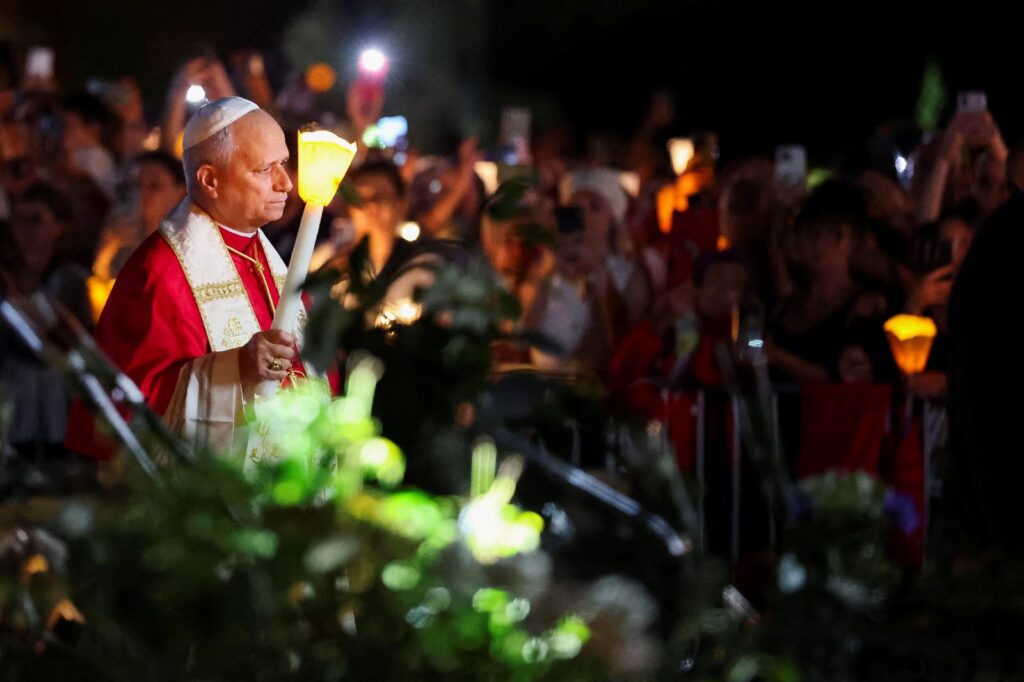
Pope Leo XIV in Notre Dame Cathedral
Pope Leo at Notre Dame with the statue of Our Lady of Charles X

 From Vatican News:

Light inundated Notre-Dame as Pope Leo XIV celebrated vespers in Paris' beloved Cathedral. It felt like a fitting celebration for the restored and renewed basilica, a place of worship and iconic symbol of the “Ville Lumière“, badly damaged by fire on 15 April 2019.

On that day, dramatic images and videos of the cathedral engulfed in flames, and of people praying in the streets as the fire consumed the building, spread around the world through social media and news outlets.

Today, the French Church has come together again. This time to rejoice, as the Pope visited the Cathedral and celebrated Vespers, almost two years after its reopening in December 2024, following a long and meticulous restoration process.

As the sun shone through the stained-glass windows, colorful patterns moved slowly across the walls. Meanwhile, an organ played and the choir sang while the bishops, priests, consecrated men and women, seminarians, and other members of the French Church solemnly prayed together with the Successor of Peter.

Before the Vespers, Pope Leo venerated a relic of the crown of thorns, which was placed on Christ’s head during his Passion. A symbol of his suffering and sacrifice before his Resurrection.

“We are gathered for Evening Prayer in this place which, more than any other, has invited the people of Paris for centuries to lift their eyes towards heaven,” Pope Leo said in his homily. (Read more.)

Mass at the Place de la Concorde, where thousands were guillotined (Via Daily Mail)

I wish instead of Robespierre the article had mentioned Madame Elisabeth. From Rome Reports:

The Place de la Concorde in Paris is a site marked by some of the darkest moments in French history.

During the Revolution, the guillotine stood here, and more than a thousand people were executed. Louis XVI, Marie Antoinette and Robespierre were among them.

Two centuries later, Pope Leo XIV celebrates the Eucharist here before nearly 600,000 people. A turnout that marks a new chapter in the Church in France.

The pope is using this celebration to call for a secular society.

LEO XIV

Seeing you gathered here, brothers and sisters, heirs to a long and beautiful history of holiness in France, I say to you: in turn, drink deeply from this spring that is the pierced Heart of Jesus. Yes, you thirst for God, for life, for truth, for unity, for peace, for communion, for happiness. You long to rediscover a radiant horizon, to build a renewed nation rooted in a faith that nourishes its very foundations.

But the pope does not stop with France’s religious identity. He goes straight to the individual and a much more universal question: what does a Catholic drink from when he or she thirsts for life?

LEO XIV

Brothers and sisters, we must acknowledge that here on earth, nothing can fully satisfy us. Just when we think our search is finally over and our efforts have been rewarded, that inner emptiness often resurfaces, even more profound than before.

Are we content with material possessions, immediate gratification, and the countless little idols that promise the world but leave our hearts empty?

And while, in 2008, Benedict XVI came to France asking how faith could survive in a secularized society, today, Pope Leo XIV is not talking about survival.

He is talking about renewing the country from its roots: building a renewed nation through a faith that can once again nourish society.

This is not about rebuilding a blood-soaked square, but renewing a society that, according to the pope, thirsts for truth, peace and happiness. (Read more.)

Pope Leo XIV visits the Sanctuary of Our Lady of Lourdes, a Marian shrine and pilgrimage site dedicated to Our Lady of Lourdes, on Sept. 27, 2026. | Credit: Vatican Media
Pope Leo in Lourdes

From EWTN:

Leo met Sept. 27 with staff and sick guests of the Accueil Notre-Dame (Notre Dame Home), a residential accommodation classified as a healthcare facility, which hosts sick, disabled, and frail pilgrims to Lourdes.

The Catholic shrine is one of the most visited in the world, drawing more than 3 million people every year, many in search of miraculous physical healing.

The 136-acre property includes the Grotto of Massabielle, where a young St. Bernadette Soubirous saw 18 apparitions of the Virgin Mary starting on Feb. 11, 1858. Today, pilgrims to the sanctuary bathe themselves in the freshwater spring Mary revealed to Bernadette.

Visitors have reported 7,000 healings since the apparitions; after lengthy investigations, the Church has declared that 72 of the recoveries were miraculous, meaning unexplainable by science. (Read more.)


 From CWR:

The Sanctuary of Our Lady of Lourdes is among the most popular Catholic shrines in the world, built on the site of Mary’s apparitions to St. Bernadette in 1858. It is particularly visited by the sick, who come to bathe in or drink its healing spring water.

In his homily, Pope Leo noted that a “call to conversion, both tender and urgent,” was a central part of the message the Virgin Mary entrusted to Bernadette, and that “it is today, not tomorrow, that we must repent.”

He said Jesus is quite direct about the call to repentance: “As St. Luke tells us, ‘Unless you repent, you will all perish.’ But he also extends our horizon beyond this earthly life to the horizon of eternal life.”

“Did not the Virgin Mary say to St. Bernadette, ‘I do not promise to make you happy in this world but in the next’?” Leo said.

The pope noted that we can often forget this in an age and society focused on progress and material wellbeing.

Eternal life is already won for us by Jesus’ sacrifice, he continued, but “the obstacle to grace and eternal life — the only obstacle to this love — is sin.” (Read more.)


 From OSV:

Holding a large candle in his right hand and a rosary in his left, Pope Leo processed slowly behind an illuminated statue of the Virgin Mary through the crowd of pilgrims holding candles, as the five decades of the glorious mysteries of rosary were prayed in multiple languages.

As the “Ave Maria” Lourdes hymn was sung between mysteries, all of the pilgrims in the square in front of the Basilica of Our Lady of the Rosary lifted their candles high in the air, creating a sea of lights.

“The light that guides us and draws us onward is the light of hope, which never abandons us even as we journey through this life — a life often marked by trials, yet already filled with the joy of knowing ourselves to be children of God, loved and saved by Jesus,” the pope said.

“Those who are sick are privileged witnesses to this transfiguration of our lives through faith and love of God and neighbor.” (Read more.)
Share

Sunday, September 27, 2026

Royal Orders

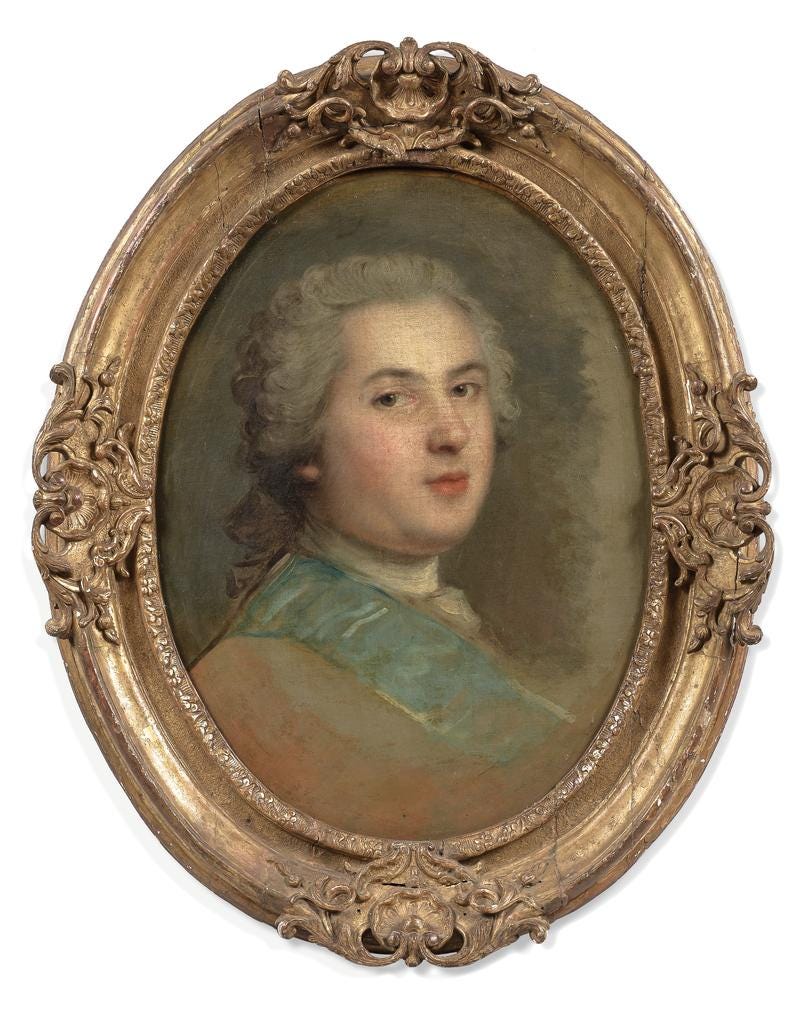
Which orders were worn by Louis XVI? A fascinating blog Once I Was a Clever Boy explores the question. To quote:
In the portraits the King can clearly be seen wearing the sky blue moiree riband of the Order and the breast star with its motif of the Dove. The riband was the first to be prescribed in the statutes of an order, and is the origin of the term 'cordon bleu' as asign of honour. The Order specifically commemorated King Henri's accession to the thrones of Poland on Whitsunday 1573, and to that of France on Whitsunday 1574, and hence the use of the Dove as a symbol. It also served to recall the account of the Holy Dove bringing the Sainte-Ampoulle at the baptism of Clovis in 496, and the source of the Holy Oil used at the Sacre of the King at Rheims. The design of the breast star and badge of the Order was to be copied and adapted by many other orders in Spain, Sicily, Sweden and Great Britain with the badge of the Military Division of the Order of the Bath, with lions and unicorns replacing the fleur-de-lys.
Share

Saturday, September 26, 2026

French Country Decor Ideas


From Léonce:

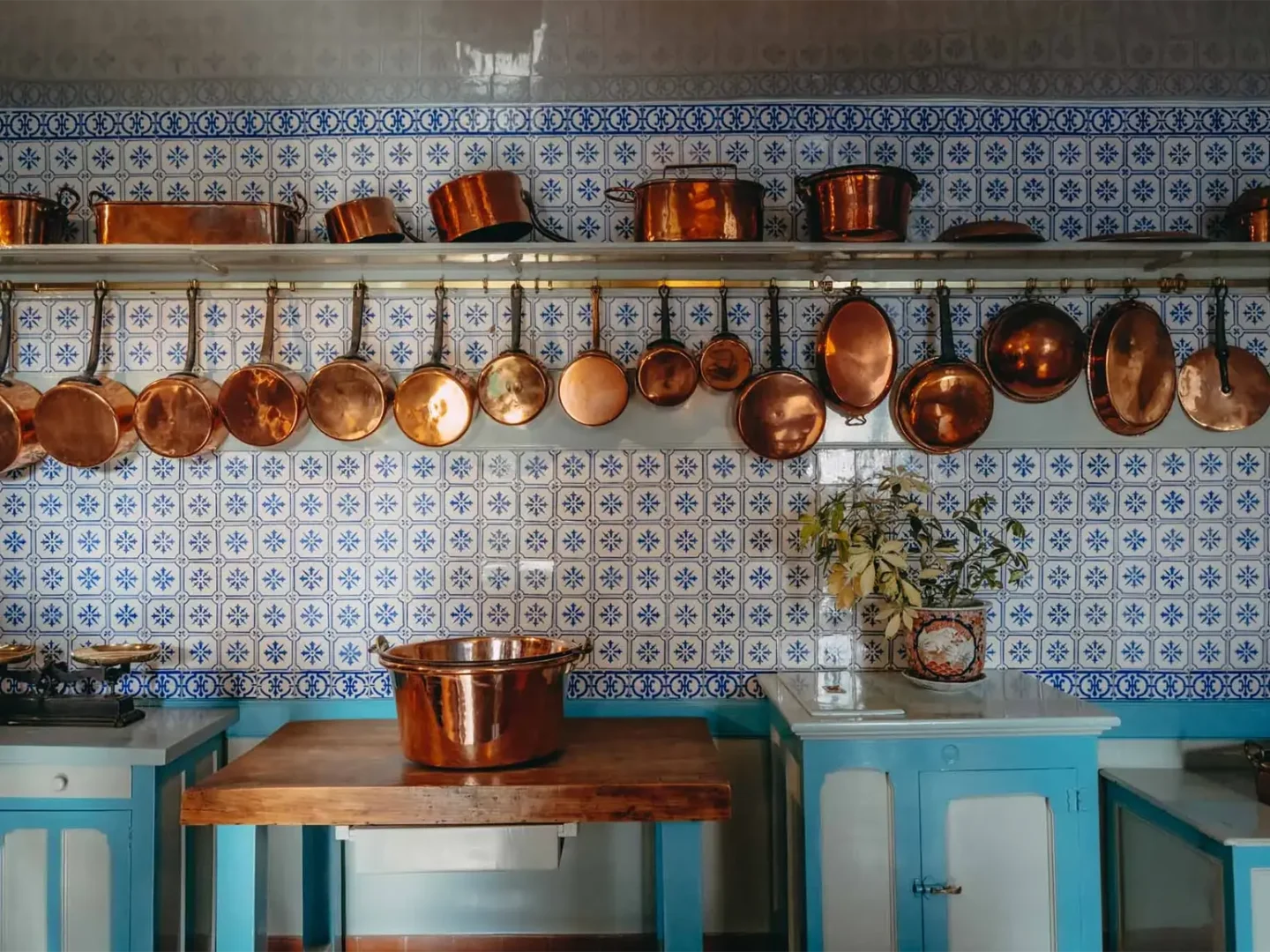
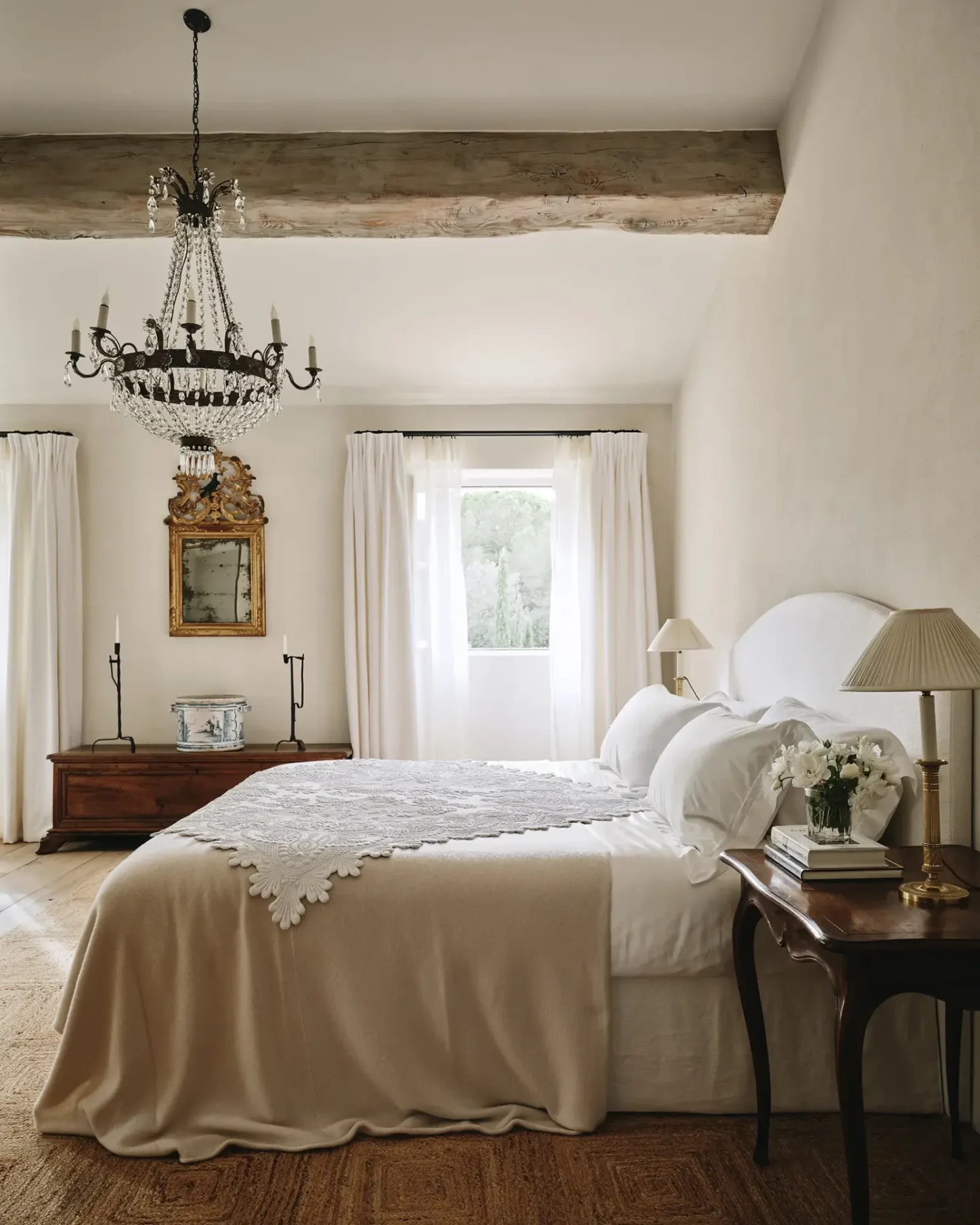
Over the past few months, I’ve saved countless home décor images on Pinterest (and if you enjoy French and Parisian inspiration, feel free to follow me there for more). Not that I’m currently renovating my apartment here in Amsterdam (although, truth be told, that would be one of my dreams) but I recently realized that many of the images I had saved seemed to gravitate toward the same aesthetic: French country style, sometimes also called French cottage style.

And without quite realizing it at first, this is also the direction my own Amsterdam home has slowly been evolving toward over the past few months. An aesthetic that feels rustic yet chic. Simple and unpretentious. Filled with natural materials: wood, linen, glass, ceramics, copper, and brass. A touch of vintage, but never kitsch. The kind of interior that creates a warm and welcoming atmosphere and that, to me, often evokes the charm of grandmother’s houses, countryside homes where everything feels convivial and where one immediately feels at ease.

Amsterdam, and the Netherlands more broadly, have influenced this shift more than I expected. Kitchens here often feel more rustic than Parisian ones, and because winters can be long and sometimes harsh, homes and apartments tend to have a naturally cozy and comforting quality that I’ve come to appreciate more and more.

This article is therefore a blend of different European influences which I hope will inspire you and perhaps give you a few ideas for bringing the charm of a French country home into your own space, wherever you may live. My inspirations draw from several places: the interior of Claude Monet’s house in Giverny, the Parisian atelier of Astier de Villatte in the 5th arrondissement near Place Maubert, the architecture and interiors typical of Amsterdam houses, as well as the timeless charm of traditional British cottages. (Read more.)

Share

Thursday, September 24, 2026

The Mystery of the ‘Real’ Milady de Winter


Yet another descendant of Mary Boleyn. From History Extra:

In the preface to The Three Musketeers, Dumas claims that he was researching Louis XIV in the Bibliothéque nationale de France when he happened upon the first volume of The Memoirs of M. d’Artagnan. This is not entirely true: he found the book in the public library in Marseilles, borrowed it and never returned it.

The Memoirs of M. d’Artagnan is a first-person pseudo memoir written by a former soldier, Gatien de Courtilz de Sandras, and first published in 1700. It tells the story of d’Artagnan, a young man setting out on his journey to become a musketeer. As well as d’Artagnan, Dumas discovered Athos, Porthos and Aramis, who would eventually become major characters in The Three Musketeers. He also found Milady de Winter. Courtilz never gives Milady’s name. Instead, she is referred to simply as ‘Milady’ followed by a dash or asterisks where her name should be. She is introduced as a maid of honour to Henrietta Maria, queen to the executed Charles I of England, whose exile in France Milady shares.
The daughter of an English peer, Milady has as much wit as beauty, and d’Artagnan thinks her the most beautiful woman he has ever seen. He promptly falls in love with her. There then follows a complicated sexual intrigue, one of several for Courtilz’s d’Artagnan. Once it is over, Milady is never heard from again. This is the episode that Dumas adapted for The Three Musketeers. The affair of the queen’s diamonds is absent from Courtilz, but at least part of the story as Dumas told it is supported by several contemporary memoirs. Those of Françoise Bertaut de Motteville, Pierre de La Porte and Henri-Auguste de Loménie, Comte de Brienne – all of whom served at the royal court of France – each provide an account of the Duke of Buckingham’s visit to France in 1625. Buckingham had been sent to escort Henrietta Maria, then Charles I’s new queen, to England. While in France, he ostentatiously courted the queen, Anne of Austria.
None of these memoirs, however, mention the diamonds that Anne was said to have given to the duke. For this part of the story, it is necessary to consult the memoirs of Henri-Auguste's son, an obscure publication known as Recueil A, and the memoirs of François de La Rochefoucauld. Louis-Henri de Loménie, Comte de Brienne served Louis XIV as secretary of state, a position he inherited from his father. He left a memoir, which was published in the early 19th century. Certain editions, particularly that edited by Jean François Barrière, include an account of the queen’s diamonds.

It does not form part of Brienne’s original narrative – he was not even born at the time of the alleged diamond affair. Instead, it is mentioned in an introductory essay, written by the editor, explaining the manners and customs of 17th-century France. It is then related in full in an appendix, Éclaircissements historiques, or ‘historical clarifications’. In this version, the diamond thief is named as Lady Clarik. However, the story was lifted word-for-word from Recueil A, and inserted into the memoir. Recueil A is the first volume of a large collection published in the 18th century. It comprises an assortment of documents, including extracts of memoirs, concerning the history of France. The author of the account of the diamond affair is enigmatically identified as ‘M. le M. de T’. Behind these initials, according to the anonymous editor of the Recueil, is René de Froulay, Comte de Tessé.

The Comte de Tessé was a real person. Born in 1651, he was a military man, diplomat and courtier. He did indeed leave a memoir, but the diamond affair does not appear in it. The story as found in Recueil A and later inserted into the memoir by Brienne is, therefore, unreliable. What then of La Rochefoucauld? In his memoir, the lady who stole the diamonds was not Lady Clarik but the countess of Carlisle. In fact, Lady Clarik did not exist – but Lady Carlisle certainly did. (Read more.)


Read about the Countess of Carlisle in my Henrietta Maria novels, HERE and HERE.

Share

Sunday, September 20, 2026

Louis XVI's Last Meeting with His Family

From Vive la Reine:
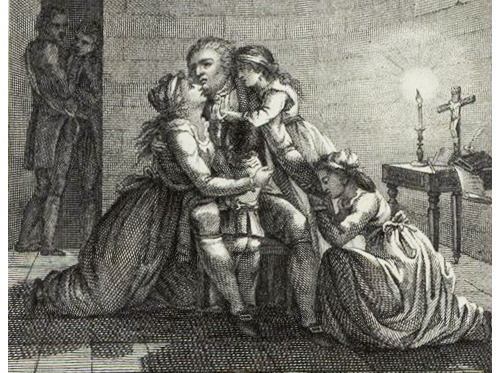
At half-past eight the door opened; the queen appeared first, holding her son by the hand; then Madame Royale and Madame Élisabeth; they ran to the arms of the king. A gloomy silence reigned for several minutes, interrupted only by sobs.
… The king sat down, the queen on his left, Madame Élisabeth on his right, Madame Royale nearly opposite to him, and the little prince between his knees.
All were bending towards him and held him half embraced. This scene of sorrow lasted seven quarters of an hour, during which it was impossible to hear anything; we could see only that after each sentence of the king the sobs of the princesses redoubled, lasting some minutes; then the king would resume what he was saying.—the journal of Jean-Baptiste Cléry

Share

Saturday, September 19, 2026

Marie-Thérèse Viewing a Portrait of Her Family at the Temple

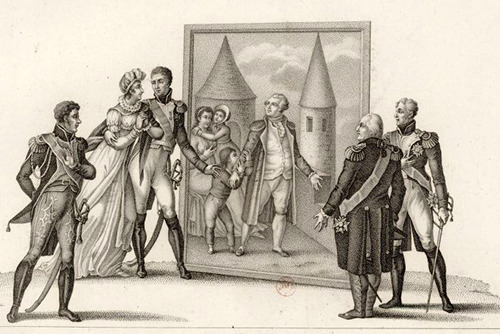
Notice how her husband Louis-Antoine is very attentive. He knew how such things upset her.  Berry stands alone off to the side on the left. And then there are Artois and Louis XVIII on the right. One wonders what passed through their minds when seeing their doomed brother and his family. Via Vive la Reine. Share

How to Create a French Cheese Board

From Léonce:

This is usually how I compose a board. I begin with the cheese I most want to eat, or one I am curious to discover, then choose the others in relation to it. For a full board, I like five cheeses. It is enough to create variety without making the meal feel exhaustive. One can be familiar, another unexpected; one soft, another firm; one gentle and another with more character.

You might look for something creamy, something aged, something fresh or tangy, something aromatic and a blue. But this is only a starting point. A board of mountain cheeses may contain several firm cow’s milk cheeses, while a Loire selection may be almost entirely devoted to goat’s cheese. What matters is that the cheeses feel different enough to make tasting them together interesting.

I try not to choose several with almost the same texture and intensity simply because I like each one individually. They should have something to say to one another. (Read more.)


Share

Friday, September 18, 2026

Charity of the Dauphine

Before becoming Queen of France, Marie-Antoinette was known for her mercy and sweetness. From Vive la Reine:
Mme la Dauphine, who had returned, got out of her carriage, ran toward the woman, and held out some perfume to her nose, which made her come out of her faint. Mme la Dauphine gave her all the money she had with her, but what was even more admirable was the kind and consoling way in which HRH talked to the poor woman. Finally, Mme l'Archiduchesse, who was touched, shed tears and, at that moment, caused more than a hundred spectators to do the same….

Then, having called for her carriage, Mme la Dauphine gave orders that the peasant woman be taken in it back to her cottage which was in a neighboring hamlet.* Her Royal Highness waited right there for her carriage to return; she asked about the care of the wounded man … I cannot describe to Your Majesty the greatness or intensity of the sensation caused by the event, not only among the courtiers, but even more among the people of Fontainebleau….

The public in Paris [seems very moved;] whenever Mme la Dauphine’s name comes up, it evokes a universal cry of joy and admiration.
–Ambassador Mercy to Maria Theresa, 12 November 1773
(Read more.)
Share

The De-Christianization of France

 From The War on Beauty:

France has been in a process of de-Christianization since the Revolution in 1789 when Catholicism was outlawed and replaced with a new atheistic cult called ‘The Cult of Reason.’ A lot of people were surprised by the recent mockery of the Last Supper at the Olympic Games, but this isn’t the first time there has been an outright assault on the Catholic Church in France, nor is this the worst instance (shockingly).

After the Catholic monarchs and Ancien Régime were violently couped in 1789, a new anti-religious, and clearly satanic totalitarian government came to power and immediately severed all ties with the Church. Along with the persecution of the aristocracy, normal French people/ peasants, including thousands of clergy were martyred for not renouncing their Catholic beliefs.

This was the first big move in shifting France away from a faith-based society to one that worships reason, science, and man’s own ‘intelligence’ as the new God. The new regime went so far as to remove all crosses and religious symbols in the country including from graveyards, ceased all Catholic schooling, and not only closed all churches but forcibly confiscated them from the diocese to fund the new government. (Read more.)


Share

Wednesday, September 16, 2026

A Simple (French) Way of Eating

 From Léonce:

What was passed down to me, first. And then what I learned over time, through experience, curiosity, and a conscious return to common sense. When I really thought about it, I realised that my way of eating rests on three very simple principles.

  1. I cook almost everything I eat, using mostly whole or minimally processed ingredients.
  2. I very rarely buy ultra-processed foods.
  3. And when I feel like eating something sweet, I make it myself.

My kitchen is therefore built around basic ingredients: seasonal fruits and vegetables (organic when possible) whole bread, cheeses, plain yogurts, eggs, butter, flour, sugar, milk (often plant-based, oat milk for instance), pasta, fish, carefully chosen meat, spices, herbs, garlic, onions, shallots, and always a good dark chocolate for homemade cakes. With very little, you can do a great deal. Endless variations, countless meals.

I believe this way of eating comes from my mother, who has always cooked a lot, and from my grandmother before her. When we were children, industrial biscuits were rarely allowed at home. Instead, there was almost always a homemade cake: a chocolate cake, an apple tart, chocolate mousse, pastries made for no particular reason. My father grew a vegetable garden. Seasonal fruits and vegetables were simply part of daily life. I grew up this way, without it ever being framed as a rule or a restriction. It was simply normal.

Even today, my meals follow a fairly traditional structure. Two to three meals a day, depending on the day, my mood, the rhythm of the week. I sometimes skip breakfast if I am not hungry. Other days, especially on weekends, I take my time: pastries from the day before, French toast, waffles, crêpes, chocolate cookies, always homemade. There is something deeply reassuring in these gestures: the anticipation of flavours, even before tasting them, the smell of warm butter in the kitchen, a cake left to cool on the counter while the house slowly grows quiet.

During the week, lunch is often simple, sometimes eaten quickly. In the evenings and on weekends, I like to cook more. Since my years living and working in London, I have lost the very French habit of long lunch breaks, but dinner remains an important moment. The one thing I very rarely do is snack between meals. I was always taught that eating between meals dulls the appetite for the next one. I kept this habit. If I am hungry earlier than expected, I simply eat earlier. (Read more.)


Share

Monday, September 7, 2026

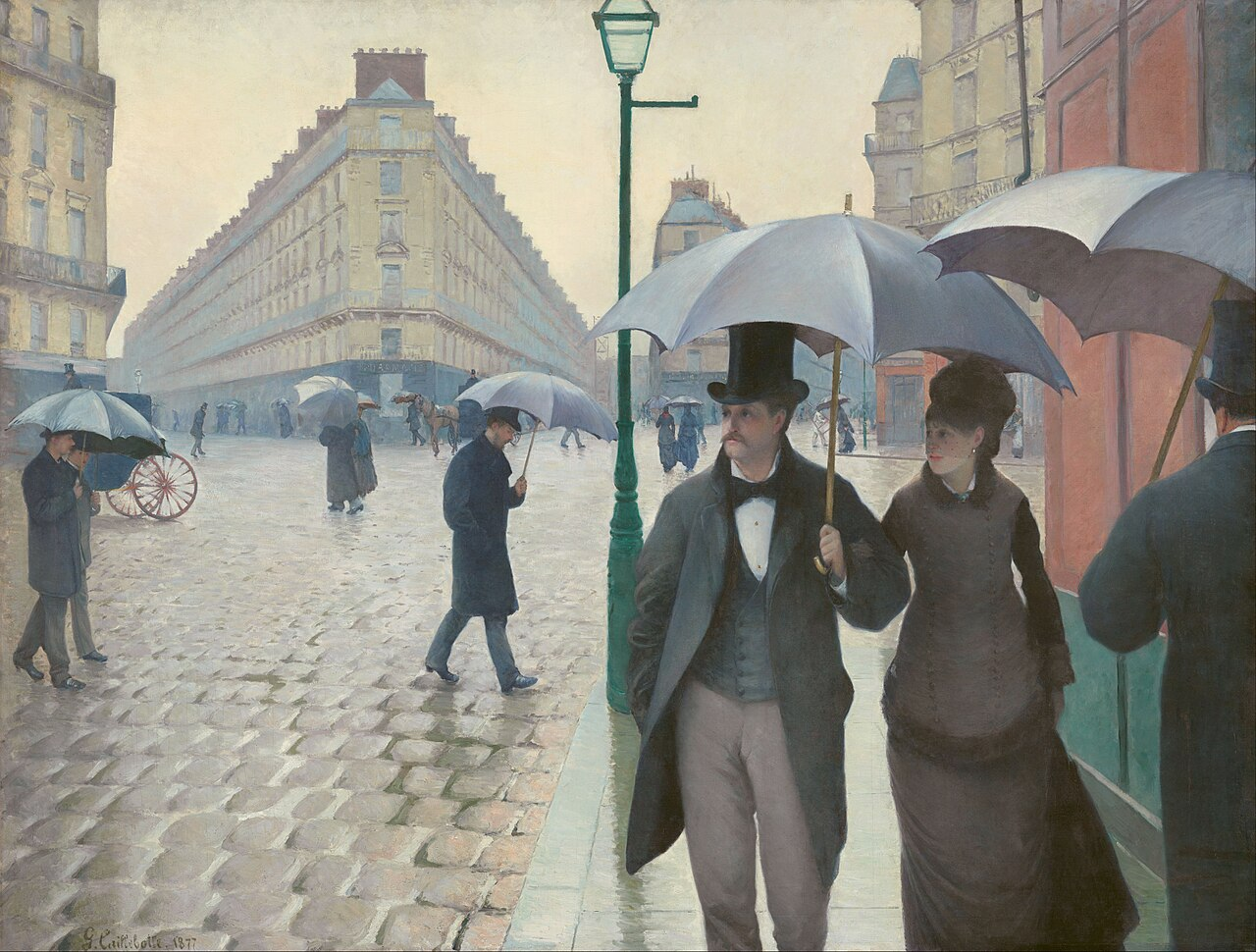
Umbrellas: The Aesthetics of 19th-Century Urban Life


From The History Avenue:

 Appearing in Ancient Egypt around the 25th century BC, umbrellas evolved and took on different purposes. In Ancient Egypt, Akkad, and Persia, for example, umbrellas served as status symbols, often tied to regal processions. In Ancient Greece, fashionable ladies used umbrellas as a style statement. In Rome, maidservants also used umbrellas to protect high-status women from the sun. There are rare mentions of umbrellas used for protection from rain. During the Middle Ages and the 16th and 17th centuries, umbrella popularity declined. Umbrellas were mostly reserved for clergy and religious processions. Records also note Italian riders using them as protection from rain. 

In the 18th century, things changed. Umbrellas were mostly used by women to protect themselves from rain. There was also a common perception that umbrella users were “vulgar” and didn’t have their own carriage to escape from rain. Apart from women, the most frequent users of umbrellas were the lower classes, who saw them as protection from sudden downpours or long, slow autumn rains. The first lightweight folding umbrella in Europe was introduced by French merchant Jean Marius, who had a shop in Paris. Princess Palatine purchased a model in 1712 and introduced it to her aristocratic friends. Very soon, umbrellas became a hit fashion statement in Paris. This paved the way for luxury umbrellas where the handle was especially important. The makers of umbrellas paid a lot of attention to crafting special handles depicting animals and having special shapes made from precious materials and carefully ornamented. In England, Jonas Hanway, a merchant and the founder of Magdalen Hospital, was the first person who braved public ridicule by carrying an umbrella in public. By the end of the 18th century, umbrellas were widely accepted by English gentlemen. (Read more.)


Share

Friday, September 4, 2026

‘Desk Revolutionaries’

 From History Today:

The Directory, the regime which ruled France during the closing years of the revolutionary decade, took its name from the five-man executive body that was elected by a two-chamber legislature, according to the Constitution of 1795. It has been disparaged as an uninspiring, corrupt, and chaotic interlude between two far more dramatic periods, that of the Terror, which preceded it, and the Bonapartist dictatorship that followed. In the past, most historians simply ignored it, concluding their accounts of the Revolution in 1794, with the fall of Robespierre, but that is no longer the case. The Directory remained true to the founding principles of 1789, and is now rightly regarded as an integral part of a greater project to replace the ancien régime in France. Although this experiment failed to end the Revolution by restoring political stability as its leaders intended, they made an invaluable contribution to that protracted process. Their achievements have often been credited to Napoleon, who did bring the upheaval to a close, while many of the individuals who served the Directory would continue to do so under his Consulate and Empire.

Biancamaria Fontana has chosen to approach the Directory from a biographical point of view, devoting the substantive chapters of this book to seven of its leaders, six of whom (from a total of 13) held the post of director for varying lengths of time between 1795 and 1799, while the other was a minister of justice. Their appellation as ‘desk revolutionaries’ might have been more convincingly addressed, though the majority of these mostly lesser-known individuals worked diligently to organise a French Republic which had barely survived its unexpected inception in 1792. This perspective offers significant insight into the regime’s operation, as well as the solid, if unspectacular, measures that were adopted under the Directory, most notably in the realms of finance and taxation. Success on the battlefield was also secured with the annexation of additional territory to the Republic, yet continuing warfare was hardly conducive to orderly progress, and deep-rooted political divisions persisted. The recourse to purges of the legislature, in 1797 and 1798, so as to preserve the system only served to demonstrate its fragility.

The personnel examined here were all seasoned national deputies who had voted for Louis XVI’s execution in 1793 and were thus committed to creating a lasting Republic. Three of them, the directors Reubell, Merlin de Douai, and François de Neufchâteau, were lawyers and had acquired considerable experience of office-holding before the Revolution. The task of legal codification progressed, government finances were much improved, and the bureaucracy was streamlined. Another director, Carnot, an army engineer, pursued the task of military reform by integrating conscripts into the regular army, while the dissolute ex-noble Barras, whose personal conduct gave the Directory such a poor reputation, alone served in the post from beginning to end, when he colluded in its downfall in Brumaire (November 1799). This famous coup d’état was orchestrated by his short-lived fellow director, the abbé Sieyès, who, having played a major role in the events of 1789, now joined the executive with the aim of extending its powers. This could only be done by overthrowing the regime. Outmanoeuvred by Bonaparte, who supplied military support for the coup, Sieyès would collaborate with the subsequent Napoleonic regime, to which Merlin de Douai and Cambacérès in particular made outstanding contributions. (Read more.)


Share

Wednesday, September 2, 2026

The Forgotten Prince of Versailles, Part II


From Philip Diaz-Lewis at Rationis Fines:

In 1763, two years before his death, Louis-Ferdinand helped make a book for lay people, to help them fit devotion around their duties according to their state’. The translation of the Psalms was taken from Jean-Joseph Languet de Gergy, while the Dauphin added his own composed meditations (or hymnes). The work was published by the Cardinal de Luynes, as Office divin abrégé pour tous les temps à l’usage des personnes pieuses.2 As the opening quote should show, the meditations could be quite weighty given the stated intention of the book. It is noteworthy that a prince would care so much to insert such passages into something whose stated aim is speed.

In part one, I introduced the obscure figure of Louis-Ferdinand, son of Louis XV, father of Louis XVI, and Dauphin of France until his premature death in 1765. Using the standard modern scholarly study on his life, La vertu et le secret by Bernard Hours (2006),3 he emerged as a devout, conservative, and anti-radical figure, yet not a mindless zealot. He was widely-read, well-educated, and a writer of maxims and reflections in the ancient Stoic style. Now I turn to the question: was he not merely a thinker, but a coherent one?

Hours flags that quite a number of the sayings recorded by the Dauphin’s posthumous biographers contain commonplaces typical of hagiographical writing.4 This does not by itself invalidate them, for a Christian prince could well have thought in these stock ideas gotten from devout literature. But it does make them less secure as primary sources, since his biographers may have shaped or embellished what they remembered, perhaps without meaning to. Thus, in what follows I will focus only on those maxims and sayings that Hours thinks most likely came from the man himself. (Read more.)

Share

Saturday, August 29, 2026

'A Very Regal Look at Palace Intrigue'


A review of My Queen, My Love by Julie Sara Porter at Bookworm Reviews:

This Historical Fiction novel tells of the tumultuous years in English history preceding the Civil War through the eyes of Queen Henrietta Maria of France, the Catholic wife of King Charles I. This book tells of Henrietta Maria’s early years and her marriage to Charles. It also recounts her rivalry with George Villiers, the Duke of Buckingham and the king’s best friend. The Queen and the Duke vie for the king’s attention, ear, and heart. 

This book is a chess match between two formidable opponents who differ in personalities, religion, ideologies, and views. Henrietta Maria is motivated by her history as a Medici and her Catholic faith. Her family line taught her about palace intrigue, how to play the court games, and to be wary of potential rivals for influence. Her faith not only gives her solace but gives the British Catholics much longed for representation. 

Villiers also has his own motivations. He had a history of developing connections with Charles’ family. He had been the friend and lover of Charles’ father James I. He thinks of the younger king as a kid brother who needs his influence. He also is incredibly ambitious and wants to move upwards in society. Henrietta Maria and George Villiers are equally matched opponents with Charles and the entire kingdom in the middle. 

My Queen My Love is a very regal look at palace intrigue and the love and loyalties of the monarch and those around them. It begins with a rivalry between two individuals and eventually will escalate into a war that will envelop the whole country. (Read more.)


Share

Friday, August 28, 2026

"Engrossing and Beautiful"

 Charles I and Henriette-Marie de France
   
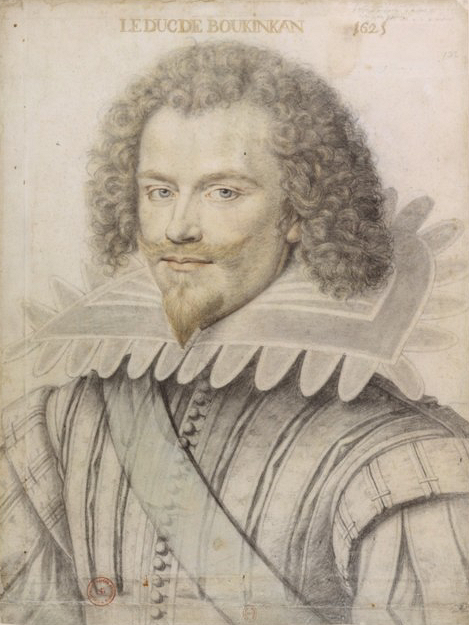
George Villiers, Duke of Buckingham

 A most eloquent review of My Queen, My Love.

If you read this book, be prepared to obsess over the characters like you would with any engrossing fictional story . . . only to be reminded that they are, in fact, real.  After doing so, you may just scour the Internet for photos of your new "friends."  Be prepared also to lie awake wondering what REALLY happened regarding a matter of court intrigue, asking your husband when you should be sleeping if he thinks that so-and-so poisoned so-and-so before the story started. While you're at it, you should also expect to wonder whether or not you should really google the villain and behold his countenance.

But, of course, you will. After all, you HAVE to know if he really, truly existed.

Then, once you know that he WAS, in fact, real, you will fervently wish for a time machine so that you can go back to warn everyone about him.

. . . or maybe that's just me. ;)  After all, I was crying over Giuliano de' Medici a few months ago.

MY QUEEN, MY LOVE: A NOVEL OF HENRIETTA MARIA by Elena Maria Vidal reminded me of why I love history (and even revitalized that love): that is to say, it is not a simple list of dates and facts, but, rather, a compelling story, alive with rich "characters" that have the power to stay with you. Vidal masterfully wove together a literary tapestry that tapped into real-life events in a way that inspired the reader to keep turning the page. There was beauty, there was tragedy, there was romance . . . and, much to my surprise, the plot was also layered with key characteristics of a mystery novel. Since I didn't know much about this particular "story" going in, it truly was similar to reading a completely fictional work where there still exists uncertainty and suspense.

Yet, despite the strong elements of intrigue and mystery, at the center of the entire narrative is a love story: that of a king and his queen and the Love that transcends their world.

From early on in the novel, I fell in love with the love story of Henrietta Maria and King Charles I. Rather than compose more coherent sentences, I have decided to instead include my "freak-out" gushing below. Unprofessional or not, it accurately reflects my state of mind when delving into the story and may perhaps best inform potential readers:
------------------------------------------------
HE FELL IN LOVE WITH HER WHEN SHE WAS DANCING---NOT ATTRACTION, BUT REAL LOVE AT FIRST SIGHT WHERE HE SAW THE DEPTHS OF WHO SHE TRULY WAS.
 
BUT SHE DIDN'T KNOW HE WAS THERE AS HE WATCHED FROM AFAR.

And then she fell in love with HIM through his letters, which is SO BEAUTIFUL AND ROMANTIC, too!!! AHHHH. Because she has SUCH a pure heart, like Cinderella and her prince when they first meet in the live action movie.

AND THEN THERE IS THIS EMOTIONAL BUILD-UP OF STORY TENSION because they have to still MEET. And the reader just needs it to happen asap!

And then they meet . . . and it is a Moment with a capital M!

But there be villainy afoot. ;) 
------------------------------------------------
Vidal's writing skill shone through once again in her brilliant introduction of the villain of the story through the eyes of one who regarded him as a close friend. Without going into detail, he could have been mistaken as a flawed comic relief, before his true nature became clear. Not only did this make the story-line more compelling and unpredictable, but it served as a rather profound commentary on evil relevant to today. In the presence of some, evil masquerades as Cool Guy, charming everyone with his jokes. But, when only some are watching, the mask just might come off.

As a Catholic, I was particularly drawn to the historical depiction of events as concerns the persecution those of my faith faced in England at the time. It was important for me to learn more about their plight, and my heart broke for those who suffered, much like that of Henriette, just as it rejoiced at moments when they received better treatment.  Yet the pain and suffering is balanced also with Light, the reason for which they are fighting.  Through vivid and sometimes ethereal descriptions, as well as profound reflections, Vidal was able to illustrate what we love so dearly.

The writing style in general is both detailed and engaging, rich with beautiful imagery that is, at times, quite lyrical. I found a kindred spirit in the romantic way that Vidal chose to describe figures, scenery, and events and likewise enjoyed the sprinkling of Arthurian legend in the novel. It was lovely to see Henrietta and Charles share a mutual love of these old stories, which not only added depth to their relationship and to them as individuals, but also seamlessly tied into the plot and foreshadowing of future events.

In terms of the characters on an individual level, I found myself bonding quite a lot with Henrietta, between her innocent romanticism, deep love of her faith, and moments of wit and humor.  But, on another level, I wondered at times if she were a saint and found her on the whole to be an inspiring figure. While there were moments in which the reader was called to be frustrated with Charles for being blinded as to certain individuals, I came to care a great deal for him and deeply admire his nobility of heart and desire to do what was right. The reader may also sympathize with the long-seated pain that he experienced, which is slowly revealed within this man of a pure and childlike nature yet confident, regal bearing.

While there were difficult moments to read throughout the novel, beginning with the tragic backstory of Henriette's mother, Marie de' Medici, the beauty of the center characters continued to illuminate the pages. Without going into detail, I will say that the intrigue of the novel also remains until the very end. Just like with a true mystery story, there are revelations at the conclusion that truly took me by surprise.  At the same time, the final pages served as a "bookend" in more than one way.  I'll leave it at that.

The reader should bear in mind that there may be occasional phrasings or actions with which he or she may not agree, even concerning supporting characters with a great deal of good.  However, such may also be found in real life, and it is likely that Vidal wished to present people and events with as much historical accuracy as possible while simultaneously putting forth a compelling narrative.  The meticulous research conducted for this book is abundantly clear from the detailed historical facts imbued into the text (as well as the lengthy works cited), although the novel format also allows for some speculation and presumably fleshing out of characters and situations.
(Read more.)

Share

Tuesday, August 25, 2026

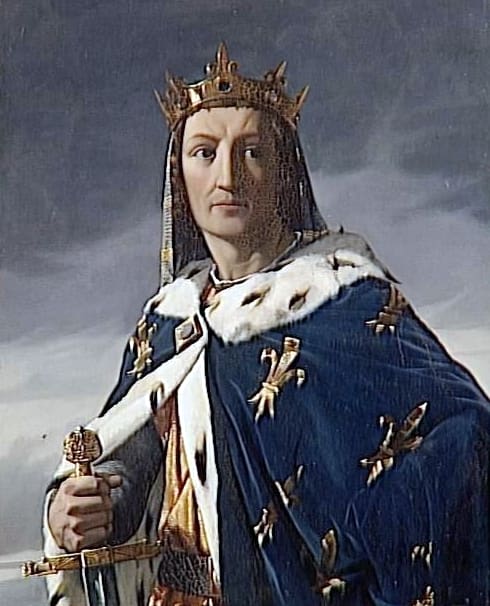
Saint Louis IX and Politics


 From Catholicism:

Today is the feast of King Saint Louis of France. As the formerly Christian West is sliding further into the tyranny of liberalism, it is balm to the soul to consider that the people in Louis’ France were freer than we are today. They were free from big government meddling in their lives and their wallets. And they were free in the most important way, for Saint Louis believed in a Christian order wherein the State was neither inimical nor neutral to the Church, but was the Church’s helper in securing the happiness, temporal and eternal, of her subjects.

Our modern “freedom,” by contrast, is servitude.

Sad to say, Saint Louis’ own grandson, Philip IV (“the Fair” — called so on account of his outward looks, not his inward dispositions!) was greedy to rob the Church of her influence in civil society. It has long struck me as ironic that this same Philip, who was so ill disposed to the traditional role of the Church in statecraft, was also the one who persecuted the Knights Templar, robbing them of their possessions and murdering their leaders. One of his victims was Jacques de Molay, the twenty-third and last Grand Master of the Templars. The reason I find all this ironic, is that the Freemasons, who are much closer to Philip than to de Molay in their ideology, falsely take the murdered Templar as one of their own heroes — among other ways, by naming their young men’s fraternal organization, “DeMolay International.” Philip IV, who murdered Jacques de Molay, also persecuted Pope Boniface VIII, a great pope who defended — as I’ve pointed out elsewhere — the same traditional alliance of throne and altar that Philip’s saintly grandfather believed in. That tradition, known as “the doctrine of the two swords,” was eloquently put forth in Unam Sanctam, a bull written in direct opposition to Philip the Fair.

It was Boniface VIII, by the way, who canonized Saint Louis IX. (Read more.)


More HERE.


Also from Catholicism:

The custom of genuflecting (literally, in Latin, “bending the knee”) for the Incarnation (“…and the Word was made Flesh…”) in the Creed, was begun by Saint Louis IX, King of France, who knelt out of devotion when he heard the words sung at Mass one day. This is something of a holy mirror of the secular custom of standing for the “Hallelujah Chorus” in Handel’s Messiah. (King George II was so stirred during the performance that he rose to his feet in excitement. When the king stands, everybody stands, even during a concert.) Similarly, thanks to Louis’ piety, and the French respect for their monarch, the King of Kings is saluted with a genuflection every time his Holy Incarnation is recalled in the Credo of the Roman Rite. (Read more.)


Share

Monday, August 24, 2026

La Reine Margot and the St. Bartholomew's Day Massacre

A first hand account from a notorious lady, who nevertheless saved the life of her husband Henri de Navarre, the future Henri IV. Henri IV, through his second marriage to Marie de' Medici, was the father of Queen Henrietta Maria.
Five or six days afterwards, those who were engaged in this plot, considering that it was incomplete whilst the King my husband and the Prince de Conde remained alive, as their design was not only to dispose of the Huguenots, but of the Princes of the blood likewise; and knowing that no attempt could be made on my husband whilst I continued to be his wife, devised a scheme which they suggested to the Queen my mother for divorcing me from him. Accordingly, one holiday, when I waited upon her to chapel, she charged me to declare to her, upon my oath, whether I believed my husband to be like other men. "Because," said she, "if he is not, I can easily procure you a divorce from him." I begged her to believe that I was not sufficiently competent to answer such a question, and could only reply, as the Roman lady did to her husband, when he chid her for not informing him of his stinking breath, that, never having approached any other man near enough to know a difference, she thought all men had been alike in that respect. "But," said I, "Madame, since you have put the question to me, I can only declare I am content to remain as I am;" and this I said because I suspected the design of separating me from my husband was in order to work some mischief against him....(Read more.)
Share

‘Mr Molière: A Brief History’

 From Jemahl Evans at Seventeenth-Century Lady:

Jean-Baptiste Poquelin (1622-1673) more commonly known as Molière, is a titan of world literature. The French Shakespeare, his influence on the development of early modern theatre, and his acerbic observations on the human condition in his work have fascinated and enthralled audiences for centuries. So great was his lasting influence on French literature that in 2025 Melvyn Bragg would restate the claim that French: ‘…is the language of Molière.’

Jean Baptiste was born into a well-to-do Parisian family in 1622. Christened ‘Le Nez’ (The Nose) by a maid, it remained a family nickname for the rest of his life. His father purchased the rank of Valet de chambre ordinaire et tapissier du Roi (Upholsterer to the King) in 1631 when the boy was just six. The title provided a steady income and conferred respectability on the upwardly mobile clan. After the death of his mother in 1632, Jean Baptiste was educated at the elite Collège de Clermont run by the Jesuit order (now the Lycée Louis-le-Grand). It is here that the young Parisian got his first taste of the theatre and actors. The Church would never forgive him.

The profession was not held in high regard in Seventeenth-Century France. Actors were publicly shamed as sinners, ran the risk of excommunication, and were forbidden from burial in consecrated ground. It was not the career path for a scion of a respectable bourgeoisie Parisian family. A decree by Louis XIII in 1641 stating that actors were ‘not to be considered worthy of blame nor prejudicial to their reputation’ did little to improve matters, even as the public flocked to theatrical performances. After completing his education, Jean Baptiste initially succeeded his father as Upholsterer to the King and started training as a lawyer. However, at the age of 21, he abandoned a respectable career for a life on the stage. His father and wider family were predictably appalled by the decision. (Read more.)


Share

Sunday, August 23, 2026

Louis XVI and Tuberculosis

Louis-Auguste, Duc de Berry, the future Louis XVI, was born on August 23, 1754. August 25, the feast of St. Louis of France, was his name-day, and kept with special festivity after he became king in 1774. He was given the same exact baptismal name as his sainted ancestor. A few years ago on Catherine Delors' blog many interesting points were brought up in the comment box about the childhood traumas of Louis-Auguste and how those later affected his reactions to the events of the Revolution.

Louis contracted tuberculosis when he was six by being made to sit at the bedside of his dying older brother, the Duc de Bourgogne. It was a traumatic experience in many ways for a small boy, especially since he himself became quite ill. Louis-Auguste was generally regarded as unhealthy and not likely to live to adulthood. Several members of the French royal family, including Louis' parents and brother, had already died of consumption. Louis managed to survive with the proper care. Nevertheless, tuberculosis is a disease which can remain inactive for many years but can later recur. It can have many side effects, including depression.

Provence and Berry
The tuberculosis would come back to haunt him, infecting his baby daughter Sophie and his oldest son. I think seeing Louis-Joseph die just as he had watched his older brother die long ago revived a lot of the childhood trauma. Death from tuberculosis is not pretty to watch. I am of the opinion that since the death of his oldest son, which coincided with the beginning of the Revolution in 1789, Louis XVI was suffering from clinical depression. In the past, he had acted with much more energy and decision. This is one of the reasons Marie-Antoinette had to become more involved in the political arena during the Revolution.

I think Louis struggled with "melancholy" at various times throughout his life, perhaps due to the childhood infection with tuberculosis. Louis was a man accustomed to strenuous exercise, especially hunting and riding, not to mention his labors as a locksmith. It is my belief that he needed the fresh air and the exertion for both his mental and physical health. With the regimen of exercise and his strictly adhered to routine he was able to keep melancholy from overwhelming him. He was deprived of much of his riding after October 1789 and it had a devastating effect upon his health and state of mind. Losing two of his children, his authority, his home, seeing his people and family suffer, and being deprived of the exercise and fresh air vital to his health, left him in a very bad condition.

If we consider the courage with which Louis XVI faced the worst moments of crisis, including his death, then he is to be admired, especially in the light of everything else. The Queen is to be admired as well, for she could have slipped out of the country with her surviving children and left Louis to his doom (there were many plans for her escape) but she refused to budge from Louis' side. She would not leave him to face the disasters alone.

Happy Birthday to Louis XVI!

Share

Monday, August 17, 2026

Queenship and Revolution in Early Modern Europe: Henrietta Maria and Marie-Antoinette

Marie-Antoinette de Lorraine d'Autriche

Henriette-Marie de France
Queen Marie-Antoinette, wife of King Louis XVI of France and Queen Henrietta Maria, wife of King Charles I of England were two of the most notorious queens in European history. They both faced accusations that they had transgressed social, gender and regional norms, and attempted to defend themselves against negative reactions to their behaviour. Each queen engaged with the debates of her time concerning the place of women within their families, religion, politics, the public sphere and court culture and attempted to counter criticism of her foreign origins and political influence. The impeachment of Henrietta Maria in 1643 and trial and execution of Marie Antoinette in 1793 were also trials of monarchical government that shaped the English Civil Wars and French Revolution.
I was lucky enough to receive a copy from Palgrave Macmillan of Queenship and Revolution in Early Modern Europe: Henrietta Maria and Marie Antoinette by Carolyn Harris, which is a part of their Queenship and Power series. Marie-Antoinette has had much written about her, while Henrietta Maria seems to have been quite forgotten. I only recently received a new biography about her.
The comparison between Marie-Antoinette and Henrietta Maria is perhaps not one that immediately comes to mind, but both women lived in a time of civil unrest, albeit over 100 years apart. Both women were childless for the first part of their marriage and suffered for it. It’s a rather interesting comparison, and I especially enjoyed reading about Henrietta Maria’s impeachment, about which so little appears to have been written. Henrietta Maria managed to escape to France, but without her husband who was eventually executed in 1649. Marie-Antoinette and her family also attempted to escaped, but they were caught, and both Marie-Antoinette and her husband were executed by guillotine. (Read more.)
  My books on the two Queens available HERE. Share