Showing posts with label St. Joseph. Show all posts

Thursday, April 2, 2026

Blessed Karl, Clericalism and Lay Church Governance

 From Charles Coulombe at One Peter 5:

In many ways, Austro-Hungarian Emperor-King Franz Joseph epitomised the traditional relationship between the lay and clerical powers of the Church. As with the other Crowned Heads of Europe, he had inherited a particular style of Catholic devotion peculiar to his own dynasty – the Pietas Austriaca. Bound up with a veneration of the True Cross and the Passion, the Blessed Sacrament and the Sacred Heart, the Blessed Virgin and St. Joseph (the family patron), this religiosity had led to the tremendous collection of relics at the Hofburg, the Imperial Palace in Vienna. The Maundy Thursday Footwashing and the Corpus Christi procession were highlights of court life in Vienna, and in 1898 Franz Joseph led the Imperial Family in observing the Consecration of All Mankind to the Sacred Heart, led by Leo XIII in Rome. In the canon of the Mass, the Good Friday Collects, and the Holy Saturday Exsultet, the Emperor was prayed for by name.

Franz Joseph was crowned and anointed King of Hungary in 1867. As Emperor-King he appointed the Cardinals, Archbishops, and Bishops, subject to Papal approval. Exempt from this were Salzburg and Olomouc, their metropolitans being elected by the cathedral chapters, and the former ‘Salzburg dioceses’ of Seckau, Lavant, and Gurk. The Archbishop of Salzburg had the right of appointment for Seckau and Lavant, the occupation of Gurk was regulated in a mixed manner, that is, the Emperor proposed two candidates, the subsequent nomination was made by the Archbishop of Salzburg. The Nuncio had to be consulted to make sure that the choice was not obnoxious to the Pope – either disapproval would derail the process; the separate Austrian and Hungarian ministries of Worship and Education would do the research, but it was Franz Joseph who had to approve the choices, both for Latin and Eastern Rite Catholic Bishops. Moreover, he had to bear in mind that some of his appointees would sit in one or more legislatures within the Monarchy.

There were three national parliaments. In the Upper House – House of Lords (Herrenhaus) of the Austrian Parliament could be found the prince-archbishops of Vienna, Prague, Salzburg, Görz, and Olmütz, the archbishops of Lemberg and Zara, the Byzantine Catholic archbishop of Lemberg, the Armenian Catholic archbishop of Lemberg, and the Greek Orthodox archbishop of Czernowitz, as well as the prince-bishops of Brixen, Breslau (although located in what was then Germany, for the diocesan territory in Austrian Silesia), Krakau, Seckau, Trient, Laibach, Lavant, and Gurk. In the Hungarian Upper House, the Főrendiház or “House of Magnates,” had an even higher proportion of ecclesiastical members – although it was also more interfaith than Austria’s: forty-two dignitaries of the Catholic and Orthodox Churches, including the Primate, Archbishops, Bishops, Abbots, and various other high officials, and thirteen representatives of the Protestant confessions. The annexation of Bosnia in 1908 presented a challenge in creating representative institutions for a region that had never known them. But while Bosnian diet (Sabor) would only one have one house, it would also have religious representatives appointed by the Monarch. These were, in deference to the Muslim majority, the Reis, who was the principal of Muslims’ granted lands, and the Muslims’ regional leader from Mostar; four Metropolitans and the president of the Orthodox community; the Catholic archbishop and two province members of Franciscan order of Bosnia and Herzegovina; and the Sephardic rabbi of the higher order. The various provincial diets in the Austrian half of the Monarchy also numbered the local Catholic bishops in their number.

Another religious duty that Franz Joseph took very seriously was that of funding missions – even though Austria-Hungary had no colonies. The Catholic Church in Scandinavia, Albania, and Bulgaria (Latin and Byzantine in that case) was heavily funded by the Emperor, as was the Church in the Holy Land and Egypt (the Coptic Catholic Church was funded from its beginning thereby, and Franz Joseph paid for the building of the Latin Catholic Cathedral of St. Catherine in Alexandria, where, ironically, the remains of  his wartime enemy King Victor Emmanuel III would rest until their recent repatriation to Italy). But since 1826, very largely out of funds given by both Franz Joseph and his two immediate predecessors, a large amount of this largesse went to the Church in the United States. Through an organisation called the Leopoldinenstiftung – the “Leopoldine Foundation” – the Habsburgs and many of their subjects poured millions of dollars into the American Church, founding 400 parishes, subsidising wholly or partly 300 missionaries (such as St. John Neumann and Ven. Bishop Baraga), and sending an endless flow of vestments, statues, stained glass, liturgical implements, and the like. A great deal of dynastic money went to Eastern Rite churches in the United States as well. Unfortunately, the outbreak of war in 1914 ended the flow of generosity – which, of course, would be repaid by Woodrow Wilson’s insistence of the deposition of Franz Jospeh’s successor, his exile, and the partition of his domains. (Read more.)

Share

Thursday, March 19, 2026

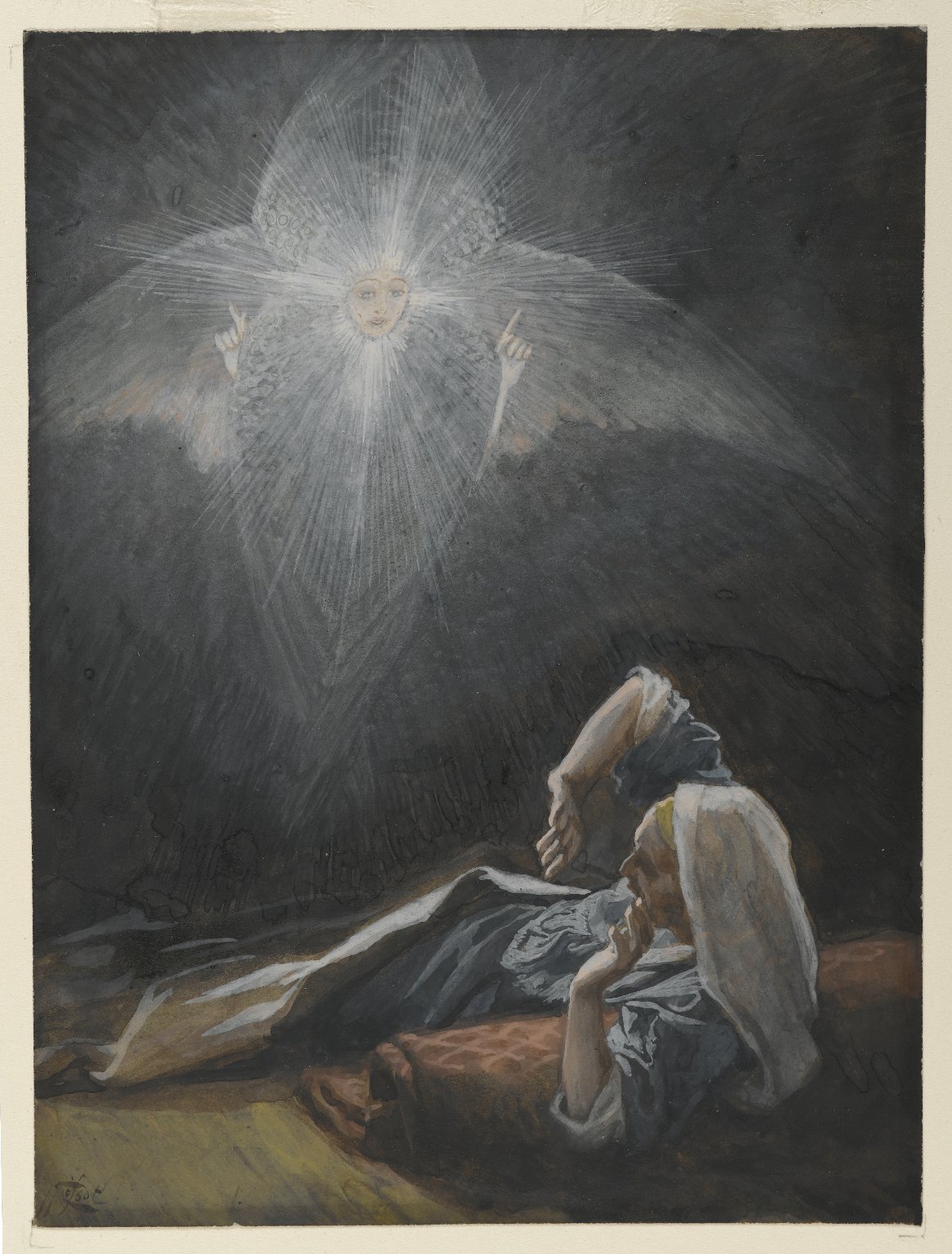
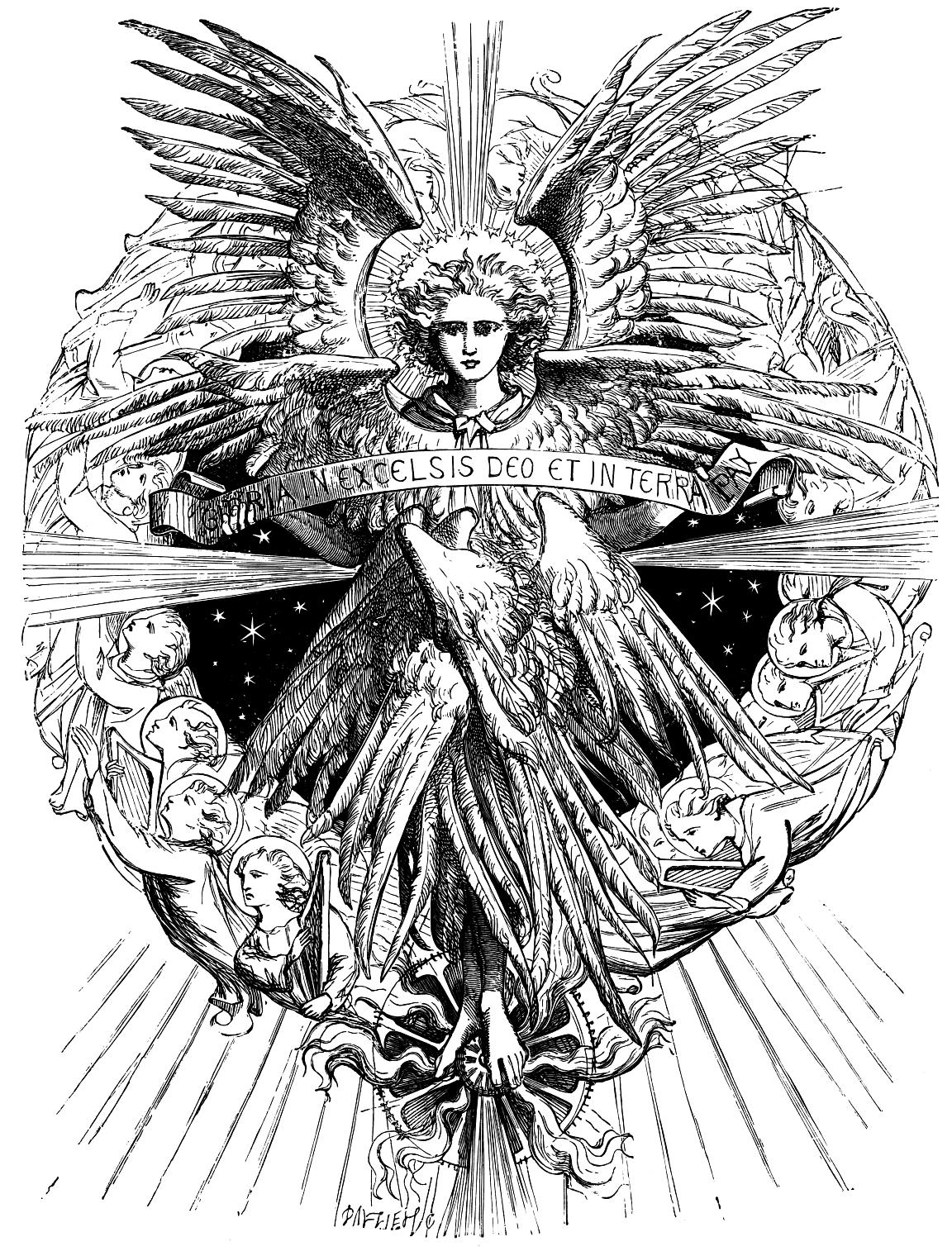
"The Vision of St. Joseph" by James Tissot

What a wonderful angel! Via East of the Sun, West of the Moon.

"I am poor, and in labors from my youth and being exalted, I was humbled and troubled." Psalm 87:16

Joseph of Nazareth
On a joiner's bench
You ply your trade.
Hands calloused
Fingers nimble.
Wood chips and shavings
At your feet.
Sawdust
In your beard.
You sing
The song of your people
Longing
For the Face
Of Him
Who is to come.

Joseph of Nazareth
Of David's line
You sing
The wedding song.
"My sister, my spouse
Is a garden
Enclosed..."
Virgin husband
Of the Daughter of Sion
You prepare a
Dwelling
For the Stainless One.

Joseph of Nazareth
In sweat of anguish
You ponder
Another Joseph
Thrown in the cistern.
Your song
Becomes sad.
"Save me
O God
For the waters
Are come in
Even unto
My soul..."
You sing
Then fall silent.
Sleep comes
With the breeze
That stirs
The curls of wood...
And then
The voice: 
"Joseph, Son of David,
Fear not...."

By a Carmelite tertiary Share

Monday, March 2, 2026

St. Joseph: The Model of Manhood

March is the month of St. Joseph. From The Catholic Gentleman:

Why did God choose St. Joseph? Of all the thousands of Jewish men, many of whom no doubt were righteous, why was a humble carpenter chosen for the task of being the earthly father of the Savior? The answer is simple: God knew St. Joseph would immediately do anything that was asked of him, no matter how difficult.

The saints agree that conformity to the will of God through prompt obedience is one of the surest paths to holiness. St. Joseph exemplified this virtue, and a perfect example is the flight into Egypt. The angel of the Lord appeared to St. Joseph in a dream, warning him of the danger that was coming. Scripture then tells us that, “When he arose, he took the young Child and His mother by night and departed for Egypt.” Did you catch that? The minute he woke up, he obeyed. He didn’t let fear of uncertainty paralyze him, he didn’t spend weeks planning, and he didn’t save up some money first. He took Jesus and Mary and left for Egypt, entrusting his family to the providence of God. That is prompt obedience, and that is why  St. Joseph was entrusted with the greatest responsibility ever given to a man. (Read more.)

Share

Friday, December 26, 2025

The Sacred Earthiness of Christmas

 From George Weigel at First Things:

Christianity begins in a real place, at a specific point in time in which real men and women met an itinerant rabbi named Jesus of Nazareth—and after what they had thought to be the utter catastrophe of his degrading and violent death, met him anew as the Risen Lord Jesus. The lives of those real men and women were so transformed by these encounters that they, in turn, went out and got to work on the task the Risen One gave them: to “make disciples of all nations” (Matt. 28:19). 

The earthiness of the Christmas story—the manger, the stable, the “swaddling clothes,” the stolid oxen and lowing cows, the bewildered but kindly shepherds, the exotic Magi from the East and their gifts of gold, frankincense, and myrrh, the child’s circumcision—underscores this core Christian conviction: The Second Person of the Most Holy Trinity, the “Word” through whom “all things were made” (John 1:1, 3), entered history through the cooperation of a Jewish girl and her overshadowing by the Holy Spirit, and was born at a precise moment in time at a precise place. Whether “the first cuttings of His infant hair” really are in Rome’s Basilica of the Holy Cross in Jerusalem may be beyond historical verification; the real point being made in such claims is that the incarnate Son of God really was at one point in his life among us, an infant who had an infant’s hair and all the other attributes of a weak and defenseless child. 

Ditto for what is really being proposed by the “napkins,” the cradle, St. Joseph’s blanket-cloak, and all the rest: He whom Christianity proclaims as Lord and Savior, the One who fully reveals both the truth about God and the truth about our humanity’s dignity and destiny, was not a character in some virtual reality “metaverse” constructed by Mark Zuckerberg. He was here, on this third planet of the solar system. And he is still with us: in the Scriptures proclaimed, and above all in the holy bread broken and shared. (Read more.)


Share

Thursday, December 25, 2025

Merry Christmas!

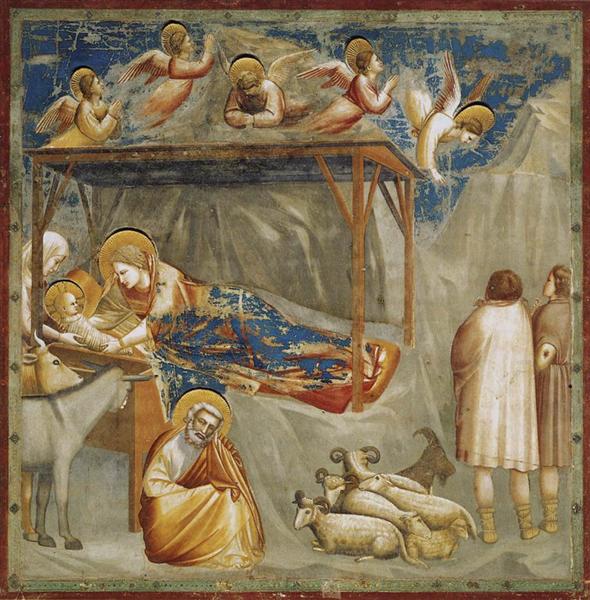
The Nativity by Giotto
And a Happy New Year! Thanks to everyone who has visited this blog in 2025~ I will pray for you all this Christmas Day in the morning. Please pray for me.
Welcome, all wonders in one sight!

       Eternity shut in a span;

Summer in winter; day in night;

       Heaven in earth, and God in man.

Great little one, whose all-embracing birth

Lifts earth to heaven, stoops heav’n to earth.
 ~  from "In the Holy Nativity of Our Lord" by Richard Crashaw

Share

Christmas Scenes


From East of the Sun, West of the Moon. And Christmas trees, HERE.


And scenes of winter, too. Happy New Year!


Share

Wednesday, December 17, 2025

The Nativity: Reason and Reality

 From the late Fr. Schall at Catholic World Report:

The Nativity of the Lord follows the Incarnation of the same Lord. The latter, in its turn, recalls the announcement nine months previously to Mary, if she accepted it, that a Son was to be born of her. She would call Him Emmanuel, “God with us”. And before the Incarnation, we read of prophets and kings who longed for a Savior, who longed to see God, and who expected Him to come to them in some fashion.

In many ways, we do everything possible to celebrate Christmas except to acknowledge why it is worth celebrating. It is almost as if we celebrate Christmas in order to avoid celebrating what it is in the history of the world. Indeed, we insist on celebrating just to be celebrating, an aberration if there ever was one. But in no case will we acknowledge that some event of the past is still present among us and is the foundation of our celebrating. We stubbornly refuse to acknowledge that what happened did happen. We suspect that if were we to do so it would make demands on us that we would not like to follow.

Something odd and curious surrounds this careful and systematic effort to avert our eyes and minds from the central fact of the Nativity. The Nativity is more difficult to explain away than the Incarnation. When a child is born in this world, we cannot deny it is there. We can ask, with the carol, “What Child is this?” It is a question that requires an answer. What is claimed for this Child transcends even the world itself. “In the beginning was the Word”—this was the Word that took flesh and dwelt amongst us, at least for a time. But  He was with us long enough for us to be certain that He actually did exist in places in this world: Bethlehem, Nazareth, Galilee, and Jerusalem. (Read more.)

Share

Monday, December 15, 2025

An Anglo-Saxon Christmas Sermon

From A Clerk at Oxford:
Angels often appeared to men under the old law, but it is not written that they came with light; that honour was reserved for the glory of this day, that they revealed themselves with heavenly light when the true light rose in the darkness for the righteous, the merciful and just Lord. The angel said to the shepherds, “Do not be afraid; behold, I bring you tidings of great joy which has come to all people, because now today for you the Saviour Christ is born in the city of David.” Truly he brought them tidings of great joy which will never end, because the birth of Christ brought gladness to the dwellers in heaven, in earth, and in hell. The angel said, "Now today for you the Saviour Christ is born in the city of David". He rightly said "today" and not "tonight", because Christ is the true day, who by his coming drives away all the dark ignorance of the old night and illuminates the whole world by his grace...(Read more.)

Share

Wednesday, July 23, 2025

Byzantine and Carolingian Art


Brilliant. From Hilary White at The Sacred Images Project:

Icons to the eastern Christian to this day, are not “illustrations of the faith” intended to “teach illiterates Bible stories,” but points of immediate contact with the reality of the Incarnation, rendered in a symbolic style meant to invite prayer and communion, not analysis. The Carolingian north, however, increasingly favoured legibility, narrative story telling, hierarchy and natural form in service of a more didactic, rationalised approach to religion and governance. In one sense, these two ways of thinking about sacred art represent the theological divergence that was already unfolding between East and West. Rome’s was consolidating power around a Latin, imperial western Christendom on the one hand, and Constantinople maintaining the ancient mystical, liturgical cosmology on the other.

These two streams would sometimes clash and sometimes blend and finally the resulting hybrid would see unique new expressions in art, architecture and monastic life, which we’ll eventually see more fully in the Norman period, with the Italo-Byzantine and early Romanesque. But in the 9th and 10th centuries, they still stood largely apart, like two rival visions of what Christian civilisation could be. (Read more.)

Share

Tuesday, December 24, 2024

Christmas Eve

Today you will know the Lord is coming, and in the morning you will see His glory. (Invitatory Antiphon for December 24.)

The Christmas Martyrology.
In the five thousand one hundred and ninety-ninth year of the creation of the world from the time when God in the beginning created the heavens and the earth;
the two thousand nine hundred and fifty-seventh year after the flood;

the two thousand and fifteenth year from the birth of Abraham;
the one thousand five hundred and tenth year from Moses and the going forth of the people of Israel from Egypt;
the one thousand and thirty-second year from David's being anointed king; in the sixty-fifth week according to the prophecy of Daniel;
in the one hundred and ninety-fourth Olympiad;
the seven hundred and fifty-second year from the foundation of the city of Rome;
the forty second year of the reign of Octavian Augustus;
the whole world being at peace,
in the sixth age of the world, Jesus Christ the eternal God and Son of the eternal Father, desiring to sanctify the world by his most merciful coming, being conceived by the Holy Spirit, and nine months having passed since his conception, was born in Bethlehem of Judea of the Virgin Mary, being made flesh.
Share

Friday, March 22, 2024

The ‘Religion of the Incarnation’


We live in an age of great artists. From CNA:

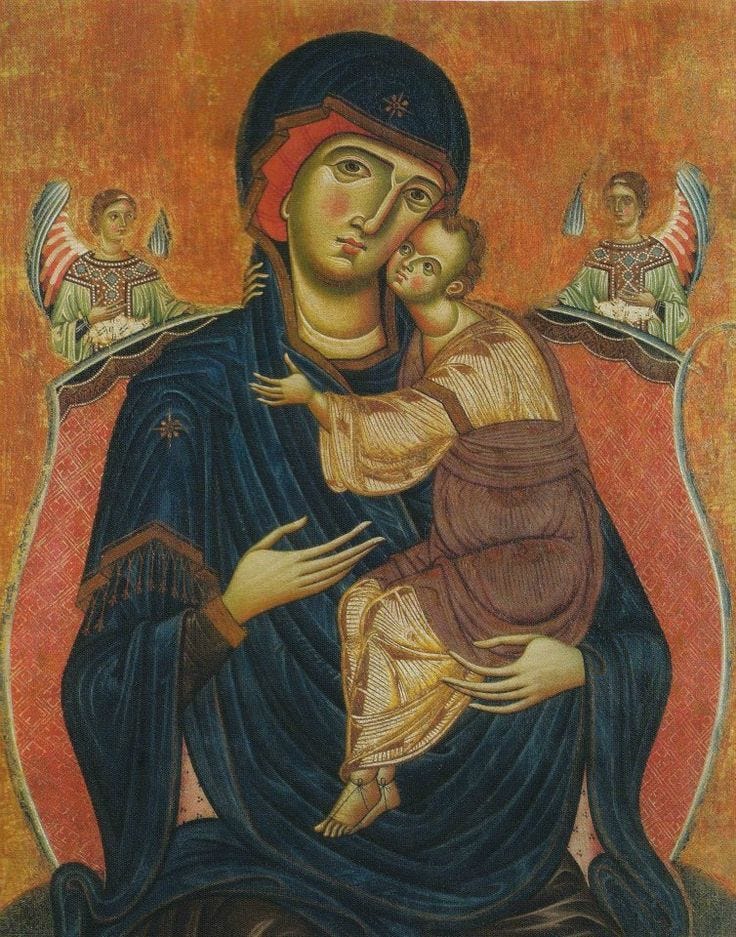
Daniel Mitsui, a contemporary Catholic artist based in Hobart, Indiana, who creates art in the medieval style, told CNA that Catholic art today suffers from the wounds of a double-edged sword: rejection of tradition and complacency.

“I believe that Catholic religious artists have two tasks,” he said. “First, they should be faithful to tradition, attempting to hand down in their turn the things that have been remembered since the time of the New Testament and that are reflected also in the sacred liturgy and the writings of the Church Fathers. And second, they should make their work as beautiful as possible, because they are attempting to depict things the way that God sees them.”

“The experience of beauty,” he said, “is like a dim memory of life in paradise, an experience that no fallen human artist will be able to recreate. But we should strive to do the best we can!”  (Read more.)

Share

Friday, March 15, 2024

St Joseph and the Penance of Daily Duty

 From Marianna Bartold

Share

Tuesday, November 28, 2023

The Orans Posture in the Tradition

 From Fr. Veliz:

Thus, through the centuries, the Church has traditionally reserved this liturgical orans posture for the priest alone in the rubrics of the Roman Missal for offering Holy Mass.  The word, rubrics, means the rules or laws in the Missal that refer to the instructions in red that regulate the recitation of the prayer formulae in black.  In this sense, they guide or instruct the priest to recite the prayers in the Rite of Holy Mass, using the assigned postures that he alone may use, as intended by the Church.  For this reason, the priest does the red and says the black in offering Mass according to the rubrics.  These rubrics proceed from the highest authority in the Church, from the sovereign pontiff himself, for maintaining good or proper order in the Liturgy of Holy Mass.  As indicated by the rubrics, this means that the priest alone may use the orans posture in reciting the prayers in the Eucharist as he intercedes to God on behalf of the people.  As such, he alone may extend his hands in Holy Mass by raising them to God in prayer. In fact, he is instructed, by the rubrics, to use this posture about fourteen times from the Introductory Rites of the Mass to the Concluding Rites.  This would include the prayer he says after the Universal Prayer. Accordingly, the rubrics assign the orans posture to the priest alone because he alone acts in the person of Christ, the Head, in offering Holy Mass as mediator to God on behalf of the Body of Christ, the Church.

     Conversely, there is not a single rubric in the Roman Missal that instructs the deacon or the laity to use the orans posture in the Liturgy of Holy Mass.  On the contrary, none of the rubrics there instruct the laity or deacon to extend their hands in prayer to God by raising them during Mass. Nevertheless, people claim that because the rubrics are silent on this question, this would suggest an implicit permission or tolerance, by the Church, for the laity and deacon to use the orans posture.  However, arguing for the use of the orans by lay people and the deacon on the basis of such rubrical silence is contrary to the Liturgical Tradition of the Church, and harmful to the uniformity of the Liturgy of Holy Mass. Indeed, using this argument from silence has already introduced other harmful practices into Holy Mass that the rubrics are silent about, such as holding hands during the Our Father.

     Furthermore, in addressing the assigned postures of the priest, the deacon and the laity in Holy Mass, the Church’s General Instruction of the Roman Missal says that they are all required to be faithful to the received liturgical Tradition as determined by the General Instruction and by the Traditional practice of the Roman Rite.  In doing so, they act, not according to their private inclination or subjective choice, but in the service of the common spiritual good of the people of God (GIRM 42). For this reason, the Church calls the priest, deacon and the laity to follow the instructions in the rubrics of the Missal that they may be uniform in the postures assigned to them during Holy Mass (GIRM 43).

     Consequently, in Sacrosanctum Concilium, the Council Fathers of Vatican II teach that no person, not even a priest, nor a layperson, may add, remove, or change the objective norms of the Liturgy on his authority. This prohibition would certainly apply to the layperson who uses a posture in Mass not assigned to him in the rubrics of the Rite, particularly the orans posture. In doing so, he would be acting contrary to the received Liturgical Tradition (SC 22.3). On this basis, here the Council Fathers remind the priest, deacon and laity that they are called to do nothing else, but only those actions or postures in Holy Mass assigned to them by the nature of the Roman Rite and the principles of Liturgy (SC 28). (Read more.)

Share

Saturday, November 4, 2023

A River Monster and a Future Catholic Sister

 From Stephanie Mann at A Song of Joy:

Sister Frances Margaret (Fanny) Allen of the Religious Hospitallers of St. Joseph died on Sept. 10, 1819, in Montreal at the Hotel-Dieu, the hospital and convent founded by Venerable Jerome Le Royer, Venerable Marie de la Ferre, and Jeanne Mance. She was a Vermonter in Canada, the first woman from New England to become a Catholic religious, and the daughter of deist, rationalist and American Revolutionary hero, Ethan Allen.

Fanny Allen was born on Nov. 13, 1784. Her father died when she was 4 years old and her mother, also named Fanny, remarried (to Dr. Jabez Penniman). Neither the Allen nor the Penniman household was particularly religious. In the midst of the great religious revivals in the British colonies and the post-revolutionary period, Ethan Allen had written and self-published Reason: The Only Oracle of Man (1785). So few copies sold that the printer demanded more money to cover his losses. Fanny laughed through her baptism ceremony when she was an adult. Her mother insisted she be baptized by an Episcopalian minister in 1805 before she went to Catholic Montreal to study French. The minister, Daniel Barber, did not appreciate her mirth. (Read more.)

Share

Tuesday, March 28, 2023

Spain and the Hispanic World


A new exhibit in London at the Victoria and Albert Museum. From Catholic World Report:

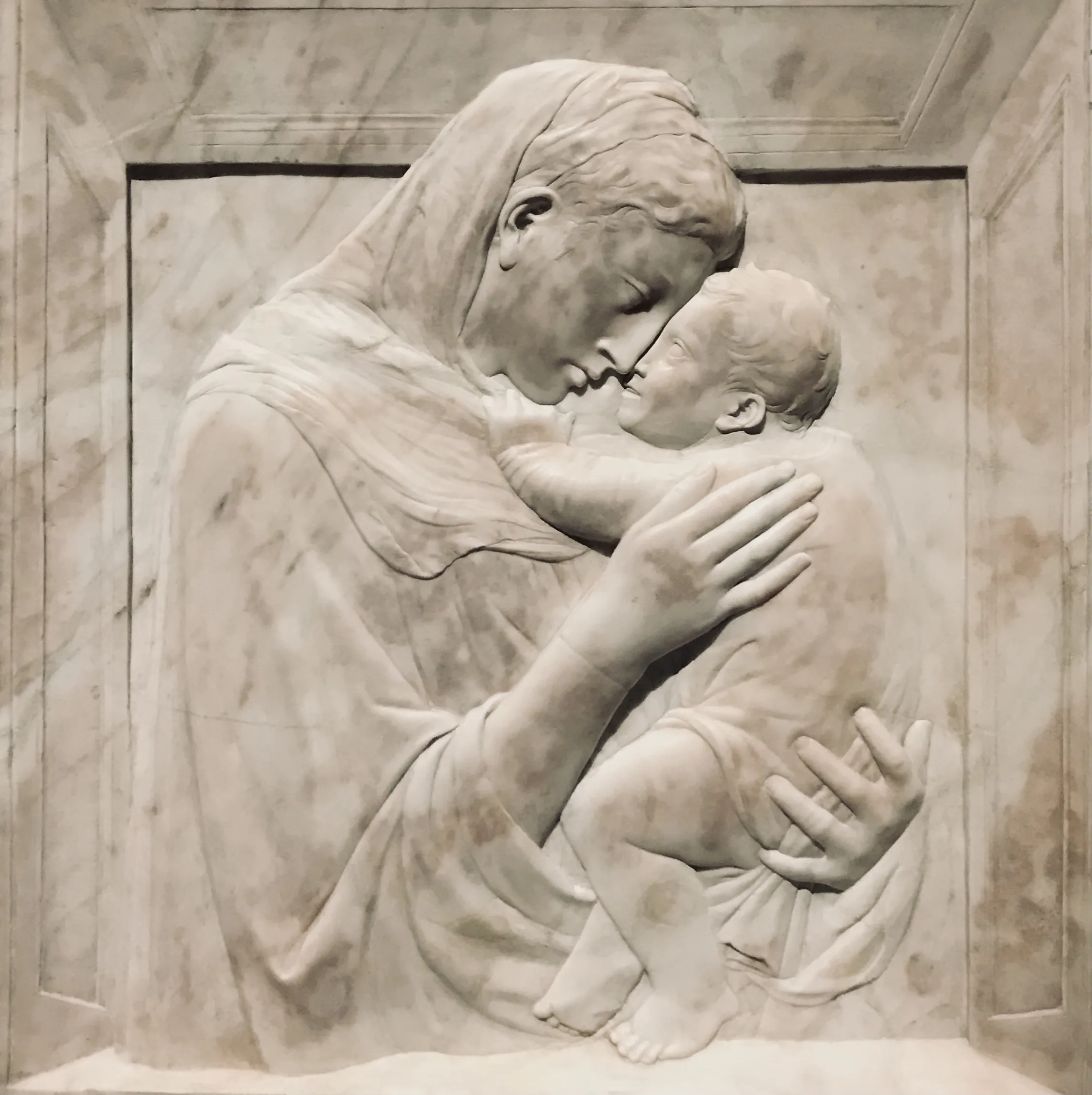
The Victoria and Albert Museum is more inclined to offbeat blockbusters such as “A Brief History of Underwear” (2017) and “Fashioning Masculinities” (2022). Tackling Renaissance sculpture is unusual despite the enthusiasm shown by the founders, Queen Victoria and Prince Albert. Victoria never went to Rome but was a frequent visitor to Florence. Life-copies of the city’s two most famous statues of David — by Donatello and Michelangelo — were made during her reign. Although Donatello’s sculpture was one of the very few he created that might not have met Victorian standards of modesty, the royal couple was more open-minded than most at the time.

The 19th-century copy of Donatello’s bronze David (circa 1440) is on view at the London show, having been moved from the other side of the museum. The last time the original left Florence was in 1930, accompanied by Benito Mussolini on a publicity mission to the Royal Academy. The Victoria and Albert Museum has instead secured Donatello’s fully clothed version of David (1408), in marble. It is the first work that greets visitors to the show. Created when Donatello was only 22 years old, its carefully composed naturalism sets the scene for the sculptures he made later in his long life.

Taking center stage, after the marble David, is a life-size bronze crucifix by Donatello himself, lent by a church, not a museum. This is part of what makes the exhibition so remarkable. Many of the works would look more appropriate back in their original sacred setting. Most have long since been acquired by museums. Carved forms are something that Catholics are still accustomed to seeing at Mass, unlike Renaissance paintings that once served a pious purpose but for generations have been lining the walls of public galleries. In the case of the Donatello crucifix, it’s displayed between two sculptures in a composition that suggests a reworking of the Calvary spectacle. Taking the place of Dismas and the Impenitent Thief are bronze statues of a bishop and St. George. (Read more.)
Share

Monday, March 20, 2023

The Greatest of the Patriarchs

 From The Catholic Weekly:

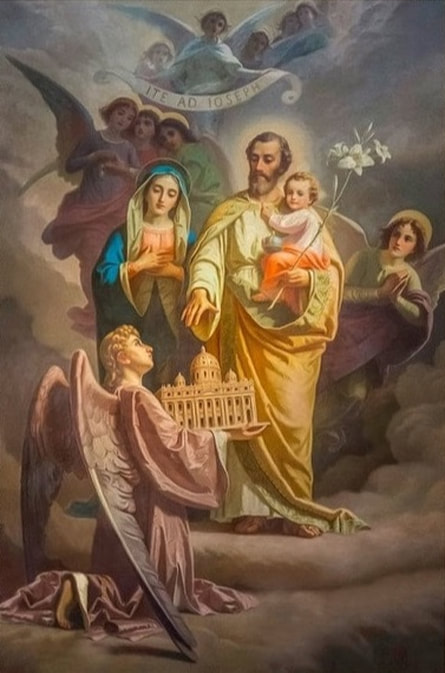
A recurring question about St Joseph is that of his age at the time of his marriage to Our Lady. It seems from Scripture that St Joseph had died before the start of Jesus’s public ministry but how old he was at the time of his death is impossible to tell from scripture. In the Eastern churches and especially in the Coptic Church the tradition has been that St Joseph was of mature years when he married Our Lady, and according to some Eastern traditions he was a widower. However in the western Church the stronger tradition has been that St Joseph was a virgin at the time of his marriage to Our Lady.

Three contemporary figures in western Christianity have argued that St Joseph was not an old man when he married Our Lady but someone who was young vigorous and chaste. First, Mother Angelica, the founder of the global EWTN television network with some 264 million subscribers. She was also a mystic who claimed to have had a vision of the child Jesus. She remarked, “who has ever heard of an old man walking to Egypt?” In other words, we are told that St Joseph had to take Our Lady and the baby Jesus away from the territory of King Herod so that he would not be slaughtered and this had to be done in the middle of the night.

What we now call the flight into Egypt sounds like getting out of Vienna to a neutral country just hours before the Anschluss. Mother Angelica’s point was that if Our Lady and Our Lord needed someone to protect them and manage the logistics of secretive border crossings and then the task of earning a living in the foreign country, assuming they managed a safe passage, the Holy Spirit would have chosen a young and athletic man. St Josemaria Escriva agreed that St Joseph was probably not elderly. He wrote:

I don’t agree with the traditional picture of St Joseph as an old man, even though it may have been prompted by a desire to emphasise the perpetual virginity of Mary. I see him as a strong young man, perhaps a few years older than our Lady, but in the prime of his life and work. You don’t have to wait to be old or lifeless to practice the virtue of chastity. Purity comes from love; and the strength and joy of youth are no obstacle for noble love.

Venerable Fulton Sheen made the same argument in his book The World’s First Love:

To make Joseph appear pure only because his flesh had aged is like glorifying a mountain stream that has dried. The Church will not ordain a man to his priesthood who has not his vital powers. She wants men who have something to tame, rather than those who are tame because they have no energy to be wild. It should be no different with God.

Archbishop Sheen concluded that St Joseph was probably young, strong, virile, athletic, handsome, chaste, and disciplined … Instead of being a man incapable of loving, he must have been on fire with love … Instead … of being “dried fruit to be served on the table of the king, he was rather a blossom filled with promise and power”. (Read more.)
Share

Monday, January 23, 2023

Medieval Homes

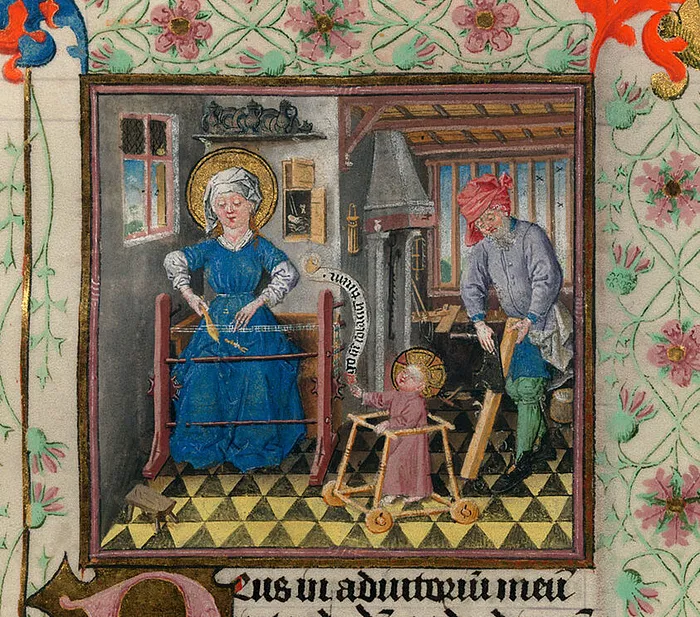
I love the Christ Child's walker!
From Medievalists:

The medieval homes depicted in these manuscript illustrations offer historians a lot of interesting evidence. They are often rectangular in design, and the key feature would have been the fireplace and chimney. McKinnon also notes that most of these images also show homes that are well-constructed and have several furnishings. She adds:

This observation suggests another conclusion: that a measure of material well-being and economic prosperity had been attained by at least some members of peasant society in the fifteenth century. The architecture depicted in these illuminations indicates that they had achieved a standard of living above subsistence level.

The article, “The Peasant House: The Evidence of Manuscript Illuminations,” by Sarah M. McKinnon, appeared in Pathways to Medieval Peasants, edited by J. Ambrose Raftis, which was published by the Pontifical Insitute of Mediaeval Studies in 1981. This collection of essays also features a piece on festivals that took place in an English medieval village. (Read more.)
Share

Friday, January 6, 2023

Ballade to Our Lady


By François Villon (1431-1463) at The Thinking Housewife:

O excellent Virgin Princess! thou didst bear
King Jesus, the most excellent comforter,
Who even of this our weakness craved a share
And for our sake stooped to us from on high,
Offering to death His young life sweet and fair.
Such as He is, Our Lord, I Him declare,
And in this faith I choose to live and die.

(Dante Gabriel Rossetti, trans.)

(Read more.)

Share

Wednesday, January 4, 2023

A Proportioned Extravagance

 From Father Paul Scalia:

The Incarnation is a great example of that scholastic maxim, Whatever is received is received according to the mode of the receiver. (Quidquid recipitur ad modum recipientis recipitur.) By becoming incarnate of the Virgin Mary, the Son of God proportions himself to our “mode” so that we can receive him. In his mercy, he doesn’t demand that we become capable of him but makes himself capable of being received by us. True mercy always has this quality of being fitted, tailor-made for those in need, neither too high for them to reach nor too hard for them to accept.

So God comes to us in a manner we can receive. The infinite becomes finite, the eternal enters time, and the Creator of all is born of the Virgin and laid in the manger. We can receive him because he has become accessible to all of us, and to every kind of us, from the lowly shepherds to the learned Magi. We can receive mercy more easily because – without losing any of its power – it has been scaled to our size.

And not only to our size. God’s mercy is also fitted to our wounded human nature. He is born poor to meet us – we who have squandered our gifts and lost our inheritance. He is born homeless for us, who live in this world as exiles. He is born exposed to the elements and even to his enemies to encounter us, who are so weak and in danger. He is born alienated from his own people – who “received him not,” (Jn 1:11) – to be one with us, who are alienated from God and from one another.

He unites himself to us in these sorrows because mercy does not stand far off and look patronizingly on the suffering. The Lord of mercy draws near, unites himself with us, and becomes one with us in our misery. The poverty of his birth already points to Jesus as the man of sorrows, the one united with humanity’s every kind of suffering – mental, emotional, physical, spiritual.

But the simplicity and ease with which we can now approach God doesn’t mean that his mercy is indulgent and permissive. On the contrary, like all newborn children, he calls out and asks something from us. The infant Christ cries out to us, asking that we receive him and respond. Yet even this inconvenience is proportioned to our needs, for it keeps us from the vice of taking his mercy for granted. (Read more.)


From Aleteia:

 Many of us forget, however, that Christmas is actually the origin of the thing we call “childhood!” That’s because Christianity essentially invented this cherished human phase. Before the news that God was born in infant flesh, “childhood” could not make its mark on the human imagination. We can thank Jesus, therefore, for the modern concept of “the child.”

In the ancient world, children were often regarded as burdens to society, expendable, fleeting, and unworthy of too much sacrifice or care. Rates of infant mortality were high, and even the children of nobility were raised by slaves or servants. Children were vessels of potential, yes—but a potential whose realization was uncertain. Perhaps the ancient heart resisted investing too much in something so fragile. Perhaps a hardscrabble world could not look with too much indulgence on “idle mouths to feed.”

In ancient art, then, we seldom see children that look like children. They are diminutive adults, pasted over with symbols of their future usefulness, pointing to a time when they’ll “pull their weight.” Girl children in ancient Egypt were shown with bodies fully-developed and often eroticized. Boys had adult proportions and wore cumbersome insignia or uniforms. Even in Augustan Rome, whose government policies rewarded childbearing, the royal princes were depicted in heavy togas, gazing with eyes haunted by weighty responsibility.

With Christianity, however, came a new appreciation for childhood. The One, transcendent God had become a baby! Divinity had inhabited the infant form, revealing its grace and beauty—a beauty that lay precisely in “uselessness” and vulnerability! Famously, the first image of the Christ Child appears in the catacombs of Priscilla in northern Rome. Here, a gentle, veiled lady holds a chubby toddler on her lap. Thenceforth, Christian artists would show greater and greater insight into the condition of childhood and all its precious stages—each a poignant revelation of a vulnerable and self-giving God. (Read more.)


Share

Saturday, April 9, 2022

The Surprising Sacred Art of the Pre-Raphaelites

I love the pre-Raphaelites and made a special trip to the Tate Britain while in London to see some of their work. From Aleteia:

This band of brothers – and one part-time sister – wanted to turn back the clock to a less polished era. Above beauty and artifice they valued realism. They were not averse to Raphael’s love of religious themes, nor were they put off by the papal commissions that the 16th-century master relied on. It was not really Raphael himself they objected to; for these young rebels he cannot have seemed like an old fogey as he died at the age of  37. They just visualized things differently. 

Perhaps the most brutally honest reworking of a sacred theme was Christ in the House of His Parents by J.E. Millais. Few paintings scandalized Victorian society as much as this one, shown at London’s Royal Academy in 1850. Where was the grandeur or good looks of the First Family of Christianity? The Pre-Raphaelite concern for realism had introduced, according to The Times: “misery, dirt and even disease.” Charles Dickens was alarmingly offended by the physical appearance of Jesus: “a hideous, wry-necked, blubbering, red-haired boy in a nightshirt.” There was also “a kneeling woman, so horrible in her ugliness that she would stand out from the rest of the company in the vilest cabaret in France.” 

Seldom has such scorn been poured onto a painting in which so much symbolism has been cleverly inserted.  The most important element is the wound on Jesus’s hand as the blood drips onto his foot. (Read more.)


Share