Showing posts with label Marie-Antoinette. Show all posts

Tuesday, August 11, 2026

"Most Mournful and Moving"

From Ancient Origins:
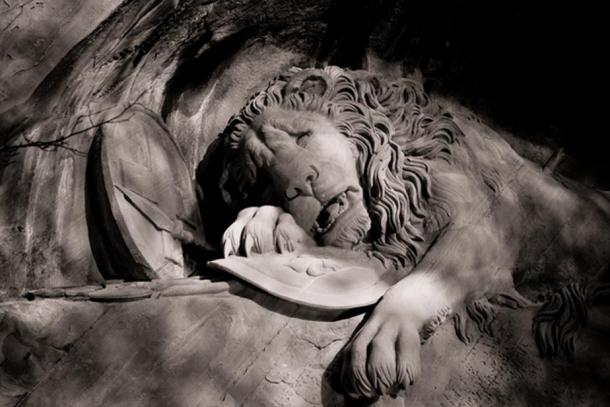
The Lion of Lucerne (known also as the Lion Monument) is a memorial located in Lucerne, Switzerland. This monument is a rock relief carved into the cliff face of a former sandstone quarry, and features a dying lion. Sculpted during the early part of the 19th century, the purpose of the Lion of Lucerne was to commemorate the Swiss Guards who lost their lives in 1792 during the French Revolution.  

The Lion of Lucerne was designed by Bertel Thorvaldsen, a famous Danish sculptor who lived between the 18th and 19th centuries. The man who was responsible for the actual carving of the monument, however, was a stonemason from Constance (in southern Germany) by the name of Lucas Ahorn. The memorial was designed by Thorvaldsen in 1819 whilst he was staying in Rome, and work began in the following year by Ahorn. The monument, which measures 10 meters (32.8 ft.) in length and 6 meters (19.7 ft.) in height, was completed in 1821. (Read more.)

More HERE and HERE. Share

Monday, August 10, 2026

The Fall of the French Monarchy, August 10, 1792

Run on the Tuileries on 10. Aug. 1792 during the French Revolution -  Wikidata
August 10, 1792 , the Feast of St. Laurence the Martyr, saw the fall of the French monarchy, the massacre of the Swiss Guards and the beginning of the Reign of Terror. Madame Royale gave a detailed account in her Memoirs of the royal family's flight from the Tuileries to the National Assembly, of the long, agonizing hours trapped in the stenographer's box, and the imprisonment in the Temple prison. Here follows the account of the teenage daughter of Louis XVI and Marie-Antoinette:
Massacre at the Tuileries; Dethronement of my Father.
The Days from the 10th to the 13th of August, 1792.
After the fatal epoch of June 20, my family no longer enjoyed any tranquillity; every day there were fresh alarms, and rumours that the faubourgs Saint Antoine and Saint Marceau [together with those wretches who were called the Marseillais] were marching against the château. Sometimes they sounded the tocsin and beat the générale; sometimes, under pretext of a dinner of confraternity, they invited [and worked upon] the sections of opposite opinions to demand the dethronement of the king, which Danton, Robespierre, and their party wanted at all costs. After these many preludes, we heard with certainty on the 9th of August that the populace, armed, was assembling to attack the [Page 237] Tuileries; it was already evening. The troops who remained faithful to my father were therefore hastily collected, among them the Swiss Guard; and a great number of the nobles who were [still] in Paris arrived [in haste]. Imagine the situation of my unhappy parents during that horrible night; they remained together [expecting only carnage and death], and my mother had ordered my brother and me to go to bed.
Pétion arrived about eleven o'clock, exclaiming loudly against this new tumult. My father treated him as he deserved and sent him away; nevertheless, malignant people spread the news that Pétion was kept prisoner in the Tuileries; [on which] minds grew [embittered and] inflamed even to fury, and at midnight the signal was given to begin the dreadful massacre. The first shot fired killed M. Clermont-Tonnerre, a member of the First Assembly. For a part of the night the tumult went on outside the Tuileries, where fresh reinforcements of the National Guard were successively arriving; unfortunately, [far] too many came, for most of them were already seduced and treacherously inclined.
At six in the morning it was suggested to my father to visit all the posts and encourage the troops to defend him; but only a few cries of Vive le Roi! were heard in the courtyards, and what was worse, when he wished to enter the garden, the artillery-men, most wicked of all, dared to turn their cannon against their king; a thing not believable if I did not declare that I saw it with my own eyes.
My father, having thus indubitably recognized the bad disposition of the National Guard, saw but too well that no faithful subjects remained about him, except a few nobles who had come to us, a part of the servants of the château, and the Swiss Guard; they all armed themselves. M. Mandat, commandant of the National Guard in the Tuileries [a man of little enterprise but faithful], was summoned by [Page 238] the mayor to the Hôtel de Ville; there he was murdered by order of the municipality, who immediately appointed Santerre to replace him. Towards seven in the morning Roederer, head of the department, arrived. He asked to speak alone with the king; there, he threw himself at his feet and conjured him to save himself; he represented to him that furious brigands were arriving in masses, that he had too few persons to defend him, that he had no course left but to go, he and his family, and take refuge in the National Assembly. My father rejected the idea for a long time, but Roederer insisting, and the peril becoming urgent and inevitable, he at last resolved to go to the Assembly with his family, Mme. de Lamballe, and Mme. de Tourzel. He left all the rest of his people in the château, not doubting that as soon as it was known that he had gone, the tumult would cease and there would be no longer any danger for those he left there. 1
We crossed the garden of the Tuileries in the midst of a few National guards, who still remained faithful. On the way we were told that the Assembly would not receive my father. The terrace of the Feuillants, along which we had to pass, was full of wretches, who assailed us with insults; one of them cried out: "No women, or we will kill them all!" My mother was not frightened at the threat and continued her way. At last we entered the passage to the Assembly. Before being admitted [to the hall] we had to wait more than half an hour, a number of deputies still [Page 239] opposing our entrance. We were thus kept in a narrow corridor, so dark that we could see nothing, and hear nothing but the shouts of the furious mob. My father, my mother, and my brother were in front with Mme. de Tourzel; my aunt was with me, on the other side. I was held by a man whom I did not know. I have never thought myself so near death, not doubting that the decision was made to murder us all. In the darkness I could not see my parents, and I feared everything for them. We were left to this mortal agony more than half an hour.
At last we were allowed to enter the hall of the Assembly, and my father on entering said [in a loud voice] that he came to take refuge with his family in the bosom of the Assembly, to prevent the French nation from committing a great crime. We were placed at the bar, and they then discussed whether it was proper that my father should be present at their deliberations. They said, as to that, that it was impossible to let him stay at the bar without infringing on the inviolability of the sovereign people; and they declaimed speeches thereon which were full of horrors. After this they took us into the box of a journalist.
We had hardly entered this species of cage when we heard cannon, musket-shots, and the cries of those who were murdering in the Tuileries; but we were ignorant at the time of what was happening. We heard later how the massacre began. My father had hardly left the château before a party of wretches [already in the courtyards] began to attack with armes blanches [sabres and pikes] the Swiss Guard, who fired in self-defense. Nothing more was needed to push their fury to the highest point; those who were outside hearing the Swiss fire first, and taking them for the aggressors, spread the rumour that my father had ordered them to fire on the people. Soon, not only the courtyard gates but those [Page 240] of the château were forced, and these madmen rushed in, massacring all whom they found, especially the Swiss. [Then and there perished an immensity of faithful servitors of all ranks and classes. Among the victims were MM. de Clermont d'Amboise and de Castéja, de Viomesnil and d'Hervilly; the Maréchal de Mailly, MM. de Maillardoz and de Bachmann died later. All the old officers of the Guard called "constitutional," the two battalions of the Filles-St.-Thomas and the Petits-Pères distinguished themselves by an unbounded devotion, though, unhappily, fruitless. What could they do against a multitude maddened with drink and blood and fury?] The Tuileries then became a spectacle of horror; blood ran everywhere, especially in the apartments of the king and queen. Nevertheless, in the midst of these abominations some traits of humanity were shown; among these monsters were some who saved several persons, taking them by the arm and making them pass for their friends or relatives . The carnage lasted all that day on one side or the other; the number of brigands who perished was considerable, for those wretches killed each other in their blind fury. At night, the château took fire; fortunately, the flames lasted but a little while, and so ended those awful and too memorable scenes.
Meantime our terrors increased as these dreadful noises went on; but it was even worse when we heard the same sort of cries close to the Assembly. The members themselves were frightened, and in their fear they tore out the iron railing of the box where we were and forced my father into the midst of them; but this tumult was soon appeased. It was occasioned by the approach of a number of the Swiss Guard who had escaped from the Tuileries and were trying to come to the support of the king; they had almost forced the door of the Assembly when an officer said to them: [Page 241] "What are you doing? The king is in the midst of assassins; they will murder him if you advance." This reflection held them back and they surrendered; it was thus that these brave foreigners [ever faithful], to the number of about one hundred, escaped the massacre. As for those of their compatriots who did not perish in the Tuileries, they were taken to the Hôtel-de-Ville and there massacred with their principal officers. A forged order from the king was sent to summon the Swiss Guard from the barracks at Courbevoie; on their arrival in Paris they met the same fate.
Still kept on the box at the Assembly, we witnessed the horrors of all kinds which there took place. Sometimes they assailed my father and all his family with [the basest and most atrocious] insults, triumphing over him with cruel joy; sometimes they brought in gentlemen dying of their wounds; sometimes they brought my father's own servants, who, with the utmost impudence, gave false testimony against him; while others boasted of what they had done. At last, to complete the revolting scene, they brought in the Host and flung the sacred wafers on the ground. It was in the midst of these abominations that our entire day, from eight in the morning until midnight, passed [as one may say] through all gradations of whatever was most terrible, most awful.
The session ended by [a decree full of insults to my father, declaring the king suspended from his functions and ordering the convocation of a National Convention. They next wished to take up the fate of my brother; they proposed to appoint his governor, and even to make him king; but the latter motion was rejected, and that of giving him a governor was adjourned until the Convention should declare whether the Nation desired to still have a king]. At last they permitted us, about one at night to retire to one of the little rooms near-by, in the convent of the Feuillants; there we [Page 242] were left alone [without the slightest defense against the sanguinary rage of these wretches]. The next day, several persons belonging to my father's service came to us. We were forced to return again to the Assembly and spend the whole day there while they discussed what should be done with the king, and where he should be kept. The Place Vendôme, in which is the Chancellerie, was proposed for this purpose, on which Manuel, public prosecutor for the Commune of Paris, demanded, in the name of his constituents, to be intrusted with the responsibility of keeping my father and his family; and this being granted, he proposed the château of the Temple for our residence, which was decreed.
That day and the next were passed like the preceding day; we were forced to listen in the hall of the Assembly to the prowess of those who had distinguished themselves by their barbarities. At night we returned to our rooms, [where we were not allowed to enjoy in peace the hours consecrated to rest], a deputy of the Assembly coming an hour after midnight to search and see if we had men hidden there; none were found, for my father had been obliged to send away those who had come to him. On the 12th it was determined that we should be transferred to the Temple on the following day.
On the 13th we did not go to the Assembly. Towards three in the afternoon Pétion and Manuel came to take my father, and they made us all get into a carriage with eight seats, into which they got themselves [with their hats on their heads and shouting, Vive la Nation! ]. We drove through the streets leading to the Temple in great peril and loaded with insults; our conductors themselves feared the people so much that they would not let the carriage stop for a moment; and yet it took two hours before we could reach the Temple through that immense throng. On the [Page 243] way they had the cruelty to point out to my parents things that would distress them,–the statues of the Kings of France thrown down, even that of Henri IV., before which the populace compelled us to stop, to make us look at him on the ground. We did not observe on our way any feeling souls touched by our condition, such terror was now inspired in those who still thought rightly. And yet, in the midst of so many sights which might well break down the strongest soul, my father and my mother preserved the tranquillity and courage that a good conscience can alone inspire.
~ Memoirs of Madame Royale
The attack on the Tuileries
Share

Saturday, August 8, 2026

The Vow of Louis XIII

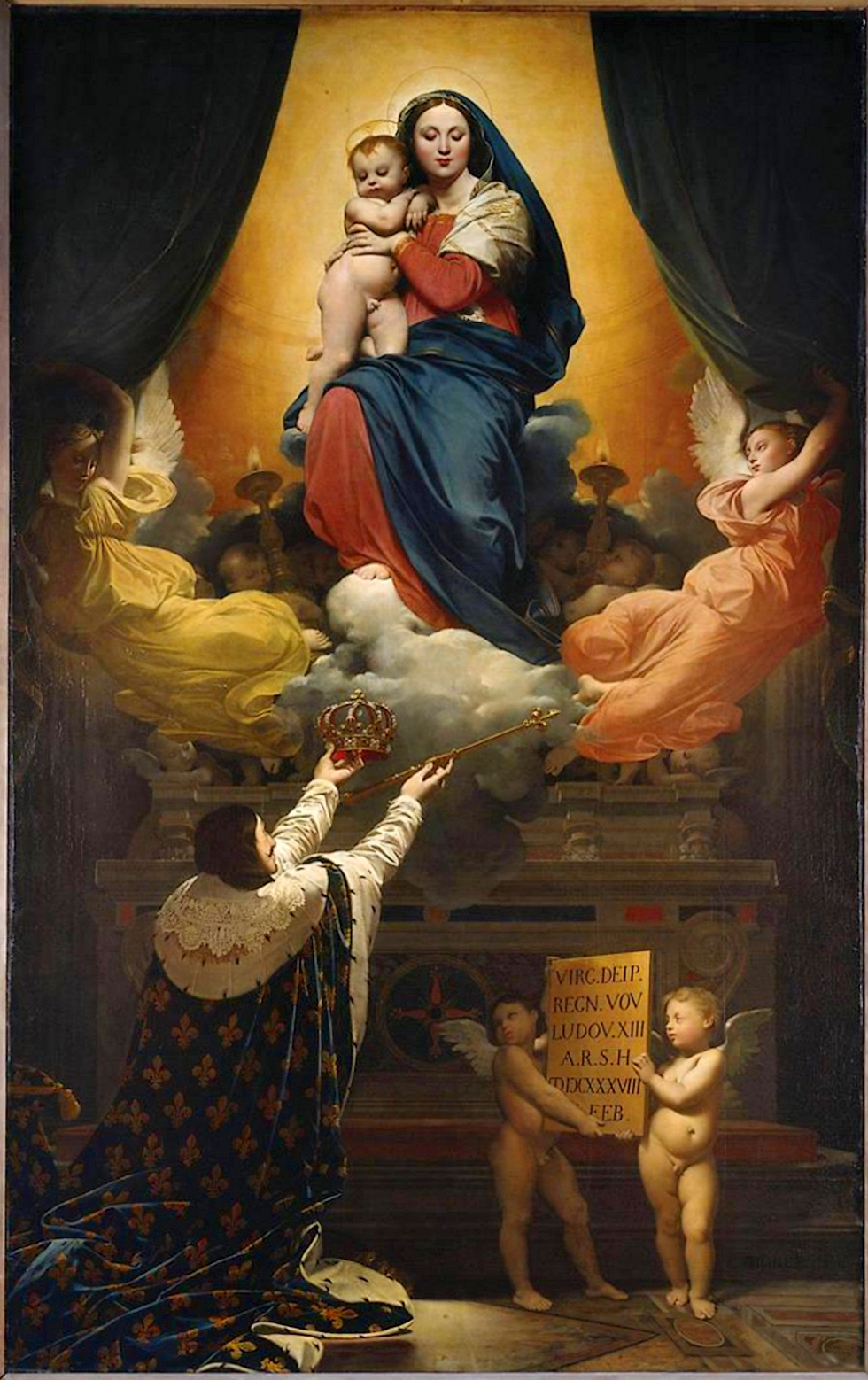
Ingres' painting of the "Vow" of Louis XIII in 1637, in which he dedicated his Kingdom to the Mother of God. Louis XIII was rewarded with an heir to the throne, a prince who became Louis XIV. Every year afterwards on the Assumption the King of France would lead a procession in honor of Our Lady in which he would once again place France under her protection. The Assumption was also considered the feast-day of the queens of France. Processions are still held all over France on the Assumption to honor the King's vow and the patronal feast-day of France. In 1826 Charles X, the last anointed king, had a statue made which is still carried in Paris on the feast of the Assumption. Here is the Vow of Louis XIII:
We have declared and declare that, in taking the very holy and glorious Virgin as the special protector of our Kingdom, we dedicated to her ourselves, our state, our Crown and our subjects, pleading her to inspire in us very holy behaviour and to defend this kingdom against the efforts of all its enemies, with great care, whether it may suffer under the scourge of war, or enjoy the sweetness of peace that we are asking God to deliver us with all our hears, there are no paths of grace that do not lead to paths of glory.

The Virgin of Charles X

Share

Friday, August 7, 2026

How Marie Antoinette Shaped Centuries of Fashion and Design

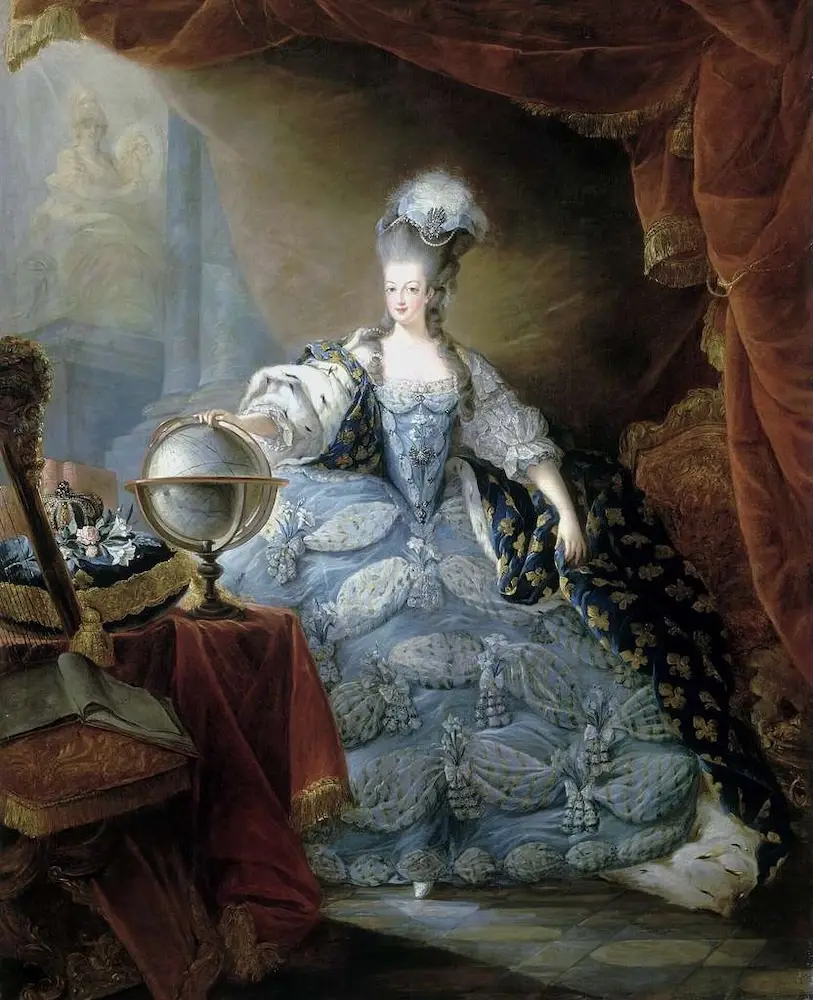
A young Marie-Antoinette in formal court dress, which she disliked.
 

painting of marie antoinette
Marie-Antoinette at 19 in a formal court gown for a state occasion, corseted with panniers (side hoops), jewels, rouge, and very elaborate hair. Some people think this gown was what she wore to her husband's coronation.

The Queen with her two oldest children in the less formal attire she preferred.


There are not many of Marie-Antoinette's gowns left because the really fine ones were made into Mass vestments and donated to the Church. The other gowns were given to her ladies, particularly the lady in charge of the Queen's clothes, who could then sell the gowns for extra income. From History:

“Court fashion was highly prescribed. Marie Antoinette wanted to break free of that and express herself,” says Jeffrey Mayer, professor of fashion history at Syracuse University. Her style signaled a departure from the Baroque era (17th–18th century), which was defined by lavish ornamentation. Instead, she embraced "an elegant, fresh, feminine style, made provocatively modern,” says Cox.

Inspired by Enlightenment thinkers like Jean-Jacques Rousseau, the queen embraced all things pastoral. She regularly used printed cottons such as toile de Jouy, a fabric depicting monochromatic pastoral scenes. Her playful style drew from the Rococo movement, an 18th-century decorative trend that featured curved lines, pastels, wooden marquetry, ribbons and florals. Marie Antoinette's embrace of these motifs helped popularize the style and laid the groundwork for the “French country” aesthetic. At the Petit Trianon, the queen’s personal retreat in Versailles, she harmonized interior design with fashion. Motifs like her beloved cornflowers adorned everything from her custom tea set to her gowns. Although earlier royals used monograms, she emblazoned “M.A.” on everything from banisters to cosmetics, creating a lasting association between monograms and luxury, says Cox. 

 [...]

The palace of Versailles was open to the public (as long as you met the dress code), and visitors could tour the queen’s closet. They could also visit the Parisian shop of Rose Bertin, Antoinette’s stylist and unofficial “Minister of Fashion.” They could even commission a copy of her latest look…as long as they waited the mandated two weeks after the queen debuted it.

Bertin’s Paris shop, Le Grand Mogol (The Grand Mogul) “functioned as an early couture salon, showing new collections each season and maintaining a fully staffed workroom. This was the blueprint for the modern 'fashion house' or maison de couture,” says Mayer. (Read more.)

The young Queen with flowers replacing jewels.

At a costume ball, escorted by her brother-in-law, the Comte d'Artois (Charles X)

In simple attire, no jewels, hair unpowdered.

Marie-Antoinette in simple attire, hair unpowdered, no jewels. But the portrait was seen as being disrespectful to her queenly status.


Share

Saturday, August 1, 2026

Chemise à la Reine vs. Grande Robe Française

This simple style was introduced by Marie-Antoinette and, although she did not wear such a low neckline as shown in the fashion plate above, it still upset many people. The Queen intended the dress for quiet times at Trianon. Via Tiny Librarian:
Chemise à la Reine with bound sleeves, the neckline trimmed with a frill, Marlborough Hat wrapped with a wide ribbon striped in black and colour. (1784)
“Chemises” belonged to the category of simple and comfortable dress which was in vogue from about 1781 overall due to Marie Antoinette.

At the time, one said that an upper-body garment was made en chemise when “the beginning of the sleeves ended in two pieces which were added” (Dictionary of the abbé Jaubert, 1778).  One frequently finds in the notes of Mlle Bertin mentions such as “a piece en chemise of Italian gauze”, “a fichu-chemise* of Italian gauze”, etc.  On the date of the appearance of the “chemises à la reine”, Bachaumont fixes it for us in writing about the portraits of the Queen and Madame, by Vigée-Lebrun, shown in 1783: “The two princesses are en chemise, a costume invented recently for women.”

And he added, “Many people have found it inappropriate that these august personages are offered to the public in a garment reserved for the interior of their palace.”
(Read entire post.)

This gown is an example of the most formal attire possible, which the Queen was trying to get away from. However, people were more displeased by her simple attire than by her grand formal costume. More HERE. Share

Tuesday, July 28, 2026

Bellevue

Bellevue was a country estate originally built by Louis XV for Madame de Pompadour. It was on a hill overlooking the Seine and the forest of Meudon; the view was said to be truly magnificent. In 1775, after he had become king, Louis XVI gave Bellevue to his maiden aunts Adélaïde, Victoire, and Sophie, the surviving daughters of Louis XV, known as Mesdames Tantes. Madame Louise having already entered the Carmelite monastery, Louis thought it would be good for his other aunts to have a retreat from the court, a house they could call their own. For all their genuine piety, Mesdames Tantes had manipulated and gossiped about Marie-Antoinette in the early years of her marriage, coining the term L'Autrichienne, an epithet that would later be taken up by the Revolutionaries. It probably helped maintain the peace at court for Antoinette to be at her Trianon while the aunts were at their Bellevue.

According to the Comte d'Hézecques, who in his capacity as a page at Versailles witnessed the inner workings of the court:

The position of Mesdames at Court being obscure and unsatisfactory, they were seldom seen there. They spent the chief part of the year either at Bellevue, on that splendid height that commands the proud city and the charming country around it; or at the Hermitage, a little garden at the other end of Versailles, by the road leading to Marly.

Madame Adelaide and Madame Victoire were the only survivors of the four daughters of Louis XV who outlived their father. The third, Madame Sophie, had died two years before ; and the other, Madame Louise, had quitted the world in one of those sudden resolutions that can only be inspired by great religious fervour, or by a quick and ardent spirit that will not be satisfied by smaller sacrifices—resolutions that always cause astonishment to men of the world, whatever be their cause....

Mesdames the Aunts only came to Paris in the winter, as they had been able to stay at Bellevue up to the 5th of October. Seeing that they were of very little use to their nephew, unable to enjoy his confidence, and fearing measures opposed to their religious opinions, they at last decided on going to Rome. Possibly in their solitude, standing in a position whence they could form a better judgment of the course of events, theirs was the surer presentiment of all the trouble that hung over their family; therefore, they separated themselves from it for life, but they could not prevail on Madame Elizabeth to leave her brother and accompany them. . . . No doubt Mesdames did not find themselves happy at Rome. The news of the fall of the throne of their fathers and the sorrows of their family came to disturb the peace they might have enjoyed in the Eternal City. They could at least carry their tears and prayers for their guilty country to the foot of the altar, till the day when they were forced to quit the hospitable city that had received them, by conquests that the noble head of the Church could neither arrest nor foresee. So they left Rome to retire to Naples; and, after several changes of their place of refuge, Madame Adelaide had the sorrow of seeing her younger sister die at Trieste. Her own mournful existence was shortened by grief, and she soon died herself at Klagenfurth.—Recollections of a Page, by Comte d'Hézecques, pp. 79-82.


Here is furniture, originally from Bellevue, that once belonged to Madame Adélaïde.

Here is a view of the orangerie and formal terrace at Bellevue. The palace was looted during the Revolution. In 1823, it was demolished.

In the 1780's Mesdames Tantes had Mique create an English-style garden at Bellevue, complete with a tower, a lake, a mill, a dairy and a grotto, similar to what Marie-Antoinette had at Trianon. It is fascinating that they were so censorious of the Queen and yet imitated her in that for which she was greatly criticized, the creation of fanciful gardens. The tower and some other structures of the gardens of Bellevue survived well into the twentieth century; little is left of it today.


Here is a picture of the grotto of Mesdame Tantes, which is just about all that is left of the Bellevue estate. Sic transit gloria mundi.

(Photos from Le Boudoir de Marie-Antoinette) Share

Thursday, July 23, 2026

French Royal Family on Porcelain

A 1788  vase with painting by Pierre-Philippe Thomire from the Château de Versailles. From left to right are Louis XVI, Louis-Charles, Duc de Normandie, Marie-Antoinette, Madame Royale, the Dauphin Louis-Joseph and probably Jean Amilcar, the African boy brought up  and educated by Marie-Antoinette. Share

Saturday, July 18, 2026

The Tragic Life of Marie-Thérèse of France


From Salon Privé Magazine:
As Marie-Thérèse Charlotte of France grew older, the French Revolution threatened. Because the country supported the American Revolution, funds were very low and France was borderline bankrupt. Attacks on the royal family became more vicious and the monarchy’s popularity plummeted. Within the Court of Versailles, xenophobia and jealousy were the primary causes of resentment towards Marie Antoinette, and due to her unpopularity with high-ranking officials within the court, she became the target of a vicious smear campaign. Pamphlets and leaflets were printed accusing her of a wide range of sexual deviancies and of sending France into financial ruin. Now, experts agree that Marie Antoinette was unfairly victimised and did little to deserve such treatment. At the time, however, this smear campaign worked and the public turned on her. (Read more.)

Madame Royale is one of the only novels about the life of Marie-Thérèse Charlotte.


Share

Thursday, July 16, 2026

Marie-Antoinette and the Carmelite Order

15 Princess louise marie of france Images: PICRYL - Public Domain Media  Search Engine Public Domain Search

Madame Louise of France


Marie Antoinette - Wikipedia
Marie-Antoinette as Dauphine

The connection between the Carmelite Order and the Royal House of France originated in the Middle Ages, when St. Louis IX encountered the hermits on Mt. Carmel and brought them to France. When the Discalced Reform came to France from Spain in the early seventeenth century, the royal family assisted the nuns with their patronage. The French court was shaken in 1674 when Louise de la Vallière, the former mistress of Louis XIV, publicly begged the queen's forgiveness and entered a Carmelite monastery. In his book To Quell the Terror, William Bush details the many connections of the later Bourbons with Carmel, particularly the patronage of Queen Marie Lesczynska and her daughter Madame Louise. When Louise herself chose to become a Carmelite nun in 1770, it cemented the spiritual ties between those in the worldliness of Versailles and those in the austerity of the cloister.

Marie-Antoinette of Austria married the Dauphin in the same year that Madame Louise entered the monastery. The young princess offered to represent Louis XV at the ceremony at which his daughter Louise received the habit of Carmel, since it was too painful for the king and the rest of his family to be present. So it was the teenage Marie-Antoinette who veiled the new "Soeur Thérèse de Saint-Augustin."

In the years the followed, Marie-Antoinette would visit her husband's aunt three times year at the Carmel, of which she was a benefactress. As the Queen's maid Madame Campan relates in her Memoirs:

The Court went to visit her about three times a year, and I recollect that the Queen, intending to take her daughter there, ordered me to get a doll dressed like a Carmelite for her, that the young Princess might be accustomed, before she went into the convent, to the habit of her aunt, the nun.
According to Madame Campan, Madame Louise as a nun was deeply involved in church affairs; she was always petitioning her nephew's wife, so that Marie-Antoinette called her: "the most intriguing little Carmelite in the kingdom." It was at the request of Madame Louise, however, that Marie-Antoinette granted a dowry to a poor, pious girl named Mademoiselle Lidoine, so that she could enter the Carmel of Compiègne. Mademoiselle Lidoine became the Mother Prioress of the heroic Martyrs of Compiègne, who like Marie-Antoinette, died on the guillotine during the French Revolution.

Share

Tuesday, July 14, 2026

Bastille Day and the French Revolution Were Not Caused by Marie-Antoinette

From The New American:
July 14 marks another anniversary of Bastille Day, the day the Paris mob rioted and stormed the Bastille, a prison fortress in the city. The popular image of the incident is that of the French Revolution itself, which is that the liberty-loving French folk in Paris spontaneously rose up against a tyrannical king and his arrogant wife, and heroically stormed the symbol of the Old Regime — liberating hundreds of political prisoners. This led to an abolition of the monarchy and the establishment of a government dedicated to liberty for all the people of France.

Nothing could be further from the truth.

Almost everyone has heard that Queen Marie Antoinette said, “Let them eat cake,” in haughty response to the plea of the poor starving masses of France: “We have no bread.”

That is also untrue.

And it is widely believed that Antoinette caused or at least was the principal cause — of the entire French Revolution.

That is ridiculous.

Whereas Louis XVI and his wife, Marie, are usually pictured in the history books and in the popular culture as tyrants of the worst sort, the truth is quite different. The real Marie Antoinette was a charitable woman, who lodged and fed 12 poor families, at her own expense, at Trianon. She founded the Society of Ladies of Maternal Charity. She even once stopped her carriage for over an hour to aid an injured person, waiting until a surgeon was located.

Historian Antonia Fraser disputed the cruel libel in her book Marie Antoinette, the Journey. “As a handy journalistic cliché, [“Let them eat cake”] it may never die,” Fraser wrote, adding “such ignorant behavior would have been quite out of character. The unfashionably philanthropic Marie Antoinette would have been far more likely to bestow her own cake impulsively upon the starving people before her.”

If the Revolution was not caused by Marie Antoinette, then just who did cause it? (Read more.)
Share

Thursday, July 9, 2026

Death of Baby Sophie

Vive La Reine reminds us of the death of Louis XVI and Marie-Antoinette's youngest child, HERE. The portrait below was originally supposed to be a happy one, of the Queen and her children preparing the cradle for the new baby. The Queen is wearing a maternity dress. However, by the time the painting was completed the baby, Madame Sophie, had died and so the artist, Madame Lebrun, had to cover the cradle with black crêpe. Here is a quote from a letter of Madame Elizabeth's:
The queen is very kind to me just now; we are going together to Saint-Cyr, which she calls my cradle. She calls Montreuil my little Trianon. I have been to hers the last few days with her, without any consequences, and there was no attention she did not show me. She prepared for me one of those surprises in which she excels; but what we did most was to weep over the death of my poor little niece [Madame Sophie.]
The Empty Cradle 
Share

“Animalia"

 From Galerie:

When Sheikh Hamad Bin Abdullah Al Thani sold off the Hotel Lambert in Paris and its extraordinary contents in 2022, the depth and extent of his collecting became a thing of legend. A soup tureen gifted to Catherine the Great by Count Orloff; a gilded candelabra commissioned by Marie Antoinette; a hand-painted screen of the Bay of Naples that had belonged to Coco Chanel… it took five distinctive lots to deliver this unparalleled treasure trove of decorative arts to the market. The sale made $76.56 million, and the house—an early baroque palace by architect Louis Le Vau with interiors by Charles le Brun and Eustache Le Sueur—sold for $226 million to the French businessman and art collector Xavier Niel. Actually not bad for a mini-Versailles: the same design team went on to make the most famous palace in the world.

But Sheikh Hamad, a key member of the Qatari royal family who is now in his mid-40s, has not stopped collecting. Since 2021, carefully curated exhibitions at the Hôtel de la Marine in Paris have shown highlights from The Al Thani Collection, which now contains over 5,000 works of art, including very contemporary paintings by artists including Issy Wood and Adrian Ghenie. The latest exhibition, called “Animalia,” offers a look at man’s relationship to animals through the medium of finely crafted objects, from Neolithic times to 1900.

“Sheik Hamad has the mind and the eyes of a falcon,” Giambatista Valli, the couturier who is a friend of the prince, told me at the time of the Hotel Lambert sale. “He is passionate about beauty first and foremost. He is driven by a curiosity which is backed up by incredible knowledge.” (Read more.)


Share

Saturday, July 4, 2026

Louis XVI and American Independence


It is fairly well-known that without the military and financial aid given by Louis XVI to the American colonists in their struggle for independence from Great Britain, our nation may never have arisen. The King of France was reluctant to go to war, recoiling from both the expense and the shedding of blood; he did so only when convinced that it would benefit France in the long run. Marie-Antoinette was initially against assisting the Americans; she thought it set a dangerous precedent to help the colonists rebel against their king. Nevertheless, once war was declared, she did not hesitate to embrace the joint cause of France and America. According to Lafayette she once greeted him by saying: "Give me news of our good Americans, of our dear Republicans!"

Lafayette may have colored her words with his own enthusiasm for the cause. However, the general repartee in the French court over the American revolt is rather humorous, or at least it would be, had the consequences for France not been so tragic. When Marie-Antoinette's brother, Emperor Joseph II, was visiting Versailles, some pro-American French lady kept badgering him about the colonists' revolt. Finally, the Holy Roman Emperor curtly replied: "Madame, I am a royalist by profession." When Lafayette joined the followers of Mesmer, Louis XVI asked him, ironically: "What will Washington think when he hears that you have become the first apothecary of Mesmer?"

The King and Queen graciously received Benjamin Franklin, Thomas Jefferson, John Adams and other Americans at Versailles. Louis XVI was depicted in art with Benjamin Franklin and George Washington. Sadly, the bankruptcy France incurred by the war caused the political crisis in France to escalate, leading to a bloody revolution and to the deaths of Louis XVI and Marie-Antoinette. But Louis XVI did indeed show foresight in his decision to help the colonies. Twice the new nation would come to the aid of France when France was in dire need. I always have thought that in addition to saying "Lafayette, we are here," General Pershing should have said "Louis XVI, we are here" since without the King's help America may never have become a nation.

(Quotations from Marie-Antoinette, Daughter of the Caesars)

Share

Friday, July 3, 2026

"Jeweled" Sèvres Vases

During a recent visit to the Walter's Art Museum in Baltimore, Maryland I saw the vases above, part of the famous "jeweled" Sèvres collection ordered by Louis XVI.  According to the Walter's website:
Between 1778 and 1782, Sèvres manufactured for Louis XVI a series of vases with handles shaped as busts of infants, young women, and old men, hence the name "vases des âges." The Walters' examples, with the infants and a "bleu nouveau" ground color, bear classical scenes and an additional decoration of "jewels" composed of enamel drops over gold foil.

The classical scenes are derived from an illustrated edition of Télémaque, a romance set in antiquity written by Fénélon in 1699. These vases show Telemachus, the son of Ulysses, winning a chariot race and Minerva, disguised as an old man, persuading Telemachus to participate in a war against the Dauniens. These vases were designed by Jacques-François Deparis. The painting was by Antoine Caton, the gilding by Etienne-Henry Le Guay, and the jewels by Philippe Parpette.
Share

Wednesday, July 1, 2026

"Enchanted with Life"

Chateaubriand remembers Marie-Antoinette, Queen of France.
After his presentation to Louis XVI, Chateaubriand passed through the gallery to meet the Queen returning from chapel. “She soon came in sight,” he says, “surrounded by a large and brilliant suite; she made a dignified courtesy, appearing enchanted with life. And those fair hands, which then held so gracefully the scepter of so many kings, were, before they were tied by the executioner, to patch the rags of the widow, the prisoner of the Conciergerie.” (Read entire post.)
Share

Monday, June 29, 2026

Petit Trianon and the Hamlet Revisited


 The grand salon at Petit Trianon from East of the Sun, West of the Moon.

 More pictures, HERE.

From the dining room at Petit Trianon
 The Queen's house at the hameau has been restored. It is interesting to me that Napoleon gave the hamlet to his second wife Marie-Louise, who was the Queen's great niece. He was really unabashed in his fascination with Marie-Antoinette. From France Today:
Left to rack and ruin for the best part of two centuries, the Maison de la Reine, Marie Antoinette’s country retreat on the fringes of the Château de Versailles, has finally been restored to its former glory, thanks to a major £326 million renovation. Built between 1783 and 1787 as the extravagant centrepiece of the Hameau de la Reine, a model ‘village’ and folly of epic scale complete with a (decorative) windmill, sheep trussed up in silk ribbons, a cluster of farmers’ cottages and working farm, the Queen’s House had lain empty since 1848 when the Dior Foundation stepped in three years ago intent on rescuing it from certain ruin and giving it the regal makeover it so begged for.

Secreted in the sprawling gardens of the Petit Trianon, away from fawning courtiers’ prying eyes, the Hameau was Marie Antoinette’s refuge from Versailles’s folderol – for the two short years she got to enjoy it – and only a handful of her closest confidantes were allowed in its inner sanctum, the Maison de la Reine. Conceived with little thought for longevity, the hamlet fared poorly in the post-Revolution years and was all but a crumbling heap when Napoleon ordered a full restoration in 1810. Never one for sentimentalism, the emperor had the most ramshackle structures summarily torn down. Another renovation followed in the 1930s, courtesy of John Rockefeller. Part of the complex was refurbished in the late 20th century and the farm rebuilt in 2006. (Read more.)
From the Queen's house at the hameau
  Share

Saturday, June 27, 2026

Marie Antoinette and the Stories We Prefer to Tell

Dauphin Louis-Charles or Louis XVII
 
Marie-Antoinette de Lorraine d'Autriche

Of course, Marie-Antoinette was never indifferent to the poverty of the people since some of her first recorded deeds as wife to the heir to the throne involved her efforts to relieve suffering. From Front Porch Republic:

The use of the dead Marie Antoinette as a republican icon is something that ought to be carefully considered. It is a willful simplification of the past in order to tell a gentler and more fun story to a modern nation. The French dislike of Marie Antoinette in the late 18th century is well documented and well deserved. Her lavish lifestyle and indifference to the poverty of the French people made her a public enemy when the revolutionary committee came to power. Her husband Louis XVI was executed for treason by guillotine, baptizing the revolution with the thrill of public blood. Marie and her children were imprisoned in the Concierge, initially together, and then forcibly separated. The revolutionary tribunal blamed her for the lavish expenditure of the royal court and for her ongoing communications with rival Austria. However, she was also accused and tried for a host of fabricated charges, including incest with her seven year old son (a false explanation for the wounds the boy suffered while in prison). The child signed an affidavit of this abuse by his mother after being visited in prison by radical members of the tribunal, certainly under pressure and possibly under compulsion. For these things, Marie was executed publicly at the guillotine. Her son spent three more years in prison, where he was tortured by his jailers and died of tuberculosis at age ten. He was not directly executed like his parents, but his death by abuse was a great convenience to the new republic, who feared that his royal blood might arouse sympathies in his powerful relatives across Europe.

The execution of Marie Antoinette and the treatment of her family is nothing for France to be proud of. Her punishment is the first evidence of a revolution run amok. The spirit of her trial was public vengeance and it can barely be considered a legal proceeding. Her child, age seven, was forced to testify under duress and in prison to incestuous rape by his mother. The effort put forth to bring this particular charge against Marie shows that the trial was not solely about her conduct of affairs of state, but rather about humiliating her publicly. Marie refused to answer the charge in the courtroom, saying it was beneath her dignity as a mother. Killing Marie was not an act of justice. It was extrajudicial public revenge and an act worthy of, if not outright condemnation, then at least very careful reconsideration. The imprisonment and death of her son is a clear example of cruelty and abuse to an innocent child for the sake of convenience and as an act of family retribution.

The Olympic torch traveled past the headless Marie and through a staging of Les Miserables’ famous barricades. The French opening ceremonies thematically tied all of these events together for the viewer. In their preferred story, Marie was justifiably killed by a righteous revolution, now remembered in heroic songs and glorified as a time of liberation for the people. Nobody should begrudge a nation’s desire to show the very best of their heritage and culture to the world. However, the conscious rewriting of an event and glorification of a national evil is troubling. A similar editing of national memory played out in the decades following the collapse of the Vichy government, France’s Nazi-collaborating wartime regime. (Read more.)
Share

Friday, June 26, 2026

The Paris Temple

The former Temple enclosure in Paris

 The tower of the original Paris Temple was used as a prison during the French Revolution to house Louis XVI, Marie-Antoinette and their family. It was torn down by Napoleon in 1808 to discourage the pilgrims who were flocking to the site. From the BBC:

Their original estate has long since succumbed to the great march of history, but you can still visit the site on which it once stood on rue de Lobau, located just behind the Hôtel de Ville. Back in the day, surrounding the mansion were miles of uncultivated marshland. In order to make the land arable, the Knights Templar set about drying the marsh – a feat that they were able to fully achieve circa 1240. But though the wetlands have long since disappeared, the area is still referred to as ‘le Marais’ or ‘the Marsh’....

Surrounded by eight 10m-high crenelated walls reinforced by turrets and buttress, this gargantuan fortress once featured towers, a drawbridge, a gothic church, vast stables and homes for the knights. It was here that the Templars guarded mass portions of their treasure and created a powerful ‘state-within-a-state’ that was entirely sovereign from the kings of France.

While this system of sovereignty worked for a time, everything changed in 1303 when the Knights Templar were forced to move their base of operations from the Temple Mount to their European headquarters – the enclos du Temple – after Jerusalem was recaptured by Muslim armies.

The king of France at the time, Philip the Fair, deeply resented the Knights Templar’s powerful ‘state-within-a-state’ and resolved to bring the order down by any means necessary. King Philip’s reasoning for destroying the order is speculated to this day, though many scholars believe his motivations were financial. “Philip could use the silver coin he acquired from the Templars' treasury in Paris to improve the quality of the heavily debased French coinage,” explained Dr Helen Nicholson, author of The Knights Templar: A New History and professor of medieval history at Cardiff University. (Read more.)

From Paris Marais:
To the north east lay stretches of marshland, remnants of the ancient branch of the Seine that had once flowed down from the heights of Belleville, east of Paris. It took the hardy Templars barely a century to turn it into the market garden (marais) of the capital, emulating the monks of Saint Martin des Champs who had dried up the swamps on the western fringe of the future arrondissement a century earlier. Having redeemed the land, they moved to its north-eastern edge, where they built a fortified compound,  l'Enclos du Temple, which also served as their European headquarters.

Forget about Rennes-le-Château and other such fantasies - there was nothing mysterious about the Order. Rather, it was their sophisticated farming methods that enabled them to redeem the marshy land of the future Marais, and it was their acute business acumen that incited them to use their geographical dispersion to advantage and develop a kind of international deposit bank  which contributed to the continual increase of their wealth. This, and their independence, were jealously kept behind the crenellated walls of the Enclos du Temple, roughly on the site of today's rue du Temple, rue de Bretagne, rue de Picardie and rue Béranger, south of Place de la République. It was complete with watch towers and a drawbridge that led to the Temple' only gate (now corner of rue des Fontaines-du-Temple and rue du Temple). (Read more.)
Banner honoring Louis XVII who died in the Temple

More HERE.
Share

Wednesday, June 24, 2026

The Madeleine Cemetery

 From Sortir à Paris:

In the 8th arrondissement, there is a discreet garden that is nonetheless steeped in history. It now stands atop the former Madeleine Cemetery and its mass grave where Louis XVI, Marie-Antoinette, and hundreds of Revolution-era executions were originally buried, and today it houses the Expiatory Chapel.

In Paris, there are gardens that feel almost secret, yet they hide a grand history. This is one such verdant enclave with a macabre past. Nestled behind the sober façades of the 8th arrondissement, the Louis XVI Square, adjacent to the Expiatory Chapel, sits on the site of the former cimetière de la Madeleine, which during the Revolution became a burial ground for the victims of the guillotine. Behind its appearance as a small, discreet haven, this historic Parisian garden sits atop an old burial ground linked to Louis XVI, to Marie-Antoinette and to hundreds of victims of the Terror.

Originally, the cimetière de la Madeleine opened in the 18th century to meet the needs of a rapidly expanding neighborhood. But during the Revolution, its proximity to today’s Place de la Concorde—then the Place de la Révolution, where the guillotine stood—made it a particularly convenient burial site for the bodies of the condemned.

Approximately 500 guillotined were laid to rest there. Among them are famous names such as Olympe de Gouges, Charlotte Corday, Madame du Barry, and several Girondin deputies. King Louis XVI, executed on 21 January 1793, is buried there in an individual grave. Marie-Antoinette, executed on 16 October 1793, was also interred there. Both are said to have been covered with lime.

Following the Revolution and the Empire, Louis XVIII, brother of Louis XVI, chose to mark the site with a commemorative monument. In 1815, the remains believed to be those of Louis XVI and Marie-Antoinette are transferred to the Basilica of Saint-Denis, after which a chapel is erected on the site of their former burial. The project, entrusted to Pierre Fontaine, gets underway in 1816 and is completed in 1826. The monument is designed in a neoclassical style and today hosts exhibitions open to the public.

The Louis XVI Square as we know it today was laid out later, in the 19th century, when Haussmann’s renovations reshaped the district. Its white floral decorationsecho royalty and the memory of Louis XVI and Marie-Antoinette. But what has become of the mass grave? If the supposed remains of Louis XVI and Marie-Antoinette were moved to the royal necropolis for the kings and queens of France in Saint-Denis, a common view persists that the bodies buried on this site were relocated to the Paris Catacombs, as was the fate of other former intra-mural Paris cemeteries.

In fact, Louis XVIII reportedly insisted that no land “saturated with victims” be taken away from the site. The remains of the old cemetery were thus kept in ossuaries. In other words, even after the monarchs were moved, the place remained a necropolis of the Revolution.

The confusion seems to stem from a Catacombs plaque mentioning another “old Madeleine Cemetery,” located on Laville-Lévêque Street, whereas the cemetery on which the Expiatory Chapel was built lay on Rue d’Anjou. Archaeological surveys conducted in 2018 even confirmed the presence of bones behind the walls of the lower chapel. (Read more.)


Share

Sunday, June 21, 2026

The Flight to Montmédy

  On June 21, 1791, Louis XVI, Marie-Antoinette, and their family were captured at Varennes after escaping from the Tuileries in Paris. The King begged the the grocer Sauce and his family not to hand them over to the authorities, saying:

I am your King; this is the Queen and the royal family. Surrounded in the capital by daggers and bayonets, I have come to the country, into the midst of my faithful subjects, to seek the peace and liberty you all enjoy. I could not stay in Paris; it would have been death to myself and my family. I have come to live among you my children, whom I will not forsake....Save my wife, save my children." (Webster, Louis XVI and Marie-Antoinette during the Revolution, p.149)
His entreaties fell on deaf ears; the royal family were sent back to Paris where they all, except for young Madame Royale, met their deaths. It was Corpus Christi; the Royal Family passed the small home altars all along their route back to Paris and prison.

Some people find it interesting how a quatrain in the prophecies of Nostradamus appears to allude to the capture of the royal family at Varennes.

De nuict viendra par le forest de Reines,
Deux pars, vaultorte, Herne la pierre blanche,
Le moyne noir en gris dcdans Varennes:
Esleu Cap. cause tempeste, feu, sang, tranche.

By night shall come through the forest of Reines
Two parts, face about, the Queen a white stone,
The black monk in gray within Varennes.
Chosen Cap. causes tempest, fire, blood, slice.

Whether the prophecy genuinely refers to the night of Varennes or not, it was indeed the night that spelled the end of the monarchy.

Vive la Reine on some common misconceptions. [Falsehoods are in bold type]

Louis XVI, Marie Antoinette and the royal family were fleeing to the town of Varennes
The intended destination of the royal family was actually the royalist fortress of Montmedy.
Louis XVI intended to flee France
Louis XVI firmly refused to leave the country and, according to biographers such as Fraser, Webster, Hardman and more, turned down several flight routes to Montmedy which would have been much faster and safer because they briefly took him across the French border.
The coach which carried the royal family was recognized because it bore their royal arms/was too extravagant
The coach, presumably ordered by Axel Fersen, was large but not unusually so and was in fact based upon previously drafted plans for a Parisian’ companies carriage. It was not decorated with the arms of the royal family and, on the outside, was nothing out of the ordinary. The coach featured a variety of traveling amenities often used by those who could afford them - including a larder, cooker, fold-up table and chamber pots - because it was necessary for the flight to eliminate the need for its passengers to stop or leave the carriage. (Read entire post.)
#louis xvi from treasure for your pleasure: marie antoinette


The Royal Family returns to Paris after being captured at Varennes
Share