Showing posts with label Baltic. Show all posts

Saturday, September 5, 2026

The Teutonic Knights

 From The Collector:

Also known as the Deutscher Orden and the Brothers of the German House of St. Mary in Jerusalem, the Teutonic Order was a key player in the medieval expansion in Eastern Europe. During the Baltic Crusades in Prussia, present-day Latvia and Estonia, and Lithuania, the Teutonic Knights virtually wiped out the pagan population living in these areas, replacing the established authorities with a theocratic state. Read on to learn more about the Teutonic Order and its role in the Christianization of Europe’s last strongholds of paganism.

In 1189, the Crusading forces led by Guy of Lusignan were besieging the town of Acre, which was then controlled by Saladin, the sultan of Egypt and Syria. In 1187, Saladin had also conquered the city of Jerusalem, leading to the fall of the Kingdom of Jerusalem, a Crusader state established by the Crusaders in 1099 after the end of the First Crusade.

When news of the fall of Jerusalem reached Europe, Pope Gregory VIII initiated the Third Crusade to restore the city to Christian control. In 1190, during the siege of Acre, a number of German merchants, mostly from Bremen and Lübeck, decided to form a fraternity to care for the sick. A year later, after the Crusaders managed to capture Acre, the fraternity established its headquarters in a hospital in the town, and it became known as the Hospital of St. Mary of the German House in Jerusalem. (Read more.)

Share

Friday, July 17, 2026

Rare Royal Crowns

 From Archaeology News:

The exhibition, titled “Hidden Within,” is now open at the Vilnius Church Heritage Museum. Visitors see burial regalia placed with King Alexander Jagiellon, Queen Elizabeth of Austria, and Queen Barbara Radziwill during the 16th century. The collection includes three funeral crowns, a scepter, an orb, jewelry, and personal items once buried with the rulers. Many experts believed these objects had disappeared forever.

The story began in 1931, when spring floods exposed royal crypts beneath Vilnius Cathedral. Archaeologists uncovered the remains of the three rulers along with their burial insignia. As World War II approached, church officials hid the collection to protect it from looting and damage. Part of the cathedral treasury returned to light in 1985, though the royal burial objects stayed missing for decades. (Read more.)

Share

Sunday, August 2, 2020

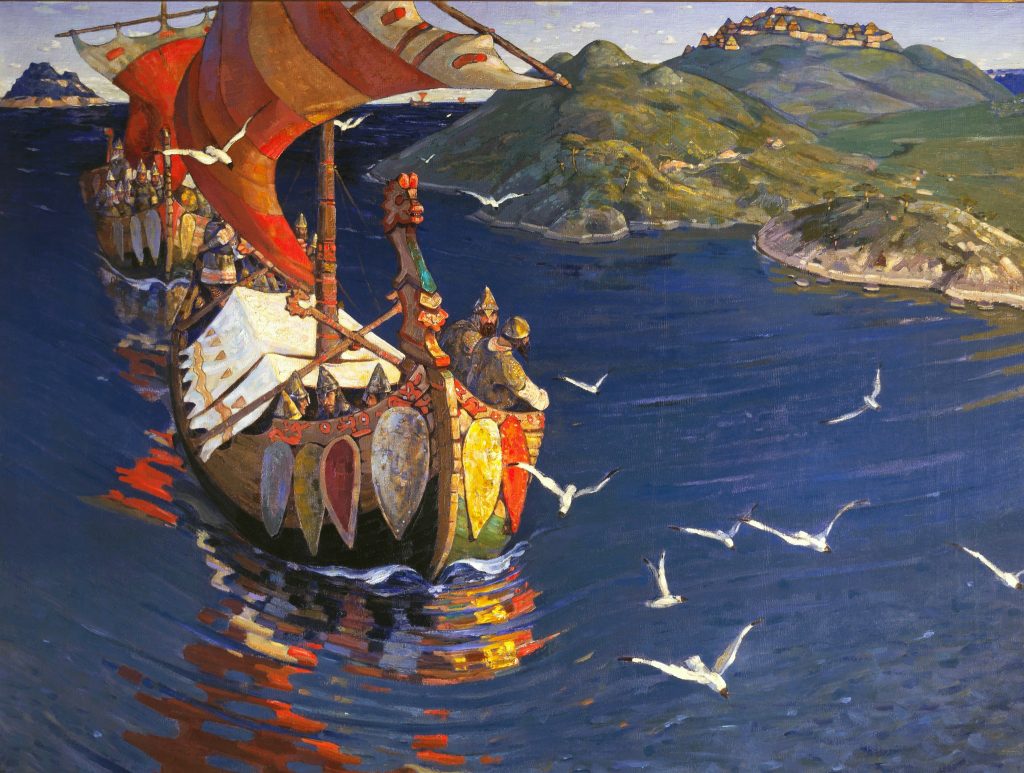
The Vikings of Estonia

From Estonian World:
A scientist’s long crusade for making the world see the hidden part of the Viking history. The Estonia and Denmark-based Tallinn University archaeologist, Marika Mägi, has spoken about the Viking Age sailors for many years, but still compares it with banging her “head against the wall”. It is because she does not speak about the Norsemen, the Scandinavian Vikings, but the ones who lived a bit to the east, along the eastern Baltic Sea shores. And this is often uncomfortable to hear for other scientists and Viking experts, because it forces them to rethink their knowledge. If the world would accept the crucial role of the Baltic region in Viking communication, many stories would have to be retold and many knowledge gaps refilled. And that’s hard work.

When Mägi points out that they missed a piece in the puzzle, her listeners politely nod and go on ignoring the region. Why make the effort? The Baltic region, as usual, is seen like an empty void between Scandinavia and Russia. But this is simply not the truth. (Read more.)
Share