Showing posts with label Christina Croft. Show all posts

Tuesday, July 9, 2024

The Martyrdom of ‘the Most Beautiful Woman in Europe’

Elizabeth of Hesse, a granddaughter of Queen Victoria, was known as "Ella" and later as Grand Duchess Elizabeth Feodorovna. She married one of the sons of Tsar Alexander II, the Grand Duke Sergei. Her sister was Empress Alexandra Feodorovna. From The National Catholic Register.
In 1888, the young couple represented the Russian Royal House at the dedication of the Russian Orthodox Church of St. Mary Magdalen on the Mount of Olives. There, whilst priests intoned prayers and incensed icons, Ella felt the first stirrings of her heart away from the Lutheranism of her birth. As it turned out, this visit to Jerusalem and the Holy Places impressed Ella greatly. Although always a devout Christian, her faith began to deepen from this time as she entered into an intense period of prayer and study, which eventually lead her to the Orthodox faith of her husband.
In the spring of 1891, Sergei was asked by his brother, Tsar Alexander III, to assume the position of Governor of Moscow. It was a significant post that was growing in importance on account of unrest from workers, intellectuals and anarchists. This city, that was to become Ella’s home, was then the seedbed of the revolutions that followed. And, as state repression followed unrest, soon that cycle became a deadly one for all concerned, not least its governor. Eventually, Sergei was to step down, but there were those who still sought revenge upon him.
On February 17, 1905, a grenade was tossed into the former Governor of Moscow’s carriage. It detonated immediately. As it did so, the windows of the nearby Kremlin rattled. Ella knew instantly that it was the sound of her husband’s assassination, and ran from the palace out onto the snow-covered streets. Stunned but still calm, she knelt in the blackened snow beside the mangled wreckage, as an equally stunned crowd gathered around her. As help came to collect the mortal remains of her husband onto a stretcher, in the snow Ella noticed the religious medals he was wearing. Bending down, she gathered these into her palm, before rising to pass silently through the crowds back into the Kremlin’s dark emptiness. (Read more.)

More HERE.
The Alapayevsk Martyrs

Share

Thursday, May 16, 2024

The Carthusian Martyrs

The Carthusian Martyrs


The Carthusian Martyrs

I am honored to have a guest post by author Christina Croft in celebration of her new book, Martyrs of the English Reformation: 1535-1681.

Of the eight-hundred religious houses in England, none had a finer reputation for sanctity and learning than the London Charterhouse, where, in 1535, thirty Carthusian monks and eighty lay-brothers lived under the leadership of forty-nine-year-old Prior John Houghton. Short in stature and of slight physique, Prior Houghton’s ascetic appearance mirrored his innate humility.

‘He was,’ wrote a contemporary Carthusian, ‘…striving always to hide himself…and was ever desirous of being forgotten or deemed unworthy of special esteem.’ 

According to their Rule, the Carthusians did not involve themselves in political matters and, as guests were not permitted to enter the cloister, ‘one rarely heard an idle word, or a word about worldly affairs.’ Thus, when the King’s commissioners arrived to order the monks to take the Oath of Succession, declaring the King’s first marriage void, and ensuring that the throne would pass to the issue of his second wife, Anne Boleyn, Prior Houghton replied that it was not his business whom the King chose to marry. Nonetheless, when pressed, he and the monastery’s procurator, Humphrey Middlemore, refused to take the Oath, for which they were imprisoned for a month in the Tower of London until  the Bishop of York persuaded them that the succession was a merely a temporal matter so they could satisfy the King without troubling their consciences. 

Soon after their release, however, the King’s private secretary, Thomas Cromwell, devised a new version of the Oath, which included a repudiation of the Pope and his authority. This left Prior Houghton in a terrible predicament, knowing that he could not swear to something that contravened his faith, but that failure to do so could lead to the dissolution of his monastery. 

In the spring of 1535, as he was pondering the problem, Prior Robert Lawrence of Beauvale in Nottinghamshire arrived at the Charterhouse, troubled by the same dilemma. The two men agreed to spend three days together in prayer and penance before reaching a decision, and, on the second day, they were interrupted by the arrival of a third prior, Augustine Webster of Axholme, who agreed to participate in their triduum.  When the three days were over, they decided to approach Cromwell to seek an exemption from taking the Oath on condition that they never spoke a word against the King. 

Cromwell, however, coldly replied, “I admit no exception. Whether the law of God permits it or no, you shall take the oath without any reserve whatsoever, and you shall observe it too.” 

As they refused to comply, they were held in the Tower of London pending a trial for treason in Westminster Hall on 27th April. Impressed by their obvious sanctity, the jury asked, ‘How can such holy men be guilty of treason?’ and said that they needed more time to consider their verdict. Irked by the delay, Cromwell repeatedly sent messengers to threaten the jury but they repeatedly refused to be swayed until Cromwell himself burst into the room, warning that they would be condemned as traitors unless they found the prisoners guilty. This time, with great reluctance, they yielded. 

On the morning of 4th May 1535, as Sir Thomas More watched the priests being tied to pallets to be drawn to Tyburn, he remarked that they were ‘going as cheerfully going to their death as bridegrooms to their marriage.’ 

Prior Houghton was the first to face the executioner, reciting the thirtieth psalm – I will extol thee, O Lord; for thou hast lifted me up, and hast not made my foes to rejoice over me – as he ascended the cart beneath the gallows. When his prayers were completed, the cart was pulled from beneath him, leaving him hanging and writhing in a slow strangulation. While still alive, he was cut down and stripped naked, enabling the executioner to slice open his body and remove his entrails, which were thrown into a cauldron over a fire. 

“Oh, most holy Jesus, have mercy on me!” he gasped as the executioner moved the knife towards his heart and made the fatal cut. 

One after another, his fellow priors endured the same fate and, when the disembowelled corpses lay in a bloody heap on the ground, each was cut into four pieces and thrown into the cauldron. Once the flesh had boiled, the limbs were removed to put on display at different sites across the city, including the door of the London Charterhouse to which John Houghton’s arm was fastened. 

This was but the beginning of the trials of the London Carthusians as, six weeks later, three more of the monks – Humphrey Middlemore, William Exmew and Sebastian Newdigate, followed Prior Houghton to Tyburn; and those who remained in the Charterhouse were constantly harassed and threatened until some were terrified into fleeing or taking the Oath. Eventually, the remaining ten were taken to Newgate and chained to pillars by their necks and ankles. Hearing of the sordid conditions in which they were being held, Sir Thomas More’s adopted daughter, Margaret Clements, disguised herself as a milkmaid and bribed the gaoler to allow her to place food in their mouths and to clean up the filth beneath them. When she was refused permission to visit again, she climbed onto the roof and pulled up the tiles to lower food down to them. Her activities were soon discovered and, as she was no longer able to feed them, nine of the ten prisoners starved to death. The tenth, a lay-brother, William Horne, was drawn to Tyburn on 4th August 1540 to be hanged and quartered. 

In 1537, the London Charterhouse was dissolved and was eventually bought by Thomas Howard, the Duke of Norfolk, whose son, Philip, intended to restore it as a monastery, but he died in horrific conditions in prison as another Catholic martyr, before he could bring his plan to fruition.

Available from Amazon


Share

Sunday, March 26, 2023

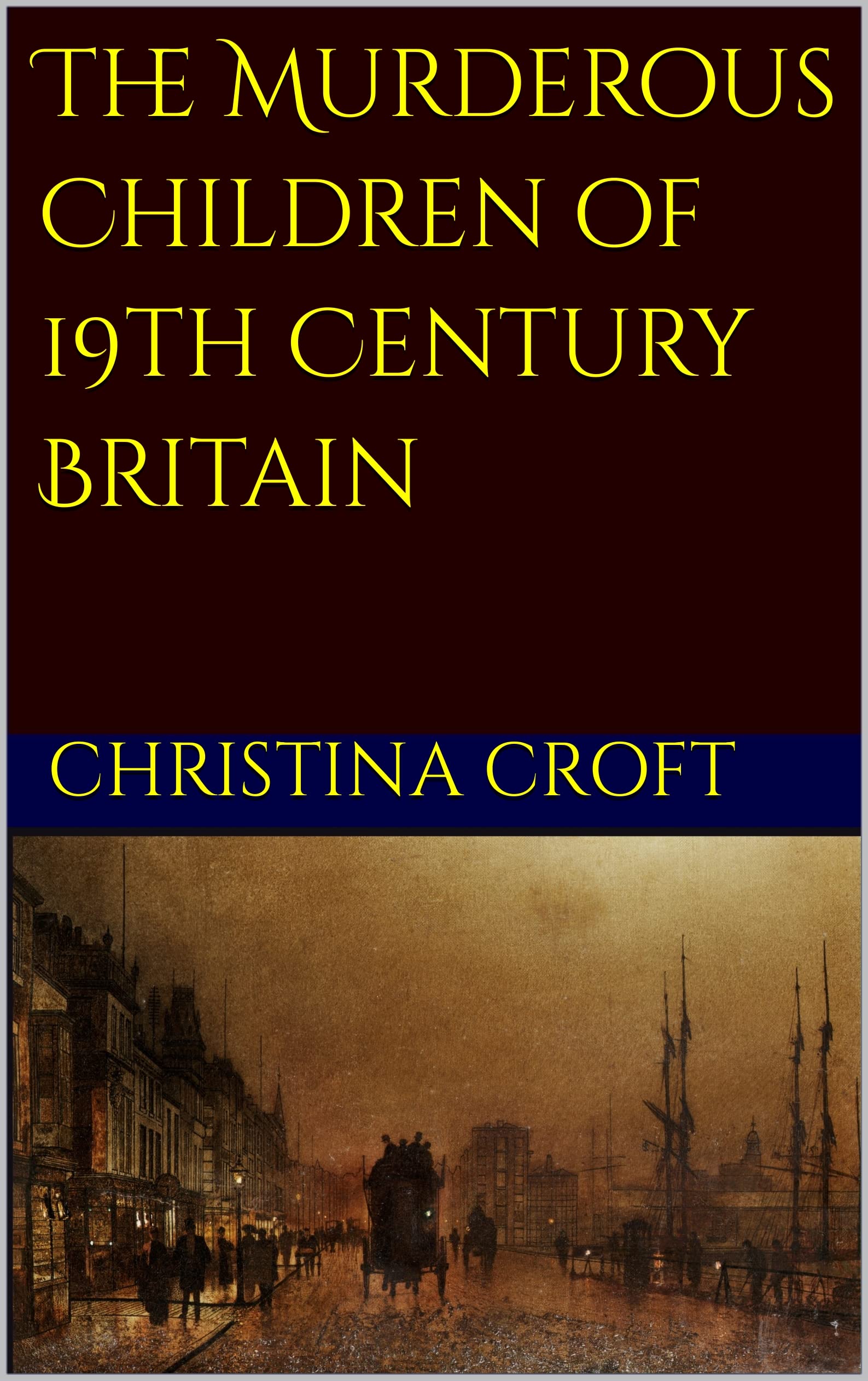
The Murderous Children of 19th Century Britain

 Anyone who has read Dickens is aware that the lot of the poor in Victorian England was dire, in spite of continuous efforts  on the part of both church and state to give aid. While the Industrial Revolution brought many advantages to society in general, such as more efficient transportation, cheaper and plentiful food and personal amenities, the initial transformation of society from agricultural and rural to urban and mechanized caused great upheavals. Family life, religious custom, moral guidelines, were seemingly trampled in the maze of crowded slums of those whose new center of life was the factories where health and safety measures were practically unknown. No laws existed initially to protect children from working all day and so they labored at many jobs all over the country. One would not therefore be surprised at children turning to crime in the cities, like Oliver Twist and the Artful Dodger. 

What surprised me about Christina Croft's carefully researched book about child murderers of the nineteenth century were how the children in the countryside seemed as depraved as those in the towns. Little children killing other little children just out of spite, curiosity, or for no apparent reason occurred in idyllic country villages as well as in thriving centers of commerce. Some people blamed the Penny Dreadfuls, which were serialized bloody and lurid tales aimed at a youthful audience, for giving violent ideas to unformed minds. Others blamed the fact that many poor families drank gin or ale when clean drinking water was absent, which it was most of the time. And so it seems many poor children, bereft of an adequate breakfast, were stumbling around intoxicated by mid-morning. In order to feed them, many destitute families sent their children, as soon as they were old enough, to work in service to middle class or wealthy families. It was in respectable and prosperous homes that many of the most infamous murder cases occurred, for the child servants were given the task of watching over the babies of the family. It seems the repressed or suppressed anger of some servant children manifested itself when they were supposed to be caring for helpless infants. England was shocked by such incidents, and the death penalty did not distinguish between adult and child criminals.

Besides willful murder, there were also children who raped other children, as well as children who enjoyed throwing rocks at strangers' heads and seeing them collapse. There were no gun laws regarding children; many curious young boys found it exciting to steal their fathers' firearms but then accidentally shoot innocent passersby or even their friends and family members. Christina Croft has recorded dozens of tragic cases of all varieties of crime which put one more in mind of twenty-first century Baltimore, Maryland than nineteenth century Great Britain. My Beatrix Potter-like visions of Victorian children having rustic tea parties in the garden along with bunnies, dolls and hedgehogs have been smashed forever.

Share

Friday, July 13, 2012

Shattered Crowns

 The following is a guest post by author Christina Croft.
"The Greatest Crime of the Twentieth Century"
When attempting to solve a series of crimes, detectives tend to look for patterns and gradually create a profile of the criminal and his/her methods. In the same way, while carrying out research for what I believe was the greatest and most appalling crime in history – the First World War - I became increasingly aware of a terrible pattern which bears the distinct hallmark of the methods that have been – and continue to be - used by some of the most secretive and powerful criminals imaginable.
Speaking of the French Revolution, Elena Maria Vidal eloquently points out that a secretive group deliberately provoked the revolution and purposely and unjustly vilified King Louis XVI and Marie Antoinette in order to justify their subsequent executions. The King had to be removed and the Roman Catholic Church suppressed so that these people could gain the power they were seeking. It is almost too horrific to contemplate but, while researching the background for my ‘Shattered Crowns’ trilogy, it became very apparent that the same methods were used to provoke the war in order to bring about the collapse of the autocracies of Russia, Germany and Austria-Hungary...and over eight million soldiers and many more millions of civilians from over one hundred countries were killed in the process.
Who could commit such a crime and why? Perhaps it is worth asking who had anything to gain from this war. The monarchs certainly didn’t. Wars are extremely expensive and they each contributed to the war effort from their own personal funds, gaining nothing in return. What’s more, they were friends and cousins and to the last moment they were desperately seeking to avoid war. Tsar Nicholas of Russia and Emperor Franz Josef of Austria (and his heir Archduke Franz Ferdinand) had many domestic problems to deal with, while Kaiser Wilhelm’s Germany was prospering and thriving after forty years of peace. Archduke Franz Ferdinand (who sadly is only remembered for his murder)  had made definite plans to bring greater autonomy to the different ethnic groups within Austria-Hungary and, had he lived to succeed as Emperor, he would have implemented many changes, creating greater harmony within his Empire. Sadly, those who wanted a war, did not want greater harmony and Franz Ferdinand was murdered. Even more striking is the fact that the week before the Archduke was murdered, Kaiser Wilhelm paid him an informal visit during which both men agreed to make friendly overtures to the Tsar of Russia in order to maintain peace in Europe. This is rarely mentioned in the history books, nor is it stated that all the monarchs were away on holiday in the days immediately prior to the declarations of war.
Unfortunately, however, these independent monarchs stood in the way of the same group who perpetrated the French Revolution, in their desire to gain control of the resources and the economies of these nations. In order to do that, it was necessary to bring down the autocracies and the easiest method of so-doing was first to bankrupt them by expensive war (at the same time the members of this group were lending vast sums at very high interest to both sides) and to create chaos, disillusionment and disorder. After this – as clearly happens today - the very people who created the disorder could then step in and restore calm on their own terms. While this was happening, the economic centre for the Allies shifted from London to Wall Street – so soon after the founding of the (privately owned, I believe?) Federal Reserve - and over a thousand new millionaires prospered almost overnight in the United States. Interestingly, too, Trotsky, one of the leaders of the Russian revolution was being driven around New York in a limousine and, soon after his and Lenin’s arrival in Russia, vast amounts of Russian gold were shipped to a specific American-based banking house and access was granted to the Russian oilfields. In the same way, by the terms of the Treaty of Versailles, the thriving German Chemical industry passed into the hands of foreign industrialists, and all German patents taken out in America were sold for next to nothing to pharmaceutical companies, coincidentally owned by members of the same banking/industrialist families.
It was not sufficient, however, to gain economic control. There was also a spiritual aspect to this crime. Austria-Hungary – the Apostolic Kingdom – was bound to the Roman Catholic Church and the Russian Imperial Family were bound to Orthodoxy. It was necessary to destroy these links and, through the media and oppressive laws, turn people to a more materialistic ideology (which, of course, profits the banker-industrialists).
The Tsar was murdered with his entire family; Kaiser Wilhelm and Emperor Karl (who had succeeded to the Austro-Hungarian thrones in 1916) were deposed and forced into exile; and, as with Louis and Marie Antoinette, they were each vilified. The Tsar has been erroneously portrayed as weakling; the Kaiser as a madman and a warmonger, and Emperor Karl (now Blessed Karl of Austria) as an alcoholic womaniser! It is easy to refute each of these ridiculous accusations but it would take to long to do so here.
In the Shattered Crowns trilogy, I hope to have demonstrated the courage and humanity of these monarchs who were genuinely concerned for the welfare of their people and who endured many personal tragedies, and to cast a different light on the greatest crime of the twentieth century. The first two books The Scapegoats (1913-1914) and The Sacrifice (1914-1917) are available in paperback and Kindle format; the third book of the trilogy ‘The Betrayal’, will be coming soon.
Thank you, Elena, for your hospitality and allowing me to write on your blog!   
Share