Showing posts with label Greece. Show all posts

Saturday, August 29, 2026

What Ancient Greeks Looked Like

 From The Greek Reporter:

Ancient Greek writers have left behind clues about how they perceived the physical appearance of Greeks as a people. Several surviving texts use terms describing complexion, hair, body build, and facial features, offering a glimpse into how some ancient authors portrayed the Greeks themselves. Perhaps the most detailed surviving example comes from the Physiognomonica of Adamantius, a work from Late Antiquity that draws heavily on the earlier physiognomist Polemon.

Adamantius refers explicitly to those among whom the “Hellenic and Ionian stock” (Ἑλληνικὸν καὶ Ἰωνικὸν γένος) had remained “pure.” He describes them as relatively large and broad, upright and strongly built, with straight legs and well-proportioned extremities. More strikingly, he calls them “lighter or whiter in complexion” (λευκότεροι τὴν χρόαν) and xanthos (more on that later). He subsequently describes their hair as subtly blond (ὑπόξανθον), soft, and gently curling. Adamantius continues by describing a square face, thin lips, a straight nose, and bright, highly expressive eyes, concluding that the Hellenic people had the finest eyes of all peoples.

The passage should not be mistaken for anything resembling a modern anthropological study. Ancient physiognomy sought to draw conclusions about a person’s character from outward physical characteristics, a practice formalized in Greek and Roman antiquity but long since rejected as highly unscientific. (Read more.)

Share

Saturday, August 22, 2026

Death of the Great God Pan

 From The Greek Reporter:

One of the strangest stories to survive from the ancient world of the Greeks tells of a mysterious voice heard across the sea announcing something almost unthinkable. According to the voice, the Greek god Pan was dead.

The story was recorded by the Greek philosopher and historian Plutarch in his work On the Obsolescence of Oracles, written during the Roman period. Rather than recounting a familiar myth about a god battling monsters or interfering in human affairs, Plutarch presented the episode almost like a contemporary report. He included named witnesses, specific geographical locations, and even an investigation allegedly ordered by the Roman emperor.

The story raises an enduring mystery about what Plutarch believed had happened and why the death of Pan would have been considered such a remarkable event. It also offers a glimpse into how ancient Greeks understood their gods, oracles, and the changing religious world around them. (Read more.)


Share

Tuesday, August 18, 2026

The Remarkable Rise of Empress Theodora

 From Risto Gjorgjiev:

 Born around 500 AD in the vibrant city of Constantinople, Theodora’s early life was far from royal. Her father, Acacius, was a bear trainer for the city’s grand Hippodrome, a colossal stadium renowned for its chariot races and theatrical spectacles. After his untimely death, Theodora’s mother, a dancer and actress, found herself struggling to provide for her three daughters. To make ends meet, young Theodora was thrust into the world of entertainment, becoming an actress and dancer in the very Hippodrome her father had worked.

 The Hippodrome was not just a place of entertainment; it was the beating heart of Byzantine social life. Here, factions clashed, politics played out, and the mood of the populace was gauged. Theodora, with her keen observation, learned to read the crowd’s behavior, understanding their passions, grievances, and loyalties. This knowledge would later prove invaluable.

However, life in the limelight was not without its challenges. Theodora faced societal disdain due to her profession, which was often associated with promiscuity. Her travels across the Eastern Mediterranean exposed her to various cultures and experiences, including a tumultuous relationship with a Syrian official that left her stranded in North Africa.

In a twist of fate, Theodora’s return to Constantinople marked a new chapter in her life. Embracing Christianity, she left behind the world of entertainment and joined a community of devout women. It was during this period of reflection that destiny played its card: she caught the eye of Justinian, the nephew of the reigning emperor and the empire’s most eligible bachelor. (Read more.)

 The Mad Monarchist has a post about one of the most colorful women who ever lived, the Empress Theodora.

Together with her husband Empress Theodora oversaw the rebuilding of Constantinople into one of the most spectacular cities in history. She helped in the building of hospices, churches and refuges for the poor. She is also credited with influencing new laws to protect women, making rape and kidnapping capital offenses, no matter if the woman was noble or common born. Women could not be forced into the entertainment industry or prostitution and could not be put in prison for debts. Instead they were to be placed under the supervision of religious women to work off their debt. This was necessary because of the rape and abuse women often suffered in prison. She cracked down hard on prostitution, buying the freedom of many girls herself, meting out harsh punishment to their captors and setting up establishments to help them get back on their feet in legitimate ways. (Read more.)

Empress Theodora did much to protect women during her husband's reign. From The Collector:

The origins of women’s rights can be attributed to Empress Theodora. Probably her experience as a young woman marginalized by the institutional system of that time pushed her to work on the improvement of women’s rights in the Empire. She elaborated on The Corpus Juris Civilis, a series of juridical reforms included in Roman law, and laid the foundation for a framework for Western legal heritage for women’s rights, including the English Common Law, the American Constitution, and even contemporary international public law. Additionally, under Empress Theodora, rape became punishable by death. No matter their position or status, everyone present during the rape was affected by this rule, and the rapist’s property was handed over to the victim. (Read more.)

Share

Monday, August 17, 2026

Did the Hittites Record the Fall of Homeric Troy in Cuneiform?

 From The Collector:

Homer’s account of the Trojan War in the Iliad, written in the 7th century BC, is one of the world’s most enduring stories. But was it purely fantasy, or based on real historical events? In the search for confirming evidence, scholars have examined clay tablets containing the historical archives of the Hittite kings at Hattusa. They preserve details of Anatolian politics in the 13th century BC, the time when the Trojan War was supposed to have been fought. While these administrative texts do not speak of golden armor or meddling gods, they do record a century of real conflict over the legendary city the Hittites called Wilusa, which many scholars believe was ancient Troy.

The Hittite Empire ruled over much of Anatolia throughout the Late Bronze Age, the era between approximately 1550 and 1150 BC. Numerous Hittite documents have been uncovered and translated. In particular, thousands of clay tablets were unearthed at Bogazköy in modern Turkey in the early 20th century, containing administrative records kept by Hittite royal scribes of the Hittite capital of Hattusa. This collection contains diplomatic letters between rulers, quite a few of which refer to attacks on western Anatolia by a nation called the Ahhiyawa. While not universally accepted, the majority of scholars agree that the Ahhiyawa were the Mycenaean Greeks. The ethnonym “Ahhiyawa” is held to be a Hittite version of “Akhaioi,” the Greek form of “Achaeans.”

As soon as these documents were uncovered and translated, historians began to realize their potential significance regarding the Iliad. According to Homer’s epic poem, a thousand Greek ships were launched against Troy in western Anatolia in the 13th century BC. This was not a war against just one city but against Troy’s many allies all over western Anatolia as well. Hittite documents dating to the same period appear to confirm that the Ahhiyawa were engaged in large-scale warfare in western Anatolia at this time. (Read more.)


Share

Monday, July 27, 2026

The Agony of The Odyssey

 From Paul du Quenoy at Chronicles:

“Hahaha. Very proud to say we got the Odyssey removed from the curriculum this year!” Lawrence, Massachusetts, high school teacher Heather Levine tweeted in 2020, responding to a post from a fellow “scholar-educator” who called Homer’s epic poem “trash.” The Wall Street Journal reported that the teachers were part of an online group of left-wing activist educators who tried to get Homer’s epic and other classics of Western literature banned from classrooms because of their supposedly racist, sexist, and ableist contents.

These undoubtedly enlightened purveyors of knowledge have yet to register any reaction to this summer’s blockbuster release of Sir Christopher Nolan’s film adaptation of Homer’s epic. Nolan’s film, which he co-produced with his wife Emma Thomas and for which he wrote the script, debases The Odyssey so cheaply that Hellenophobic New England schoolmarms might well be pleased, assuming they are not too triggered to see the film.

Nolan was on tap to direct Troy, an adaptation of Homer’s Iliad executed more than two decades ago by Wolfgang Petersen, but the studio eased Nolan out of the project, giving him Batman Begins as a consolation prize. Nolan has said in interviews that at the time, he felt ill-prepared to tackle The Iliad. He only conceived his Odyssey project in 2024, after the stunning success of Oppenheimer, his disjointed biopic of the troubled atomic bomb scientist J. Robert Oppenheimer, which won seven Academy Awards. According to interviews, Nolan kept the subject of his next film secret for nearly a year while he read several translations of Homer’s epic, along with various related media, apparently including comic book adaptations.

Perhaps naturally, Nolan contextualized The Odyssey within his larger oeuvre of feature films, many of which, including Memento, Interstellar, and his Batman trilogy, relate existential quests involving emotionally tortured men who suffer from familial loss. From that perspective, Homer’s epic—a hero’s 10-year voyage home from a distant battlefield to a faithful but beleaguered family—may have seemed a natural fit. Nolan had the time, money, and opportunity to make a stirring and searching literary adaptation of great significance, if for no other reason than that a serious film adaptation of The Odyssey hasn’t been undertaken since Italian director Mario Camerini’s flawed 1954 attempt in technicolor, Ulysses, starring Kirk Douglas. (Read more.)

Share

Monday, July 20, 2026

‘The Odyssey’: The Blueprint of a Civilization

 From Ekathimerini:

We tend to file “The Odyssey” under “mythology” – alongside stories of gods who never existed, sung by people trying to explain thunder. That filing is a mistake, and it obscures the single most consequential literary achievement in human history.

“The Odyssey” is not a myth. It is a founding document. It is the moment human beings first discovered that they had an inside – and it is the blueprint from which an entire civilization, and everything that civilization would eventually give the world, was built.

Read “The Iliad” closely and something strange emerges. Achilles does not decide to rage – rage arrives and moves through him like wind fills a sail. When a god speaks, the hero does not experience it as an outside voice interrupting his thoughts; the god’s command is his thought. Heroes act. They do not deliberate. There is no interior room where a self sits and weighs its options – there is only impulse, arriving as if from outside, and action following immediately after.

The Odyssey breaks this pattern, and the break is the whole point.

Odysseus pauses. He calculates. He lies, plots, improvises, disguises himself, and – for the first time in surviving literature – he talks to himself. Clinging to a rock through a violent night, he says: “Endure, my heart. You have endured worse than this.” That is not a god speaking through him. That is one part of a man addressing another part of the same man. It is the first recorded act of a human being holding itself together through interior dialogue.

Homer did not just tell a story about a man finding his way home. He recorded – perhaps without fully realizing it – the birth of human self-awareness. (Read more.)

Share

Saturday, July 18, 2026

Homer’s ‘The Odyssey’ Is About Duty, Loyalty, and Family

 From Victor Davis Hanson at The Daily Signal:

Christopher Nolan, the renowned British director, has a new film coming out, another remake of “The Odyssey” by Homer. It’s supposed to come out July 17.  

Everybody’s been talking about it, not because they know what’s in it or they’re trying to guess how he treats this age-old epic, but because one of the stars, Lupita Nyong’o, and forgive me if I mispronounced her name, has been very vocal that, as she views the script and Homer’s work himself, there’s a matter of feminism that Homer did not highlight women sufficiently. 

Homer wrote “The Odyssey,” remember, around 700 to 650 BC at the dawn of the Greek city-state. It’s the second of his two epics, "The Iliad" and "The Odyssey", and it’s a much different epic than "The Iliad", which takes place in about 11 weeks on the plain of Troy.  

This is a panoramic view of the Mediterranean and traces the 20-year odyssey of the hero Odysseus to get back from Troy to the northeastern island off the coast of Greece, Ithaca. 

What she said was that there was not a sufficient portrayal of women or they were not powerful enough. I couldn’t understand that. I taught “The Odyssey” for 20 years in English at the California State University system to a variety of students, probably 2,000 students in humanities courses, as well as a much smaller number in Greek. 

And one thing one comes away with is that there’s no literature anywhere in the world at that time that has been more deferential or more interested in women. (Read more.)

Share

Wednesday, July 15, 2026

Does King Priam of Troy Appear in Hittite Records?

 From The Greek Reporter:

King Priam was the famous king of Troy during the Trojan War. It was his son, Paris Alexander, who took Helen back to Troy and inadvertently caused the enormous war with the Greeks. Priam himself was allegedly a powerful monarch. He was married to a princess from the nearby kingdom of Phrygia, which itself was a very wealthy and powerful kingdom.

The father of Priam was Laomedon, the king who had fortified the city of Troy. He was the last king in a dynasty going all the way back to Dardanus, some five generations prior to him. While many of the kings in this line had Greek names, scholars generally interpret Priam’s name to be Luwian. This was an Anatolian language common in the Bronze Age.

Traditionally, scholars believe Priam first appears in Homer’s Iliad. However, some researchers claim he appears in records, such as those of the Hittites, long before this.

What are the records in question? They are Hittite documents dating to the 13th century BCE, particularly the middle and late part of that century. These documents reveal that a certain war leader named Piyama-Radu was active in Western Anatolia in that era. (Read more.)

Share

Tuesday, June 23, 2026

The Lost Basilica of Saint John at Ephesus

 From Liturgical Arts Journal:

This basilica was constructed by the Emperor Justinian in the sixth century over what was said to be the site of tomb of the apostle John. It replaced another, even earlier church founded on this same site, a church that was already ancient and worn down by Justinian's time. This new church was constructed in a typical Eastern Roman, Byzantine style and, according to the Greek historian Procopius, it took its design inspiration from the Church of the Holy Apostles in Constantinople. The actual dates for its construction are A.D. 548-565 and the construction was overseen by the local bishop of Epheuus, Hypatius. 

This basilica was cruciform in shape and included typical features such as a long, columned nave; a sanctuary surrounded by a balustrade, a ciborium covering the altar and tomb of St. John, and a synthronon located behind. There was also an octagonal baptistery attached to the basilica, as well as a forecourt. 

The interior walls of the basilica were covered in polychrome marbles, as were the columns and there was a decorative stone pavement for the basilica's floor. Mosaic work ornamented the ceiling and at some point following the main construction of the church, iconographic paintings were also added, a few of which are still extant.  

In short, it sounds like both familiar and noble, and between the basilica's imperial patronage and its connection with the Apostle John, it would go on to become one of the most important Christian sites in the region -- though one which, sadly, history would not be as generous toward. (Read more.)

Share

Monday, June 1, 2026

The Ancient Philosophy of Brutality in Euripides’ Cyclops

 From The Collector:

Euripides’ Cyclops is the only satyr play that has survived intact. We do not know anything about the performance history of this play, or why or even when exactly it was written. The plot borrows from well-known versions of Odysseus’ encounter with the cyclops Polyphemus. The plot is simple and brutal, but with comic elements provided by Silenus and the satyrs. The play is perhaps easy to dismiss, but Euripides raises some interesting questions about power and brutality.

The three main characters in the play are Polyphemus, a cyclops; Odysseus, the cunning Homeric hero; and Silenus, the former companion and tutor of Dionysus. There are also a number of satyrs, described as Silenus’ sons, that act as the chorus. Odysseus’ shipwrecked crew is present, but none have speaking roles and were probably not depicted on stage.

Silenus has a few guises in Greek mythology. Sometimes he is depicted as a drunken man and other times as a satyr-like creature. In Euripides’ Cyclops, he is depicted as an old man. In the play, Silenus is toadying, coarse, sly, and greedy. He is there for comic effect, as are his sons, the satyrs. Odysseus is the same character we see in the Odyssey. He uses his cunning to outsmart the cyclops and escape. However, in Euripides’ play, we do not see all of the tricks Odysseus uses in Homer’s story.

Polyphemus is a cyclops. He lives on an island with his cyclops brothers. They are referenced but not seen. Cyclopes are solitary creatures and self-sufficient. Polyphemus lives off the sheep, which he forces the satyrs to look after. They were captured and enslaved after becoming shipwrecked on the island. Polyphemus is brutish but not unintelligent. He believes himself to be superior to the gods by virtue of his brute strength. (Read more.)


Share

Sunday, May 31, 2026

Why Constantinople’s Fall Was Not Inevitable

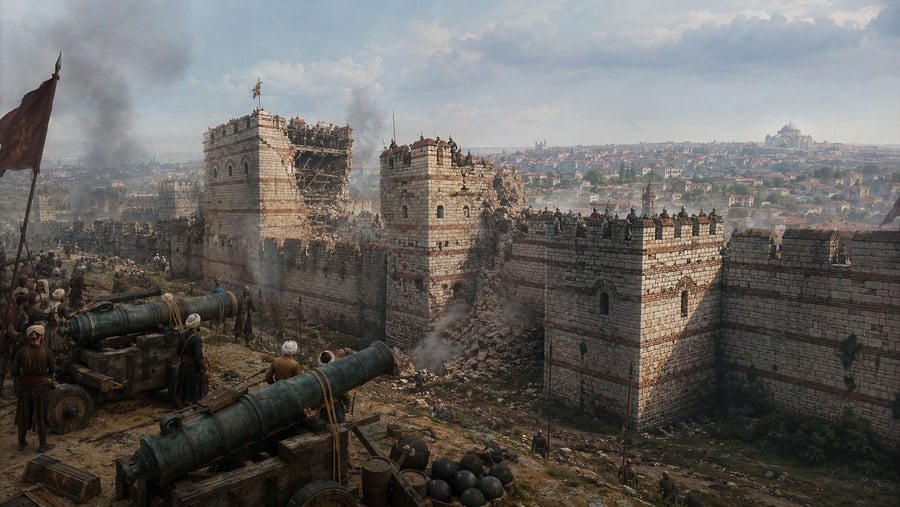
Illustration of the 1453 siege of Constantinople, showing Ottoman artillery attacking the Theodosian Walls 

From The Greek Reporter:

Historian Anthony Kaldellis, Professor of Classics at the University of Chicago, challenges the long-held idea that the Fall of Constantinople in 1453 was inevitable, arguing that the siege should be understood through the specific military and tactical factors that shaped its outcome.

Speaking to Greek Reporter about his new book, 1453: The Conquest and Tragedy of Constantinople, Kaldellis explains that historians cannot prove that an event was inevitable because they have only one historical timeline to go by. “In a sense, nothing in history is inevitable,” Kaldellis tells Greek Reporter. “We can’t go back and run experiments to see if we change certain variables what would happen.”

His argument is directed against the idea that Constantinople’s fall was inevitable, a view he noted appears across scholarship, novels, journalism, and online commentary. Rather than reading 1453 backward from its outcome, Kaldellis argues that the event should be examined through the variables that determined the result “one way or another.” (Read more.)

More HERE, HERE, and HERE.

Share

Wednesday, May 20, 2026

Lady Hamilton: The 18th-Century Beauty Who Revived Ancient Greek Fashion

undefined 

From The Greek Reporter:

Lady Hamilton, a woman who became famous in Europe for her astonishing beauty as well as her political influence, also spread ancient Greek-inspired fashion across the continent for the first time. Born into poverty and working as a scullery maid in her teenage years, she was scorned by her first two lovers who took advantage of her youthful beauty and then left her. Her third lover, however, was Sir William Hamilton, the English ambassador to Naples, who, against all social norms, then made her his wife. Lady Hamilton soon became a fashion icon and started trends, such as draping herself in simple garments that were inspired by classical times and ancient Greece, in particular. She called this Greek-inspired theme “Attitudes” and was known to have used her many shawls during her public performances based on ancient Greek symposia.

Goethe famously wrote of Lady Hamilton: “She wears a Greek garb, becoming to her to perfection. She then merely loosens her locks, takes a pair of shawls, and effects changes of postures, moods, gestures, mien, and appearance that make one really feel as if one were in some dream….”

“Successively standing, kneeling, seated, reclining, grave, sad, sportive, teasing, abandoned, penitent, alluring, threatening, agonized…one follows the other, and grows out of it. She knows how to choose and shift the simple folds of her single kerchief for every expression, and to adjust it into a hundred kinds of headgear,” he wrote. (Read more.)


More on Lady Hamilton, HERE.

Share

Tuesday, May 19, 2026

Odysseus’ Sanctuary on Ithaca

 From ZME Science:

The rocky hills of Ithaca, home to olive groves and old Greek legends, have now yielded their most evocative secret: the possible sanctuary of Odysseus. At a site known for over two centuries as the “School of Homer,” archaeologists have unearthed compelling evidence of a hero cult that persisted for more than a thousand years — dedicated to the mythological king of Ithaca himself and protagonist of Homer’s Odyssey.

The discovery was announced by the Greek Ministry of Culture in early June, 2025, but it is the culmination of decades of archaeological labor. The project, based at the Agios Athanasios site in northern Ithaca, is led by Professor Emeritus Giannos G. Lolos and includes work by Dr. Christina Marambea of the University of Ioannina.

While historians agree that Odysseus was a fictional character, these findings reveal just how real his memory was to the ancient Greeks, who worshipped him, invoked him, and etched his name into stone for generations.

This is the strongest indication yet that the legends of Homer’s Odyssey were not just preserved in verse — but etched into the lives, rituals, and civic identity of the people who lived where the story begins. (Read more.)

Share

Monday, May 18, 2026

The Discovery at Oxyrhynchus

 From The Sunday Times:

The Egyptian archaeological site of Oxyrhynchus, 120 miles south of Cairo, might not have the glamour and renown of the hallowed Valley of the Kings. But a team from the University of Barcelona working at the site has made one of the most significant discoveries in decades.

A mummy from the late Roman period, about 1,600 years old, was discovered buried with a verse of Homer’s The Iliad, the original of which dates back 2,800 years. The text was found in clay with an embalmer’s seal on the outside of the mummy’s wrapping. It is the first time a Greek literary text has been found directly incorporated into the Egyptian mummification process. The discovery, at the ancient city of El-Bahnasa, started as a relatively unexceptional find, said Ignasi-Xavier Adiego, a professor at the University of Barcelona who directs the Oxyrhynchus project. (Read more.)


From The Conversation:

Archaeologists have found something unexpected inside a 1,600-year-old Roman-era Egyptian mummy: a fragment of Homer’s Iliad. It wasn’t placed beside the body, but inside the mummy’s abdomen. But the real surprise isn’t just where the fragment was found. It’s how it got there. To understand, we must go back – to the Iliad itself, and to what it became in the Roman world.

In The Iliad, a poem shaped in the 8th century BC and attributed to Homer, the Trojan war does not end in triumph or renewal. It ends in devastation. The poem closes at the edge of collapse, with Troy reduced to a landscape of heroic ruin. And yet, this is not where the story ends.

According to later Roman tradition, one Trojan escaped. Aeneas – son of Anchises and the goddess Aphrodite – fled the burning city carrying his father on his shoulders and the household gods in his hands. He moved west, across the Mediterranean, towards Italy, where he became the ancestor of Rome.

This continuation did not come from the Iliad itself. It was shaped centuries later, most famously in Virgil’s Aeneid. But it changed the meaning of the Trojan war entirely. The past, in other words, was actively reorganised – through stories that could be reworked, extended and connected across time and space. (Read more.)

Share

Thursday, April 9, 2026

The Ancient Greek Myth That Inspired Tolkien

 From The Greek Reporter:

In Tolkien’s writings, Númenor is described as an ancient kingdom located on a large island to the west of Middle Earth. It is inhabited by the greatest human civilization to have existed and is essentially an idyllic utopia ruled by wise kings. The island itself was a gift presented by the Valar – angelic godlike figures – to the ancestors of the Númenóreans as a reward for facing the Dark Lord Morgoth in battle.

However, over time, the Númenórean civilization is corrupted. The trouble started when the last king of Númenor, Ar-Pharazôn, defeated Sauron, the lieutenant of Morgoth, and brought him back as a prisoner to the island kingdom. Sauron, who was remarkably deceitful, managed to convince the Númenórean king that he could live eternally if only he worshiped Morgoth as a god.

Consequently, the Númenóreans ceased their worship of Eru Ilúvatar, the One God in Tolkien’s mythos, and disaster ensues. For their hubris and corruption, they were punished with the sinking of their island. Only a few of the virtuous Númenóreans escaped to Middle Earth, where they founded the kingdoms of Gondor and Arnor. (Read more.)

Share

Wednesday, April 8, 2026

The Greatest Byzantine Greek Scholars of the Renaissance

 From The Greek Reporter:

Between the 14th and 15th centuries, a wave of Greek scholars left their beleaguered homeland in the Byzantine Empire for the Italian Peninsula, where their work would play an important role in the flowering of the Renaissance. The Renaissance, which literally means “rebirth”, was a period usually identified as lasting between the 14th and 17th centuries. It was characterized by an increased interest in the Greek and Roman past, with the scholars of the time looking back to Classical civilization for inspiration in the arts and sciences.

When the Byzantine Greek scholars arrived in Italy, they brought centuries of knowledge from Greco-Roman civilization with them. Medieval Italian scholars had already taken an interest in Classical Roman civilization, but this new wave of Byzantine intellectuals were well versed in ancient Greek sources and greatly widened the scope of the academic and artistic endeavors that were then possible. (Read more.)

Share

Tuesday, March 24, 2026

The Buried City – Unearthing the Real Pompeii

 https://blogger.googleusercontent.com/img/b/R29vZ2xl/AVvXsEjwvZ3He1YRCZZCRTieyDnPsk7n-802DXp4EGejwpI3sidEtKAm95ZhTkhttcgXomtqnETb1WNcdvyNIBtxMIwWe2R3tpQRFm1gT0543JoXvKTM4X8Gf0hToHPeWw9PvdLj43Xc80r_NHTwYJDWT7lQz4k44CnEAoH5i_417zU0nO7kOWjISXNsdlFmIyQm/s1298/buried+city.webp 

From Reid's Reader:

Zuchtriegel makes it clear that Romans followed and copied Greek art. In fact at one point he notes that Pompeii did not ever have the best art work. He says that ancient Rome, Capua and Verona had more great art works than Pompeii ever had, and they had larger arenas.  He spends some time examining the famous copy of the statue of the Greek god Apollo and its connection with Greek culture. Sensuality and eroticism were displayed in some of the houses of the rich. Zuchtriegel spends some time with freaks and hermaphrodites as they were depicted in Greek tales. Wealthy people’s walls were painted with images of Greek fables and the doings of the Greek gods, sometimes dealing with rape or violence but just as often dealing with images of serenity or weddings. One house, excavated in the early years of archaeologism [in the late 19th century] was named as the House of the Vetti, generally interpreted as a brothel. Wealthy people also had slaves, and the prostitutes were slaves. Slaves could be freed sometimes, but often this would simply mean that an old slave was of no worth anymore and the freed slave was left in poverty and would have nowhere to go.

Having explained all of this, Zuchtriegel notes that in the last years of Pompeii there was a god that was very popular. This was the Greek Dionysus. But he also notes that the very ground Pompeii was built on was originally Etruscan land, and the Etruscan gods were related to nature and agriculture. There were many rituals that had been carried through to the late years of Pompeii. He then returns to the state of the city as it now is. Among other things, some of the ruins were destroyed during the Second World War due to American bombing near to Naples. For a long time there were misunderstandings about the meanings of some buildings that had been buried in the 79 A.D. earthquake. For example, one building that was dug up by amateur archaeologists in the early 20th century, became known as the Villa of Mysteries because it looked dark and there was a long frieze whose meaning was difficult to understand. Could it have been the site of a forbidden cult? But it is now understood that there was no mystery at all. The villa, as it originally stood, was open to the passing public, there were no orgies taking place in it, and the images on the wall had to do with celebrations of a wedding.

It is in the last parts of The Buried City that Gabriel Zuchtriegel goes back to what actually happened when Pompeii was almost obliterated. He likes to show how ordinary people – not just the rich – were going through the streets of the city just before the sky fell in. One example was a chariot that has only recently been dug up by modern archaeologists. Only parts of it survived, but it was clearly being driven on its way to some ordinary event.  Zuchtriegel also often reminds us that those who lived in the most horribly cramped quarters were the poor people – who made up most of the population – and the slaves. As he sees it, the most important people in Pompeii were the poor and the slaves who kept the city running. They were the ones who drove carts bringing into the city the food that came from the fields and the fishing boats, cooked and produced meals, looked after the children of rich etc. Yet they had to live in the worst houses.

Regrettably, says Zuchtriegel, despite all the help of the police, there is still in Naples the Camorra – the Neapolitan version of the Sicilian Mafia -  which illegitimately raids parts of Pompeii, stealing antiquities and selling them to the rich in the black market. But things are now being tightened. There is the frequently-asked question “How many people lived in Pompeii at the time it was destroyed?” Answers range from 40,000 to 20,000, but one also has to be aware of the fact that the rural areas, which brought in grain, stock and milk, should also be seen as part of Pompeii. At an odd point, too,  Zuchtriegel says that Pompeii was probably economically declining in the years before its ruin. Apparently more local farmers now raised grapes as wine became most important… but this meant that grain had to be imported from different countries – like Egypt  - at great price.  (Read more.)

Share

Monday, March 9, 2026

Atlantis: How Plato’s Story Corresponds to Real History

 From Greek Reporter:

Although most people around the world agree that the original Santorini hypothesis so far made the most compelling case where Plato’s Atlantis once was, unfortunately, there are two critical flaws with that theory, which have allowed critics over the years to maintain the story was just a myth.

The first problem is that the hypothesis entirely discards Plato’s given chronology of 9,600 BC. A more significant problem with the original theory is that the primary island of Atlantis, an island the size of Crete, one Plato said was supposed to be nine kilometers away from the circular island within an island setting, is not around the Santorini backdrop of 1,600 BC.

As is common knowledge, a genuine discovery requires that all elements of a physical description are present, and all are in the given order. In this case, if any of the clues given to us by Plato are missing, the elements are not arranged in the correct order, or the chronology does not coincide with Plato’s given chronology, then all is speculation.

The book ATLANTIS The Find of a Lifetime embarks on a 10,000-year journey that effectively reveals Atlantis’s submerged island and demonstrates how Plato’s 2400-year-old story corresponds to real history. (Read more.)


Share

Sunday, March 8, 2026

The Three Tongues on the Cross and The Inheritance of Christianity

 From Jared Selim:

When Our Lord hung with outstretched arms upon the tormenting Cross of Golgotha, Pilate fixed a titulus above His Head. It declared before the world in the three great languages that resounded through Judea: “Jesus of Nazareth, King of the Jews.”

These languages were Hebrew, Greek, and Latin. In the scornful inscription of the Romans, they declared despite themselves what the Jews who delivered their Messiah to death would not: the true and universal Kingship of the Logos made flesh, Filius Dei—the Son of God. As St. Jerome said, “the voices and writings of all nations proclaim the passion and the resurrection of Christ. […] the Jews, the Greeks, and the Romans, [were] peoples which the Lord has dedicated to His faith by the title written on His cross.”1

If these three peoples represent all nations, then every Christian, by our baptism and life in Mother Catholic Church, enters into the Hebraic, Greek, and Roman expressions of Christ.2 The Messiah shines in the particular forms and manners of these nations.(Read more.)

Share

Saturday, January 31, 2026

The Transformation of the Roman Empire Into Byzantium

 From The Greek Reporter:

The transformation of the Roman Empire into what modern historians call Byzantium was not a single event but a gradual process, reaching a profound turning point in the 7th century. By this time, the Roman state had changed in territory, culture, language, religion, and political structure, becoming something new—yet it continued to call itself Roman. The 7th century marked the moment when the Ancient Roman world evolved into the medieval Byzantine Empire, which had previously been known as the Eastern Roman Empire.

Although Hellenistic culture had long prevailed, cemented by the founding of Constantinople in 330, the Eastern Roman Empire retained the core elements of imperial Rome. Its administration remained rooted in Roman institutions, its cities preserved Classical urban culture, and its emperors regarded themselves as heirs of Augustus and Constantine. Latin was in decline, however, even as it remained the official language and the emperors claimed dominion over the entire Mediterranean.

 The transformation was inevitable: Constantinople was emerging as the center of the empire while Rome’s influence waned. As historian Peter Brown observed, Byzantium represents continuity: “The Roman Empire did not fall in the East. It was transformed.” Centered in Constantinople, the Eastern Roman Empire remained a powerful and sophisticated Roman state but with a distinct Byzantine character—while still seeing itself as Roman. (Read more.)


A Byzantine princess in Kyivan Rus. From History of Royal Women:

As the sister of the Byzantine Emperor and as a princess born in the purple, Anna was a highly desirable bride. In 972, the Holy Roman Emperor, Otto II, married Theophano, a relative of the Byzantine Emperor, after requesting an imperial princess. Sometimes Theophanu is thought to have been a sister of Anna, but she was probably related to her more distantly. It is possible that Otto may have wanted to marry Anna instead. In 986, a Bulgarian prince appears to have asked Basil for his sister’s hand in marriage, but this was rejected.

In 988, the new French king, Hugh Capet, sent a letter to Basil, asking him to find a bride for his son, the future Robert II, of equal rank. It was likely Anna, who he was asking for. This arrangement did not go through either. It is believed that all of these proposals were turned down because, at the time, Byzantine princesses born in the purple were considered too important to marry foreigners, even if they were kings or emperors. The Byzantines at this time were also said to have still considered the Western Europeans as barbarians. Everything changed in 988 when Vladimir, Grand Prince of Kyiv, wished to marry Anna. (Read more.)

Share