Wednesday, April 30, 2025

The Sale of Charles I’s Collection

Rubens' Crucifixion, similar to the one in Henrietta Maria's Chapel at Somerset House
 

From Kings, Collectors, and Paintings in the Seventeenth Century:

 The first “authorized moves” (Haskell) may have been carried out at the end of October, 1642. Nine months after the King left London, parliamentary troops seized Windsor Castle and removed the magnificent silver plate made by Christian van Vianen for the ceremonies of the Order of the Garter lost, presumably melted down. From early 1643 onwards, more systematic confiscation and destruction followed and an inventory was made of Queen’s “hangings and household stuff.” A Rubens’s altarpiece may have been thrown in the Thames and it may have had some connection with James I’s Catholic Secretary of State, Sir George Calvert.[1] This Crucifixion by Rubens definitely hung in the Queen’s Chapel, and it seems to have been a victim of Puritan anger. It is known that instructions were given to deface “superstitious” paintings in the chapel of St James’s Palace, but it is not known which, although it looks like Rubens’s altarpiece was destroyed by an enraged Parliamentary commissioner in March 1643 on site rather than being thrown in the river.[2] Despite this vandalism, the King’s pictures survived the war “relatively unscathed.” The King’s collection became a target for the Puritans in whom it aroused anger because of the large sums spent on it, at a time when Charles was engaged in levying taxes without summoning Parliament. (Read more.)


Stuart novel, HERE.
Share

The Last Modern Pope

 From First Things:

For me, the Francis years have the unmistakable sense of an ending, of a last hurrah. Nobody would have predicted that in 2013. To begin with, Francis was, quite simply, a phenomenon. For a while he was as unavoidable as Taylor Swift was last summer. The soundbites echoed through the media for days. The face—grandfatherly, shrewd, usually wearing a broad smile—was everywhere. The Paris Climate Agreement, the prevention of U.S. military intervention in Syria, the peaceful 2016 elections in the Central African Republic, and a surge in confessions in England were all attributed to his efforts.

Moreover, he was consistently surprising. Next to Francis, Donald Trump looked drearily predictable. Just when you were tempted to write him off as a liberal, he would poleaxe the German bishops or issue a thunderous statement on “gender ideology.” Just when you were relishing his comment that “If we don’t proclaim Jesus Christ . . . [w]e would become a compassionate NGO and not a Church,” he would release some turgid document composed in impeccable U.N.-speak. His sternest critics would find themselves floored by a public gesture of kindness or a beautiful mini-sermon on the love of God. Previously undreamed-of initiatives crash-landed on the Church: an Amazon synod; a synod on pretending not to want to change Catholic teaching on the sacraments; a synod on synodality; a ban on advertising the Latin Mass in parish bulletins; a cinematic collaboration with Wim Wenders; a deal to give the Chinese Communist party new powers over bishops and priests. Even the hideous cover-up scandals, like the Zanchetta and Rupnik affairs, had an insane, couldn’t-make-it-up quality to them. He visited sixty-eight countries, published millions of words, and rewrote swathes of canon law. This was a pontificate on a Napoleonic, a Henry VIII scale. You could almost miss, underneath it, the signs of an era coming to a full stop.

That era began in 1864, when Pope Pius IX outraged European and American opinion by condemning the notion that “The Roman Pontiff can, and ought to, reconcile himself, and come to terms with progress, liberalism and modern civilization.” It was, of course, a thoroughly modern sentiment. As Roger Scruton observed, one definition of “modernity” is the condition in which people go around thinking about what it means to be modern. And for the 150 years after Pius’s throwing-down of the gauntlet, there was a general impression that the Church should be thinking about it a great deal, and that the pope’s job was to define the Church’s relationship to the modern world. (Read more.)

Share

How The Dating Scene Became Apocalyptic

From The Daily Wire:

A big part of the problem is that we’ve reached peak feminism in 2025, with so many women opting out of dating entirely and not even pretending to want to settle down with a husband and children. According to a recently published Wall Street Journal article, this is mostly because they’re unhappy with their prospects.

“I’m financially self-sufficient enough to do these things [house hunting, having babies] myself,” one Boston-based single told the outlet. “I’m willing to accept being single versus settling for someone who isn’t the right fit.”

But what is “the right fit?” According to these women who are quick to swipe left on any man who isn’t 100% on board with their career ambitions, it requires an absolutely perfect meshing of interests, values, and goals, plus physical attraction, earning potential, and of, course, height. There is no room for compromise from these perfection-seeking women who say they’re just as content to live solo and brunch with their friends on weekends.

A Washington-based firefighter told WSJ she doesn’t want to be financially tied to a man. “If I need companionship, I volunteer at the dog shelter,” she said. (Read more.)

Share

Tuesday, April 29, 2025

Life of Louise-Marie d'Artois

Author Gareth Russell gives a brief sketch of Louise d'Artois, also known as Louise de Berry, granddaughter of Charles X.
As dramatised in Elena Maria Vidal's novel, Madame Royale, Princess Louise-Marie's life was not to be as happy or tranquil as royalists would have hoped. At the age of only five months, she lost her father when he was stabbed to death by a republican assassin as he left the opera one evening with his wife who was, already, two months pregnant as her husband bled to death in front of her. The Duke's death led to a backlash of anti-republican legislation and sentiment in France, with royalism in France losing its liberal base and becoming more and more dominated by conservatives of the far Right. When the old King died in 1824 and Louise-Marie's grandfather inherited the throne as King Charles X, he was determined to preside over a government with a policy of zero tolerance for compromise. Along with colonial expansion in Algeria and government support for the Industrial Revolution, Charles's government also curtailed the freedom of the press, limited the suffrage and promoted the Catholic religion so overzealously to the extent that one wit once quipped that it was a government for priests, by priests. Intent on atoning for the sins of his youth, Charles X apparently could not understand that the whole nation was not content for the government to insist they atone along with him. In 1830, the King was badly advised by those around him and betrayed by members of his own family, when he was swept off the throne in favour of his liberal cousin, Louis-Philippe. (Read entire post.)
Share

Trump Signs Act Blue EO

From Creative Destruction Media:

I just signed an order to crack down on illegal "straw donor" and foreign contributions in U.S. elections — following reports and congressional investigations regarding potentially unlawful activities through ActBlue and other online fundraising platforms.

Here is the text of the memorandum:

Federal law (52 U.S.C. 30121 and 30122) strictly prohibits making political contributions in the name of another person, as well as contributions by foreign nationals.

Notwithstanding these laws designed to protect American democracy, press reports and investigations by congressional committees have generated extremely troubling evidence that online fundraising platforms have been willing participants in schemes to launder excessive and prohibited contributions to political candidates and committees.

Specifically, these reports raise concerns that malign actors are seeking to evade Federal source and amount limitations on political contributions by breaking down large contributions from one source into many smaller contributions, nominally attributed to numerous other individuals, potentially without the consent or even knowledge of the putative contributors. The reports also raise concerns that such "straw donations" are being made through "dummy" accounts, potentially using gift cards or prepaid credit cards to evade detection.

Further, there is evidence to suggest that foreign nationals are seeking to misuse online fundraising platforms to improperly influence American elections. A recent House of Representatives investigation revealed that a platform named ActBlue had in recent years detected at least 22 "significant fraud campaigns", nearly half of which had a foreign nexus. During a 30-day window during the 2024 campaign, the platform detected 237 donations from foreign IP addresses using prepaid cards, indicating that this activity remains a pressing concern. (Read more.)


Share

St. Malachy and Fr. René Thibaut

"But of this one thing be not ignorant, my beloved, that one day with the Lord is as a thousand years, and a thousand years as one day." 2 Peter 3:8

"But of that day and hour no one knoweth, not the angels of heaven, but the Father alone." Matthew 24:26

After I shared some reflections about the famous “Prophecy of St Malachy” sixteen years ago (see The Prophecies of St. Malachy, Part 1 and Part 2) a reader sent me a book entitled La Mystérieuse prophétie des papes by Fr. René Thibaut, S.J. (Namur: Bibliothèque de la Faculté de philosophie et lettres,1951, Imprimatur: June 28, 1945, Et. Jos. Carton de Wiart) Fr. Thibaut (1883-1952) was a Belgian Jesuit and scholar who made a study of the list of popes attributed to St. Malachy. Fr. Thibaut’s research reveals that there is a great deal more to the Prophecy than I had ever imagined. It is a penetrating treatise which, because of the author’s vast knowledge of Church history and Sacred Scripture, both informs and inspires. The middle of the book is devoted to charts tracing the date of Easter over the years, and the leap years, as well as various ciphers, anagrams and acrostics with which, as Fr. Thibaut demonstrates, the list of Popes is imbued. Fr. Thibaut’s analysis becomes complex at that point although he explains his conclusions with clarity.

Fr. Thibaut maintains that the Prophecy of the Popes is a genuine prophecy. However, the identity of the actual prophet remains unclear. The author of the Prophecy is probably not St Malachy but someone who wrote under the name of the great Irish saint in order to honor him. (p.7) Fr. Thibaut insists that the Prophecy is not meant to worry or disturb but to reassure the faithful about the Providence of God during even the most difficult of times. It is a sort of litany which celebrates the glory and triumph of the universal Church throughout the ages under the leadership of the Roman pontiffs. (p.24) It was a mistake for people of the past (and present) to use the list of popes in order to predict who the next pope would be, for that was never the intention of the original author. (p.20) Neither is it meant to herald the imminent end of the world, because "of that day and hour no one knoweth, not the angels of heaven, but the Father alone." (Matthew 24:36)

According to Fr. Thibaut, the papal legate Nicholas Sanders (1530-1581) may have brought a primitive document containing the Prophecy to Rome during the reign of St. Pius V. Sanders spent a great deal of time in Ireland, which continued to be Catholic in spite of Elizabeth I. Sanders wrote De visibili Monarchia Ecclesiae in which he states that the reigns of the popes are the best “measure of time.” (pp. 23-24) Fr. Thibaut believes that the Prophecy, eventually made public by Wion in 1595, has qualities which indicate an older document of Celtic origin, namely due to the word play and the use of numbers in the various anagrams and acrostics. (p.92) Reading Fr. Thibaut’s explanation of the complex patterns of words and numbers embedded in the list reminds me of the intricacy of the Celtic knot work designs in the Book of Kells and other Irish illuminated manuscripts, albeit the intricacy is in numbers and letters rather than designs.

Of the 111 titles describing all the popes and anti-popes from 1143 to the present, Fr. Thibaut says that while the first 71 titles have been subjected to the tampering of a forger, the last 40, which cover the years 1572 to 2012, are untouched. The year of 2012 is repeatedly emphasized as coinciding with the last Pope on the list, called the “Glory of the Olive.” [Pope Benedict XVI] Fr. Thibaut demonstrates the calculation of the year 2012 on a series of charts. The last 40 popes of the genuine part of the prophecy span four centuries with an average of eleven years per reign, and so he calculates 440 years from 1572. 1572 +440 =2012. (pp. 22-23) Fr. Thibaut shows how the year 2012 keeps appearing in other calculations as well. He also insists that it will only be in the year 2012 that it will become clear whether his interpretation of The Prophecy is correct or not. (p.101)

Fr. Thibaut says that 2012 signifies the end of an era in the history of the Church, recalling how other eras have come and gone. The destruction of Jerusalem in A.D. 70 marked the close of an era, as did the fall of Rome in the fifth century. The fifteenth century saw the end of medieval Christianity with the Reformation. (p.22) The Revolutions of the eighteenth and nineteenth centuries as well as the World Wars of the twentieth century were events which manifested the judgment of God as well as signaling changes for the Church and the world. (pp. 88, 92, 96)Throughout such stages, the Church has been guided by the successors of St. Peter. (p. 22)

Speaking of St. Peter, the list concludes with the following phrase: "In the final persecution of the Holy Roman Church there will reign Peter the Roman, who will feed his flock amid many tribulations, after which the seven-hilled city will be destroyed and the dreadful Judge will judge the people.” Fr. Thibaut explains how “Peter the Roman” does not signify a future pope calling himself “Pope Peter II” but rather Petrus Romanus symbolizes all the Roman pontiffs since St. Peter, for the Church has continually undergone persecution of some kind. (p.25) The destruction of Rome will not necessarily follow immediately after the end of the era in 2012, but may come at a later date. (p.21) Nevertheless, Fr. Thibaut surmises that it is not unthinkable that at some point in the future the Popes may change their residence and govern the Church from somewhere other than the city of Rome. (p.22)

The final pope on the list is given the title Gloriae olivae, “The Glory of the Olive.” Fr. Thibaut says that the olive represents the people of God whom His judgment will glorify. (p.97) Once again, Fr. Thibaut insists that the Prophecy is genuine since so often in the last 400 years the titles have accurately described a pope and his reign, too many times for it to be pure chance. This is discussed in great detail and perhaps will be the topic of a future blog post. (To do full justice to such an exhaustive work is beyond the scope of one or two blog articles.) Fr. Thibaut ends by saying: L'année 2012 dira si, oui ou non, le prophête a vu clair. (p.101) That remains to be seen.

Fr. Thibaut's analysis of the titles given to the various popes is worth reflecting upon since so much of the history of the Church is captured therein. The last forty titles of the prophecy attributed to St. Malachy, which escaped the tampering of Renaissance forgers, are carefully scrutinized. Fr. Thibaut discerns that among the complex patterns woven into the Prophecy are thirteen couplets or binaries, as seen on p. 85:

77. Crux Romulea, Aquila rapax 97. Clement VIII, Pie VII.
78.Undosus vir, Peregrinus apostolicus 96. Leon XI, Pie VI.
79. Gens perversa, Ursus velox 95. Paul V, Clement XIV.
80. In tribulatione pacis, Rosa Umbriae 94. Gregoire XV, Clement XIII.
81. Lilium et rosa, Canis et coluber 98. Urbain VIII, Leon XII.
82. Jucunditas crucis, Lumen in caelo 102. Innocent X, Leon XIII.
83. Montium custos, Crux de cruce 101. Alexandre VII, Pie IX.
84. Sidus olorum, De balneis Etruriae 100. Clement IX, Gregoire XVI.
85. De flumine magno, Vir religiosus 99. Clement X, Pie VIII.
86.Bellua insatiabilis, Animal rurale 93. Innocent XI, Benoit XIV.
87· Paenitentia gloriosa, Columna excelsa 92. Alexandre VIII, Clement XII.
88. Rastrum in porta, Miles in bello 91. Innocent X II, Benoit XIII.
89. Flores circumdati, De bona religione 90. Clement XI, Innocent XIII.
I will share Fr. Thibaut's explanations of some of the binaries and how they connect with historical events. Crux Romulea (Clement VIII, 1592-1605) and Aquila rapax (Pius VII, 1800-1823) signify the confrontation between two Romes, of Christian Rome symbolized by the Cross with pagan Rome symbolized by the Eagle. Under Clement VIII the Protestant advance was halted while under Pius VII Napoleon, "the rapacious eagle," tried to make Europe and the Church his own in a new Roman Empire. (p.86)

The titles Lilium et rosa (Urban VIII, 1623-1644)) embraces the latter period of the counter Reformation of seventeenth century. (p.86) The "Lily and the Rose" symbolize the virtues of purity and chastity preached and lived by such extraordinary saints as St. Francis de Sales, St. Vincent de Paul, St. Jeanne de Chantal, and St. Louise de Marillac, as well as the religious orders founded at the time, such as the Visitation, the Daughters of Charity, the Lazarists, the Eudists, the Oratorians, and the Sulpicians. (p.87) Canis et coluber (Leo XII, 1823-1829)) or the "Dog and the Serpent" signifies the age of Revolution, of the liberalism which encouraged unrestrained license (p.87) and the class hatred and envy that would eventually give rise to socialism.

Bellua insatiabilis (Innocent XI, 1676-1689) or "Insatiable Beast" represents Louis XIV whom Innocent excommunicated. In his insistence on controlling the Church in France, Louis emulated Philip le Bel, as well as becoming a precursor of Napoleon, the "Rapacious Eagle." Gallicanism opened the way for the overt paganism of the reign of Louis XV, manifested in art, in literature and in lifestyles. Animal rurale (Benedict XIV, 1740-1758) symbolizes the preoccupation with naturalism that characterized the era, being that in prophetic language the words "animal" and "rural" symbolize paganism. (p.88) Such elements opened the way to the Revolution.

Towards the end of the list, Fr. Thibaut explores the individual meaning of the titles in chronological order, often in strophes of three. I will mention those I found especially compelling. Rosa Umbriae is Clement XIII, reigning from 1758 to 1769. In 1765 Pope Clement authorized the feast of the Sacred Heart; the "Rose" symbolizes the feast of love. (p. 90)

There follows a triptych of popes, numbers 95, 96 and 97 which are Ursus velox (Clement XIV, 1769-1774), Peregrinus apostolicus (Pius VI, 1775-1799) and Aquila rapax (Pius VII, 1800-1823). Clement XIV's reign saw the prelude to the Revolution, ideas and forces which swept Europe like a "charging bear" during the years which also saw the suppression of the Jesuit order. The Jesuits were among the few who had the ability to debate and confound the new ideas put forward by the philosophes; the order was disbanded at the moment it was most needed.

As an anagram "PeregrInUS aPostolIcUS" or "Apostolic pilgrim" signifies both Pius VI and VII who were forced into exile. Fr. Thibaut says that the repetition of the name "Pius" is a refrain. "Pius! Pius!" is similar to the sailors' cry of "Land! Land!" upon catching sight of a distant shore. (p.91) The difference between the two popes is that Pius VI had to contend with the Revolution, and Pius VII with the Aquila rapax, Napoleon Bonaparte, as has been said before.

Another triptych of popes includes Crux de cruce (Blessed Pius IX, 1846-1878), Lumen in caelo (Leo XIII, 1878-1903), and Ignis Ardens (St. Pius X, 1903-1914) There is an exhaustive analysis of the mysterious connections between the three popes and the historical circumstances which they each faced which would take five blog posts to explain. For one thing, they each received at baptism a name of one of the three saints closest to the Blessed Mother: John, Joachim, and Joseph. (p.95) The "Cross from the Cross" refers to the persecution of the papacy at the hands of the House of Savoy, whose coat-of-arms bore a cross. On a deeper level, it signifies Christ Crucified, with Mary the Coredemptrix at the foot of the cross. "Cross from the Cross" is an echo of "flesh of my flesh" of Genesis 2:23, when Eve was brought forth. The new Eve, Mary Immaculate, received the privilege of her Immaculate Conception, defined by Blessed Pius IX in 1854, because of the future merits of her Son. (p.94) "The Light in the Sky" of Leo XIII is an allusion the the Eternal Father who dwells in light inaccessible. (1 Tim. 6:16). It also alludes to Apocalypse 12: 1: "And a great sign appeared in the sky." (p.94) The encyclicals of Leo XIII challenged the modern world as it grew closer to the cataclysms of the twentieth century. "The Ardent Fire" of St. Pius X signifies the persecution of the Church (p. 93), about to be intensified in many places, and already in full force in France, where many religious communities were expelled.

Next Fr. Thibaut analyzes the three popes who faced the upheavals of the early twentieth century, Religio Depopulata (Benedict XV, 1914-1922), Fides Intrepida (Pius XI, 1922-1939), and Pastor Angelicus (Pius XII, 1939-1958). "Religion Depopulated" refers to the World War I which Fr. Thibaut says was the natural effect of the great apostasy of the European nations. The apostasy, however, was not universal, and the "Intrepid Faith" of Pius XI symbolizes the martyrs in Spain and Mexico at the time. (p.96) The fall of Russia into Communism and the resultant persecution of believers needs also to be remembered. "The Angelic Shepherd" was Pius XII, who would lead the sheep through many catastrophes, namely World War II and the spread of Communism.

Pius XII was still reigning when Fr. Thibaut published his book, so his historical insights end with that pope, although he guesses at what the future would hold. He surmises that Pastor et nauta, the "Pastor and Mariner" whom we know as John XXIII (1958-1963), signifies that the Church's mission to the world would come into into stormy seas. (p.97) Fr. Thibaut predicted that the persecution of the Church by the world would be redoubled during that reign. He saw Flos florum, "The Flower of Flowers" of Paul VI as a consoling symbol (p.97) Others have connected the lilies of purity with Humane Vitae.

De medietate lunae "Of the half moon" is (John Paul I, August 26-September 28, 1978) and De labore solis "The Eclipse of the Sun" is (John Paul II, 1978-2005). Fr. Thibaut says that in prophetic language the sun and moon herald the coming of the judgment of God as well as calamitous times of great schism in the Church. Changes in the moon signify civil anarchy and changes in the sun suggest religious anarchy. (p.97) It also comes to mind, remembering how Pope John Paul II canonized more saints than any pope in history, the verse from Matthew: "Then shall the saints shine like the sun in the kingdom of their Father." (Matthew 13:43)

It is then, as Fr. Thibaut interprets, that the kingdom of God will be manifested in an extraordinary manner. Benedict XVI is De gloria olivae. "The Glory of the Olive" means that the people of God, represented by the olive tree, will be glorified in an unprecedented way. Fr. Thibaut claims that many factors point to 2012 as being the pivotal year for the culmination of events but, as he makes clear, exactly what the future holds remains to be seen. (p.97) He makes it clear, however, that this does not indicate the end of the world but the end of an era. As for myself, I have found Fr. Thibaut's book to be inspiring, in that he reflects upon all that has already transpired, upon the many calamities through which the Church has journeyed. It is cause for hope rather than trepidation, hope which inspires reverence, prayer and vigilance.

"But of that day and hour no one knoweth, not the angels of heaven, but the Father alone." Matthew 24:26


(More reflections on Fr. Thibaut's book, HERE.)

Share

Monday, April 28, 2025

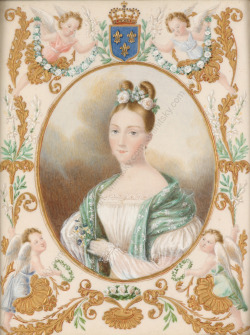
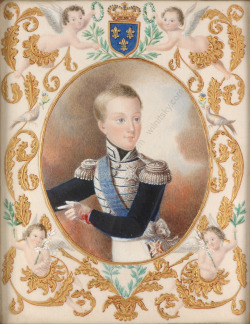
Louise and Henri d'Artois

The grandchildren of Charles X.


Madame Royale is available HERE.
Share

Intentional Crash

 From Tierney's Real News:

A few months ago, I wrote a detailed 4-part series about the helicopter that collided with a plane near DC and provided evidence that it was likely intentional and NOT an accident. I was called all sorts of names by people - even conservatives - who called me a conspiracy nut, deranged and worse.

"Why can't it just be an accident??" shouted one to my face.

BECAUSE THE EVIDENCE INDICATED IT WAS NOT AN ACCIDENT AND I BELIEVE IN REPORTING THE TRUTH - NOT MAKING THINGS UP SO PEOPLE FEEL BETTER!

WELL, it just came out that the female helicopter "pilot" - Rebecca Lobach - who worked at the White House with Biden - REPEATEDLY ignored orders to turn away from the American Airlines plane and flew right into it - killing 60 plus people. The New York Times just released new details about the fatal crash and it revealed that the alleged pilot, Rebecca Lobach, repeatedly ignored warnings from her co-pilot about her altitude and her course. 

If you studied the evidence like I did - it was obvious that the helicopter was engineered both horizontally and vertically to purposefully crash into that plane. Either the equipment was faulty, or the pilot was faulty, or both.

The co-pilot, a male Army flight instructor, directly told her repeatedly to turn away, and she flew straight into a passenger jet.

“Not only was the Black Hawk flying too high, but its pilot failed to heed a directive from her co-pilot, an Army flight instructor, to change course."

Sounds intentional. Sounds like MK ULTRA to me. If you haven't read my report yet - you should read it. I believe I was one of the few to get it right. If you are one of those readers who viciously attacked me for my original premise - I hope you are honest enough to say you were wrong instead of pretending you were right all along. Thank you. (Read more.)

Share

The New Pope?


Share

Sunday, April 27, 2025

Why Veils Mattered at the Pope’s Funeral

I have no idea why a hat with a black netting would be considered particularly "British." From MSM:

The European royals are masters when it comes to dressing for formal ceremonies. But Melania Trump proved she could hold her own amongst them at the funeral of Pope Francis in the Vatican City’s St Peter’s Square on Saturday.

The US first lady wore a black double-breasted coat-dress, lace gloves and a black lace mantilla-style veil over her hair. Her predecessor, Dr Jill Biden, also adhered to the dress code flawlessly, donning a veil and sheer black tights. Among the royals in attendance were Queen Letizia of Spain, Crown Princess Mette-Marit of Norway, Queen Mathilde of Belgium and Queen Silvia of Sweden – they all wore similar head coverings, but chose to eschew the requirement for gloves. If anyone has a sense of when to bend the rules, it would be them, so Prime Minister Keir Starmer’s wife Victoria was in good company. Her black circular hat with black netting made for a very British twist on head covering. (Read more.)


Share

Civil War

 From Tierney's Real News:

General Flynn published this article and it’s a view that’s rarely discussed - so I thought I would share it. As you read it - think about the implications for America.

As many of you know, Angela Merkel of Germany was famous for saying that she wanted to build an EU army and that’s why she imported so many fighting age men from 3rd world countries. Her motive for “helping the poor immigrant” was not a humanitarian one - it was so they could die to protect HER country. The motive behind LBJ’s “new society” was the same - he changed the draft rules so he could force MORE young black men and Hispanic men to die for him in Vietnam. I believe that’s one of the reasons why the left has opened America’s borders wide as well - to bring in fighting-aged men for an eventual draft - just like they are doing in Ukraine. It’s not just for votes and cheap labor - it’s also for the military. In fact, Ukraine has drafted so many men that they are now rounding up women off the streets to die for their war with Russia.

Now they want Americans to die them for as well. What does General Flynn think will happen in Europe after the Ukraine-Russia war ends? CIVIL WAR.

Europe’s Next War Won’t Be in Ukraine—It’ll Be in the Streets

The European Union is quietly dreading the day the war with Ukraine ends. Because when the war ends, the real trouble begins.

Not all the weapons being sent to Ukraine are staying there. There are credible reports of smuggled arms already making their way into black markets across Europe. Think assault rifles, grenade launchers, anti-tank weapons—serious hardware.

We’ve seen this movie before. After the Yugoslav wars in the 1990s, Europe was awash with surplus weapons. Those weapons were later used in everything from gang shootouts to terrorist attacks. Ukraine has become a training ground for paramilitary groups. What happens when these people come home to Europe?

You don’t have to imagine it. Just look at post-ISIS Europe. Veterans of jihadist fronts came back radicalized, traumatized, and ready for violence. The EU has spent the last decade allowing—often encouraging—mass immigration with minimal vetting.

In countries like France, Sweden, and Germany, authorities are now struggling to deal with rising crime, gang violence, and extremist networks. Some neighborhoods have effectively become no-go zones. Sexual violence has spiked. Integration has failed in key places.

Now ask yourself: What happens when radicalized individuals already inside the EU—some of them with ties to extremist Islamist groups—get access to the same black-market weapons flowing out of Ukraine? It’s a nightmare scenario that nobody in the EU wants to talk about. (Read more.)

Share

What the Catholic Church Needs

 From Politibrawl:

With the passing of Pope Francis—may he rest in peace—the faithful face a pivotal moment. For millions of Catholics worldwide, the papacy is not just a symbol; it’s the spiritual anchor, the guiding light in a world drowning in moral confusion. Today, as secularism, wokeism, and modernism erode the foundations of faith, we need a pope who will fiercely defend the Church’s timeless traditions, not bend to the fleeting whims of a culture gone astray. We need a leader like Cardinal Robert Sarah—a bold, anti-woke, pro-life traditionalist—to steer the Church back to its unwavering moral core.

Let’s be clear: the Church is not a political institution, nor should it chase popularity contests. Its mission is eternal—to proclaim the truth of Christ, to uphold the sanctity of life, marriage, and family, and to provide a moral compass for a world desperate for meaning. But under Pope Francis, God bless him, we saw a papacy that too often flirted with modern ideologies, softening the Church’s stance to appease left-wing interests. His efforts to embrace inclusivity and environmental causes, while well-intentioned, diluted the Church’s moral clarity. The faithful don’t need a pope who panders to the progressive elite. They need a shepherd who stands firm, unapologetically proclaiming the Gospel in a world that’s lost its way. (Read more.)


Share

Saturday, April 26, 2025

What You Might Not Know about Marie-Antoinette

About eight years ago I came upon two articles that purport to inform the world about what it does not know about Marie-Antoinette. With the PBS atrocity bringing all the old slanders to life, it is time to revive a critique of the false stories.  The History.com article is fairly accurate, except the nonsense about Louis having a "painful medical condition" for which there is no medical evidence. As for the part about the "fairy-tale village", the Queen merely rebuilt the village at Trianon that had once been there, giving the cottages to local peasants, with one for herself.  To quote:
When told that starving French peasants lacked any bread to eat, the queen is alleged to have callously declared, “Let them eat cake!” There is no evidence, however, that Marie Antoinette ever uttered that famous quip. The phrase used to encapsulate the out-of-touch and indifferent royals first appeared years before Marie Antoinette ever arrived in France in philosopher Jean-Jacques Rousseau’s description of Marie-Therese, the Spanish princess who married King Louis XIV in 1660. The remark was also ascribed to two aunts of Louis XVI before it was apocryphally tied to Marie Antoinette. (Read more.)
The National Geographic article is good except for the part about the Queen using flour on her wigs. Marie-Antoinette was almost always "in her own hair," that is wigless, sometimes with light powder. And this absurd statement: "To be clear, Marine Antoinette was no saint. She believed that the French Bourbon monarchy had been ordained by God, and so she didn’t accept the idea that royals like her were equal to their subjects." So we are to understand that Marie-Antoinette was "no saint" simply because she believed in the only system of government she had ever known? Does being part of a  monarchy automatically disqualify someone from sainthood? Does the writer not know that the Church has canonized emperors and empresses, kings and queens?

But the rest of the article is not bad. To quote:
Versailles, for all its decadence, was a very dirty place, filled with animals and excrement. Instead of cleaning their shoes, the royals and aristocrats would throw them out every few days. This culture of waste and excess was something Marie Antoinette stepped into when she arrived in France. She didn’t create it, and she didn’t take it to the extremes that others did. At least four members of the royal family spent more on clothing than she did—including Louis XVI’s brother the comte d'Artois, who ordered 365 pairs of shoes per year. Though she certainly went through more shoes than the average French person, Marie Antoinette “wasn’t known to have been a particular shoe freak” at Versailles, says Weber. (Read more.)
Share

Tesla Loses Its Appeal to the Left

 From Direct Line:

Fast-forward to the Tesla era.

If Subaru is stealth signaling, Tesla is the equivalent of a pride parade riding a Bitcoin bull. Elon Musk doesn’t do subtle. And yet, the early Tesla buyer had a few clear boxes to check:

  • ✅ Tech Savvy

  • ✅ Climate Conscious

  • ✅ Casually Affluent

The car was sleek, the software was new, and the vibe was distinctly coastal—bicoastal, to be specific. Alexandria Ocasio-Cortez had one. So did Adam Schiff. Climate guilt? Assuaged. Luxury status? Secured. The only hiccup for the Left was that Teslas weren’t union-made. But faced with a choice between climate correctness and “the workers,” AOC chose to go green. Essentially sums up the priorities of today’s progressives.

But here’s the twist. Cars, unlike hats or hashtags, don’t change with the season. You’re stuck with one for years. So when Elon Musk made his not-so-subtle ideological pivot (Dogecoin tweets, anti-woke rants, boisterous MAGA cheerleading), it left Tesla’s early adopters in a bind.

Because if you’re a progressive with a Tesla in your garage, you’re now driving around in the equivalent of a red hat—just with better aerodynamics.

It’s the same identity whiplash that hit Bud Light.

Once the go-to beer of suburban backyard masculinity, Bud Light found itself center stage in a culture war after a brief partnership with transgender influencer Dylan Mulvaney. The campaign wasn’t even a full ad—just a branded can and an Instagram video. But it was enough to trigger a collective identity crisis among its most performatively macho consumers.

Pity the guy who just wanted a cold one and ended up in the wrong side of a Newsmax segment. Many switched to Modelo, Coors Light, or whatever beverage still felt “safe” from narrative shifts. That’s the dilemma for brand-loyal consumers today: You don’t just buy a product—you buy its politics, its vibe, its signal. And when the signal changes, you’re left stranded. With a six-pack. Or a $60,000 electric car.

It gets worse. EVs, it turns out, don’t hold their value. There’s no thriving used market. No easy off-ramp. Teslas can depreciate more rapidly than other vehicles, especially due to factors like frequent price changes and evolving technology. The rapid pace of innovation in the EV market can make older Teslas feel less desirable quickly, affecting their resale value. That sleek car in your driveway is aging into a paperweight with a lithium-ion battery.

So, feel free to give Alexandria Ocasio-Cortez a call. She’s looking to unload her Tesla at a reasonable price. And she wants to continue following Bernie Sanders’ lead and get a Subaru Forester. (Read more.)

Share

The Story Of Christabella Wyndham

 Charles II's first mistress, a much older woman, who had been one of his nurses. Bizarre on many levels. He was only 14. Today she would be jailed. From London Walks:

When Charles was 14, England was in the middle of the Civil Wars. It was during the struggles between the Parliamentarians and the Royalists, mainly over England’s governance and issues of religion which ended with the execution of Charles I in 1649. The following so-called Commonwealth period under the Puritan rule and de facto dictatorship of Oliver Cromwell.

In the spring of 1645, the young Prince Charles, then Prince of Wales, was sent by his father to Bridgwater garrison under the command of Edmund Wyndham to unite royalist forces and to hold Council. With him was his chief advisor, Edward Hyde, Chancellor of the Exchequer who was a bit of a schoolmasterish and a rather pompous man, maybe not the best man to deal with a 14-year-old fun-loving boy.

It was at Bridgwater garrison that Charles re-encountered his former nurse Christabella and apparently sparks flew, she seduced him without any resistance from his side and it came to a scandalous liaison.

What is curious is that according to contemporary morals, it wasn’t the fact that a young boy was seduced by an older woman which was scandalous. This was considered more of a privilege than an offence, not even that the seducer was his former wet-nurse. No, what caused a scandal was that Mrs Wyndham, a celebrated beauty, and Charles were displaying an open show of affection, including spontaneous gestures like diving across the room and covering his face with kisses. Hyde was outraged at their behaviour and he felt that she distracted Charles “with her folly and petulance” from conducting his business.

What Hyde was criticising was Charles’ teenage rebellion and defiance of authority, coupled with a strong interest in sex. Something that Charles would always be remembered for and which was possibly triggered by the woman who had given him his first physical pleasures. (Read more.)

Share

Friday, April 25, 2025

Louis XVI and Marie-Antoinette in a Eucharistic Procession

Louis XVI and Marie-Antoinette in the Eucharistic procession that opened the Estates-General in the spring of 1789. (From Vive la Reine.)
On May 4, 1789, she put Louis-Joseph and his sister with Madame de Polignac on a balcony above the stables so they could watch the magnificent Eucharistic procession which marked the opening of the Estates-General. The procession wound from the Royal Chapel, across the vast courtyard of the palace, through the streets of the town of Versailles, to the Church of Saint Louis. The monstrance, in the hands of a bishop, was under a rich canopy carried by Provence, Artois, Berry, and Angoulême. Everyone held a candle, except for the standard bearers, with the fluttering silken banners, and the royal falconers, with falcons on their wrists, looking both noble and fierce. The King, with a lighted taper, walked directly behind the monstrance. He wore a cloth of gold mantle and a plumed hat with the famous Regent diamond. He was wildly applauded by the crowds that lined the route. But when Antoinette, who with her ladies followed the King’s household, passed by in her gown of gold and silver tissue, every tongue fell silent. She could almost taste the hatred. It frightened her. 
When passing beneath the balcony where her sick boy was lying, she glanced up to blow him a kiss. The cry “Long live Orléans!” resounded in her ears. The extent of the malice overwhelmed her. That someone could hate her so much that they would use her child’s suffering as an opportunity to humiliate her; that they would praise her known enemy at a moment when as a mother she was most vulnerable, within the hearing of her pain-wracked Dauphin, stunned her as much as if she had been whipped or burnt. She halted, dizzily, then turned to see who had insulted her. In doing so, she staggered, but before she lost her balance, Princesse de Lamballe took her arm and steadied her.
 ~ from Trianon by Elena Maria Vidal
Share

The Crimean Conundrum

 From Jeff Childers:

U.S. negotiators had organized a high-profile Wednesday meeting to discuss terms for a permanent cease-fire plan with top Ukrainian officials in London. The US intended to present a deal the Russians had allegedly agree to, which would have completely and indefinitely halted the fighting while a final peace deal could then be negotiated at leisure.

Problems arose when Kiev’s thespian-in-chief got an advance copy of the agenda. His bloodshot eye was immediately drawn, not to his side of the ledger, but to something the U.S. had offered Russia to lock in Putin’s agreement. Specifically, the Americans offered to recognize Crimea as Russian territory. But the deal did not require Ukraine to make the same concession. It was win-win.

But winning was too much for the vertically-challenged Martial Law Administrator. He blew his short stack. Zelensky, enraged, got in front of Ukrainian media before yesterday’s talks began and delivered a defiant diatribe that would make a South African military dictator blush. Never Crimea! We won’t do it! We won’t let YOU do it! And more ranting to the same effect.

Secretary of State Rubio and Special Envoy Steven Witkoff immediately pulled out, scratched, and canceled their reservations, and let the junior members of the team handle the Ukrainians instead. Surprising no one, the discussions came up empty, or as NBC put it, “the high-level talks disintegrated.”

Ukraine’s Deputy Prime Minister, Yulia Svyrydenko, who attended the short-lived meeting explained, “Our people will not accept a frozen conflict disguised as peace.” Whatever that means.

Crimea is literally the dumbest place imaginable to stake out a red line.

🚀 Crimea is a jagged peninsula shaped like a lion’s paw, jutting defiantly into the northern Black Sea, sun-scorched in summer, wind-lashed in winter, and soaked in the blood of centuries of conflict. The storied peninsula has been claimed, conquered, and coveted by civilizations from the Greeks, Scythians, and Byzantines to the Tatars, Ottomans, and finally, the Russians, when Catherine the Great annexed it in 1783, calling it “the jewel in her southern crown.” (Read more.)

Share

The Tomb of Alexander the Great: New Clues

 From The Collector:

Few historical figures have captured the imagination as much as Alexander the Great, the conqueror of Persia who never lost a battle and whose empire stretched from Greece to India. Yet, despite his legacy, the location of his tomb and body remains one great unsolved mystery. In a fascinating interview with Dr. Christian de Vartavan*, an Egyptologist and author of “Locating the Tomb and Body of Alexander the Great”, we explore new theories about Alexander’s tomb and body

*Dr. Christian de Vartavan (FLS FRSA CMLJ) was educated at University College London’s Institute of Archaeology, where he earned his BA, MSc, and PhD degrees. While still a student, Dr de Vartavan gained world fame in Egyptology by discovering part of the forgotten plant material from King Tutankhamun’s tomb in the Royal Botanical Gardens, Kew in 1988. Dr de Vartavan’s Egyptology research has earned him the rare honor of being part of the UK’s National Archive in his lifetime and is kept by the University of Oxford’s Griffith Institute (Sackler Library). His family lived in Alexandria between 1903 and 1992, where he spent part of his youth. (Read more.)


Share

Thursday, April 24, 2025

Library at Althorp

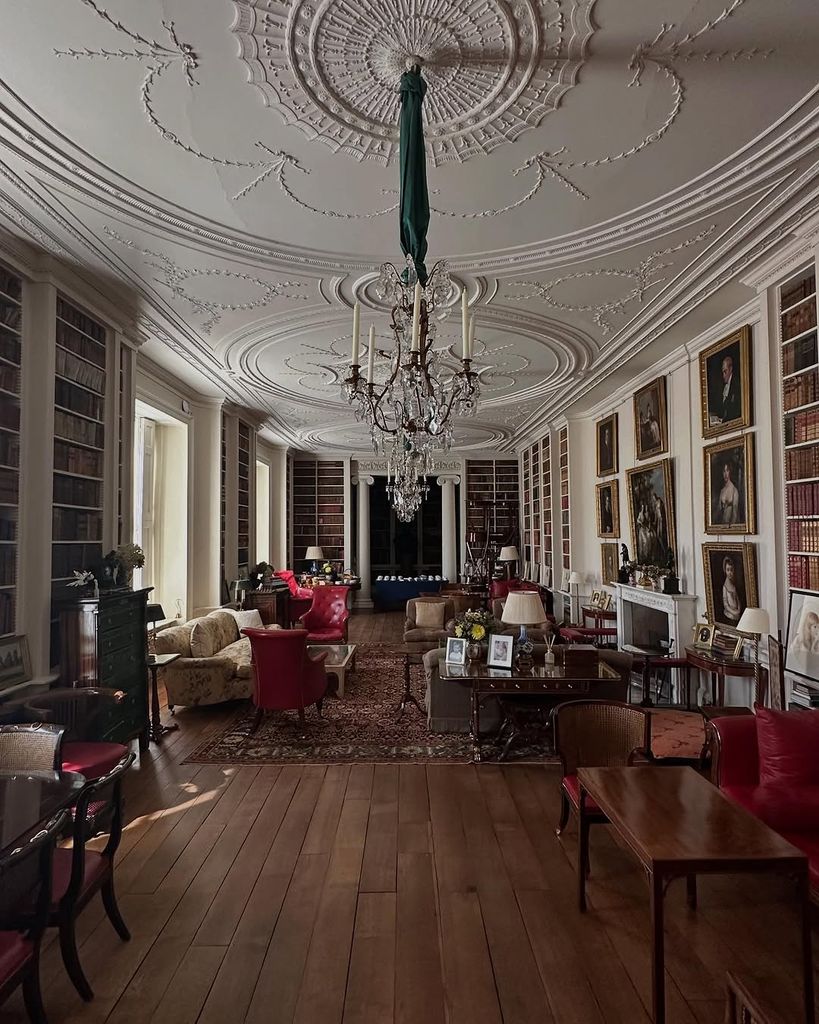
 big library with many chairs and chandelier on ceiling 

From Hello!:

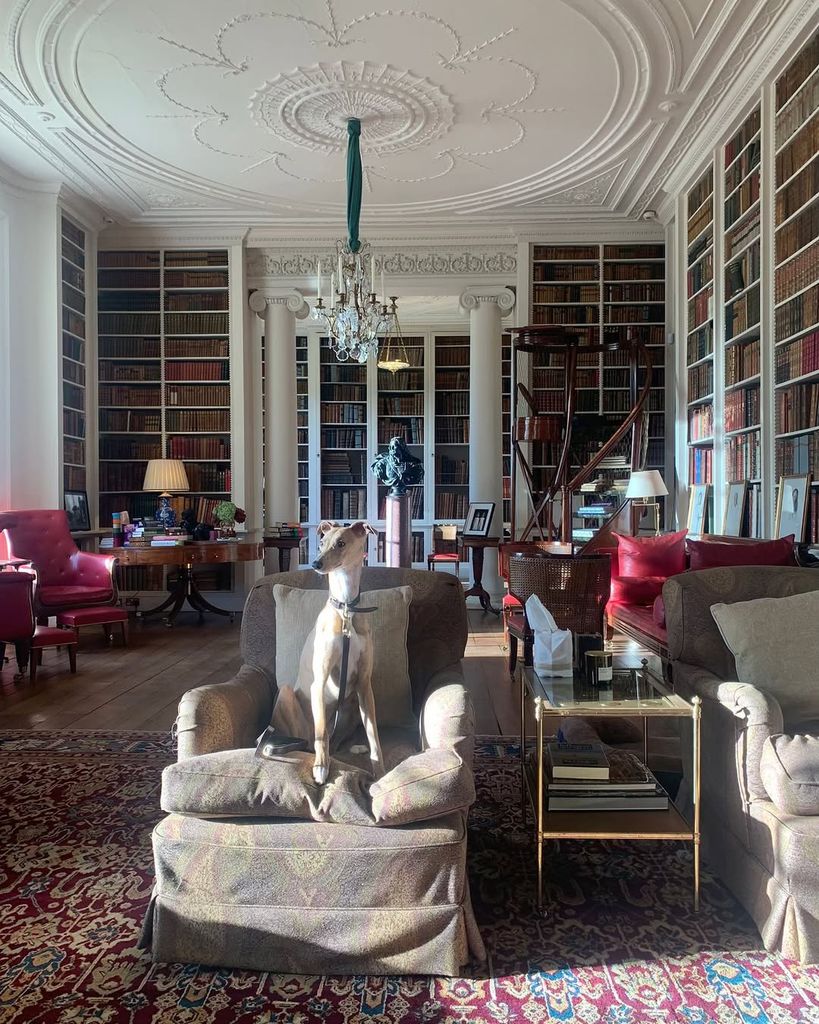
In October Charles shared new photos of the 10,000-book library, which is undeniably one of the most breathtaking areas in the 90-room home, which sits on 13,000 acres of land. The latest snap pictured a dog sitting on one of the many chairs, as sunlight bathed the packed shelves in a near-magical glow. An array of mahogany furniture pieces and a deep red leather armchair give the room a truly rustic feeling, while an impressive chandelier hangs above.

"A pair of photographs taken by friends staying this weekend - a lurcher in the Library, and leaves on the lawn," Charles penned in the caption. "Zelda the lurcher is a frequent visitor to Althorp, and rightly feels quite proprietorial."

He also revealed earlier last year, in a separate Instagram post, that the room hadn't always been a library: "Traditionally the family sitting room, the Library in Althorp House, is home to 10,000 books, including the remnants of the private library amassed by the Second Earl, which was once the finest in the world." (Read more.)

dog sitting on chair in library

Share

Noble Motherhood

 From Ally's Substack:

It seems like we are hearing more and more complaints from mothers about the duties of motherhood—cleaning, cooking, driving kids to practice. I get it; I have done my fair share of grumbling. I had to laugh when I saw a short clip of the famous Aretha Franklin. When asked what the most difficult thing she faced was, she thought for a while and said, “Trying to figure out what to make for dinner every day.” That is a woman we can relate to! And yet this culture of disrespecting motherhood as well as mothers themselves, continually complaining about their lot, is certainly not good for society, or for the young girls watching and deciding in advance they don’t want such grief.

And even if many of the duties and “emotional toll” of motherhood do dampen happiness, is that a reason to give it up or to whine about it? As Lewis Carroll explains, giving others happiness is more noble than being happy ourselves. What makes such self-sacrifice noble? (Read more.)

Share

America’s 13 Colonies Did Not Fight Alone

 From The Christian Science Monitor:

In his excellent new book, “Shots Heard Round the World: America, Britain, and Europe in the Revolutionary War,” author John Ferling places much of his emphasis on “the world.” Ferling dramatically conveys the global significance of America’s long fight for independence in what he calls an “international history” of the war.

This is not to suggest that the author, a professor emeritus at the University of West Georgia, neglects the home front in his elegantly written volume. He opens with the circumstances that led the 13 American Colonies to break from England and then covers each year of the drawn-out conflict in vivid detail. He describes the pivotal confrontations – from the opening Battles of Lexington and Concord in April 1775 to the victorious Battle of Yorktown exactly 6 1/2 years later – and analyzes the strategies, accomplishments, and missteps of Continental army Commander in Chief George Washington, British commander William Howe, and Howe’s eventual replacement, Henry Clinton. (Read more.)

Share

Wednesday, April 23, 2025

The Shame of Our Nation

The race card. From Fox News:

Pastor Corey Brooks, known as the "Rooftop Pastor," is the founder and Senior Pastor of New Beginnings Church of Chicago and the CEO of Project H.O.O.D. (Helping Others Obtain Destiny), the church's local mission. He gained national attention for his 94-day and 343-day rooftop vigils to transform the notorious "O-Block," once known as Chicago's most dangerous block, into #OpportunityBlock. Learn more at ProjectHOOD.org. (Read more.)

Share

Ice Age Art

 From ARTnews:

The British Museum has announced that it will loan “some of the rarest surviving examples” of Ice Age art to Bradford, the 2025 UK City of Culture.

Around 70 objects from the museum will be shown in the northern city as part of an exhibition titled “Ice Age Art Now.” It is the result of a partnership between the British Museum and Bradford District Museum & Galleries, and is slated to open June 21 at Cliffe Castle Museum in the town of Keighley, West Yorkshire. The museum is 10 miles northwest of Bradford.

The exhibition will showcase works made in Europe toward the end of the last Ice Age, which ended 12,000 years ago. It is being curated by Jill Cook, the keeper of Britain, Europe, and Prehistory art at the British Museum.

“[Between 24,000 and 12,000 years ago], the slow recovery from near extinction caused by climate change stimulated an extraordinary artistic renaissance,” the British Museum said in a statement. “As the climate warmed, there was a vast increase in the production of drawings, sculptures, decorated tools and weapons, jewellery, and complex patterns. These artworks were not crucial to the physical survival of human groups but then, as now, art contributed to people’s psychological and emotional wellbeing, helping to establish the strong social bonds essential to sustaining their ways of life.”

The British Museum said that many of the objects in question are rarely loaned out due to their fragility and age. They include an old flint point found in France that’s 24,000 years old: “It reveals the ability and dexterity of the artisan, as well as the capacity to materialise and communicate ideas through the production of high-quality, non-functional objects.”

Two reindeer engraved on bone, found in France around 13,500 years ago, will also be on show, as well as an engraved bone pendant depicting a wolverine that’s roughly 13,000 years old. It was also discovered in France. (Read more.)

Share

Tuesday, April 22, 2025

Fake News and Salacious Rumors at Versailles

 
I am disappointed to hear that the PBS series Marie Antoinette depicts Count Fersen as the true father of the Queen's two youngest children. A book by Nancy Goldstone which came out a few years ago is filled with the same lies that the revolutionaries used to destroy her reputation. I so enjoyed Goldstone's books on Elizabeth Stuart and Marguerite de Valois. But to say that Marie-Antoinette's youngest children were illegitimate is utterly contrary to what we know about the Queen. And Louis XVI may have been high-functioning on the Asperger's/autism spectrum but that did not keep him from loving his wife and fathering children. So many old fallacies resurrected. What a shame! From Caroline Weber at The New York Times:

In her new biography, “In the Shadow of the Empress,” Nancy Goldstone seeks to tell “the story of a family of immensely strong women, beginning with Marie Antoinette’s formidable mother, the empress Maria Theresa … and three of her daughters, of whom the notorious queen of France was but the youngest.” (The other two are Queen Maria Carolina of Naples and Marie Christine, Duchess of Techsen.) Goldstone, the author of books about Catherine de Medici and Mary, Queen of Scots, is drawn to female royals who defy “tradition and stereotype,” and on that count her new subjects have much to offer. Regrettably, her book does not.

The problem starts with the “selected genealogy” that opens the book, where Goldstone lists the two youngest of Marie Antoinette and Louis XVI’s four children, Louis-Charles (later Louis XVII) and Sophie, as the illegitimate offspring of Count Axel von Fersen, a Swedish officer whom the queen undoubtedly loved, but with whom, as the scholar Susan Lanser wrote in 2003, “no one yet … has been able to establish whether she had a consummated relationship.” Indeed, historians and biographers generally agree that the evidentiary record cannot answer this question conclusively.

On the one hand, speculation about the nature of the pair’s involvement was rife at Versailles, where scabrous rumor-mongering — especially about the ladies of the court — had flourished for more than a century. On the other, Marie Antoinette’s rank subjected her to the round-the-clock company and scrutiny of countless attendants, domestics and (during the French Revolution) guards. So closely monitored was her existence that of her 15-year friendship with Fersen his own diary — which Goldstone includes in her bibliography, and which Stefan Zweig describes in his influential study of Marie Antoinette as “a record of incomparable value for those who love ‘hard facts’” — identifies just one specific date on which the pair may have spent the night alone together. That hypothetical tryst occurred in February 1792, nearly seven years after Louis-Charles’s birth and five and a half years after Sophie’s. Even so, Goldstone justifies her claim about the two children’s paternity by asserting without qualification that the “Nordic dreamboat” was “the queen’s lover” and “stayed with her many nights.” (Read more.)

I cannot even begin to say how ridiculous the idea of  a 1792 affair is, because the Queen was under house arrest at the Tuileries, with guards outside the door and coming into her rooms at all time of the day and night. I have written more about this HERE, HERE, and HERE. And in my bio of Marie-Antoinette, HERE.


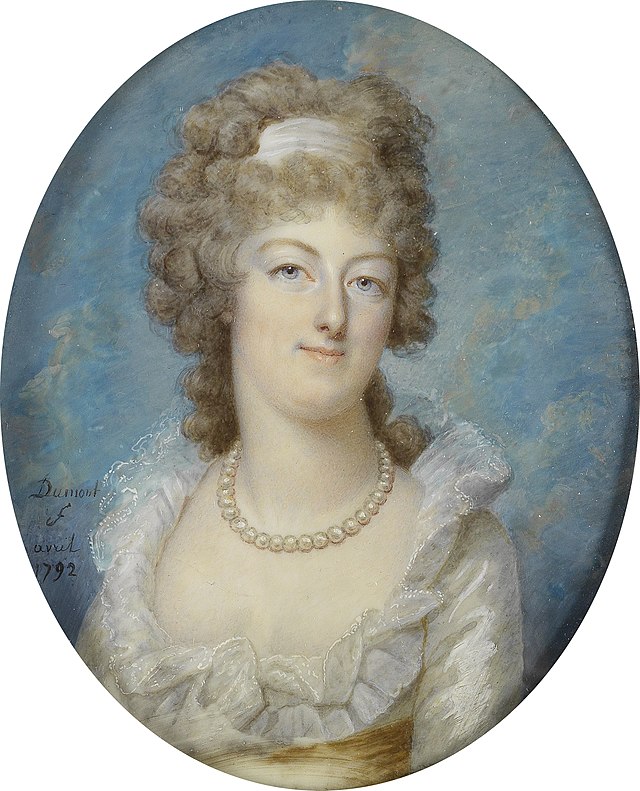
Marie-Josèphe de Saxe, Dauphine of France, wife of Louis the Dauphin, was the mother of Louis XVI. It is said that her little grandson, the tragic Louis XVII, resembled her a great deal, as can be seen in the portrait below. It gives further lie to the ridiculous rumor that Count Axel von Fersen fathered Louis-Charles (Louis XVII).

Share

The Church After Francis

 From Archbishop Chaput at First Things:

Having said that, an interregnum between papacies is a time for candor. The lack of it, given today’s challenges, is too expensive. In many ways, whatever its strengths, the Francis pontificate was inadequate to the real issues facing the Church. He had no direct involvement in the Second Vatican Council and seemed to resent the legacy of his immediate predecessors who did; men who worked and suffered to incarnate the council’s teachings faithfully into Catholic life. His personality tended toward the temperamental and autocratic. He resisted even loyal criticism. He had a pattern of ambiguity and loose words that sowed confusion and conflict. In the face of deep cultural fractures on matters of sexual behavior and identity, he condemned gender ideology but seemed to downplay a compelling Christian “theology of the body.” He was impatient with canon law and proper procedure. His signature project, synodality, was heavy on process and deficient in clarity. Despite an inspiring outreach to society’s margins, his papacy lacked a confident, dynamic evangelical zeal. The intellectual excellence to sustain a salvific (and not merely ethical) Christian witness in a skeptical modern world was likewise absent. (Read more.)


More HERE.


Share

Under One Roof

From GMA:

The 29-year-old is a mom of three. She said she made the choice to live with her 84-year-old grandmother, her mother, and her younger sister to prioritize stability and financial freedom.

"Between my grandma, my mom and my sister, they kind of all just, like, help out. And the price of rent -- I pay my mom a portion versus having my own mortgage," Jade Lowe explained.

The U.S. Census Bureau estimates housing costs are still unsustainable for many households, with rent in the U.S. averaging $1,406 and the median mortgage coming in at $1,902. About 1 in 3 adults between the ages of 18 and 34 also still live in their parents' home.

Jade Lowe said it's a choice she doesn't regret at all.

"It allowed me to still live my best life in my 20s. It allowed me to honestly just be happy and not have to worry about those extra expenses. I get to keep it, and I get to put it in my savings," she said. "It means everything, honestly." (Read more.)

Share

Monday, April 21, 2025

A Brief History of Tutus


 From BAE:

New advancements in the theater—particularly in lighting—played an important role in tutu development. In the late 18th century, theaters were lit by candlelight and ballet costumes were made of heavy silk, woven with metallic thread and decorated with spangles and sequins, which glittered in the flickering light. By the early 19th century, brighter and more even gaslighting had been invented, which created a very different effect. The new tutus glowed bright white in this light.

However, the combination of lighter-weight fabrics and gaslighting was a dangerous duo. Many ballerinas tragically died when the skirts of their tutus caught fire. The most famed was Taglioni’s protégée Emma Livry, whose costume caught fire during a rehearsal. Although fireproofing was available, many dancers refused because it made the costumes stiff and dull. Eventually, new ways of fireproofing were developed, and lighting was made safer. (Read more.)

Share

Maher and Kirk on Women's Sports

 From The Vigilant Fox:

The conversation pivoted to an issue even some liberals are struggling to defend: women’s sports. Kirk praised Maher for speaking out.

“You deserve credit for being a liberal that acknowledges male-female distinctions,” he said.

“Oh, of course! Of all the low-lying fruit the Democrats just hand the Republicans to win elections, that’s the one,” Maher responded.

Kirk grinned and asked, “Are they really gonna let us win every national election on this no-men-in-women’s-sports thing?”

Maher answered bluntly: “It’s so ridiculous.”

He cited the stat that 890 trophies had already gone to biological males competing in women’s events—and even pointed out that California’s own Gavin Newsom had backed away from the debate.

“You lost Gavin Newsom on this,” he said. “Take that as a hint.” (Read more.)

Share

Phoenicians: The First Rulers of the Mediterranean

 From The Greek Reporter:

The ancient Greeks named the Phoenicians the “purple people” because of the rare purple dye they made out of snail shells, but they were much more than that: they were the Mediterranean seafarers who created the first alphabet

It was the Greeks who named the Mediterranean civilization Phoenicia (Φοινίκη) in the Late Bronze Age (1500-1200 BC). It was located in modern-day Lebanon and locals called their land Canaan and themselves Canaanites.

Herodotus described the Phoenicians as avid sailors, skilled merchants, technological innovators, and naval warriors. Homer’s literary depiction of them is that they were famous skilled sailors in the Mediterranean with posts reaching to modern-day Portugal and Spain and that they made beautiful textiles which they traded. (Read more.)

Share

Saturday, April 19, 2025

Irish Easter

St. Columba

 From The Easton Gazette:

The old Irish celebrated Easter on a different date from the continental Church for two centuries or more during what is known as the Dark Ages. This has fascinated me ever since I did a book report on the Synod of Whitby (664) in college. It was at Whitby that the conflict between the different customs of Celtic and Roman Christians in the British isles came to a head. Most of the north of Britain had been converted by the zealous Irish monks, led by Saint Colum Cille.

The Irish monks wore a tonsure different from the Roman monks; the Irish had their foreheads shaved from ear to ear, with long hair trailing down their back, while the Roman custom was to shave the crown of the head. The Irish claimed that their tonsure came from Saint John the Evangelist whereas the Romans claimed to have inherited their tonsure from Saint Peter. The tonsure, however, did not cause nearly as much problems as the date of Easter. From the beginning of Christianity the Church celebrated Easter at the same time the Jews observed Passover, on 14 Nisan, at the first full moon after the Spring Equinox. Following the Council of Nicaea in 325, the Roman church placed the equinox on March 21, while the Celtic churches insisted upon March 25 as the date of the Equinox. And so some years Easter in the two rites coincided but other years it did not. From The Freelance History Writer:

The Celts understood that the tradition they followed was that taught by the apostle John and they calculated Easter day as falling between 14 Nisan and 20 Nisan – i.e. When the 14 Nisan (the Passover) fell on a Sunday, they celebrated it on that day. But if it fell on the day after (on Monday) then the Easter celebration would fall on the following Sunday (20 Nisan), etc. The Rome loyalists claimed the authority of the apostle Peter, and calculated Easter Day as falling between 15 Nisan and 21 Nisan.

So when the date of 15 Nisan through to the 20 Nisan fell on a Sunday, and the full moon had fallen after March 25th, both Celtic and Roman Christians would celebrate Easter on the same day. It was when the Celts celebrated on 14 Nisan itself on Sunday that one main difference came, as the Rome loyalists then celebrated Easter a week later on 21 Nisan instead. This explains the situation described by the Venerable Bede: “Thus it is said to have happened in those times that Easter was twice kept in one year; and that when the king having ended the time of fasting, kept his Easter, the queen and her followers were still fasting, and celebrating Palm Sunday”. In that particular year 14 Nisan had fallen on a Sunday.

 (Read more.)


More HERE.

Share