Showing posts with label Marriage. Show all posts

Tuesday, August 9, 2022

The Book of St Alban


From Open Culture:

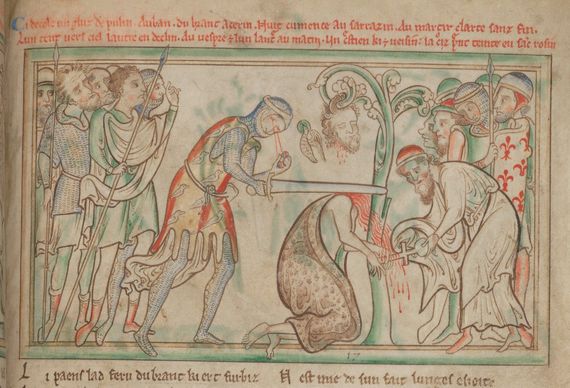
This past month, on the eve of the June 22nd feast of St Alban, the library of Trinity College Dublin announced that it had digitized the “13th century masterpiece” the Book of St Alban, a richly illustrated manuscript that “features 54 individual works of medieval art and has fascinated readers across the centuries, from royalty to renaissance scholars.” Created by the Benedictine monk Matthew Paris, the manuscript “chronicles the life of St Alban,” notes The Irish Times, “and also outlines the construction of St Alban’s Cathedral in Hertfordshire.” The text and illustrations explain the origins of a cult of St. Alban, the first English martyr, that began to spring up after his 4th century death. (Read more.)
Share

Thursday, February 10, 2022

Myths About the French Revolution

 A fairly accurate assessment from Lessons from History:

Confusingly, the Revolution did not begin on 14 July 1789 when a mob tore down the Bastille a notorious Paris prison. Yet, France celebrates the destruction of the Bastille as the beginning of the Revolution. Instead, historians mark the beginning of the Revolution as the great Fiscal Crisis that came to a head in 1788. Essentially, the French Monarchy could not raise enough money to pay its bills. The crisis began because the Monarchy lacked the legal power to impose the taxes needed to finance the government.

Instead, the fiscal crisis forced King Louis XVI to take drastic action. The drastic action was to convene the first meeting of France’s parliament, the Estates General, since 1614. No king had convened an Estates General for 175 years because the body theoretically had the power to rewrite France’s constitution. Yet, Louis XVI felt he had no choice because the government needed money. (Read more.)


From Mental Floss:

When the Bastille was stormed on July 14, 1789, there were only seven inmates. One was a wayward relative sent by his family, four were serving time for forgery, and two had been committed due to insanity—not the political prisoners you might have imagined. But if the goal wasn’t to free prisoners, why attack a prison? The real reason, according to most historians, was for ammunition.

At the time, it was clear to everyone that France was in serious debt, in part because they had just helped the U.S. win the American Revolution. Back in France, it was the already-worse-off citizens who were suffering from the fallout of that financial crisis, including inflation, food shortages, and so on.

Two months before the attack on the Bastille, King Louis XVI had convened the Estates-General to figure out a game plan. There were three estates: The First was clergy; the Second was nobility; and the Third comprised everyone else—which mostly consisted of the bourgeoisie and peasants. The Third Estate was raring for serious reform, and its members were worried that the more conservative elements of France would try to tamp them down.

Those worries escalated in July, when Louis XVI fired Jacques Necker, a finance minister who had enjoyed the Third Estate’s support. That, combined with the fact that troops had moved into positions surrounding Paris, made Third Estate members think the king was plotting against them.

So on July 14, about 2000 people raided Paris’s Hôtel des Invalides for weapons and then marched to the Bastille to seize its ammunition. Guards tried to resist, but the Bastille’s governor, Bernard-René de Launay, finally gave in. It didn’t turn out great for Launay—he was beaten badly, and when he kicked someone in the crotch, the mob cut his head off and paraded it around town.

It didn’t take long for the storming of the Bastille to take on an almost mythic significance. Revolutionaries considered the fortress a symbol of monarchical overreach and oppression, and they slowly tore it down over the coming months. (Read more.)


Share

Wednesday, November 17, 2021

“I Just Can’t be Cheerful in the Morning.”

 From Alice von Hildebrand at Finer Femininity:

The French author Balzac writes, “It’s easier to be a lover than a husband, because it’s easier to say witty things occasionally than to be witty every day.”

Balzac is highlighting the fact that an illicit relationship is limited to a short time, when you put on your most attractive face. But marriage is marriage, early in the morning and late at night. This is one of the difficulties all spouses encounter in marriage: they’re together when they’re not at their best. As you’ve discovered, sleeping together is a great and beautiful intimacy; but it also means you wake up together, which for most of us isn’t the best moment of the day. We’re disheveled, groggy with sleep, not interested in talking, and usually rushing around to get ready for the day’s work. Unless this potentially disillusioning aspect of the intimacy of marriage is counter-balanced by a deepening of your love and spiritual life – and a great measure of patience – it’s bound to cause difficulties that don’t crop up in a casual relationship.

There are ways to deal with these problems. If you’re not cheery in the morning, then talk with Michael about it – but do it later, when you’re brighter and more clearheaded. Let him know you’re sorry and are trying to change, but aren’t having much success. Assure him that in the early morning he just isn’t encountering your true self and ask him to avoid discussions at these times, because they’re bound to end badly. (Hasn’t Michael asked you to do the same for him when he comes home from work tired and grumpy?)

Yes, Balzac is right: it is easier to be a lover than a spouse, because it’s easier to be at your best occasionally than to be at your best all the time. But our concern isn’t with what is easier; our concern is with what is more beautiful: a relationship based on the feelings of the moment or a deep enduring love, sealed by marriage, in which the spouses love each other in good times and bad, in sickness and in health, until they’re parted by death. Marriage is the beautiful mystery of faithful love – a theme so profound and so fascinating that it unleashes in me a torrent of thoughts which I long to share with you. (Read more.)


Share