Showing posts with label Louis XVI. Show all posts

Monday, September 28, 2026

The Pope in France

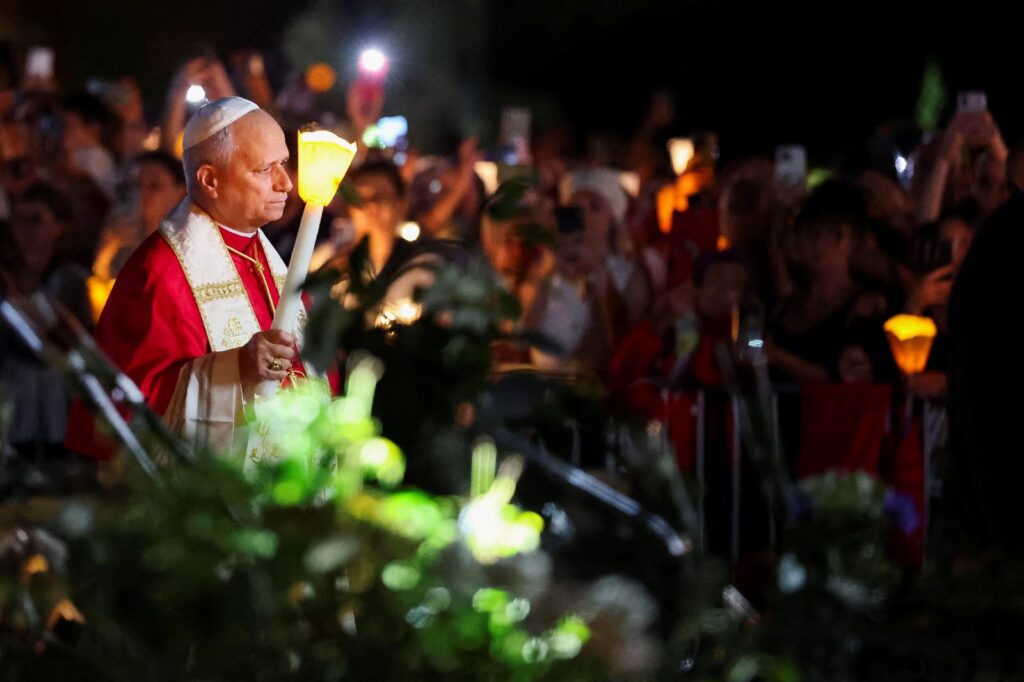
Pope Leo XIV in Notre Dame Cathedral
Pope Leo at Notre Dame with the statue of Our Lady of Charles X

 From Vatican News:

Light inundated Notre-Dame as Pope Leo XIV celebrated vespers in Paris' beloved Cathedral. It felt like a fitting celebration for the restored and renewed basilica, a place of worship and iconic symbol of the “Ville Lumière“, badly damaged by fire on 15 April 2019.

On that day, dramatic images and videos of the cathedral engulfed in flames, and of people praying in the streets as the fire consumed the building, spread around the world through social media and news outlets.

Today, the French Church has come together again. This time to rejoice, as the Pope visited the Cathedral and celebrated Vespers, almost two years after its reopening in December 2024, following a long and meticulous restoration process.

As the sun shone through the stained-glass windows, colorful patterns moved slowly across the walls. Meanwhile, an organ played and the choir sang while the bishops, priests, consecrated men and women, seminarians, and other members of the French Church solemnly prayed together with the Successor of Peter.

Before the Vespers, Pope Leo venerated a relic of the crown of thorns, which was placed on Christ’s head during his Passion. A symbol of his suffering and sacrifice before his Resurrection.

“We are gathered for Evening Prayer in this place which, more than any other, has invited the people of Paris for centuries to lift their eyes towards heaven,” Pope Leo said in his homily. (Read more.)

Mass at the Place de la Concorde, where thousands were guillotined (Via Daily Mail)

I wish instead of Robespierre the article had mentioned Madame Elisabeth. From Rome Reports:

The Place de la Concorde in Paris is a site marked by some of the darkest moments in French history.

During the Revolution, the guillotine stood here, and more than a thousand people were executed. Louis XVI, Marie Antoinette and Robespierre were among them.

Two centuries later, Pope Leo XIV celebrates the Eucharist here before nearly 600,000 people. A turnout that marks a new chapter in the Church in France.

The pope is using this celebration to call for a secular society.

LEO XIV

Seeing you gathered here, brothers and sisters, heirs to a long and beautiful history of holiness in France, I say to you: in turn, drink deeply from this spring that is the pierced Heart of Jesus. Yes, you thirst for God, for life, for truth, for unity, for peace, for communion, for happiness. You long to rediscover a radiant horizon, to build a renewed nation rooted in a faith that nourishes its very foundations.

But the pope does not stop with France’s religious identity. He goes straight to the individual and a much more universal question: what does a Catholic drink from when he or she thirsts for life?

LEO XIV

Brothers and sisters, we must acknowledge that here on earth, nothing can fully satisfy us. Just when we think our search is finally over and our efforts have been rewarded, that inner emptiness often resurfaces, even more profound than before.

Are we content with material possessions, immediate gratification, and the countless little idols that promise the world but leave our hearts empty?

And while, in 2008, Benedict XVI came to France asking how faith could survive in a secularized society, today, Pope Leo XIV is not talking about survival.

He is talking about renewing the country from its roots: building a renewed nation through a faith that can once again nourish society.

This is not about rebuilding a blood-soaked square, but renewing a society that, according to the pope, thirsts for truth, peace and happiness. (Read more.)

Pope Leo XIV visits the Sanctuary of Our Lady of Lourdes, a Marian shrine and pilgrimage site dedicated to Our Lady of Lourdes, on Sept. 27, 2026. | Credit: Vatican Media
Pope Leo in Lourdes

From EWTN:

Leo met Sept. 27 with staff and sick guests of the Accueil Notre-Dame (Notre Dame Home), a residential accommodation classified as a healthcare facility, which hosts sick, disabled, and frail pilgrims to Lourdes.

The Catholic shrine is one of the most visited in the world, drawing more than 3 million people every year, many in search of miraculous physical healing.

The 136-acre property includes the Grotto of Massabielle, where a young St. Bernadette Soubirous saw 18 apparitions of the Virgin Mary starting on Feb. 11, 1858. Today, pilgrims to the sanctuary bathe themselves in the freshwater spring Mary revealed to Bernadette.

Visitors have reported 7,000 healings since the apparitions; after lengthy investigations, the Church has declared that 72 of the recoveries were miraculous, meaning unexplainable by science. (Read more.)


 From CWR:

The Sanctuary of Our Lady of Lourdes is among the most popular Catholic shrines in the world, built on the site of Mary’s apparitions to St. Bernadette in 1858. It is particularly visited by the sick, who come to bathe in or drink its healing spring water.

In his homily, Pope Leo noted that a “call to conversion, both tender and urgent,” was a central part of the message the Virgin Mary entrusted to Bernadette, and that “it is today, not tomorrow, that we must repent.”

He said Jesus is quite direct about the call to repentance: “As St. Luke tells us, ‘Unless you repent, you will all perish.’ But he also extends our horizon beyond this earthly life to the horizon of eternal life.”

“Did not the Virgin Mary say to St. Bernadette, ‘I do not promise to make you happy in this world but in the next’?” Leo said.

The pope noted that we can often forget this in an age and society focused on progress and material wellbeing.

Eternal life is already won for us by Jesus’ sacrifice, he continued, but “the obstacle to grace and eternal life — the only obstacle to this love — is sin.” (Read more.)


 From OSV:

Holding a large candle in his right hand and a rosary in his left, Pope Leo processed slowly behind an illuminated statue of the Virgin Mary through the crowd of pilgrims holding candles, as the five decades of the glorious mysteries of rosary were prayed in multiple languages.

As the “Ave Maria” Lourdes hymn was sung between mysteries, all of the pilgrims in the square in front of the Basilica of Our Lady of the Rosary lifted their candles high in the air, creating a sea of lights.

“The light that guides us and draws us onward is the light of hope, which never abandons us even as we journey through this life — a life often marked by trials, yet already filled with the joy of knowing ourselves to be children of God, loved and saved by Jesus,” the pope said.

“Those who are sick are privileged witnesses to this transfiguration of our lives through faith and love of God and neighbor.” (Read more.)
Share

Sunday, September 27, 2026

Royal Orders

Which orders were worn by Louis XVI? A fascinating blog Once I Was a Clever Boy explores the question. To quote:
In the portraits the King can clearly be seen wearing the sky blue moiree riband of the Order and the breast star with its motif of the Dove. The riband was the first to be prescribed in the statutes of an order, and is the origin of the term 'cordon bleu' as asign of honour. The Order specifically commemorated King Henri's accession to the thrones of Poland on Whitsunday 1573, and to that of France on Whitsunday 1574, and hence the use of the Dove as a symbol. It also served to recall the account of the Holy Dove bringing the Sainte-Ampoulle at the baptism of Clovis in 496, and the source of the Holy Oil used at the Sacre of the King at Rheims. The design of the breast star and badge of the Order was to be copied and adapted by many other orders in Spain, Sicily, Sweden and Great Britain with the badge of the Military Division of the Order of the Bath, with lions and unicorns replacing the fleur-de-lys.
Share

Tuesday, September 22, 2026

Reforms of Louis XVI


Here are some of the reforms of Louis XVI, made of his own free will beginning from the moment he ascended the throne. He was considered quite the Liberal. 

  1774 Louis XVI placed Turgot in charge of finances and introduced free circulation of grain. Founded School of Medicine in Paris. 

  1775 Droits d'octroi were reduced, prison reform begun, and the death penalty for deserters was abolished. 

 1776 The king signed the six edicts of Turgot comprising the abolition of the corvée. The parlements resisted the edicts, preventing them from becoming law. In the same year he reduced his household.

  1778 More taxes reduced. 

  1779 The king abolished servitude and other reforms were made.

  1780 Further reductions in the Royal household were made, hospital reform was begun, prison reform continued, most torture was abolished. 

  1784 Relief given to Jews. 

  1786 More hospital reform, aid to the deaf, and provisions made for lost children. 

  1787 Steps taken towards the total abolition of the corvée, more reductions in royal household, civil rights accorded to Jews and Protestants. 

 1788 All forms of torture were abolished, greater freedom given to press, steps towards abolition of lettres de cachet.

 All of the above is taken from Nesta Webster's Louis XVI and Marie-Antoinette during the Revolution, but it is a matter of public record as well. There are also discussions on the king's reforms in Simon Schama's Citizens and Vincent Cronin's Louis and Antoinette. Anyone who thinks Louis XVI was a lazy, sluggish, do-nothing king need only examine the six volumes of laws passed during his reign. He wanted to reform the feudal tax system, which is why he called the Estates-General. If all the nobles and wealthy clergy had been minimally taxed, there would have been no deficit. The enemies of the king were determined his plans were not to succeed. They had been planning for years. As Marie-Antoinette wrote to her brother Leopold II in August 1790 about the society she had once thought to be innocuous:

Be well on your guard where you are with regard to all associations of Freemasons. You must already have been warned that it is by this means that all the monsters here count on attaining the same end in every country. Oh, God, preserve my fatherland and you from such misfortunes.
(Image: Louis XVI rendant la liberté aux serfs de son royaume. Dessin de Charles de Wailly, 1783.) Share

Sunday, September 20, 2026

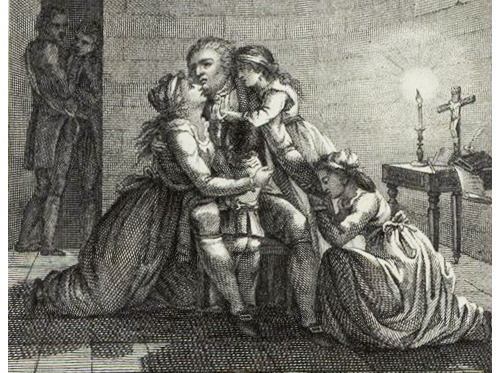
Louis XVI's Last Meeting with His Family

From Vive la Reine:
At half-past eight the door opened; the queen appeared first, holding her son by the hand; then Madame Royale and Madame Élisabeth; they ran to the arms of the king. A gloomy silence reigned for several minutes, interrupted only by sobs.
… The king sat down, the queen on his left, Madame Élisabeth on his right, Madame Royale nearly opposite to him, and the little prince between his knees.
All were bending towards him and held him half embraced. This scene of sorrow lasted seven quarters of an hour, during which it was impossible to hear anything; we could see only that after each sentence of the king the sobs of the princesses redoubled, lasting some minutes; then the king would resume what he was saying.—the journal of Jean-Baptiste Cléry

Share

Saturday, September 19, 2026

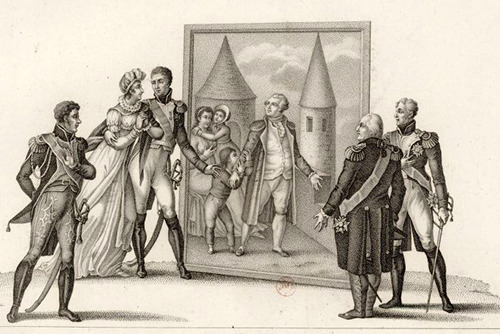
Marie-Thérèse Viewing a Portrait of Her Family at the Temple

Notice how her husband Louis-Antoine is very attentive. He knew how such things upset her.  Berry stands alone off to the side on the left. And then there are Artois and Louis XVIII on the right. One wonders what passed through their minds when seeing their doomed brother and his family. Via Vive la Reine. Share

Wednesday, September 9, 2026

Madame Elisabeth: A Consoling Angel

From Detroit Catholic:

Called a "consoling angel," the sister of King Louis XVI decided to stay on the side of her family even when death was imminent for doing so in the midst of the horrors of the French Revolution. On the 230th anniversary of her death under the guillotine on May 10, 1794, "Madame Elisabeth" is one step closer to beatification as the historical commission for her sainthood cause wrapped up its work May 2. The diocesan phase of her sainthood cause was reopened in 2017. Since then, Fr. Xavier Snoëk, the postulator, has spared no effort to raise awareness of the noble lady.

She was "an original and very modern young woman … pious and exuberant at the same time," Father Snoëk told OSV News. "She read a lot while being passionate about science and mathematics. She was also very athletic. She loved the outdoors and was an excellent horseback rider." (Read more.)

Share

Sunday, September 6, 2026

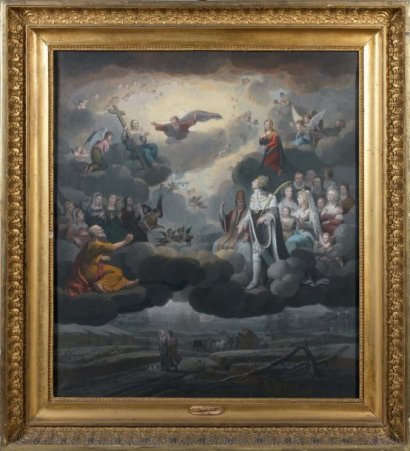
The Cloud of Witnesses

A marvelous painting showing Madame Royale in exile, walking down a long road with her uncle Louis XVIII, as the Blessed Trinity, the saints, the angels and her own family, watch over her from above. Share

Friday, September 4, 2026

‘Desk Revolutionaries’

 From History Today:

The Directory, the regime which ruled France during the closing years of the revolutionary decade, took its name from the five-man executive body that was elected by a two-chamber legislature, according to the Constitution of 1795. It has been disparaged as an uninspiring, corrupt, and chaotic interlude between two far more dramatic periods, that of the Terror, which preceded it, and the Bonapartist dictatorship that followed. In the past, most historians simply ignored it, concluding their accounts of the Revolution in 1794, with the fall of Robespierre, but that is no longer the case. The Directory remained true to the founding principles of 1789, and is now rightly regarded as an integral part of a greater project to replace the ancien régime in France. Although this experiment failed to end the Revolution by restoring political stability as its leaders intended, they made an invaluable contribution to that protracted process. Their achievements have often been credited to Napoleon, who did bring the upheaval to a close, while many of the individuals who served the Directory would continue to do so under his Consulate and Empire.

Biancamaria Fontana has chosen to approach the Directory from a biographical point of view, devoting the substantive chapters of this book to seven of its leaders, six of whom (from a total of 13) held the post of director for varying lengths of time between 1795 and 1799, while the other was a minister of justice. Their appellation as ‘desk revolutionaries’ might have been more convincingly addressed, though the majority of these mostly lesser-known individuals worked diligently to organise a French Republic which had barely survived its unexpected inception in 1792. This perspective offers significant insight into the regime’s operation, as well as the solid, if unspectacular, measures that were adopted under the Directory, most notably in the realms of finance and taxation. Success on the battlefield was also secured with the annexation of additional territory to the Republic, yet continuing warfare was hardly conducive to orderly progress, and deep-rooted political divisions persisted. The recourse to purges of the legislature, in 1797 and 1798, so as to preserve the system only served to demonstrate its fragility.

The personnel examined here were all seasoned national deputies who had voted for Louis XVI’s execution in 1793 and were thus committed to creating a lasting Republic. Three of them, the directors Reubell, Merlin de Douai, and François de Neufchâteau, were lawyers and had acquired considerable experience of office-holding before the Revolution. The task of legal codification progressed, government finances were much improved, and the bureaucracy was streamlined. Another director, Carnot, an army engineer, pursued the task of military reform by integrating conscripts into the regular army, while the dissolute ex-noble Barras, whose personal conduct gave the Directory such a poor reputation, alone served in the post from beginning to end, when he colluded in its downfall in Brumaire (November 1799). This famous coup d’état was orchestrated by his short-lived fellow director, the abbé Sieyès, who, having played a major role in the events of 1789, now joined the executive with the aim of extending its powers. This could only be done by overthrowing the regime. Outmanoeuvred by Bonaparte, who supplied military support for the coup, Sieyès would collaborate with the subsequent Napoleonic regime, to which Merlin de Douai and Cambacérès in particular made outstanding contributions. (Read more.)


Share

Wednesday, September 2, 2026

The Forgotten Prince of Versailles, Part II


From Philip Diaz-Lewis at Rationis Fines:

In 1763, two years before his death, Louis-Ferdinand helped make a book for lay people, to help them fit devotion around their duties according to their state’. The translation of the Psalms was taken from Jean-Joseph Languet de Gergy, while the Dauphin added his own composed meditations (or hymnes). The work was published by the Cardinal de Luynes, as Office divin abrégé pour tous les temps à l’usage des personnes pieuses.2 As the opening quote should show, the meditations could be quite weighty given the stated intention of the book. It is noteworthy that a prince would care so much to insert such passages into something whose stated aim is speed.

In part one, I introduced the obscure figure of Louis-Ferdinand, son of Louis XV, father of Louis XVI, and Dauphin of France until his premature death in 1765. Using the standard modern scholarly study on his life, La vertu et le secret by Bernard Hours (2006),3 he emerged as a devout, conservative, and anti-radical figure, yet not a mindless zealot. He was widely-read, well-educated, and a writer of maxims and reflections in the ancient Stoic style. Now I turn to the question: was he not merely a thinker, but a coherent one?

Hours flags that quite a number of the sayings recorded by the Dauphin’s posthumous biographers contain commonplaces typical of hagiographical writing.4 This does not by itself invalidate them, for a Christian prince could well have thought in these stock ideas gotten from devout literature. But it does make them less secure as primary sources, since his biographers may have shaped or embellished what they remembered, perhaps without meaning to. Thus, in what follows I will focus only on those maxims and sayings that Hours thinks most likely came from the man himself. (Read more.)
Share

Sunday, August 23, 2026

Louis XVI and Tuberculosis

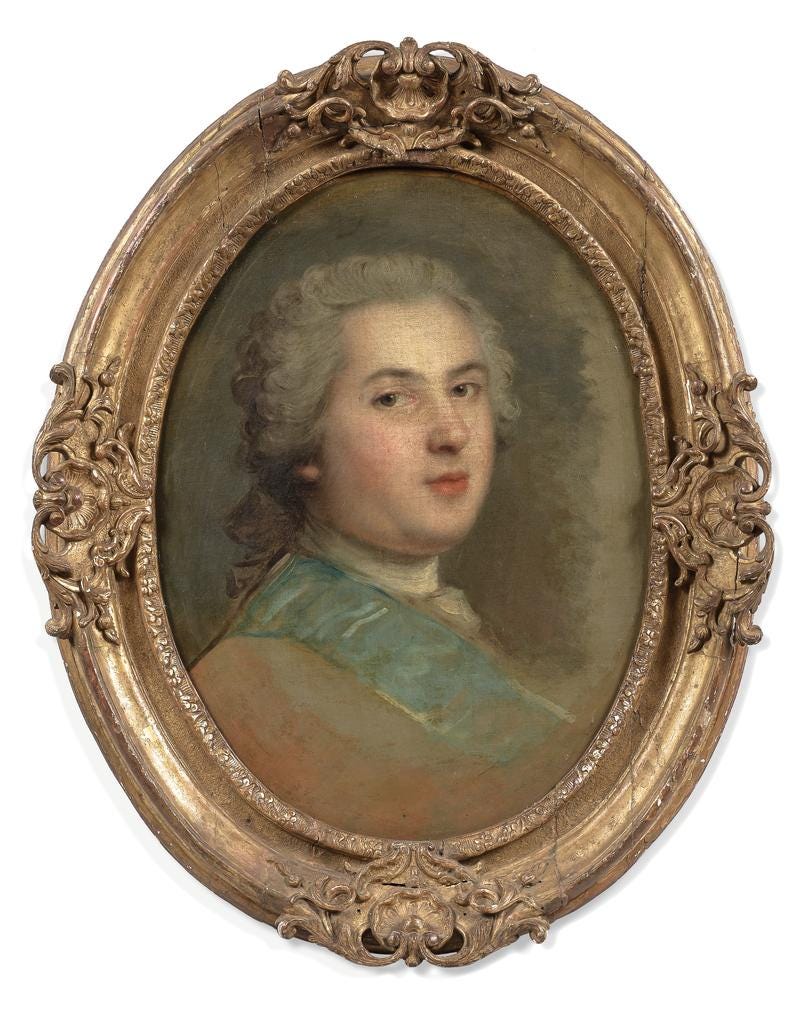
Louis-Auguste, Duc de Berry, the future Louis XVI, was born on August 23, 1754. August 25, the feast of St. Louis of France, was his name-day, and kept with special festivity after he became king in 1774. He was given the same exact baptismal name as his sainted ancestor. A few years ago on Catherine Delors' blog many interesting points were brought up in the comment box about the childhood traumas of Louis-Auguste and how those later affected his reactions to the events of the Revolution.

Louis contracted tuberculosis when he was six by being made to sit at the bedside of his dying older brother, the Duc de Bourgogne. It was a traumatic experience in many ways for a small boy, especially since he himself became quite ill. Louis-Auguste was generally regarded as unhealthy and not likely to live to adulthood. Several members of the French royal family, including Louis' parents and brother, had already died of consumption. Louis managed to survive with the proper care. Nevertheless, tuberculosis is a disease which can remain inactive for many years but can later recur. It can have many side effects, including depression.

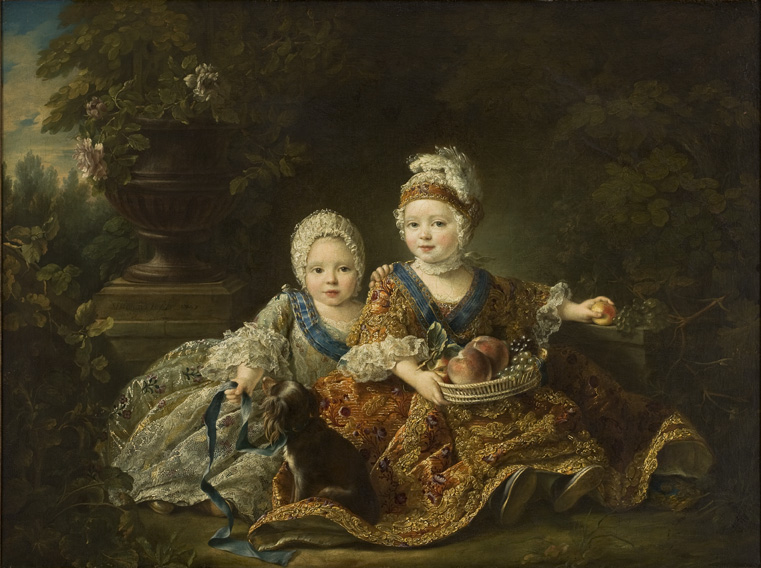
Provence and Berry
The tuberculosis would come back to haunt him, infecting his baby daughter Sophie and his oldest son. I think seeing Louis-Joseph die just as he had watched his older brother die long ago revived a lot of the childhood trauma. Death from tuberculosis is not pretty to watch. I am of the opinion that since the death of his oldest son, which coincided with the beginning of the Revolution in 1789, Louis XVI was suffering from clinical depression. In the past, he had acted with much more energy and decision. This is one of the reasons Marie-Antoinette had to become more involved in the political arena during the Revolution.

I think Louis struggled with "melancholy" at various times throughout his life, perhaps due to the childhood infection with tuberculosis. Louis was a man accustomed to strenuous exercise, especially hunting and riding, not to mention his labors as a locksmith. It is my belief that he needed the fresh air and the exertion for both his mental and physical health. With the regimen of exercise and his strictly adhered to routine he was able to keep melancholy from overwhelming him. He was deprived of much of his riding after October 1789 and it had a devastating effect upon his health and state of mind. Losing two of his children, his authority, his home, seeing his people and family suffer, and being deprived of the exercise and fresh air vital to his health, left him in a very bad condition.

If we consider the courage with which Louis XVI faced the worst moments of crisis, including his death, then he is to be admired, especially in the light of everything else. The Queen is to be admired as well, for she could have slipped out of the country with her surviving children and left Louis to his doom (there were many plans for her escape) but she refused to budge from Louis' side. She would not leave him to face the disasters alone.

Happy Birthday to Louis XVI!

Share

Thursday, August 20, 2026

What Does Marie-Antoinette Mean to Us Now?


Posthumous portrait of the Queen by Madame Lebrun
Many people are disgusted by the depiction of Marie-Antoinette in the BBC series. My piece for Catholic Answers:

I first visited Marie-Antoinette’s private retreat at Petit Trianon when I was seventeen years old. It was January, but the birds were singing in the gardens. Then and on successive trips, I experienced a strong sense of timelessness. Others have confided to me a similar feeling of enchantment when wandering through the gardens of Trianon.

People frequently ask me why I write about Marie-Antoinette. One of the reasons is that I keep encountering educated people who really think she said, “Let them eat cake.” I continue to encounter Christians who think Marie-Antoinette was killed as punishment for some egregious wickedness or, at least, for unforgivable stupidity. Having read books about her since childhood, I knew she was misunderstood; it was only after a great deal more research that I came to see how completely false are the common beliefs about her.

But the demonization of Marie-Antoinette in the popular mind is necessary to justify the excesses of the French Revolution. When people have a false and distorted view of history, it is difficult for them to grasp the present, and almost impossible to meet the future with any kind of preparedness.

The French Revolution was not necessary, simply because it is never necessary to murder tens of thousands of people. Reform certainly was needed, but reform can happen without mass murder.

Louis XVI was an intrepid reformer. He was not afraid to break with the past and abolish outdated customs while introducing new ways of doing things. Louis was not resistant to change, although that is how he is usually portrayed. The changes were slow but over time might have been effective, had the violent upheavals not swept everything away.

Too often, the violence is represented as a sad but unavoidable means of achieving freedom and democracy. But it is not only that the French Revolution overturned the social order; it was ultimately an attack on the Catholic Church. Many Catholics were killed, especially those peasants who did not want their religion taken away.

The French Revolution has been the blueprint for every totalitarian regime that has followed and has continued to be the model for those wishing not only to destroy the Catholic Church, but all Christian society. (Read more.)


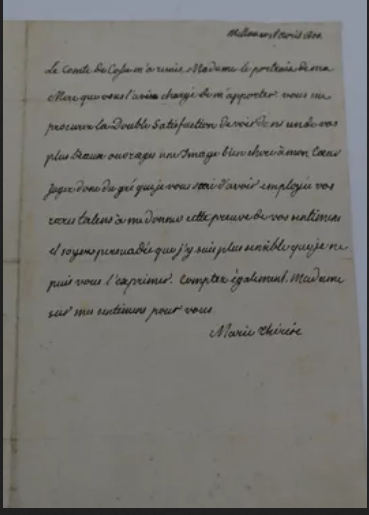
The portrait above was painted posthumously by Madame Lebrun. Here is a letter from Marie-Thérèse Charlotte to the artist, who was a friend of the family:


 A letter written by Marie-Thérèse Charlotte to Elisabeth Vigee-Lebrun on April 15th, 1800, regarding a portrait of Marie Antoinette, which was given to Marie-Thérèse by the comte de Cossé. The duchesse wrote that he gave her…

“…the portrait of my Mother that you had charged him to bring me. You give me the double satisfaction of seeing in a more beautiful work an image very dear to my heart. Judge therefore how grateful I am to you for having used your rare talents to give me this proof of your feelings and be convinced that I am more sensitive to it than I can express to you. You can count equally, Madame, on my feelings for you.”

Share

Wednesday, August 19, 2026

The King's Touch


I knew the French and English monarchs prayed over those afflicted with scrofula but I did not know it was done in Scotland. When Charles I was crowned King of Scots in June, 1633, he continued the ancient ceremony. From The Scotsman:
Charles had already been crown by the English in 1626, this was the first coronation in Scotland since that of King James VI in 1567, and more notably, the first time an adult had been crowned as our monarch since that of James IV in 1458, who was 15, not an adult? Okay let’s go further back to King James I, he was 30, happy now? The abbey of Scone, traditional place of coronations up to 1424, had been destroyed, and for this occasion the ceremonial was located in the remains of Holyrood abbey, which had seen the coronation of King James II in 1437.

All that remained of the abbey was the nave, the remainder of the church having been demolished in 1570, and the structure was now restored for the occasion. Charles was baptised in the Chapel Royal at Holyrood Palace in 1600 by David Lindsay, Bishop of Ross, and created Duke of Albany, the traditional title of the second son of the King of Scotland.

[...]

While researching this I found an article about Charles and the “laying on of hands” a ceremony he performed while at Holyrood, a practice said to have been performed by all the Stewart monarchs but discontinued by the Hanoverian’s. Bonnie Prince Charlie though is said to have performed it during the 45. (Read more.) 
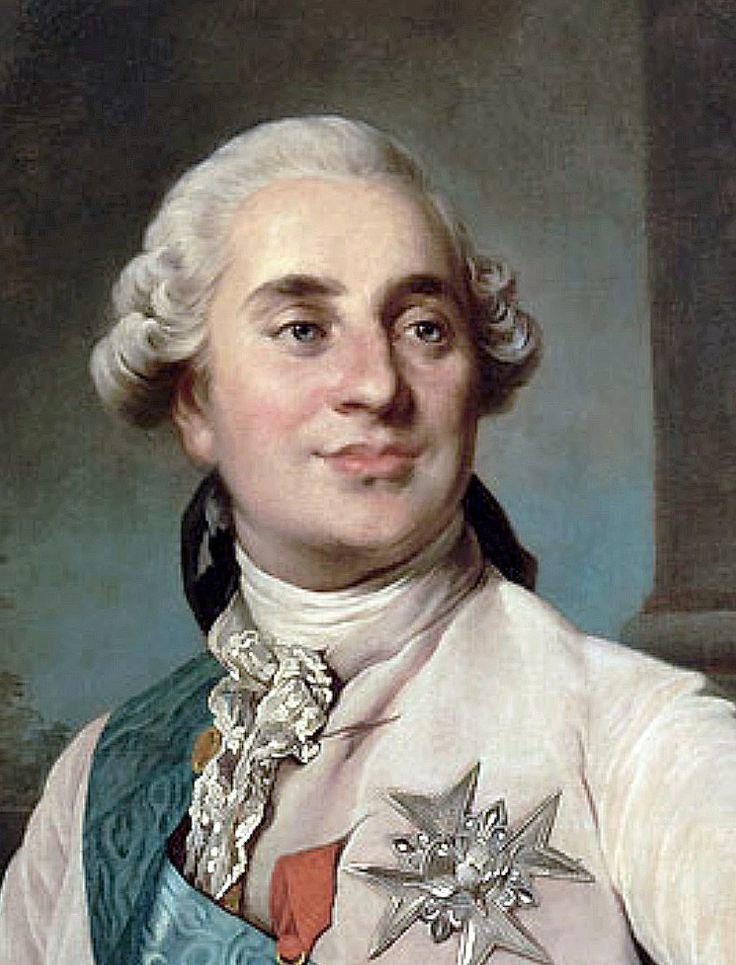
This is of particular interest to me since Louis XVI was a direct descendant of Charles I. King Louis treasured the ancient healing ceremony and celebrated it several times a year, not just at his coronation, as described in my book.

More HERE.


Share

Saturday, August 15, 2026

The Affair of the Necklace

The diamond necklace was commissioned by Louis XV for his mistress, Madame du Barry, from the crown jewellers, Boehmer and Bassenge. With the death of the King, the necklace was not paid for, almost bankrupting the jewellers and leading to various unsuccessful schemes to secure a sale to Queen Marie-Antoinette.

On August 15, 1785, the "Affair of the Necklace" broke upon France, just as Louis XVI and Marie-Antoinette were about to assist at the Mass of the Assumption, the patronal solemnity of the realm. Cardinal Louis de Rohan, who was supposed to offer the Mass, was publicly arrested in his pontifical robes for his part in the debacle. The Diamond Necklace scandal was one of the events which precipitated the French Revolution of 1789 and the fall of the monarchy. After perusing the internet I think it becomes necessary to affirm once again that Marie-Antoinette, according to several major biographers, was an innocent victim in one of the most sordid intrigues in history. She never sought to possess the necklace. For one thing, the necklace was not to her liking; she preferred light, aerial creations. A few scholars even doubt that Madame du Barry, whom the jewelers had in mind when they originally designed the huge, garish necklace, would have cared for it, her taste being not quite so grotesque as is generally assumed. Also, by 1785 Marie-Antoinette had cultivated simpler tastes; she was very much under the influence of Madame de Polignac, who never wore diamonds. It is known that when Boehmer tried to sell her the necklace, she remarked that France needed ships, not diamonds.

The fault of the King and Queen was in attempting to be too above board in the handling of the proceedings. Instead of trying to settle the disaster quietly, there was a public trial of the Cardinal, for whom Marie-Antoinette harbored resentments. Not only had Cardinal de Rohan rudely infiltrated one of her garden parties, but he had told ribald jokes about Marie-Antoinette's mother. He had many mistresses (including Bonnie Prince Charlie's daughter). He symbolized the worst decadence of the French nobility and the corrupt higher clergy. He was grand almoner of Versailles due to his ancestral prerogatives, but neither the king nor the queen had any use for him. The scandal rid them of him, but at a very high price. They could never have known at the onset the cast of bizarre characters with whom the Cardinal was involved, who were brought into the light of day. The Queen's name was dragged through the mud by being associated with such people in the gazettes, people who were complete strangers to her. Biographer Maxime de la Rocheterie believed that even if the king and queen had tried to suppress the scandal, the results would have been disastrous nevertheless.

How did it all come about? Through a woman who lied. Each lie told by Madame de la Motte was more outrageous than the last, yet individuals motivated by lust or ambition or greed believed her tales. She told people that she was an intimate friend of the Queen, who had never even heard of her. The swindle was tragic for all involved, especially for the innocent Marie-Antoinette, for it confirmed in the popular imagination all the salacious gossip which portrayed her as a loose, extravagant woman.

For details of the Diamond Necklace Scandal, read my book Marie-Antoinette, Daughter of the Caesars.
Share

Friday, August 14, 2026

Arrest of Cardinal de Rohan

It is tragic and ironic that the scandal that led to the fall of the French monarchy would explode on the patronal feast day of the kingdom, the Assumption of the Blessed Virgin Mary. It was also the feast-day for the Queens of France, who in the days of the Bourbons were all named "Marie." It is an additional irony that a Cardinal of the Roman Church was instrumental in the culmination of the scandal through his own unworthy and imprudent conduct. Here is Madame Campan's account of the Cardinal's arrest:

On the following Sunday, the 15th of August, being the Assumption, at twelve o’clock, at the very moment when the Cardinal, dressed in his pontifical garments, was about to proceed to the chapel, he was sent for into the King’s closet, where the Queen then was.

The King said to him, “You have purchased diamonds of Boehmer?”

“Yes, Sire.”

“What have you done with them?”

“I thought they had been delivered to the Queen.”

“Who commissioned you?”

“A lady, called the Comtesse de Lamotte-Valois, who handed me a letter from the Queen; and I thought I was gratifying her Majesty by taking this business on myself.”

The Queen here interrupted him and said, “How, monsieur, could you believe that I should select you, to whom I have not spoken for eight years, to negotiate anything for me, and especially through the mediation of a woman whom I do not even know?”

“I see plainly,” said the Cardinal, “that I have been duped. I will pay for the necklace; my desire to please your Majesty blinded me; I suspected no trick in the affair, and I am sorry for it.”

He then took out of his pocket-book a letter from the Queen to Madame de Lamotte, giving him this commission. The King took it, and, holding it towards the Cardinal, said:

“This is neither written nor signed by the Queen. How could a Prince of the House of Rohan, and a Grand Almoner of France, ever think that the Queen would sign Marie Antoinette de France? Everybody knows that queens sign only by their baptismal names. But, monsieur,” pursued the King, handing him a copy of his letter to Baehmer, “have you ever written such a letter as this?”

Having glanced over it, the Cardinal said, “I do not remember having written it.”

“But what if the original, signed by yourself, were shown to you?”

“If the letter be signed by myself it is genuine.”

He was extremely confused, and repeated several times, “I have been deceived, Sire; I will pay for the necklace. I ask pardon of your Majesties.”

“Then explain to me,” resumed the King, “the whole of this enigma. I do not wish to find you guilty; I had rather you would justify yourself. Account for all the manoeuvres with Baehmer, these assurances and these letters.”

The Cardinal then, turning pale, and leaning against the table, said, “Sire, I am too much confused to answer your Majesty in a way–”

“Compose yourself, Cardinal, and go into my cabinet; you will there find paper, pens, and ink,–write what you have to say to me.”

The Cardinal went into the King’s cabinet, and returned a quarter of an hour afterwards with a document as confused as his verbal answers had been. The King then said, “Withdraw, monsieur.” The Cardinal left the King’s chamber, with the Baron de Breteuil, who gave him in custody to a lieutenant of the Body Guard, with orders to take him to his apartment. M. d’Agoult, aide-major of the Body Guard, afterwards took him into custody, and conducted him to his hotel, and thence to the Bastille....

The moment the Cardinal’s arrest was known a universal clamour arose. Every memorial that appeared during the trial increased the outcry. On this occasion the clergy took that course which a little wisdom and the least knowledge of the spirit of such a body ought to have foreseen. The Rohans and the House of Conde, as well as the clergy, made their complaints heard everywhere. The King consented to having a legal judgment, and early in September he addressed letters-patent to the Parliament, in which he said that he was “filled with the most just indignation on seeing the means which, by the confession of his Eminence the Cardinal, had been employed in order to inculpate his most dear spouse and companion.”

Fatal moment! in which the Queen found herself, in consequence of this highly impolitic step, on trial with a subject, who ought to have been dealt with by the power of the King alone. The Princes and Princesses of the House of Conde, and of the Houses of Rohan, Soubise, and Guemenee, put on mourning, and were seen ranged in the way of the members of the Grand Chamber to salute them as they proceeded to the palace, on the days of the Cardinal’s trial; and Princes of the blood openly canvassed against the Queen of France.

Here is additional information about the Cardinal, who was tried but acquitted, and a line which I found interesting:

Rohan’s acquittal did not stop the king from banishing him to Chaise-Dieu. During the French Revolution, Rohan left France for Germany. His character improved and he spent the remains of his wealth providing for the poor clergy around him. The Rohan family spent decades paying off the debt of the diamond necklace–they were honor-bound to pay the 1.6 million francs owed for the necklace since Cardinal Rohan had been guarantor.

Share

Tuesday, August 11, 2026

"Most Mournful and Moving"

From Ancient Origins:
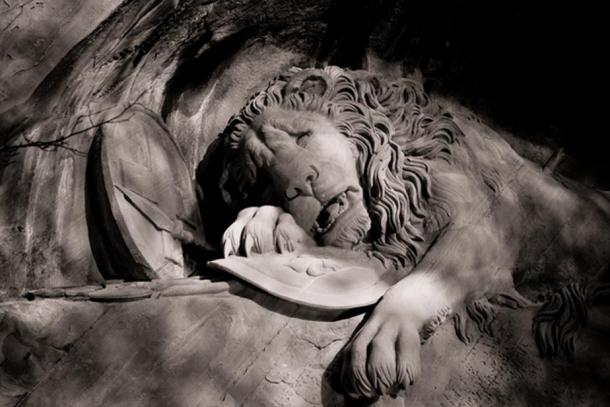
The Lion of Lucerne (known also as the Lion Monument) is a memorial located in Lucerne, Switzerland. This monument is a rock relief carved into the cliff face of a former sandstone quarry, and features a dying lion. Sculpted during the early part of the 19th century, the purpose of the Lion of Lucerne was to commemorate the Swiss Guards who lost their lives in 1792 during the French Revolution.  

The Lion of Lucerne was designed by Bertel Thorvaldsen, a famous Danish sculptor who lived between the 18th and 19th centuries. The man who was responsible for the actual carving of the monument, however, was a stonemason from Constance (in southern Germany) by the name of Lucas Ahorn. The memorial was designed by Thorvaldsen in 1819 whilst he was staying in Rome, and work began in the following year by Ahorn. The monument, which measures 10 meters (32.8 ft.) in length and 6 meters (19.7 ft.) in height, was completed in 1821. (Read more.)

More HERE and HERE. Share

Monday, August 10, 2026

The Fall of the French Monarchy, August 10, 1792

Run on the Tuileries on 10. Aug. 1792 during the French Revolution -  Wikidata
August 10, 1792 , the Feast of St. Laurence the Martyr, saw the fall of the French monarchy, the massacre of the Swiss Guards and the beginning of the Reign of Terror. Madame Royale gave a detailed account in her Memoirs of the royal family's flight from the Tuileries to the National Assembly, of the long, agonizing hours trapped in the stenographer's box, and the imprisonment in the Temple prison. Here follows the account of the teenage daughter of Louis XVI and Marie-Antoinette:
Massacre at the Tuileries; Dethronement of my Father.
The Days from the 10th to the 13th of August, 1792.
After the fatal epoch of June 20, my family no longer enjoyed any tranquillity; every day there were fresh alarms, and rumours that the faubourgs Saint Antoine and Saint Marceau [together with those wretches who were called the Marseillais] were marching against the château. Sometimes they sounded the tocsin and beat the générale; sometimes, under pretext of a dinner of confraternity, they invited [and worked upon] the sections of opposite opinions to demand the dethronement of the king, which Danton, Robespierre, and their party wanted at all costs. After these many preludes, we heard with certainty on the 9th of August that the populace, armed, was assembling to attack the [Page 237] Tuileries; it was already evening. The troops who remained faithful to my father were therefore hastily collected, among them the Swiss Guard; and a great number of the nobles who were [still] in Paris arrived [in haste]. Imagine the situation of my unhappy parents during that horrible night; they remained together [expecting only carnage and death], and my mother had ordered my brother and me to go to bed.
Pétion arrived about eleven o'clock, exclaiming loudly against this new tumult. My father treated him as he deserved and sent him away; nevertheless, malignant people spread the news that Pétion was kept prisoner in the Tuileries; [on which] minds grew [embittered and] inflamed even to fury, and at midnight the signal was given to begin the dreadful massacre. The first shot fired killed M. Clermont-Tonnerre, a member of the First Assembly. For a part of the night the tumult went on outside the Tuileries, where fresh reinforcements of the National Guard were successively arriving; unfortunately, [far] too many came, for most of them were already seduced and treacherously inclined.
At six in the morning it was suggested to my father to visit all the posts and encourage the troops to defend him; but only a few cries of Vive le Roi! were heard in the courtyards, and what was worse, when he wished to enter the garden, the artillery-men, most wicked of all, dared to turn their cannon against their king; a thing not believable if I did not declare that I saw it with my own eyes.
My father, having thus indubitably recognized the bad disposition of the National Guard, saw but too well that no faithful subjects remained about him, except a few nobles who had come to us, a part of the servants of the château, and the Swiss Guard; they all armed themselves. M. Mandat, commandant of the National Guard in the Tuileries [a man of little enterprise but faithful], was summoned by [Page 238] the mayor to the Hôtel de Ville; there he was murdered by order of the municipality, who immediately appointed Santerre to replace him. Towards seven in the morning Roederer, head of the department, arrived. He asked to speak alone with the king; there, he threw himself at his feet and conjured him to save himself; he represented to him that furious brigands were arriving in masses, that he had too few persons to defend him, that he had no course left but to go, he and his family, and take refuge in the National Assembly. My father rejected the idea for a long time, but Roederer insisting, and the peril becoming urgent and inevitable, he at last resolved to go to the Assembly with his family, Mme. de Lamballe, and Mme. de Tourzel. He left all the rest of his people in the château, not doubting that as soon as it was known that he had gone, the tumult would cease and there would be no longer any danger for those he left there. 1
We crossed the garden of the Tuileries in the midst of a few National guards, who still remained faithful. On the way we were told that the Assembly would not receive my father. The terrace of the Feuillants, along which we had to pass, was full of wretches, who assailed us with insults; one of them cried out: "No women, or we will kill them all!" My mother was not frightened at the threat and continued her way. At last we entered the passage to the Assembly. Before being admitted [to the hall] we had to wait more than half an hour, a number of deputies still [Page 239] opposing our entrance. We were thus kept in a narrow corridor, so dark that we could see nothing, and hear nothing but the shouts of the furious mob. My father, my mother, and my brother were in front with Mme. de Tourzel; my aunt was with me, on the other side. I was held by a man whom I did not know. I have never thought myself so near death, not doubting that the decision was made to murder us all. In the darkness I could not see my parents, and I feared everything for them. We were left to this mortal agony more than half an hour.
At last we were allowed to enter the hall of the Assembly, and my father on entering said [in a loud voice] that he came to take refuge with his family in the bosom of the Assembly, to prevent the French nation from committing a great crime. We were placed at the bar, and they then discussed whether it was proper that my father should be present at their deliberations. They said, as to that, that it was impossible to let him stay at the bar without infringing on the inviolability of the sovereign people; and they declaimed speeches thereon which were full of horrors. After this they took us into the box of a journalist.
We had hardly entered this species of cage when we heard cannon, musket-shots, and the cries of those who were murdering in the Tuileries; but we were ignorant at the time of what was happening. We heard later how the massacre began. My father had hardly left the château before a party of wretches [already in the courtyards] began to attack with armes blanches [sabres and pikes] the Swiss Guard, who fired in self-defense. Nothing more was needed to push their fury to the highest point; those who were outside hearing the Swiss fire first, and taking them for the aggressors, spread the rumour that my father had ordered them to fire on the people. Soon, not only the courtyard gates but those [Page 240] of the château were forced, and these madmen rushed in, massacring all whom they found, especially the Swiss. [Then and there perished an immensity of faithful servitors of all ranks and classes. Among the victims were MM. de Clermont d'Amboise and de Castéja, de Viomesnil and d'Hervilly; the Maréchal de Mailly, MM. de Maillardoz and de Bachmann died later. All the old officers of the Guard called "constitutional," the two battalions of the Filles-St.-Thomas and the Petits-Pères distinguished themselves by an unbounded devotion, though, unhappily, fruitless. What could they do against a multitude maddened with drink and blood and fury?] The Tuileries then became a spectacle of horror; blood ran everywhere, especially in the apartments of the king and queen. Nevertheless, in the midst of these abominations some traits of humanity were shown; among these monsters were some who saved several persons, taking them by the arm and making them pass for their friends or relatives . The carnage lasted all that day on one side or the other; the number of brigands who perished was considerable, for those wretches killed each other in their blind fury. At night, the château took fire; fortunately, the flames lasted but a little while, and so ended those awful and too memorable scenes.
Meantime our terrors increased as these dreadful noises went on; but it was even worse when we heard the same sort of cries close to the Assembly. The members themselves were frightened, and in their fear they tore out the iron railing of the box where we were and forced my father into the midst of them; but this tumult was soon appeased. It was occasioned by the approach of a number of the Swiss Guard who had escaped from the Tuileries and were trying to come to the support of the king; they had almost forced the door of the Assembly when an officer said to them: [Page 241] "What are you doing? The king is in the midst of assassins; they will murder him if you advance." This reflection held them back and they surrendered; it was thus that these brave foreigners [ever faithful], to the number of about one hundred, escaped the massacre. As for those of their compatriots who did not perish in the Tuileries, they were taken to the Hôtel-de-Ville and there massacred with their principal officers. A forged order from the king was sent to summon the Swiss Guard from the barracks at Courbevoie; on their arrival in Paris they met the same fate.
Still kept on the box at the Assembly, we witnessed the horrors of all kinds which there took place. Sometimes they assailed my father and all his family with [the basest and most atrocious] insults, triumphing over him with cruel joy; sometimes they brought in gentlemen dying of their wounds; sometimes they brought my father's own servants, who, with the utmost impudence, gave false testimony against him; while others boasted of what they had done. At last, to complete the revolting scene, they brought in the Host and flung the sacred wafers on the ground. It was in the midst of these abominations that our entire day, from eight in the morning until midnight, passed [as one may say] through all gradations of whatever was most terrible, most awful.
The session ended by [a decree full of insults to my father, declaring the king suspended from his functions and ordering the convocation of a National Convention. They next wished to take up the fate of my brother; they proposed to appoint his governor, and even to make him king; but the latter motion was rejected, and that of giving him a governor was adjourned until the Convention should declare whether the Nation desired to still have a king]. At last they permitted us, about one at night to retire to one of the little rooms near-by, in the convent of the Feuillants; there we [Page 242] were left alone [without the slightest defense against the sanguinary rage of these wretches]. The next day, several persons belonging to my father's service came to us. We were forced to return again to the Assembly and spend the whole day there while they discussed what should be done with the king, and where he should be kept. The Place Vendôme, in which is the Chancellerie, was proposed for this purpose, on which Manuel, public prosecutor for the Commune of Paris, demanded, in the name of his constituents, to be intrusted with the responsibility of keeping my father and his family; and this being granted, he proposed the château of the Temple for our residence, which was decreed.
That day and the next were passed like the preceding day; we were forced to listen in the hall of the Assembly to the prowess of those who had distinguished themselves by their barbarities. At night we returned to our rooms, [where we were not allowed to enjoy in peace the hours consecrated to rest], a deputy of the Assembly coming an hour after midnight to search and see if we had men hidden there; none were found, for my father had been obliged to send away those who had come to him. On the 12th it was determined that we should be transferred to the Temple on the following day.
On the 13th we did not go to the Assembly. Towards three in the afternoon Pétion and Manuel came to take my father, and they made us all get into a carriage with eight seats, into which they got themselves [with their hats on their heads and shouting, Vive la Nation! ]. We drove through the streets leading to the Temple in great peril and loaded with insults; our conductors themselves feared the people so much that they would not let the carriage stop for a moment; and yet it took two hours before we could reach the Temple through that immense throng. On the [Page 243] way they had the cruelty to point out to my parents things that would distress them,–the statues of the Kings of France thrown down, even that of Henri IV., before which the populace compelled us to stop, to make us look at him on the ground. We did not observe on our way any feeling souls touched by our condition, such terror was now inspired in those who still thought rightly. And yet, in the midst of so many sights which might well break down the strongest soul, my father and my mother preserved the tranquillity and courage that a good conscience can alone inspire.
~ Memoirs of Madame Royale
The attack on the Tuileries
Share

Tuesday, July 28, 2026

Bellevue

Bellevue was a country estate originally built by Louis XV for Madame de Pompadour. It was on a hill overlooking the Seine and the forest of Meudon; the view was said to be truly magnificent. In 1775, after he had become king, Louis XVI gave Bellevue to his maiden aunts Adélaïde, Victoire, and Sophie, the surviving daughters of Louis XV, known as Mesdames Tantes. Madame Louise having already entered the Carmelite monastery, Louis thought it would be good for his other aunts to have a retreat from the court, a house they could call their own. For all their genuine piety, Mesdames Tantes had manipulated and gossiped about Marie-Antoinette in the early years of her marriage, coining the term L'Autrichienne, an epithet that would later be taken up by the Revolutionaries. It probably helped maintain the peace at court for Antoinette to be at her Trianon while the aunts were at their Bellevue.

According to the Comte d'Hézecques, who in his capacity as a page at Versailles witnessed the inner workings of the court:

The position of Mesdames at Court being obscure and unsatisfactory, they were seldom seen there. They spent the chief part of the year either at Bellevue, on that splendid height that commands the proud city and the charming country around it; or at the Hermitage, a little garden at the other end of Versailles, by the road leading to Marly.

Madame Adelaide and Madame Victoire were the only survivors of the four daughters of Louis XV who outlived their father. The third, Madame Sophie, had died two years before ; and the other, Madame Louise, had quitted the world in one of those sudden resolutions that can only be inspired by great religious fervour, or by a quick and ardent spirit that will not be satisfied by smaller sacrifices—resolutions that always cause astonishment to men of the world, whatever be their cause....

Mesdames the Aunts only came to Paris in the winter, as they had been able to stay at Bellevue up to the 5th of October. Seeing that they were of very little use to their nephew, unable to enjoy his confidence, and fearing measures opposed to their religious opinions, they at last decided on going to Rome. Possibly in their solitude, standing in a position whence they could form a better judgment of the course of events, theirs was the surer presentiment of all the trouble that hung over their family; therefore, they separated themselves from it for life, but they could not prevail on Madame Elizabeth to leave her brother and accompany them. . . . No doubt Mesdames did not find themselves happy at Rome. The news of the fall of the throne of their fathers and the sorrows of their family came to disturb the peace they might have enjoyed in the Eternal City. They could at least carry their tears and prayers for their guilty country to the foot of the altar, till the day when they were forced to quit the hospitable city that had received them, by conquests that the noble head of the Church could neither arrest nor foresee. So they left Rome to retire to Naples; and, after several changes of their place of refuge, Madame Adelaide had the sorrow of seeing her younger sister die at Trieste. Her own mournful existence was shortened by grief, and she soon died herself at Klagenfurth.—Recollections of a Page, by Comte d'Hézecques, pp. 79-82.


Here is furniture, originally from Bellevue, that once belonged to Madame Adélaïde.

Here is a view of the orangerie and formal terrace at Bellevue. The palace was looted during the Revolution. In 1823, it was demolished.

In the 1780's Mesdames Tantes had Mique create an English-style garden at Bellevue, complete with a tower, a lake, a mill, a dairy and a grotto, similar to what Marie-Antoinette had at Trianon. It is fascinating that they were so censorious of the Queen and yet imitated her in that for which she was greatly criticized, the creation of fanciful gardens. The tower and some other structures of the gardens of Bellevue survived well into the twentieth century; little is left of it today.


Here is a picture of the grotto of Mesdame Tantes, which is just about all that is left of the Bellevue estate. Sic transit gloria mundi.

(Photos from Le Boudoir de Marie-Antoinette) Share

Thursday, July 23, 2026

French Royal Family on Porcelain

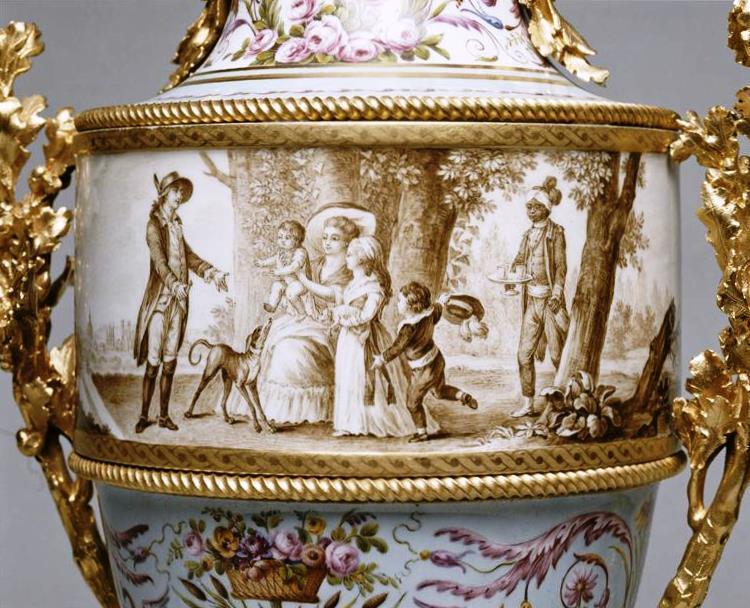
A 1788  vase with painting by Pierre-Philippe Thomire from the Château de Versailles. From left to right are Louis XVI, Louis-Charles, Duc de Normandie, Marie-Antoinette, Madame Royale, the Dauphin Louis-Joseph and probably Jean Amilcar, the African boy brought up  and educated by Marie-Antoinette. Share

Saturday, July 18, 2026

The Tragic Life of Marie-Thérèse of France


From Salon Privé Magazine:
As Marie-Thérèse Charlotte of France grew older, the French Revolution threatened. Because the country supported the American Revolution, funds were very low and France was borderline bankrupt. Attacks on the royal family became more vicious and the monarchy’s popularity plummeted. Within the Court of Versailles, xenophobia and jealousy were the primary causes of resentment towards Marie Antoinette, and due to her unpopularity with high-ranking officials within the court, she became the target of a vicious smear campaign. Pamphlets and leaflets were printed accusing her of a wide range of sexual deviancies and of sending France into financial ruin. Now, experts agree that Marie Antoinette was unfairly victimised and did little to deserve such treatment. At the time, however, this smear campaign worked and the public turned on her. (Read more.)

Madame Royale is one of the only novels about the life of Marie-Thérèse Charlotte.


Share

Wednesday, July 15, 2026

Augustinian Traces in Louis XVI

Louis XVI of France - Alchetron, The Free Social Encyclopedia 

There is some amazing new scholarship about Louis XVI. Here is a paper about Louis XVI's spirituality as formed by his education, which influenced his future actions. From Dr. Philip Diaz-Lewis via the History of European Ideas:

This article argues that Louis XVI’s student notes, the Réflexions sur mes Entretiens avec M. le duc de la Vauguyon reveal a coherent Augustinian Platonist ethics derived from Fénelon, in which humanité functions as a divine exemplar idea through which moral principles are known and royal virtues specified. Against existing interpretations that oppose Louis’s reformism to his attachment to sacral monarchy, it proposes that the same philosophical framework can be used to interpret both his constitutional initiatives and his maintenance of traditional court ritual. The argument proceeds by reconstructing the Dauphin’s formation under La Vauguyon, Moreau, and Berthier, then by a close reading of key Réflexions passages on God, natural law and humanité, interpreted with the aid of the Dictionnaire de Trévoux lexicon. (Read more.)

Share