Showing posts with label The Irish. Show all posts

Thursday, August 6, 2026

How Ireland Became a Woke Theme Park

 From Jack Cashill:

Arriving in Shannon Airport in western Ireland last week, we were greeted by a gaggle of protestors unhappy with American foreign policy. Not the most robust of allies, Ireland has nonetheless been allowing American military aircraft to refuel at Shannon. So upset was one 91-year-old activist with the war in Iran that she walked all the way across Ireland to have her protest heard. The media declared her a hero.

 The “we,” in question was my extended family and close friends, all 40 of us. Before our bus driver, a good fellow and superior tour guide, could venture an opinion on the protest, I cautioned him that two-thirds of us had voted for Donald Trump. That acknowledgment surprised him. The Irish know few self-declared Republicans. Twenty years ago, for instance, a colleague of my wife’s at the university in Galway took me to lunch. because he had never met a “Bush man,” even a tepid one like me.

Even more so abroad than at home, liberal Americans are eager to stake out their positions publicly. Today, in a newly woke country like Ireland, they hope to assure their foreign hosts they were neither racist nor reactionary enough to have elected Donald Trump president. (Read more.)

Share

Wednesday, August 5, 2026

The Private Life of James II

 I have posted about Justine Brown's biography of James II, HERE and HERE; I am happy to say that I have at last been able to read it for myself. It really is the best book I have ever read about James. For one thing it does not trash everyone else in his family as some biographies do. And it explores the walking contradiction that was James II, second son of Charles I and Henrietta Maria, whose very real virtues were overshadowed by his principal vice, that of lust, leading to several torrid extramarital love affairs and a handful of illegitimate offspring. I have often wondered if the obvious sex addictions which ruled Charles II and James II were a result of the traumas suffered when they were young and witnessed the bloodshed of war, resulting in the judicial murder of one beloved parent with long separations from the other beloved parent. Or maybe it was just that they took after their grandfather Henri IV, le vert galant. Their first cousin Louis XIV resembled le bon roi Henri as well, when it came to women, without the excuse of having witnessed the horrors of war as a child, although he came close enough. While James was handsomer than his brother Charles, he possessed neither his earthy charm nor his uncanny ability for double-dealing. James, a military man, was forthright and blunt, seeing the world in black and white, which some have characterized as bigotry, although his ideas of freedom of conscience as applied to the law were revolutionary for his time. Ironically, James is seen as a tyrant and absolutist, when all he wanted was for Catholics and non-conformist Protestants to enjoy the same religious liberties as Anglicans. He had the makings of a great king but was betrayed by his own flesh and blood, changing the course of history and plunging Ireland and Scotland into another century of persecution.

People have mocked James for throwing the Great Seal of England into the Thames before fleeing his kingdom. However, after reading Justine's book it becomes clear why he did so. He was emotionally devastated by the betrayal of his beloved daughters, as well as by his sons-in-law, one of whom was also his nephew, only child of his beloved sister Mary, the Princess Royal. In all the upheavals of the English Civil Wars, James' immediate family had always remained loyal to his father Charles I and to each other. While they had been sundered by miles, illness, imprisonment and death, they never betrayed each other. For James to have his throne stolen by his own children, with the help of the Churchills, to whom he had given everything, was like a knife in the heart. I think he also knew that the ancient monarchy was over and that kings and queens would no longer rule but merely reign.

Perhaps James' main mistake was, other than underestimating the ruthlessness of his daughters Mary and Anne, was underestimating the hatred of Catholicism that the Whig party was intent upon keeping alive in England. During his exile and army career, James had visited Catholic countries; he was married to an Italian and his sister-in-law was Portuguese. He thought that seeing the open practice of Catholicism would wean the populace from their worn-out prejudices. But the fear of popery that erupted into violence, forcing his Queen and his newborn son to escape to France, showed him that he had miscalculated.

James II emerges from the book as a tragic but fascinating personality. He was one of the last Kings of England to have had personal experience of warfare. As Duke of York he built up the British navy, preparing it to be the mega-force which was to rule the seas in the next century. He was a patron of the lively Restoration theater and of all the arts. He was a patron of Catholic shrines, reopening defunct Catholic places of pilgrimage during his short reign. He possessed basic familiarity with his Celtic realms, having lived for several years in Scotland as Duke of Albany. He is patriarch of a European dynasty, the Fitz-James Stuarts, and also has many descendants in the United Kingdom to this day, including the current Prince of Wales. In his last years, exiled in France, the founder of the Trappists, Abbot Armand Jean le Bouthillier de Rancé was his father-confessor. For anyone interested in English history The Private Life of James II by Justine Brown is a must-read.

The biography may be purchased, HERE. An interview with the author is HERE. My novel about James' mother, Queen Henrietta Maria, is HERE.

Share

Shattered Realm, Scattered People

 From Peter D. Richards:

The year 1066 is often remembered for a single, pivotal day on a Sussex hillside—the clash of shield walls at Hastings, the fall of King Harold Godwinson, and the triumph of William the Conqueror. Yet, the Battle of Hastings was merely the prologue to a far broader socio-political cataclysm. In the decades that followed, native Anglo-Saxon society was systematically dismantled.

While stone Norman castles rose like iron beacons across the landscape, the people who had called England home for six centuries faced two distinct, painful fates: exile across the known world for the elite, or subjugation on the lands their ancestors had plowed for the masses left behind.

For the surviving Anglo-Saxon aristocracy, life under Norman rule quickly proved untenable. Following a series of crushed rebellions across the Midlands, the North, and the Fens, the native elite recognised that submission meant disinheritance, imprisonment, or death. Thousands chose flight over servitude.

This sparked one of the most remarkable, yet underreported, diasporas of the Middle Ages:

  • The Celtic & Scandinavian Fringes: Many nobles sought immediate refuge in Scotland and Ireland. Margaret, sister of the un-crowned Anglo-Saxon claimant Edgar Ætheling, married King Malcolm III of Scotland, weaving English royal lineage directly into the Scottish monarchy. Others fled to Denmark and Norway, appealing to Scandinavian kin for military aid.

  • The Exodus to Byzantium: The most extraordinary chapter of the diaspora unfolded far to the east. By the late 1070s, a massive fleet of dispossessed Anglo-Saxon warriors and their families sailed into the Mediterranean, bound for Constantinople.

  • The Varangian Guard: The Byzantine Emperor, Alexios I Comnenus, eagerly inducted these seasoned housecarls into his elite Varangian Guard. The English became the primary core of the Emperor’s personal bodyguard. In a dramatic twist of history, these exiles faced their Norman foes once more at the Battle of Dyrrhachium in 1081.

(Read more.)


Share

Friday, July 31, 2026

"Beautiful Love Story"

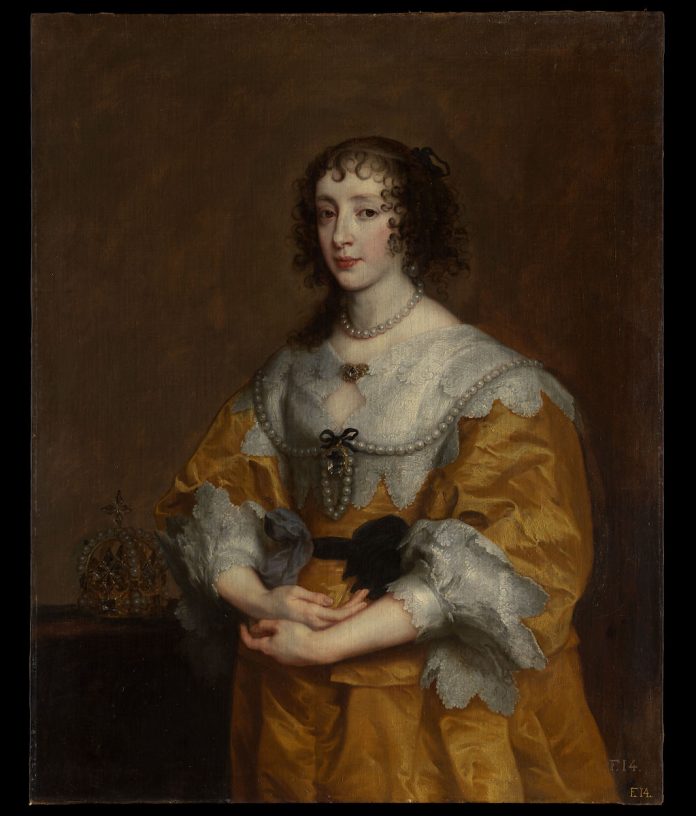
Henrietta Maria with two of her Children

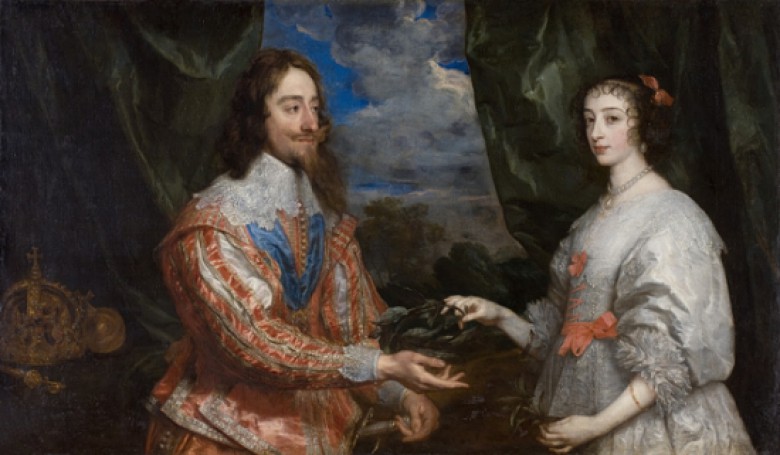
Charles I and Henrietta Maria with Charles Prince of Wales and Mary the Princess Royal

The Queen doing Penance at Tyburn

A glowing review from Pursuing Stacie:
I have a huge love for classics. Little Women, Jane Eyre, Anne of Green of Gables…I will reach for these novels again and again, and then sigh happily about 3, 428 times throughout the story. This was exactly my experience while reading My Queen, My Love: A Novel of Henrietta Maria. It just has that rare classic, cozy, wholesome feel. Mind you, there’s plenty of suspense and intrigue. But the story is just so good!

The author skillfully fleshes out the characters and story of Charles and Henrietta, allowing her readers to sink into the novel. When I was about three chapters in, I realized with a start that I had not only completely missed my bedtime, but had forgotten altogether that I was reading a book, so engrossed was I in the story. (Have you ever read a book that feels like a movie?) (You’re about to.)

While the author set a scene masterfully, she also brought these historical characters to life in rich detail. (Might I suggest Googling their names as you meet them, by the way? So fun to put a face to the new friend that you’ve just made.) I adored Henrietta and will carry her with me always. But truly, each character was dynamic and real. From the beautiful love story to the suspense that only villainy can bring, this novel is perfect from beginning to end. (Read more.)

Because the two of them worked hard to make their marriage work, they ended up deeply in love with each other which made it satisfying. There is plenty of drama, politics, and courtly intrigue that will engage the reader to keep turning the page! I can’t wait to read the next book in the series to learn what comes next for Queen Henrietta Maria of England! I recommend this for fans of Jean Plaidy, Alison Weir, and Philippa Gregory! My Queen, My Love is a promising start to an enthralling series on one of England’s most tragic queens! (Read more.)

My Queen, My Love and Generalissima are available from Amazon.
Share

Sunday, July 19, 2026

My Guest Post for Tony Riches


 My thanks to Tony for such a wonderful opportunity! From The Writing Desk:

Wife of the ill-fated Charles I, the colony named for her was intended to be a refuge for Roman Catholics, the Catholic religion being forbidden in the Three Kingdoms. In my room as a teenager there was a print of the Van Dyck portrait of Henrietta Maria, the original of which is in the National Gallery of Art in Washington, D.C. Called “Mary” by her subjects, the second Stuart queen of England peers down from the portrait with her black eyes, which contemporaries described as large, sparkling and beautiful. Her dark curls with auburn highlights contrast against the deep marine blue shimmer of a silk dress, with the salmon-pink bows and elaborate white cuffs and high starched collar. A wide-brimmed plumed black hat was of the type made famous by the cavaliers who later fought for her husband in the English Civil Wars. 

The white plumes are reminiscent of the one made famous by her father Henri IV of France, which he wore into battle so that his men could always find him. Like her father, Henrietta Maria was not afraid to stand out, remaining a devoted Catholic in a land where her faith was banned, becoming the number one lawbreaker, while also striving to be a traditionally obedient wife, as was expected. But the expectations placed upon her made her life a tightrope walk which almost broke her.

The life of Henrietta Maria of France (1609-1669) was turbulent from the beginning. Half-Bourbon and half-Medici, her father, the famous Henri IV, was assassinated when she was an infant. Brought up by her mother, the Queen Regent Marie de’ Medici, to be a devout Catholic, she also mastered ballet, singing, and acting, skills which she would use in masques to entertain the Bourbon Court and later the Stuart Court. At fifteen she was sent to marry Charles Stuart, grandson of Mary Queen of Scots, who had just succeeded his father James I to the throne of the Three Kingdoms. 

While Charles I never converted to Catholicism, as had been hoped by many, his relationship with his wife was profoundly spiritual, enhancing the intense physical passion between them. After the initial clashing of cultures and personalities, theirs became one of the most devoted in the history of royal marriages, and was blessed with nine children. During the troubles which led to the English Civil War, Henrietta Maria became a liability to Charles because of her religion and her meddling, both perceived and actual. But her courage and her devotion fuelled the royalist cause, as she sold her jewels to raise money for arms and led soldiers to aid her husband. 

The challenges the royal couple faced in their early years of marriage are told in Book 1 of the Henrietta of France trilogy, My Queen, My Love. Book 2 will deal with the Civil Wars and Book 3 will be about the Queen’s widowhood as well as the adventures of her surviving children.

My view of historical fiction is that the author attempts to paint a portrait of the past with words. A historical novel is like a portrait come to life, allowing the reader to step into the past. Authenticity is vital, and that comes only from thorough research. While it is not always possible to visit the historical places that play a part in the novel, it helps. 

The internet has been a gift to historical fiction writers, making accessible old documents, manuscripts, pictures and books that one once had to travel far to find. I found the original program of the 1623 masque performed by Anne of Austria and Henrietta of France at the Louvre during Shrovetide. It was at the rehearsal of the masque that Charles Stuart first saw Henrietta during his incognito visit to Paris. Such primary sources, like the Queen’s letters, are indispensable for creating a living portrait.

So much of what people think they know about Henrietta Maria has been filtered secondhand through multiple writers, some of whom view her as a frothy but tiresome fanatic who led her husband into ruin. This is often accompanied by the perception of the Queen as a dangerous seductress, who used her French wiles in the boudoir to subject Charles to her will. 

And others decide that Charles was not enough for her but she had lovers such as Henry Jermyn who actually told her what to do, while fathering her children. Just as her enemies called her the “popish brat of France,” she has been portrayed erroneously either as a sex fiend soaked with crazed religiosity, or as a shy, pious pawn. (Read more.)

Novel available HERE.

Share

Saturday, July 11, 2026

"A Lush, Passionate Portrait"


  From BookLife:

In the first of her Henrietta of France trilogy, Vidal (Marie-Antoinette, Daughter of the Caesars) paints a lush, passionate portrait of the life of Henriette-Marie, a seventeenth century French princess descended from the Bourbons and Medicis. Wed to King Charles I of England at the tender age of fifteen, Henriette is determined to bring Catholicism back to England, despite her Protestant husband and the country’s “hatred of Catholicism.” Often buffeted by political and social forces beyond her control, Henriette, known in England as Queen Mary, faces the challenges she encounters with the courage and resolve that she draws from her deep Catholic faith.

Firmly grounded in real historical events and settings, Vidal breathes life into Henriette’s era through extensive, evocative descriptions of its clothing, food, and palaces. This attention to detail offers a tantalizing immersion in this royal world, from the elaborately-costumed “masques” she and courtiers create to entertain the King at holiday celebrations to her beloved spaniel, Hebe. Vidal also illustrates the complexity of royal life through her careful elaboration of the complicated web of marriages, kinships, and associations. Some readers will be overwhelmed by the many branches of the royal family tree, but the text’s clear exposition and strong narrative arc offer clarity and guidance.

Vidal highlights the most important characters through her vivid depiction of their personalities and motivations. Antagonist George Villiers, the Duke of Buckingham, creates a true sense of menace as he threatens Henriette and works to disempower her. Although she is pure and steadfast in her intentions, Henriette’s struggles to balance her devotion to her husband and to her faith will earn readers’ respect and sympathy, even if they do not share her allegiance to the Catholic church. Offering insight into the passions behind the protocols, My Queen, My Love infuses these historical figures with humanity.

Takeaway: Readers of historical fiction will appreciate the depth and nuance Vidal brings to this often overlooked historical figure. (Read more.)


"Elena Maria Vidal brings history to life again with the story of Queen Henriette Marie, complete with an unlikely but true love story of the Queen and King Charles I of England, a formidable personal enemy in the menacing Duke of Buckingham, lots of well-researched period details, and the matters of Christian faith behind many of the conflicts. An antidote to the Whiggish story that is often passed off as history in America, with its anti-monarchical bias. Though Henriette Marie is not nearly as well known as another maligned consort, Marie Antoinette, Americans should learn her story because, coming after Jamestown's founding, she was their queen." —John Beeler, A Conservative Blog for Peace


Available HERE.

Share

Sunday, June 21, 2026

An Irishman Against American Slavery

From A Catholic Bard:

Daniel O’Connell  (August 6, 1775 – 15 May 15, 1847) hailed in his time as The Liberator, was the acknowledged political leader of Ireland’s Roman Catholic majority in the first half of the 19th century. His mobilisation of Catholic Ireland, down to the poorest class of tenant farmers, secured the final installment of Catholic emancipation in 1829 and allowed him to take a seat in the United Kingdom Parliament to which he had been twice elected. –Wikipedia

Gentlemen:

We have read, with the deepest affliction, not unmixed with some surprise and much indignation, your detailed and anxious vindication of the most hideous crime that has ever stained humanity—the slavery of men of color in the United States of America.

We are lost in utter amazement at the perversion of mind and depravity of heart which your address evinces.
How can the generous, the charitable, the humane, the noble emotions of the Irish heart, have become extinct among you? How can
your nature be so totally changed as that you should become the apologists and advocates of that execrable system which makes man the property of his fellow-man destroying the foundation of all moral and social virtues—condemns to ignorance, immorality, and irreligion, millions of our fellow-creatures—renders the slave hopeless of relief, and perpetuates oppression by law ; and, in the name of what you call a Constitution!

It was not in Ireland you learned this cruelty and inhumane.
Your mothers were gentle, kind, Their bosoms overflowed with the honey of human charity. Your sisters are, probably, many of them still among us, and participate in all that is good and benevolent in sentiment and action.
How, then, can you be so depraved?
(Read more.)


Another Communist invention? From Tierney's Real News:

Portugal and Britain were the biggest slave-trading countries in the world - providing about 70% of all Africans transported to the colonies to work. Britain sent some 3 million African slaves to its colonies in the Caribbean, North America and South America from 1610-1807. How did they get them? They paid African leaders to “capture” and enslave their own brothers and sisters and sell them to British slave traders.

Black Muslims, who sold their own, were the WORST and most prolific slavers in history. They enslaved MILLIONS and still traffic and enslave their own in Africa TODAY in open slave markets on the streets.

Among the first documented Africans in British North America were approximately 20 men and women who arrived at Jamestown, Virginia, in 1619. They were seized by private slave traders from a slave ship bound for Mexico and traded in Virginia. The Africans worked the tobacco fields in Jamestown along with white indentured servants. Early Africans were also held as slaves by Native Americans, the original slave traders in North America, who enslaved other tribes as well.

The British were aided by loyal Native American tribes, slaves from Africa and Hessian troops from Germany to fight AGAINST American patriots.

IN OTHER WORDS, BLACK SLAVES WERE EXPORTED TO AMERICA BY THE BRITISH AND THEN BLACK SLAVES FOUGHT WITH AMERICAN INDIANS AND THE BRITISH AGAINST AMERICAN PATRIOTS.

In other words, black slaves and American Indians in America tried to STOP America from becoming a free and independent nation! They fought with their masters (the British) to try to defeat American patriots! That’s the truth that they refuse to tell us!

Therefore, the historical reality of the Revolutionary War directly challenges the idea that Juneteenth represents a more unifying national independence story than July 4th. IT DOES NOT.

During the Revolutionary war, thousands of enslaved individuals defected to the British military following Lord Dunmore’s Proclamation, taking up arms against the American Patriots. By fighting alongside the British Crown, these individuals actively worked to defeat the American revolution and preserve British colonial rule over the continent.

Juneteenth should be celebrated as a milestone of freedom, but it cannot replace the holiday that marks the birth of the very Republic that made that freedom legally possible. (Read more.)

Share

Monday, June 8, 2026

Writing Seventeenth-century Fiction

 From The Seventeenth Century Lady:

Not a Chronos title, but reviewing Gerard Fitzgibbon’s Kingdom Overthrown: Ireland and the Battle for Europe 1688–1691 for the Irish Examiner also profoundly broadened my understanding of the 1600s, revealing it as an era of international conflict, sectarian violence, and colonial ambition. Through accounts of the Williamite-Jacobite wars in Ireland, one witnesses how Catholic and Protestant divisions were not theological disagreements at all, but a means to determine land ownership, political rights, loyalty, and often life itself. To a budding novelist, the story created a rich framework for writing about conflict. Accounts of the battles of the Boyne, Aughrim, and Limerick reveal not heroic romantic warfare but exhaustion, famine, mud, terror, and brutality. Fitzgibbon’s descriptions of soldiers dying slowly from musket wounds, starvation spreading after scorched-earth campaigns, and divided leadership among the Jacobites all help strip away modern romanticism about war which I strive to bring to the novel.

Recurring truths about the 17th century kept popping up. Reputation could destroy lives. Religion shaped identity and loyalty. War was brutal and constant. Empire displaced entire populations. Survival depended on adaptability. People feared God, plague, famine, and political betrayal. Honour mattered. Bloodlines mattered. Religious identity mattered. Death was common and often sudden.

Having been provided with the building blocks of a believable historical world, dynastic ambition, war, exile, colonial expansion, and survival inside brutally unstable political systems, slowly my novel started taking shape. The sensory details contained within works I’d read were equally valuable to help me write about the texture of daily life… velvet gowns, sweat beneath brocade, banquets, candle wax. (Read more.)


Share

Saturday, May 30, 2026

Henrietta Maria: Number One Lawbreaker

Henrietta Maria holding a butterfly

 My guest post at an amazing site called Novels Alive
.

In the lone tent, waiting for victory,
She stands with eyes marred by the mists of pain,
Like some wan lily overdrenched with rain:
The clamorous clang of arms, the ensanguined sky,
War’s ruin, and the wreck of chivalry
To her proud soul no common fear can bring:
Bravely she tarrieth for her Lord the King,
Her soul a-flame with passionate ecstasy.
~from “Henrietta Maria” by Oscar Wilde

Henriette-Marie of France, or “Henrietta Maria,” is the protagonist of my new novel My Queen, My Love (Mayapple Books, November 25, 2021), the first of the Henrietta of France Trilogy. It is the story of the fifteen-year-old princess Henriette-Marie who is mandated by the Pope and by her brother the King of France to convert the English back to Catholicism by marrying their King, Charles I. Meanwhile, the Catholic Faith is outlawed in the British Isles, so as Queen she becomes the number one lawbreaker. The powerful Duke of Buckingham tries to thwart her growing influence with her husband. And England has become known as a place where queens lose their heads. 

[...]

As Regent, Queen Marie chose to avoid war by making peace with the other Catholic powers of Spain and the Holy Roman Empire. She believed that Catholic monarchies should unite to keep Protestantism at bay. She sent her youngest daughter Henriette to marry in England because she believed there was a chance of bringing Charles I into Catholicism. So at fifteen years old Henriette-Marie aka Henrietta Maria was sent to marry Charles Stuart, who was a decade or so older. The royal couple initially clashed over culture and religion. They quarreled whenever together and so avoided each other for weeks at a time. When they finally did fall in love, theirs became one of the most devoted in the history of royal marriages, and was blessed with nine children. (Read more.)

A review from Gwendalyn's Books:

Henrietta is one to root for as we see the very young bride overcome so many obstacles. Particularly because she is a devout Catholic, and by the actions of the villainess character, George Villiers.

The author take great care to include a vast amount of characters, which made for a more rewarding read for me. A book to catapult its readers into the turbulent era of England in the 1600’s. From the beginning I was hooked and read this one in a day.

Historical fiction at its finest. This was an exceptional portrait of a the wife of Charles I. Brought stunningly to life, with seamless narration and three dimensional characters, a true treasure piece of historical fiction.

E.M. Vidal meticulous research and descriptive writing, has brought one of England’s most tragic queens, Henrietta Maria, vividly to life. (Read more.)

Share

Thursday, May 21, 2026

How Religious Toleration for the Irish Helped America Win Independence

 From Providence:

In July Fourth 1779, Congress went to Mass. One newspaper reported that on “the day which gave freedom to the vast republic of America, the Congress, the president and councils of state, with other civil and military officers” attended “Roman chapel” at the invitation of “His Most Christian Majesty” Louis XVI’s emissary. “A Te Deum was performed,” giving “great satisfaction to all present.” Protestant American rebels worshipping with Catholic French monarchists elicited cross-confessional interest in another country: Ireland. 

The above report comes from the Presbyterian Londonderry Journal in the north of Ireland. Writing for the Anglican Freeman’s Journal in Dublin, Catholic polemicist Father Arthur O’Leary wondered how “banishment and proscription, on account of religious systems” still prevailed in Ireland when “Presbyterians and Catholics chant the Te Deum in the same chapel in America?” Irish interest in Franco-American worship suggests that the American Revolution was a war with not only global implications but religious ones too. Irishmen and Irish-Americans—Anglican, Presbyterian, Catholic—provided essential manpower for both rebels and royalists alike. How Crown and Congress respectively managed religious tensions in mobilizing Irish troops helped decide the war’s outcome. The Continental Army overcame sectarian tensions to become a multiconfessional force. In contrast, King George’s army saw religious animosities hamper recruitment, strain soldier-officer relations, and polarize the war in Ireland.      

Nearly half a million Irish immigrated to British North America in the eighteenth century. Outside New England, one in six white Americans were of Irish descent. Two-thirds were “Scotch-Irish” Presbyterians, the rest mostly Catholics. The American colonies appealed to Irishmen because they lacked the religious hierarchy that restricted liberty and opportunity in Ireland. Sectarian and dynastic wars in seventeenth-century Ireland produced a “Protestant Ascendancy” that prescribed privileges for Anglicans but led to dispossession for Catholics and discrimination against Presbyterians. While Catholics owned two-thirds of Irish land in 1640, they retained only a tenth of it sixty years later. “Penal laws” deprived Catholics of civil rights. Largely of Scottish descent, Presbyterians provided invaluable settlers and soldiers to the Ascendancy, yet remained second-class subjects. The Sacramental Test Act excluded most Presbyterians from politics. The linen industry, lifeblood of Presbyterian Ulster, suffered trade fluctuations exacerbated by British commercial rules. Presbyterians resented Anglican attempts in the 1710s to nullify their marriages and collect tithes. New Light minister John Abernathy’s call for “every man” to “enjoy the freedom of following the Light of his Conscience” resonated with Presbyterians. Unavailable in Ireland, economic and religious liberty proved plentiful in America.  

“The Irish in America, with a few exceptions, were attached to independence,” observed a South Carolina patriot.. Irish Presbyterians constituted a fifth of Pennsylvanians and a quarter of South Carolinians and Georgians.. Frontier fights against the French and their Native American allies reinforced Presbyterian attachment to ideals of liberty and property. Many Irish Presbyterians had preferred to emigrate than to pay tithes supporting an exclusionary Ascendancy.  Their descendants preferred to fight than to pay taxes imposed by a remote Parliament. If the first shot at Concord was likely discharged by a New England Puritan, many future volleys fired in freedom’s name came from Irish Presbyterians. (Read more.)


Share

Sunday, April 26, 2026

The Easter Rising

 From The Abbey of Misrule:

The April weather in the Irish west was astonishing this year, for a while. Two whole weeks of unseasonal heat brought the land out from the finalities of winter. True, the frost still came at night, but by the afternoon I was digging the garden with my top off. Everything on our land awoke. Our field, in which we planted 800 trees nearly a decade ago and which is now becoming a forest, hums with insects heading for the poplar blossom and the whitethorn. The pond is full of frogspawn and the soil is warming. Crocus and cowslip defeat the couch grass in their quest for the light. Sparrows gather moss and straw, the hazel poles are budding. We have set up a beehive in a grove by the hedgerow, and now we wait in the hope that some worker will seek it out and beckon the swarm to follow.

But ask the animals, and they will teach you, or the birds in the sky, and they will tell you; or speak to the earth, and it will teach you, or let the fish in the sea inform you.

As the land has sung itself back into life, it is as if I have awakened too from some numbness that overcame me. It was not simply the numbness of winter. For a while, I have felt closed off from my land; somehow an alien as I walked through it. Maybe I was reading too much theology. I always knew that the Holy Spirit sung itself through bud and blossom, but knowledge is not experience. Back in the day, when I was a pagan and a pantheist, I felt the force of nature as an overwhelming power within me. Then I became a Christian, and something retreated.

What was it?

I wondered this, and I concluded that I had misdirected my worship. I had worshipped the trees rather than their creator. I think that this was a category error; still, I missed the feeling it gave me. I missed the sense that the trees were my sisters and the birds my brothers. Those who have never felt this may call it ‘pagan’, as if that meant anything, but they would be wrong. It is not ‘pagan’ to feel, as Adam did, as Eve did, that this place was created to be our home. That we were intended to be at one with it before we broke away and began instead to worship ourselves.

The heavens declare the glory of God; the sky proclaims the work of his hands. Daily they speak, they never become silent.

Something has happened to me this Easter, though; that old feeling has come back. Now I walk through my growing forest and I feel again that green force that I once felt, and I am overjoyed because I missed it. Is it different now? Yes, and no. I feel the land breathe within me and to me, I see that everything here has its own life, I feel the inscape of it all, but now I feel something beyond it too; something that made it, that sings it every hour, though for this force there is no time. (Read more.)

Share

Tuesday, April 21, 2026

My Lagan Love

https://blogger.googleusercontent.com/img/b/R29vZ2xl/AVvXsEjyEQRMpFkqbMvqB7C7W-i9Ezcc0UxzHNCJo2RLGF3jebVNqCYy0-6WGLEcR4fn0QlwxPIH0_fvSIfBzZl1yHZy_A9XIbVQTKj5q8lEi0wKwMoecYplzUWtkMAGdcnOYFFzntS5_0GBPeE/s1600/My+Lagan+Love.jpg
Where Lagan stream sings lullaby
There blows a lily fair

The twilight gleam is in her eye

The night is on her hair

And like a love-sick
leánan sídhe
She has my heart in thrall

Nor life I own nor liberty

For love is lord of all.


Her father sails a running-barge

'Twixt
Leamh-beag and The Druim;
And on the lonely river-marge

She clears his hearth for him.

When she was only fairy-high

Her gentle mother died;

But dew-Love keeps her memory

Green on the Lagan side.


And often when the beetle's horn

Hath lulled the eve to sleep

I steal unto her shieling lorn

And thru the dooring peep.

There on the cricket's singing stone,

She spares the bogwood fire,

And hums in sad sweet undertone

The songs of heart's desire


Her welcome, like her love for me,

Is from her heart within:

Her warm kiss is felicity

That knows no taint of sin.

And, when I stir my foot to go,
'Tis leaving Love and light

To feel the wind of longing blow
From out the dark of night.


Where Lagan stream sings lullaby

There blows a lily fair

The twilight gleam is in her eye

The night is on her hair

And like a love-sick
leánan sídhe
She has my heart in thrall

Nor life I owe nor liberty

For love is lord of all.


(from an old Irish song)
A beautiful rendition, HERE, HERE and HERE.

To quote from Mary O'Hara's notes on this song, from her book A Song For Ireland:

The leánan sídhe (fairy mistress) mentioned in the song is a malicious figure who frequently crops up in Gaelic love stories. One could call her the femme fatale of Gaelic folklore. She sought the love of men; if they refused, she became their slave, but if they consented, they became her slaves and could only escape by finding another to take their place. She fed off them so her lovers gradually wasted away - a common enough theme in Gaelic medieval poetry, which often saw love as a kind of sickness. Most Gaelic poets in the past had their leanán sídhe to give them inspiration. This malignant fairy was for them a sort of Gaelic muse. On the other hand, the crickets mentioned in the song are a sign of good luck and their sound on the hearth a good omen. It was the custom of newly-married couples about to set up home to bring crickets from the hearths of their parents' house....

undefined
Waterhouse's "Hylas and the Nymphs"


Share

Friday, April 17, 2026

The Context of Henriette-Marie


An insightful assessment of My Queen, My Love from Laura Crockett at The History Desk:

Henriette Marie married Charles I of England in 1625. She became his queen but was never crowned, formally. When she married Charles, she was 15. Our modern perspective tells us that is a mere girl. Nevertheless, previous ages were practical in these matters. Henriette died when she was 59. That too, is young in our eyes.  Nonetheless, she lived to a ripe age, because the average, back in the day, was 35 years.

Vidal structures the story as one of those perfect circles, wherein she begins with Marie de Medici, Henriette’s mother, and then closes the story with Marie. What is given to us, in between the Marie sections, is the story of her daughter, who lived during a crucial development era in the history of the Western world.

Marie’s story is fascinating all on its own. Marie was an old maid of 25 before she was married. But what a marriage! Her guy was Henry IV, perhaps one of the smartest men to hold the French crown for centuries. His grandson was Louis XIV. But after that, for the French royal houses, it was all downhill. Marie was Henri’s second wife. Louis XIII, of Musketeer fame, was their first child. Henriette their last. When Henriette was still in infancy, her father was assassinated. That was an event that truly changed the trajectory of history. Henri would be considered a rather liberal thinker, in the traditional sense of the word; live, and let live. Indeed, the French coined the phrase, laissez faire; leave it alone. Wherein we get the phrase, if it ain’t broke, don’t fix it. Henri gave us the Edict of Nance, which ended the religious wars in France. The essence of the Edict was toleration of the protestants, i.e., leave them alone. (Read more.)

Share

Monday, April 6, 2026

Sacred Art and the Coming of Islam

 From Hilary White at the Sacred Images Project:

And yet, despite the chaos, the sacred arts flourished. In Constantinople, the domes of Hagia Sophia shimmered with gold and glass mosaics that captured the uncreated light of heaven. In Ravenna, Christ gazed out from apse and arch with the serene confidence of divine kingship. Processions of saints in jewel-toned robes crossed the walls of sanctuaries like heavenly courtiers. The image of God made visible, incarnate, and triumphant had become the cornerstone of Christian art.

To the west, Britain and Ireland, far from the imperial centres, were stirring with new creative energy. Missionaries and monks were carving a fresh Christian identity into the raw material of a post-Roman world. The Book of Durrow, the Lindisfarne Gospels, and the carved stone crosses of Iona emerged from this wild frontier of the faith, filled with patterns and symbols that spoke of eternity in knots and spirals.

But across the deserts of Arabia, something was stirring, something that would soon cast a long and complex shadow over the entire Christian world.

Within a single lifetime, Islam would rise from obscurity and sweep across the old heartlands of Eastern Christianity. Antioch, Damascus, Jerusalem, and Alexandria, centres of theology, pilgrimage, monasticism, and sacred art, would fall under a new religious power. The sea that had been a Christian sea, ringed by basilicas and monastic foundations, would become the heart of an Islamic empire.

The world had changed, and Christian culture would never be the same. (Read more.)

Share

Sunday, April 5, 2026

Irish Easter

The old Irish celebrated Easter on a different date from the continental Church for two centuries or more during what is known as the Dark Ages. This has fascinated me ever since I did a book report on the Synod of Whitby (664) in college. It was at Whitby that the conflict between the different customs of Celtic and Roman Christians in the British isles came to a head. Most of the north of Britain had been converted by the zealous Irish monks, led by Saint Colum Cille. The Irish monks wore a tonsure different from the Roman monks; the Irish had their foreheads shaved from ear to ear, with long hair trailing down their back, while the Roman custom was to shave the crown of the head. The Irish claimed that their tonsure came from Saint John the Evangelist whereas the Romans claimed to have inherited their tonsure from Saint Peter. The tonsure, however, did not cause nearly as much problems as the date of Easter. Members of the same family, depending on whether they followed the Celtic or Roman practice, would keep Lent and Easter at different times. This caused no end of inconvenience for those who had to cook the meals.

According to Edmund Curtis in A History of Ireland (1936):
Under the papal authority the Paschal date had been fixed for the Church by Victorius in 457, but the Celtic churches adhered to the Paschal term as fixed by Anatolius in the third century. As a practical result the Irish were found keeping Easter from the fourteenth to the twentieth of the lunar month and the Continental church between the sixteenth and the twenty-second. On this matter of controversy many letters had passed between the Irish leaders and Rome. Popes Honorius and John IV had urged the Irish to conform and had been answered by Cummian and by Columbanus. The latter, writing to Saint Gregory the Great, boldly maintained the Irish position over Easter, but conceded to the Holy See a primacy of honor and a measure of supreme authority, adding, 'it is known to all that our Savior gave Saint Peter the keys of the kingdom of Heaven, and that Rome is the principal seat of the orthodox faith.'

By the middle of the seventh century southern Ireland had accepted the [Roman] Easter and only northern Ireland and Iona, strong in the name and memory of Columba, stood out. (pp.15-16)
Iona finally gave in around 716 and northern Ireland followed suit. After the Synod at Whitby had brought most of northern Britain into the Roman calculation of Easter, the Celtic monks in Scotland and northern England had withdrawn to Iona. What intrigues me about this controversy is that there were great saints who vehemently disagreed with each other on ecclesiastical matters.

Share

Tuesday, March 17, 2026

Colcannon

A staple in my novel The Paradise Tree. From Irish Central:
Colcannon with its unique and simple recipe has become popular around the world. It normally includes chopped kale or green cabbage mixed with hot, floury mashed potatoes. This simple recipe is an ideal one to make with the kids. The word colcannon is from the Gaelic "cal ceannann," which literally means "white-headed cabbage."
In the past, charms were mixed in with the colcannon. Depending on what charm you found it was seen as a portent for the future. A button meant you would remain a bachelor and a thimble meant you would remain a spinster for the coming year. A ring meant you would get married and a coin meant you would come into wealth. Others filled their socks with colcannon and hung them from the handle of the front door in the belief that the first man through the door would be their future husband. (Read more.)
Share

Bards

It has always fascinated me how the telling of stories was held in high regard in Irish culture. Here is a little history:

In medieval Ireland, bards were one of two distinct groups of poets, the other being the fili. According to the Early Irish law text on status, Uraicecht Becc, bards were a lesser class of poets, not eligible for higher poetic roles as described above. However, it has also been argued that the distinction between filid (pl. of fili) and bards was a creation of Christian Ireland, and that the filid are were more associated with the church.[3]

Irish bards formed a professional hereditary caste of highly trained, learned poets. The bards were steeped in the history and traditions of clan and country, as well as in the technical requirements of a verse technique that was syllabic and used assonance, half rhyme and alliteration, among other conventions. As officials of the court of king or chieftain, they performed a number of official roles. They were chroniclers and satirists whose job it was to praise their employers and damn those who crossed them. It was believed that a well-aimed bardic satire, glam dicenn, could raise boils on the face of its target.

The bardic schools were extinct by the mid 17th century in Ireland and by the early 18th century in Scotland.

The bards played an important role in preserving the traditions and legends of the Irish people, as well as their genealogical connections. Stories were passed on through poems, songs, ballads and the loricas. According to one article:

Bards are found in Celtic cultures (Ireland, Scotland, Wales, Manx and Brittany) and a rough equivalent can be found in Norse culture, too, where they were known as "scops."

There is no real equivalent to the Celtic Bard in Anglo-Saxon England, however.

In Ireland and Scotland, the use of the word "Bard" apparently fell into some disrepute, as the records we have show that the Bard was simply a minor poet, while the "filidh" (seer) or the "ollave" (master poet) occupied the former status and functions of the Bard....

The word "Bard," in Wales, denoted a master-poet. In Ireland it meant a poet who was not an Ollave, one who had not taken all the formal training. Apparently even the lower-status Irish Bard was on a level with the Welsh Bard in knowledge and poetic education, however, and these were what I have termed "hedge-bards," above.

In the Celtic cultures, the Bard/Filidh/Ollave was inviolate. He could travel anywhere, say anything, and perform when and where he pleased. The reason for this was, of course, that he was the bearer of news and the carrier of messages, and, if he was harmed, then nobody found out what was happening over the next hill. In addition, he carried the Custom of the country as memorized verses...he could be consulted in cases of Customary (Common) Law. He was, therefore, quite a valuble repository of cultural information, news, and entertainment.

Share

Monday, March 16, 2026

Lorrha Stories: Irish Monasticism

 From The Abbey of Misrule:

St Ruadhán was one of the ‘twelve apostles of Ireland’, a collective of significant early Irish saints who studied under the legendary St Finian of Clonard. Ruadhán (whose name is pronounced ‘Rowan’, and means ‘red-haired’) was, like his fellow apostles, a monk of the Celtic tradition, which later came into conflict with Rome over various issues, like the date of Easter, the correct form of tonsure and other such theological details. In reality though, these issues were secondary to the real one, which was how much power Rome should have over monasteries in distant lands.

In early Ireland, Christianity was monastic, and it was Abbots rather than Bishops who called the shots. Irish monasticism had, for around 500 years, developed a specifically ‘Celtic’ character which seems to have been greatly influenced - and, I think, directly seeded - by Egyptian desert monks. This was the age of the round tower, the beehive hut and the small-scale, ascetic Christianity of the Wild Saints. It was the world of Patrick and Kevin, Colmcille and Bridget.

The Pontiff in Rome, however, wanted this scruffy, desert Christianity reined in under a hierarchy of Bishops answerable to him, and in Ireland, as in England a century before, the Normans would be his vessels. In 1066, the Norman king William the Conqueror (William the Bastard to his friends) had invaded England, killing its legitimate (and elected) King, Harold II, at the Battle of Hastings. He had done so under the Papal banner, which he had carried into battle, and on his victory he set about demolishing the old wooden Anglo-Saxon churches and building new, stone ‘Romanesque’ ones in their places. He also gave the green light to the continental monastic orders to move in and replace their indigenous counterparts. (Read more.)

Share

Thursday, March 5, 2026

Banshees

"The Banshee Appears"

The Irish people have a colorful folklore, rich with stories of creatures from the Otherworld. In spite of the obviously pagan origins, many legends have endured to modern times. One legend is that of the banshee (bean-sidhe), a spirit which is supposed to haunt certain Irish families when a member is about to die. According to Ireland's Eye:
The bean-sidhe (woman of the fairy) may be an ancestral spirit appointed to forewarn members of certain ancient Irish families of their time of death. According to tradition, the banshee can only cry for five major Irish families: the O'Neills, the O'Briens, the O'Connors, the O'Gradys and the Kavanaughs. Intermarriage has since extended this select list.
Here is a more detailed description from Irish Culture and Customs:
The Bean Sidhe or Banshee makes her appearance when someone in the household is about to die. She haunts only the families of the "high Milesian race" - those whose names have an "O", "Mac" or other prefix. One exception to this rule has been granted by virtue of the Irish poets who have given her to some of the Norman-Irish families - the FitzGerald's for example. In any event, she heralds the demise of only those who are of authentic noble stock and it is with great dread when her piercing "caoine" or keening is heard. In many respects, this mysterious creature resembles traditional Irish keeners or mourners of old; as with her mortal counterparts, those who have seen her describe her as drawing a comb through her hair, similar to tearing the hair out in anguish, which the ancient mourners used to do. Incidentally, or maybe not, while the Banshee is considered benign, she supposedly has a sister force who isn't; this force is called the Lianhan Sidhe and her sole purpose is to seek the love of mortal men. Their desire for her ultimately destroys them.
The banshee, according to legend, is usually heard at night, but sometimes in the morning, and at noon. An old Irish poem refers to the appearance of the Banshee in the morning:

Hast thou heard the Banshee at morn,
Passing by the silent lake,

Or walking the fields by the orchard?

Alas! that I do not rather behold

White garlands in the hall of my fathers.
There were a few banshee stories among some of my older relatives. (I suppose being descended from the Kavanaughs and the O'Neills as well as the O'Connors made them especially worthy of hauntings!) Irish lore is full of tales of the preternatural; the banshee is definitely one of the most interesting.

My Irish novel is HERE.
Share

Saturday, February 14, 2026

Hellelil and Hildebrand: the Meeting on the Turret Stairs

 undefined

From ArtNet:

Burton’s awareness and interest in the specific story of Hellelil and Heldebrand can likely be traced to his friend Whitley Stokes, a Celtic scholar who translated and published the medieval Danish ballad in the mid-1850s.

In the story, the noblewoman Helleil fell in love with one of her personal guards, Heldebrand, Prince of Engelland. When her father finds out about the affair, he, along with his seven sons, set out to kill Heldebrand. In an act of honor, Heldebrand fights her kin, killing the father and six of the seven brothers. Hellelil, watching from afar, calls out to her beloved before he slays the youngest brother, asking him to stay his hand. Though Heldebrand spared him, the brother took it as a moment of opportunity and dealt Heldebrand a mortal blow in return. Ultimately, after relating the series of events to her mother, Helleil died of a broken heart.

Like many medieval love stories, it is a tragic one, and Burton takes focus on the poignant last meeting of the ill-fated lovers. Hellelil is turned away in sorrow, stepping up the turret stairs to safety, and a trampled white rose, a symbol of innocence and purity, lies trampled near her feet. Heldebrand moves down the stairs to go meet her father, brothers, and, unbeknownst to him, his demise, holding her arm in a farewell embrace. It is a tender, prescient moment that bears the weight of what is to come. (Read more.)

Share