Showing posts with label Italy. Show all posts

Thursday, September 17, 2026

Heavenly Earth: Images of Saint Francis at La Verna

A 2018 exhibition. Today is the feast of the stigmata of St. Francis. From The Leaven:
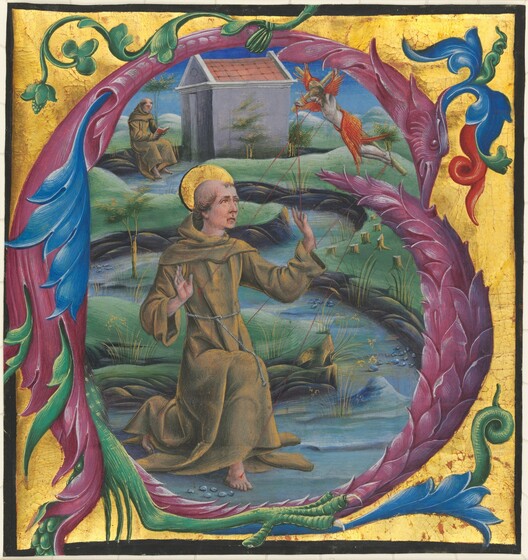
WASHINGTON (CNS) — St. Francis of Assisi’s reception of the stigmata, the wounds of Christ, at La Verna in Italy and its depiction by artists beginning in the 15th century is the focus of a National Gallery of Art exhibit. “Heavenly Earth: Images of Saint Francis at La Verna” includes 30 pieces of Franciscan art centered on the miraculous 13th-century event. The exhibit was to open Feb. 25. Ginger Hammer, an assistant curator at the museum in Washington, said the display focuses on an “unprecedented event in Western spirituality.” No one in recorded history had experience such an occurrence before St. Francis did in 1224.

It happened while St. Francis was meditating on the passion of Christ during one of his regular retreats in the mountain wilderness. “He wanted to understand the very suffering that Christ endured. The result of his prayers reportedly is that a seraph, or six-winged angel, approached him enfolding the image of Christ on the cross. When the seraph departed, the actual wounds of Christ’s passion were transferred to the body of Francis,” Hammer told Catholic News Service Feb. 20 during a media preview. “That had never happened before and it was quite remarkable that through his own endeavors something mystical of this magnitude could happen to a human being,” she said.

A Franciscan sanctuary and museum complex mark the La Verna site today and continues to welcome pilgrims. The event was so extraordinary that artists over the centuries have tried to capture it to share with others. The exhibit focuses on work in various media from the 15th through 18th centuries. (Read more.)
More information at the National Gallery of Art website, HERE. Share

Monday, September 14, 2026

Henrietta Maria and Her Mother, Marie de’ Medici


 My guest post for Tony Riches.

First of all, I would like to thank Tony Riches for opening his popular blog to other historical writers so that we may share our research. I am the author of a biography of Marie-Antoinette as well as six historical novels. The latest two novels are about Queen Henrietta Maria, wife of Charles I and they are entitled My Queen, My Love and Generalissima. They are part of an unfinished trilogy; the third installment Avalon will be out sometime in 2027 or 28. 

In my readings about Henrietta of France, I have found that her mother Marie de’ Medici played an enormous role not only in her upbringing but in her ongoing political decisions, as well as shaping her faith, her love of the arts, of music, theater, and architecture. Queen Marie has ended up playing a much larger role in my novels than I originally would ever have imagined, due to the sheer force of her personality as much as to her real adventures, which included leading rebellions against her son, climbing out of windows to escape the royal guards, and hiding with her entourage of dwarves in a German brewery. All of this followed a glittering career of being Queen Mother Regent of France. Most of the Queen’s life is captured in the spectacular series of twenty-four huge paintings by Rubens, now at the Louvre. (Read more.)


Books available HERE.

Share

Monday, August 31, 2026

Remembering the Battle of Mohács

A brilliant article which shows how the European powers' fears over the growth of Habsburg hegemony contributed to the triumph of Islam. From Chronicles:

Hungary’s defeat coincided with larger European developments. The Habsburgs were then emerging as a major European power, considered by many players—and most dishonorably by the French—to be more threatening than the 100,000-strong devastating Turkish host advancing up the Danube Valley. The Habsburgs were able to establish control over the westernmost fifth of Hungary, and from there, 150 years later under the leadership of their brilliant commander Eugene of Savoy, to advance steadily south to the Military Frontier established along the northern banks of the Sava and the Danube east of Belgrade. In the Hungarian heartland under Turkish rule, however, and in  autonomous Transylvania in the east,  because so many Catholic hierarchs and priests died at Mohács, the Hungarian Reformation consolidated its territorial hold.

In 1526 there was a structural imbalance between Europe’s acute political fragmentation, while the Ottomans, under Suleiman, had achieved an impressive level of administrative centralization and military efficiency. The Turkish edifice would start crumbling only decades after Suleiman’s death in 1566, but in the meantime Europe faced immense danger from the east. It loomed just as Europe engaged—during the Thirty Years’ War—in the most destructive episode of self immolation until that time. The Ottoman threat finally retreateed after the second siege of Vienna in 1683.

The battle lost in 1526 has had a defining role in forming Hungarian historical consciousness. The “Mohács Trauma” appeared in the public discourse soon after the battle, and eventually became synonymous with continuing Hungarian misfortune in the public mind. For a long time that trauma was restricted mainly to the upper social stratum. This was in contrast to Serbia and other Serb lands, where the epic saga of the Battle of Kosovo and its mystical transformation of military defeat into moral victory lived on even among illiterate peasants, indeed especially among them. (Read more.)

Share

Sunday, August 30, 2026

Mary of Modena: James II's Dazzling Queen

 The Writing Desk: Book review: Mary of Modena: James II's Dazzling Queen,  by Justine Brown

There are several cases throughout history of arranged royal marriages in which it was as if God had chosen to favor a particular country by sending a bride who possessed not only virtue but great physical beauty to be the wife of the ruler and the mother of the heir. A few of those alliances ended catastrophically when, for certain reasons, the bride in question was rejected by her adopted people, even when loved by her husband. I am thinking in particular of Henrietta Maria of France, despised for her attachment to her Catholic faith. There is also Marie-Antoinette, hated for her Austrian heritage, made worse by a campaign of vicious slander. The tragic Empress Alexandra, whom Tsar Nicholas married for love, was falsely accused of betraying Russia to her German relatives. Among such consorts, noble and fair to behold, shines Mary Beatrice of Modena, the second wife of James II. Justine Brown, author of The Private Life of James II, has surpassed herself in this comprehensive biography of the last Catholic Queen of England, Scotland and Ireland. I found it engrossing for the detailed descriptions of the pageantry of the final years of the Stuart dynasty before the so-called "Glorious Revolution" in which the true monarch was overthrown by his own daughters. The evidence is compiled to show that James II was driven from his throne not for any tyranny, as is claimed by Whiggish historians, but because his wife had give birth to a Catholic heir. It was hatred of the Faith that disrupted the royal line and led to the weakening of the royal authority, so that in time British sovereigns reigned but no longer ruled.

From the Amazon page:

Mary Beatrice learns governance, defies scandal, and becomes a steadfast beacon for Jacobite resilience amid a turbulent Restoration era.

The 1688 “Glorious Revolution” that toppled James II and VII also veiled his consort in propaganda. Mary of Modena: James II’s Dazzling Queen reveals the extraordinary woman beneath. Lovely and spirited, Mary Beatrice Isabella d’Este is also England’s sole Italian queen. Her father came from an ancient line, while her mother was one of Cardinal Mazarin’s seven famed nieces (the “Mazarinettes”).

Mary Beatrice learned the rudiments of governance at her widowed mother’s knee, and would one day act as regent of the Stuart court-in-exile—first for King James, then for their son, James Francis Edward. “The Queen over the Water” would shine as a beacon for the Jacobite cause.

Once, Mary Beatrice longed to be a nun. Instead, the young woman had to accept a different mission—marriage to James Duke of York, heir to the thrones of England, Scotland, and Ireland. Although James’s conversion to Catholicism made their marriage possible, it set off a firestorm of controversy in the mysterious northern realm.

The story of the British Isles was romantic, but the reality was jarring. Thrown into the frenzy of Restoration politics, Mary Beatrice met each fresh episode courageously. Charles II adored his sister-in-law, but MPs strove to annul the “Italian match” before it could be consummated. She and James fell in love, but his philandering nearly broke her.

Building on Este tradition, Mary Beatrice won over the common folk, inspired poets and painters, introduced Italian opera, and drew talented ladies to court. She also attracted her flamboyant Mazarinette cousin Hortense Mancini to England, where she joined King Charles’s harem.

Ultimately, James and Mary Beatrice were coronated with great ceremony, but their troubles were only just beginning. For the first time in English history, it looked like the birth of a healthy prince might actually destroy the monarchy instead of strengthening it…
(Read more.)
In Justine's account, I found Mary of Modena to be inspiring not only as a brave and steadfast Queen but as a Catholic wife and mother dealing with adversity. As a teenage bride she was shattered to discover that the handsome husband she had fallen in love with was a chronic adulterer with a growing number of illegitimate offspring. And while the children of James' mistresses grew and thrived, Mary's children miscarried, or were stillborn or died young. But Mary, who had originally wanted to be a Visitandine nun, followed the teaching of the founder of the Visitation order, St. Francis de Sales. St. Francis de Sales emphasized a loving acceptance of trials as well as complete trust and confidence in God. Queen Mary's spiritual director was the Jesuit St. Claude La Colombière who brought to England the devotion to the Sacred Heart of Jesus, for he had been the confessor of  the Visitation nun who claimed to have visions of the Savior, known to history as St. Margaret Mary. Mary of Modena would help spread the devotion to the Heart of God throughout Europe in her later years of exile. Meanwhile, James II, whose childhood had been disrupted by war, imprisonment and exile, came to learn to live a devout life from his much younger wife, so that he gave up his transgressive lifestyle. I was particularly struck by the happiness of James and Mary when they had lost everything, but had each other and their children. I recommend this biography of a Queen of England who experienced a white martyrdom, yet the more she was diminished, the greater she became.
Share

Tuesday, August 4, 2026

Taddeo di Bartolo: Sienese Gothic in the Early Renaissance


From Hilary White at The Sacred Images Project:

If I hadn’t told you the date, would you have guessed the early fifteenth century?

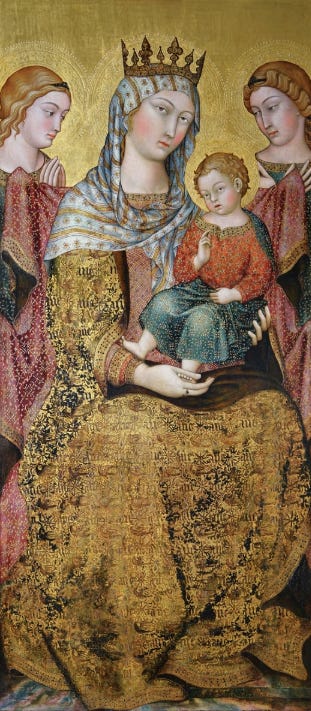
Most people wouldn’t, and would probably peg it as “early Renaissance”. In fact, even readers who’ve been following the Sacred Images Project for a while might hesitate. At first glance, this looks like a classic mid-14th century, “Trecento” Sienese Gothic Madonna. It has all the notes: a glowing gold background functioning as non-natural space, meticulously and elaborately tooled and stamped to show the haloes, the richly patterned cloth created by picking out the paint with the sgraffito technique to expose the gold underlay. 

 Here are the typical Sienese gentle almond eyes, elongated figures, softly rounded and luminous features, and the solemn little Christ Child, royally dressed, blessing the viewer. It all belongs to a visual language that seems to have come straight from the age of Duccio and Simone Martini.

But this isn’t 1340. It was painted around 1405, sixty-five years later. What makes it so intriguing is that the great flowering of the Sienese “golden age,” so characterised by this very distinctive painting style, was supposed to have ended quite abruptly in 1348, with the Black Death that wiped out 50% of Siena’s population in a single year. But we will see below that this is an oversimplification. Since there’s no documentation it’s only speculation, but wouldn’t it be fun to think of him as saying, “We’re Sienese, dammit, whatever those heathen Florentines are doing”? What if Siena wasn’t behind Florence but simply disagreed with Florence? (Read more.)

Share

Sunday, August 2, 2026

Fra Angelico’s First Major Altarpiece Gets a Groundbreaking Repair

a group of angels stand looking at the Virgin who is out of the picture in this part of the Fra Angelico altarpiece 

From Artnet:

Antonella Ranaldi, director of Florence and Prato’s cultural heritage office, called the restoration “a case study of the greatest interest that will serve as a model for restorers in the years to come.”

The work is considered Fra Angelico’s first major large-scale work. In the early 1420s, the budding painter-friar, née Guido di Pietro, entered the convent of San Domenico in Fiesole, a complex just north of Florence, where he was tasked with creating an altarpiece for the newly built monastery. In keeping with the fashions of the age, Fra Angelico created a late Gothic style triptych with a liberal use of gold, centering a serene depiction of the Virgin and Child alongside adoring angels and four haloed saints.

Time has not been kind to the San Domenico altarpiece. By 1501, 50 years after the artist’s death, the painter Lorenzo di Credi was commissioned with updating the work to contemporary tastes. He removed the partitions, downsized the Virgin’s throne, and replaced the gold grounding with a naturalistic landscape. Over the coming centuries, the altarpiece was broken up, its parts looted or sold on the antiques market—the original predella, for instance, now belongs to London’s National Gallery. Fra Angelico’s central panel remained at the convent, albeit damaged by haphazard restorations and eaten by wood-boring insects. (Read more.)

Share

Monday, July 27, 2026

The Agony of The Odyssey

 From Paul du Quenoy at Chronicles:

“Hahaha. Very proud to say we got the Odyssey removed from the curriculum this year!” Lawrence, Massachusetts, high school teacher Heather Levine tweeted in 2020, responding to a post from a fellow “scholar-educator” who called Homer’s epic poem “trash.” The Wall Street Journal reported that the teachers were part of an online group of left-wing activist educators who tried to get Homer’s epic and other classics of Western literature banned from classrooms because of their supposedly racist, sexist, and ableist contents.

These undoubtedly enlightened purveyors of knowledge have yet to register any reaction to this summer’s blockbuster release of Sir Christopher Nolan’s film adaptation of Homer’s epic. Nolan’s film, which he co-produced with his wife Emma Thomas and for which he wrote the script, debases The Odyssey so cheaply that Hellenophobic New England schoolmarms might well be pleased, assuming they are not too triggered to see the film.

Nolan was on tap to direct Troy, an adaptation of Homer’s Iliad executed more than two decades ago by Wolfgang Petersen, but the studio eased Nolan out of the project, giving him Batman Begins as a consolation prize. Nolan has said in interviews that at the time, he felt ill-prepared to tackle The Iliad. He only conceived his Odyssey project in 2024, after the stunning success of Oppenheimer, his disjointed biopic of the troubled atomic bomb scientist J. Robert Oppenheimer, which won seven Academy Awards. According to interviews, Nolan kept the subject of his next film secret for nearly a year while he read several translations of Homer’s epic, along with various related media, apparently including comic book adaptations.

Perhaps naturally, Nolan contextualized The Odyssey within his larger oeuvre of feature films, many of which, including Memento, Interstellar, and his Batman trilogy, relate existential quests involving emotionally tortured men who suffer from familial loss. From that perspective, Homer’s epic—a hero’s 10-year voyage home from a distant battlefield to a faithful but beleaguered family—may have seemed a natural fit. Nolan had the time, money, and opportunity to make a stirring and searching literary adaptation of great significance, if for no other reason than that a serious film adaptation of The Odyssey hasn’t been undertaken since Italian director Mario Camerini’s flawed 1954 attempt in technicolor, Ulysses, starring Kirk Douglas. (Read more.)

Share

Sunday, July 19, 2026

My Guest Post for Tony Riches


 My thanks to Tony for such a wonderful opportunity! From The Writing Desk:

Wife of the ill-fated Charles I, the colony named for her was intended to be a refuge for Roman Catholics, the Catholic religion being forbidden in the Three Kingdoms. In my room as a teenager there was a print of the Van Dyck portrait of Henrietta Maria, the original of which is in the National Gallery of Art in Washington, D.C. Called “Mary” by her subjects, the second Stuart queen of England peers down from the portrait with her black eyes, which contemporaries described as large, sparkling and beautiful. Her dark curls with auburn highlights contrast against the deep marine blue shimmer of a silk dress, with the salmon-pink bows and elaborate white cuffs and high starched collar. A wide-brimmed plumed black hat was of the type made famous by the cavaliers who later fought for her husband in the English Civil Wars. 

The white plumes are reminiscent of the one made famous by her father Henri IV of France, which he wore into battle so that his men could always find him. Like her father, Henrietta Maria was not afraid to stand out, remaining a devoted Catholic in a land where her faith was banned, becoming the number one lawbreaker, while also striving to be a traditionally obedient wife, as was expected. But the expectations placed upon her made her life a tightrope walk which almost broke her.

The life of Henrietta Maria of France (1609-1669) was turbulent from the beginning. Half-Bourbon and half-Medici, her father, the famous Henri IV, was assassinated when she was an infant. Brought up by her mother, the Queen Regent Marie de’ Medici, to be a devout Catholic, she also mastered ballet, singing, and acting, skills which she would use in masques to entertain the Bourbon Court and later the Stuart Court. At fifteen she was sent to marry Charles Stuart, grandson of Mary Queen of Scots, who had just succeeded his father James I to the throne of the Three Kingdoms. 

While Charles I never converted to Catholicism, as had been hoped by many, his relationship with his wife was profoundly spiritual, enhancing the intense physical passion between them. After the initial clashing of cultures and personalities, theirs became one of the most devoted in the history of royal marriages, and was blessed with nine children. During the troubles which led to the English Civil War, Henrietta Maria became a liability to Charles because of her religion and her meddling, both perceived and actual. But her courage and her devotion fuelled the royalist cause, as she sold her jewels to raise money for arms and led soldiers to aid her husband. 

The challenges the royal couple faced in their early years of marriage are told in Book 1 of the Henrietta of France trilogy, My Queen, My Love. Book 2 will deal with the Civil Wars and Book 3 will be about the Queen’s widowhood as well as the adventures of her surviving children.

My view of historical fiction is that the author attempts to paint a portrait of the past with words. A historical novel is like a portrait come to life, allowing the reader to step into the past. Authenticity is vital, and that comes only from thorough research. While it is not always possible to visit the historical places that play a part in the novel, it helps. 

The internet has been a gift to historical fiction writers, making accessible old documents, manuscripts, pictures and books that one once had to travel far to find. I found the original program of the 1623 masque performed by Anne of Austria and Henrietta of France at the Louvre during Shrovetide. It was at the rehearsal of the masque that Charles Stuart first saw Henrietta during his incognito visit to Paris. Such primary sources, like the Queen’s letters, are indispensable for creating a living portrait.

So much of what people think they know about Henrietta Maria has been filtered secondhand through multiple writers, some of whom view her as a frothy but tiresome fanatic who led her husband into ruin. This is often accompanied by the perception of the Queen as a dangerous seductress, who used her French wiles in the boudoir to subject Charles to her will. 

And others decide that Charles was not enough for her but she had lovers such as Henry Jermyn who actually told her what to do, while fathering her children. Just as her enemies called her the “popish brat of France,” she has been portrayed erroneously either as a sex fiend soaked with crazed religiosity, or as a shy, pious pawn. (Read more.)

Novel available HERE.

Share

Thursday, July 16, 2026

Armenia Was the Most Important Buffer State Between Rome and Persia

 From The Collector:

The Roman Empire fought for centuries with powerful Persian dynasties in the east, which prevented it from establishing a fixed eastern frontier. The Parthian Empire and then the Sasanian Empire were among Rome’s greatest and most powerful rivals, and their conflicts often took place in the lands between their territories. One of those lands was Armenia, a kingdom situated between Anatolia, Mesopotamia, and the Caucasus. Control of Armenia provided a key defensive barrier and control of important trade routes. The Kingdom of Armenia became one of the most important buffer states between the two mighty empires.

Armenia is located in what has always been a geographically sensitive region. In ancient times, it was located between the eastern Roman provinces and the western territories of the Parthian and, later, the Sasanian Empire. Armenia forms a natural bridge between Anatolia, the Iranian plateau, and Mesopotamia. It is also close to an important transregional route connecting the Black Sea basin to the Near East.

The territory of Armenia is defined by rugged highlands, making the Armenian plateau rich in mountains and deep valleys, with limited passes. These passages were crucial because they directed armies and traders along predictable routes. These vast mountain ranges gave Armenia a great advantage because it was almost unconquerable. Consequently, the major powers like Rome and Persia, instead of conquering, often sought to secure the allegiance and loyalty of the Armenian crown. (Read more.)

Share

Saturday, July 11, 2026

Vatican Begins Restoration of Raphael Loggias

 From The Art Newspaper:

The restoration follows two pilot projects carried out between 2019 and 2024, in which experts tested the technology that will be applied to the entire cycle.

The restoration is supported by $5.5m from the Legacy of Raphael: The Vatican and Beyond initiative, a World Monuments Fund project for restoration, training, digital documentation and dissemination. That initiative was itself funded with a $14.3m donation by the Stephen A. Schwarzman Foundation, a New York-based philanthropic organisation. The work on the loggias has also been supported by the group Patrons of the Arts in the Vatican Museums.

Jatta adds that the installation of the new windows had been made possible with a donation by The Patrons of the Arts in the Vatican Museums, which also financed the pilot projects.

“The new windows are absolutely essential,” Jatta says. “If the right microclimatic conditions aren’t created in that space, there’s no point in carrying out the restoration, as those areas and the frescoes would certainly deteriorate again.” (Read more.)

Share

Wednesday, July 8, 2026

The Mysterious Frescoes of Castelseprio


 From Hilary White at The Sacred Images Project:

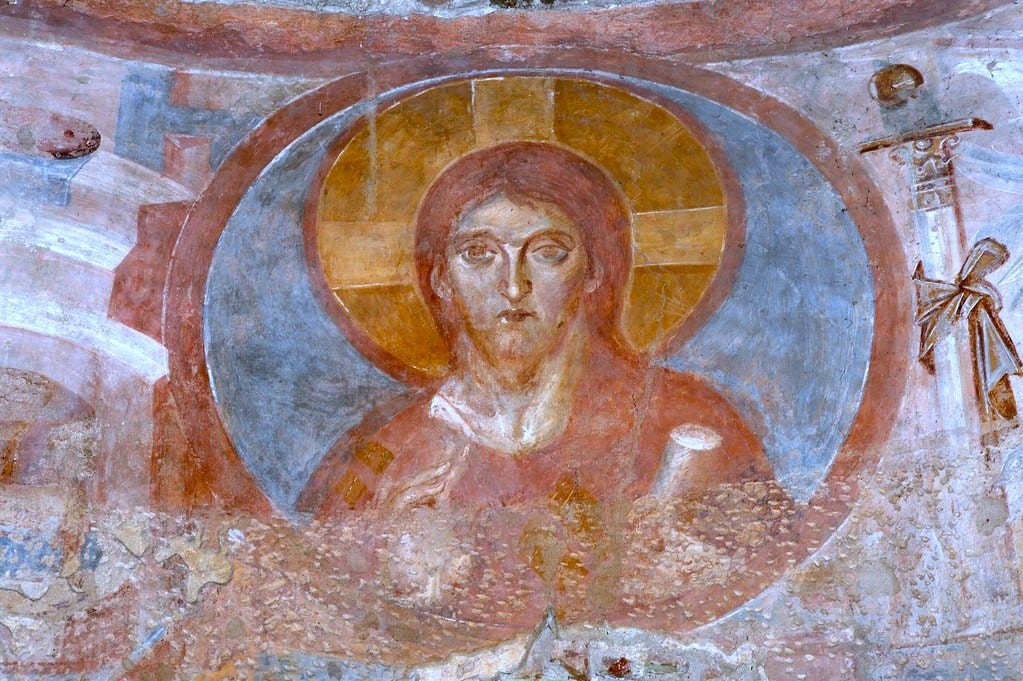
It might seem surprising that this fresco of Christ Pantocrator, discovered in the apse of a small obscure church in the north of Italy, is so unusual that it caused a major re-write of the art-history timeline. It looks like any early Byzantine image that we’ve seen hundreds of times: serene, otherworldly, with the face symmetrical with classical proportions, modelled with lights and darks to give the impression of lifelike three-dimensionality. But at the same time, we can see it is stylistically different: the softness of the facial modelling, the natural fall of the hair, the subtly rendered shadow beneath the chin, the piercing gaze and human expression.

In fact, it immediately reminds me in its naturalism of the frescos discovered at Pompei and Herculaneum. It might not be surprising to find that it dates to the earliest paleo-Christian period, when Roman standards were still in use.

But that would be the wrong guess. 

In today’s post for all subscribers, we will explore the treasure left forgotten in a tiny church in the forests of Lombardy. Hidden for centuries beneath layers of plaster, the exceptionally beautiful and lively Byzantine frescoes of Castelseprio challenge everything scholars thought they knew about Western art of the early middle ages - the time of the Lombard Kingdom, Carolingian and Ottonian empires.

Were they painted by a wandering Byzantine master, or do they reveal a local tradition that quietly preserved the grace and theology of late antique sacred art? (Read more.)

Share

Tuesday, June 30, 2026

History of the Christian Altar


From Shawn Tribe at The Liturgical Arts Journal:

Altars are (or ought to be at least), architecturally and liturgically, the central focal point of the interior of our churches. Given their evident importance, it is no surprise that there can be much in the way of disagreement as to what the ideal form of the altar is. Debates rage about free-standing altars versus altars with grand reredoses attached to them.

It was through the consideration of the different forms of the altar, particularly through the pursuits of the Liturgical Movement, that the idea arose of taking a brief look at the history and development of its forms. I. Early Christian Antiquity If we look to the earliest time of Christian antiquity, there are two early forms of altar that can be identified. One is those of the house-churches, which were wooden and in table form. Some of the Eucharistic frescoes of the Roman catacombs may give some sense of this form:
The "Fractio Panis" fresco in the Capella Greca of the Roman catacomb of St. Priscilla
The second form was the use of the stone tombs of the martyrs as altars. This custom is thought to trace to the first quarter of the 2nd century. Marble tops were placed upon the tombs for the Mass to be celebrated upon.
The Fractio Panis fresco of the Capella Greca, which belongs to this period is located in the apse directly above a small cavity which Wilpert supposes to have contained the relics of a martyr, and it is highly probable that the stone covering this tomb served as an altar. (The Catholic Encyclopedia)

(Read more.)

At San Clemente in Rome, although the church was built facing west, Mass was offered facing east. The congregation would face east as well. From Shawn Tribe at The Liturgical Arts Journal:

I cannot definitively explain why the church was laid out this way as a glance at the property would suggest that it could easily have been orientated, which is to say, designed so that one's movement through the church was from west to east, toward the rising sun. All the churches built by Constantine in Rome were laid out "backwards" this way (except Santa Croce in Gerusalemme, which was built into an existing building), and I can only guess that this was done in part to imitate the Temple at Jerusalem.

There are other possibilities as well. The priest offering the Holy Sacrifice is facing east, of course--the design of the altar makes it impossible for Mass to be offered any other way. It is thought that in antiquity the assembly would actually turn around and face east with the celebrant, putting the Sanctuary behind them. This is not as strange as it might at first sound. A shepherd is always behind his flock. This is why the celebrant always comes last in procession. Furthermore, the church building symbolizes the Barque of Peter. In fact, the word nave derives from the Latin navis, which means boat. So the Sanctuary is where the helm in an ancient ship would be--at the back.

We have a dual movement, then. We move into the church building toward the west, and then we turn around at a certain point in the liturgy and proceed east. Now consider for a moment St. Germanus' text. He says that the Sanctuary is an image of the tomb in which Christ was buried; the Altar is "the spot in the tomb where Christ was placed"; and the apse corresponds to the cave in which He was buried. So perhaps our movement from east to west toward the Sanctuary, toward the setting sun, is actually a representation of our burial with Christ. And turning around and proceeding east, toward the rising sun, represents our sharing in His Resurrection. (Read more.)

Share

Monday, June 22, 2026

How Augustus’ Moral Laws Controlled Culture in Ancient Rome

 Believe it or not. From The Collector:

When Augustus emerged as the ultimate winner of the years of civil war that ended the Roman Republic, he set about rebuilding Rome. In truth, he was constructing a new city that reflected his new imperial regime, but this was dressed up as Rome restored to a mythical, glorious Republican past, before the destructive corruption of the late Republic. Augustus was focused on the physical city (turning a city of brick into one of marble) and the city’s soul: its people and traditions. Rome’s population and social norms had been decimated by years of conflict. Augustus tried to restore both through a series of legislation known as his “moral laws.”

When Octavian defeated Mark Antony at the Battle of Actium in 31 BC, he was left the undisputed ruler of Rome. Years of strongmen battling for power in civil wars had left the Republic in tatters and had allowed one man to emerge as an absolute ruler. But while the Republican system may have been broken, it was still beloved, and the assassination of Julius Caesar just over a decade earlier showed that, despite everything, Rome was not ready to accept a king.

This placed Octavian in a predicament. How could he secure and codify his power without invoking the wrath of the fickle Roman people? He did so by cloaking his new position in the traditions of the Republic. He gave up his extraordinary powers and instead used twists on Republican traditions. For example, he was awarded permanent imperium, giving him ultimate control of Rome’s armies, and accepted tribunicia potestas annually, allowing him to propose and veto laws. For his “sacrifices,” Octavian was awarded the name Augustus in 27 BC. (Read more.)


Share

Saturday, June 20, 2026

The Christology of the Stairs: Medieval Raised Sanctuaries vs. Modern "Worship Spaces"

 From Hilary White at The Sacred Images Project:

Visitors to the medieval churches of Umbria and Tuscany are often surprised by an architectural feature that is found surviving in great abundance in our area; raised or elevated sanctuaries in our most ancient churches. That is, the place where the liturgical actions happen, that we are used to seeing conducted right in front of us, is set on a high platform, sometimes as much as 15 feet above the level of the nave, and mostly impossible to see.

We’re used to the sanctuary part of the church being raised at least a few feet above the level of the nave, often with the altar raised again on a stepped platform, but several meters? So high the congregation can’t see anything?

Architecture always catechizes. We all know that Catholic church architecture is used to express particular beliefs about the nature of reality, Christology, man’s relationship with God and his proper place in creation. Most Catholic churches, until the middle of the twentieth century, were built on a cruciform floor plan. The church itself is the image of the crucified Christ; the faithful literally enter into the symbol. Medieval builders extended this symbolic language far beyond the floor plan. Every aspect of the building could be made to communicate theological truths. These ancient stone churches emerge from a worldview that understands reality itself as hierarchical, which the designers of the elevated sanctuaries took very literally.

 Why are so many ancient churches in Umbria and Tuscany built with sanctuaries raised high above the congregation, sometimes so high that much of the liturgy would have been difficult to see? It has very little to do with practicality and a great deal to do with how medieval Christians understood Christ, the Mass, heaven, earth and the structure of reality itself. (Read more.)


Share

Thursday, May 28, 2026

Medieval Lepers

 From Archaeology Magazine:

Phys.org reports that Elena Fiorin of Sapienza University of Rome and her colleagues looked for mercury in samples of dental calculus taken from the remains of people buried at two medieval lepers’ hospitals, or leprosaria—Peterborough Abbey in England, which was founded in 1125, and Saint-Thomas-d’Aizier, built in the late eleventh century in Normandy, France. During the medieval period, the toxic metal was used to treat syphilis and leprosy in the form of ointments that were rubbed onto the skin. Samples of bones, teeth, and hair are usually used to test mercury levels in human remains. “Dental calculus offers a new and complementary perspective,” Fiorin said. “Because it forms in the mouth during life, it can capture substances that enter the body more directly, including medical treatments applied in or around the mouth,” she explained. The researchers also tested soil from the graves to see if mercury could have entered the dental calculus after burial, and analyzed the dental calculus of people who had been buried in non-leprosaria cemeteries in England and France. “Individuals buried in leprosaria show significantly higher mercury levels than those from other cemeteries, and our analyses indicate that this mercury was incorporated during life rather from the soil,” Fiorin said. “In addition, there is no evidence of local environmental sources, such as mining, that could explain these patterns.” Mercury detected in the soil at the leprosaria likely leached from contaminated bodies, since the levels of mercury in the dental calculus tended to be higher than those in the soil samples. The highest levels of mercury were found in the remains of two individuals who had been buried in a leprosarium chapel, perhaps indicating that they were elites with access to more medical treatment. Read the original scholarly article about this research in the Journal of Archaeological Science. To read more about chemical sampling of soil around burials, go to "Secrets of Life in the Soil." (Read more.)

Share

Wednesday, May 27, 2026

DNA Analysis of Christopher Columbus

 From Bored Panda:

Christopher Columbus may not have been who we thought, as researchers are closer to unraveling the mystery of his true identity. According to the widely accepted story about the famous explorer, he is a man of humble Italian origins. But a new genetic study has challenged this, saying he may be from a powerful and influential family elsewhere.

For centuries, history books have painted Columbus as a navigator of modest Italian origins.

Despite not being the first to make it to the Americas, he was the man credited with discovering the “New World” after convincing the Catholic Monarchs to finance a voyage that changed the course of history.

On August 3, 1492, he and his crew of nearly 100 people set sail from the port of Palos in southern Spain in three vessels: The Niña, Pinta, and Santa Maria.

To find a route to China and India was Columbus’ mission.

But after 35 days at sea and growing frustration among his crew, he nearly turned back. But the cry of land being spotted was heard at around 2 a.m. on October 12. And thus, Columbus had arrived in the Americas. (Read more.)


Share

Friday, May 22, 2026

Blood Red Dirt

 From Hilary White at The Sacred Images Project:

I’ve started doing something lately that I’ve wanted to try for years, but for some reason never quite had the nerve to attempt. I know that many of the earth pigments used by our artistic forbears in Italy were prospected, dug up and processed by the painters, or by members of their workshops, themselves. Back then, unless one lived in Florence or Bologna, one could not simply go to an art supply shop and buy tubes of ready-made colour or pots of dry powdered pigments. A skilled painter, or a professional workshop, was expected to understand materials intimately and would often have prepared them personally.

So, in the interests of science, I’ve collected up a basic set of tools from stuff around the house and have started hunting for pigments in the woods and trails and rock-formations along the Narni-Amelia limestone ridge, in the farming countryside around Narni and Terni, and along the steep cliffs and banks of the Nera river gorge. (Read more.)

Share

Monday, May 18, 2026

The Discovery at Oxyrhynchus

 From The Sunday Times:

The Egyptian archaeological site of Oxyrhynchus, 120 miles south of Cairo, might not have the glamour and renown of the hallowed Valley of the Kings. But a team from the University of Barcelona working at the site has made one of the most significant discoveries in decades.

A mummy from the late Roman period, about 1,600 years old, was discovered buried with a verse of Homer’s The Iliad, the original of which dates back 2,800 years. The text was found in clay with an embalmer’s seal on the outside of the mummy’s wrapping. It is the first time a Greek literary text has been found directly incorporated into the Egyptian mummification process. The discovery, at the ancient city of El-Bahnasa, started as a relatively unexceptional find, said Ignasi-Xavier Adiego, a professor at the University of Barcelona who directs the Oxyrhynchus project. (Read more.)


From The Conversation:

Archaeologists have found something unexpected inside a 1,600-year-old Roman-era Egyptian mummy: a fragment of Homer’s Iliad. It wasn’t placed beside the body, but inside the mummy’s abdomen. But the real surprise isn’t just where the fragment was found. It’s how it got there. To understand, we must go back – to the Iliad itself, and to what it became in the Roman world.

In The Iliad, a poem shaped in the 8th century BC and attributed to Homer, the Trojan war does not end in triumph or renewal. It ends in devastation. The poem closes at the edge of collapse, with Troy reduced to a landscape of heroic ruin. And yet, this is not where the story ends.

According to later Roman tradition, one Trojan escaped. Aeneas – son of Anchises and the goddess Aphrodite – fled the burning city carrying his father on his shoulders and the household gods in his hands. He moved west, across the Mediterranean, towards Italy, where he became the ancestor of Rome.

This continuation did not come from the Iliad itself. It was shaped centuries later, most famously in Virgil’s Aeneid. But it changed the meaning of the Trojan war entirely. The past, in other words, was actively reorganised – through stories that could be reworked, extended and connected across time and space. (Read more.)

Share

Wednesday, May 13, 2026

Raphael and the Pursuit of Sublime and Heavenly Beauty

The Alba Madonna 

From Word on Fire:

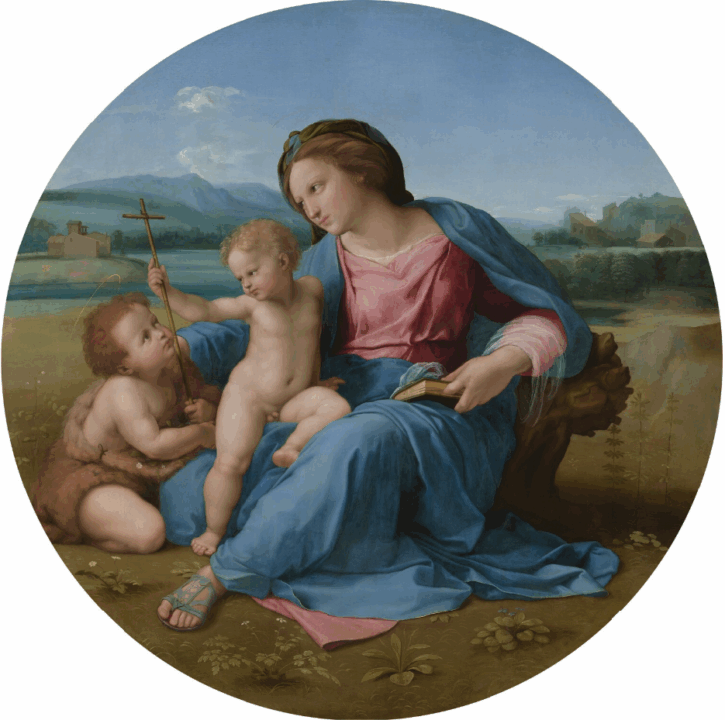
Raphael’s drawings clearly show that the young artist learned quickly and adapted to the rapid artistic developments occurring during the Renaissance. Leonardo and Michelangelo’s influence becomes apparent in the motion, arrangement, and anatomical accuracy that began to characterize the figures in Raphael’s sketches, which he referenced for his paintings. The progression of his technique reveals that Raphael was a man who strove for perfection—and many would argue that he achieved it to the greatest extent possible within the realm of human capabilities.

Raphael’s continual refinement of his skills in the chase after excellence didn’t stop there. He went to Rome in 1508, becoming the court artist for Pope Julius II (r. 1503–1513) and Pope Leo X (r. 1513–1521). He made drawings of the ancient monuments in the city to learn the ins and outs of classical architecture. This knowledge proved useful for the School of Athens, a fresco that Raphael made for a four-part series in the Stanza della Segnatura in the Apostolic Palace.

We’ll never know how much further Raphael could have gone in his endeavors. Raphael did not enjoy the longer lives of his contemporaries, whose artwork had such a noteworthy impact on him; Michelangelo and Leonardo died at 88 and 67 years of age, respectively. Raphael left this world at 37, making the progression of his artistic career even more remarkable than theirs, at least in regard to time. In 1520, he completed what became his last masterpiece: The Transfiguration, a stunning example of his masterly orchestration of light, color, and human bodies to create a dramatic scene. (Read more.)


Share

Saturday, May 2, 2026

How the Fall of Rome Created the Power of the Medieval Papacy

 From The Collector:

In the Early Middle Ages, after the fall of the Roman Empire left the existing government structures in shambles, the papacy established itself as the preeminent authority in the West. Indeed, in a post-Roman world, where there was no large political structure to ensure stability in Europe, the Roman Church emerged as the only force able to provide some unity. Led by a series of popes functioning as both spiritual and temporal rulers, the papacy came to dominate the intellectual life, political landscape, and culture of the so-called Dark Ages.

In 476, the German chief Odoacer deposed Romulus Augustulus, ending the succession of Roman emperors inaugurated by Augustus. He then proclaimed himself king. The event is traditionally considered the end of the Roman Empire. By then, the so-called “barbarian invasions,” or the migration of Germanic peoples into Roman-controlled Europe, had already significantly altered the social and political composition of the empire.

In 406, the Vandals, Suebi, Alani, Burgundians, and Alemanni, fleeing from the advance of the Huns, crossed the River Rhine, pouring into Gaul. Some years later, they arrived in Spain. Meanwhile, the Visigoths established themselves in Narbonensis and Aquitania (the territories in Gaul). Though partially successful in regaining control of portions of Gaul, Roman general Constantius was unable to expel the “barbarians” from the country.

In 410, Alaric, at the head of the Visigoths, sacked Rome, pillaging the heart of the Roman Empire for three days. Only the churches were spared, as Alaric had converted to Christian Arianism. In the first half of the 5th century, other Germanic peoples began to establish themselves in the Roman territories. In 435, the Vandals conquered Carthage in North Africa. In 450, Attila and his Huns invaded Italy. Only Pope Leo the Great managed to persuade them not to sack Rome. (Read more.)


Share