Showing posts with label The Scots. Show all posts

Wednesday, September 23, 2026

Queen Victoria, the Stuarts and Scotland

Victoria and Albert as Catherine of Braganza and Charles II by Winterhalter


Gown worn by Victoria at her Stuart Ball

Tartan dress of Queen Victoria

Royal Family in Highlands

Scotch air, Scotch people, Scotch hills, Scotch rivers, Scotch woods, are all far preferable to those of any other nation in or out of this world.~Queen Victoria, ca. 1849. 

 In the mid-18th century, in an uprising known as "The 45" Prince Charles Edward Stuart tried to reconquer the thrones of England and Scotland for his father James III, known as the "Old Pretender." The thrones had been usurped by the German and Protestant House of Hanover in spite of the fact that the legal Catholic sovereign was alive and well. The Scots in particular did not take well to their rightful sovereign being disinherited because of the English preference for German Protestants. The uprising failed miserably, bringing more hardship and tragedy to the Scottish people for the remainder of the century. Meanwhile many songs, tales and legends of that time imprinted themselves upon the land and the people. Many of those tales and legends found their way into the writings of Sir Walter Scott, one of the first historical novelists, whose Waverley novels of the early 19th century brought the lost Stuart rebellions and their heroes to life for a new generation. The prince Regent, the future George IV, rebelled against his Hanoverian patrimony after reading the Scott novels, and headed for Scotland.

From Peter Harrington:

The romanticisation of Scotland can be most definitively linked in literature with the Waverley novels of Sir Walter Scott. The first of the Waverley novels was published in 1814 and was set during the Jacobite uprising which took place almost a century earlier. The novels were so popular that Scott was propelled to fame, and was invited to dine with King George IV, (then Prince Regent). When, several years later, the Scottish ‘Radical War’ of 1820, inspired by the American and French Revolutions, caused King George to plan the first royal visit to Scotland in over two hundred years in an effort to quell unrest, it was Scott he called on to carefully stage manage the visit. By now a baronet with numerous valuable connections to Scottish nobility, Scott saw the opportunity both to avert an uprising and to promote highland culture. He reasoned that, because of George’s lineage, the king could legitimately claim as much Stuart heritage as Bonnie Prince Charlie and could thus present himself as a Jacobite prince, properly accoutred Royal Stuart tartan. Kilts at this time were no longer generally worn, having been banned by the Dress Act of 1746, which made the wearing of ‘Highland dress’ illegal. Though the act was repealed in 1782, kilts had only come back into fashion with the Scottish gentry, a number of whom set up ‘Highland Societies’.... For the king to appear so attired was not only an attempt to appeal to the heritage of the Scottish people but also to gloss over old wrongs.

George’s visit sparked an interest in Scottish dress, and, in its wake, the demand for kilts grew so high that Scottish weaving mills were unable to cope with the demand. It was in this period that (contrary to the generally assumed belief that individualised tartans are a much older tradition) many of the clan tartans were designated. (Read more.)

 George IV died and was succeeded by his brother William IV, who in turn left the throne to their niece Victoria in 1837. It was the Romantic Era, and Queen Victoria also loved the Waverley novels. In general she found the Stuarts far more romantic than her own Hanoverians and decided to fill her life with tokens of the Stuart homeland of Scotland. Her beloved husband Prince Albert shared her predilection, in spite of being German himself and in the 1840's they began spending as much time as possible in their northern kingdom.

From Quartermile Blog:

The first land to capture the Queen’s heart wasn’t Scotland, but Ireland. Early in her reign, Victoria spent her holidays in. Yet after the potato famine of 1845 irreparable damage was done to the relationship between the British government and the people of Ireland. Despite Victoria’s personal donation of £5,000 to the cause (nearly £600,000 in today’s money) and her visit to the country in 1849, the relationship never recovered....Scotland fared much better in Victoria’s eyes. In fact, Victoria made frequent visits north of the border during her reign despite the fact that Scotland had only been visited twice by reigning monarchs in the previous two centuries.

Victoria and Albert’s love for Scotland drove them to take out a long-term lease on the stunning Balmoral Castle in Deeside in 1848. Later, in 1852, the royal couple permanently purchased the property for £31,500 (£4million today) and had it significantly extended. From this point on, Victoria and Albert spent a section of each summer in Balmoral, thanks to the advances in British rail travel....Victoria’s ever growing affection for Scotland didn’t just stretch to the land itself, but to the culture and fashion too. Through their experience of Scotland, Victoria and Albert both became big fans of tartan, and helped to elevate the status and reputation of the pattern south of the border.

According to accounts from the time, Victoria and Albert enthusiastically redecorated Balmoral Castle with reams of “Balmoral tartan, in red and grey” furnishings. They even included “innumerable stags’ antlers” in their décor. For Victoria, the use of tartan was an outward sign of being connected to her favourite part of the world. (Read more.)

Victoria showed that she not only loved Scotland but cherished the memory of the Stuarts, masquerading as Catherine of Braganza, consort of Charles II, at a ball. She had an Italian sculptor create a marble statue of Princess Elizabeth Stuart, the daughter of Charles I who died in prison at age thirteen, reputedly with her head on her murdered father's Bible. She passed the interest on to her children, as can be seen from a water color of Mary Queen of Scots by the Princess Royal. The Stuarts must have fulfilled Victoria's vision of a monarchy in which the kings and queens did not only reign but ruled, had adventures, tragedies, romances and died for love.

Princess Elizabeth Stuart: "Go ... And see the tomb of Charles's child wet with Victoria's tears"

Carl Haag’s "Luncheon at Cairn Lochan" depicts the royal family picnicking in Scotland.

Balmoral today with flock wallpaper ordered by Queen Victoria

Painting of Mary Queen of Scots by Queen Victoria's daughter the Princess Royal


Share

Tuesday, September 8, 2026

A Guide to the Children of James VI and I and Anne of Denmark

The first Prince of Wales from the House of Stuart was named for his grandfather, Lord Darnley. (Yes, the Lord Darnley.) To quote author Linda Root:
Many historians wrongly refer to Henry Frederick Stuart as the Prince of Wales from the time he arrived in England in 1603.  This is incorrect.  He was not invested with that title until 1610.  His predecessor was Edward Tudor, the boy king Edward VI (1537-1553)  Upon Henry Frederick's  birth in Scotland he was given the customary title of a male Scottish heir apparent, Duke of Rothesay, as well as several lesser grants appropriate to the Scottish heir. However, when he arrived in England he was also conferred the English title Duke of Cornwall.  He had to wait seven more years to become Prince of Wales.  Referring to him as Prince of Wales during his early childhood should be a cause of embarrassment to a any historian or historical novelist who refers to him as Wales prior to 1610 and yet, it is a common mistake.  It is the way he is most often remembered although he only lived two years to enjoy the title. (Read more.)
Share

Sunday, August 30, 2026

Mary of Modena: James II's Dazzling Queen

 The Writing Desk: Book review: Mary of Modena: James II's Dazzling Queen,  by Justine Brown

There are several cases throughout history of arranged royal marriages in which it was as if God had chosen to favor a particular country by sending a bride who possessed not only virtue but great physical beauty to be the wife of the ruler and the mother of the heir. A few of those alliances ended catastrophically when, for certain reasons, the bride in question was rejected by her adopted people, even when loved by her husband. I am thinking in particular of Henrietta Maria of France, despised for her attachment to her Catholic faith. There is also Marie-Antoinette, hated for her Austrian heritage, made worse by a campaign of vicious slander. The tragic Empress Alexandra, whom Tsar Nicholas married for love, was falsely accused of betraying Russia to her German relatives. Among such consorts, noble and fair to behold, shines Mary Beatrice of Modena, the second wife of James II. Justine Brown, author of The Private Life of James II, has surpassed herself in this comprehensive biography of the last Catholic Queen of England, Scotland and Ireland. I found it engrossing for the detailed descriptions of the pageantry of the final years of the Stuart dynasty before the so-called "Glorious Revolution" in which the true monarch was overthrown by his own daughters. The evidence is compiled to show that James II was driven from his throne not for any tyranny, as is claimed by Whiggish historians, but because his wife had give birth to a Catholic heir. It was hatred of the Faith that disrupted the royal line and led to the weakening of the royal authority, so that in time British sovereigns reigned but no longer ruled.

From the Amazon page:

Mary Beatrice learns governance, defies scandal, and becomes a steadfast beacon for Jacobite resilience amid a turbulent Restoration era.

The 1688 “Glorious Revolution” that toppled James II and VII also veiled his consort in propaganda. Mary of Modena: James II’s Dazzling Queen reveals the extraordinary woman beneath. Lovely and spirited, Mary Beatrice Isabella d’Este is also England’s sole Italian queen. Her father came from an ancient line, while her mother was one of Cardinal Mazarin’s seven famed nieces (the “Mazarinettes”).

Mary Beatrice learned the rudiments of governance at her widowed mother’s knee, and would one day act as regent of the Stuart court-in-exile—first for King James, then for their son, James Francis Edward. “The Queen over the Water” would shine as a beacon for the Jacobite cause.

Once, Mary Beatrice longed to be a nun. Instead, the young woman had to accept a different mission—marriage to James Duke of York, heir to the thrones of England, Scotland, and Ireland. Although James’s conversion to Catholicism made their marriage possible, it set off a firestorm of controversy in the mysterious northern realm.

The story of the British Isles was romantic, but the reality was jarring. Thrown into the frenzy of Restoration politics, Mary Beatrice met each fresh episode courageously. Charles II adored his sister-in-law, but MPs strove to annul the “Italian match” before it could be consummated. She and James fell in love, but his philandering nearly broke her.

Building on Este tradition, Mary Beatrice won over the common folk, inspired poets and painters, introduced Italian opera, and drew talented ladies to court. She also attracted her flamboyant Mazarinette cousin Hortense Mancini to England, where she joined King Charles’s harem.

Ultimately, James and Mary Beatrice were coronated with great ceremony, but their troubles were only just beginning. For the first time in English history, it looked like the birth of a healthy prince might actually destroy the monarchy instead of strengthening it…
(Read more.)
In Justine's account, I found Mary of Modena to be inspiring not only as a brave and steadfast Queen but as a Catholic wife and mother dealing with adversity. As a teenage bride she was shattered to discover that the handsome husband she had fallen in love with was a chronic adulterer with a growing number of illegitimate offspring. And while the children of James' mistresses grew and thrived, Mary's children miscarried, or were stillborn or died young. But Mary, who had originally wanted to be a Visitandine nun, followed the teaching of the founder of the Visitation order, St. Francis de Sales. St. Francis de Sales emphasized a loving acceptance of trials as well as complete trust and confidence in God. Queen Mary's spiritual director was the Jesuit St. Claude La Colombière who brought to England the devotion to the Sacred Heart of Jesus, for he had been the confessor of  the Visitation nun who claimed to have visions of the Savior, known to history as St. Margaret Mary. Mary of Modena would help spread the devotion to the Heart of God throughout Europe in her later years of exile. Meanwhile, James II, whose childhood had been disrupted by war, imprisonment and exile, came to learn to live a devout life from his much younger wife, so that he gave up his transgressive lifestyle. I was particularly struck by the happiness of James and Mary when they had lost everything, but had each other and their children. I recommend this biography of a Queen of England who experienced a white martyrdom, yet the more she was diminished, the greater she became.
Share

Wednesday, August 19, 2026

The King's Touch


I knew the French and English monarchs prayed over those afflicted with scrofula but I did not know it was done in Scotland. When Charles I was crowned King of Scots in June, 1633, he continued the ancient ceremony. From The Scotsman:
Charles had already been crown by the English in 1626, this was the first coronation in Scotland since that of King James VI in 1567, and more notably, the first time an adult had been crowned as our monarch since that of James IV in 1458, who was 15, not an adult? Okay let’s go further back to King James I, he was 30, happy now? The abbey of Scone, traditional place of coronations up to 1424, had been destroyed, and for this occasion the ceremonial was located in the remains of Holyrood abbey, which had seen the coronation of King James II in 1437.

All that remained of the abbey was the nave, the remainder of the church having been demolished in 1570, and the structure was now restored for the occasion. Charles was baptised in the Chapel Royal at Holyrood Palace in 1600 by David Lindsay, Bishop of Ross, and created Duke of Albany, the traditional title of the second son of the King of Scotland.

[...]

While researching this I found an article about Charles and the “laying on of hands” a ceremony he performed while at Holyrood, a practice said to have been performed by all the Stewart monarchs but discontinued by the Hanoverian’s. Bonnie Prince Charlie though is said to have performed it during the 45. (Read more.) 

This is of particular interest to me since Louis XVI was a direct descendant of Charles I. King Louis treasured the ancient healing ceremony and celebrated it several times a year, not just at his coronation, as described in my book.

More HERE.


Share

Thursday, August 6, 2026

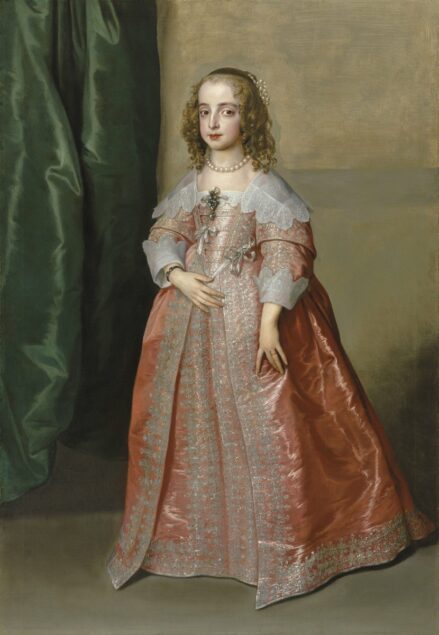
Portrait of Princess Mary Henrietta Stuart

From Codart:
Charles I of England wanted his eldest daughter, Mary Henrietta Stuart, to marry William II, Prince of Orange. The dynastic marriage was aimed at strengthening the alliance between England and the Netherlands. The ceremony was held on 2 May 1641 but the marriage could not be consummated since Mary Henrietta was nine and William was fourteen years old. (Their child, who would be the English king as William III, was only born nine years later.) In the wedding portrait, the princess has a wedding ring on her left hand, and wears on her dress the large diamond brooch she received as a wedding gift from her husband. In the exhibition, we can see the parents and the husband of the princess in engraved portraits.

Children of rulers were regularly portrayed in European courts. Among the portraits of children displayed in the exhibition, there are several who were somehow connected to Princess Mary Henrietta. Balthasar Charles, Prince of Asturias, two years senior to Mary Henrietta, was one of the princess’ possible husbands-to-be. He was also her cousin, just like the children of “The Winter King”, Frederick V of the Palatinate. (Read more.)


Princess Mary is a main character in my novels about her mother, Queen Henrietta Maria.

Share

Wednesday, August 5, 2026

The Private Life of James II

 I have posted about Justine Brown's biography of James II, HERE and HERE; I am happy to say that I have at last been able to read it for myself. It really is the best book I have ever read about James. For one thing it does not trash everyone else in his family as some biographies do. And it explores the walking contradiction that was James II, second son of Charles I and Henrietta Maria, whose very real virtues were overshadowed by his principal vice, that of lust, leading to several torrid extramarital love affairs and a handful of illegitimate offspring. I have often wondered if the obvious sex addictions which ruled Charles II and James II were a result of the traumas suffered when they were young and witnessed the bloodshed of war, resulting in the judicial murder of one beloved parent with long separations from the other beloved parent. Or maybe it was just that they took after their grandfather Henri IV, le vert galant. Their first cousin Louis XIV resembled le bon roi Henri as well, when it came to women, without the excuse of having witnessed the horrors of war as a child, although he came close enough. While James was handsomer than his brother Charles, he possessed neither his earthy charm nor his uncanny ability for double-dealing. James, a military man, was forthright and blunt, seeing the world in black and white, which some have characterized as bigotry, although his ideas of freedom of conscience as applied to the law were revolutionary for his time. Ironically, James is seen as a tyrant and absolutist, when all he wanted was for Catholics and non-conformist Protestants to enjoy the same religious liberties as Anglicans. He had the makings of a great king but was betrayed by his own flesh and blood, changing the course of history and plunging Ireland and Scotland into another century of persecution.

People have mocked James for throwing the Great Seal of England into the Thames before fleeing his kingdom. However, after reading Justine's book it becomes clear why he did so. He was emotionally devastated by the betrayal of his beloved daughters, as well as by his sons-in-law, one of whom was also his nephew, only child of his beloved sister Mary, the Princess Royal. In all the upheavals of the English Civil Wars, James' immediate family had always remained loyal to his father Charles I and to each other. While they had been sundered by miles, illness, imprisonment and death, they never betrayed each other. For James to have his throne stolen by his own children, with the help of the Churchills, to whom he had given everything, was like a knife in the heart. I think he also knew that the ancient monarchy was over and that kings and queens would no longer rule but merely reign.

Perhaps James' main mistake was, other than underestimating the ruthlessness of his daughters Mary and Anne, was underestimating the hatred of Catholicism that the Whig party was intent upon keeping alive in England. During his exile and army career, James had visited Catholic countries; he was married to an Italian and his sister-in-law was Portuguese. He thought that seeing the open practice of Catholicism would wean the populace from their worn-out prejudices. But the fear of popery that erupted into violence, forcing his Queen and his newborn son to escape to France, showed him that he had miscalculated.

James II emerges from the book as a tragic but fascinating personality. He was one of the last Kings of England to have had personal experience of warfare. As Duke of York he built up the British navy, preparing it to be the mega-force which was to rule the seas in the next century. He was a patron of the lively Restoration theater and of all the arts. He was a patron of Catholic shrines, reopening defunct Catholic places of pilgrimage during his short reign. He possessed basic familiarity with his Celtic realms, having lived for several years in Scotland as Duke of Albany. He is patriarch of a European dynasty, the Fitz-James Stuarts, and also has many descendants in the United Kingdom to this day, including the current Prince of Wales. In his last years, exiled in France, the founder of the Trappists, Abbot Armand Jean le Bouthillier de Rancé was his father-confessor. For anyone interested in English history The Private Life of James II by Justine Brown is a must-read.

The biography may be purchased, HERE. An interview with the author is HERE. My novel about James' mother, Queen Henrietta Maria, is HERE.

Share

Shattered Realm, Scattered People

 From Peter D. Richards:

The year 1066 is often remembered for a single, pivotal day on a Sussex hillside—the clash of shield walls at Hastings, the fall of King Harold Godwinson, and the triumph of William the Conqueror. Yet, the Battle of Hastings was merely the prologue to a far broader socio-political cataclysm. In the decades that followed, native Anglo-Saxon society was systematically dismantled.

While stone Norman castles rose like iron beacons across the landscape, the people who had called England home for six centuries faced two distinct, painful fates: exile across the known world for the elite, or subjugation on the lands their ancestors had plowed for the masses left behind.

For the surviving Anglo-Saxon aristocracy, life under Norman rule quickly proved untenable. Following a series of crushed rebellions across the Midlands, the North, and the Fens, the native elite recognised that submission meant disinheritance, imprisonment, or death. Thousands chose flight over servitude.

This sparked one of the most remarkable, yet underreported, diasporas of the Middle Ages:

  • The Celtic & Scandinavian Fringes: Many nobles sought immediate refuge in Scotland and Ireland. Margaret, sister of the un-crowned Anglo-Saxon claimant Edgar Ætheling, married King Malcolm III of Scotland, weaving English royal lineage directly into the Scottish monarchy. Others fled to Denmark and Norway, appealing to Scandinavian kin for military aid.

  • The Exodus to Byzantium: The most extraordinary chapter of the diaspora unfolded far to the east. By the late 1070s, a massive fleet of dispossessed Anglo-Saxon warriors and their families sailed into the Mediterranean, bound for Constantinople.

  • The Varangian Guard: The Byzantine Emperor, Alexios I Comnenus, eagerly inducted these seasoned housecarls into his elite Varangian Guard. The English became the primary core of the Emperor’s personal bodyguard. In a dramatic twist of history, these exiles faced their Norman foes once more at the Battle of Dyrrhachium in 1081.

(Read more.)


Share

Friday, July 31, 2026

"Beautiful Love Story"

Henrietta Maria with two of her Children

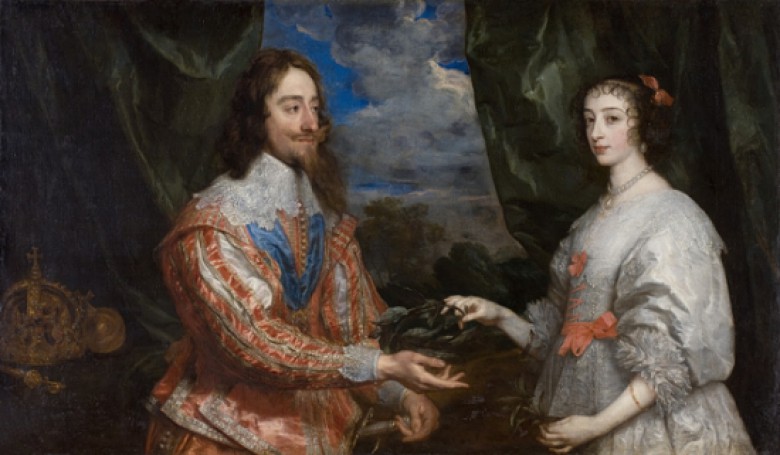
Charles I and Henrietta Maria with Charles Prince of Wales and Mary the Princess Royal

The Queen doing Penance at Tyburn

A glowing review from Pursuing Stacie:
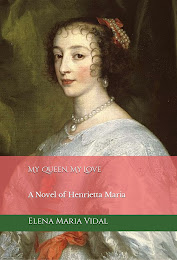
I have a huge love for classics. Little Women, Jane Eyre, Anne of Green of Gables…I will reach for these novels again and again, and then sigh happily about 3, 428 times throughout the story. This was exactly my experience while reading My Queen, My Love: A Novel of Henrietta Maria. It just has that rare classic, cozy, wholesome feel. Mind you, there’s plenty of suspense and intrigue. But the story is just so good!

The author skillfully fleshes out the characters and story of Charles and Henrietta, allowing her readers to sink into the novel. When I was about three chapters in, I realized with a start that I had not only completely missed my bedtime, but had forgotten altogether that I was reading a book, so engrossed was I in the story. (Have you ever read a book that feels like a movie?) (You’re about to.)

While the author set a scene masterfully, she also brought these historical characters to life in rich detail. (Might I suggest Googling their names as you meet them, by the way? So fun to put a face to the new friend that you’ve just made.) I adored Henrietta and will carry her with me always. But truly, each character was dynamic and real. From the beautiful love story to the suspense that only villainy can bring, this novel is perfect from beginning to end. (Read more.)

Because the two of them worked hard to make their marriage work, they ended up deeply in love with each other which made it satisfying. There is plenty of drama, politics, and courtly intrigue that will engage the reader to keep turning the page! I can’t wait to read the next book in the series to learn what comes next for Queen Henrietta Maria of England! I recommend this for fans of Jean Plaidy, Alison Weir, and Philippa Gregory! My Queen, My Love is a promising start to an enthralling series on one of England’s most tragic queens! (Read more.)

My Queen, My Love and Generalissima are available from Amazon.
Share

Monday, July 27, 2026

The Six Loves of James I


In the last few decades some really amazing authors have begun writing about the Stuart dynasty. The abundance of Tudor biographies and novels have led to an interest in the family which succeeded them on the throne of England. While the Tudors were wily politicians, they were continually challenged when it came to male heirs. Because Margaret, the oldest daughter of Henry VII and Elizabeth of York, married James IV of Scotland, her Stuart descendants became the heirs of the Three Kingdoms of England, Scotland and Ireland and of the principality of Wales. James VI of Scotland, son of the murdered Mary Stuart, was de facto heir of the last Tudor, Elizabeth I. He became James I of England. Gareth Russell's fascinating biography of this brilliant and complicated man is a must-read for anyone venturing into the upheavals and achievements of the seventeenth century. Mr. Russell is known for his painstaking research of primary sources as well as for his witty and entertaining prose. This must be at least the tenth work among his several books and plays that I have read.

James I was a series of contradictions. A peaceful man, he was haunted by violence from the womb, when a Scottish lord held a pistol to his mother's pregnant stomach during a palace coup. He survived the violent deaths of both his parents as well as attempts upon his own life, in addition to kidnappings. Yet what damaged him most was the harsh, unloving and even brutal treatment he received as a motherless child from those entrusted with his upbringing. When he finally had a his own wife and family, he loved his Anna, and saw to the thorough education of his children. He was nevertheless constantly becoming infatuated with a series of handsome young men. 

A scholar of Hebrew and Greek, James presided over the translation of the Bible into the English, known as the "King James version." Famous for writing works of theology, he was also notorious for rowdy and boisterous banquets at which he became drunk, while making and laughing at coarse oaths. A persecutor of Catholics, he also insisted on the Anglican liturgy being uniform and dignified, with vestments and candles, which the Calvinists saw as papist. A prosecutor of witches, as a matter of conscience, he would then scandalize the court by showing public affection for his boyfriend of the moment. It was James I's elevation of his favorite, George Villiers, as Duke of Buckingham, while treating him practically as a member of the Royal Family, that prepared the way for Buckingham to be a fixture at the court of James' son, Charles I. Unfortunately, the role Buckingham played in the government of Charles, particularly as perceived by the people, weakened the royal authority.

From Folger Shakespeare Library:

“Elizabeth was king, now James is queen.” So went the joke circulating around London in the 17th century. While Elizabeth I became an icon for transgressing traditional gender roles, her successor is all too often overlooked or even mocked for the same reasons. Yet James I was a multifaceted ruler who led a fascinating life—and his personal relationships only add to that complexity.

For generations, historians avoided labeling the intimate relationships between James and his “favorites” as romantic. But after combing through James’s personal correspondence, historian and author Gareth Russell has uncovered compelling evidence of five significant love affairs with men. His award-winning book, The Six Loves of James I, reveals how these relationships—and his marriage to Queen Anna of Denmark*—guided the course of his life and reign.

James I’s story is a turbulent one, filled with assassination attempts, kidnapping, and witch hunts. It’s also a story of a man who loved “indiscreetly and obstinately,” for better or for worse. In this episode, Gareth Russell explores the untold history of a complicated king through the lens of the great loves of his life. (Read more.)


The Six Loves is available HERE.

Share

Sunday, July 19, 2026

My Guest Post for Tony Riches


 My thanks to Tony for such a wonderful opportunity! From The Writing Desk:

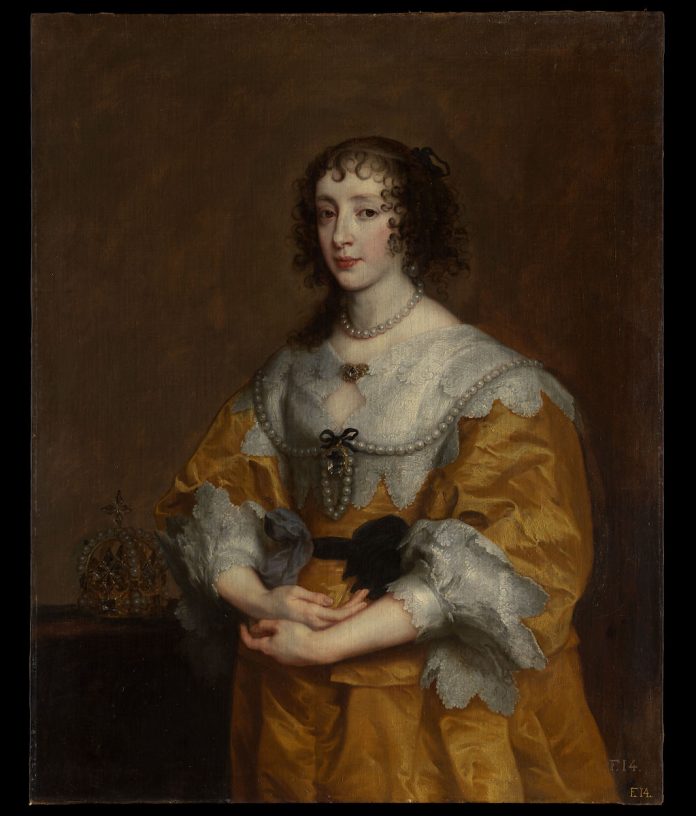
Wife of the ill-fated Charles I, the colony named for her was intended to be a refuge for Roman Catholics, the Catholic religion being forbidden in the Three Kingdoms. In my room as a teenager there was a print of the Van Dyck portrait of Henrietta Maria, the original of which is in the National Gallery of Art in Washington, D.C. Called “Mary” by her subjects, the second Stuart queen of England peers down from the portrait with her black eyes, which contemporaries described as large, sparkling and beautiful. Her dark curls with auburn highlights contrast against the deep marine blue shimmer of a silk dress, with the salmon-pink bows and elaborate white cuffs and high starched collar. A wide-brimmed plumed black hat was of the type made famous by the cavaliers who later fought for her husband in the English Civil Wars. 

The white plumes are reminiscent of the one made famous by her father Henri IV of France, which he wore into battle so that his men could always find him. Like her father, Henrietta Maria was not afraid to stand out, remaining a devoted Catholic in a land where her faith was banned, becoming the number one lawbreaker, while also striving to be a traditionally obedient wife, as was expected. But the expectations placed upon her made her life a tightrope walk which almost broke her.

The life of Henrietta Maria of France (1609-1669) was turbulent from the beginning. Half-Bourbon and half-Medici, her father, the famous Henri IV, was assassinated when she was an infant. Brought up by her mother, the Queen Regent Marie de’ Medici, to be a devout Catholic, she also mastered ballet, singing, and acting, skills which she would use in masques to entertain the Bourbon Court and later the Stuart Court. At fifteen she was sent to marry Charles Stuart, grandson of Mary Queen of Scots, who had just succeeded his father James I to the throne of the Three Kingdoms. 

While Charles I never converted to Catholicism, as had been hoped by many, his relationship with his wife was profoundly spiritual, enhancing the intense physical passion between them. After the initial clashing of cultures and personalities, theirs became one of the most devoted in the history of royal marriages, and was blessed with nine children. During the troubles which led to the English Civil War, Henrietta Maria became a liability to Charles because of her religion and her meddling, both perceived and actual. But her courage and her devotion fuelled the royalist cause, as she sold her jewels to raise money for arms and led soldiers to aid her husband. 

The challenges the royal couple faced in their early years of marriage are told in Book 1 of the Henrietta of France trilogy, My Queen, My Love. Book 2 will deal with the Civil Wars and Book 3 will be about the Queen’s widowhood as well as the adventures of her surviving children.

My view of historical fiction is that the author attempts to paint a portrait of the past with words. A historical novel is like a portrait come to life, allowing the reader to step into the past. Authenticity is vital, and that comes only from thorough research. While it is not always possible to visit the historical places that play a part in the novel, it helps. 

The internet has been a gift to historical fiction writers, making accessible old documents, manuscripts, pictures and books that one once had to travel far to find. I found the original program of the 1623 masque performed by Anne of Austria and Henrietta of France at the Louvre during Shrovetide. It was at the rehearsal of the masque that Charles Stuart first saw Henrietta during his incognito visit to Paris. Such primary sources, like the Queen’s letters, are indispensable for creating a living portrait.

So much of what people think they know about Henrietta Maria has been filtered secondhand through multiple writers, some of whom view her as a frothy but tiresome fanatic who led her husband into ruin. This is often accompanied by the perception of the Queen as a dangerous seductress, who used her French wiles in the boudoir to subject Charles to her will. 

And others decide that Charles was not enough for her but she had lovers such as Henry Jermyn who actually told her what to do, while fathering her children. Just as her enemies called her the “popish brat of France,” she has been portrayed erroneously either as a sex fiend soaked with crazed religiosity, or as a shy, pious pawn. (Read more.)

Novel available HERE.

Share

Saturday, July 11, 2026

"A Lush, Passionate Portrait"


  From BookLife:

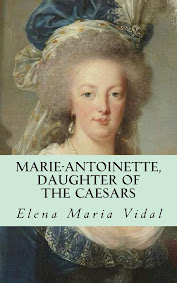
In the first of her Henrietta of France trilogy, Vidal (Marie-Antoinette, Daughter of the Caesars) paints a lush, passionate portrait of the life of Henriette-Marie, a seventeenth century French princess descended from the Bourbons and Medicis. Wed to King Charles I of England at the tender age of fifteen, Henriette is determined to bring Catholicism back to England, despite her Protestant husband and the country’s “hatred of Catholicism.” Often buffeted by political and social forces beyond her control, Henriette, known in England as Queen Mary, faces the challenges she encounters with the courage and resolve that she draws from her deep Catholic faith.

Firmly grounded in real historical events and settings, Vidal breathes life into Henriette’s era through extensive, evocative descriptions of its clothing, food, and palaces. This attention to detail offers a tantalizing immersion in this royal world, from the elaborately-costumed “masques” she and courtiers create to entertain the King at holiday celebrations to her beloved spaniel, Hebe. Vidal also illustrates the complexity of royal life through her careful elaboration of the complicated web of marriages, kinships, and associations. Some readers will be overwhelmed by the many branches of the royal family tree, but the text’s clear exposition and strong narrative arc offer clarity and guidance.

Vidal highlights the most important characters through her vivid depiction of their personalities and motivations. Antagonist George Villiers, the Duke of Buckingham, creates a true sense of menace as he threatens Henriette and works to disempower her. Although she is pure and steadfast in her intentions, Henriette’s struggles to balance her devotion to her husband and to her faith will earn readers’ respect and sympathy, even if they do not share her allegiance to the Catholic church. Offering insight into the passions behind the protocols, My Queen, My Love infuses these historical figures with humanity.

Takeaway: Readers of historical fiction will appreciate the depth and nuance Vidal brings to this often overlooked historical figure. (Read more.)


"Elena Maria Vidal brings history to life again with the story of Queen Henriette Marie, complete with an unlikely but true love story of the Queen and King Charles I of England, a formidable personal enemy in the menacing Duke of Buckingham, lots of well-researched period details, and the matters of Christian faith behind many of the conflicts. An antidote to the Whiggish story that is often passed off as history in America, with its anti-monarchical bias. Though Henriette Marie is not nearly as well known as another maligned consort, Marie Antoinette, Americans should learn her story because, coming after Jamestown's founding, she was their queen." —John Beeler, A Conservative Blog for Peace


Available HERE.

Share

Thursday, July 2, 2026

Wedding of Marie of Edinburgh


The three wedding ceremonies of the future Queen of Romania. From Royal Musings:

The bridal party arrived at the Stadkirche at 4:30 p.m, for the first religious wedding, a Roman Catholic ceremony. The "picturesque church" was overflowing with guests.  Kaiser Wilhelm II, dressed as an imperial Field Marshal, entered first, escorting the bride's mother, the Duchess of Edinburgh.  They were followed by the Duke of Connaught  with the Princess of Hohenzollern, Grand Duke Alexis and the Duchess of Connaught,  Prince and Princess Leopold of Hohenzollern,  King Carol of Roumania, Crown Prince Ferdinand, and the bride and groom's brothers and sisters. Princess Marie and her father, the Duke of Edinburgh, were the last to enter the church.

The marriage was conducted by the parish priest, and the nuptial address was given by the Abbot of the Benedictine Monastery at Beuron. Crown Prince Ferdinand's "Ja" was "heard distinctly all over the church," but Princess Marie's answer was "quite inaudible to those placed at any distance from the chancel." After they had "exchanged rings and clasped hands, Prince Ferdinand and Princess Marie, "rose as man and wife to the strain of the beautiful chorale "Laus tibi Domine." (Read more.)

Share

Saturday, May 30, 2026

Henrietta Maria: Number One Lawbreaker

Henrietta Maria holding a butterfly

 My guest post at an amazing site called Novels Alive
.

In the lone tent, waiting for victory,
She stands with eyes marred by the mists of pain,
Like some wan lily overdrenched with rain:
The clamorous clang of arms, the ensanguined sky,
War’s ruin, and the wreck of chivalry
To her proud soul no common fear can bring:
Bravely she tarrieth for her Lord the King,
Her soul a-flame with passionate ecstasy.
~from “Henrietta Maria” by Oscar Wilde

Henriette-Marie of France, or “Henrietta Maria,” is the protagonist of my new novel My Queen, My Love (Mayapple Books, November 25, 2021), the first of the Henrietta of France Trilogy. It is the story of the fifteen-year-old princess Henriette-Marie who is mandated by the Pope and by her brother the King of France to convert the English back to Catholicism by marrying their King, Charles I. Meanwhile, the Catholic Faith is outlawed in the British Isles, so as Queen she becomes the number one lawbreaker. The powerful Duke of Buckingham tries to thwart her growing influence with her husband. And England has become known as a place where queens lose their heads. 

[...]

As Regent, Queen Marie chose to avoid war by making peace with the other Catholic powers of Spain and the Holy Roman Empire. She believed that Catholic monarchies should unite to keep Protestantism at bay. She sent her youngest daughter Henriette to marry in England because she believed there was a chance of bringing Charles I into Catholicism. So at fifteen years old Henriette-Marie aka Henrietta Maria was sent to marry Charles Stuart, who was a decade or so older. The royal couple initially clashed over culture and religion. They quarreled whenever together and so avoided each other for weeks at a time. When they finally did fall in love, theirs became one of the most devoted in the history of royal marriages, and was blessed with nine children. (Read more.)

A review from Gwendalyn's Books:

Henrietta is one to root for as we see the very young bride overcome so many obstacles. Particularly because she is a devout Catholic, and by the actions of the villainess character, George Villiers.

The author take great care to include a vast amount of characters, which made for a more rewarding read for me. A book to catapult its readers into the turbulent era of England in the 1600’s. From the beginning I was hooked and read this one in a day.

Historical fiction at its finest. This was an exceptional portrait of a the wife of Charles I. Brought stunningly to life, with seamless narration and three dimensional characters, a true treasure piece of historical fiction.

E.M. Vidal meticulous research and descriptive writing, has brought one of England’s most tragic queens, Henrietta Maria, vividly to life. (Read more.)

Share

Tuesday, May 26, 2026

Audubon's 'Birds of America'

 From Country Life:

In November 2023, shortly after taking up the position of Heritage Lead at the Royal College of Physicians and Surgeons of Glasgow, Claire McDade, a woman who positively thrums with all the compact energy and bright-eyed good cheer of a goldfinch on a sunny spring morning, removed the dust sheet that for the previous 30-odd years had covered a waist-high cabinet, about the size of a foosball table or perhaps a little larger, in a corner of the college’s upstairs library.

What lay beneath left her speechless.

A first edition of the first volume of John James Audubon’s Birds of America. ‘I hate to use the word, but, honestly, I was,’ she told me, ‘gobsmacked. I thought, “We’ve got to do something more with this.” I made it my mission.’

By May 2026, with necessary funding secured and conservation work done, her mission was accomplished. As of this week, the college’s Audubon is, for a few precious hours every Monday, available for public inspection. (Read more.)

Share

Sunday, April 19, 2026

Childhood of Mary Stuart

From English Historical Fiction Writers: 
Although historians often cast the dismissal of her playmates in a harsh light, Poissy was only a few miles from Saint Germain.  The Four Maries often visited the palace on weekends and holidays. They had not been exiled to an austere convent in a backwater location. The convent school at Saint Louis Priory provided a high-quality liberal education to its aristocratic students. Even religious policies were flexible to a degree. Marie Livingston, whose family embraced the new learning, was encouraged but not forced to attend Mass. By the time the Four Maries reached puberty, they were well educated and highly polished French girls, ready to be integrated into the life at the French court.  Nevertheless, their place in the life of the Queen had been taken by the Princesses Elisabeth and Claude, and their brother Francois, the Dauphin.
By the time she was eleven, the Queen of Scots might well have been homesick for her mother, but there is no reason to think she missed or even remembered the land of which she was sovereign. (Read more.)
Share

Friday, April 17, 2026

The Context of Henriette-Marie


An insightful assessment of My Queen, My Love from Laura Crockett at The History Desk:

Henriette Marie married Charles I of England in 1625. She became his queen but was never crowned, formally. When she married Charles, she was 15. Our modern perspective tells us that is a mere girl. Nevertheless, previous ages were practical in these matters. Henriette died when she was 59. That too, is young in our eyes.  Nonetheless, she lived to a ripe age, because the average, back in the day, was 35 years.

Vidal structures the story as one of those perfect circles, wherein she begins with Marie de Medici, Henriette’s mother, and then closes the story with Marie. What is given to us, in between the Marie sections, is the story of her daughter, who lived during a crucial development era in the history of the Western world.

Marie’s story is fascinating all on its own. Marie was an old maid of 25 before she was married. But what a marriage! Her guy was Henry IV, perhaps one of the smartest men to hold the French crown for centuries. His grandson was Louis XIV. But after that, for the French royal houses, it was all downhill. Marie was Henri’s second wife. Louis XIII, of Musketeer fame, was their first child. Henriette their last. When Henriette was still in infancy, her father was assassinated. That was an event that truly changed the trajectory of history. Henri would be considered a rather liberal thinker, in the traditional sense of the word; live, and let live. Indeed, the French coined the phrase, laissez faire; leave it alone. Wherein we get the phrase, if it ain’t broke, don’t fix it. Henri gave us the Edict of Nance, which ended the religious wars in France. The essence of the Edict was toleration of the protestants, i.e., leave them alone. (Read more.)

Share

Saturday, April 11, 2026

Mary and Isabella – the Women in Cages

 From History...the Interesting Bits:

On 25 March 1306 Mary, Christian, Elizabeth and little Marjorie were all present when Robert the Bruce was crowned King Robert I by Isabella MacDuff, Countess of Buchan, who claimed her family’s hereditary right to crown Scotland’s kings (despite her being married to a Comyn). The Earls of Fife had, for centuries, claimed the hereditary right to crown Scotland’s kings. However, in 1306, the earl was only a teenager, in English custody, and a loyal devotee of Edward I. It fell to the courageous Isabella MacDuff, the young earl’s aunt, to claim the hereditary right to perform the ritual.

Isabella’s husband was John Comyn, Earl of Buchan, friend and cousin to the John Comyn killed in the church in Dumfries. Isabella knew that she was not only facing the wrath of King Edward but also her husband in participating in Robert’s inauguration as king. Isabella’s participation was an act of bravery and defiance. She would have known that her actions would mean there was no going back. In supporting Robert the Bruce, the man who stood accused of John Comyn’s murder, Isabella turned against her husband and his entire family, people she had lived among for her entire married life. Isabella is said to have stolen one of her husband’s destriers for the ride to Scone to place the crown on the new king’s head. However, it is also suggested that Robert sent the Earl of Atholl to fetch Isabella from her lands, to perform the inauguration, indicating she was rather reluctant to play her part in the open defiance of Edward I.

With the murder of Comyn hanging over him, Robert the Bruce wanted to ensure that his inauguration was an imitation of that of Alexander III, to reinforce his legitimacy and respectability as king. In the absence of the royal crown of Scotland, a gold circlet was placed on Robert’s head. The ceremony may have been overseen by bishops Wishart and Lamberton, though both claimed they were not present when questioned by Edward I. Bishop Lamberton, as Bishop of St Andrews and senior prelate in Scotland, certainly celebrated High Mass for the new king and queen two days later, on 27 March.

Robert’s coronation was the start of the most desperate period of his life – and that of his supporters. Edward I of England was never one to acquiesce when his will was flouted; he sent his army into Scotland to hunt down the new king and his adherents. After Robert’s defeat by the English at Methven in 1306, he went into hiding in the Highlands. (Read more.)

Share

Sunday, April 5, 2026

Irish Easter

The old Irish celebrated Easter on a different date from the continental Church for two centuries or more during what is known as the Dark Ages. This has fascinated me ever since I did a book report on the Synod of Whitby (664) in college. It was at Whitby that the conflict between the different customs of Celtic and Roman Christians in the British isles came to a head. Most of the north of Britain had been converted by the zealous Irish monks, led by Saint Colum Cille. The Irish monks wore a tonsure different from the Roman monks; the Irish had their foreheads shaved from ear to ear, with long hair trailing down their back, while the Roman custom was to shave the crown of the head. The Irish claimed that their tonsure came from Saint John the Evangelist whereas the Romans claimed to have inherited their tonsure from Saint Peter. The tonsure, however, did not cause nearly as much problems as the date of Easter. Members of the same family, depending on whether they followed the Celtic or Roman practice, would keep Lent and Easter at different times. This caused no end of inconvenience for those who had to cook the meals.

According to Edmund Curtis in A History of Ireland (1936):
Under the papal authority the Paschal date had been fixed for the Church by Victorius in 457, but the Celtic churches adhered to the Paschal term as fixed by Anatolius in the third century. As a practical result the Irish were found keeping Easter from the fourteenth to the twentieth of the lunar month and the Continental church between the sixteenth and the twenty-second. On this matter of controversy many letters had passed between the Irish leaders and Rome. Popes Honorius and John IV had urged the Irish to conform and had been answered by Cummian and by Columbanus. The latter, writing to Saint Gregory the Great, boldly maintained the Irish position over Easter, but conceded to the Holy See a primacy of honor and a measure of supreme authority, adding, 'it is known to all that our Savior gave Saint Peter the keys of the kingdom of Heaven, and that Rome is the principal seat of the orthodox faith.'

By the middle of the seventh century southern Ireland had accepted the [Roman] Easter and only northern Ireland and Iona, strong in the name and memory of Columba, stood out. (pp.15-16)
Iona finally gave in around 716 and northern Ireland followed suit. After the Synod at Whitby had brought most of northern Britain into the Roman calculation of Easter, the Celtic monks in Scotland and northern England had withdrawn to Iona. What intrigues me about this controversy is that there were great saints who vehemently disagreed with each other on ecclesiastical matters.

Share

Wednesday, April 1, 2026

Roman Fort Found North of Hadrian’s Wall

From The Jerusalem Post:

Ruins of a Roman “fortlet” built along the Antonine Wall may have been used as part of the empire’s defense against the unconquered Scottish lands to the north, according to a March statement from GUARD Archaeology. While the fortlet was originally discovered in the back gardens of three homes in Bearsden, Scotland during 2017 excavations ahead of various property development projects, the complete findings were recently published in Archaeology Reports Online. 

The Antonine Wall, constructed on the orders of Roman Emperor Antoninus Pius in the second century CE, was a defensive border built to separate the conquered southern Scotland from the unconquered lands to the north. However, about 20 years after its construction, the wall and its fortifications were abandoned by  the Romans during their retreat south to Hadrian’s Wall. (Read more.)

Share

Friday, March 20, 2026

At the Edge of the Abyss: Euthanasia and the Fight For Human Dignity.

 From Gavin Ashenden:

Those of us who hold to a Catholic understanding of the human person — seeing each life as sacred because it is made in the image of God — have, for decades now, found ourselves resisting a growing secular pressure to legalise euthanasia.

The arguments are by now familiar. On the one hand, we hear appeals to autonomy, freedom of choice, and the understandable desire to avoid suffering. On the other, there remains a deep moral conviction that life and death are not ours to dispose of at will — and that once the boundary is crossed, the consequences are neither contained nor benign.

Experience bears this out. In Canada, there are now documented cases of disabled individuals being offered euthanasia because it is cheaper than providing basic support such as accessible housing. In the Netherlands, even teenagers suffering from depression have been granted euthanasia. What were once presented as tightly safeguarded exceptions have, in practice, expanded in ways that place the most vulnerable at risk.

The argument, therefore, is no longer theoretical. It is grounded in real examples of systems in which safeguards have failed, and where the logic of euthanasia has begun to erode the dignity it was supposed to protect.

In this conversation, I speak with Professor David Jones, Professor of Bioethics at St Mary’s University, London, and one of the central figures in the campaign against euthanasia in the United Kingdom.

Together we explore what has just taken place in the Scottish Parliament, why the proposed legislation was defeated, and what this may mean for the future of similar efforts at Westminster — where time is running short and the outcome remains finely balanced, both procedurally and in the court of public opinion. (Read more.)

Share