|
| Pope Leo at Notre Dame with the statue of Our Lady of Charles X |
From Vatican News:
Light inundated Notre-Dame as Pope Leo XIV celebrated vespers in Paris' beloved Cathedral. It felt like a fitting celebration for the restored and renewed basilica, a place of worship and iconic symbol of the “Ville Lumière“, badly damaged by fire on 15 April 2019.
On that day, dramatic images and videos of the cathedral engulfed in flames, and of people praying in the streets as the fire consumed the building, spread around the world through social media and news outlets.
Today, the French Church has come together again. This time to rejoice, as the Pope visited the Cathedral and celebrated Vespers, almost two years after its reopening in December 2024, following a long and meticulous restoration process.
As the sun shone through the stained-glass windows, colorful patterns moved slowly across the walls. Meanwhile, an organ played and the choir sang while the bishops, priests, consecrated men and women, seminarians, and other members of the French Church solemnly prayed together with the Successor of Peter.
Before the Vespers, Pope Leo venerated a relic of the crown of thorns, which was placed on Christ’s head during his Passion. A symbol of his suffering and sacrifice before his Resurrection.
“We are gathered for Evening Prayer in this place which, more than any other, has invited the people of Paris for centuries to lift their eyes towards heaven,” Pope Leo said in his homily. (Read more.)
 |
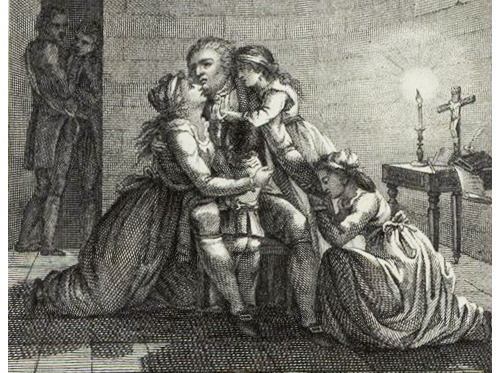
| Mass at the Place de la Concorde, where thousands were guillotined (Via Daily Mail) |
I wish instead of Robespierre the article had mentioned Madame Elisabeth. From Rome Reports:
The Place de la Concorde in Paris is a site marked by some of the darkest moments in French history.
During the Revolution, the guillotine stood here, and more than a thousand people were executed. Louis XVI, Marie Antoinette and Robespierre were among them.
Two centuries later, Pope Leo XIV celebrates the Eucharist here before nearly 600,000 people. A turnout that marks a new chapter in the Church in France.
The pope is using this celebration to call for a secular society.
LEO XIV
Seeing you gathered here, brothers and sisters, heirs to a long and beautiful history of holiness in France, I say to you: in turn, drink deeply from this spring that is the pierced Heart of Jesus. Yes, you thirst for God, for life, for truth, for unity, for peace, for communion, for happiness. You long to rediscover a radiant horizon, to build a renewed nation rooted in a faith that nourishes its very foundations.
But the pope does not stop with France’s religious identity. He goes straight to the individual and a much more universal question: what does a Catholic drink from when he or she thirsts for life?
LEO XIV
Brothers and sisters, we must acknowledge that here on earth, nothing can fully satisfy us. Just when we think our search is finally over and our efforts have been rewarded, that inner emptiness often resurfaces, even more profound than before.
Are we content with material possessions, immediate gratification, and the countless little idols that promise the world but leave our hearts empty?
And while, in 2008, Benedict XVI came to France asking how faith could survive in a secularized society, today, Pope Leo XIV is not talking about survival.
He is talking about renewing the country from its roots: building a renewed nation through a faith that can once again nourish society.
This is not about rebuilding a blood-soaked square, but renewing a society that, according to the pope, thirsts for truth, peace and happiness. (Read more.)
 |
| Pope Leo in Lourdes |
From EWTN:
Leo met Sept. 27 with staff and sick guests of the Accueil Notre-Dame (Notre Dame Home), a residential accommodation classified as a healthcare facility, which hosts sick, disabled, and frail pilgrims to Lourdes.
The Catholic shrine is one of the most visited in the world, drawing more than 3 million people every year, many in search of miraculous physical healing.
The 136-acre property includes the Grotto of Massabielle, where a young St. Bernadette Soubirous saw 18 apparitions of the Virgin Mary starting on Feb. 11, 1858. Today, pilgrims to the sanctuary bathe themselves in the freshwater spring Mary revealed to Bernadette.
Visitors have reported 7,000 healings since the apparitions; after lengthy investigations, the Church has declared that 72 of the recoveries were miraculous, meaning unexplainable by science. (Read more.)
From CWR:
The Sanctuary of Our Lady of Lourdes is among the most popular Catholic shrines in the world, built on the site of Mary’s apparitions to St. Bernadette in 1858. It is particularly visited by the sick, who come to bathe in or drink its healing spring water.
In his homily, Pope Leo noted that a “call to conversion, both tender and urgent,” was a central part of the message the Virgin Mary entrusted to Bernadette, and that “it is today, not tomorrow, that we must repent.”
He said Jesus is quite direct about the call to repentance: “As St. Luke tells us, ‘Unless you repent, you will all perish.’ But he also extends our horizon beyond this earthly life to the horizon of eternal life.”
“Did not the Virgin Mary say to St. Bernadette, ‘I do not promise to make you happy in this world but in the next’?” Leo said.
The pope noted that we can often forget this in an age and society focused on progress and material wellbeing.
Eternal life is already won for us by Jesus’ sacrifice, he continued, but “the obstacle to grace and eternal life — the only obstacle to this love — is sin.” (Read more.)
From OSV:
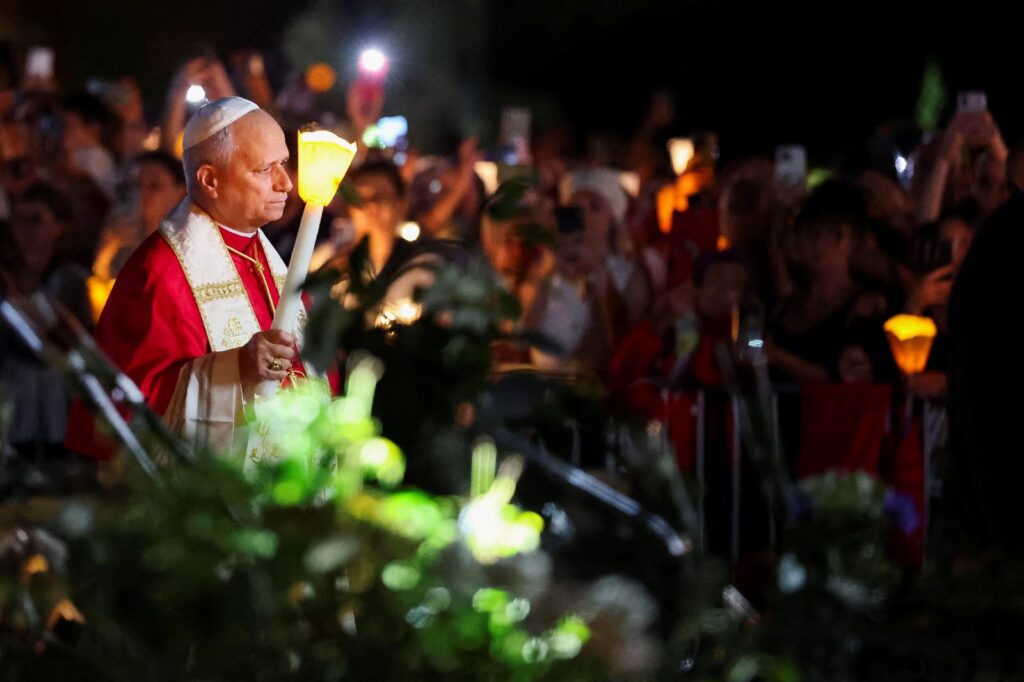
Holding a large candle in his right hand and a rosary in his left, Pope Leo processed slowly behind an illuminated statue of the Virgin Mary through the crowd of pilgrims holding candles, as the five decades of the glorious mysteries of rosary were prayed in multiple languages.
As the “Ave Maria” Lourdes hymn was sung between mysteries, all of the pilgrims in the square in front of the Basilica of Our Lady of the Rosary lifted their candles high in the air, creating a sea of lights.
“The light that guides us and draws us onward is the light of hope, which never abandons us even as we journey through this life — a life often marked by trials, yet already filled with the joy of knowing ourselves to be children of God, loved and saved by Jesus,” the pope said.
“Those who are sick are privileged witnesses to this transfiguration of our lives through faith and love of God and neighbor.” (Read more.)




%20-%20Study%20of%20Queen%20Victoria%20and%20Prince%20Albert%20in%20costumes%20of%20the%20time%20of%20Charles%20II.jpg)