Showing posts with label Latin. Show all posts

Tuesday, June 30, 2026

History of the Christian Altar


From Shawn Tribe at The Liturgical Arts Journal:

Altars are (or ought to be at least), architecturally and liturgically, the central focal point of the interior of our churches. Given their evident importance, it is no surprise that there can be much in the way of disagreement as to what the ideal form of the altar is. Debates rage about free-standing altars versus altars with grand reredoses attached to them.

It was through the consideration of the different forms of the altar, particularly through the pursuits of the Liturgical Movement, that the idea arose of taking a brief look at the history and development of its forms. I. Early Christian Antiquity If we look to the earliest time of Christian antiquity, there are two early forms of altar that can be identified. One is those of the house-churches, which were wooden and in table form. Some of the Eucharistic frescoes of the Roman catacombs may give some sense of this form:
The "Fractio Panis" fresco in the Capella Greca of the Roman catacomb of St. Priscilla
The second form was the use of the stone tombs of the martyrs as altars. This custom is thought to trace to the first quarter of the 2nd century. Marble tops were placed upon the tombs for the Mass to be celebrated upon.
The Fractio Panis fresco of the Capella Greca, which belongs to this period is located in the apse directly above a small cavity which Wilpert supposes to have contained the relics of a martyr, and it is highly probable that the stone covering this tomb served as an altar. (The Catholic Encyclopedia)

(Read more.)

At San Clemente in Rome, although the church was built facing west, Mass was offered facing east. The congregation would face east as well. From Shawn Tribe at The Liturgical Arts Journal:

I cannot definitively explain why the church was laid out this way as a glance at the property would suggest that it could easily have been orientated, which is to say, designed so that one's movement through the church was from west to east, toward the rising sun. All the churches built by Constantine in Rome were laid out "backwards" this way (except Santa Croce in Gerusalemme, which was built into an existing building), and I can only guess that this was done in part to imitate the Temple at Jerusalem.

There are other possibilities as well. The priest offering the Holy Sacrifice is facing east, of course--the design of the altar makes it impossible for Mass to be offered any other way. It is thought that in antiquity the assembly would actually turn around and face east with the celebrant, putting the Sanctuary behind them. This is not as strange as it might at first sound. A shepherd is always behind his flock. This is why the celebrant always comes last in procession. Furthermore, the church building symbolizes the Barque of Peter. In fact, the word nave derives from the Latin navis, which means boat. So the Sanctuary is where the helm in an ancient ship would be--at the back.

We have a dual movement, then. We move into the church building toward the west, and then we turn around at a certain point in the liturgy and proceed east. Now consider for a moment St. Germanus' text. He says that the Sanctuary is an image of the tomb in which Christ was buried; the Altar is "the spot in the tomb where Christ was placed"; and the apse corresponds to the cave in which He was buried. So perhaps our movement from east to west toward the Sanctuary, toward the setting sun, is actually a representation of our burial with Christ. And turning around and proceeding east, toward the rising sun, represents our sharing in His Resurrection. (Read more.)

Share

Saturday, June 27, 2026

How the Phoenician Spoken and Written Language Shaped the Mediterranean

 From The Collector:

The Phoenicians were prolific merchants and explorers who traveled from their home in the Levant across the ancient Near East and Mediterranean, planting colonies and trading outposts around the ancient world. Wherever the Phoenicians went, they took their language with them, and they were pioneers in this area too. They developed the first true alphabetic script. The useful tool was adopted by other cultures, including the ancient Greeks, who in turn influenced the ancient Latin alphabet, which is the basis of most modern Indo-European languages, including English.

The Phoenicians were Semitic-speaking people who primarily inhabited several coastal cities in the Levant, including Byblos, Tyre, Arvad, Berytus (Beirut), and Sidon. There was no Phoenician empire or unified state. Each city was an independent city-state. The Phoenicians never referred to themselves as “Phoenicians” in their own written texts but as members of their respective city-states.

The earliest recorded references to the Phoenicians date from the Late Bronze Age Egypt (c. 1500-1200 BC). The “Annals of Thutmose III” (c. 1479-1425 BC) mention Byblos extensively as a vassal of New Kingdom Egypt. The Egyptians called them “Asiatics.” Byblos was also mentioned in the “Amarna Letters” (1360-1332 BC) as an important city that was a source of contention between the Egyptians and Hittites. (Read more.)


Share

Wednesday, June 10, 2026

Louis XVI and Marie-Antoinette in a Eucharistic Procession

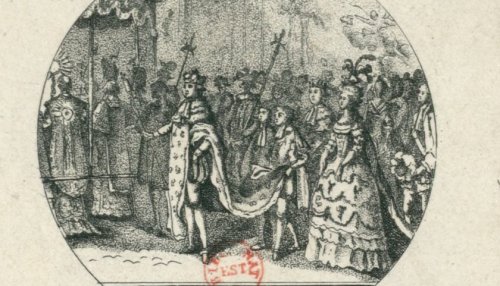
Louis XVI and Marie-Antoinette in the Eucharistic procession that opened the Estates-General in the spring of 1789. (From Vive la Reine.)
On May 4, 1789, she put Louis-Joseph and his sister with Madame de Polignac on a balcony above the stables so they could watch the magnificent Eucharistic procession which marked the opening of the Estates-General. The procession wound from the Royal Chapel, across the vast courtyard of the palace, through the streets of the town of Versailles, to the Church of Saint Louis. The monstrance, in the hands of a bishop, was under a rich canopy carried by Provence, Artois, Berry, and Angoulême. Everyone held a candle, except for the standard bearers, with the fluttering silken banners, and the royal falconers, with falcons on their wrists, looking both noble and fierce. The King, with a lighted taper, walked directly behind the monstrance. He wore a cloth of gold mantle and a plumed hat with the famous Regent diamond. He was wildly applauded by the crowds that lined the route. But when Antoinette, who with her ladies followed the King’s household, passed by in her gown of gold and silver tissue, every tongue fell silent. She could almost taste the hatred. It frightened her. 
When passing beneath the balcony where her sick boy was lying, she glanced up to blow him a kiss. The cry “Long live Orléans!” resounded in her ears. The extent of the malice overwhelmed her. That someone could hate her so much that they would use her child’s suffering as an opportunity to humiliate her; that they would praise her known enemy at a moment when as a mother she was most vulnerable, within the hearing of her pain-wracked Dauphin, stunned her as much as if she had been whipped or burnt. She halted, dizzily, then turned to see who had insulted her. In doing so, she staggered, but before she lost her balance, Princesse de Lamballe took her arm and steadied her.
 ~ from Trianon by Elena Maria Vidal
Share

Thursday, June 4, 2026

The Great Feast: The Hapsburgs And Corpus Christi

Hapsburgs Corpus Christi 

From The War for Christendom:

 In 1264, Pope Urban IV issued the Papal Bull Transiturus de Hoc Mundo, promulgating to the Latin Rite the Solemn Feast of the Body and Blood of Christ, to be celebrated on the first Thursday after Trinity Sunday. Around this same time, Rudolf the eighth Count of Hapsburg aided and protected a priest bringing the Viaticum to a dying farmer, giving the priest his horse and guiding him across a raging torrent, walking bareheaded. The priest then prophesied that the humble Count and his descendents would receive the Imperium of the Holy Roman Empire.

This veneration of the Holy Eucharist was continued by all the descendants of the Noble House, and the Feast of Corpus Christi in the Hapsburg realms became second only to the Solemn Feasts of Easter and Christmas. The Family indeed owed all to Rudolf’s great devotion to the Holy Eucharist, and the special Eucharist blessing bestowed on him, thus it was most fitting that the Feast of Christ’s Body should become the greatest feast of the Empire. So long as the Family remained devoted to the Cross and the Eucharist, God would bless and protect them (and He still does, even though they have been cast from the throne).

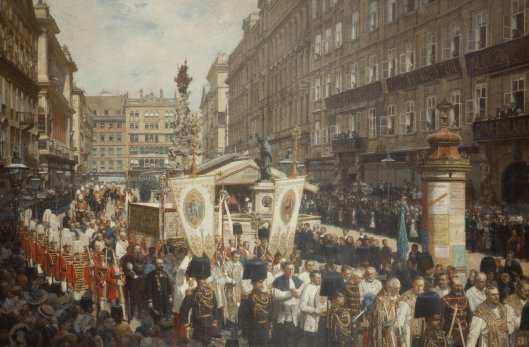
First in the great procession in the Imperial City of Vienna came three priests in splendid vestments like heralds to the city. Then came the Court officials in full Court dress, and the Court Clergy vested in gold and white vestments, followed by dignitaries of every rank. Before the gilded canopy marched the Archdukes of the House, carrying candles, and the acolytes carrying forward the Cross, the golden banners swaying in the wind, the swinging thuribles sending into the air clouds of incense, and the ever ringing bells. The great canopy itself was carried by four noble chamberlains in Imperial livery, upheld over the Hofburg Parish Priest who held up in benediction the golden Monstrance with radiating rays like the sun, in which resided the truly present Most Sacred Body of the Son of God, while the Emperor of Christendom walked behind bareheaded and flanked by the Imperial Guard, humbly worshiping his Divine King. (Read more.)


Share

Saturday, May 30, 2026

Beatings, Bible and Latin: Life as a 17th Century Grammar Schoolboy

 From BBC:

Beatings, Latin translations and Bible studies - a 17th Century grammar schoolboy received a very different style of education from today's students. An exhibition at Huntingdon's former grammar school explores how teaching and learning have changed over the centuries in the Cambridgeshire town.

Curator Stuart Orme said: "Birching (beating with birch twigs) was quite common in the 17th Century and the birch was the symbol of the schoolmaster." The tiny medieval building is now the Cromwell Museum. Its former pupils included the statesman Oliver Cromwell, diarist Samuel Pepys and wartime evacuees.

Most 17th Century school teachers were priests at a time when it was seen as a part-time job, requiring only preaching on Sundays and performing wedding or funeral services, said Orme. Cromwell (1599 to 1658) attended the school between 1610 and 1616, and the local priest Thomas Beard was the future Parliamentarian leader's teacher. Beard found the duties too much, said Orme, and asked to be released in 1614, saying he was "tired with my painful occupation of teaching and would gladly now be set free" - but was not allowed to stand down. (Read more.)

Share

Thursday, May 14, 2026

Highest of All Kings

 From A Clerk of Oxford:

The idea that gods dwell in the heights, in the sky and on the mountains, is one of the most ancient religious impulses. It's hardly difficult to see a connection between that and Christ's Ascension, and going on about 'rockets, haha!' feels like a deliberate attempt not to see it. Those silly people of the olden days found poetry in the feast rather more easily than their clever modern descendants do: in Ascension Day folklore there was 'a strong connection between the day and all things pertaining to the sky, such as clouds, rain, and birds' (Roud). Rain which fell on Ascension Day was said to be blessed - 'neither eaves' drip nor tree-drip, but straight from the sky'. The day was connected with holy water in other ways, including the custom of well-dressing and visiting sacred springs. This expresses a sense that the heavens and the earth are interconnected at the most essential level - as of course they are, whether you think of that power as physical or spiritual or both. The kind of preacher who apologises for Ascension Day is likely to call that faith superstitious, but it's infinitely grander, really, than a worldview which finds no wonder in the heavens. We are earthbound, tied to this sublunary world and its many sorrows - but this is one day when the imagination can soar to the sky. (Read more.)


More HERE. 

(Image source.) 

Share

Friday, April 3, 2026

Queen Mary Prays over the Sick on Good Friday

From Nobility. It is always bittersweet for me to read about how much potential for being a great ruler Mary Tudor had. To quote from a contemporary report:
On [Good] Friday morning the offertory was performed according to custom in the Church of the Franciscan Friars, which is contiguous to the palace. After the Passion, the Queen came down from her oratory for the adoration of the Cross, accompanied by my lord the right reverend Legate, and kneeling at a short distance from the Cross moved towards It on her knees, praying before It thrice, and then she drew nigh and kissed It, performing this act with such devotion as greatly to edify all those who were present.
Her Majesty next gave her benediction to the rings, the mode of doing so being as follows: An inclosure (un riparo) was formed for her Majesty to the right of the high altar by means of four benches placed so as to form a square, into the center of which she again came down from her oratory, and placing herself on her knees within this inclosure, two large covered basins were brought to her, filled with rings of gold and silver, one of these basins containing rings of her own, whilst the other held those of private individuals (particolari), labelled with their owners’ names. On their being uncovered she commenced reciting a certain prayer and psalms, and then taking them in her two hands (pigliandoli a mano per mano), she passed them again and again from one hand to the other, saying another prayer, which commenced thus:—
“Sanctifica, Domine, annulos istos.”

This being terminated, her Majesty went to bless the scrofulous, but she chose to perform this act privately in a gallery, where there were not above 20 persons; and an altar being raised there she knelt and recited the confession, on the conclusion of which her Majesty turned towards my Right Reverend Lord the Legate, who gave her absolution; whereupon a priest read from the Gospel according to St. Mark, and on his coming to the words— “Super ægros manus imponet et bene habebunt,” she caused one of those infirm women to be brought to her, and kneeling the whole time she commenced pressing, with her hands in the form of a cross, on the spot where the sore was, with such compassion and devotion as to be a marvel, and whilst she continued doing this to a man and to three women, the priest kept ever repeating these words:
“Super ægros manus imponet et bene habebunt.”
Then on terminating the Gospel, after the words—
“In principio erat verbum,”
and on coming to the following, namely,—
“Erat lux vera quæ illuminat omnem hominem in hunc mundum,”
then the Queen made the sick people again approach her, and taking a golden coin called an angel, she touched the place where the evil showed itself, and signed it with this coin in the form of the cross; and having done this, she passed a ribbon through a hole which had been pierced in the coin, and placed one of these round the neck of each of the patients, making them promise never to part with that coin, which was hallowed, save in case of extreme need; and then, having washed her hands, the towel being presented to her by my Lord the Right Reverend the Legate, she returned to her oratory. (Read entire article.)
Share

Tuesday, March 24, 2026

The Buried City – Unearthing the Real Pompeii

 https://blogger.googleusercontent.com/img/b/R29vZ2xl/AVvXsEjwvZ3He1YRCZZCRTieyDnPsk7n-802DXp4EGejwpI3sidEtKAm95ZhTkhttcgXomtqnETb1WNcdvyNIBtxMIwWe2R3tpQRFm1gT0543JoXvKTM4X8Gf0hToHPeWw9PvdLj43Xc80r_NHTwYJDWT7lQz4k44CnEAoH5i_417zU0nO7kOWjISXNsdlFmIyQm/s1298/buried+city.webp 

From Reid's Reader:

Zuchtriegel makes it clear that Romans followed and copied Greek art. In fact at one point he notes that Pompeii did not ever have the best art work. He says that ancient Rome, Capua and Verona had more great art works than Pompeii ever had, and they had larger arenas.  He spends some time examining the famous copy of the statue of the Greek god Apollo and its connection with Greek culture. Sensuality and eroticism were displayed in some of the houses of the rich. Zuchtriegel spends some time with freaks and hermaphrodites as they were depicted in Greek tales. Wealthy people’s walls were painted with images of Greek fables and the doings of the Greek gods, sometimes dealing with rape or violence but just as often dealing with images of serenity or weddings. One house, excavated in the early years of archaeologism [in the late 19th century] was named as the House of the Vetti, generally interpreted as a brothel. Wealthy people also had slaves, and the prostitutes were slaves. Slaves could be freed sometimes, but often this would simply mean that an old slave was of no worth anymore and the freed slave was left in poverty and would have nowhere to go.

Having explained all of this, Zuchtriegel notes that in the last years of Pompeii there was a god that was very popular. This was the Greek Dionysus. But he also notes that the very ground Pompeii was built on was originally Etruscan land, and the Etruscan gods were related to nature and agriculture. There were many rituals that had been carried through to the late years of Pompeii. He then returns to the state of the city as it now is. Among other things, some of the ruins were destroyed during the Second World War due to American bombing near to Naples. For a long time there were misunderstandings about the meanings of some buildings that had been buried in the 79 A.D. earthquake. For example, one building that was dug up by amateur archaeologists in the early 20th century, became known as the Villa of Mysteries because it looked dark and there was a long frieze whose meaning was difficult to understand. Could it have been the site of a forbidden cult? But it is now understood that there was no mystery at all. The villa, as it originally stood, was open to the passing public, there were no orgies taking place in it, and the images on the wall had to do with celebrations of a wedding.

It is in the last parts of The Buried City that Gabriel Zuchtriegel goes back to what actually happened when Pompeii was almost obliterated. He likes to show how ordinary people – not just the rich – were going through the streets of the city just before the sky fell in. One example was a chariot that has only recently been dug up by modern archaeologists. Only parts of it survived, but it was clearly being driven on its way to some ordinary event.  Zuchtriegel also often reminds us that those who lived in the most horribly cramped quarters were the poor people – who made up most of the population – and the slaves. As he sees it, the most important people in Pompeii were the poor and the slaves who kept the city running. They were the ones who drove carts bringing into the city the food that came from the fields and the fishing boats, cooked and produced meals, looked after the children of rich etc. Yet they had to live in the worst houses.

Regrettably, says Zuchtriegel, despite all the help of the police, there is still in Naples the Camorra – the Neapolitan version of the Sicilian Mafia -  which illegitimately raids parts of Pompeii, stealing antiquities and selling them to the rich in the black market. But things are now being tightened. There is the frequently-asked question “How many people lived in Pompeii at the time it was destroyed?” Answers range from 40,000 to 20,000, but one also has to be aware of the fact that the rural areas, which brought in grain, stock and milk, should also be seen as part of Pompeii. At an odd point, too,  Zuchtriegel says that Pompeii was probably economically declining in the years before its ruin. Apparently more local farmers now raised grapes as wine became most important… but this meant that grain had to be imported from different countries – like Egypt  - at great price.  (Read more.)

Share

The ‘Polar Unity’ of the Two Forms of the Roman Rite

 From The Catholic Thing:

The motu proprio Summorum Pontificum (2007) of Pope Benedict XVI introduced into the contemporary ecclesial vocabulary a distinction that has since become both fruitful and contentious: the “Ordinary Form” and the “Extraordinary Form” of the one Roman Rite. Benedict was at pains to insist that these are not two rites but two usages of the same lex orandi. The Missal promulgated by Pope Paul VI after the Second Vatican Council constitutes the Ordinary Form; the Missal of Pope John XXIII (1962), standing in organic continuity with the Tridentine codification of Pope Pius V, may be celebrated as the Extraordinary Form.

Benedict’s claim was juridical and pastoral, but its deeper import is theological. The coexistence of the two forms within one rite can be understood as a “polar unity” in the sense articulated by Hans Urs von Balthasar: a living tension of complementary principles whose unity is not the flattening of difference but its orchestration.

Benedict himself rejected the hermeneutic of rupture that would pit preconciliar and postconciliar liturgy against one another. In his famous 2005 address to the Roman Curia, he contrasted a “hermeneutic of discontinuity and rupture” with a “hermeneutic of reform in continuity.”

The liturgy, precisely because it is the Church’s most public act of faith, must embody this continuity in a way that is not merely conceptual but sacramental. The two forms of the Roman Rite thus stand as a visible sign that tradition is not a museum piece nor a revolutionary program, but a living stream whose depth and breadth can be perceived only by holding together its historical strata.

To interpret this polarity in a richer theological key, it is helpful to turn to Balthasar’s account of the Marian and Petrine dimensions of the Church. For Balthasar, the Church is first Marian before she is Petrine. Mary, in her fiat and her immaculate receptivity, embodies the Church’s contemplative, bridal, and receptive essence. Peter, in his confession and commission, embodies the Church’s apostolic, juridical, and governing mission.

These two dimensions are inseparable; yet they are not identical. The Marian dimension grounds the Petrine; the Petrine serves the Marian. The Church is not an institution that happens to have a mystical interior; she is a mystery that necessarily assumes institutional form. (Read more.)


Share

Sunday, March 8, 2026

The Three Tongues on the Cross and The Inheritance of Christianity

 From Jared Selim:

When Our Lord hung with outstretched arms upon the tormenting Cross of Golgotha, Pilate fixed a titulus above His Head. It declared before the world in the three great languages that resounded through Judea: “Jesus of Nazareth, King of the Jews.”

These languages were Hebrew, Greek, and Latin. In the scornful inscription of the Romans, they declared despite themselves what the Jews who delivered their Messiah to death would not: the true and universal Kingship of the Logos made flesh, Filius Dei—the Son of God. As St. Jerome said, “the voices and writings of all nations proclaim the passion and the resurrection of Christ. […] the Jews, the Greeks, and the Romans, [were] peoples which the Lord has dedicated to His faith by the title written on His cross.”1

If these three peoples represent all nations, then every Christian, by our baptism and life in Mother Catholic Church, enters into the Hebraic, Greek, and Roman expressions of Christ.2 The Messiah shines in the particular forms and manners of these nations.(Read more.)

Share

Tuesday, February 24, 2026

The Spell of Posey Rings

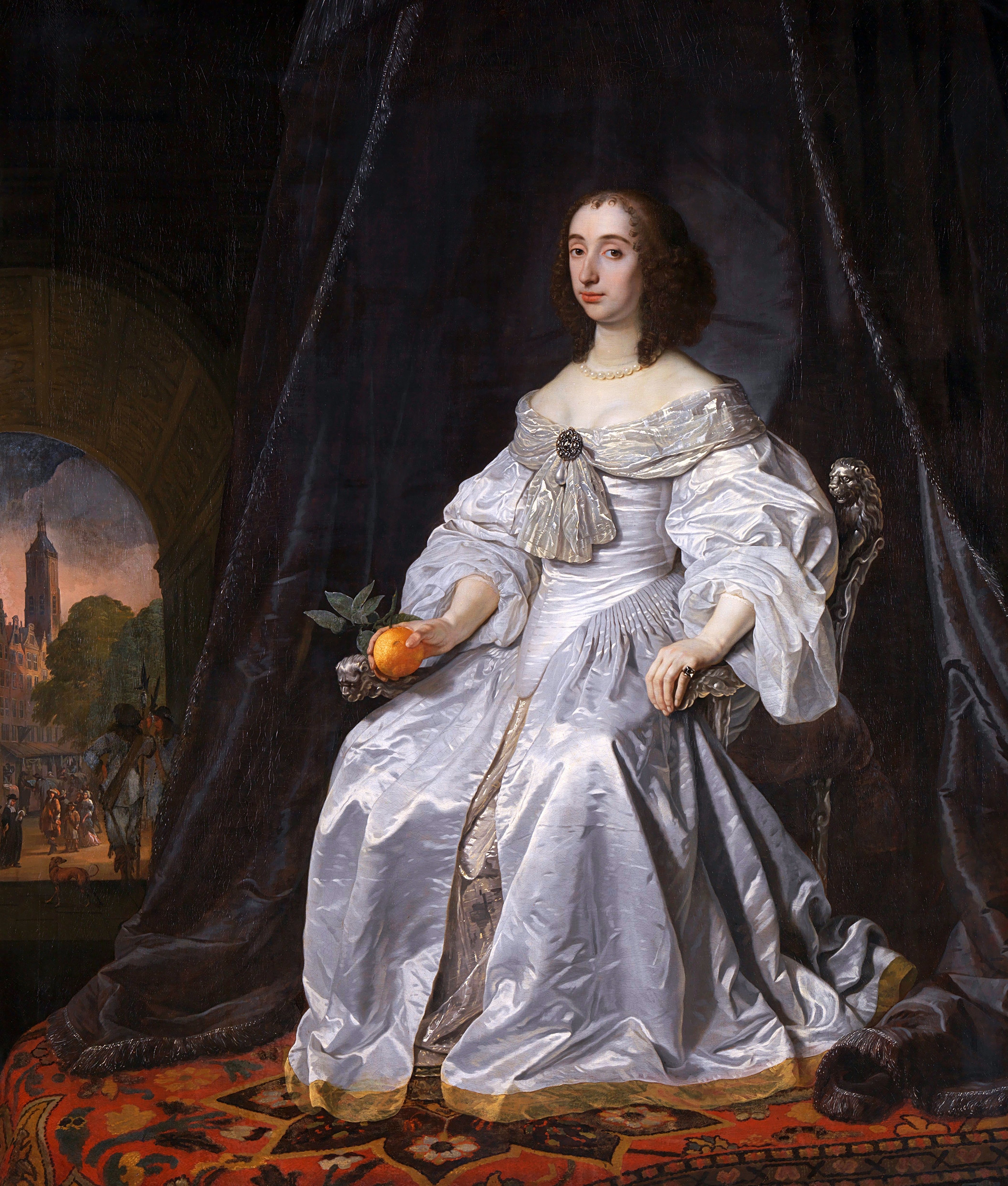
Painting of Princess Mary holding an orange
Mary of Great Britain and Ireland

From Country Life:

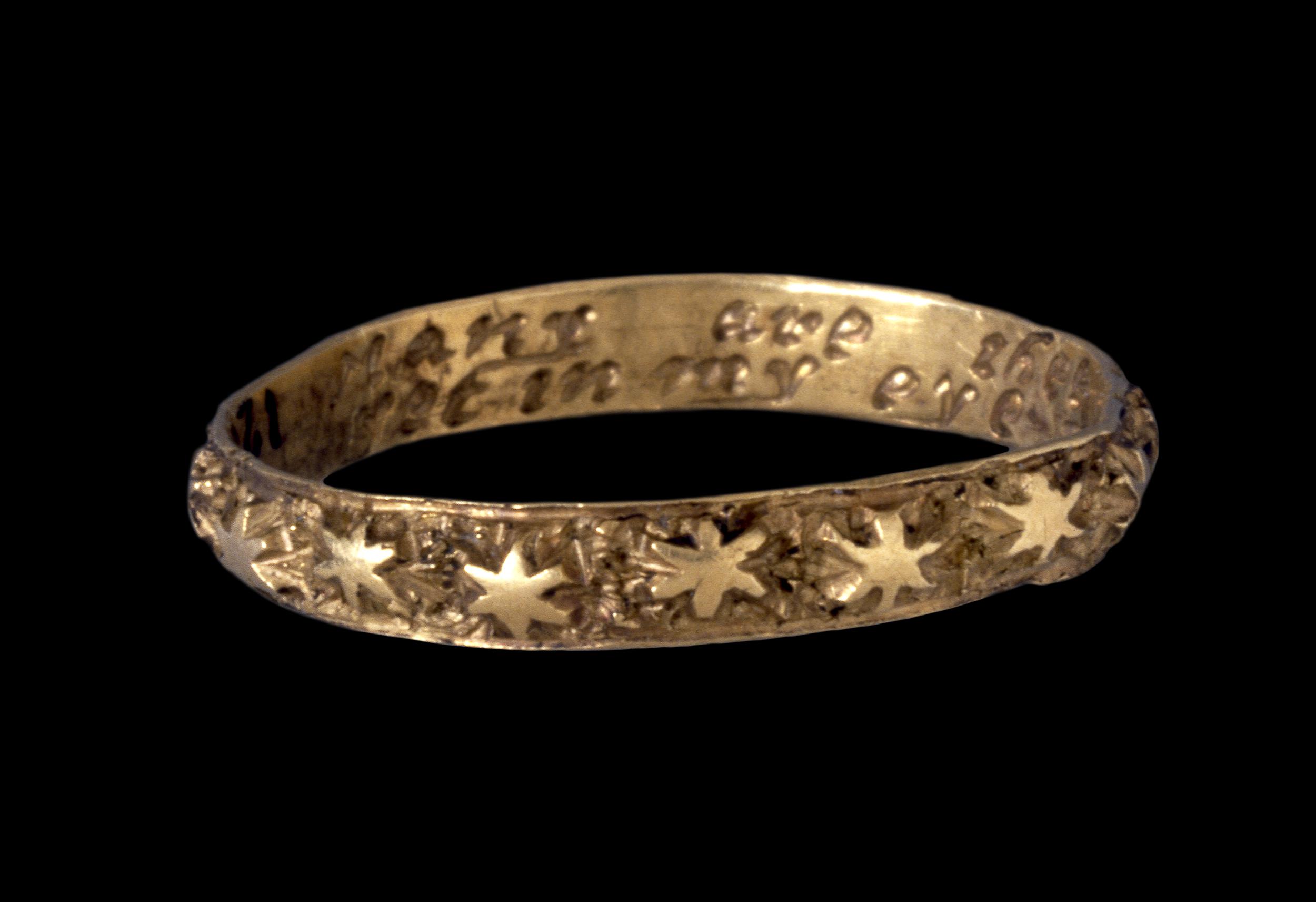
Gold rings with poesies (‘little poems’) — poésie being the Old French for ‘poetry’ — quickly became the single most popular type of jewellery in the country. They were exchanged by lovers, would-be lovers, family members and best friends, but their most common use was as a betrothal or wedding ring. Henry VIII gave a posy ring to Anne of Cleves inscribed: ‘God send me well to kepe.’ William of Orange gave one to Princess Mary inscribed: ‘I’le win and wear you if I can.’ Jewellers used to keep a stock of blank rings, and booksellers promoted inspirational handbooks, such as Loves Garland or Poſies for Rings, which was published in 1624.

I was still in my teens when a friend of my mother’s showed me his collection of posy rings. I was transfixed by their beauty — the soft, almost pure yellow gold, the finely wrought decoration (flowers, leaves, hearts and other symbols) and the elegant script, but what really fascinated me were the inscriptions. ‘I like my choyce.’ ‘True love appears/In midst of tears.’ ‘God has brought to pass that which unlikely was.’ It was as if I were listening to the voices of the long-dead givers and receivers. 

The physical appearance of posy rings changed over time. Lombardic script was replaced by Gothic script, which, in turn, gave way to Roman capitals and then italics. Earlier rings carried much more decoration, too. Niello — a hard black paste — was used to fill in the letters and the costlier rings were enamelled in bright colours. The language of courtly love was, of course, Norman French (‘sans de partier’ or ‘without parting’) although some poesies were in Latin (‘Non Auri Sed Amor’ or ‘not gold but love’) and others in a sort of proto-franglais (‘Autre ne wile and evere you best’, which hardly needs translating). Later, they were almost all in English. (Read more.)

Gold posey ring engraved with stars on a black background

Share

Saturday, January 31, 2026

The Transformation of the Roman Empire Into Byzantium

 From The Greek Reporter:

The transformation of the Roman Empire into what modern historians call Byzantium was not a single event but a gradual process, reaching a profound turning point in the 7th century. By this time, the Roman state had changed in territory, culture, language, religion, and political structure, becoming something new—yet it continued to call itself Roman. The 7th century marked the moment when the Ancient Roman world evolved into the medieval Byzantine Empire, which had previously been known as the Eastern Roman Empire.

Although Hellenistic culture had long prevailed, cemented by the founding of Constantinople in 330, the Eastern Roman Empire retained the core elements of imperial Rome. Its administration remained rooted in Roman institutions, its cities preserved Classical urban culture, and its emperors regarded themselves as heirs of Augustus and Constantine. Latin was in decline, however, even as it remained the official language and the emperors claimed dominion over the entire Mediterranean.

 The transformation was inevitable: Constantinople was emerging as the center of the empire while Rome’s influence waned. As historian Peter Brown observed, Byzantium represents continuity: “The Roman Empire did not fall in the East. It was transformed.” Centered in Constantinople, the Eastern Roman Empire remained a powerful and sophisticated Roman state but with a distinct Byzantine character—while still seeing itself as Roman. (Read more.)


A Byzantine princess in Kyivan Rus. From History of Royal Women:

As the sister of the Byzantine Emperor and as a princess born in the purple, Anna was a highly desirable bride. In 972, the Holy Roman Emperor, Otto II, married Theophano, a relative of the Byzantine Emperor, after requesting an imperial princess. Sometimes Theophanu is thought to have been a sister of Anna, but she was probably related to her more distantly. It is possible that Otto may have wanted to marry Anna instead. In 986, a Bulgarian prince appears to have asked Basil for his sister’s hand in marriage, but this was rejected.

In 988, the new French king, Hugh Capet, sent a letter to Basil, asking him to find a bride for his son, the future Robert II, of equal rank. It was likely Anna, who he was asking for. This arrangement did not go through either. It is believed that all of these proposals were turned down because, at the time, Byzantine princesses born in the purple were considered too important to marry foreigners, even if they were kings or emperors. The Byzantines at this time were also said to have still considered the Western Europeans as barbarians. Everything changed in 988 when Vladimir, Grand Prince of Kyiv, wished to marry Anna. (Read more.)

Share

Monday, January 5, 2026

Cardinal Sarah on Sacred Music

From The National Catholic Register:

The vital importance of sacred music to the liturgy, the need for every Catholic to be watchful and prepared for the Four Last Things, and the recognition that only Christ’s kingship will bring true peace were among the key messages Cardinal Robert Sarah brought to the United States late last year.

Cardinal Sarah’s visit to the U.S. was centered around the launch of his new book, The Song of the Lamb: Sacred Music and Heavenly Liturgy, co-written with Church musician Peter Carter. 

In two talks on Nov. 21 and 22, 2025, delivered at Princeton University, where Carter serves as director of sacred music for the Aquinas Institute, Cardinal Sarah underscored that at a time when, for decades, the Church’s liturgy has “too often been instrumentalized,” it is important to understand what the liturgy is and why sacred music is a central part of divine worship. 

Noting that the liturgy “has become politicized” in recent decades, the prefect emeritus of the Dicastery for Divine Worship and the Discipline of the Sacraments also defended those who have legitimately highlighted abuses, denouncing as “wrong” the fact that some Church authorities have “persecuted and excluded” these critics.

Recalling Benedict XVI’s hermeneutic of continuity between the reformed and pre-reformed liturgy and the late pontiff’s emphasis on “what earlier generations held as sacred remains sacred and great for us too,” Cardinal Sarah said liturgical abuse detracts from the twofold nature and purpose of the liturgy: to “render to Almighty God the worship that is his due” and to recognize that the liturgy “is not about what we do,” but rather about what the Lord “does for us and in us.” 

Through the worship offered by the Church in her liturgical rites, “we are sanctified,” Cardinal Sarah stressed, which is why “full, conscious and actual participation in the liturgy is essential.” By participation, he said he was not referring to many external actions but rather attuning “our minds and hearts and souls” to the “meaning of the sacred rites and chants and prayers of the Church’s liturgy.”  

“That is how we ‘plug-in’ to, or connect with, the saving action of our Lord Jesus Christ in the liturgical rites,” he said. “This, my friends, is why the liturgy is ‘sacred.’” (Read more.)

Share

Thursday, December 11, 2025

Whither the Mass of Vatican II?

 From Dom Alcuin Reid at The Catholic Herald:

Sixty years ago today Pope Paul VI offered Mass in St Peter’s Square before presiding over the ceremonies formally closing the Second Vatican Council. “The Mass was not the kind of solemn pre-conciliar ceremony once sung by the Pope and the Julian choir,” one observer remarked, “but a simple sung Mass to which the entire assembly responded.” “It was a reminder of another fruit of the Council, its Constitution on the liturgical renewal” (Council Daybook, III, p. 284).

For December 1965, such an assertion seems quite reasonable. The verbal participation in the Gregorian chant of the more than 2,400 Council Fathers (i.e. the world’s bishops) and of the numerous others present would have been quite an impressive change, and not necessarily a bad one, especially for a Mass outdoors. After all, widespread participation in the Church’s Latin chant was an early and sound goal of the liturgical movement from the beginning of the twentieth century. Experiencing this at a Papal Mass on such an historic occasion would certainly have conveyed a sense of progress and of true achievement according to the mind of the Council.

1965 had seen much progress in the liturgical reform. In January the Holy See officially published a new Order of Mass, instructing that it be included in all future editions of the Missal. The language of its promulgation, and its widespread reception at the time, suggested that this was the reform of the Mass called for by the Council. The changes it made were foreseen at the Council, and none of the world’s bishops would have been surprised by it. Herder & Herder even published a sturdy volume entitled The New Liturgy introducing it and documenting its genesis.

At the Council itself the Fathers, having been assured that “the current [i.e. 1962] Ordo Missæ, which has grown up in the course of the centuries, certainly is to be retained”, approved the simplification in the number of signs of the cross, the kissing of the altar, bows, etc; the shortening of the prayers at the foot of the altar; the reading of the readings facing the people towards whom they were to be announced; the introduction of an offertory procession as in the Ambrosian rite; the revision of the offertory prayers so as to be more sensitive to the offering of the gifts after the Consecration; the praying of the super oblata prayer aloud; an increase in the number of prefaces; the praying of the Doxology at the end of the Canon aloud with the people responding “Amen”; the abolition of the signs of the cross in the Doxology and reduced throughout the Canon itself; the reciting of the Embolism following the Pater Noster aloud, as also the Fraction prayer and its conclusion; the Fraction and the Pax were to be rearranged in a more logical manner; restrictions on which faithful may receive Holy Communion in which Masses were to be abolished; Holy Communion was to be distributed with the formula from the Ambrosian rite: “Corpus Christi. Amen”; and the end of Mass was to finish with the blessing followed by the “Ite missa est”. A simplification of the rubrics, including in pontifical rites, was also foreseen, as was the extension of the possibility of sung Mass with a deacon (without a subdeacon) beyond the Holy Week ceremonies for which this practice had been authorised in the 1950s. (Read more.)


Share

Sunday, November 30, 2025

'Conditor Alme Siderum'

Creation of the Stars

 My favorite Advent hymn. From A Clerk of Oxford:

Among the Office Hymns for Advent is 'Conditor Alme Siderum', best known in translation today as 'Creator of the stars of night'. Intended to be sung in the evening, as the early dusk of a winter night descends, this hymn praises God as the creator of the stars - those stars which seem to shine so much more brightly in a cold and frosty sky. It draws a parallel between the darkness which envelops us each day and a yet deeper darkness, 'the world's evening hour', which Christ, bright as the sun, illuminates by his entry into the world.

 [...]

Creator of the stars of night,
Thy people’s everlasting light,
O Jesu, Saviour of us all,
Hear thou thy servants when they call.

Thou, grieving at the bitter cry
Of all creation doomed to die,
Didst come to save our ruined race
With healing gifts of heavenly grace.

Thou camest, Bridegroom of the bride,
As drew the world to evening-tide;
Proceeding from a virgin shrine,
The Son of Man, yet Lord divine.

At thy great name exalted now
All knees must bend, all hearts must bow;
And things in heaven and earth shall own
That thou art Lord and King alone.

To thee, O holy One, we pray
our judge in that tremendous day,
preserve us, while we dwell below,
from every onslaught of the foe.

All praise, eternal Son, to thee,
whose advent sets thy people free,
whom with the Father we adore,
and Spirit blest, for evermore.
The best-known translation today is from the 19th century, but the hymn was first rendered into English about 800 years before that. In an Anglo-Saxon hymnal from 11th-century Canterbury, the Latin hymn is accompanied by a version in English, not a poetic translation but a full word-by-word gloss. It begins 'Eala, ðu halga scyppend tungla' ('hail, thou holy creator of the stars') and contains some recognisable vocabulary, most notably in the third verse, where the hymn alludes to Psalm 18: Christ, like the sun, comes forth 'as a bridegroom coming out of the bridal chamber'. In Old English, this is 'brydguma of brydbure', 'bridegroom from bridal bower'. (Read more.)

Share

Saturday, November 29, 2025

How One Myth Changed Empires

 From The Greek Reporter:

The myth of Persephone, or Proserpina, a daughter who disappears underground and rises again, has long helped people make sense of time. In Greece, the story of Persephone explained why the world shifts from growth to barrenness and then returns to life. In Rome, the same story—told as Proserpina—was woven into the city’s calendar and used to structure public life. What began as a tale about the seasons became, in Roman hands, a way to organize fields, markets, courts, and elections.

In the Greek version, Hades seizes Persephone, and her mother Demeter grieves so deeply that the earth withers. A compromise brings Persephone back for part of each year, but the pomegranate seeds she has eaten bind her to return below when the cycle turns. The meaning is straightforward: winter reflects her absence, and spring announces her return.

Greek communities lived this rhythm through ritual. At the Eleusinian Mysteries, initiates experienced a drama of loss and hope. In Athens, the women’s festival of the Thesmophoria paused everyday life to reflect on fertility, reciprocity, and restraint. Even farming followed signs that made nature the ultimate master clock. (Read more.)


Share

Thursday, November 20, 2025

The Liturgy Must Elevate Us to Divine Truth and Beauty

 From Edward Pentin:

“For I think that God has exhibited us apostles as last of all, like men sentenced to death; because we have become a spectacle to the world, to angels and to men.” (1 Cor 4:9). This statement of the Apostle describes the identity of Christianity, both as the proclamation of the Gospel and as the Church’s public worship. Focusing on the latter, it can rightly be said that the liturgy is the spectacle offered to the world by those who adore Christ, the one Lord of the cosmos and of history, to whom they belong and not to the world. This is recalled by the expression “liturgical service,” which is truly appropriate — unlike the term “animation,” now in vogue — as if worship were not already animated by Jesus Christ and by the Holy Spirit.

After the persecutions, this became evident, because Christians did not burn incense to the Roman emperor but to Jesus, the Son of God. Catholic liturgy therefore has regal and imperial characteristics — Eastern liturgies teach us this — because worship of God stands in opposition to any worship of the worldly rulers of the moment.

It is untrue that the Second Vatican Council desired a poor liturgy, since it asks that “rites should shine with noble simplicity” (Constitution on the Liturgy, 34), because they must speak of the majesty of God, who is noble beauty itself, and not of worldly banalities. The Church understood this from the beginning, both in East and West. Even Saint Francis prescribed that the most precious linens and vessels be used in worship.

What then is the “participation” of the faithful, if not to be part of and to take part in the “spectacle” of a faith that affirms God and therefore challenges the world and its profane spectacles — which are indeed spectacular: think of mega-conferences and rock concerts.The liturgy expresses the Sacred, that is, the Presence of God; it is not a theatrical performance. The participation desired by the last Council must be full, conscious, active, and fruitful (ibid. 11 and 14) — that is, a “mystagogy,” an entry into the Mystery that takes place per preces et ritus [through prayers and rites], which, as Saint Thomas reminds us, must elevate us as much as possible to divine truth and beauty (quantum potes tantum aude); or, in the words of then-Father Robert F. Prevost: “Our mission is to introduce people to the nature of the mystery as an antidote to the spectacle. Consequently, evangelization in the modern world must find adequate means to reorient the public’s attention, shifting it from spectacle toward mystery” (May 11, 2012). The usus antiquior of the Roman rite performs this function; otherwise it could not have withstood the secularization of the Sacred that entered into the Roman liturgy, to the point of making people believe that the Council itself wanted it. This is the identity and mission of the Church. (Read more.)

Share

Saturday, November 15, 2025

Medieval Healing


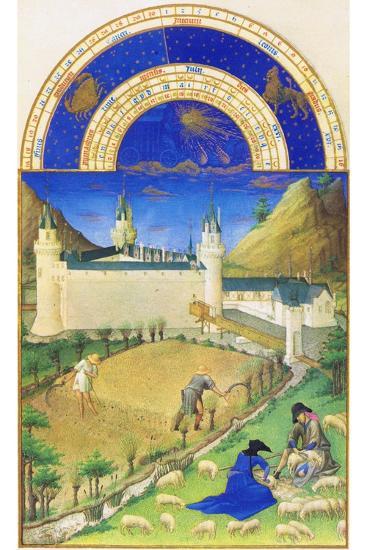
Art Print, , large
From the Book of Hours of the Duc de Berry

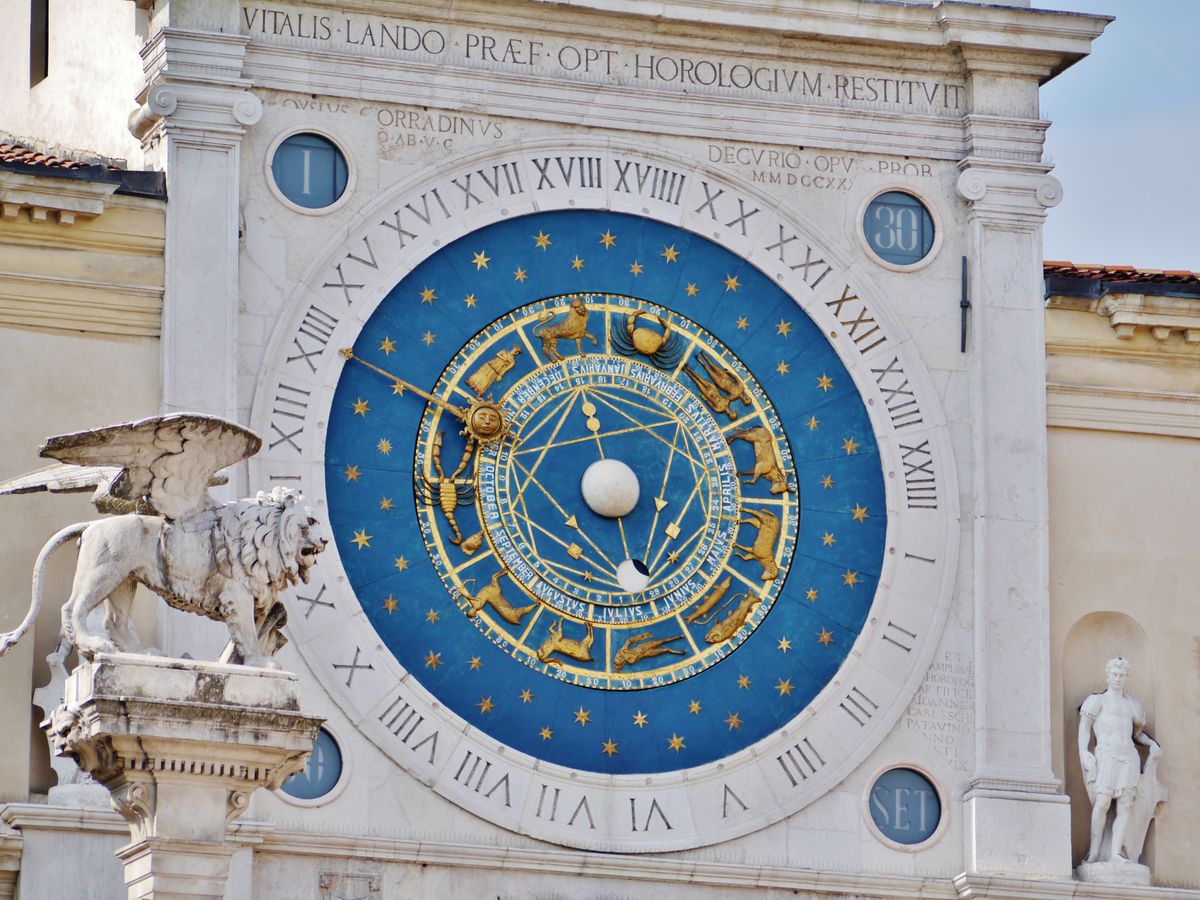
Astronomical Clock in Padua

If you ever wondered why zodiac signs often appear in old missals and breviaries (books of hours), in medieval art and on Renaissance clocks, it is because, while the Church bans divination and fortune-telling, it has never banned what is called "natural astrology" which, for most of the history of the world, was counted among the sciences. It is why many saints such as St. Hildegard, St. Thomas Aquinas, and St. Albert the Great, whose feast is today, and other holy persons, referred to the zodiac in their medical writings and "scientific" treatises. From Marina Marchione at Darkstar Mythology:

For much of history, the study of the stars was not a mystical art, but a science. The same doctors who tended the sick and studied anatomy also charted the movements of the moon and planets. To a medieval physician, the heavens and the body were woven together in one great pattern of divine design. Understanding that pattern was seen as an act of reverence for the Creator, not a defiance of Him.

In the great universities of the Middle Ages — Paris, Bologna, Oxford — medical students learned both astronomy and astrology. Astronomy meant the measurement and geometry of the heavens: how the moon moved, how eclipses worked, and how to calculate the calendar. Astrology meant understanding how those heavenly rhythms affected life on earth — weather, crops, tides, and the human body.

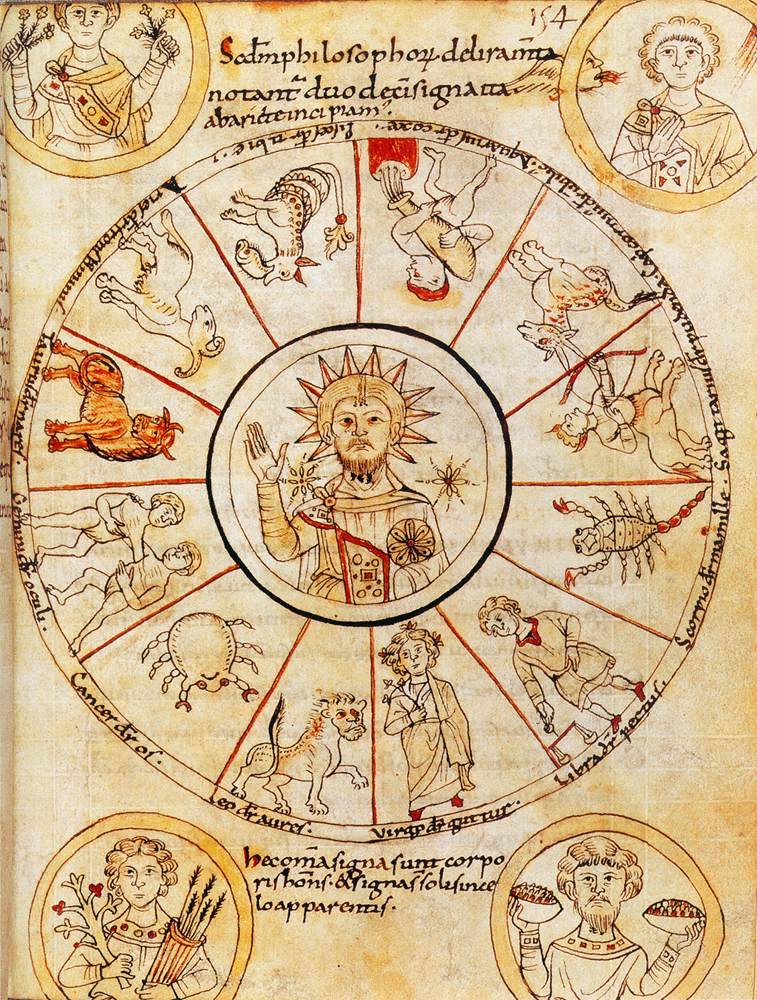
The body itself was believed to reflect the cosmos. Medieval manuscripts often show the “Zodiac Man,” a figure mapped from head to foot with the twelve signs: Aries ruling the head, Taurus the neck, Leo the heart, Pisces the feet.

The moon’s monthly journey through those signs guided physicians in their timing of treatments. They believed that when the moon was passing through the sign that governed a particular part of the body, that area was more “sensitive” — so operations or bloodletting were best avoided then.

This was not superstition to them, but science — an attempt to work with the rhythms of nature rather than against them. Their calendars of moon phases and star signs were tools for health, just as stethoscopes are today. (Read more.)

Image
 Illuminated manuscript on parchment, c. 11th century. Collection: Bibliothèque nationale de France, Paris

Share

Friday, August 15, 2025

Feast of the Assumption, or the Dormition of Mary?


From Hilary White at The Sacred Images Project:

Throughout the middle ages, the Assumption and coronation of the Virgin was one of the most popular subjects for sacred art. There are really a never-ending parade of depictions, in every style you can name, from the earliest possible Christian times. So, rather than just randomly choose a few from the heap, I thought I’d highlight one I’m personally rather fond of.

The great Narnian Ghirlandaio is a painting very difficult to photograph, in its dark room. They keep you some feet away from it with a platform built to resemble an altar, to give an idea what it might have looked like in place.

But other works are much easier to get up close to. I love this little panel of the Dormition and Coronation by a painter of the 14th century known to us only as “The Master of Narni”. It has such delicate charm and simplicity that I thought I’d love to do a set of miniature icons based on it, so I took a lot of close up photos of it one day. (Read more.)


Share

Thursday, July 31, 2025

A Selection of Mitres


From Liturgical Arts Journal:

As mentioned, the use of precious stones to add ornamental colour and texture (as well as a sense of preciousness) was common in this period (and really was so up until the most recent centuries), as for example in the case of this Neapolitan mitre made circa 1300-1325.  In this instance we can see how even the edge of the mitre has decorative ornamentation applied to it.  This was a design feature that was more commonplace in later medieval mitres.  Once again you'll see the same inverted 'T' design as well as the circular medallions and the entire face of this mitre has been covered with small white pearls.  While images of saints on mitres if very common in the medieval period, this is a good example showcasing the fact that not all mitres felt compelled to include them. Something similar can be seen in this mitre from the Cathedral of San Lorenzo at Scala/Ravello which is dated to the thirteenth or fourteenth century.  One can here too see the Italo-Byzantine influence which here comes in the form of small gold enamels depicting various apostles and saints.  (These enamels may well have come from the workshops of Constantinople). (Read more.)

Share