Showing posts with label Our Lady. Show all posts

Sunday, September 13, 2026

Our Lady of Scherpenheuvel


Marie de' Medici had great devotion to Mary under her title of Our Lady of Scherpenheuvel, giving a reproduction of the statue to her daughter Henrietta Maria for one of her chapels in London where it was used by the Confraternity of the Most Holy Rosary. From Wikipedia:

Even before the official approbation of the cult of Our Lady of Scherpenheuvel, pilgrims took particles of the oak tree with them as pious souvenirs. Several stories of miracles attributed to the intercession by the Virgin relate of the thaumaturgic power of this Scherpenheuvel or Montague wood. Following the approbation, Archbishop Hovius ordered the tree to be cut down. It was divided in several parts. Some remained with the sanctuary; one particularly large piece was given to Albert and Isabella. Most of this Montague wood was used to make images of the Virgin Mary. Distributed as gifts among princes, nobles and clergy, they helped to disseminate the cult of Scherpenheuvel.[13]

Quite a few Belgian churches and convents came to possess an image carved in Montague wood. Well known examples remain in the Church of St. Charles Borromeo in Antwerp, the Church of St. Hilonius in Izegem and the chapel of the Capuchins in Enghien. In the Grand Duchy of Luxembourg, the statue of the national patron saint, Our Lady Comforter of the Afflicted or Our Lady of Luxembourg, is believed to contain Montague wood. A smallish statue of the Virgin and Child in Montague wood was taken by St. Marguerite Bourgeoys to Montreal and stands presently on her tomb in the Notre-Dame-de-Bon-Secours Chapel.[14]

Some places of worship became closely associated with the cult of Scherpenheuvel. In the vicinity of their château of Mariemont, Albert and Isabella founded the priory of Montaigu in the present day municipality of Morlanwelz. In the town of Gray a statue of the Virgin made out of Montague wood became the object of a regional devotion. Likewise in the Franche-Comté, the statue donated to the priory of Bellefontaine in Brussey came to attract many pilgrims.[15] In the proximity of the Spanish Court, the Convent of Las Descalzas Reales obtained an altar dedicated to Nuestra Señora de Monteagudo.

The House of Lorraine had a particular devotion for Scherpenheuvel. Cardinal Charles of Lorraine, prince-bishop of Strasbourg, founded a chapel dedicated to Our Lady of Scherpenheuvel in the noviciate of the Jesuits at Nancy. After his death in 1607, his sister Antoinette completed the project with an altarpiece depicting the ducal family venerating Our Lady of Scherpenheuvel. The chapel served as the repository of the embalmed hearts of the members of the House of Lorraine until 1720.[16] The cult was also greatly favored by the French Queen Marie de' Medici. During her regency, the Discalced Augustinians obtained a statue in Montague wood at their church of Notre-Dame-des-Victoires. During her exile, she donated one statue in Montague wood to the city council of Cologne and another to the monastery of the Discalced Carmelites of that city. While serving the Catholic household of her daughter, Queen Henrietta Maria, the Queen's Chapel of St James's Palace likewise had an altar with a Madonna in Montague wood.[17] (Read more.)


(Image Source) 

A history of the original statue, HERE.

Share

Sunday, September 6, 2026

The Cloud of Witnesses

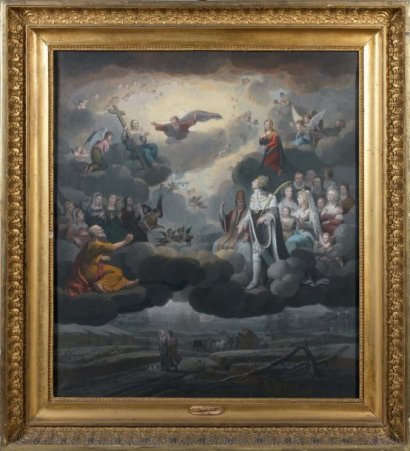
A marvelous painting showing Madame Royale in exile, walking down a long road with her uncle Louis XVIII, as the Blessed Trinity, the saints, the angels and her own family, watch over her from above. Share

Thursday, September 3, 2026

The Art of Pilgrimage


September is the month of Our Lady of Sorrows. From The Way of Beauty:

Pope Benedict XVI, in The Spirit of the Liturgy, identified three authentic traditions of Christian liturgical art: the iconographic, the Gothic, and the Baroque. Each is a legitimate expression of the Christian understanding of the human person and our relationship to God, and each communicates that understanding through a distinct visual language, thereby promoting prayer and worship among the faithful. The iconographic tradition, which dominated Christian art in both East and West until the 12th century, portrays man as he will be in heaven: transfigured, luminous, outside ordinary space and time. The Baroque, which developed in the 17th century, portrays fallen historical man in this life, in the full drama of suffering and grace. The Gothic stands between them, and it is the art most characteristic of the high medieval period in the West.

The Gothic is an authentic and distinct style of liturgical art that developed organically in the West from the iconographic prototype. As the change was gradual, any attempt to date its beginning involves some arbitrary choice. Most commentators settle on the mid-12th century, coinciding broadly with the completion of what is generally considered the first Gothic church, the Abbey of St Denis in Paris, in 1144. The name ‘Gothic’ was coined by High Renaissance commentators as a term of contempt. They held it to be a barbaric style belonging to the period of cultural decline that they believed had begun when the Goths overran the Roman Empire in the West a thousand years earlier. Historians today do not generally share that view of cultural decline, but the name stuck. Even those of us who admire Gothic culture and art continue to use it!

The impetus for the departure from the iconographic prototype stemmed from an increased emphasis on the reliability of human experience and the value of information received through the senses. This led to a greater curiosity about and appreciation of the natural world. Such appreciation was not new: Christians had always relied on sensory information and valued the beauty of the cosmos. What was different was the degree of weight now placed upon them.

Tied to this was the conviction that our world, though fallen and imperfect, is nevertheless good, ordered, and beautiful. There may be evil and suffering in the world, and it may not be as good and beautiful as it ought to be, but it remains God’s creation. This appreciation of the natural world and confidence in our ability to know it through the senses sparked curiosity and a desire to observe it more closely. One effect was the rise of scientific inquiry; another, the one that concerns us here, was an increased naturalism in art, a greater correspondence to natural appearances. The devotion to rational inquiry bound up with this cultural movement also led to a new approach to learning and to the establishment of the great universities, among them those of Paris and Oxford. (Read more.)


Share

A Monastery to ‘Last a Thousand Years’

 From NCR:

A community of Discalced Carmelite sisters is using centuries-old methods to build a monastery in hopes that it will serve as “a beacon of light” for generations to come in Fairfield, Pennsylvania. When the sisters of the Carmel of Jesus, Mary, and Joseph realized they had outgrown their 1940s monastery in the Diocese of Harrisburg, they knew they wanted to build their next home “in a way that is designed to last,” that would speak to St. Teresa of Ávila’s vision for their charism, Catherine Bauer, the director of marketing and development for the sisters, told EWTN News. “And by that, they mean last a thousand years.”

Bucking modern architecture and building conventions, the Fairfield sisters have opted to build their monastery using old-world methods including traditional stonemasonry and timber framing. While the scale of the monastery “will be on the smaller side,” according to Bauer, “it’s more about the stonework, the authenticity of building from the ground up using no nails, no glue, [and] no electricity running through it.” (Read more.)

Share

Tuesday, August 25, 2026

Traditions: The Chapel Veil

 From Catholic 365:

The chapel veil is also called a mantilla, and is worn by Catholic women to honor the Lord as truly present in the Eucharist. This is a very old tradition and is also a symbol of imitation of Mary, the Mother of God. The wearing of the Mantilla is an act of veiling a woman's physical beauty, so that the beauty of God may be glorified instead. It is also a way of emulating Mary, our mother, who is the archetype of purity and humility.  Moreover, the mantilla, or chapel veil, signifies the role of women as a life-bearing vessel.  The chalice holding the blood of Christ is veiled until the Preparation of the Gifts, and the tabernacle is veiled between Masses. Both of these vessels hold the Eucharist – the very life of Christ. (Read more.)

Share

Tuesday, August 18, 2026

The Remarkable Rise of Empress Theodora

 From Risto Gjorgjiev:

 Born around 500 AD in the vibrant city of Constantinople, Theodora’s early life was far from royal. Her father, Acacius, was a bear trainer for the city’s grand Hippodrome, a colossal stadium renowned for its chariot races and theatrical spectacles. After his untimely death, Theodora’s mother, a dancer and actress, found herself struggling to provide for her three daughters. To make ends meet, young Theodora was thrust into the world of entertainment, becoming an actress and dancer in the very Hippodrome her father had worked.

 The Hippodrome was not just a place of entertainment; it was the beating heart of Byzantine social life. Here, factions clashed, politics played out, and the mood of the populace was gauged. Theodora, with her keen observation, learned to read the crowd’s behavior, understanding their passions, grievances, and loyalties. This knowledge would later prove invaluable.

However, life in the limelight was not without its challenges. Theodora faced societal disdain due to her profession, which was often associated with promiscuity. Her travels across the Eastern Mediterranean exposed her to various cultures and experiences, including a tumultuous relationship with a Syrian official that left her stranded in North Africa.

In a twist of fate, Theodora’s return to Constantinople marked a new chapter in her life. Embracing Christianity, she left behind the world of entertainment and joined a community of devout women. It was during this period of reflection that destiny played its card: she caught the eye of Justinian, the nephew of the reigning emperor and the empire’s most eligible bachelor. (Read more.)

 The Mad Monarchist has a post about one of the most colorful women who ever lived, the Empress Theodora.

Together with her husband Empress Theodora oversaw the rebuilding of Constantinople into one of the most spectacular cities in history. She helped in the building of hospices, churches and refuges for the poor. She is also credited with influencing new laws to protect women, making rape and kidnapping capital offenses, no matter if the woman was noble or common born. Women could not be forced into the entertainment industry or prostitution and could not be put in prison for debts. Instead they were to be placed under the supervision of religious women to work off their debt. This was necessary because of the rape and abuse women often suffered in prison. She cracked down hard on prostitution, buying the freedom of many girls herself, meting out harsh punishment to their captors and setting up establishments to help them get back on their feet in legitimate ways. (Read more.)

Empress Theodora did much to protect women during her husband's reign. From The Collector:

The origins of women’s rights can be attributed to Empress Theodora. Probably her experience as a young woman marginalized by the institutional system of that time pushed her to work on the improvement of women’s rights in the Empire. She elaborated on The Corpus Juris Civilis, a series of juridical reforms included in Roman law, and laid the foundation for a framework for Western legal heritage for women’s rights, including the English Common Law, the American Constitution, and even contemporary international public law. Additionally, under Empress Theodora, rape became punishable by death. No matter their position or status, everyone present during the rape was affected by this rule, and the rapist’s property was handed over to the victim. (Read more.)

Share

Saturday, August 15, 2026

Merciful Love through Mary

 From Vultus Christi:

Those familiar with the devotion of total consecration to Jesus through Mary will be familiar with all these ideas. Saint Louis de Montfort says that, through Mary, every little work becomes acceptable, and even its imperfections are entirely cleansed. He recommends Mary as merciful. He states that those who take other ways have more (not less) “obscure nights, combats, strange agonies, craggy mountains, cruel thorns, and frightful deserts.” But he affirms that “by the path of Mary, we pass more gently and more tranquilly.” And because the offering of ourselves is so little, he states that we do well to offer ourselves through Mary so that Mary will offer herself with us.

Perhaps the most remarkable similarity, though, is the way that both the Oblation to Merciful Love and Total Consecration to Mary involve the handing over of everything: all we are, have, and possess, such that we die and show up at the judgment seat with empty hands, without a single good work or spiritual treasure. And yet in the case of both, this engenders confidence. We are freed to do everything and give everything — no matter how small or imperfect — for love alone with confidence that, if we truly keep nothing for ourselves, neither farthing or penny, we will be clothed with riches that are not our own, the riches of Jesus Christ and His Holy Mother. With such similarities, the question naturally arises about the compatibility of the two. Is it merely the case that some are attracted to offering themselves to Merciful Love and others to Mary, or is there, perhaps, a way in which the two fit together into a single whole? This is the question we hope to explore over the coming days.

But first, let us take a closer look at true devotion and total consecration to Mary. (Read more.)

Share

Saturday, August 8, 2026

The Vow of Louis XIII

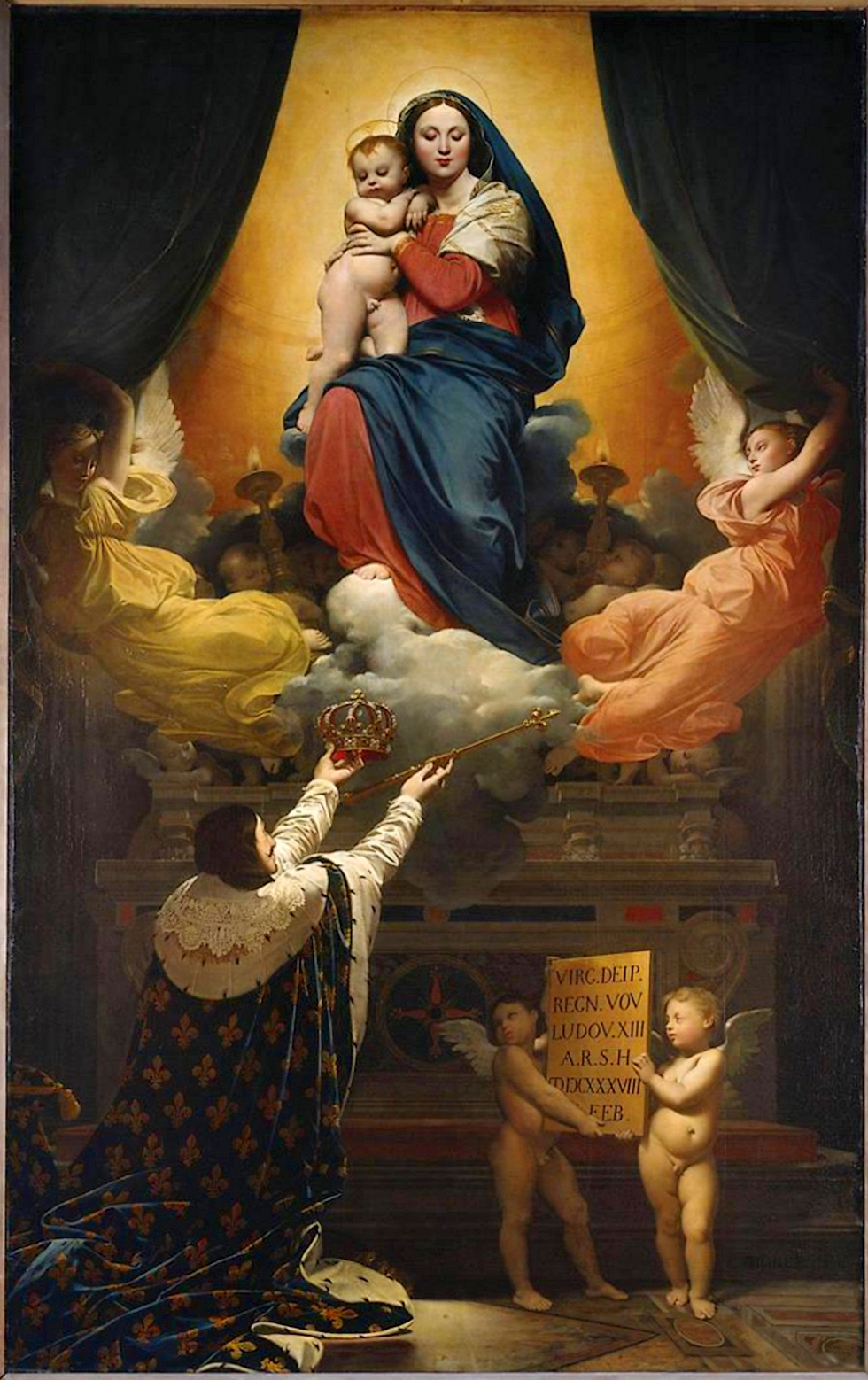
Ingres' painting of the "Vow" of Louis XIII in 1637, in which he dedicated his Kingdom to the Mother of God. Louis XIII was rewarded with an heir to the throne, a prince who became Louis XIV. Every year afterwards on the Assumption the King of France would lead a procession in honor of Our Lady in which he would once again place France under her protection. The Assumption was also considered the feast-day of the queens of France. Processions are still held all over France on the Assumption to honor the King's vow and the patronal feast-day of France. In 1826 Charles X, the last anointed king, had a statue made which is still carried in Paris on the feast of the Assumption. Here is the Vow of Louis XIII:
We have declared and declare that, in taking the very holy and glorious Virgin as the special protector of our Kingdom, we dedicated to her ourselves, our state, our Crown and our subjects, pleading her to inspire in us very holy behaviour and to defend this kingdom against the efforts of all its enemies, with great care, whether it may suffer under the scourge of war, or enjoy the sweetness of peace that we are asking God to deliver us with all our hears, there are no paths of grace that do not lead to paths of glory.

The Virgin of Charles X

Share

'Hemingway in Toronto'

 From Old Hollywood and Beyond:

“Paris in the Dark Ages,” wrote Belloc, gave way to an ‘awakening Europe’ in which “the Normans show first how true a kingdom, with peace and order and unity, may be established” and how “Rome did not die; it was transformed” and how “the philosophy of the Empire had been touched with mysticism” and “the shrine, the miracle, the unseen had replaced the clear and positive attitude, the speculative and cold intelligence, which had distinguished the philosophy of Rome.”

In its place was “medieval religion, its legends, its marvels . . . the one good counterbalance that ultimately saved the world from barbarism.”

Hemingway absorbed it all and gave it back to us, brilliantly, in The Sun Also Rises. While many think this, his debut novel, is just about drinking and debauchery, underlying that decadence is an iceberg of spiritual healing.

Its protagonist, “Jake” Barnes, is inspired by St. James—whom Mary, i.e., Our Lady of Pilar, appeared to shortly after her Assumption into Heaven. On the eve of his trip to Pamplona, Jake refers to the Paris street named for St. James as “the rigid north and south of the rue saint-Jacques.” A curious description, Stoneback thought, since there’s nothing rigid about it, unless the underlying spirituality along this medieval main street is, in fact, the whole point of the literary device.

Le long de la rue, there’s the famous Church of the Val-de-Grâce, meaning “vale of grace”—an architectural splendor King Louis XIII’s wife, Queen Anne of Austria, built to celebrate the birth of their son Louis XIV (“The Sun King”); and the adjoining monastery, later converted into a hospital for wounded soldiers, imaging Jake’s war wounds—Hemingway’s, too. Then there’s that plaque dedicated to Pamplona, a town along the Chemins Pèlerinage—the Way of St. James. (Read more.)

Share

Tuesday, August 4, 2026

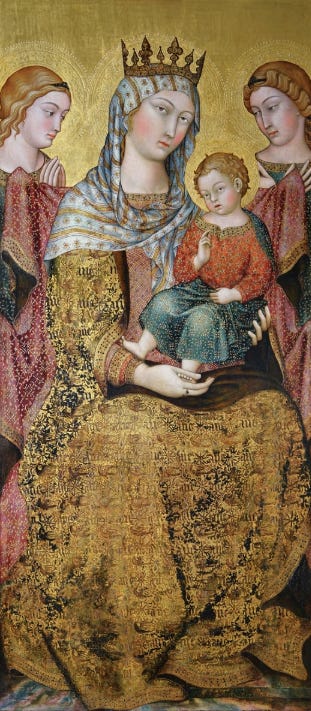
Taddeo di Bartolo: Sienese Gothic in the Early Renaissance


From Hilary White at The Sacred Images Project:

If I hadn’t told you the date, would you have guessed the early fifteenth century?

Most people wouldn’t, and would probably peg it as “early Renaissance”. In fact, even readers who’ve been following the Sacred Images Project for a while might hesitate. At first glance, this looks like a classic mid-14th century, “Trecento” Sienese Gothic Madonna. It has all the notes: a glowing gold background functioning as non-natural space, meticulously and elaborately tooled and stamped to show the haloes, the richly patterned cloth created by picking out the paint with the sgraffito technique to expose the gold underlay. 

 Here are the typical Sienese gentle almond eyes, elongated figures, softly rounded and luminous features, and the solemn little Christ Child, royally dressed, blessing the viewer. It all belongs to a visual language that seems to have come straight from the age of Duccio and Simone Martini.

But this isn’t 1340. It was painted around 1405, sixty-five years later. What makes it so intriguing is that the great flowering of the Sienese “golden age,” so characterised by this very distinctive painting style, was supposed to have ended quite abruptly in 1348, with the Black Death that wiped out 50% of Siena’s population in a single year. But we will see below that this is an oversimplification. Since there’s no documentation it’s only speculation, but wouldn’t it be fun to think of him as saying, “We’re Sienese, dammit, whatever those heathen Florentines are doing”? What if Siena wasn’t behind Florence but simply disagreed with Florence? (Read more.)

Share

Sunday, August 2, 2026

Fra Angelico’s First Major Altarpiece Gets a Groundbreaking Repair

a group of angels stand looking at the Virgin who is out of the picture in this part of the Fra Angelico altarpiece 

From Artnet:

Antonella Ranaldi, director of Florence and Prato’s cultural heritage office, called the restoration “a case study of the greatest interest that will serve as a model for restorers in the years to come.”

The work is considered Fra Angelico’s first major large-scale work. In the early 1420s, the budding painter-friar, née Guido di Pietro, entered the convent of San Domenico in Fiesole, a complex just north of Florence, where he was tasked with creating an altarpiece for the newly built monastery. In keeping with the fashions of the age, Fra Angelico created a late Gothic style triptych with a liberal use of gold, centering a serene depiction of the Virgin and Child alongside adoring angels and four haloed saints.

Time has not been kind to the San Domenico altarpiece. By 1501, 50 years after the artist’s death, the painter Lorenzo di Credi was commissioned with updating the work to contemporary tastes. He removed the partitions, downsized the Virgin’s throne, and replaced the gold grounding with a naturalistic landscape. Over the coming centuries, the altarpiece was broken up, its parts looted or sold on the antiques market—the original predella, for instance, now belongs to London’s National Gallery. Fra Angelico’s central panel remained at the convent, albeit damaged by haphazard restorations and eaten by wood-boring insects. (Read more.)

Share

Sunday, July 26, 2026

Narrative Icons


From Hilary White at The Sacred Images Project:

One of the most useful distinctions made by people who analyse art is between an image that simply presents something, and an image that tells a story. A portrait of a king, a still life of a bowl of fruit, a simple landscape, or an icon of Christ Pantocrator asks us to contemplate a single subject. They are essentially static images, like a single object in a dark room under a spotlight. Nothing is happening, and nothing is about to happen. It’s just Him and you.

But iconography is about making a visual statement about some eternal reality, even when the image itself is a story being told. We are all familiar with the single-figure icons of course, but there are narrative icons as well. The Nativity icon is a good example of this, where a single image will have several elements of a story presented as if they’re all happening at the same visual “time”1. The format here is to have the most important thing - the Nativity itself - in the centre, with all the side adventures going on around it.

This is called “continuous narrative,” in which the same characters appear multiple times within a single image to depict successive moments in a story. Time is compressed into one pictorial space. But instead of reading left-to-right like a comic strip, the viewer follows the action throughout the composition.

This technique goes back to classical Roman art (for example, Trajan’s Column) and was taken east by Byzantine artists, where it became especially common in manuscript illumination, fresco cycles, and some icons. (Read more.)


Share

Monday, July 13, 2026

Chesterton on St. Joan


From Rae at Educating Souls:

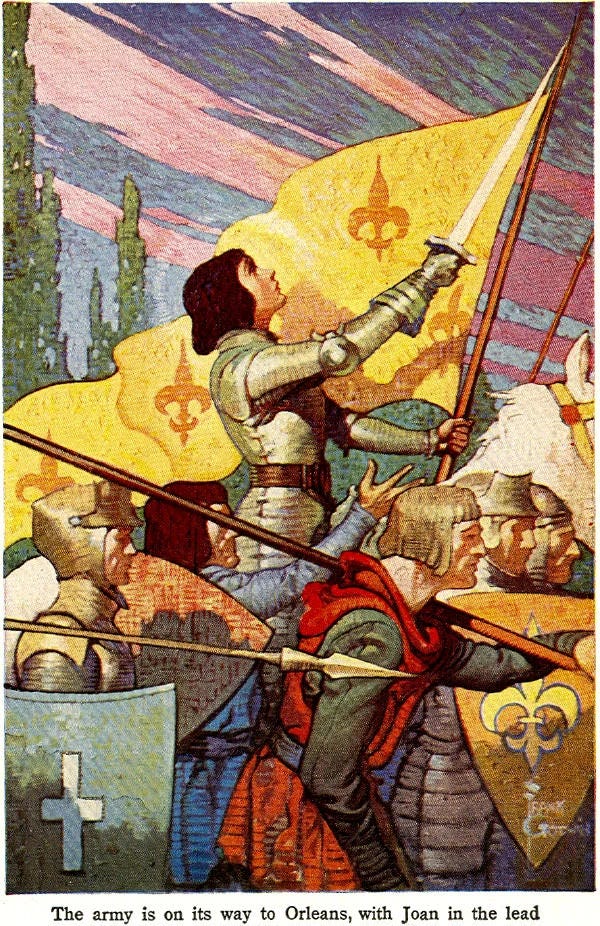
Joan of Arc had all that, and again with this difference, that she did not praise fighting, but fought. We know that she was not afraid of an army, while Nietzsche, for all we know, was afraid of a cow. Tolstoy only praised the peasant; she was the peasant. Nietzsche only praised the warrior; she was the warrior. She beat them both at their own antagonistic ideals; she was more gentle than the one, more violent than the other. Yet she was a perfectly practical person who did something, while they are wild speculators who do nothing. — G.K. Chesterton

(Illustration by Jessie Willcox Smith)


Share

Friday, June 12, 2026

Vow of Louis XVI

Here is an English translation of the Vow of Louis XVI made in the Tuileries palace in the spring of 1791:
Well dost Thou see, O my God, the great sadness that oppresses my heart, the grief that wounds it and the depth of the abyss into which I have been cast. I am assailed by countless evils from all sides. To the oppression of my soul, the horrible tragedies that have befallen me and my family add up to those that cover the whole extension of the realm. The clamoring of all the misfortunate and the moans of our oppressed religion reaches my ears, and an inner voice suggests to me that perhaps Thy justice holds me accountable for all these calamities for not having restrained, during the days of my power, their main causes, which are the people’s licentiousness and the spirit of irreligion, and for supplied heresy, now triumphant, its weapons by favoring it by laws that gave it redoubled strength and enough boldness to dare anything.
 
O Jesus-Christ! Divine Redeemer of all our iniquities, today I come to find relief for my soul in Thy Adorable Heart. I call to my aid the tender Heart of Mary, my august protectress and Mother, and the assistance of Saint Louis, my advocate and the most illustrious of my ancestors. Open Thyself, adorable Heart, through the most pure hands of my powerful intercessors, receive benignantly the vows of which confidence inspires me and that I offer Thee as the frank expression of my sentiments. If, as a consequence of Divine goodness, I were to recover my liberty, my crown and royal power, I solemnly promise:

1. To revoke at once all the laws that will be indicated to me by the Pope, or a Council, or by four of the more learned and virtuous bishops of my realm, as contrary to the purity and the integrity of the Faith, and contrary to the discipline and the special jurisdiction of the Holy, Roman, Catholic, and Apostolic Church; and especially to revoke the Civil Constitution of the Clergy.

2. To take, within a year, all the necessary measures to establish, with the approval of the Pope and the episcopate of my realm, and in accordance with canonical standards, a solemn feast in honor of the Sacred Heart of Jesus to be celebrated forevermore throughout all France on the first Friday immediately after the eight days following the Feast of Corpus Christi and to be always followed by a general procession. This feast will be celebrated in reparation for the outrages and desecrations perpetrated in our holy temples by schismatics, heretics and the bad Christians in these times of so great turmoil.

3. To go in person on a Sunday or a holy day within three months of the day of my deliverance to the Church of Notre Dame of Paris, or to any other principal church in the place where I will be at that time, to pronounce a solemn act of consecration of my person, my family and my realm to the Sacred Heart of Jesus next to the main altar after the Offertory of the Mass and through the hands of the priest, promising to give to all my vassals an example of the worship and the devotion due that adorable Heart.
4. To erect and adorn within a year of my release and at my own expense, in the church that I will choose, a chapel or an altar to be dedicated to the Sacred Heart, which will stand as a lasting monument of my recognition and limitless confidence in the infinite merits and inexhaustible treasures of grace that this Divine Heart contains. 

5. Finally, to renew every year, wherever I might be on the Feast of the Sacred Heart, the act of consecration stated in the third point and to participate in the general procession that will take place right after that day’s Mass.

 Now I cannot pronounce this pact except in secret, but I would sign it with my own blood if necessary; and the most beautiful day of my life will be when I will be able to proclaim it aloud in the Temple.

  O Adorable Heart of my Savior, may I neglect my right hand and my own being if I were to ignore Thy benefits these my promises, if I were to cease to love Thee and place all my trust and comfort in Thee! Amen.”
  
Louis XVI, King of France

 (Read more,)
 The original French version is HERE. In the spring of 1791, after signing the Civil Constitution of the Clergy a few months earlier, King Louis XVI fell ill at the Tuileries, where the royal family were living under house arrest. His illness was undoubtedly the result of the stress of the upheavals which he had tried to prevent, as well as the fact that his conscience was troubling him about signing the Catholic Church in France over to the revolutionary government, severing the ties with Rome. Louis had signed it under duress but deeply regretted his decision immediately.

According to biographer Bernard Fay, Louis made the Vow under the guidance of his non-juring confessor, a Eudist priest Fr. Hebert. In the 1600's a Visitation nun, Saint Margaret Mary, had claimed that Jesus had requested that the King of France consecrate France to His Sacred Heart. The consecration had never been performed. So, with the help of Fr. Hebert, Louis drafted the following Vow, which he sealed in the walls of his apartments.

The Vow was not found until the palace had been partially burned by the Commune and was being torn down in 1871. It was discovered still sealed in the wall of the king's room. Louis was a locksmith and was fascinated with construction, so building a hiding place for his papers would not have been beyond him. He was known for his penchant for secrecy and his hiding of private papers from prying eyes. The fact that the Vow was not discovered until the 1870's demolishes the claim of some that it was merely a product of pious forgery during the 1814-1830 Restoration. The methodical legality of the document is typical of Louis XVI, who as an amateur cartographer was characterized by his precision and attention to detail.
Share

Saturday, June 6, 2026

"Your Virtues and Your Kindness"

Our Lady (or perhaps the virtue of Faith, since she carries the cross) and Marie-Antoinette hold the Gospels for Louis XVI as he makes his coronation oath. The picture is accompanied by the following verse:
The hands of Divinity
Louis, sends you the crown
The scepter, the sword, the law gives to you
But it is your virtues and your kindness
Which assures you the throne in our hearts.
Share

Wednesday, May 13, 2026

Raphael and the Pursuit of Sublime and Heavenly Beauty

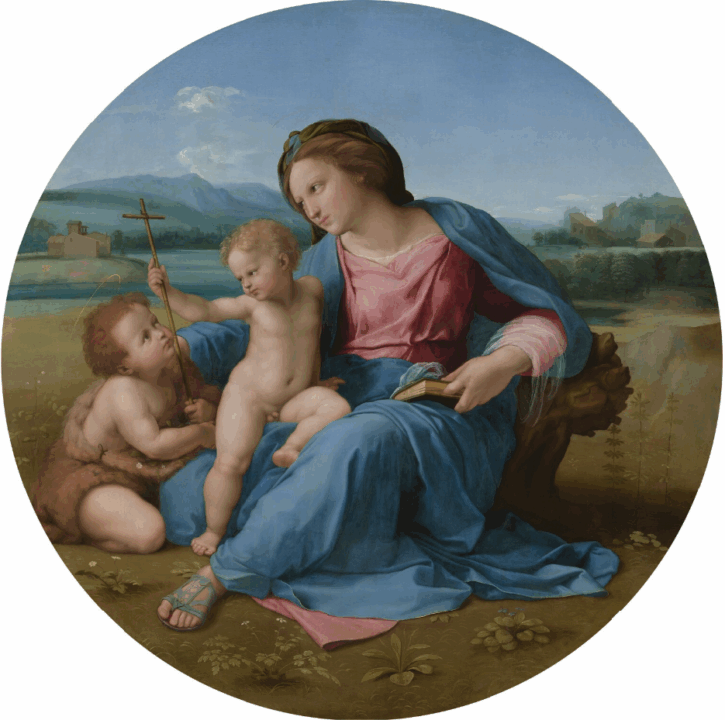
The Alba Madonna 

From Word on Fire:

Raphael’s drawings clearly show that the young artist learned quickly and adapted to the rapid artistic developments occurring during the Renaissance. Leonardo and Michelangelo’s influence becomes apparent in the motion, arrangement, and anatomical accuracy that began to characterize the figures in Raphael’s sketches, which he referenced for his paintings. The progression of his technique reveals that Raphael was a man who strove for perfection—and many would argue that he achieved it to the greatest extent possible within the realm of human capabilities.

Raphael’s continual refinement of his skills in the chase after excellence didn’t stop there. He went to Rome in 1508, becoming the court artist for Pope Julius II (r. 1503–1513) and Pope Leo X (r. 1513–1521). He made drawings of the ancient monuments in the city to learn the ins and outs of classical architecture. This knowledge proved useful for the School of Athens, a fresco that Raphael made for a four-part series in the Stanza della Segnatura in the Apostolic Palace.

We’ll never know how much further Raphael could have gone in his endeavors. Raphael did not enjoy the longer lives of his contemporaries, whose artwork had such a noteworthy impact on him; Michelangelo and Leonardo died at 88 and 67 years of age, respectively. Raphael left this world at 37, making the progression of his artistic career even more remarkable than theirs, at least in regard to time. In 1520, he completed what became his last masterpiece: The Transfiguration, a stunning example of his masterly orchestration of light, color, and human bodies to create a dramatic scene. (Read more.)


Share

Friday, May 8, 2026

Preoccupation with Sexual Sin

 From Catholic Culture:

In the rising tide of sexual immorality—or in judging the pitiful state of the world—devout Catholics tend to remember the famous statement by Our Lady of Fatima that “More souls go to hell for sins of the flesh than for any other reason” (July 13, 1917). Ever since that time, we have been citing this statement as an indication that more souls go to hell for sexual sins than for any other cause. But this is not necessarily what Our Lady meant, and we will certainly not achieve Heaven simply by avoiding these sins ourselves.

It is perhaps more likely that Mary had in mind the declaration of the Holy Spirit through St. Paul’s Letter to the Galatians:

Now the works of the flesh are plain: fornication, impurity, licentiousness, idolatry, sorcery, enmity, strife, jealousy, anger, selfishness, dissension, party spirit, envy, drunkenness, carousing, and the like. I warn you, as I warned you before, that those who do such things shall not inherit the kingdom of God. [Gal 5:19-21]

But there are a great many self-identified Christians who, in the midst of their sexual purity, indulge in the non-sexual sins in this list. (Most of us have done so.) Moreover, in his letter to the Colossians, Paul further warns his readers: “Put to death therefore what is earthly in you: fornication, impurity, passion, evil desire, and covetousness, which is idolatry” (3:5). For Paul, in effect, it seems that the sins of the flesh are all of those sins that arise from our wayward passions—that is, the sins that are triggered by unregenerate desires of every kind, which have not been conquered and transformed through our participation in the grace of God. In this sense, we might say that “sins of the flesh” are not simply sexual sins but rather all the sins we commit when we are not living in the Spirit, in accordance with the grace of Jesus Christ. (Read more.)

Share

Saturday, April 25, 2026

The Hardest Truth about Islam and Christianity

People often cite the fact that the Koran mentions the Virgin Mary with reverence, a fact which never stopped a single Muslim from kidnapping and enslaving millions of Christian women and girls in harems for over a thousand years. And the rape of "infidel" women is not seen as a sin from the Islamic point of view. From Patrick Novecosky:

Relations between the papacy and Islam stretch back more than 1,300 years to the era of Pope Donus in the 7th century, when the rapid expansion of Islam transformed the Christian world. What followed was not primarily dialogue, but conflict. Muslim armies swept through formerly Christian lands in North Africa and the Middle East. Europe responded with the Crusades. Constantinople fell. Naval battles like Lepanto became defining moments of civilizational struggle. For much of history, Christianity and Islam encountered each other not in shared spaces of worship, but on opposing sides of war.

That history does not dictate the future, but ignoring it doesn’t lend clarity to the present.

The Catholic Church’s modern approach to Islam largely dates to the Second Vatican Council in the 1960s. Its declaration, Nostra Aetate, marked a turning point, stating that the Church “has a high regard for the Muslims,” who worship the one, merciful God. It called for both sides to move beyond past hostilities and work together for justice and peace.

The Catechism of the Catholic Church builds on that framework. It teaches that Muslims, “together with us, adore the one, merciful God” and are included in God’s plan of salvation. That’s pretty remarkable language, especially when viewed against centuries of conflict. They reflect the Vatican’s deliberate effort to emphasize common ground and reduce religious hostility.

But they do not erase fundamental differences.

Islam rejects the Christian understanding of God as Trinity, denies the divinity of Jesus, and does not accept the central claim of salvation through the cross and resurrection. These are not minor disagreements. They go to the heart of what each religion believes about God and humanity’s relationship to Him. Any serious discussion of Christian-Muslim relations must grapple with that reality. (Read more.)

Share

Wednesday, April 22, 2026

The Death of Jacques de Molay

File:MolayExecution.jpg 

Awhile ago I listened to a fabulous book on the Templars by historian Barbara Frale, who spent years researching in the Vatican secret archives. Templars were not ordained to the priesthood but professed vows like monks. They were accused of heresy by King Philip IV of France. The Templars were absolved of the accusations of heresy by the Pope, only to be executed by King Philip. Philip wanted the wealth of the Templars and would stop at nothing to get it. The execution of the Templar Grand Master Jacques de Molay and his brethren was in violation of Church law, rather like the execution of St. Joan of Arc. When Jacques de Molay was bound to the stake on an island in the Seine near Notre Dame de Paris, he asked that his arms remain free. While burning, the Grand Master lifted his arms towards the spire of Notre Dame, offering his life to Our Lady, as once his order had been completely consecrated to her. From Dominic Selwood:

In Paris, King Philip immediately saw that the tide was turning against him, and that he needed to do something decisive. He therefore summoned the bishop of Sens and forced him to re-examine the Templars in his diocese. When 54 Templars insisted on their innocence, the bishop dutifully denounced them as relapsed heretics.

As Philip had known all along, a heretic who confessed was welcomed as a lost sheep, given penance, and reconciled to the Church. But if the penitent then slipped back into the heresy, he had rejected all grace, spurned salvation, and was a direct threat to Christian society.

On the 12th of May 1310, as Philip knew he would, the bishop of Sens burned the 54 Templars alive. This appalling cruelty gave Philip the shot in the arm he needed. The remaining Templar resistance petered out.

The sorry tale was drawing to a close. In October 1311, the long-awaited Council of Vienne opened to give final judgement. The evidence did not amount to much. The only Templars who had comprehensively confessed to Philip’s 127 charges were the ones tortured in his dungeons or those in territories loyal to him. There were virtually no confessions from abroad.

True to form, Philip showed up to threaten Clement with physical violence unless he shut down the Templars. There were protests from the other church delegates, who felt the Templars had not been given an opportunity to defend themselves. They also pointed to the suspicious similarity of the charges with those Philip had recently brought against the dead Pope Boniface VIII. None of this helped Clement, who threatened anyone who spoke further with excommunication.

Finally clear to impose Philip’s will, in March 1312, with Philip and his son flanking him, Clement issued the bull Vox in excelso. Citing the irreparable damage done to the Templars’ reputation, he pronounced judgement with a formula that completely sidestepped the question of innocence or guilt:

We suppress, with the approval of the sacred council, the order of Templars, and its rule, habit and name, by an inviolable and perpetual decree, and we entirely forbid that anyone from now on enter the order, or receive or wear its habit, or presume to behave as a Templar. (Vox in excelso)

It was over. All that remained was to tie up the loose ends. Templars who had confessed crimes were sentenced to imprisonment. Those who had remained silent were sent to other religious Orders.

To draw down the final curtain, on the 18th of March 1314 the four most senior living Templars were hauled to Paris. On a rostrum erected on the parvis before the great cathedral of Notre-Dame, they were publicly condemned to perpetual imprisonment. Hugues de Pairaud and Geoffroi de Gonneville accepted the sentences in silence. But Jacques de Molay and Geoffroi de Charney stunned the crowd by talking over the cardinals and professing their innocence and that of the Temple.

The electrifying news was rushed across the city to King Philip at the Louvre. Desperate to crush this dangerous new defiance, he abandoned all legal procedures and ordered the two old Templars to be burned without delay.

So as dusk fell and the canons of Notre-Dame lit the candles and incense for the lucernare before Vespers, the provost of Paris’s men torched two nearby pyres and sent de Molay and de Pairaud up in smoke alongside the canons’ prayers.

A royal chaplain eyewitness described de Molay’s last words (in verse):

“God knows who is in the wrong and has sinned. Misfortune will soon befall those who have wrongly condemned us; God will avenge our deaths. Make no mistake, all who are against us will suffer because of us. I beseech you to turn my face towards the Virgin Mary, of whom our Lord Christ was born.” His request was granted, and so gently was he taken by death that everyone marvelled. (Geoffroi de Paris)

Rumours began to circulate that, at the end, de Molay had also shouted out, summoning Philip and Clement to meet him within a year and a day before God, where they would be judged for their crimes. (Read more.)

Share

Friday, April 3, 2026

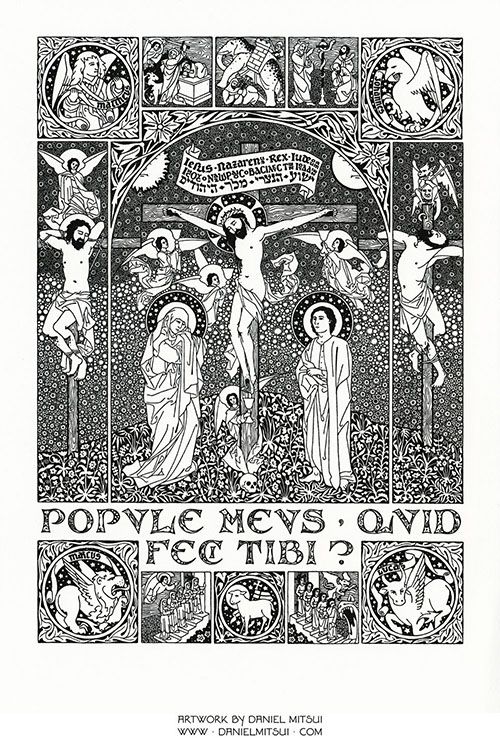
Good Friday


From Daniel Mitsui.

The Reproaches (Improperia)
I.
1 and 2: My people, what have I done to you
How have I offended you? Answer me!
1: I led you out of Egypt,
from slavery to freedom,
but you led your Savior to the cross.
2: My people, what have I done to you?
How have I offended you? Answer me!

1: Holy is God!
2: Holy and strong!
1: Holy immortal One, have mercy on us!
1 and 2: For forty years I led you
safely through the desert.
I fed you with manna from heaven,
and brought you to a land of plenty; but you led your Savior to the cross.
Repeat "Holy is God..."
1 and 2: What more could I have done for you.
I planted you as my fairest vine,
but you yielded only bitterness:
when I was thirsty you gave me vinegar to drink,
and you pierced your Savior with a lance.
Repeat "Holy is God..." 
II.
1: For your sake I scourged your captors
and their firstborn sons,
but you brought your scourges down on me.
(Repeated throughout by Choir 2)
2: My people, what have I done to you?
How have I offended you? Answer me!
1: I led you from slavery to freedom
and drowned your captors in the sea,
but you handed me over to your high priests.
2: "My people...."
1: I opened the sea before you,
but you opened my side with a spear.
2: "My people...."
1: I led you on your way in a pillar of cloud,
but you led me to Pilate's court.
2: "My people...."
1: I bore you up with manna in the desert,
but you struck me down and scourged me.
2: "My people...."
1: I gave you saving water from the rock,
but you gave me gall and vinegar to drink.
2: "My people...."
1: For you I struck down the kings of Canaan.
but you struck my head with a reed.
2: "My people...."
1: I gave you a royal scepter,
but you gave me a crown of thorns.
2: "My people...."
1: I raised you to the height of majesty,
but you have raised me high on a cross.
2: "My people...."
Share