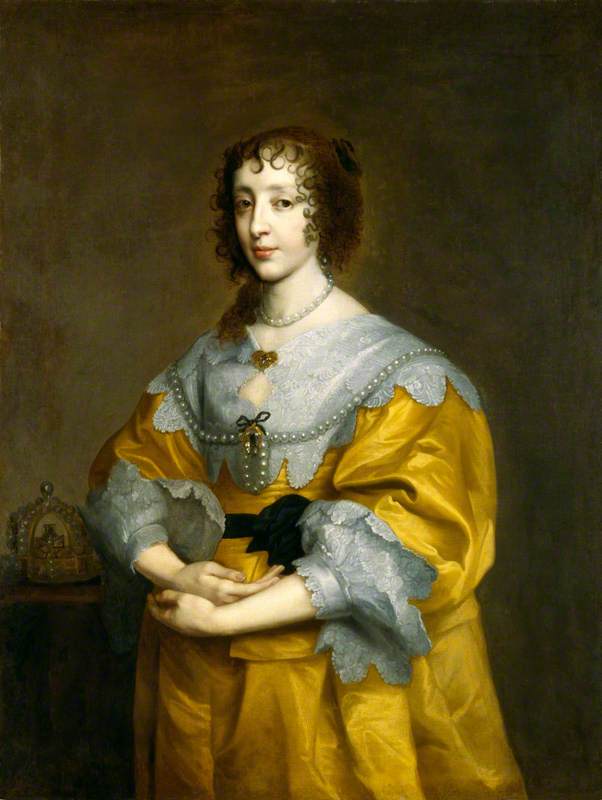
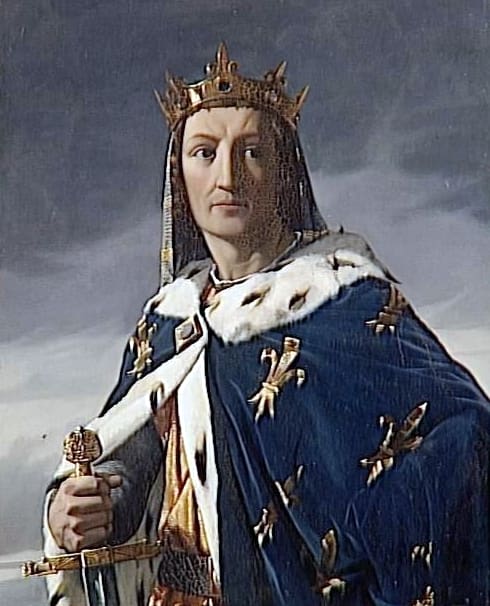
Showing posts with label Queens of France. Show all posts

Monday, September 28, 2026

The Pope in France

Pope Leo XIV in Notre Dame Cathedral
Pope Leo at Notre Dame with the statue of Our Lady of Charles X

 From Vatican News:

Light inundated Notre-Dame as Pope Leo XIV celebrated vespers in Paris' beloved Cathedral. It felt like a fitting celebration for the restored and renewed basilica, a place of worship and iconic symbol of the “Ville Lumière“, badly damaged by fire on 15 April 2019.

On that day, dramatic images and videos of the cathedral engulfed in flames, and of people praying in the streets as the fire consumed the building, spread around the world through social media and news outlets.

Today, the French Church has come together again. This time to rejoice, as the Pope visited the Cathedral and celebrated Vespers, almost two years after its reopening in December 2024, following a long and meticulous restoration process.

As the sun shone through the stained-glass windows, colorful patterns moved slowly across the walls. Meanwhile, an organ played and the choir sang while the bishops, priests, consecrated men and women, seminarians, and other members of the French Church solemnly prayed together with the Successor of Peter.

Before the Vespers, Pope Leo venerated a relic of the crown of thorns, which was placed on Christ’s head during his Passion. A symbol of his suffering and sacrifice before his Resurrection.

“We are gathered for Evening Prayer in this place which, more than any other, has invited the people of Paris for centuries to lift their eyes towards heaven,” Pope Leo said in his homily. (Read more.)

Mass at the Place de la Concorde, where thousands were guillotined (Via Daily Mail)

I wish instead of Robespierre the article had mentioned Madame Elisabeth. From Rome Reports:

The Place de la Concorde in Paris is a site marked by some of the darkest moments in French history.

During the Revolution, the guillotine stood here, and more than a thousand people were executed. Louis XVI, Marie Antoinette and Robespierre were among them.

Two centuries later, Pope Leo XIV celebrates the Eucharist here before nearly 600,000 people. A turnout that marks a new chapter in the Church in France.

The pope is using this celebration to call for a secular society.

LEO XIV

Seeing you gathered here, brothers and sisters, heirs to a long and beautiful history of holiness in France, I say to you: in turn, drink deeply from this spring that is the pierced Heart of Jesus. Yes, you thirst for God, for life, for truth, for unity, for peace, for communion, for happiness. You long to rediscover a radiant horizon, to build a renewed nation rooted in a faith that nourishes its very foundations.

But the pope does not stop with France’s religious identity. He goes straight to the individual and a much more universal question: what does a Catholic drink from when he or she thirsts for life?

LEO XIV

Brothers and sisters, we must acknowledge that here on earth, nothing can fully satisfy us. Just when we think our search is finally over and our efforts have been rewarded, that inner emptiness often resurfaces, even more profound than before.

Are we content with material possessions, immediate gratification, and the countless little idols that promise the world but leave our hearts empty?

And while, in 2008, Benedict XVI came to France asking how faith could survive in a secularized society, today, Pope Leo XIV is not talking about survival.

He is talking about renewing the country from its roots: building a renewed nation through a faith that can once again nourish society.

This is not about rebuilding a blood-soaked square, but renewing a society that, according to the pope, thirsts for truth, peace and happiness. (Read more.)

Pope Leo XIV visits the Sanctuary of Our Lady of Lourdes, a Marian shrine and pilgrimage site dedicated to Our Lady of Lourdes, on Sept. 27, 2026. | Credit: Vatican Media
Pope Leo in Lourdes

From EWTN:

Leo met Sept. 27 with staff and sick guests of the Accueil Notre-Dame (Notre Dame Home), a residential accommodation classified as a healthcare facility, which hosts sick, disabled, and frail pilgrims to Lourdes.

The Catholic shrine is one of the most visited in the world, drawing more than 3 million people every year, many in search of miraculous physical healing.

The 136-acre property includes the Grotto of Massabielle, where a young St. Bernadette Soubirous saw 18 apparitions of the Virgin Mary starting on Feb. 11, 1858. Today, pilgrims to the sanctuary bathe themselves in the freshwater spring Mary revealed to Bernadette.

Visitors have reported 7,000 healings since the apparitions; after lengthy investigations, the Church has declared that 72 of the recoveries were miraculous, meaning unexplainable by science. (Read more.)


 From CWR:

The Sanctuary of Our Lady of Lourdes is among the most popular Catholic shrines in the world, built on the site of Mary’s apparitions to St. Bernadette in 1858. It is particularly visited by the sick, who come to bathe in or drink its healing spring water.

In his homily, Pope Leo noted that a “call to conversion, both tender and urgent,” was a central part of the message the Virgin Mary entrusted to Bernadette, and that “it is today, not tomorrow, that we must repent.”

He said Jesus is quite direct about the call to repentance: “As St. Luke tells us, ‘Unless you repent, you will all perish.’ But he also extends our horizon beyond this earthly life to the horizon of eternal life.”

“Did not the Virgin Mary say to St. Bernadette, ‘I do not promise to make you happy in this world but in the next’?” Leo said.

The pope noted that we can often forget this in an age and society focused on progress and material wellbeing.

Eternal life is already won for us by Jesus’ sacrifice, he continued, but “the obstacle to grace and eternal life — the only obstacle to this love — is sin.” (Read more.)


 From OSV:

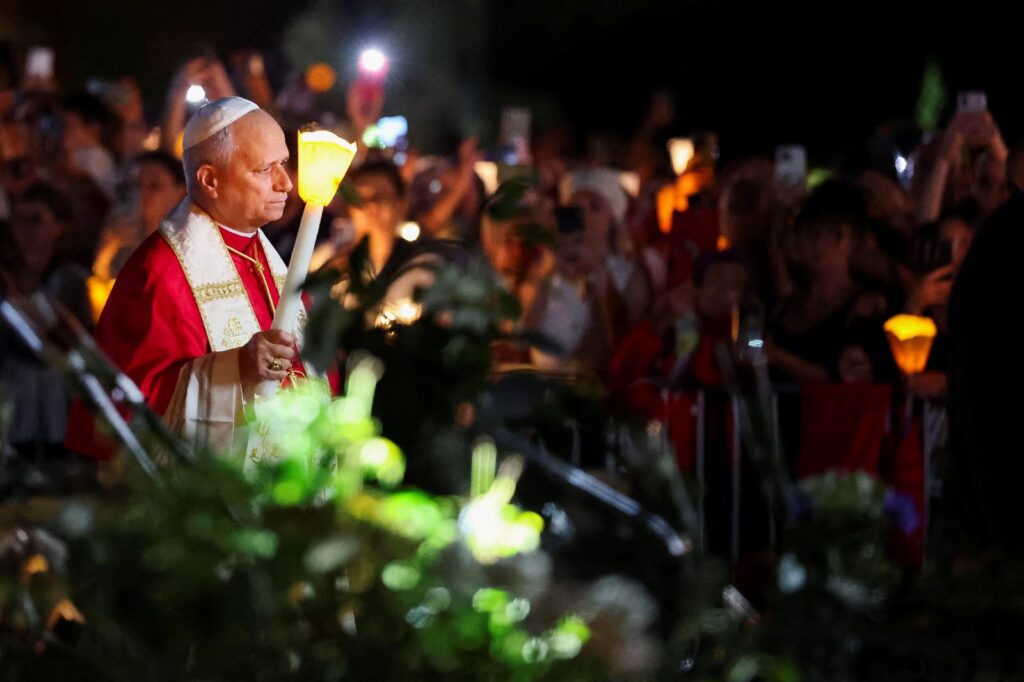
Holding a large candle in his right hand and a rosary in his left, Pope Leo processed slowly behind an illuminated statue of the Virgin Mary through the crowd of pilgrims holding candles, as the five decades of the glorious mysteries of rosary were prayed in multiple languages.

As the “Ave Maria” Lourdes hymn was sung between mysteries, all of the pilgrims in the square in front of the Basilica of Our Lady of the Rosary lifted their candles high in the air, creating a sea of lights.

“The light that guides us and draws us onward is the light of hope, which never abandons us even as we journey through this life — a life often marked by trials, yet already filled with the joy of knowing ourselves to be children of God, loved and saved by Jesus,” the pope said.

“Those who are sick are privileged witnesses to this transfiguration of our lives through faith and love of God and neighbor.” (Read more.)
Share

Sunday, September 27, 2026

Royal Orders

Which orders were worn by Louis XVI? A fascinating blog Once I Was a Clever Boy explores the question. To quote:
In the portraits the King can clearly be seen wearing the sky blue moiree riband of the Order and the breast star with its motif of the Dove. The riband was the first to be prescribed in the statutes of an order, and is the origin of the term 'cordon bleu' as asign of honour. The Order specifically commemorated King Henri's accession to the thrones of Poland on Whitsunday 1573, and to that of France on Whitsunday 1574, and hence the use of the Dove as a symbol. It also served to recall the account of the Holy Dove bringing the Sainte-Ampoulle at the baptism of Clovis in 496, and the source of the Holy Oil used at the Sacre of the King at Rheims. The design of the breast star and badge of the Order was to be copied and adapted by many other orders in Spain, Sicily, Sweden and Great Britain with the badge of the Military Division of the Order of the Bath, with lions and unicorns replacing the fleur-de-lys.
Share

Thursday, September 24, 2026

The Mystery of the ‘Real’ Milady de Winter


Yet another descendant of Mary Boleyn. From History Extra:

In the preface to The Three Musketeers, Dumas claims that he was researching Louis XIV in the Bibliothéque nationale de France when he happened upon the first volume of The Memoirs of M. d’Artagnan. This is not entirely true: he found the book in the public library in Marseilles, borrowed it and never returned it.

The Memoirs of M. d’Artagnan is a first-person pseudo memoir written by a former soldier, Gatien de Courtilz de Sandras, and first published in 1700. It tells the story of d’Artagnan, a young man setting out on his journey to become a musketeer. As well as d’Artagnan, Dumas discovered Athos, Porthos and Aramis, who would eventually become major characters in The Three Musketeers. He also found Milady de Winter. Courtilz never gives Milady’s name. Instead, she is referred to simply as ‘Milady’ followed by a dash or asterisks where her name should be. She is introduced as a maid of honour to Henrietta Maria, queen to the executed Charles I of England, whose exile in France Milady shares.
The daughter of an English peer, Milady has as much wit as beauty, and d’Artagnan thinks her the most beautiful woman he has ever seen. He promptly falls in love with her. There then follows a complicated sexual intrigue, one of several for Courtilz’s d’Artagnan. Once it is over, Milady is never heard from again. This is the episode that Dumas adapted for The Three Musketeers. The affair of the queen’s diamonds is absent from Courtilz, but at least part of the story as Dumas told it is supported by several contemporary memoirs. Those of Françoise Bertaut de Motteville, Pierre de La Porte and Henri-Auguste de Loménie, Comte de Brienne – all of whom served at the royal court of France – each provide an account of the Duke of Buckingham’s visit to France in 1625. Buckingham had been sent to escort Henrietta Maria, then Charles I’s new queen, to England. While in France, he ostentatiously courted the queen, Anne of Austria.
None of these memoirs, however, mention the diamonds that Anne was said to have given to the duke. For this part of the story, it is necessary to consult the memoirs of Henri-Auguste's son, an obscure publication known as Recueil A, and the memoirs of François de La Rochefoucauld. Louis-Henri de Loménie, Comte de Brienne served Louis XIV as secretary of state, a position he inherited from his father. He left a memoir, which was published in the early 19th century. Certain editions, particularly that edited by Jean François Barrière, include an account of the queen’s diamonds.

It does not form part of Brienne’s original narrative – he was not even born at the time of the alleged diamond affair. Instead, it is mentioned in an introductory essay, written by the editor, explaining the manners and customs of 17th-century France. It is then related in full in an appendix, Éclaircissements historiques, or ‘historical clarifications’. In this version, the diamond thief is named as Lady Clarik. However, the story was lifted word-for-word from Recueil A, and inserted into the memoir. Recueil A is the first volume of a large collection published in the 18th century. It comprises an assortment of documents, including extracts of memoirs, concerning the history of France. The author of the account of the diamond affair is enigmatically identified as ‘M. le M. de T’. Behind these initials, according to the anonymous editor of the Recueil, is René de Froulay, Comte de Tessé.

The Comte de Tessé was a real person. Born in 1651, he was a military man, diplomat and courtier. He did indeed leave a memoir, but the diamond affair does not appear in it. The story as found in Recueil A and later inserted into the memoir by Brienne is, therefore, unreliable. What then of La Rochefoucauld? In his memoir, the lady who stole the diamonds was not Lady Clarik but the countess of Carlisle. In fact, Lady Clarik did not exist – but Lady Carlisle certainly did. (Read more.)
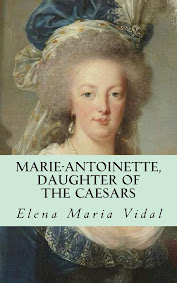
 

Read about the Countess of Carlisle in my Henrietta Maria novels, HERE and HERE.

Share

Sunday, September 20, 2026

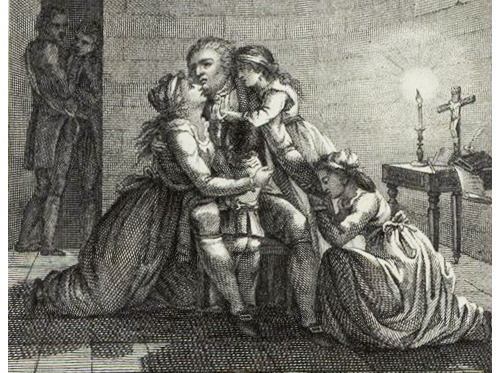
Louis XVI's Last Meeting with His Family

From Vive la Reine:
At half-past eight the door opened; the queen appeared first, holding her son by the hand; then Madame Royale and Madame Élisabeth; they ran to the arms of the king. A gloomy silence reigned for several minutes, interrupted only by sobs.
… The king sat down, the queen on his left, Madame Élisabeth on his right, Madame Royale nearly opposite to him, and the little prince between his knees.
All were bending towards him and held him half embraced. This scene of sorrow lasted seven quarters of an hour, during which it was impossible to hear anything; we could see only that after each sentence of the king the sobs of the princesses redoubled, lasting some minutes; then the king would resume what he was saying.—the journal of Jean-Baptiste Cléry

Share

1918 and the End of Christendom

 From The Maistre Institute:

The charter of the modern state was signed at Westphalia in 1648 by exhausted men who wanted the killing to stop and were prepared to pay almost anything for it. What they agreed was that the religion of a territory would follow the conscience of its prince, and that no authority whatsoever stood above the sovereign to adjudicate the question. We remember this as the birth of toleration. It was also, and more consequentially, the moment the universal Church was subordinated to the territorial ruler as a matter of public law. Innocent X saw exactly what had been done and declared the settlement null and void insofar as it prejudiced the Catholic religion. Nobody listened. A pope proposing terms of peace would be disregarded again in 1917, on the same reasoning and by the same sort of men, though by then the disregard was so habitual that hardly anyone thought to remark on it.

After Westphalia the sovereign state acknowledged no superior on earth. Christendom, which had always meant something standing above the princes rather than beside them, survived mainly as a family inheritance maintained by one dynasty out of stubbornness and piety in roughly equal measure.

The Revolution then took what Westphalia had built and knocked out the last support. Sovereignty no longer descended from God to the prince. It rose from below, from the people, and it needed no warrant from heaven at all. Napoleon abolished the Holy Roman Empire outright in 1806, the title simply lapsing after eight hundred years, and the Habsburgs withdrew to the merely Austrian crown. Then came the nationalisms, lyrical in their poetry and homicidal in their politics, each teaching a people that its destiny required a state of its own. Then 1848. By the time Princip fired in Sarajevo the intellectual demolition was finished and had been for some while. Only the building was still standing, and buildings come down fast once the footings are gone. (Read more.)
Share

Saturday, September 19, 2026

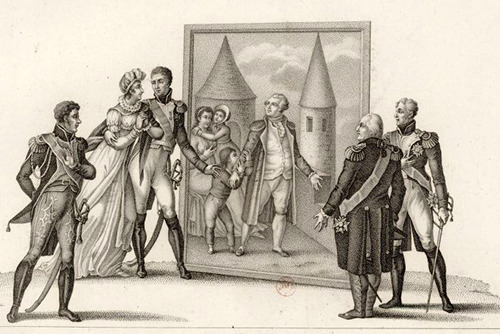
Marie-Thérèse Viewing a Portrait of Her Family at the Temple

Notice how her husband Louis-Antoine is very attentive. He knew how such things upset her.  Berry stands alone off to the side on the left. And then there are Artois and Louis XVIII on the right. One wonders what passed through their minds when seeing their doomed brother and his family. Via Vive la Reine. Share

Friday, September 18, 2026

The De-Christianization of France

 From The War on Beauty:

France has been in a process of de-Christianization since the Revolution in 1789 when Catholicism was outlawed and replaced with a new atheistic cult called ‘The Cult of Reason.’ A lot of people were surprised by the recent mockery of the Last Supper at the Olympic Games, but this isn’t the first time there has been an outright assault on the Catholic Church in France, nor is this the worst instance (shockingly).

After the Catholic monarchs and Ancien Régime were violently couped in 1789, a new anti-religious, and clearly satanic totalitarian government came to power and immediately severed all ties with the Church. Along with the persecution of the aristocracy, normal French people/ peasants, including thousands of clergy were martyred for not renouncing their Catholic beliefs.

This was the first big move in shifting France away from a faith-based society to one that worships reason, science, and man’s own ‘intelligence’ as the new God. The new regime went so far as to remove all crosses and religious symbols in the country including from graveyards, ceased all Catholic schooling, and not only closed all churches but forcibly confiscated them from the diocese to fund the new government. (Read more.)


Share

Monday, September 14, 2026

Henrietta Maria and Her Mother, Marie de’ Medici


 My guest post for Tony Riches.

First of all, I would like to thank Tony Riches for opening his popular blog to other historical writers so that we may share our research. I am the author of a biography of Marie-Antoinette as well as six historical novels. The latest two novels are about Queen Henrietta Maria, wife of Charles I and they are entitled My Queen, My Love and Generalissima. They are part of an unfinished trilogy; the third installment Avalon will be out sometime in 2027 or 28. 

In my readings about Henrietta of France, I have found that her mother Marie de’ Medici played an enormous role not only in her upbringing but in her ongoing political decisions, as well as shaping her faith, her love of the arts, of music, theater, and architecture. Queen Marie has ended up playing a much larger role in my novels than I originally would ever have imagined, due to the sheer force of her personality as much as to her real adventures, which included leading rebellions against her son, climbing out of windows to escape the royal guards, and hiding with her entourage of dwarves in a German brewery. All of this followed a glittering career of being Queen Mother Regent of France. Most of the Queen’s life is captured in the spectacular series of twenty-four huge paintings by Rubens, now at the Louvre. (Read more.)
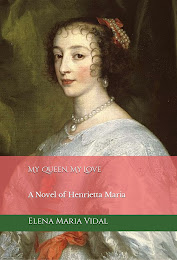
 

Books available HERE.

Share

Sunday, September 13, 2026

Our Lady of Scherpenheuvel


Marie de' Medici had great devotion to Mary under her title of Our Lady of Scherpenheuvel, giving a reproduction of the statue to her daughter Henrietta Maria for one of her chapels in London where it was used by the Confraternity of the Most Holy Rosary. From Wikipedia:

Even before the official approbation of the cult of Our Lady of Scherpenheuvel, pilgrims took particles of the oak tree with them as pious souvenirs. Several stories of miracles attributed to the intercession by the Virgin relate of the thaumaturgic power of this Scherpenheuvel or Montague wood. Following the approbation, Archbishop Hovius ordered the tree to be cut down. It was divided in several parts. Some remained with the sanctuary; one particularly large piece was given to Albert and Isabella. Most of this Montague wood was used to make images of the Virgin Mary. Distributed as gifts among princes, nobles and clergy, they helped to disseminate the cult of Scherpenheuvel.[13]

Quite a few Belgian churches and convents came to possess an image carved in Montague wood. Well known examples remain in the Church of St. Charles Borromeo in Antwerp, the Church of St. Hilonius in Izegem and the chapel of the Capuchins in Enghien. In the Grand Duchy of Luxembourg, the statue of the national patron saint, Our Lady Comforter of the Afflicted or Our Lady of Luxembourg, is believed to contain Montague wood. A smallish statue of the Virgin and Child in Montague wood was taken by St. Marguerite Bourgeoys to Montreal and stands presently on her tomb in the Notre-Dame-de-Bon-Secours Chapel.[14]

Some places of worship became closely associated with the cult of Scherpenheuvel. In the vicinity of their château of Mariemont, Albert and Isabella founded the priory of Montaigu in the present day municipality of Morlanwelz. In the town of Gray a statue of the Virgin made out of Montague wood became the object of a regional devotion. Likewise in the Franche-Comté, the statue donated to the priory of Bellefontaine in Brussey came to attract many pilgrims.[15] In the proximity of the Spanish Court, the Convent of Las Descalzas Reales obtained an altar dedicated to Nuestra Señora de Monteagudo.

The House of Lorraine had a particular devotion for Scherpenheuvel. Cardinal Charles of Lorraine, prince-bishop of Strasbourg, founded a chapel dedicated to Our Lady of Scherpenheuvel in the noviciate of the Jesuits at Nancy. After his death in 1607, his sister Antoinette completed the project with an altarpiece depicting the ducal family venerating Our Lady of Scherpenheuvel. The chapel served as the repository of the embalmed hearts of the members of the House of Lorraine until 1720.[16] The cult was also greatly favored by the French Queen Marie de' Medici. During her regency, the Discalced Augustinians obtained a statue in Montague wood at their church of Notre-Dame-des-Victoires. During her exile, she donated one statue in Montague wood to the city council of Cologne and another to the monastery of the Discalced Carmelites of that city. While serving the Catholic household of her daughter, Queen Henrietta Maria, the Queen's Chapel of St James's Palace likewise had an altar with a Madonna in Montague wood.[17] (Read more.)


(Image Source) 

A history of the original statue, HERE.

Share

Wednesday, September 9, 2026

Madame Elisabeth: A Consoling Angel

From Detroit Catholic:

Called a "consoling angel," the sister of King Louis XVI decided to stay on the side of her family even when death was imminent for doing so in the midst of the horrors of the French Revolution. On the 230th anniversary of her death under the guillotine on May 10, 1794, "Madame Elisabeth" is one step closer to beatification as the historical commission for her sainthood cause wrapped up its work May 2. The diocesan phase of her sainthood cause was reopened in 2017. Since then, Fr. Xavier Snoëk, the postulator, has spared no effort to raise awareness of the noble lady.

She was "an original and very modern young woman … pious and exuberant at the same time," Father Snoëk told OSV News. "She read a lot while being passionate about science and mathematics. She was also very athletic. She loved the outdoors and was an excellent horseback rider." (Read more.)

Share

Sunday, September 6, 2026

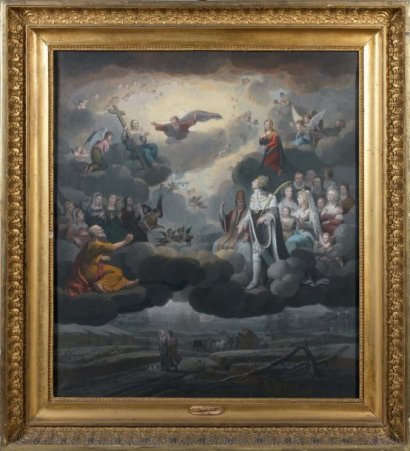
The Cloud of Witnesses

A marvelous painting showing Madame Royale in exile, walking down a long road with her uncle Louis XVIII, as the Blessed Trinity, the saints, the angels and her own family, watch over her from above. Share

Wednesday, September 2, 2026

The Forgotten Prince of Versailles, Part II


From Philip Diaz-Lewis at Rationis Fines:

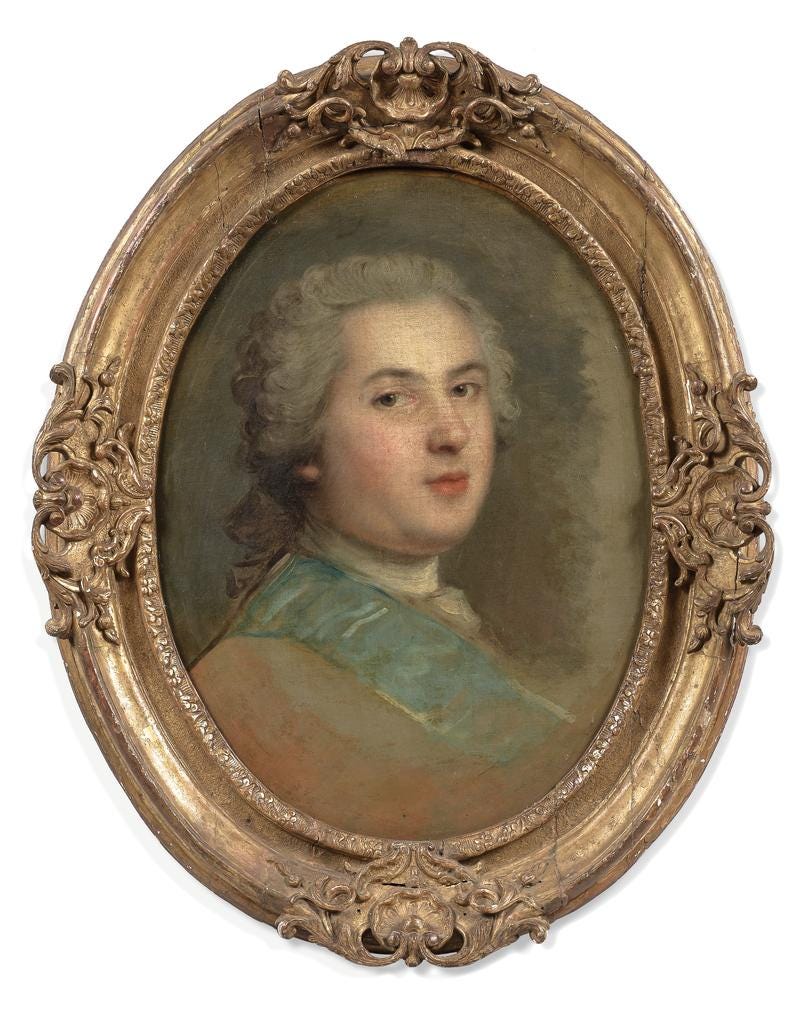
In 1763, two years before his death, Louis-Ferdinand helped make a book for lay people, to help them fit devotion around their duties according to their state’. The translation of the Psalms was taken from Jean-Joseph Languet de Gergy, while the Dauphin added his own composed meditations (or hymnes). The work was published by the Cardinal de Luynes, as Office divin abrégé pour tous les temps à l’usage des personnes pieuses.2 As the opening quote should show, the meditations could be quite weighty given the stated intention of the book. It is noteworthy that a prince would care so much to insert such passages into something whose stated aim is speed.

In part one, I introduced the obscure figure of Louis-Ferdinand, son of Louis XV, father of Louis XVI, and Dauphin of France until his premature death in 1765. Using the standard modern scholarly study on his life, La vertu et le secret by Bernard Hours (2006),3 he emerged as a devout, conservative, and anti-radical figure, yet not a mindless zealot. He was widely-read, well-educated, and a writer of maxims and reflections in the ancient Stoic style. Now I turn to the question: was he not merely a thinker, but a coherent one?

Hours flags that quite a number of the sayings recorded by the Dauphin’s posthumous biographers contain commonplaces typical of hagiographical writing.4 This does not by itself invalidate them, for a Christian prince could well have thought in these stock ideas gotten from devout literature. But it does make them less secure as primary sources, since his biographers may have shaped or embellished what they remembered, perhaps without meaning to. Thus, in what follows I will focus only on those maxims and sayings that Hours thinks most likely came from the man himself. (Read more.)

Share

Monday, August 31, 2026

Remembering the Battle of Mohács

A brilliant article which shows how the European powers' fears over the growth of Habsburg hegemony contributed to the triumph of Islam. From Chronicles:

Hungary’s defeat coincided with larger European developments. The Habsburgs were then emerging as a major European power, considered by many players—and most dishonorably by the French—to be more threatening than the 100,000-strong devastating Turkish host advancing up the Danube Valley. The Habsburgs were able to establish control over the westernmost fifth of Hungary, and from there, 150 years later under the leadership of their brilliant commander Eugene of Savoy, to advance steadily south to the Military Frontier established along the northern banks of the Sava and the Danube east of Belgrade. In the Hungarian heartland under Turkish rule, however, and in  autonomous Transylvania in the east,  because so many Catholic hierarchs and priests died at Mohács, the Hungarian Reformation consolidated its territorial hold.

In 1526 there was a structural imbalance between Europe’s acute political fragmentation, while the Ottomans, under Suleiman, had achieved an impressive level of administrative centralization and military efficiency. The Turkish edifice would start crumbling only decades after Suleiman’s death in 1566, but in the meantime Europe faced immense danger from the east. It loomed just as Europe engaged—during the Thirty Years’ War—in the most destructive episode of self immolation until that time. The Ottoman threat finally retreateed after the second siege of Vienna in 1683.

The battle lost in 1526 has had a defining role in forming Hungarian historical consciousness. The “Mohács Trauma” appeared in the public discourse soon after the battle, and eventually became synonymous with continuing Hungarian misfortune in the public mind. For a long time that trauma was restricted mainly to the upper social stratum. This was in contrast to Serbia and other Serb lands, where the epic saga of the Battle of Kosovo and its mystical transformation of military defeat into moral victory lived on even among illiterate peasants, indeed especially among them. (Read more.)

Share

Friday, August 28, 2026

"Engrossing and Beautiful"

 Charles I and Henriette-Marie de France
   
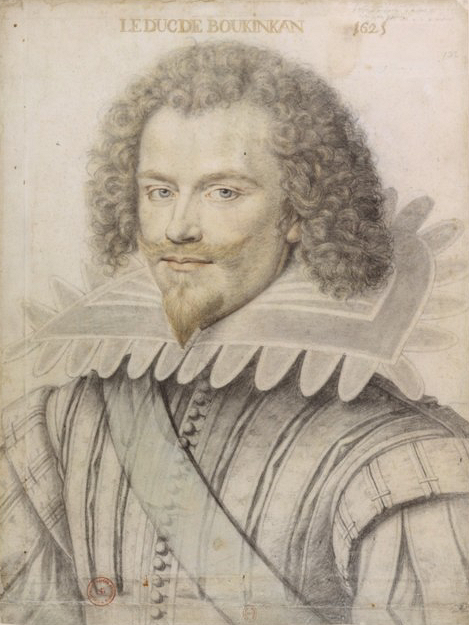
George Villiers, Duke of Buckingham

 A most eloquent review of My Queen, My Love.

If you read this book, be prepared to obsess over the characters like you would with any engrossing fictional story . . . only to be reminded that they are, in fact, real.  After doing so, you may just scour the Internet for photos of your new "friends."  Be prepared also to lie awake wondering what REALLY happened regarding a matter of court intrigue, asking your husband when you should be sleeping if he thinks that so-and-so poisoned so-and-so before the story started. While you're at it, you should also expect to wonder whether or not you should really google the villain and behold his countenance.

But, of course, you will. After all, you HAVE to know if he really, truly existed.

Then, once you know that he WAS, in fact, real, you will fervently wish for a time machine so that you can go back to warn everyone about him.

. . . or maybe that's just me. ;)  After all, I was crying over Giuliano de' Medici a few months ago.

MY QUEEN, MY LOVE: A NOVEL OF HENRIETTA MARIA by Elena Maria Vidal reminded me of why I love history (and even revitalized that love): that is to say, it is not a simple list of dates and facts, but, rather, a compelling story, alive with rich "characters" that have the power to stay with you. Vidal masterfully wove together a literary tapestry that tapped into real-life events in a way that inspired the reader to keep turning the page. There was beauty, there was tragedy, there was romance . . . and, much to my surprise, the plot was also layered with key characteristics of a mystery novel. Since I didn't know much about this particular "story" going in, it truly was similar to reading a completely fictional work where there still exists uncertainty and suspense.

Yet, despite the strong elements of intrigue and mystery, at the center of the entire narrative is a love story: that of a king and his queen and the Love that transcends their world.

From early on in the novel, I fell in love with the love story of Henrietta Maria and King Charles I. Rather than compose more coherent sentences, I have decided to instead include my "freak-out" gushing below. Unprofessional or not, it accurately reflects my state of mind when delving into the story and may perhaps best inform potential readers:
------------------------------------------------
HE FELL IN LOVE WITH HER WHEN SHE WAS DANCING---NOT ATTRACTION, BUT REAL LOVE AT FIRST SIGHT WHERE HE SAW THE DEPTHS OF WHO SHE TRULY WAS.
 
BUT SHE DIDN'T KNOW HE WAS THERE AS HE WATCHED FROM AFAR.

And then she fell in love with HIM through his letters, which is SO BEAUTIFUL AND ROMANTIC, too!!! AHHHH. Because she has SUCH a pure heart, like Cinderella and her prince when they first meet in the live action movie.

AND THEN THERE IS THIS EMOTIONAL BUILD-UP OF STORY TENSION because they have to still MEET. And the reader just needs it to happen asap!

And then they meet . . . and it is a Moment with a capital M!

But there be villainy afoot. ;) 
------------------------------------------------
Vidal's writing skill shone through once again in her brilliant introduction of the villain of the story through the eyes of one who regarded him as a close friend. Without going into detail, he could have been mistaken as a flawed comic relief, before his true nature became clear. Not only did this make the story-line more compelling and unpredictable, but it served as a rather profound commentary on evil relevant to today. In the presence of some, evil masquerades as Cool Guy, charming everyone with his jokes. But, when only some are watching, the mask just might come off.

As a Catholic, I was particularly drawn to the historical depiction of events as concerns the persecution those of my faith faced in England at the time. It was important for me to learn more about their plight, and my heart broke for those who suffered, much like that of Henriette, just as it rejoiced at moments when they received better treatment.  Yet the pain and suffering is balanced also with Light, the reason for which they are fighting.  Through vivid and sometimes ethereal descriptions, as well as profound reflections, Vidal was able to illustrate what we love so dearly.

The writing style in general is both detailed and engaging, rich with beautiful imagery that is, at times, quite lyrical. I found a kindred spirit in the romantic way that Vidal chose to describe figures, scenery, and events and likewise enjoyed the sprinkling of Arthurian legend in the novel. It was lovely to see Henrietta and Charles share a mutual love of these old stories, which not only added depth to their relationship and to them as individuals, but also seamlessly tied into the plot and foreshadowing of future events.

In terms of the characters on an individual level, I found myself bonding quite a lot with Henrietta, between her innocent romanticism, deep love of her faith, and moments of wit and humor.  But, on another level, I wondered at times if she were a saint and found her on the whole to be an inspiring figure. While there were moments in which the reader was called to be frustrated with Charles for being blinded as to certain individuals, I came to care a great deal for him and deeply admire his nobility of heart and desire to do what was right. The reader may also sympathize with the long-seated pain that he experienced, which is slowly revealed within this man of a pure and childlike nature yet confident, regal bearing.

While there were difficult moments to read throughout the novel, beginning with the tragic backstory of Henriette's mother, Marie de' Medici, the beauty of the center characters continued to illuminate the pages. Without going into detail, I will say that the intrigue of the novel also remains until the very end. Just like with a true mystery story, there are revelations at the conclusion that truly took me by surprise.  At the same time, the final pages served as a "bookend" in more than one way.  I'll leave it at that.

The reader should bear in mind that there may be occasional phrasings or actions with which he or she may not agree, even concerning supporting characters with a great deal of good.  However, such may also be found in real life, and it is likely that Vidal wished to present people and events with as much historical accuracy as possible while simultaneously putting forth a compelling narrative.  The meticulous research conducted for this book is abundantly clear from the detailed historical facts imbued into the text (as well as the lengthy works cited), although the novel format also allows for some speculation and presumably fleshing out of characters and situations.
(Read more.)

Share

Wednesday, August 26, 2026

Court Masques

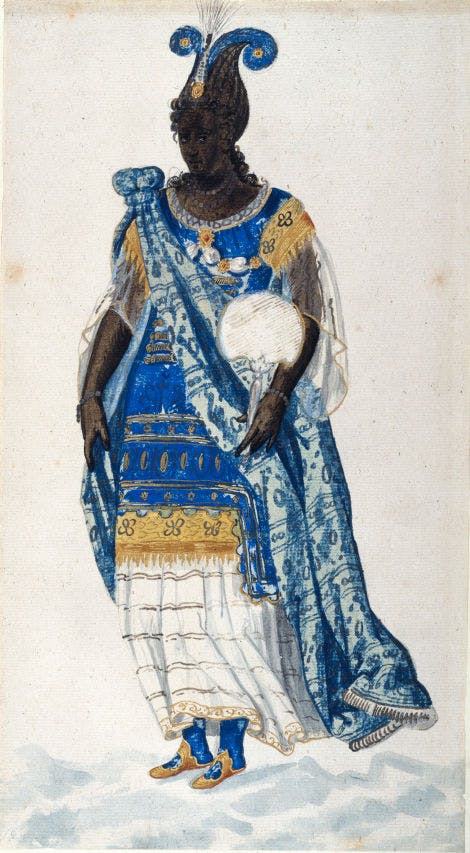
Costume design by Inigo Jones for Queen Anne's "Masque of Blackness"                                                                                                                     

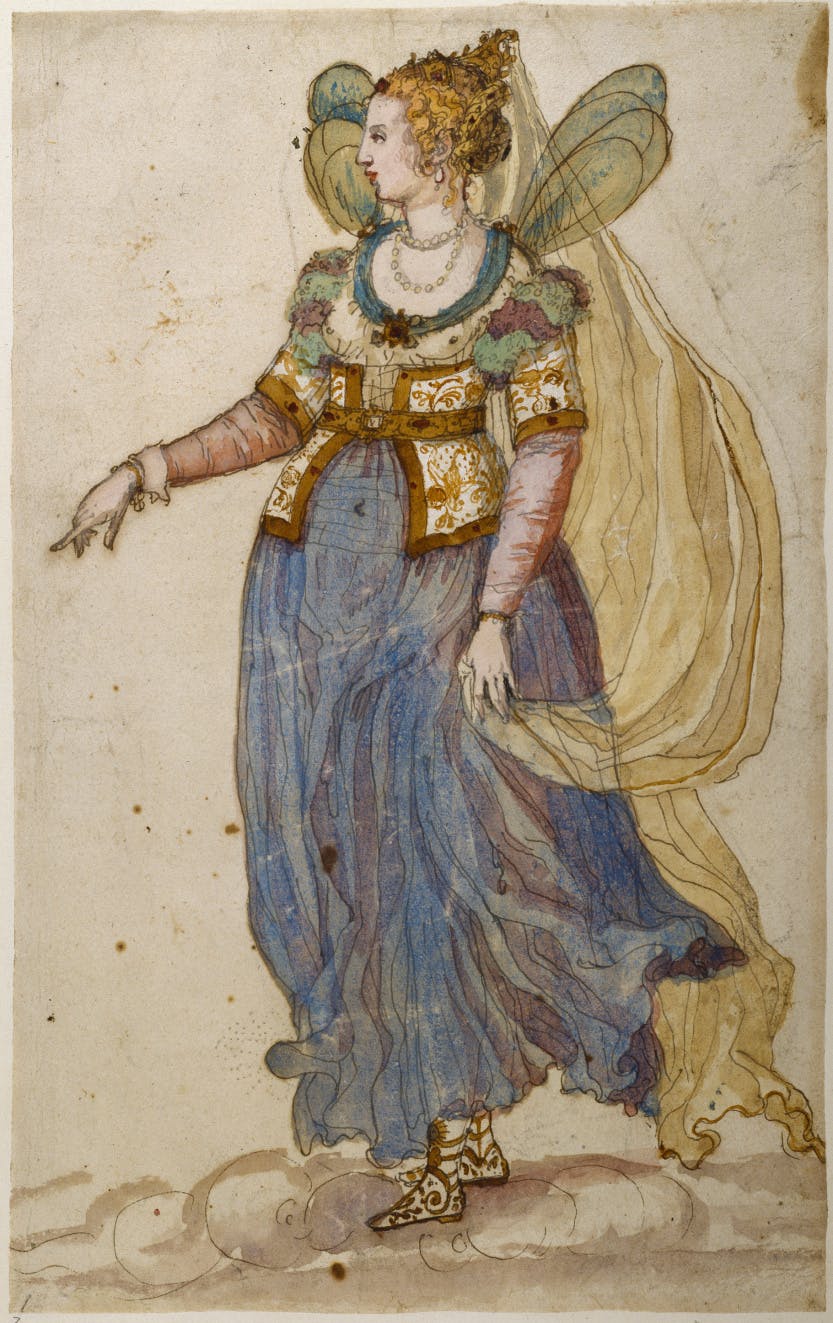
Another design by Inigo Jones for one of Henrietta Maria's masques

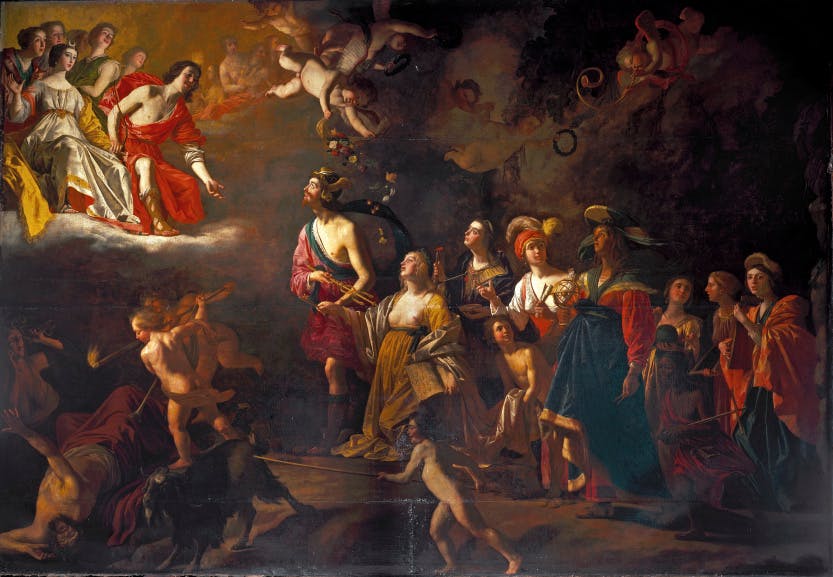
The court of Charles I in costume in a classical fantasy, Buckingham and his life Katherine are staring up at Charles I and Henrietta Maria.

Henrietta Maria of France

Masques were a big part of court life in both the English and French courts of the seventeenth century, especially during Shrovetide. From Historic Royal Palaces:

The masque began as an improvised performance at court in the 16th century during which courtiers and even royals would disguise themselves for play acting, fun and dancing. 

Masques were staged at Whitehall and Hampton Court Palaces for the Stuarts, with singing, acting, music, dialogue, amazing costume and above all, ‘special effects’ and moving scenery. By the early 1600s, under masque-loving monarchs James I and his queen Anne of Denmark, it became really elaborate. 

A Banqueting House was built specifically for the performance of masques at Whitehall Palace in 1608, but this burnt down in 1619, and was replaced by the present building, designed by Inigo Jones and completed in 1622. 

The Stuart Masques were mostly created by the brilliant partnership of playwright Ben Jonson and set and costume designer Inigo Jones. These temperamental artists quarrelled over whose contribution was more important, and after 1632, Jones worked with less argumentative (and less talented) poets.

The masques were a heady combination of opera, theatre, ballet and ball. They were always allegorical, featuring gods and goddesses from mythology and British history. Their purpose was to demonstrate the wisdom, and God-given right to rule, of the Stuart monarchs. There was always an ‘anti-masque’, featuring wild and outlandish dancers, who symbolised the chaos of a kingdom before the Stuarts. This was followed by the masque proper portraying the idealistic world of peace and harmony under divine kingship. At the end of the masque, the King would dance, and then the courtiers. Masques were performed for, rather than by, the court, although sometimes the queen and her ladies danced. 

A masque was also a place to see and be seen. They were incredibly expensive to produce; some of the most lavish were staged by affluent lawyers. But despite the cost, they weren’t always the most comfortable of shows to attend, for either actors or audiences. The crowded room was stifling hot, and smoke from the hundreds of torches must have been oppressive. Sometimes there was a long delay before the performance began. The chaplain to the Venetian Ambassador wrote of his experience after attending a masque in 1618: ‘So crowded and uncomfortable that had it not been for our curiosity we would have given up or expired … every box was filled notably with the most noble and richly arrayed ladies… During the two hours of waiting we had leisure to examine them again and again.’ (Read more.)

From Luminarium:

HAD Ben Jonson never lived, the English masque would scarcely need to be chronicled among dramatic forms. For despite the fact that mumming, disguising, and dancing in character and costume were pastimes in England quite as old, if not older, than the drama itself, it is to Jonson that we owe the infusion of dramatic spirit into these productions, together with the crystallization of their discordant elements into artistic unity and form. Generically, the masque is one of a numerous progeny, of more or less certain dramatic affiliation. Specifically, a masque is a setting, a lyric, scenic, and dramatic framework, so to speak, for a ball.1  It is made up of "a combination, in variable proportions, of speech, dance, and song;" and its "essential and invariable feature is the presence of a group of dancers . . . called masquers."2   These dancers — who range in number from eight to sixteen — are commonly noble and titled people of the court. They neither speak nor sing, nor is it usual to exact of them any difficult or unusual figures, poses, or dances. Their function is the creation of "an imposing show" by their gorgeous costumes and fine presence, enhanced by artistic grouping, and by the aids which decoration and scenic contrivance can lend to the united effect. On the other hand, the speech of the masque, whether of presentation or in dialogue, and the music, both vocal and instrumental, were from the first in the hands of the professional entertainer, and developed as other entertainments at court developed. The masque combined premeditated with unpremeditated parts. The first appearance of the masquers with their march from their "sieges" or seats of state in the scene, and their first dance — all designated the "entry" — was carefully arranged and rehearsed; so also was the return to the "sieges" or "going cut," and this preparation included sometimes the preceding dance. The "main," too, or principal dance, was commonly premeditated, as in Jonson Masque of Queens, where the masquers and their torchbearers formed in their gyrations the letters of the name of Prince Charles. Between the "main" and the "going out," two extemporal parts were interpolated, the "dance with the ladies" and the "revels," which last consisted of galliards, corantos, and la voltas. It was in the development of the "entry" and the "main" that the growth of the masque chiefly consisted. (Read more.)

From Dr. Lawrence Shafe:

There was an Italian tradition, particularly a Florentine tradition, called the intermezzi. These were entertainments designed to fill in the gap between plays. The key series was in 1589 when the Grand Duke got married. They were trying to recreate a Roman theatre with classical allegory in the form of an entertainment. Bernado Buontalenti was the architect engineer of these displays.

A 1600 Florentine drawing shows a mountain rising from a stage, at the top is Pegasus with Apollo and the Muses below and Poetry below them. Clouds float in with people in them and they have trees that sprout leaves. Light boxes were used containing multiple candles made brighter with mirrors and the theatres were not darkened as much as ours. This event was publicized across Europe and news came back to Henry, Prince of Wales. His friend John Harrington was in Florence and wrote back describing them.

The intermezzi increased the scale and the engineering (trap doors, revolving stages) and it was these the Stuart court wanted to emulate.

Ben Johnson and Inigo Jones were the great double act although they eventually fell out.

Caroline masques in England had a stage with a proscenium arch (first developed in the 16thC in Florence and picked up by Jones). The stage tilts at an angle and it has slots in the sides for scenery. In 1635 Inigo Jones a country scene for The Temple of Love. 1609 Jones, [at] The Masque of Queens for Anne of Denmark [made] a machine with a round arch doorway and a revolving section on top with seats. The machine was called machina versitilis.

Anne of Denmark was the prime mover to create these spectacular masques. She loved dancing and was the leading dancer. She singled out Ben Johnson but the ideas were unfortunately hers so they were all a bit thin. All the music and choreography has been lost, in fact the scenery was pulled down and destroyed as soon as the masque was over. They were modelled on the French ballet do corps where the dancers formed a complex pattern. James I never ever took part. (Read more.)


 HERE is the original program for the ballet danced by Henrietta Maria at the Louvre when Charles first saw her.

An article on the masques of Queen Henrietta Maria, HERE.

More on the stage props created by Inigo Jones, HERE.

My novel on Henrietta Maria, HERE.
Share

Tuesday, August 25, 2026

Saint Louis IX and Politics


 From Catholicism:

Today is the feast of King Saint Louis of France. As the formerly Christian West is sliding further into the tyranny of liberalism, it is balm to the soul to consider that the people in Louis’ France were freer than we are today. They were free from big government meddling in their lives and their wallets. And they were free in the most important way, for Saint Louis believed in a Christian order wherein the State was neither inimical nor neutral to the Church, but was the Church’s helper in securing the happiness, temporal and eternal, of her subjects.

Our modern “freedom,” by contrast, is servitude.

Sad to say, Saint Louis’ own grandson, Philip IV (“the Fair” — called so on account of his outward looks, not his inward dispositions!) was greedy to rob the Church of her influence in civil society. It has long struck me as ironic that this same Philip, who was so ill disposed to the traditional role of the Church in statecraft, was also the one who persecuted the Knights Templar, robbing them of their possessions and murdering their leaders. One of his victims was Jacques de Molay, the twenty-third and last Grand Master of the Templars. The reason I find all this ironic, is that the Freemasons, who are much closer to Philip than to de Molay in their ideology, falsely take the murdered Templar as one of their own heroes — among other ways, by naming their young men’s fraternal organization, “DeMolay International.” Philip IV, who murdered Jacques de Molay, also persecuted Pope Boniface VIII, a great pope who defended — as I’ve pointed out elsewhere — the same traditional alliance of throne and altar that Philip’s saintly grandfather believed in. That tradition, known as “the doctrine of the two swords,” was eloquently put forth in Unam Sanctam, a bull written in direct opposition to Philip the Fair.

It was Boniface VIII, by the way, who canonized Saint Louis IX. (Read more.)


More HERE.


Also from Catholicism:

The custom of genuflecting (literally, in Latin, “bending the knee”) for the Incarnation (“…and the Word was made Flesh…”) in the Creed, was begun by Saint Louis IX, King of France, who knelt out of devotion when he heard the words sung at Mass one day. This is something of a holy mirror of the secular custom of standing for the “Hallelujah Chorus” in Handel’s Messiah. (King George II was so stirred during the performance that he rose to his feet in excitement. When the king stands, everybody stands, even during a concert.) Similarly, thanks to Louis’ piety, and the French respect for their monarch, the King of Kings is saluted with a genuflection every time his Holy Incarnation is recalled in the Credo of the Roman Rite. (Read more.)


Share

Monday, August 24, 2026

La Reine Margot and the St. Bartholomew's Day Massacre

A first hand account from a notorious lady, who nevertheless saved the life of her husband Henri de Navarre, the future Henri IV. Henri IV, through his second marriage to Marie de' Medici, was the father of Queen Henrietta Maria.
Five or six days afterwards, those who were engaged in this plot, considering that it was incomplete whilst the King my husband and the Prince de Conde remained alive, as their design was not only to dispose of the Huguenots, but of the Princes of the blood likewise; and knowing that no attempt could be made on my husband whilst I continued to be his wife, devised a scheme which they suggested to the Queen my mother for divorcing me from him. Accordingly, one holiday, when I waited upon her to chapel, she charged me to declare to her, upon my oath, whether I believed my husband to be like other men. "Because," said she, "if he is not, I can easily procure you a divorce from him." I begged her to believe that I was not sufficiently competent to answer such a question, and could only reply, as the Roman lady did to her husband, when he chid her for not informing him of his stinking breath, that, never having approached any other man near enough to know a difference, she thought all men had been alike in that respect. "But," said I, "Madame, since you have put the question to me, I can only declare I am content to remain as I am;" and this I said because I suspected the design of separating me from my husband was in order to work some mischief against him....(Read more.)
Share

‘Mr Molière: A Brief History’

 From Jemahl Evans at Seventeenth-Century Lady:

Jean-Baptiste Poquelin (1622-1673) more commonly known as Molière, is a titan of world literature. The French Shakespeare, his influence on the development of early modern theatre, and his acerbic observations on the human condition in his work have fascinated and enthralled audiences for centuries. So great was his lasting influence on French literature that in 2025 Melvyn Bragg would restate the claim that French: ‘…is the language of Molière.’

Jean Baptiste was born into a well-to-do Parisian family in 1622. Christened ‘Le Nez’ (The Nose) by a maid, it remained a family nickname for the rest of his life. His father purchased the rank of Valet de chambre ordinaire et tapissier du Roi (Upholsterer to the King) in 1631 when the boy was just six. The title provided a steady income and conferred respectability on the upwardly mobile clan. After the death of his mother in 1632, Jean Baptiste was educated at the elite Collège de Clermont run by the Jesuit order (now the Lycée Louis-le-Grand). It is here that the young Parisian got his first taste of the theatre and actors. The Church would never forgive him.

The profession was not held in high regard in Seventeenth-Century France. Actors were publicly shamed as sinners, ran the risk of excommunication, and were forbidden from burial in consecrated ground. It was not the career path for a scion of a respectable bourgeoisie Parisian family. A decree by Louis XIII in 1641 stating that actors were ‘not to be considered worthy of blame nor prejudicial to their reputation’ did little to improve matters, even as the public flocked to theatrical performances. After completing his education, Jean Baptiste initially succeeded his father as Upholsterer to the King and started training as a lawyer. However, at the age of 21, he abandoned a respectable career for a life on the stage. His father and wider family were predictably appalled by the decision. (Read more.)


Share

Thursday, August 20, 2026

What Does Marie-Antoinette Mean to Us Now?


Posthumous portrait of the Queen by Madame Lebrun
Many people are disgusted by the depiction of Marie-Antoinette in the BBC series. My piece for Catholic Answers:

I first visited Marie-Antoinette’s private retreat at Petit Trianon when I was seventeen years old. It was January, but the birds were singing in the gardens. Then and on successive trips, I experienced a strong sense of timelessness. Others have confided to me a similar feeling of enchantment when wandering through the gardens of Trianon.

People frequently ask me why I write about Marie-Antoinette. One of the reasons is that I keep encountering educated people who really think she said, “Let them eat cake.” I continue to encounter Christians who think Marie-Antoinette was killed as punishment for some egregious wickedness or, at least, for unforgivable stupidity. Having read books about her since childhood, I knew she was misunderstood; it was only after a great deal more research that I came to see how completely false are the common beliefs about her.

But the demonization of Marie-Antoinette in the popular mind is necessary to justify the excesses of the French Revolution. When people have a false and distorted view of history, it is difficult for them to grasp the present, and almost impossible to meet the future with any kind of preparedness.

The French Revolution was not necessary, simply because it is never necessary to murder tens of thousands of people. Reform certainly was needed, but reform can happen without mass murder.

Louis XVI was an intrepid reformer. He was not afraid to break with the past and abolish outdated customs while introducing new ways of doing things. Louis was not resistant to change, although that is how he is usually portrayed. The changes were slow but over time might have been effective, had the violent upheavals not swept everything away.

Too often, the violence is represented as a sad but unavoidable means of achieving freedom and democracy. But it is not only that the French Revolution overturned the social order; it was ultimately an attack on the Catholic Church. Many Catholics were killed, especially those peasants who did not want their religion taken away.

The French Revolution has been the blueprint for every totalitarian regime that has followed and has continued to be the model for those wishing not only to destroy the Catholic Church, but all Christian society. (Read more.)


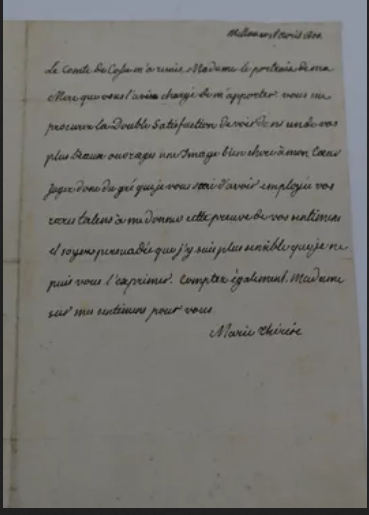
The portrait above was painted posthumously by Madame Lebrun. Here is a letter from Marie-Thérèse Charlotte to the artist, who was a friend of the family:


 A letter written by Marie-Thérèse Charlotte to Elisabeth Vigee-Lebrun on April 15th, 1800, regarding a portrait of Marie Antoinette, which was given to Marie-Thérèse by the comte de Cossé. The duchesse wrote that he gave her…

“…the portrait of my Mother that you had charged him to bring me. You give me the double satisfaction of seeing in a more beautiful work an image very dear to my heart. Judge therefore how grateful I am to you for having used your rare talents to give me this proof of your feelings and be convinced that I am more sensitive to it than I can express to you. You can count equally, Madame, on my feelings for you.”

Share