Showing posts with label Netherlands. Show all posts

Thursday, August 6, 2026

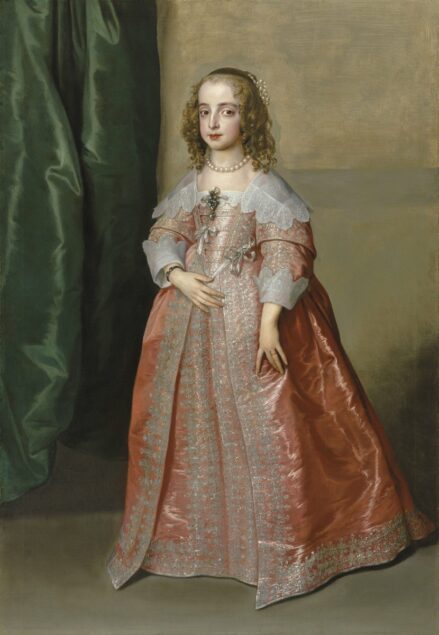
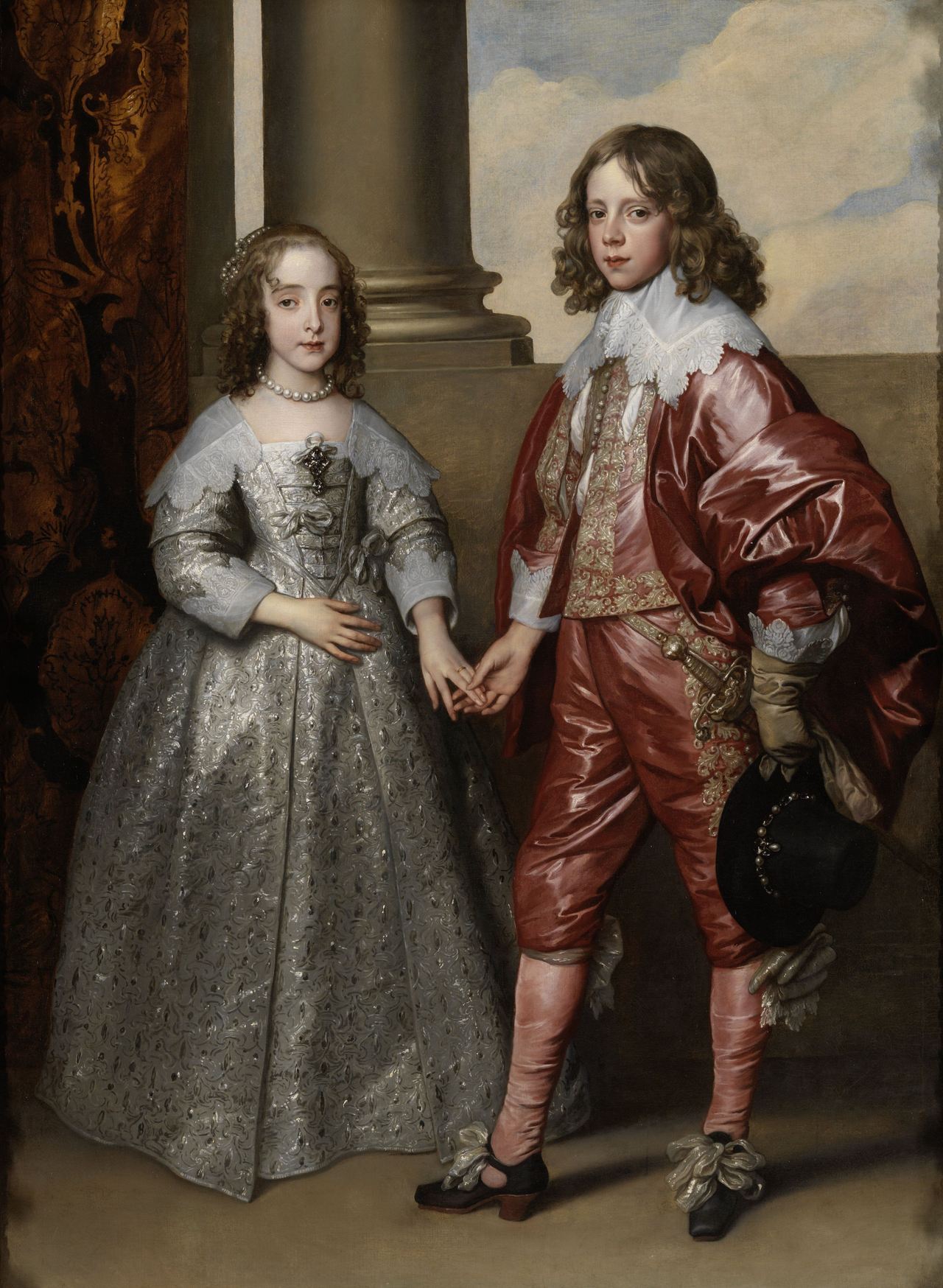
Portrait of Princess Mary Henrietta Stuart

From Codart:
Charles I of England wanted his eldest daughter, Mary Henrietta Stuart, to marry William II, Prince of Orange. The dynastic marriage was aimed at strengthening the alliance between England and the Netherlands. The ceremony was held on 2 May 1641 but the marriage could not be consummated since Mary Henrietta was nine and William was fourteen years old. (Their child, who would be the English king as William III, was only born nine years later.) In the wedding portrait, the princess has a wedding ring on her left hand, and wears on her dress the large diamond brooch she received as a wedding gift from her husband. In the exhibition, we can see the parents and the husband of the princess in engraved portraits.

Children of rulers were regularly portrayed in European courts. Among the portraits of children displayed in the exhibition, there are several who were somehow connected to Princess Mary Henrietta. Balthasar Charles, Prince of Asturias, two years senior to Mary Henrietta, was one of the princess’ possible husbands-to-be. He was also her cousin, just like the children of “The Winter King”, Frederick V of the Palatinate. (Read more.)


Princess Mary is a main character in my novels about her mother, Queen Henrietta Maria.

Share

Friday, March 20, 2026

At the Edge of the Abyss: Euthanasia and the Fight For Human Dignity.

 From Gavin Ashenden:

Those of us who hold to a Catholic understanding of the human person — seeing each life as sacred because it is made in the image of God — have, for decades now, found ourselves resisting a growing secular pressure to legalise euthanasia.

The arguments are by now familiar. On the one hand, we hear appeals to autonomy, freedom of choice, and the understandable desire to avoid suffering. On the other, there remains a deep moral conviction that life and death are not ours to dispose of at will — and that once the boundary is crossed, the consequences are neither contained nor benign.

Experience bears this out. In Canada, there are now documented cases of disabled individuals being offered euthanasia because it is cheaper than providing basic support such as accessible housing. In the Netherlands, even teenagers suffering from depression have been granted euthanasia. What were once presented as tightly safeguarded exceptions have, in practice, expanded in ways that place the most vulnerable at risk.

The argument, therefore, is no longer theoretical. It is grounded in real examples of systems in which safeguards have failed, and where the logic of euthanasia has begun to erode the dignity it was supposed to protect.

In this conversation, I speak with Professor David Jones, Professor of Bioethics at St Mary’s University, London, and one of the central figures in the campaign against euthanasia in the United Kingdom.

Together we explore what has just taken place in the Scottish Parliament, why the proposed legislation was defeated, and what this may mean for the future of similar efforts at Westminster — where time is running short and the outcome remains finely balanced, both procedurally and in the court of public opinion. (Read more.)

Share

Thursday, February 26, 2026

Mary Henrietta of England

The daughter of Charles I and mother of William III.
Wishing to imitate the French tradition of the firstborn daughter of the King being known as Madame Royale, the French-born Queen consort wanted to do something similar for her own daughter. So, in 1642 King Charles I gave Princess Mary the title of Princess Royal, establishing a new tradition in the British Royal Family. Even as a tiny child, the new Princess Royal was immediately the center of marriage negotiations. Originally, King Charles had wished his daughter to marry into the Spanish Royal Family to secure a long-lasting alliance between Britain and Spain. His own father had tried to see him married to a Spanish princess as King James had hoped that Britain could act as the great peace-maker between the Catholic and Protestant powers as the wars between the two sides were tearing Europe apart. This was a long-standing ambition of the House of Stuart, to emerge as the monarchy that restored peace, if not unity, to Christendom. (Read entire post.)
Share

Tuesday, February 24, 2026

The Spell of Posey Rings

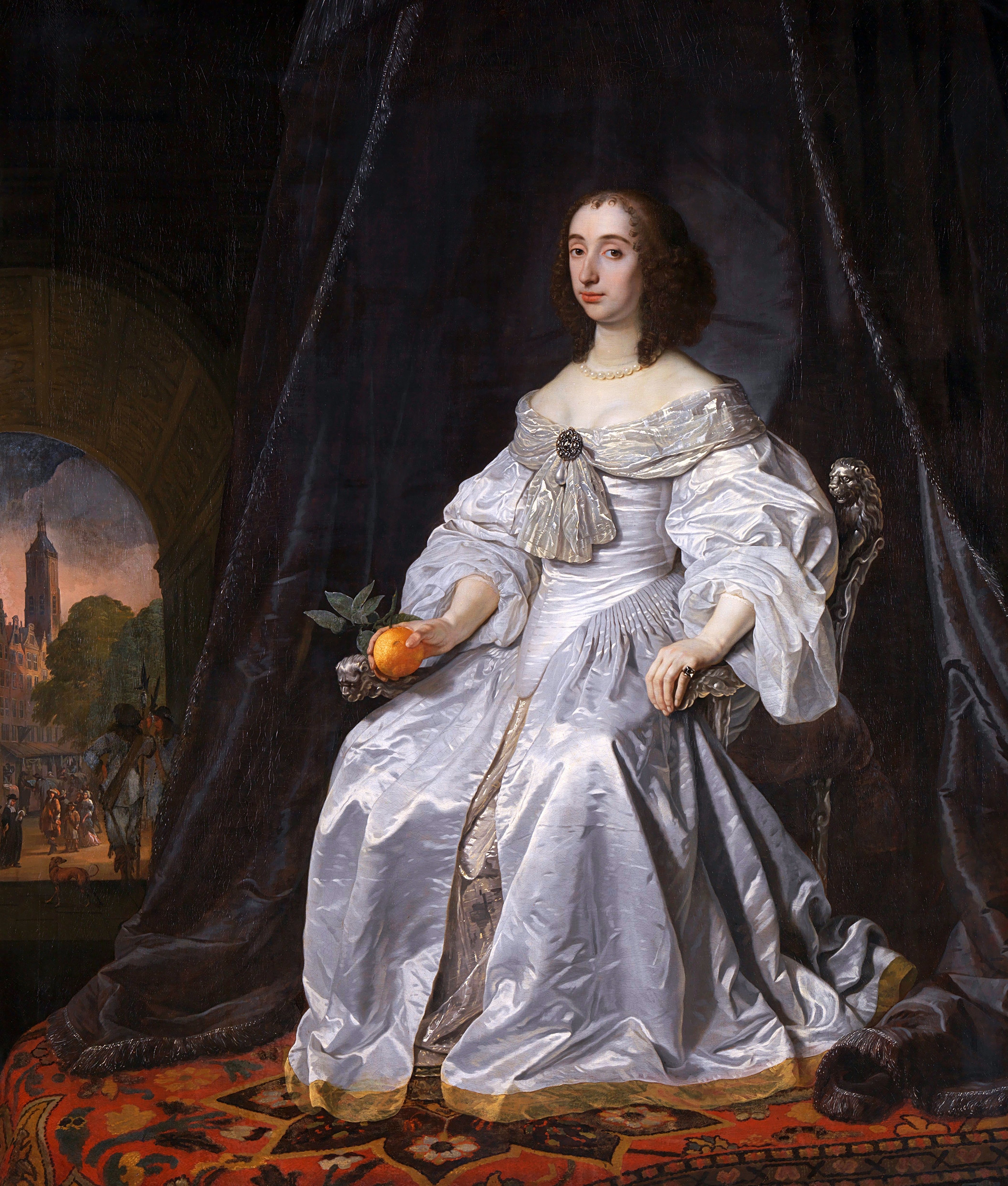
Painting of Princess Mary holding an orange
Mary of Great Britain and Ireland

From Country Life:

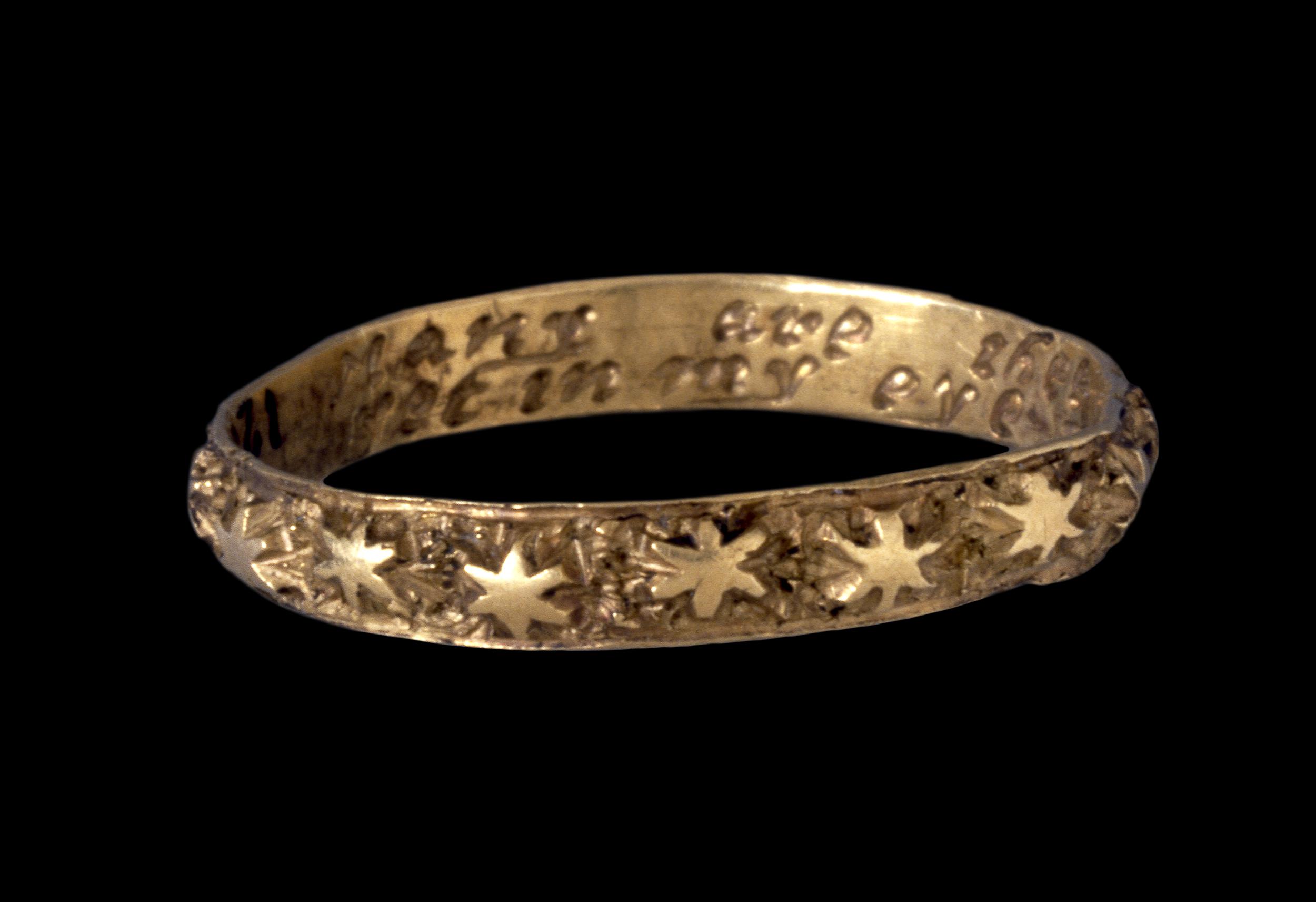
Gold rings with poesies (‘little poems’) — poésie being the Old French for ‘poetry’ — quickly became the single most popular type of jewellery in the country. They were exchanged by lovers, would-be lovers, family members and best friends, but their most common use was as a betrothal or wedding ring. Henry VIII gave a posy ring to Anne of Cleves inscribed: ‘God send me well to kepe.’ William of Orange gave one to Princess Mary inscribed: ‘I’le win and wear you if I can.’ Jewellers used to keep a stock of blank rings, and booksellers promoted inspirational handbooks, such as Loves Garland or Poſies for Rings, which was published in 1624.

I was still in my teens when a friend of my mother’s showed me his collection of posy rings. I was transfixed by their beauty — the soft, almost pure yellow gold, the finely wrought decoration (flowers, leaves, hearts and other symbols) and the elegant script, but what really fascinated me were the inscriptions. ‘I like my choyce.’ ‘True love appears/In midst of tears.’ ‘God has brought to pass that which unlikely was.’ It was as if I were listening to the voices of the long-dead givers and receivers. 

The physical appearance of posy rings changed over time. Lombardic script was replaced by Gothic script, which, in turn, gave way to Roman capitals and then italics. Earlier rings carried much more decoration, too. Niello — a hard black paste — was used to fill in the letters and the costlier rings were enamelled in bright colours. The language of courtly love was, of course, Norman French (‘sans de partier’ or ‘without parting’) although some poesies were in Latin (‘Non Auri Sed Amor’ or ‘not gold but love’) and others in a sort of proto-franglais (‘Autre ne wile and evere you best’, which hardly needs translating). Later, they were almost all in English. (Read more.)

Gold posey ring engraved with stars on a black background

Share

Thursday, February 5, 2026

"Dramatic and Compelling"


From the Historical Novel Society:

Generalissima is the second volume in Vidal’s trilogy on Queen Henrietta Maria, wife of King Charles I of England and sister to Louis XIII of France. This installment traces her life from the unrest that sparked the civil wars of the Three Kingdoms to her dramatic flight to France in 1644.

The novel is divided into two parts. The first centres on the queen’s twin obsessions: converting Charles and their family to Roman Catholicism and preventing the marriage of their eldest daughter to the Prince of Orange. But as the Puritans gain strength, Charles refuses decisive action and Henrietta departs with their older children, carrying her jewels and valuables to sell for arms and munitions in Europe. The second part follows Henrietta in her role as Generalissima, revealing a resolve and strategic boldness that Charles lacks. She is willing to take the risks that might have preserved the monarchy, yet as a French, Catholic woman, she is not heeded. By 1644, after a series of dramatic events, the stage is set for the trilogy’s final volume. (Read more.)


Generalissima available, HERE.

Share

Tuesday, October 28, 2025

At the End of the Postwar World

 From Victor Davis Hanson at Freedom Frequency:

When fighting in Europe ends with the Nazi surrender on May 9, the continent is left in shambles, impoverished, and immediately threatened with both internal and external communist takeovers. Some 70 million to 85 million lives have been lost in this war. Perhaps 35 million died in Europe, on the Eastern Front, and in the Mediterranean. The traditional European economic powerhouse of Germany is flattened, occupied, and divided, with 30 percent of its territory under the control of the Soviet Union.

Many of the borders in Eastern Europe and the Balkans are radically altered, and these vast territorial changes will lead to some 20 million refugees. Perhaps up to 2 million displaced persons will have died of starvation, disease, or exposure by 1950. The vast majority of them are Germans expelled from Silesia, Prussia, and Pomerania to make way for the restoration of Poland. A quarter-million Jews who survived the Holocaust are homeless.

When the war ends, more than half of some 500 Soviet rifle divisions are occupying both Eastern Europe and East Germany—even as a broke Britain and a tired America are planning to collectively demobilize more than 3 million expeditionary troops eager to leave for home as quickly as possible.

The economies and infrastructure of the losing Axis-associated powers of Germany, Italy, Austria, Hungary, Romania, Bulgaria, and Slovakia are ruined. Their political systems are near-nonexistent. Neutrals like Spain, Portugal, Sweden, and Switzerland are still in the economic doldrums. The lands of formerly German-occupied Europe—especially the Netherlands and France—have seen their economies absorbed by Nazi mercantilism and are busy hunting down former internal collaborators.

Yet the ascendant Soviet Union is even more impoverished. Its western territories are ravaged. And it has suffered 26 million civilian and military deaths. (Read more.)

Share

Monday, September 8, 2025

Generalissima: A Novel of Henrietta Maria


 Now in paperback. From the Amazon page:

"In this, the second part of the Henrietta of France trilogy, once again Elena Maria Vidal relies on strong characters based on meticulously researched historical facts to tell her story. Feel for the family of King Charles I as their country is riven by a civil war. Meet, again or for the first time, his unpopular French-born wife, a Catholic in a hostile country that was Protestant for only about a century then. But most of the time here she is simply a mother who of course wants to protect her children, who include the future kings Charles II and James II. The political intrigue and real risk of losing her life are not only on the battlefields of the English Civil War, nor only a war between king and subjects, but extend even to the queen's inner circle as she no longer knows who or what to trust. Except, that is, for her faith, which she surreptitiously tries to teach to her legally Protestant little ones. Dive into history presented with a human touch!" John Beeler, Journalist

 "Good historical fiction requires thorough research, and I enjoy research. The storyline is basically provided for you; all the author has to do is weave the historical events together in a coherent and entertaining manner. The challenge for the historical fiction writer is to maintain the integrity of the historical persons, remembering that those who were real people have the right to be presented as close as possible to how they were in life...There is something about certain persons that reaches out to you from the past, the past being like Alice's mirror that she climbs through into another universe. People who faced hardships with courage, fortitude and faith have always appealed to me. By studying their lives and recreating what we discover into a living portrait we historical fiction writers are able to invite others to join us in our journeys into the past." from an interview with Elena Maria Vidal by Avellina Balestri at Fairydust and Fellowship

undefined
William Harvey, the Prince of Wales and the Duke of York at the Battle of Edgehill by W.F. Yeames.
Share

Sunday, November 10, 2024

Pogrom in Amsterdam

 From The National Pulse:

Israel was forced to send aircraft to the Netherlands this week to rescue Israeli soccer fans who were attacked in the streets of Amsterdam, leading to five injuries and at least 62 arrests. Videos have emerged on X and other social media platforms showing antisemitic mobs attacking supporters of the Maccabi Tel Aviv soccer club and chanting anti-Israeli slurs on Thursday, November 7.

Amsterdam Mayor Femke Halsema stated that police had to escort the Israeli soccer fans to their hotels. She added that they were targeted for violent attacks, including having fireworks launched at them. Israel’s Prime Minister Benjamin Netanyahu and his office sent five airplanes to Amsterdam to help the soccer fans get home. Dick Schoof, the Prime Minister of the Netherlands, who is part of a right-wing coalition with anti-Islamist Geert Wilders‘s party, said he was “horrified” by the scenes.

“This is completely unacceptable. I am in close contact with all parties involved and have just spoken to [Prime Minister] Netanyahu by phone to stress that the perpetrators will be identified and prosecuted,” he wrote on X. (Read more.)

Share

Sunday, April 7, 2024

Netherlands Story Proves That Most Kids Grow Outgrow Discomfort With Gender

 From Jan Greenhawk at The Easton Gazette:

I remember when I found out that I would have menstrual periods. I learned it first in sex ed and then my mother confirmed it for me when I went home. I think I was 11 years old.

I told her I wouldn't be participating in that. She laughed and said, "You'll be the first woman in history that will be able to avoid that. " It was in the late 60's.

I was what they called back then a "tomboy." I loved sports and riding horses. I wanted to be a horse trainer and ride in the rodeo. I didn't like dolls or dresses, much to the chagrin of my mother. If I had been given a choice back then, I would have made the decision some girls make nowadays and transition to being a boy.

Thank God that wasn't an option or I never would have enjoyed my life as a woman, a wife, and a mom.

Then again, I didn't have the option shoved in my face every day via social media, counselors, and even teachers in the classroom. There were no tik tok videos championing the wonders of being transgender. My parents weren't warned that if they didn't let me be a boy I'd kill myself. Back then, pharmaceutical companies had other concerns like finding cures for cancer and preventing disease. They didn't push hormone blockers on adolescent girls.

I also wasn't subjected to the screaming diatribes of transgender activists calling everyone who doesn't follow their doctrine "bigots" or "transphobes." I wasn't constantly being told that being trans was "cool" and "science." It wasn't a popular fad.

Yet every day in this country, we are told over and over that being transgender was just a part of life and we should accept the physical and pharmaceutical abuse of our children at the hands of doctors. It seems to be part of the norm of the current times.

Now, a study of 2700 children from The University of Groningen in the Netherlands has shown that discontent with one's own gender peaks at 11% during adolescence and then dips to 4% around the age of 26. It seems wanting to change gender is a phase.

The researchers concluded, “Gender non-contentedness, while being relatively common during early adolescence, in general decreases with age and appears to be associated with a poorer self-concept and mental health throughout development.”

Kids who don't like their biological gender change their minds as they grow older, become more mature, and adjust. They are also more able to withstand the influences pushed upon them if they are mentally sound. Of course, in the United States, there is a concerted effort to push gender re-assignment surgery and puberty blockers as if this will solve all the problems a child may be having. All the while, those who have already made the drastic, life altering decision seek affirmation by changing the lives of "recruits" to their lifestyle. Misery loves company.

And doctors, who should be about protecting patients from harmful procedures and drugs, have either given up their physician's oath for money or have been threatened with legal action if they tell their patients the truth about the lifelong damage of hormone blockers and the risk of gender reassignment surgery.

Thank goodness we have a handful of de-transitioners who are willing to tell the truth. Here is the story from the New York Post of one, Chloe. Her tale is terribly sad. (Read more.)


Share

Monday, January 22, 2024

The Princes in the Tower Revisited


 Richard Duke of York and Edward V by Millais

 I was finally able to read Philippa Langley's new book The Princes in the Tower: Solving History's Greatest Cold Case and as with her previous work on Richard III, which I reviewed HERE, was deeply impressed by the level of research. I have seen historians mockingly dismiss Philippa's latest work, which they obviously had not read, because anyone who reads it could not help but be impressed by the careful scholarship of not only the author, but of the team of researchers involved in "The Missing Princes Project." From the Amazon page:

In 1483, Edward V (age twelve) and his brother Richard, Duke of York (age nine), disappeared from the Tower of London. History has judged they were murdered on the orders of Richard III. This new book reveals the truth behind the greatest unsolved mystery in English history.

Philippa Langley took the world by storm when, against all the odds and after a seven-year investigation, she discovered the grave of King Richard III (1452-1485) in a Leicester car park. A king finally laid to rest, the rediscovery and reburial of Richard III was watched by a global audience of over 366 million.

Now, in
The Princes in the Tower, Langley reveals the findings of a remarkable new research initiative: "The Missing Princes Project." In the summer of 1483, Edward V (age 12) and his brother Richard Duke of York (age 9), disappeared from the Tower of London. For over five hundred years, history has judged that they were murdered on the orders of their uncle, Richard III.

Following years of intensive research in British, American, and European archives, Philippa has uncovered astonishing new archival discoveries that radically change what we know about the fate of the princes in the Tower. Established by Langley in 2016, "The Missing Princes Project" employs the methods of a cold-case police inquiry. Using investigative methodology, it aims to place this most enduring of mysteries under a forensic microscope for the very first time.

In
The Princes in the Tower, Langley narrates the painstaking investigative work and research of the project. By questioning received wisdom, she and her international team of researchers shed light upon one of history's greatest miscarriages of justice, in turn revealing a surprising and phenomenal untold story.
The premise of the book is to approach the case of the missing Edward V and Richard Duke of York as a police inquiry, going over day-by-day accounts of witnesses as well as the usual letters, receipts, bills, royal orders, and household records from the summer of 1483 when they "disappeared." Who sailed where and who went into the countryside and who was seen at the Tower are all gone over with a fine tooth comb. All the characters involved are studied as closely as documentation allows. Many "facts" historians have taken for granted are shown to be questionable in the light of  the new findings, many of which are just old findings given a second look.
What makes The Princes in the Tower unique is the international team of historians and archivists who came together to tackle the mystery with unrivaled determination. They found documents in various archives in what had once been the realms of Mary of Burgundy and her husband Maximilian of Austria, documents which had either been lost or ignored. Each document was given to experts to be authenticated. Mary of Burgundy's beloved stepmother was Margaret of York, the aunt of the missing princes. Margaret acknowledged both the young men who came forward following the defeat of Richard III at Bosworth claiming to be Edward V and Richard Duke of York as her nephews and she supported them each financially and militarily. She had nothing to gain and much to lose by giving her support. Margaret was highly regarded by her contemporaries for her political acumen; I cannot see her doing anything frivolously.The research on this aspect of the case is gone over quite thoroughly so that no one after reading it can ever see the era in the same way again. While the author presents all the evidence and gives her educated opinion she allows the readers to make up their own minds. I am impressed at how all the information was pulled together in a way that can be read and mulled over by non-historians or by amateur historians. Yet I found the footnotes to be as riveting as the main text and poured over them for days. It may be police work but it is also history at its best.
The sites and articles available online on the topic of the princes are abundant. HERE is one on Edward IV's pre-contract to Lady Eleanor Talbot. HERE author Matthew Lewis tackles the discrepancies in the version of events ascribed to Sir Thomas More. And who was the eldest brother of the princes, the Marquess of Dorset?
Share

Wednesday, June 14, 2023

A Brief History of Chintz


 From Architectural Digest:

You’ve probably encountered the multicolored, lively cotton fabrics known as chintz at some point, and your response likely veered toward one of two very different feelings. The eye-catching East Asian textiles, which originated in India and were prized by Europe’s elite classes for centuries, continue to mesmerize and polarize the world today with their intense, floral designs. 

For some, the term chintz conjures images of overtly feminine, grandmillennial interiors—explosions of busily patterned floral fabric overtaking bed covers, curtains, and walls. For others, chintz suggests a sophisticated, old-world nod to the intricacies of British living—a symbol of classic English country homes. But what, exactly, is chintz? There’s more to the celebrated fabric than meets the eye. Chintz is a cotton textile that emerged from India in the 16th century, featuring colorful, woodblock-printed, painted, glazed, or stained designs, typically on a pale or plain white cotton background. Celebrated for its vibrancy, intricacy, and resilience, traditional Indian chintz was used to make palampores—light, airy cotton bed coverings—tent panels, and other items featuring botanical or pastoral imagery (including still popular design motifs like the ubiquitous Tree of Life). 

“Chintz, as we know it today, is a continuation of a story that began in the 17th century, when printed Indian textiles were first introduced to the West by Dutch and Portuguese traders,” says Sumitra Mattai, vice president of Kravet and design director for Lee Jofa and Brunschwig & Fils. “Broadly defined, chintz refers to a floral print that has been finished to give the surface of the fabric a polished sheen, often used for home furnishings. Chintz fabrics make fabulous drapery or upholstery, especially [on] accent furniture.” 

“It’s a refined and elegant fabric, typically characterized by its smooth, glazed finish and intricate, often floral patterns,” says Jo Littlefair, cofounder and director of London interior design studio Goddard Littlefair. (Glazing refers to a polished sheen made either by pressing cotton through rollers or applying resin to create luster.) “It adds a touch of sophistication and classic charm to any space,” Littlefair adds. (Read more.)

Share

Monday, August 15, 2022

Netherlands to SHUT DOWN 11,200 Farms

From The Freedom Corner:

According to calculations done by the Finance ministry, a whopping 11 200 livestock farmers will be forced to shut down by the government to reduce nitrogen emissions in order to meet European environmental rules. Another 17 600 farmers would need to reduce the amount of animals they keep to meet these climate goals.

And this is bad. Because there are about 54 000 farms in the Netherlands, meaning that around 1/5 of all farms will be forced to shut down and almost 1/3 of farms forced to scale down and reduce livestock. Meaning that thousands and thousands of farmers will be loosing their livelihoods in order to meet government climate goals.

They are literally going to make people loose their livelihoods in order to meet climate goals. That is crazy. Not only that, think about all the food that will be lost as a result of this. We are already facing a food crisis due to sky high fertilizer prices and grain shortages due to the war in Ukraine. (Read more.)


Share

Sunday, August 7, 2022

The Dutch Farmer Protests

 From The Federalist:

Americans should start paying closer attention to the ongoing farmer protests in the Netherlands, which this week transformed long swaths of Dutch highways into what looked like a post-apocalyptic warzone: roadside fires raging out of control, manure and farming detritus heaped across highways, traffic stalled for miles, and massive protests across the country in support of the farmers.

Why is the Netherlands, of all places, experiencing such unrest? Americans need to understand what’s happening over there because the ruinous climate policies that triggered these protests are precisely what President Joe Biden and the Democrats have in mind for the United States.

Specifically, Dutch farmers are protesting a government plan to cut fertilizer use and reduce livestock numbers so drastically that it will force many farms out of business. Earlier this month, farmers used tractors and trucks to block highways and entrances to food distribution centers across the country, saying their livelihood and way of life are being targeted by the government. (Read more.)


Share

Monday, July 25, 2022

The Marriage of William II, Prince of Orange to Mary, Princess Royal

Mary of Great Britain and Ireland with William of Orange

 Mary, Princess Royal and William of Orange were the parents of the more notorious William of Orange, who also married a Mary Stuart. From Everything I Ever Loved:

On Sunday, May 2, 1641…William and Mary were married at Whitehall. Standing side by side, the two children made a handsome couple: William, with pink-flushed cheeks and long, curly brown hair, was every inch the elegant cavalier with a gold sword at his side; Mary, half a head shorter, was all in white, with ringlets and pearls in her hair; the huge diamond brooch William had given her was clasped on her bodice. There had been no time to prepare the usual grand festivities. Instead, around 2 p.m., the royal family sat down to dinner in the king’s withdrawing chamber, “with the greatest privacy that might be.” That evening, the Dutch ambassadors joined them to “see the married couple bedded together.” For the newlywed children, it was a mere formality, designed to ensure that the marriage could not be annulled; in the half hour they spent in bed together, nothing more was exchanged than a few kisses. Then William spent “the rest of the night in the bedchamber of the king of Great Britain, who looks on him most fondly.” ~A Royal Passion: The Turbulent Marriage of King Charles I of England and Henrietta Maria of France, by Katie Whitaker (Read more.)


From Melanie Clegg:

Back to the royal wedding of 1641, which seems to have had plenty of the drama that all weddings manage to engender. In this case, the bride’s mother, Henrietta Maria was a bit narked that her eldest daughter was being married off to a relatively obscure Dutch princeling, while her father would have preferred her to be married to her cousin, the son of the King of Spain. To add further complications, their nephew, the Prince Palatine, who sounds like a most unpleasant chap and who had none of the famous charm of his mother, Elizabeth of Bohemia or other siblings (which included the heavenly but rather grumpy Prince Rupert), rolled up in the country in a right old sulk because he thought the Princess Mary had been promised to him.

Oh dear. Vivacious Mary herself was nine at the time and appears to have seen nothing wrong with her fifteen year old suitor, who was pretty good looking for a prince if a bit quiet. She was escorted down the aisle of the Chapel Royal by her brothers Charles and James and followed by her watchful governess and an ostentatious troupe of sixteen aristocratic bridesmaids. Her father waited by the altar to give her away, while her mother, sister Princess Elizabeth and grandmother, Marie de Medici watched from behind a curtain at the side. (Read more.)

Mary, Princess Royal, and her husband William of Orange


Share

Thursday, February 3, 2022

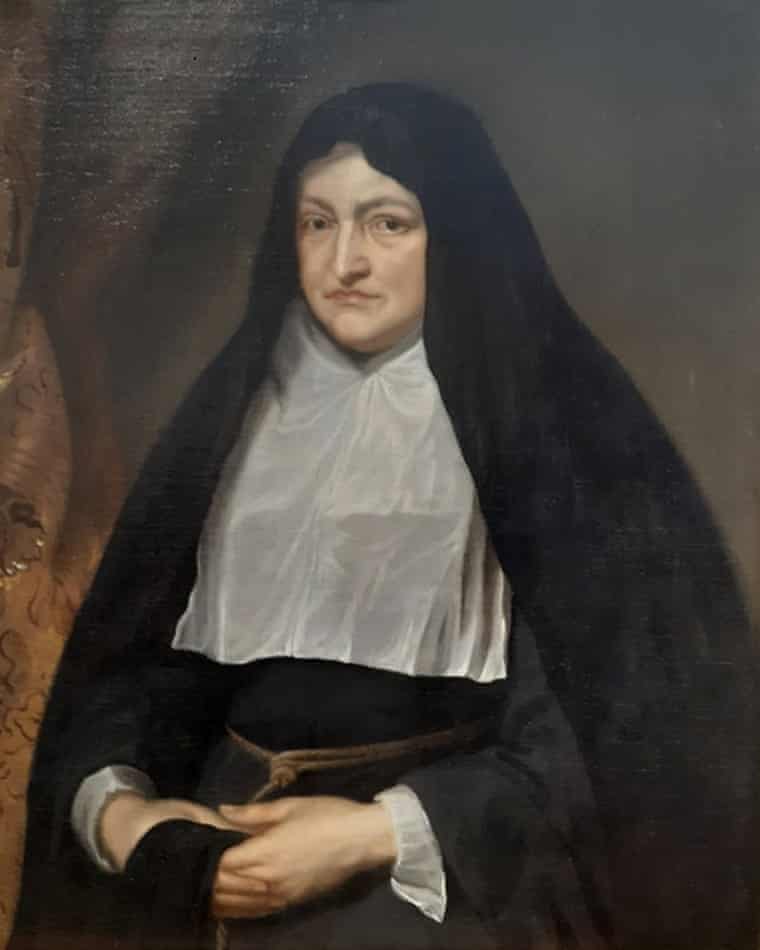
Lost Portrait of Isabella Clara Eugenia, Infanta Of Spain

She was the granddaughter of Henri II and Catherine de Medici and daughter of Philip II and Isabel of Valois. At one time her father had hoped to put her on the English throne. As ruler of the Netherlands the Infanta late in life gave refuge to her cousin Marie de' Medici, Dowager Queen of France. From ArtNet:

Art historian Christopher Wright has a track record of spotting unrecognized masterpieces from art history in other people’s collections. But his latest find comes a bit closer to home. It turns out, a portrait he picked up for just £65 back in 1970 may actually be an original work by the great 17th-century Flemish artist Anthony van Dyck.

Wright had always assumed that the portrait of Isabella Clara Eugenia, sovereign of the Spanish Netherlands from 1598 to 1621, was a mere copy. But when Colin Harrison, senior curator of European art at the Ashmolean Museum, Oxford, stopped by for a visit, he was immediately struck by the work’s quality, and told Wright it might be the real deal. The art historian decided to act on Harrison’s hunch and had the painting examined and restored at London’s Courtauld Institute of Art.

“The adroit skill leads us to tentatively propose that [it] can be attributed to Van Dyck’s workshop and that it was completed during his lifetime and under his supervision,” the Courtauld wrote in a report by Kendall Francis and Timothy McCall. Now, Wright believes that the real Van Dyck, lying under he nose for over 50 years, could be worth as much as £40,000 ($54,000). Wright has previously identified works including a George Stubbs portrait at Ferens Art Gallery in Hull. This latest unexpected discovery suggests that Wright should have taken the proverb “physician, heal thyself,” to heart.

“The syndrome is the cobbler’s children are the worst shod. So the art historian’s collection is the least looked at,” Wright told the Guardian. “It was dirty and had yellow varnish, but it was in decent condition. The whole thing looks absolutely magnificent now.” Van Dyck likely painted the work between 1628 and 1632, depicting the Eugenia in a nun’s habit, mourning the death of her husband, Archduke Albert VII of Austria, in 1621. (Read more.)

Isabella Clara Eugenia as a young woman

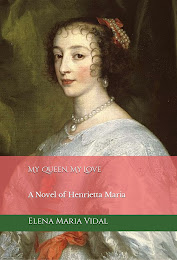
More in My Queen, My Love:

Share

Monday, January 10, 2022

Elizabeth Stuart, Queen of Hearts

Henrietta Maria's sister-in-law. An interview with biographer Nadine Akkerman from Aspects of History:

Those who know about Elizabeth will know of the famous quote attributed to her: “I would rather be the Palsgrave’s wife than the greatest papist Queen in Christendom”. Do you think, historically, her reputation has been romanticised as the “royal wife” rather than a woman of agency? If so, why?

This is an excellent example of how Elizabeth’s reputation has been managed over the centuries. It is part of an alleged conversation with her mother, who wanted Elizabeth to marry King Philip III of Spain rather than become the ‘Goodwife Palsgrave’ by marrying Frederick. It has several weaknesses. The first is that this response was noted by an author in 1697, eighty five years after it allegedly occurred! Furthermore, it shows how the English, both then and perhaps still, fundamentally misunderstand the make up of the Holy Roman Empire. Frederick was, in fact, the most powerful of the Empire’s seven Electors. Anna, with many dynastic links to the Habsburgs (the family that ruled the Empire in the shape of the Emperor himself), would not have made such an error. The exchange is almost certainly apocryphal. As for Elizabeth being cast as a mere ‘royal wife’, and thus a tragic figure tossed hither and thither on the high seas of fortune, this merely demonstrates the many misconceptions over the agency of queen consorts in the early modern period. Yes, they operated within certain restrictions due to their sex, but their ability to circumvent them is underestimated. This is largely down to the lack of access to the correspondence of any of the Stuart queens. Without clearly annotated editions of their letters, how can we hope to appreciate their true political efforts? (Read more.)


More HERE.


Share

Thursday, November 11, 2021

Vincent van Gogh’s Favorite Works of French Literature

 From LitHub:

Vincent van Gogh loved writers as much as he loved painters. It was partly by immersing himself in literature that Van Gogh developed the singular, elegant voice that makes his letters such an important literary achievement. This immersion also helped give him an ability to describe so persuasively his appreciation for the work of other artists and his intentions for his own art, making it unusually possible—­perhaps uniquely so—­for us to see art through the eyes of an artist of his stature.

The trajectory for Van Gogh’s love of reading—­as for so much else in his life—­was set in earliest childhood. Every evening at his parents’ parsonage in the small village of Zundert, situated in the south of the Netherlands, ended the same way: with a book. Far from being a solitary, solipsistic exercise, reading aloud bound the family together and set them apart from the sea of rural illiteracy that surrounded them. His parents read to each other and to their children; the older children read to the younger; and, later in life, the children read to their parents. Reading aloud was used to console the sick and distract the worried, as well as to educate and entertain. Whether in the shade of the garden awning or by the light of an oil lamp, reading was (and would always remain) the comforting voice of family unity. Long after the children had dispersed, they continued to exchange books and book recommendations as if no book was truly read until all had read it. (Read more.)
Share

Wednesday, November 10, 2021

On Van Gogh’s Painterly Relationship to France

 From LitHub:

Vincent Van Gogh had arrived in Paris in late February 1886. He was writing to Horace Mann Livens, a young English painter he’d met at the Academy in Antwerp while practicing on gypsum casts of ancient sculptures. The letter, which sold at auction in 1995 and is in a private collection, is a rare testament to Vincent’s time in Paris: only ten letters document the two years he spent there.

In this first letter, Vincent talked about his new landscape studies, “frankly green, frankly blue.” He said that since life is found in color, “true drawing is modeling with color.” He reiterated his respect for all-stars like Delacroix and mentioned artists he’d never heard of before—peers or people not much older than himself. In Antwerp, he hadn’t known about the impressionists. Now, he told his friend that he wasn’t “one of the club” but that he admired Degas’s nude figures and Monet’s landscapes. But Vincent hadn’t moved to Paris to join the impressionists.

His three months in Antwerp had been miserable, economically and physically. He’d failed to work with live models or find women who would pose naked, so he’d settled for gypsum casts—a common practice in the academies. He also used casts while working at home in Paris. He owned a few small casts of ancient Venus figurines, which led to sketches, drawings, and eventually to sublime still lifes—like Still Life with Plaster Statuette, a Rose and Two Novels and Plaster Cast of a Woman’s Torso. These seem to have predated some of Cézanne’s similar experiments, such as his L’Amour en Plâtre (1895), now at the Courtauld in London. The tradition of inserting casts or statuettes into larger paintings has been alive and well since the Renaissance. It took on new life after Vincent’s experiments, and then, after Cézanne’s practice, with artists like Matisse and Picasso at the beginning of the twentieth century. (Read more.)


Share

Friday, August 27, 2021

Uncovered Cupid


Art lovers get ready to be struck by Cupid’s arrow, as the first image of the completed restoration of Johannes Vermeer’s Girl Reading a Letter at an Open Window (around 1657-59) has been released today by Dresden’s Gemäldegalerie Alte Meister, fully revealing a hidden image of Cupid. The change to the composition in one of Vermeer’s most famous paintings is so great that the German museum is dubbing it a “new” Vermeer in publicity materials.
The painting has been in the museum’s collection for more than 250 years and the hidden Cupid had been known about since an x-ray in 1979 and infrared reflectography in 2009. It had been assumed that the artist himself had altered the composition by covering over the painting of Cupid. (Read more.)
Share

Thursday, June 17, 2021

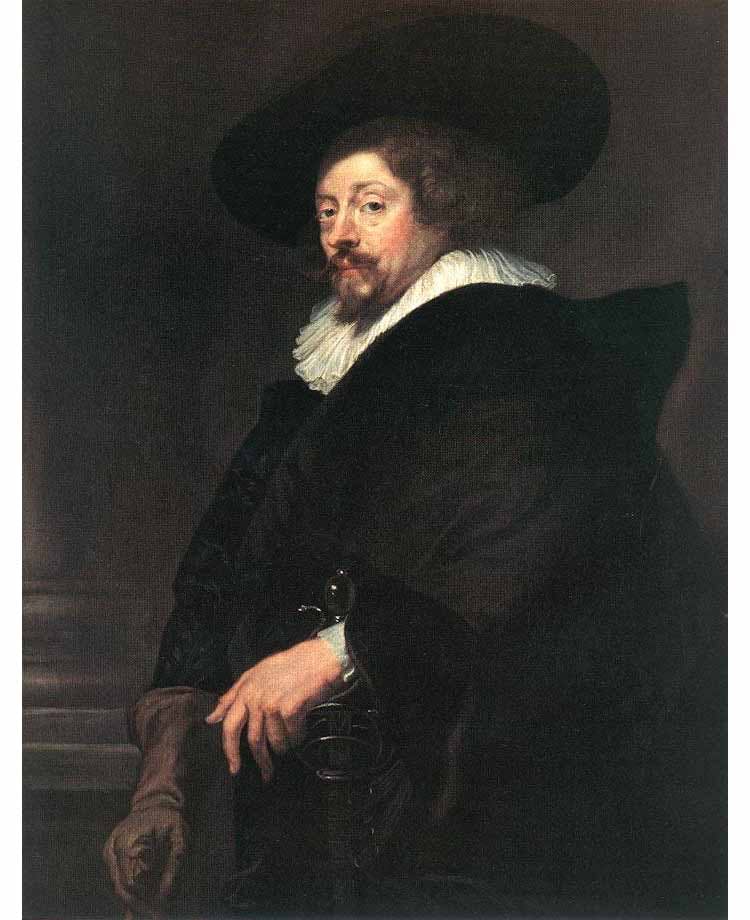
Peter Paul Rubens: Court Painter and Diplomat

From Barneby's:

The later master of the baroque painting Peter Paul Rubens was born on 28 or 29 June 1577 in Siegen, which at that time belonged to the county of Nassau-Dillenburg. His father, Jan Rubens, was a lawyer in Antwerp before he had to flee from the Spanish Netherlands, ruled by the Catholic Hamburgers, because of his Calvinist faith.

Later, Jan and his wife moved to Cologne with their six children. After his death in 1587, the rest of the family returned to Antwerp, where they came closer to Catholicism. Peter Paul received a good education at a Latin school and got to know courtly life as a page of a Flemish princess' daughter. From 1592 to 1600, Peter Paul Rubens was apprenticed in succession to the painters Tobias Verhaecht, Adam van Noort and Otto van Veen. Even before the end of his apprenticeship he was accepted into the Antwerp Guild of St Luke in 1598.

 Afterwards, Rubens, then 23 years old, traveled to Italy, where he studied the works of Titian, Tintoretto, Raphael and Caravaggio. Despite his youth, the Duke of Mantua, Vincenzo Gonzaga, became aware of him and made him his court painter – and his envoy: in 1603 the Duke sent the painter on a diplomatic mission to the court in Madrid. (Read more.)

Share