Showing posts with label The Paradise Tree. Show all posts

Sunday, September 13, 2026

More Irish Than the Irish

 From Medievalists:

Mac William (Mac Uilleiam, son of William) was a pseudo-Gaelic title which passed solely through the Hiberno-Norman De Burgo, de Burgh or Burke/Bourke family. The William in question was William de Burgh, who arrived in Ireland in 1185 under the patronage of King Henry II of England, styled Lord of Ireland. By 1400, William’s progeny had spread across Ireland, with the highest concentrations being in Galway, Mayo, Limerick and Tipperary. By 1574, Galway could boast 110 castles in Burke hands and 64 in Mayo. In the Barony of Kilmaine, in an area of just 10 miles by eight, there were 41, which included 12 castles held by the MacJonyn or MacSheoinin clan, a derivative of Little John, a son of John de Burgo, later anglicised to Jennings. (Read more.)

Share

Tuesday, March 17, 2026

Colcannon

A staple in my novel The Paradise Tree. From Irish Central:
Colcannon with its unique and simple recipe has become popular around the world. It normally includes chopped kale or green cabbage mixed with hot, floury mashed potatoes. This simple recipe is an ideal one to make with the kids. The word colcannon is from the Gaelic "cal ceannann," which literally means "white-headed cabbage."
In the past, charms were mixed in with the colcannon. Depending on what charm you found it was seen as a portent for the future. A button meant you would remain a bachelor and a thimble meant you would remain a spinster for the coming year. A ring meant you would get married and a coin meant you would come into wealth. Others filled their socks with colcannon and hung them from the handle of the front door in the belief that the first man through the door would be their future husband. (Read more.)
Share

Bards

It has always fascinated me how the telling of stories was held in high regard in Irish culture. Here is a little history:

In medieval Ireland, bards were one of two distinct groups of poets, the other being the fili. According to the Early Irish law text on status, Uraicecht Becc, bards were a lesser class of poets, not eligible for higher poetic roles as described above. However, it has also been argued that the distinction between filid (pl. of fili) and bards was a creation of Christian Ireland, and that the filid are were more associated with the church.[3]

Irish bards formed a professional hereditary caste of highly trained, learned poets. The bards were steeped in the history and traditions of clan and country, as well as in the technical requirements of a verse technique that was syllabic and used assonance, half rhyme and alliteration, among other conventions. As officials of the court of king or chieftain, they performed a number of official roles. They were chroniclers and satirists whose job it was to praise their employers and damn those who crossed them. It was believed that a well-aimed bardic satire, glam dicenn, could raise boils on the face of its target.

The bardic schools were extinct by the mid 17th century in Ireland and by the early 18th century in Scotland.

The bards played an important role in preserving the traditions and legends of the Irish people, as well as their genealogical connections. Stories were passed on through poems, songs, ballads and the loricas. According to one article:

Bards are found in Celtic cultures (Ireland, Scotland, Wales, Manx and Brittany) and a rough equivalent can be found in Norse culture, too, where they were known as "scops."

There is no real equivalent to the Celtic Bard in Anglo-Saxon England, however.

In Ireland and Scotland, the use of the word "Bard" apparently fell into some disrepute, as the records we have show that the Bard was simply a minor poet, while the "filidh" (seer) or the "ollave" (master poet) occupied the former status and functions of the Bard....

The word "Bard," in Wales, denoted a master-poet. In Ireland it meant a poet who was not an Ollave, one who had not taken all the formal training. Apparently even the lower-status Irish Bard was on a level with the Welsh Bard in knowledge and poetic education, however, and these were what I have termed "hedge-bards," above.

In the Celtic cultures, the Bard/Filidh/Ollave was inviolate. He could travel anywhere, say anything, and perform when and where he pleased. The reason for this was, of course, that he was the bearer of news and the carrier of messages, and, if he was harmed, then nobody found out what was happening over the next hill. In addition, he carried the Custom of the country as memorized verses...he could be consulted in cases of Customary (Common) Law. He was, therefore, quite a valuble repository of cultural information, news, and entertainment.

Share

Monday, March 16, 2026

Lorrha Stories: Irish Monasticism

 From The Abbey of Misrule:

St Ruadhán was one of the ‘twelve apostles of Ireland’, a collective of significant early Irish saints who studied under the legendary St Finian of Clonard. Ruadhán (whose name is pronounced ‘Rowan’, and means ‘red-haired’) was, like his fellow apostles, a monk of the Celtic tradition, which later came into conflict with Rome over various issues, like the date of Easter, the correct form of tonsure and other such theological details. In reality though, these issues were secondary to the real one, which was how much power Rome should have over monasteries in distant lands.

In early Ireland, Christianity was monastic, and it was Abbots rather than Bishops who called the shots. Irish monasticism had, for around 500 years, developed a specifically ‘Celtic’ character which seems to have been greatly influenced - and, I think, directly seeded - by Egyptian desert monks. This was the age of the round tower, the beehive hut and the small-scale, ascetic Christianity of the Wild Saints. It was the world of Patrick and Kevin, Colmcille and Bridget.

The Pontiff in Rome, however, wanted this scruffy, desert Christianity reined in under a hierarchy of Bishops answerable to him, and in Ireland, as in England a century before, the Normans would be his vessels. In 1066, the Norman king William the Conqueror (William the Bastard to his friends) had invaded England, killing its legitimate (and elected) King, Harold II, at the Battle of Hastings. He had done so under the Papal banner, which he had carried into battle, and on his victory he set about demolishing the old wooden Anglo-Saxon churches and building new, stone ‘Romanesque’ ones in their places. He also gave the green light to the continental monastic orders to move in and replace their indigenous counterparts. (Read more.)

Share

Thursday, March 5, 2026

Banshees

"The Banshee Appears"

The Irish people have a colorful folklore, rich with stories of creatures from the Otherworld. In spite of the obviously pagan origins, many legends have endured to modern times. One legend is that of the banshee (bean-sidhe), a spirit which is supposed to haunt certain Irish families when a member is about to die. According to Ireland's Eye:
The bean-sidhe (woman of the fairy) may be an ancestral spirit appointed to forewarn members of certain ancient Irish families of their time of death. According to tradition, the banshee can only cry for five major Irish families: the O'Neills, the O'Briens, the O'Connors, the O'Gradys and the Kavanaughs. Intermarriage has since extended this select list.
Here is a more detailed description from Irish Culture and Customs:
The Bean Sidhe or Banshee makes her appearance when someone in the household is about to die. She haunts only the families of the "high Milesian race" - those whose names have an "O", "Mac" or other prefix. One exception to this rule has been granted by virtue of the Irish poets who have given her to some of the Norman-Irish families - the FitzGerald's for example. In any event, she heralds the demise of only those who are of authentic noble stock and it is with great dread when her piercing "caoine" or keening is heard. In many respects, this mysterious creature resembles traditional Irish keeners or mourners of old; as with her mortal counterparts, those who have seen her describe her as drawing a comb through her hair, similar to tearing the hair out in anguish, which the ancient mourners used to do. Incidentally, or maybe not, while the Banshee is considered benign, she supposedly has a sister force who isn't; this force is called the Lianhan Sidhe and her sole purpose is to seek the love of mortal men. Their desire for her ultimately destroys them.
The banshee, according to legend, is usually heard at night, but sometimes in the morning, and at noon. An old Irish poem refers to the appearance of the Banshee in the morning:

Hast thou heard the Banshee at morn,
Passing by the silent lake,

Or walking the fields by the orchard?

Alas! that I do not rather behold

White garlands in the hall of my fathers.
There were a few banshee stories among some of my older relatives. (I suppose being descended from the Kavanaughs and the O'Neills as well as the O'Connors made them especially worthy of hauntings!) Irish lore is full of tales of the preternatural; the banshee is definitely one of the most interesting.

My Irish novel is HERE.
Share

Sunday, February 1, 2026

Pro Ecclesia et Pontifice


In March of 1966
, my great grandfather Dr. Fergus O’Connor received the medal of the Holy Cross Pro Ecclesia et Pontifice from Pope Paul VI in recognition of his contributions to medicine for over sixty years. The papal nuncio came to the house at 193 Earl Street in Kingston, Ontario to bestow the medal, due to the advanced age of the recipient, celebrating Mass there as well. In March of 2008, when my late Aunt Mary's belongings were being distributed among the relatives, I happened to come across the certificate that accompanied the medal from the pope. (See photo above.) According to the Catholic Encyclopedia:
The medal Pro Ecclesia et Pontifice was instituted by Pope Leo XIII (17 July, 1888, "Quod Singulari") in memory of his golden sacerdotal jubilee, and bestowed on those women and men who had merited well by aiding and promoting, and by other excellent ways and means assisted in making the jubilee and the Vatican Exposition successful. This decoration was made a permanent distinction only in October, 1898 (Giobbio, see below). Its object is to reward those who in a general way deserve well of the pope on account of services done for the Church and its head. The medal is of gold, silver or bronze. The decoration is not subject to chancery fees. The medal is a cross made octangular in form by fleurs-de-lis fixed in the angles of the cross in a special manner. The extremities of the cross are of a slightly patonce form. In the centre of the cross is a small medal with an image of its founder, and encircling the image are the words LEO XIII P. M. ANNO X (tenth year of his pontificate). On the obverse side are the papal emblems in the centre, and in the circle surrounding the emblems the motto PRO DEO ET PONTIFICE is stamped. On the obverse surface of the branches of the cross are comets — which with the fleurs-de-lis form the coat of arms of the Pecci family. On the reverse side are stamped the words, PRIDIE (left branch); KAL. (top branch); JANUAR. (right branch); 1888 (at the foot). The ribbon is purple, with delicate lines of white and yellow on each border. The decoration is worn on the right side of breast.
Fergus Joseph O'Connor was the son of Charles and Emily O'Connor of Long Point Farm, born on April 1, 1879, Easter Sunday. As Fergus' second son and namesake wrote of him: "It's hard to describe a man with such integrity of character. He was the perfect son to his parents -- the brother to his only sister and complete support to his family." (Dr. Fergus James O'Connor, Because You asked For It)

Fergus loved horses and wanted to become a jockey, for which he was suited due to his stocky stature. His mother, however, encouraged him to seek as much education as possible. He went to high school in Athens, Ontario, and then went to the “Normal School” for teachers' training in Ottawa. It was around that time that he decided to study medicine. His father had wanted Fergus to help him maintain the homestead, but accepted his decision to become a doctor. He taught school to earn his tuition for medical school at Queen's University in Kingston. In his third year, he missed classes the first term because his funds had run out and he had to teach school again to make more money, but his roommate took notes for him, so he was able to pass anyway. He did not have much recreation, and only went to one football game all the time he was at Queen's.

In the summer of 1902, when Fergus first registered at Queen’s he rode his bicycle the 32 miles into Kingston. After finishing his business at the university, he became lost. He drove past three young ladies playing croquet on the front lawn and asked them for directions. One of them was Frances Keating. Frances Margaret Keating was of Norman-Irish stock on her father’s side; her mother was an O’Neill.
Fergus and Frank were married at the dawn Mass at Saint Mary’s Cathedral in Kingston on September 3, 1907. The Mass was followed by a simple wedding breakfast. The new Dr. and Mrs. O’Connor moved to Gananoque in the Thousand Islands area where Fergus set up a practice and built a house.

Fergus' practice involved house calls, as was the custom in those days. He was often called out at night to deliver a baby, and often had to travel unlit roads into remote areas. It was vital for a country doctor to have a reliable horse so as to get him to his patients; my great grandfather had many stories about horse traders. After tending to a patient in the countryside, he could doze in the buggy or sleigh, since the horse knew the way home.

In December of 1916, Fergus was elected mayor of Gananoque. His election was a tribute to the respect generated by his professional dedication and personal integrity. It was remarkable given the local history of conflict between the few Irish Catholics settlers and the Protestant majority, especially the Irish Protestants, called “Orangeman.” Fergus, without compromising any of his beliefs and principles, was able to overcome a great deal of anti-Catholic prejudice, and became the popular “little mayor.”

In 1918, my great-grandparents moved to 193 Earl Street in Kingston, Ontario, with seven of their soon-to-be eight children. They decided to move into Kingston so that their children could go to the Catholic schools available there. A white rose bush from the original that old Daniel had brought over from Ireland was planted outside the front door. Fergus slowly built up a new practice. He taught medicine at Queen’s University, and continued on the faculty for forty years. His close friend, Monsignor J.G. Hanley said of him:
His concern for his students was not limited to their professional development. Working in an area fraught with deep moral implications, he instilled in future obstetricians sound ethical principles to guide them in making crucial decisions which would crucially affect the lives of their patients. Moreover, he was not merely a professor to his students; they all regarded him as a personal friend, and so he was.
By the late 1930’s he was delivering one third of all the babies in Kingston. He had many poor patients who could not pay, but to Fergus being a doctor was a vocation, not a career. However, he would gratefully accept an offering such as a bag of potatoes in the place of money, so that he could feed his family. He eventually became Chief of Obstetrics at the Hotel Dieu Hospital in Kingston and remained so for almost half a century. He delivered his last baby at age eighty-four.

Fergus was also active in the community and the church. He was o
n the Separate School Board for many year
s, as well as being a city alderman. He belonged to the Knights of Columbus and in 1945 founded the Queen’s chapter of the Newman Club.

Fergus died on April 21, 1971. I am grateful for the few memories I have of this wonderful man, a true patriarch. I recall how approachable he was, how kindly and gentle with small children. A Kingston newspaper article described him in his nineties as being “still active and spry…his eyes twinkling….with short quick steps“ and that is exactly as he appears in my memory. One of the main characters in The Paradise Tree is based upon him.
 

Share

Friday, January 30, 2026

The Potato Famine: A Modern Catastrophe

 From Chronicles:

Sometimes great matters depend upon… vegetables. Ancient civilization was founded on the simple discovery that grasses could become grains, reliable and storable, allowing the emergence of fixed Fertile Crescent cities with rulers and philosophers. But vegetables can also yield disaster. The failure of the Irish potato crop in the mid-1840s not only brought terrible suffering to that island but has blighted Anglo-Irish relations ever since. Few other episodes have left such a toxic aftertaste, with over 100 memorials around the world and countless cultural references.

Canadian historian Padraic X. Scanlan has Irish antecedents, and generally left-of-center views. Still, he writes a careful analysis of an episode that is far from England’s finest hour. He has steeped himself not only in the cultivation, mythology, and natural history of the potato, but also in the cultural, economic, industrial, mercantile, and political currents which together heaped horrors on the Irish. He shows that what is often portrayed as a medieval-style catastrophe was in fact a modern one, a predictable product of the dynamic 19th century—and, furthermore, offers insights for our world regarding economic insecurities, environmental destruction, and ever-evolving pathogens. 

Sometime in 1844 or 1845, a cargo of seed potatoes from America was offloaded somewhere in Europe. Unfortunately, that cargo contained an unobtrusive mold called Phytophthora infestans, which launched itself onto the Old World with alacrity. Potato crops from Spain to Sweden were affected, causing dearth and deaths, but the direst effects were felt in Ireland, where the population was uniquely dependent on the potato. In 1841, there were some 8.2 million people in Ireland; by 1851, that number decreased to 6.5 million, through death by starvation or disease, or forced emigration. Such was the culture shock that for almost a century afterwards the population of Ireland would continue to decline. The Irish government still issues annual warnings to farmers about the likelihood of blight. 

Although Ireland had much fertile land and was famous for dairy and meat products, millions had been perilously reliant on the potato as early as the 1730s. There had been crop failures before; in 1740–41, the harvest was ruined by weather, and 300,000 died, a proportionally higher number than would die during the famine. Since its arrival in Tudor times, the potato had proved its worth as a cheap, easily cultivated, and highly nutritious staple. Grown and eaten close to home, the potato was largely insulated from market vagaries that were just becoming important with the rise of industry and commodity capitalism. Landlords encouraged it because it could feed more workers on less land, leaving acreages open to more lucrative grain or livestock. (Read more.)

Share

Saturday, December 27, 2025

Jesus Christ the Apple Tree


It is St. John's day, which is the name-day of my late father. This early American carol was one of his favorites. It invokes images of Eden and the lost earthly paradise, while bringing to mind the Tree of Life which is the Cross. From Hymns and Carols of Christmas:
1. The tree of life my soul hath seen,
Laden with fruit and always green:
The trees of nature fruitless be
Compared with Christ the apple tree.

2. His beauty doth all things excel:
By faith I know, but ne'er can tell
The glory which I now can see
In Jesus Christ the apple tree.

3. For happiness I long have sought,
And pleasure dearly I have bought:
I missed of all; but now I see
'Tis found in Christ the apple tree.

4. I'm weary with my former toil,
Here I will sit and rest awhile:
Under the shadow I will be,
Of Jesus Christ the apple tree.

5. This fruit doth make my soul to thrive,
It keeps my dying faith alive;
Which makes my soul in haste to be
With Jesus Christ the apple tree.
From The Thinking Housewife: "The lyrics were written by an unknown poet in the 18th century and call to mind the tradition in the Middle Ages of decorating Christmas trees with apples, symbolic of the Tree of Knowledge." (Read more.)

The Tree of Life and Death


Share

Wednesday, December 24, 2025

Irish Christmas Blessings and Carols

From Ireland Calling:
Carols are also important in an Irish Christmas. Ireland has its fair share of original carols such as The Wexford Carol and While Shepherds Watched Their Flocks by Night. Many others have been translated into Irish and performed by leading artists. These are some of Ireland’s best known Christmas blessing and carols.

The Wexford Carol is one of the most famous and most popular hymns to come out of Ireland. Its origins are uncertain but it certainly dates back several centuries. It originated in Co Wexford and first came to wider prominence due to the work of William Grattan Flood who was the organist at St Aidan’s Cathedral in Enniscorthy. He first came across the carol when he heard it being sung by a local singer in Wexford in the 19th century. He started to perform it at Christmas services in the cathedral and it was later published in the Oxford Book of Carols. It soon became a standard in carol books across the world. (Read more.)
Share

Tuesday, December 23, 2025

The Ancient Roots of Christmas Ghost Stories

From The Spectator:

Christmas in its traditional sense is the Christmas season – not the period from mid-August to Christmas Eve when shops are selling tinsel and mince pies, but the Twelve Days of Christmas that begin at sundown on Christmas Eve and culminate in ‘Twelfth Night’ on the evening of 5 January. The medieval 12 nights were the ultimate stand of light and warmth against cold and darkness in the depths of Europe’s Little Ice Age. Small wonder, then, that this strange time of the year gave rise to cathartic tales of the dark, death and the macabre. The nineteenth century writer Montague Rhodes James – who used to read a chilling ghost story yearly at to a select gathering of students and fellows at King’s College – described it as the desire to be made ‘pleasantly uncomfortable’. Tales of supernatural horror, when you yourself are in perfect safety, are perhaps as old as human storytelling itself. 

In a famous story recorded by Bede, the seventh-century missionary St Paulinus converted King Edwin of Northumbria by asking Edwin to imagine human life like a sparrow that flies into the king’s hall in midwinter, and for a brief moment enjoys the light and warmth of the festivities before flying again into the freezing dark:  ‘So this life of man appears for a little while, but of what is to follow or what went before we know nothing at all. If, therefore, this new doctrine tells us something more certain, it seems justly to deserve to be followed’, the king declared.  

And the Anglo-Saxon fear of winter is memorably evoked in Beowulf, a poem about the horrors that stalk the midwinter night:  

Long was the season:
Twelve-winters’ time torture suffered
The friend of the Scyldings, every affliction…  long against Hrothgar
Grendel struggled – his grudges he cherished,
Murderous malice, many a winter, 
Strife unremitting…

Grendel is not, of course, a ghost – exactly what he is remains somewhat unclear – but he is an ill-favoured otherworldly visitant. The feeling that Christmas represents a struggle of light against darkness resonates, of course, with the Gospel reading for Christmas night, John 1: ‘The light shineth in darkness, and the darkness comprehended it not’. Some have linked the appearance of ghosts on Christmas Eve to the holiness of the day to follow, as if it is a last chance for dark forces to come out and play before being driven away by the light.  

Christmas has long been associated with strange upheavals in nature; animals are supposed to gain the power of speech at midnight on Christmas Eve, as the entirety of nature is transformed in wonderment at the birth of Christ. As the Gaudete carol has it, Deus homo factus est, natura mirante – ‘God is made man, with all nature marvelling at it’. 

But this does not seem to be enough to explain why the dead should return at Christmas time. On a basic level, we all know that grief for our loved ones is heightened at Christmas, simply because it is that time of the year when families are reunited. In the Middle Ages many people believed that there was a chance for the souls of the dead to return from Purgatory at the turning of the year in order to ask for prayers in the coming year.  

Besides Dickens’s A Christmas Carol, the most famous seasonal ghost story is surely the ‘sad tale… of sprites and goblins’ started but left unfinished by the boy Mamillius in Shakespeare’s A Winter’s Tale. ‘There was a man dwelt by a churchyard…’ In those eight words we have the essence of the medieval and early modern midwinter ghost story: the setting is the churchyard, not because churchyards are spooky (a modern idea), but because the churchyard is the resting place of the dead.

Mamillius’s story is not, first and foremost, a frightening tale but a sad one – for the souls of the dead have returned to demand the mercy of the living through the offering of prayers and masses, not to scare them.  The Christmas ghost story cathartically exorcises our fear of the spirits of the outer darkness, like Grendel – but it is also a mechanism for managing our collective grief at the loss of the departed, and a reminder to offer them their due. In this context, the morally insistent ghosts of A Christmas Carol are perhaps not as untraditional as they might at first seem. 

The Christmas ghost story is far more than just a spooky bolt-on to the festive season, an antidote to tinsel and relentless good cheer. It is more than a comfortable scare. The Christmas ghost story arises from the deepest roots of the midwinter season as a time of turning, transformation and new beginnings.  Midwinter is a time of encounter with the dead; when we are reminded of their presence alongside us in our revels. The Christmas ghost stories of literature – and now TV – continue, in culturally sanitised form, an age-old and complex negotiation between light and dark, death and life, that becomes acute as the dark encroaches and daylight dwindles. (Read more.)

Share

Friday, October 31, 2025

An Irish Halloween

The picture above was painted by Irish artist Daniel Maclise in 1833, inspired by a typical Irish Halloween party. (Click on picture for details.) It was called "snap-apple night." Here is the caption which accompanied the painting:
There Peggy was dancing with Dan/While Maureen the lead was melting,/To prove how their fortunes ran/With the Cards ould Nancy dealt in;/There was Kate, and her sweet-heart Will,/In nuts their true-love burning,/And poor Norah, though smiling still/She'd missed the snap-apple turning.
For the ancient Celts, November 1 was Samhain, their New Year's day. It is not necessary to detail some of the more gruesome pagan customs which accompanied the festivities in pre-Christian times, customs which eventually disappeared as the Faith spread and took hold. Nevertheless, on a more positive note, the Celts believed that on the day in question the veil between the worlds grew thin, and one could easily pass from world to world, from time into eternity.

As Christians, in celebrating the Solemnity of All Saints, the sacred liturgy permits us to glimpse the place where the blessed ones dwell in light. We are led to think of all the dead, of the awe-inspiring realties of death, judgment, heaven and hell. On All Souls' Day we recall those who are still undergoing purgation in the realm beyond time. We, too, through the Mass and through prayer, pass from world to world, for all are present to God.

Here is an article (via A Conservative Blog for Peace) which elucidates on the history of All Hallows' Eve, the pagan versus Christian aspects and how the Irish, French, Germans, and English brought it all to North America. To quote:
Halloween can still serve the purpose of reminding us about Hell and how to avoid it. Halloween is also a day to prepare us to remember those who have gone before us in Faith, those already in Heaven and those still suffering in Purgatory. The next time someone claims Halloween is a cruel trick to lure our children into devil worship, I suggest you tell them the real origin of Halloween and let them know about its Catholic roots and significance. (By Fr Scott Archer)
 More on Irish Halloween traditions HERE.

Share

Tuesday, October 14, 2025

Echoes of the Great Famine in the Covid Era

 From Brownstone Institute:

In Spring 2020, supposedly “civilized” nations of the world tackled the prospects of how best to subjugate their domestic populations. At this time I was struck by seemingly obvious parallels to another sad chapter in the history of human misery: the Irish Potato Famine. There are many core similarities marking the two calamities.

Both evolved from real biological threats that did actually exist (a potato blight in Ireland and a novel coronavirus globally); yet government choices (rooted more in ideology and control) amplified the suffering far beyond anything naturally inflicted. British policies during the famine prioritized exports and landlord profit over human lives (Irish landlords at this time were a gentry class called the “Protestant Ascendancy” that exercised social, political, and economic domination over the subject population). Likewise, lockdown mandates favored top-down edicts over personal choice and community resilience, which only favored the social elite who could afford to sequester. Both eras saw freedoms trampled: the Irish lost access to their own food and land, while Covid restrictions silenced dissent, shuttered churches, and confined people to their homes, all under the guise of public safety.

The Irish catastrophe of 1845-1852 killed over a million and forced another million to emigrate, but it stemmed from more than crop failure. British governance enforced a system where Irish tenant farmers grew cash crops for export, leaving potatoes as their sole staple. When the blight hit, food ships sailed out of Irish ports laden with grain and livestock, bound for England, while locals starved. Relief came too late and too stingy, burdened on absentee landlords who evicted families to cut costs. This was no act of God, but rather policy as punishment and tied to centuries of colonial disdain.  

Fast-forward to 2020, and a similar script unfolded. The virus was indeed deadly for the vulnerable, but the response (in the form of indefinite shutdowns, mask mandates, and travel bans) created a cascade of harms far worse than the thing it was trying to mitigate. Economies ground to a halt, mental health crises surged, and children lost years of schooling, all while leaders preached “Follow the science” from their insulated bubbles. Freedom of speech crumbled under censorship of dissenting doctors, religious gatherings faced police raids, and personal autonomy yielded to tracking apps and vaccine passports. These toxic measures (sold as temporary) corrosively lingered, forever eroding trust in institutions. (Read more.)


Share

Thursday, May 1, 2025

"The Song of Glen Dun"

"Spring" by Sir John Lavery
An old Irish song for May.
Sure this is blessed Erin an' this the same glen,
The gold is on the whin-bush, the wather sings again,
The Fairy Thorn's in flower,—an' what ails my heart then?
Flower o' the May,
Flower o' the May,
What about the May time, an' he far away!

Summer loves the green glen, the white bird loves the sea,
An' the wind must kiss the heather top, an' the red bell hides a bee;
As the bee is dear to the honey-flower, so one is dear to me.
Flower o' the rose,
Flower o' the rose,
A thorn pricked me one day, but nobody knows.

The bracken up the braeside has rusted in the air,
Three birches lean together, so silver limbed an' fair,
Och! golden leaves are flyin' fast, but the scarlet roan is rare.
Berry o' the roan,
Berry o' the roan,
The wind sighs among the trees, but I sigh alone.

I knit beside the turf fire, I spin upon the wheel,
Winter nights for thinkin' long, round runs the reel.
But he never knew, he never knew that here for him I'd kneel.
Sparkle o' the fire,
Mother Mary, keep my love, an' send me my desire!
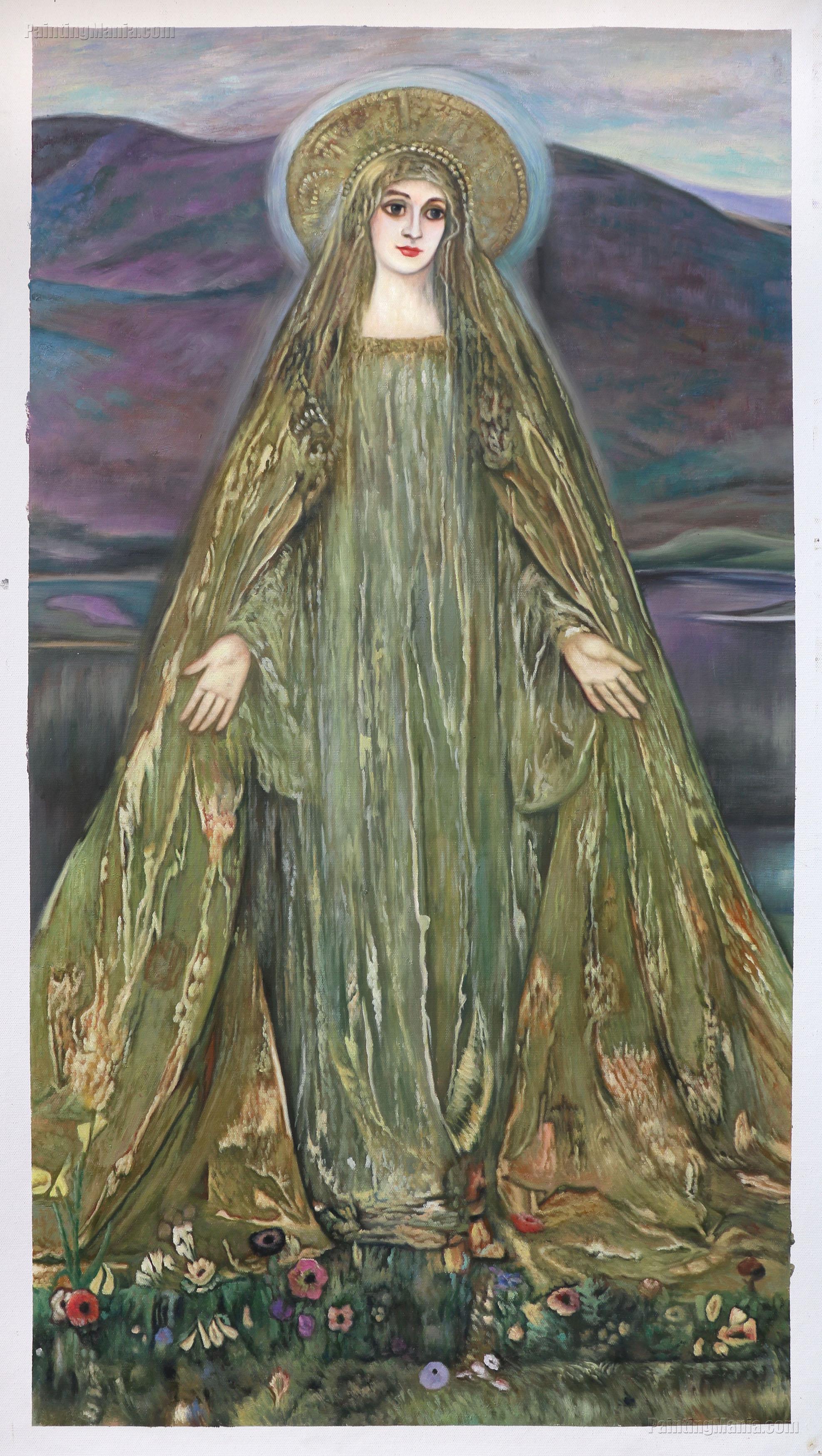
The Madonna of the Lakes by Sir John Lavery


The song is found HERE as well. Share

Monday, March 24, 2025

"Londonderry Air"


Blasket Islands

On the way to Killarney Cathedral

Never went to Derry, but I saw many other beautiful places in Ireland. And "Danny Boy" has always been a favorite in my family. From Debra Esolen at Word and Song:

Do you recall the first time you ever heard the “Londonderry Air” (or as it is more frequently called, “Danny Boy?” I can’t recall a time when I did not know that song. But if I had to guess, I’d bet that my first experience of it came from watching old TV reruns of “Make Room for Daddy” as a kid. The star of that show, Danny Thomas, was a beloved entertainer, singer, actor, and later television producer. And for obvious reasons, his producers adapted (and jazzed up!) “Danny Boy” to become his theme song. In 1953, when Thomas premiered his show, there couldn’t have been a person in the world who was not familiar with that song. But (other than from Ireland!), just where did it come from?

Well, I wasn’t just spinning my wheels when I began this post talking about collectors. I’ve covered many folk songs over the past few years at Word & Song. But in the case of the “Londonderry Air,” the song might easily have fallen into oblivion but for a few dedicated collectors of songs, and particularly of folk songs, back in the 19th century. Some people guess that the tune is linked to a couple of other folk songs even older than that. But we know that the tune itself first appeared in print, unnamed, in "The Ancient Music of Ireland” ( published by The Society for the Preservation and Publication of the Melodies of Ireland, 1855). The editor of that book, George Petrie, had been about the business of literally collecting old Irish folk tunes which had never been notated, much less published. The unnamed air — along with a good number of other genuine old Irish tunes — had been notated and sent to Mr. Petrie by yet another song collector, Miss Jane Ross of Limavady in County Derry, in Northern Ireland. (Read more.)

Share

Sunday, March 16, 2025

"Sensory and Visceral"

Brigit's Lorica

An eloquent and glowing review of The Paradise Tree from The Portland Book Review:

Elena Maria Vidal’s The Paradise Tree is the haunting saga of the O’Connor family. The reader follows the life of blacksmith Daniel O’Connor, an Irish catholic who migrates to Canada in pursuit of economic and religious freedom. O’Connor flees Ireland with a rosebush and the “Paradise Tree,” a wooden crucifix. He begins a new life in Ontario, where he cultivates his home and raises a family in a new world fraught with its own sets problems—some old, some new.

A sprawling historical novel, told from multiple perspectives, The Paradise Tree takes us into the lives of the O’Connor family in a voice that is thorough and rich. Vidal’s writing is sensory and visceral. The reader feels as if she is a member of the O’Connor family, slunk in the corner watching, rooting for the characters, feeling for the characters, and taking on their conflicts, joys, and burdens. We are told the harrowing tale of the O’Connor family in scenes that we feel we are a part of, and when necessary, a narrative voice that moves the story to it’s bittersweet conclusion as we leap along in time with the family.

Vidal’s meticulous research brings the O’Connor’s’ world to life. Lush provocative details enrich the novel instead of distracting from it: “Time for the ceilidh!”…Patrick brought out his bodhran, a wide drum…The general idea of the ceilidh was that each member of the company would contribute to the entertainment of the others with a song, story, a dance, or recitation.” Vidal’s novel is rich with history. She manages to enlighten the reader of the customs, traditions, and folklore of the O’Connor family through factual anecdotes and observations, as well as poetry and song, while moving the story forward instead of bogging us down in showy, didactic details. Whether we are discovering the “shillelagh” wielding “Orangemen,” or sitting down to a goose roasted over a spit and smelling the simmering parsnips on Christmas Eve, we are given a thorough history lesson without the lectures, the notes, and—thank goodness—the exams.

The Paradise Tree does what good novels should. It tells us a story, it shows us what it means to be human—replete with the triumphs, sadness, and conflicts entailed in being human—while whisking us away to another world that is not our own. For 232 pages we are extracted from our lives and into the lives of the O’Connor family. We root for them. We feel their hardships. We feel their connection and disconnection as a family while we are shown a distant time and place, filled with potentially unfamiliar folkways. In the end we are pleasantly reminded that the O’Connors’ story is just as much ours as we traverse the familiar territory of faith, family, and love, and how we still find ourselves dancing in the face of seemingly insurmountable odds.
(Read more.)

Purchase HERE.
Share

Saturday, March 15, 2025

Holy Wells of Ireland

St. Brigid's Holy Well in Kildare

My sister, my spouse, is a garden enclosed, a garden enclosed, a fountain sealed up...The fountain of gardens: the well of living waters, which run with a strong stream from Libanus. ~Canticle of Canticles 4:12, 15

The Irish have spread their holy well devotion throughout the world. We have a "holy well" in Frederick County, Maryland, dedicated to Our Lady of Lourdes. And miracles occur there. From Irish Central:

It will all be worth the trouble, however (call it penance!), as nearly all these wells are in stunning locations high up in the mountains, isolated on islands, or in wild and remote places, such as the Burren in Co. Clare, which has an amazing forty holy wells. The Celts, monks and saints certainly knew how to pick the best sites for peaceful prayer or contemplation. Many Irish holy wells are named after St Patrick, the patron saint of Ireland; St Brigid, patron saint of Co. Kildare who founded a convent in the county; or a local saint, such as St Colman in Co. Clare.

Holy wells in Ireland are often credited with a cure and, traveling around the country, you will find the cure to most ailments hidden away in a local well. Popular cures involve using the water to sort out you teeth or eyes. Whether that was because of the lack of dentists or the expense of spectacles at the time, who knows, but these places are still being visited today. Even if nothing too serious ails you, world-weary travelers can seek solace in nature in any of the country's holy wells. Sit beside a well where the water gushes forth from the earth, a symbol of new life in many cultures, and reflect. (Read more.)


More about Holy Wells, HERE. 

My Irish novel, HERE.

Share

Thursday, March 13, 2025

Ireland’s Abolitionist Titan


 In Ireland we stayed at the hotel in Cork where Frederick Douglass and Daniel O'Connell lectured. From First Things:

The whole saga drew considerable attention. Trinity College is one of Dublin’s grandest institutions and Ireland’s premier university. Its centuries-old campus sits in the very heart of the capital city. Trinity can doubtless congratulate itself on a difficult issue, sensitively and successfully handled. Yet this was also an opportunity scorned. Ireland has its own “anti-Berkeley,” a towering figure in the cause of abolition, and simply one of the four or five most important figures in modern Irish history: Daniel O’Connell.

O’Connell came from an old Irish family on a wild, far-flung peninsula of the Atlantic coastline, though he received some of his education in the eminent Catholic colleges of northern Europe. His place in history rests largely on successfully leading the campaign for Catholic emancipation in the early nineteenth century, earning him the sobriquet “The Liberator.” 

But his actions as an abolitionist were also remarkable. Slavery, he wrote, was “a crime of enormous magnitude to be at once, unconditionally, and for ever abolished.” He foretold that slavery would never disappear from America until “some horrible calamity befalls the country.” Of Irishmen in the United States who supported slavery, he said: “They are not Irishmen! They are bastard Irishmen!”

O’Connell gave moving and fiery speeches against slavery in Cork and Dublin, London and Glasgow. He shared platforms with Frederick Douglass and Charles Lenox Remond. Douglass later called O’Connell’s death a great blow to the cause of the American slave. Remond said that it was only on hearing O’Connell speak that he realized what being an abolitionist really meant.  

O’Connell refused all money and favors from supporters of slavery, often at great risk to the causes he pursued for the sake of the Irish. His outspokenness took him to the brink of a duel with Andrew Stevenson, former speaker of the House of Representatives and ambassador to the Court of St. James. John Quincy Adams spoke out in O’Connell’s defense.  

All of this is the subject of a full chapter in a biography by Patrick Geoghegan, who happens to be a professor of history at Trinity. Why, then, did the university forego the chance to rename their library after Ireland’s abolitionist titan? What better and more apt way could there have been to move on from Berkeley’s tainted legacy?  (Read more.)

Share

Wednesday, November 13, 2024

A Pilgrimage to Ireland


 From my newsletter:

Last month my daughter and I accompanied our parish priest and several parishioners on a pilgrimage to Ireland. We traveled with Mark Forrest, the Irish tenor, a grand gentleman. We saw the West and the South of Ireland, stopping at holy places along the way. I have written a great deal about my Irish ancestors, the Kerry-O'Connors, including a novel about them entitled The Paradise Tree. However, I had never set foot in Ireland. I was immediately struck with the feeling of having come home. It was a strange feeling, since I had never been there and everything was new, new but familiar at the same time. Thousands of years of Irish ancestral memory must be deep in my DNA. (Read more.)


Share

Friday, October 25, 2024

The True Origins of Halloween

From The Crossroads Initiative:
We’ve all heard the allegations. Halloween is a pagan rite dating back to some pre-Christian festival among the Celtic Druids that escaped Church suppression. Even today modern pagans and witches continue to celebrate this ancient festival. If you let your kids go trick-or-treating, they will be worshiping the devil and pagan gods.

Nothing could be further from the truth. The origins of Halloween are, in fact, very Christian and rather American. Halloween falls on October 31 because of a pope, and its observances are the result of medieval Catholic piety.

It’s true that the ancient Celts of Ireland and Britain celebrated a minor festival on Oct. 31 — as they did on the last day of most other months of the year. However, Halloween falls on the last day of October because the Feast of All Saints or “All Hallows” falls on Nov. 1. The feast in honor of all the saints in heaven used to be celebrated on May 13, but Pope Gregory III (d. 741) moved it to Nov. 1, the dedication day of All Saints Chapel in St. Peter’s at Rome. Later, in the 840s, Pope Gregory IV commanded that All Saints be observed everywhere. And so the holy day spread to Ireland. The day before was the feast’s evening vigil, “All Hallows Even” or “Hallowe’en.” In those days, Halloween didn’t have any special significance for Christians or for long-dead Celtic pagans. (Read more.)
Share

Saturday, September 21, 2024

Lost and Found

 From The Abbey of Misrule:

Clonmacnoise sits on the banks of the Shannon at what was once a strategic crossing point. Because of its location, and the political support of the High King of Ireland, it became in its day a wealthy and important site. More than a simple monastery, it was in effect a town, inhabited not only by monks but by many laypeople and, especially, scholars. Like many other early Irish monasteries, Clonmacnoise became famous for its scholarship, manuscript production and astonishing stone and metalwork. (Read more.)

Share