Showing posts with label Saints. Show all posts

Monday, September 28, 2026

The Pope in France

Pope Leo XIV in Notre Dame Cathedral
Pope Leo at Notre Dame with the statue of Our Lady of Charles X

 From Vatican News:

Light inundated Notre-Dame as Pope Leo XIV celebrated vespers in Paris' beloved Cathedral. It felt like a fitting celebration for the restored and renewed basilica, a place of worship and iconic symbol of the “Ville Lumière“, badly damaged by fire on 15 April 2019.

On that day, dramatic images and videos of the cathedral engulfed in flames, and of people praying in the streets as the fire consumed the building, spread around the world through social media and news outlets.

Today, the French Church has come together again. This time to rejoice, as the Pope visited the Cathedral and celebrated Vespers, almost two years after its reopening in December 2024, following a long and meticulous restoration process.

As the sun shone through the stained-glass windows, colorful patterns moved slowly across the walls. Meanwhile, an organ played and the choir sang while the bishops, priests, consecrated men and women, seminarians, and other members of the French Church solemnly prayed together with the Successor of Peter.

Before the Vespers, Pope Leo venerated a relic of the crown of thorns, which was placed on Christ’s head during his Passion. A symbol of his suffering and sacrifice before his Resurrection.

“We are gathered for Evening Prayer in this place which, more than any other, has invited the people of Paris for centuries to lift their eyes towards heaven,” Pope Leo said in his homily. (Read more.)

Mass at the Place de la Concorde, where thousands were guillotined (Via Daily Mail)

I wish instead of Robespierre the article had mentioned Madame Elisabeth. From Rome Reports:

The Place de la Concorde in Paris is a site marked by some of the darkest moments in French history.

During the Revolution, the guillotine stood here, and more than a thousand people were executed. Louis XVI, Marie Antoinette and Robespierre were among them.

Two centuries later, Pope Leo XIV celebrates the Eucharist here before nearly 600,000 people. A turnout that marks a new chapter in the Church in France.

The pope is using this celebration to call for a secular society.

LEO XIV

Seeing you gathered here, brothers and sisters, heirs to a long and beautiful history of holiness in France, I say to you: in turn, drink deeply from this spring that is the pierced Heart of Jesus. Yes, you thirst for God, for life, for truth, for unity, for peace, for communion, for happiness. You long to rediscover a radiant horizon, to build a renewed nation rooted in a faith that nourishes its very foundations.

But the pope does not stop with France’s religious identity. He goes straight to the individual and a much more universal question: what does a Catholic drink from when he or she thirsts for life?

LEO XIV

Brothers and sisters, we must acknowledge that here on earth, nothing can fully satisfy us. Just when we think our search is finally over and our efforts have been rewarded, that inner emptiness often resurfaces, even more profound than before.

Are we content with material possessions, immediate gratification, and the countless little idols that promise the world but leave our hearts empty?

And while, in 2008, Benedict XVI came to France asking how faith could survive in a secularized society, today, Pope Leo XIV is not talking about survival.

He is talking about renewing the country from its roots: building a renewed nation through a faith that can once again nourish society.

This is not about rebuilding a blood-soaked square, but renewing a society that, according to the pope, thirsts for truth, peace and happiness. (Read more.)

Pope Leo XIV visits the Sanctuary of Our Lady of Lourdes, a Marian shrine and pilgrimage site dedicated to Our Lady of Lourdes, on Sept. 27, 2026. | Credit: Vatican Media
Pope Leo in Lourdes

From EWTN:

Leo met Sept. 27 with staff and sick guests of the Accueil Notre-Dame (Notre Dame Home), a residential accommodation classified as a healthcare facility, which hosts sick, disabled, and frail pilgrims to Lourdes.

The Catholic shrine is one of the most visited in the world, drawing more than 3 million people every year, many in search of miraculous physical healing.

The 136-acre property includes the Grotto of Massabielle, where a young St. Bernadette Soubirous saw 18 apparitions of the Virgin Mary starting on Feb. 11, 1858. Today, pilgrims to the sanctuary bathe themselves in the freshwater spring Mary revealed to Bernadette.

Visitors have reported 7,000 healings since the apparitions; after lengthy investigations, the Church has declared that 72 of the recoveries were miraculous, meaning unexplainable by science. (Read more.)


 From CWR:

The Sanctuary of Our Lady of Lourdes is among the most popular Catholic shrines in the world, built on the site of Mary’s apparitions to St. Bernadette in 1858. It is particularly visited by the sick, who come to bathe in or drink its healing spring water.

In his homily, Pope Leo noted that a “call to conversion, both tender and urgent,” was a central part of the message the Virgin Mary entrusted to Bernadette, and that “it is today, not tomorrow, that we must repent.”

He said Jesus is quite direct about the call to repentance: “As St. Luke tells us, ‘Unless you repent, you will all perish.’ But he also extends our horizon beyond this earthly life to the horizon of eternal life.”

“Did not the Virgin Mary say to St. Bernadette, ‘I do not promise to make you happy in this world but in the next’?” Leo said.

The pope noted that we can often forget this in an age and society focused on progress and material wellbeing.

Eternal life is already won for us by Jesus’ sacrifice, he continued, but “the obstacle to grace and eternal life — the only obstacle to this love — is sin.” (Read more.)


 From OSV:

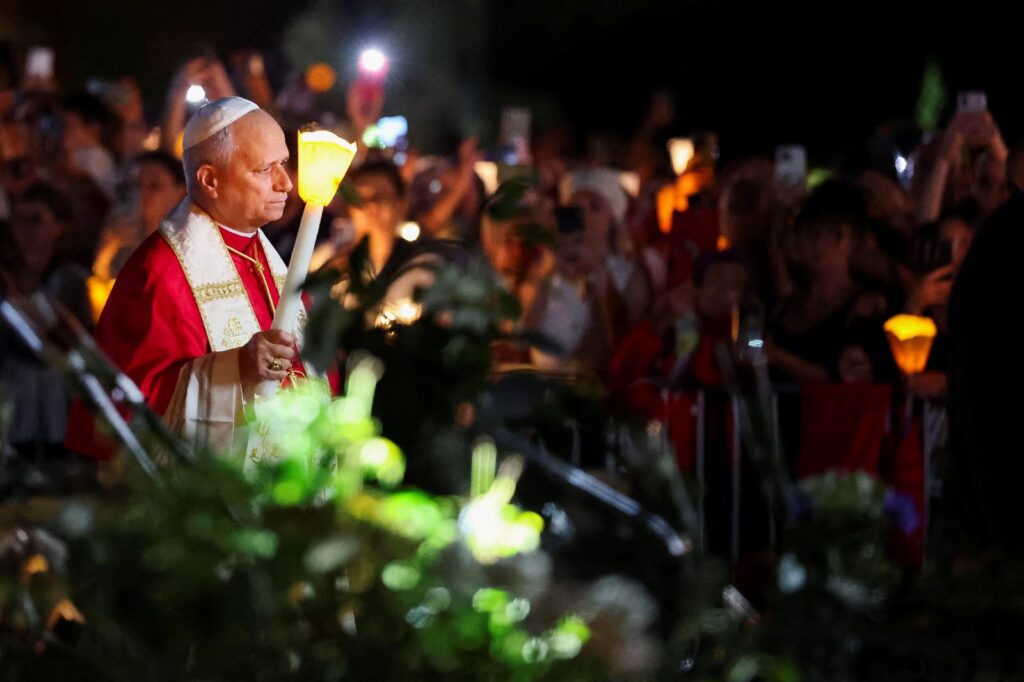
Holding a large candle in his right hand and a rosary in his left, Pope Leo processed slowly behind an illuminated statue of the Virgin Mary through the crowd of pilgrims holding candles, as the five decades of the glorious mysteries of rosary were prayed in multiple languages.

As the “Ave Maria” Lourdes hymn was sung between mysteries, all of the pilgrims in the square in front of the Basilica of Our Lady of the Rosary lifted their candles high in the air, creating a sea of lights.

“The light that guides us and draws us onward is the light of hope, which never abandons us even as we journey through this life — a life often marked by trials, yet already filled with the joy of knowing ourselves to be children of God, loved and saved by Jesus,” the pope said.

“Those who are sick are privileged witnesses to this transfiguration of our lives through faith and love of God and neighbor.” (Read more.)
Share

The Gaze That Tells Us Who We Are

 From Dominique Seraphin:

“God does not love us because we are valuable. We are valuable because God loves us.”

I have read those words many times. Each time, they seem to reach a little deeper.

It is easy to admire Fulton Sheen for what he accomplished. He was a brilliant scholar, a gifted preacher, a bishop, an author, and a pioneer who used radio and television to bring the Gospel into people’s homes. He knew how to speak about eternal things in a way that made people stop and listen.

But the part of his life that moves me most happened away from the cameras.

At his priestly ordination, Sheen promised to spend a Holy Hour each day before the Blessed Sacrament. He kept that promise for the rest of his life. Before he spoke publicly about Christ, he went to be with Christ. Before he asked others to listen, he listened. He brought his work, his questions, his gifts, and his need before Jesus in the Eucharist.

I wonder how many of his most powerful words began in that silence.

There is something beautiful about a man whose voice reached millions choosing, day after day, to be quiet before the Lord. The world knew Sheen for what he could say and do. In the chapel, he could simply be a beloved son in the presence of his Father.

Maybe that is why his words about our value carry such weight.

We hear “Jesus loves you” so often that we can forget how astonishing it is. We may readily believe that God loves humanity, the Church, our families, and the people we pray for. Yet when His love becomes personal—when we have to say, Jesus loves me, knowing everything about me—we sometimes hesitate.

We know the parts of ourselves we would rather hide. We remember the harsh words we said yesterday, the resentment we keep revisiting, the prayer we promised to make time for and didn’t. We know how quickly we compare ourselves with someone who seems more patient, more generous, more joyful, or more holy. (Read more.)

Share

Monday, September 21, 2026

Christianity in the Disembodied Age


From Hilary White at The Sacred Images Project:

When reading the New Testament through our usual theological lens of a grand cosmic drama, it’s easy to miss the significance of the kind of work done by most of the named protagonists. The first Apostles, Peter, Andrew, James and John are all fishermen. And Thomas, Bartholomew and Philip probably were too. Paul of Tarsus - a highly educated Pharisee and Roman citizen - is described as a tentmaker, though the Greek skēnopoios may mean something closer to a general leatherworker or maker of canvas goods, and his friends Aquila and Priscilla practised the same trade. Tabitha (also called Dorcas) was a seamstress.

There were a few representatives of what we might today call the “middle class”1. Lydia was a successful cloth merchant who specialised in the famous purple cloth of the region. Luke was a physician (and painter), Matthew and Zaccheus were both publicans (tax collectors for the Romans) a profession despised by the Jews, of course, though lucrative. Cornelius and Julius were centurions in the Roman army. Zenas (Titus 3:13) is identified as a lawyer.

Later the movement attracted members of the upper echelons, including Erastus, who is identified by Paul as the city of Corinth’s director of public works2. The wealthy, slave-owning convert Philemon was an upper-class patrician, probably a Romanised Greek and landowning civic politician in the city of Colossae. Very interestingly, Paul refers to Philemon3 as a “dear friend and fellow worker” in his letter about the escaped slave Onesimus.

But we get the general tone from Paul of how deeply work, and often manual work, was morally incorporated into early Christian thinking. “We labour, working with our own hands, (1 Corinthians). “We worked night and day,” ( 1st Thessalonians) and “if anyone will not work, neither shall he eat,” (2 Thessalonians).

In fact it would never have occurred to any person of that time that work - an occupation of some kind, whether manual or domestic labour, artisan craft or mercantile trade, or even senatorial-rank political involvement - was something embarrassing to be escaped in favour of a life of pure leisure and entertainment. On the contrary, Christians taught that whatever work you did it should be ordered to the Christian goals of salvation. (Obviously this meant there were some trades and professions you could not enter, like prostitution, gladiatorial combat, making idols for the temples, etc.) (Read more.)

Share

Thursday, September 17, 2026

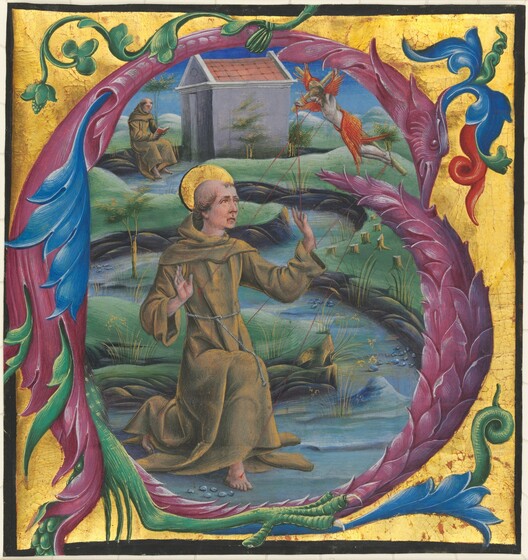
Heavenly Earth: Images of Saint Francis at La Verna

A 2018 exhibition. Today is the feast of the stigmata of St. Francis. From The Leaven:
WASHINGTON (CNS) — St. Francis of Assisi’s reception of the stigmata, the wounds of Christ, at La Verna in Italy and its depiction by artists beginning in the 15th century is the focus of a National Gallery of Art exhibit. “Heavenly Earth: Images of Saint Francis at La Verna” includes 30 pieces of Franciscan art centered on the miraculous 13th-century event. The exhibit was to open Feb. 25. Ginger Hammer, an assistant curator at the museum in Washington, said the display focuses on an “unprecedented event in Western spirituality.” No one in recorded history had experience such an occurrence before St. Francis did in 1224.

It happened while St. Francis was meditating on the passion of Christ during one of his regular retreats in the mountain wilderness. “He wanted to understand the very suffering that Christ endured. The result of his prayers reportedly is that a seraph, or six-winged angel, approached him enfolding the image of Christ on the cross. When the seraph departed, the actual wounds of Christ’s passion were transferred to the body of Francis,” Hammer told Catholic News Service Feb. 20 during a media preview. “That had never happened before and it was quite remarkable that through his own endeavors something mystical of this magnitude could happen to a human being,” she said.

A Franciscan sanctuary and museum complex mark the La Verna site today and continues to welcome pilgrims. The event was so extraordinary that artists over the centuries have tried to capture it to share with others. The exhibit focuses on work in various media from the 15th through 18th centuries. (Read more.)
More information at the National Gallery of Art website, HERE. Share

Saturday, September 12, 2026

Meet Hildegard of Bingen, the German Mystic Who Destigmatized Women’s Health

 From Literary Hub:

For Hildegard of Bingen, the German mystic, scientist, composer, and philosopher, women’s maternal bodies were not corrupting and degrading, but strong, nurturing, and creative. Hildegard, who was born at the end of the eleventh century, is the first known female medical writer in Europe during the High Middle Ages. Most of the era’s discourse about human generation came from monks and theologians who vowed never to have any contact with women’s bodies. But Hildegard introduced into the Christian medical tradition compassionate and celebratory theories about physical maternity that were inspired by her own bodily experiences and those of the women she cared for.

Hildegard was a Catholic abbess of the Benedictine Order. The tenth child of a noble family, Hildegard was tithed to the Disibodenberg, a monastery nestled between two rivers in Germany’s Rhineland‑Palatinate region, when she was born. After being cloistered when she was eight, she took her vows at fourteen and became a nun. Hildegard prized virginity as the highest state of womanhood, and she never experienced biological motherhood. But her commitment to spiritual motherhood did not stop her from thinking seriously about conceiving, bearing, and birthing. (Read more.)

Share

Sunday, September 6, 2026

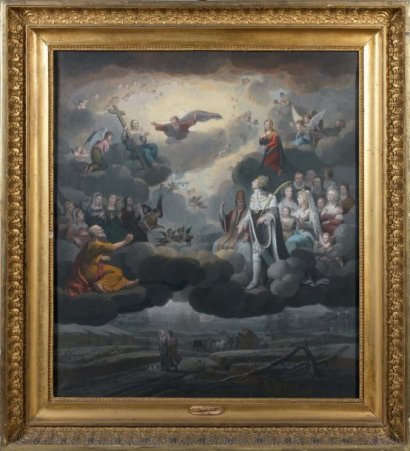
The Cloud of Witnesses

A marvelous painting showing Madame Royale in exile, walking down a long road with her uncle Louis XVIII, as the Blessed Trinity, the saints, the angels and her own family, watch over her from above. Share

Tuesday, September 1, 2026

The Best Film Ever?

In some recent Tudor novels and series there has been an emphasis on St. Thomas More's role in Henry VIII's persecution of religious dissenters. As Chancellor of England, St.Thomas had the morbid task of overseeing the execution of heretics according to the laws of the land. Most countries at the time saw heresy as a capital offense so St. Thomas was not doing anything unusual in carrying out the King's will in such matters. It is the mistake of our post-Enlightenment era to judge the past by our present way of doing things. Just as we are horrified by their burning of heretics, so would they be horrified by our massive numbers of aborted babies. From George Weigel at First Things:

I recently rewatched Fred Zinnemann’s riveting cinematic adaptation of Robert Bolt’s play for at least the sixth time, and the thought occurred: Is A Man for All Seasons the most perfect film ever made? Everything about it seems exactly right.

Bolt’s screenplay keeps the action moving, highlighting the story’s pivotal moments while losing nothing of consequence from the play’s script. Everyone in the cast is terrific, beginning with Paul Scofield’s Thomas More and continuing through Wendy Hiller’s Alice More, Robert Shaw’s Henry VIII (the young Renaissance hero, not the porcine lecher of later years), Orson Welles’s Cardinal Wolsey (embodiment of a Church crippled by its alliance with state power), Nigel Davenport’s rough-and-tumble Duke of Norfolk, Leo McKern’s cynically amoral Thomas Cromwell, and John Hurt’s Richard Rich, corrupted by intellectual arrogance and overweening ambition. Vanessa Redgrave’s lascivious, eighty-second cameo as Anne Boleyn hints at the sorry end awaiting the woman for whom King Henry broke with the Church of Rome.

Ted Moore’s cinematography is both gorgeous and true to history; I once looked out the window in More’s cell in the Tower of London and was struck by how cannily Zinnemann and his cinematographer used that view of the Thames embankment to convey the changing seasons during Sir Thomas’s lengthy imprisonment. Georges Delerue’s score is well-matched to the flow of the film and gives it an authentic Renaissance flavor.

If there is anything awry in A Man for All Seasons, I didn’t notice it. 

I’ve often taken exception to Bolt’s attempt, in the preface he wrote for the 1962 paperback edition of his play, to justify to his secularist peers his esteem for More, an ardent Catholic. In that apologia, the agnostic-bordering-on-atheist playwright positioned Thomas More as a proto-existentialist hero: one who died in defense of “an adamantine sense of his own self,” King Henry’s threat to which caused “this supple, humorous, unassuming, and sophisticated person [to] set like metal, [and be] overtaken by an absolutely primitive rigor”—a man who “could no more be budged than a cliff.” Yet in his screenplay, Bolt could not escape some decidedly Catholic facts: that the More family prayed together; that More, as a theologically knowledgeable consultant, helped Henry VIII win the title “Defender of the Faith” for a book defending the seven sacraments against Martin Luther; and that More, at his trial, insisted that the papacy was a divinely mandated institution. Then, at the end, Bolt’s More confesses that he dies “the King’s good servant, but God’s first”—the God who “will not refuse one who is so blithe to go to him.” (Read more.)

Share

Tuesday, August 25, 2026

Saint Louis IX and Politics


 From Catholicism:

Today is the feast of King Saint Louis of France. As the formerly Christian West is sliding further into the tyranny of liberalism, it is balm to the soul to consider that the people in Louis’ France were freer than we are today. They were free from big government meddling in their lives and their wallets. And they were free in the most important way, for Saint Louis believed in a Christian order wherein the State was neither inimical nor neutral to the Church, but was the Church’s helper in securing the happiness, temporal and eternal, of her subjects.

Our modern “freedom,” by contrast, is servitude.

Sad to say, Saint Louis’ own grandson, Philip IV (“the Fair” — called so on account of his outward looks, not his inward dispositions!) was greedy to rob the Church of her influence in civil society. It has long struck me as ironic that this same Philip, who was so ill disposed to the traditional role of the Church in statecraft, was also the one who persecuted the Knights Templar, robbing them of their possessions and murdering their leaders. One of his victims was Jacques de Molay, the twenty-third and last Grand Master of the Templars. The reason I find all this ironic, is that the Freemasons, who are much closer to Philip than to de Molay in their ideology, falsely take the murdered Templar as one of their own heroes — among other ways, by naming their young men’s fraternal organization, “DeMolay International.” Philip IV, who murdered Jacques de Molay, also persecuted Pope Boniface VIII, a great pope who defended — as I’ve pointed out elsewhere — the same traditional alliance of throne and altar that Philip’s saintly grandfather believed in. That tradition, known as “the doctrine of the two swords,” was eloquently put forth in Unam Sanctam, a bull written in direct opposition to Philip the Fair.

It was Boniface VIII, by the way, who canonized Saint Louis IX. (Read more.)


More HERE.


Also from Catholicism:

The custom of genuflecting (literally, in Latin, “bending the knee”) for the Incarnation (“…and the Word was made Flesh…”) in the Creed, was begun by Saint Louis IX, King of France, who knelt out of devotion when he heard the words sung at Mass one day. This is something of a holy mirror of the secular custom of standing for the “Hallelujah Chorus” in Handel’s Messiah. (King George II was so stirred during the performance that he rose to his feet in excitement. When the king stands, everybody stands, even during a concert.) Similarly, thanks to Louis’ piety, and the French respect for their monarch, the King of Kings is saluted with a genuflection every time his Holy Incarnation is recalled in the Credo of the Roman Rite. (Read more.)


Share

Sunday, August 23, 2026

The Modesty Fallacy

 Worrying about female modesty has become an obsession among many Christians. Yes, there is more flesh exposed than there was in past times. But there is such cult-like behavior in many Catholic circles, including homeschooling groups, that has nothing to do with Church teaching nor with Sacred Scripture. I knew one group of young mothers where no one could wear cologne. Another group is saying you cannot take Catholic children to the beach because of what they might see. People make up their own rules that have nothing to do with tradition but with their own irks and quirks. They are the new Puritans. And as a historian I can tell you that standards of modesty among Catholics have changed and fluctuated a great deal for 2000+ years. I will  never forget the reaction of a devout lady when she was shown the original edition of my novel Trianon with the beautiful LeBrun portrait of Marie-Antoinette and her children on the cover. "She's wearing a low-cut dress!" was the exclamation. As for immodesty being connected to rape, Muslim women are raped even when they are covered from head to toe. And what about all the nuns raped by Communists? And I have lamented about all the young Catholic women making themselves deliberately unattractive in ugly, shapeless clothes as a badge of piety.

Lindsay T. has an interesting series of articles on her substack.

The virtue of modesty is defined in the Catechism as “a virtue of the heart” which “guides how one looks at others and behaves toward them in conformity with the dignity of persons”.[7] How men and women dress is important, but judgement of one’s degree of modesty is not the responsibility of the on-looker. In fact, the on-looker should employ modesty in how he looks and behaves towards the other person.

Pope John Paul II, in his book Love and Responsibility, also places responsibility of chaste thoughts on the on-looker:

The virtue of chastity is underdeveloped in anyone who is slow to affirm the value of the person and allows the values of sex to reign supreme: these, once they take possession of the will distort one’s whole attitude to a person of the other sex. The essence of Chastity consists in quickness to affirm the value of the person in every situation.[8]

If an onlooker is tempted to lust by a woman wearing yoga pants or spaghetti straps, I would suggest their attitude towards the other sex has been distorted; they have allowed “the values of sex to reign supreme.” The focus should be on affirming “the value of the person in every situation.”

The culture around Franciscan University, though it professes to teach and encourage a Catholic sexual ethic, has proven repeatedly that it does not affirm “the value of the person in every situation” when it comes to cases of harassment and assault. In fact, it has repeatedly favored the perpetrator—which is most often male—and has scapegoated alleged victims—who are most often female. The questions that female students have received upon reporting harassment or assault prove the strength of the prevailing group theory: It can’t be the man’s fault. There must be something the girl did to incite, invite, or welcome that behavior.

[....]

As a Catholic woman and mother, it concerns and affects me when, at the local Catholic high school, a teacher who is also a Franciscan graduate tells a classroom that “rape culture” is a product of feminism (See Krason: “The sexual harassment frenzy… is the latest poison from the Sexual Revolution”) and many men’s lives have been ruined by false accusations. This group theory that women are responsible for men’s purity is a part of their cultural evangelism. The University’s sexual assault misinformation spreads with conviction. As long as this group theory can subsist—that women are responsible for male virtue—then the friars can sidestep accountability. A University that has protected abusers (who are overwhelmingly male) and mishandled (overwhelmingly female) students’ reports of harassment and assault will be seen as not only blameless, but as a conservative institution battling the woke, feminist agenda of “rape culture” (I hope that sounds as crazy to you as it does to me). (Read more.)

NOTE: Yes, there is a jab at Trump for something coarse he said years ago. He was saying how rich and powerful men are often able to get away with grotesque behavior towards women. He was not advocating the bad behavior, which is obvious when one hears the entire conversation.

Share

Saturday, August 15, 2026

Merciful Love through Mary

 From Vultus Christi:

Those familiar with the devotion of total consecration to Jesus through Mary will be familiar with all these ideas. Saint Louis de Montfort says that, through Mary, every little work becomes acceptable, and even its imperfections are entirely cleansed. He recommends Mary as merciful. He states that those who take other ways have more (not less) “obscure nights, combats, strange agonies, craggy mountains, cruel thorns, and frightful deserts.” But he affirms that “by the path of Mary, we pass more gently and more tranquilly.” And because the offering of ourselves is so little, he states that we do well to offer ourselves through Mary so that Mary will offer herself with us.

Perhaps the most remarkable similarity, though, is the way that both the Oblation to Merciful Love and Total Consecration to Mary involve the handing over of everything: all we are, have, and possess, such that we die and show up at the judgment seat with empty hands, without a single good work or spiritual treasure. And yet in the case of both, this engenders confidence. We are freed to do everything and give everything — no matter how small or imperfect — for love alone with confidence that, if we truly keep nothing for ourselves, neither farthing or penny, we will be clothed with riches that are not our own, the riches of Jesus Christ and His Holy Mother. With such similarities, the question naturally arises about the compatibility of the two. Is it merely the case that some are attracted to offering themselves to Merciful Love and others to Mary, or is there, perhaps, a way in which the two fit together into a single whole? This is the question we hope to explore over the coming days.

But first, let us take a closer look at true devotion and total consecration to Mary. (Read more.)

Share

Saturday, August 8, 2026

'Hemingway in Toronto'

 From Old Hollywood and Beyond:

“Paris in the Dark Ages,” wrote Belloc, gave way to an ‘awakening Europe’ in which “the Normans show first how true a kingdom, with peace and order and unity, may be established” and how “Rome did not die; it was transformed” and how “the philosophy of the Empire had been touched with mysticism” and “the shrine, the miracle, the unseen had replaced the clear and positive attitude, the speculative and cold intelligence, which had distinguished the philosophy of Rome.”

In its place was “medieval religion, its legends, its marvels . . . the one good counterbalance that ultimately saved the world from barbarism.”

Hemingway absorbed it all and gave it back to us, brilliantly, in The Sun Also Rises. While many think this, his debut novel, is just about drinking and debauchery, underlying that decadence is an iceberg of spiritual healing.

Its protagonist, “Jake” Barnes, is inspired by St. James—whom Mary, i.e., Our Lady of Pilar, appeared to shortly after her Assumption into Heaven. On the eve of his trip to Pamplona, Jake refers to the Paris street named for St. James as “the rigid north and south of the rue saint-Jacques.” A curious description, Stoneback thought, since there’s nothing rigid about it, unless the underlying spirituality along this medieval main street is, in fact, the whole point of the literary device.

Le long de la rue, there’s the famous Church of the Val-de-Grâce, meaning “vale of grace”—an architectural splendor King Louis XIII’s wife, Queen Anne of Austria, built to celebrate the birth of their son Louis XIV (“The Sun King”); and the adjoining monastery, later converted into a hospital for wounded soldiers, imaging Jake’s war wounds—Hemingway’s, too. Then there’s that plaque dedicated to Pamplona, a town along the Chemins Pèlerinage—the Way of St. James. (Read more.)

Share

Sunday, August 2, 2026

Fra Angelico’s First Major Altarpiece Gets a Groundbreaking Repair

a group of angels stand looking at the Virgin who is out of the picture in this part of the Fra Angelico altarpiece 

From Artnet:

Antonella Ranaldi, director of Florence and Prato’s cultural heritage office, called the restoration “a case study of the greatest interest that will serve as a model for restorers in the years to come.”

The work is considered Fra Angelico’s first major large-scale work. In the early 1420s, the budding painter-friar, née Guido di Pietro, entered the convent of San Domenico in Fiesole, a complex just north of Florence, where he was tasked with creating an altarpiece for the newly built monastery. In keeping with the fashions of the age, Fra Angelico created a late Gothic style triptych with a liberal use of gold, centering a serene depiction of the Virgin and Child alongside adoring angels and four haloed saints.

Time has not been kind to the San Domenico altarpiece. By 1501, 50 years after the artist’s death, the painter Lorenzo di Credi was commissioned with updating the work to contemporary tastes. He removed the partitions, downsized the Virgin’s throne, and replaced the gold grounding with a naturalistic landscape. Over the coming centuries, the altarpiece was broken up, its parts looted or sold on the antiques market—the original predella, for instance, now belongs to London’s National Gallery. Fra Angelico’s central panel remained at the convent, albeit damaged by haphazard restorations and eaten by wood-boring insects. (Read more.)

Share

Wednesday, July 29, 2026

The Art of Conversation

 From Return to Order:

Conversation is a vast theme. Outlining some principles that should guide our conversations can help us better understand the topic. This will help us see the true value and scope of this important art. I hope our discussion will not be a lecture but a conversation about how to converse.

First, the principle that should guide our choice of topics and our comments should be the good of others. We must seek to do good for those with whom we converse. In other words, conversation is a precious means of apostolate, that is, a means of spreading the Faith to others. Thus, our attitude towards conversation must be like that of an apostle who acts with zeal and passion.

 Second, we have a vast field to work in since the characteristics of the Church are unfathomable. God is infinite, so we have always had much to say about the Church and God. Conversations aimed at spreading our thinking are an important part of our mission as Catholics. We converse to bring souls closer to the Catholic Church and Christian civilization. (Read more.)

Share

Wednesday, July 15, 2026

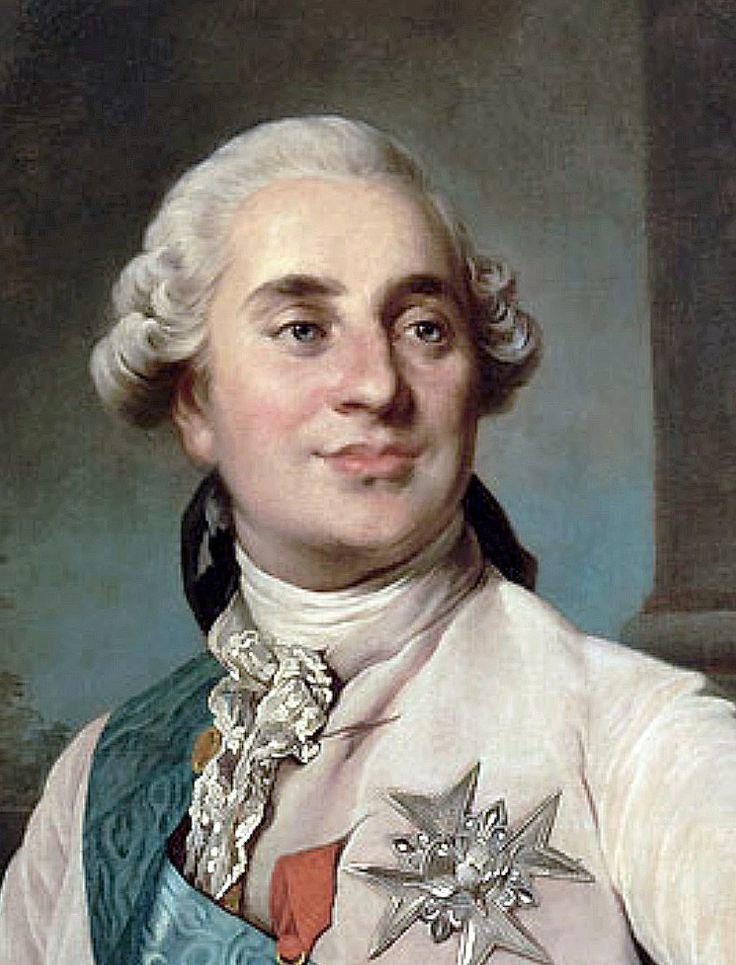
Augustinian Traces in Louis XVI

Louis XVI of France - Alchetron, The Free Social Encyclopedia 

There is some amazing new scholarship about Louis XVI. Here is a paper about Louis XVI's spirituality as formed by his education, which influenced his future actions. From Dr. Philip Diaz-Lewis via the History of European Ideas:

This article argues that Louis XVI’s student notes, the Réflexions sur mes Entretiens avec M. le duc de la Vauguyon reveal a coherent Augustinian Platonist ethics derived from Fénelon, in which humanité functions as a divine exemplar idea through which moral principles are known and royal virtues specified. Against existing interpretations that oppose Louis’s reformism to his attachment to sacral monarchy, it proposes that the same philosophical framework can be used to interpret both his constitutional initiatives and his maintenance of traditional court ritual. The argument proceeds by reconstructing the Dauphin’s formation under La Vauguyon, Moreau, and Berthier, then by a close reading of key Réflexions passages on God, natural law and humanité, interpreted with the aid of the Dictionnaire de Trévoux lexicon. (Read more.)

Share

Monday, July 13, 2026

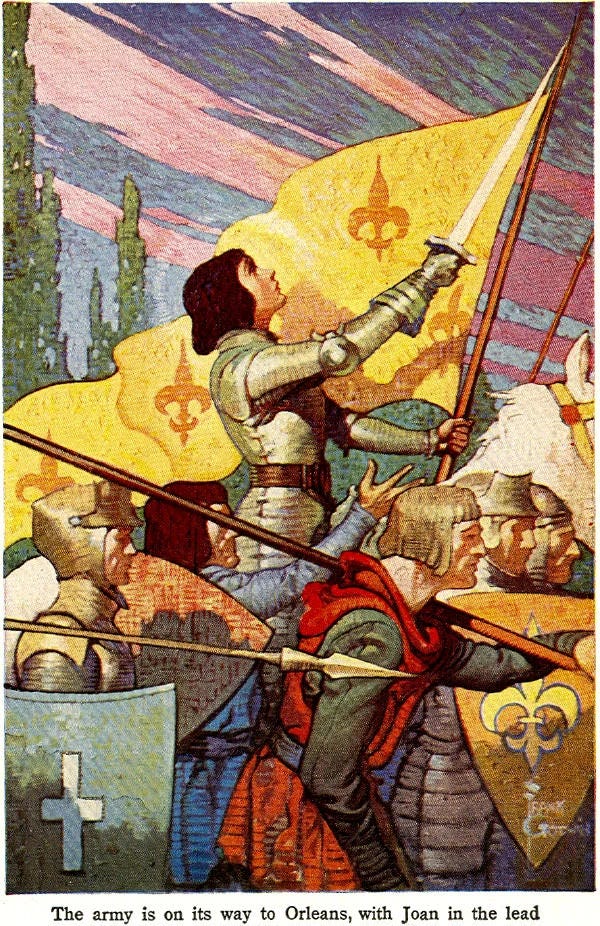
Chesterton on St. Joan


From Rae at Educating Souls:

Joan of Arc had all that, and again with this difference, that she did not praise fighting, but fought. We know that she was not afraid of an army, while Nietzsche, for all we know, was afraid of a cow. Tolstoy only praised the peasant; she was the peasant. Nietzsche only praised the warrior; she was the warrior. She beat them both at their own antagonistic ideals; she was more gentle than the one, more violent than the other. Yet she was a perfectly practical person who did something, while they are wild speculators who do nothing. — G.K. Chesterton

(Illustration by Jessie Willcox Smith)


Share

Sunday, July 12, 2026

The Power of Francis Poulenc’s “Dialogues of the Carmelites”

The nuns were martyred on July 17, 1794. From The Voegelin View:

The 1957 opera is based on the true story of the Martyrs of Compiègne, a community of sixteen Carmelite nuns who were guillotined during the French Revolution’s Reign of Terror. The libretto is the work of Georges Bernanos, the French Catholic author best known for his novel The Diary of a Country Priest.
Dialogues balances the sweep of historical events with the inner spiritual journey of Blanche de la Force, a young woman from an aristocratic family who fears the oncoming Revolution. Blanche’s fear impels her to join the Carmelite order, but in doing so she goes straight into the target of the revolutionary mob. Arrested and cast out of their convent, the nuns take a vow of martyrdom rather than renounce their vocation. Blanche initially panics and runs away, but at the last moment she finds her courage, steps out from the crowd, and joins her sisters at the guillotine. Many hold Dialogues in high esteem as one of the twentieth century’s greatest operas, even for its subject alone. The intolerant repression of religion by the architects of the French Revolution—ironically carried out in the name of “liberty,” “fraternity,” and “equality”—is a story that must be told, with heroic themes befitting grand opera.
If I have reservations about the piece, it is largely because its first half is filled with abstract spiritual discussions that are poorly suited to musical treatment. This portion of the opera feels static and verbose—not to mention overlong—with Poulenc having little to do but spin exquisite filigree around the text, between increasingly powerful orchestral interludes. The opera’s second half livens up considerably, though, as the revolutionary forces close in on the convent and the nuns take their vow of martyrdom. This is a spiritual, even intellectual opera, one that examines themes of fear and grace—particularly what Poulenc termed “transfer of grace” by which one human death can redeem another. (Read more.)
Share

Wednesday, July 1, 2026

The Challenge of the Eucharistic Heart of Jesus

 From Charles Coulombe at 1P5:

But as with everything Catholic in the Americas, devotion to the Sacred Heart long predates the United States.  Although Spain opened up the Evangelisation of the Western Hemisphere, it was in New France that this devotion took root, with the arrival of St. Marie de l’Incarnation, who founded the Ursuline Order in Canada in 1632, half a century before Our Lord began appearing to St. Margaret Mary Alacoque.  Nine years later, Catherine Symon de Longpré, Mother Catherine of Saint Augustine in religion, brought devotion to the Sacred Hearts of Jesus and Mary to Canada, along with her veneration for Marie des Vallées, with whom she was in contact.

On March 17, 1727, King Philip V of Spain, grandson of Louis XIV, wrote to Benedict XIII, asking him to approve the Office and Mass of the Sacred Heart for the kingdoms and states of the Spanish  Crown – the bulk of these were of course Spanish America and the Philippines; from this time on, the cultus of the Sacred Heart had official approbation in the Viceroyalties of the Americas.

In the newly independent United States, the Jesuit Mission at Conewago, Pennsylvania was renamed in honour of the Sacred Heart in 1787, when a new church was built.  A minor Basilica to-day, it was the first parish church named after the Sacred Heart in the United States – and possibly in the Western Hemisphere.

Inspired by the French Voeu Nationale, Gabriel García Moreno (1821-1875), President of the Republic of Ecuador, consecrated his country to the Sacred Heart of Jesus.  He was assassinated two years later, as he left the cathedral of Quito where he had just completed his customary adoration.  But he established what became the template for National Consecrations to the Sacred Heart across the globe.  In keeping with St. Margaret Mary Alacoque’s request to Louis XIV, it was done by both the Head of State, the Legislature, and the Bishops of the Country.  This emphasises that the Faith ought to encompass both Church and State.  Following Ecuador’s example, several Central and South American countries undertook this national consecration in the following years – the first being the Republic of El Salvador in 1874. (Read more.)

Share

Monday, June 29, 2026

Why the Blood-Red Cross of St. George Terrifies Britain’s Elite — and Muslims

The entire article is available to subscribers only but it is still interesting. From Raymond Ibrahim:

As Britain enters yet another moment of political upheaval following the announced resignation of Prime Minister Keir Starmer, a deeper question remains unresolved: what exactly is England’s national identity — and who gets to define it?

Take England’s oldest national flag: the red cross of St. George on a white field. It has become the center of controversy in recent years and is seen as one of Britain’s most contested symbols.

For those raising the flag through campaigns like Raise the Colours, it represents pride in England’s heritage, unity, and unapologetic patriotism. Critics, however, brand it a symbol of “far-right” extremism, racism, and hostility toward migrants (the vast majority of whom are Muslim).

Indeed, just a few days ago, a Liberal Democrat-led Oxfordshire County Council sought a High Court injunction to ban the flying of St. George’s Cross and Union flags on or near public roads — claiming they “intimidate residents,” create safety risks, and cause “fear and division.” Many Britons see this as the latest front in a broader effort to suppress English identity amid the nation’s ongoing migrant crisis.

Yet the St. George flag’s true origins reveal a deeper irony largely forgotten by both sides.

Born in the crucible of the crusades, it originated as an emblem of holy war.

The Knights Templar, founded in the early twelfth century, were the first to adopt its colors. As monks, their white mantles symbolized purity; as warriors sworn to fight Muslims to the death in defense of Christendom, the blood-red cross symbolized their readiness for martyrdom (which many experienced). (Read more.)


Share

Sunday, June 28, 2026

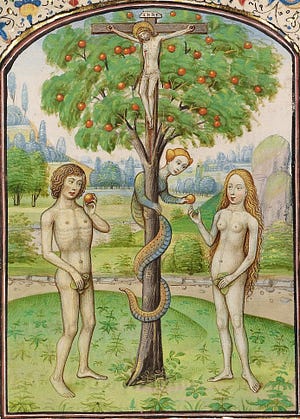
Meditation on the Tree of Knowledge


 From Justi Andreasen at Reclaiming the Biblical Worldview:

What if the fruit in Eden was never meant to remain untouched, and the transgression lay in the manner of its taking?

Most readers approach Genesis 3 as a simple account of disobedience. The command is given, the boundary is crossed, and the punishment follows. Yet this familiar reading leaves one question largely unexplored: What was the Tree of the Knowledge of Good and Evil for? In other words, why would a good God place a forbidden tree in Paradise?

St. Ephrem the Syrian offers a different vision. He describes the Tree as a veil, a living boundary akin to the curtain separating the Holy Place from the Holy of Holies. Its presence did not signal permanent exclusion. It marked a space into which one must be worthy to step. Adam and Eve were not barred forever. They were being formed for a gift.

“He planted the Tree of Knowledge, endowing it with awe, hedging it in with dread, so that it might straight way serve as a boundary to the inner region of Paradise.” -St. Ephrem, Hymn III, 3

A boundary implies not absolute prohibition but ordered approach. The Temple clarifies the pattern. The veil did not exist to enforce distance but to protect what was holy until the priest was ready to enter. Entry required preparation. When King Uzziah (a ruler who unlawfully entered the Temple to perform priestly rites reserved for consecrated priests) forced his way past the boundary, his presumption disfigured him. The Tree functioned in the same way. It stood as a threshold within creation, a sign that maturity unfolds in time. The fruit was to be received when the creature had grown into obedience.

This holds true in ordinary situations as well. Consider claiming a driver’s license without undergoing formation. You would place yourself and others at risk, because you would be exercising responsibility without the formation required to carry it safely. Or consider falsifying your CV to obtain a high position. The title might come quickly, but the strain would follow just as quickly. You would find yourself overwhelmed, and the team around you would feel the instability of leadership that has not been earned. Had the role been the fruit of your labour, had you been promoted through recognition of real competence, the weight of it would rest on something solid, and the order of the group would hold. (Read more.)

Share

Why Mark Twain Wrote a Novel of St. Joan of Arc

Personal Recollections of Joan of Arc (1896) by Mark Twain is brilliant and well-researched historical fiction. From Jennifer Gill at The Distant Meadow:

St. Joan of Arc lived in the 15th century. A century known for civil upheaval, knights, peasants and wide divides between land holders, money and poverty.

She broke all the strict codes of her day, holding the record as the only person – male or female — to hold supreme command of military forces of a nation at the age of 17.

She led men to battle, acquired victory for France and required every solider to pray and go to confession. Her life and witness inspired some of the greatest thinkers and writers to honor her in various literary forms and honors:

  • The famous French poet Charles Peguy illustrates her life in The Mystery of the Charity of Joan of Arc. One of Peguy’s plays reached the Vatican causing former Pope Benedict XVI to proclaim that Peguy’s work “is so famous that has been offered to us also showed us that Joan’s pathetic cry, which betrays her distress and helplessness, reveals above all her ardent and lucid faith, marked by hope and courage.”

  • The famous Twain, sometimes openly hostile to the Catholic Church, writes the definitive biography on the saint stating it is the best of all his books. He travels to France and researches the saint for 14 years and took two years to write his famous chronicle of her, The Personal Recollections of St. Joan of Arc.

  • The great conquer Napoleon reinstated celebrations in St. Joan of Arc’s honor after they were prohibited following the French Revolution.

  • St. Therese of Lisieux, known world-wide as the Little Flower and a Doctor of the Church wanted to emulate St. Joan of Arc. The Little Flower portrayed her in a play at the convent.

 (Read more.)


Share