


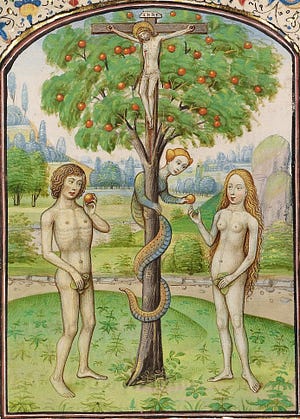
From Justi Andreasen at Reclaiming the Biblical Worldview:
ShareWhat if the fruit in Eden was never meant to remain untouched, and the transgression lay in the manner of its taking?
Most readers approach Genesis 3 as a simple account of disobedience. The command is given, the boundary is crossed, and the punishment follows. Yet this familiar reading leaves one question largely unexplored: What was the Tree of the Knowledge of Good and Evil for? In other words, why would a good God place a forbidden tree in Paradise?
St. Ephrem the Syrian offers a different vision. He describes the Tree as a veil, a living boundary akin to the curtain separating the Holy Place from the Holy of Holies. Its presence did not signal permanent exclusion. It marked a space into which one must be worthy to step. Adam and Eve were not barred forever. They were being formed for a gift.
“He planted the Tree of Knowledge, endowing it with awe, hedging it in with dread, so that it might straight way serve as a boundary to the inner region of Paradise.” -St. Ephrem, Hymn III, 3
A boundary implies not absolute prohibition but ordered approach. The Temple clarifies the pattern. The veil did not exist to enforce distance but to protect what was holy until the priest was ready to enter. Entry required preparation. When King Uzziah (a ruler who unlawfully entered the Temple to perform priestly rites reserved for consecrated priests) forced his way past the boundary, his presumption disfigured him. The Tree functioned in the same way. It stood as a threshold within creation, a sign that maturity unfolds in time. The fruit was to be received when the creature had grown into obedience.
This holds true in ordinary situations as well. Consider claiming a driver’s license without undergoing formation. You would place yourself and others at risk, because you would be exercising responsibility without the formation required to carry it safely. Or consider falsifying your CV to obtain a high position. The title might come quickly, but the strain would follow just as quickly. You would find yourself overwhelmed, and the team around you would feel the instability of leadership that has not been earned. Had the role been the fruit of your labour, had you been promoted through recognition of real competence, the weight of it would rest on something solid, and the order of the group would hold. (Read more.)











No comments:
Post a Comment