Showing posts with label Apocalypse. Show all posts

Wednesday, September 23, 2026

Pygmalion’s Passion

 From The Abbey of Misrule:

Long before the digital age, artists have pondered both the promise and peril of artificial intelligence. Homer’s Iliad described automaton tripods made by Hephaistos that might be confused with Elon Musk’s dream of putting an Optimus robot in every home. Ovid’s Metamorphoses tells of Pygmalion, disappointed in his marital prospects, carving his perfect woman and bringing her to life with the help of Venus. She was the first romantic chatbot, a reflection of Pygmalion’s self-love. Mary Shelley’s Frankenstein warns us what can happen when scientific hubris puts the creation of life and intelligence in its crosshairs. More recently, we have Frank Herbert’s Dune, with the maxim “thou shall not make a machine in the likeness of a human mind.”

Yet we are here, crafting such a machine. Many, perhaps the majority of us, have deep reservations about AI, yet struggle to explain why. We think it could create trouble but also see the great benefits. As a result, nearly all the arguments have been around the outcomes of AI. This is the modern approach - judging something by what it can do, rather than what it is.

If artificial intelligence were a tree, then nearly every discussion we are currently seeing concerns its fruits. An AI optimist predicts a cure for cancer, where a pessimist sees the elimination of the doctor-patient relationship. Mass prosperity! Or is it mass layoffs? For every rotten apple I spot, another sees a juicy golden delicious. How can we make sense of it all?

Arguing about the fruits is problematic. First, predictions are tricky business. Remember when social media was supposed to bring people together? Second, Christianity focuses on the means, not the ends. We care more about whether eggs are getting cracked than how tasty the future omelette may be. (Read more.)


Share

Sunday, September 20, 2026

1918 and the End of Christendom

 From The Maistre Institute:

The charter of the modern state was signed at Westphalia in 1648 by exhausted men who wanted the killing to stop and were prepared to pay almost anything for it. What they agreed was that the religion of a territory would follow the conscience of its prince, and that no authority whatsoever stood above the sovereign to adjudicate the question. We remember this as the birth of toleration. It was also, and more consequentially, the moment the universal Church was subordinated to the territorial ruler as a matter of public law. Innocent X saw exactly what had been done and declared the settlement null and void insofar as it prejudiced the Catholic religion. Nobody listened. A pope proposing terms of peace would be disregarded again in 1917, on the same reasoning and by the same sort of men, though by then the disregard was so habitual that hardly anyone thought to remark on it.

After Westphalia the sovereign state acknowledged no superior on earth. Christendom, which had always meant something standing above the princes rather than beside them, survived mainly as a family inheritance maintained by one dynasty out of stubbornness and piety in roughly equal measure.

The Revolution then took what Westphalia had built and knocked out the last support. Sovereignty no longer descended from God to the prince. It rose from below, from the people, and it needed no warrant from heaven at all. Napoleon abolished the Holy Roman Empire outright in 1806, the title simply lapsing after eight hundred years, and the Habsburgs withdrew to the merely Austrian crown. Then came the nationalisms, lyrical in their poetry and homicidal in their politics, each teaching a people that its destiny required a state of its own. Then 1848. By the time Princip fired in Sarajevo the intellectual demolition was finished and had been for some while. Only the building was still standing, and buildings come down fast once the footings are gone. (Read more.)

Share

Wednesday, September 9, 2026

The Falling Man

 From Tierney's Real News:

One of the most famous photographs in human history became an unmarked grave, and the man buried inside its frame—the Falling Man—became the Unknown Soldier in a war whose END we have not yet seen.

Never forget that 19 radical Islamic terrorists, funded by the Globalist NWO, the Global Communist Party, the Muslim Brotherhood & the terror state of Iran, did something we never thought possible on US soil. They slaughtered 3,000 innocent Americans and maimed 20,000 more.

9/11 was perpetrated by the same evil cabal behind the GREAT RESET and the RED-GREEN axis - who today are trying to finish the job, enslave us & overthrow us through fear and scare us into submission!

Since September 11, 2001, America has suffered hundreds more Jihadi attacks and Communist false flags and thousands more have died. Their atheist, Communist, Islamist & Satanist partners in America are kneeling before false idols, rioting in our streets, mocking our God, burning our flag and looting, torching & destroying our traditions and our country. That's what evil does - kills, burns, loots & destroys.

The fake news media and Globalist Islamo-Communist pirates who hate America want you to blame yourself, not the terrorists. They want you to replace the memory of 9/11 with January 6th - a phony 'insurrection' and military coup they engineered themselves to hurt America and remove Trump from office. Our enemies want you to forget the truth, and rewrite the past. (Read more.)

Share

Tuesday, September 1, 2026

We’re In the Midst of Another Globalist Psy-op

 From Welcome to Absurdistan:

The real damage was done to the young. While boomers made bank on global warming and globalism, kids are in despair. In the real world, the physical, nothing has happened for 35 years. Every middle and working class person has been cheated of life. Slow growth, no growth, over-regulation to stop enterprise because ‘carbon’, has nearly choked the life out of us. The Climate Change/Net Zero junta was supposed to shut us up, the science so convoluted and unreadable, we were supposed to be silent in awe of our superiors. And the corporations were about to make big big bank off the carbon tax subsidies of truck drivers and waitresses.

You know who swallowed the fiction whole? Teachers.

In a Lancet Planetary Health study of 10,000 young people across ten countries, 75 percent said the future is frightening, and 56 percent said they believe humanity is doomed. A 2025 PNAS study found one in five Americans aged 16 to 24 is afraid to have children because of the climate. That gloom has deepened over time. In Yale’s long-running survey, the share of Americans 18 to 34 who say global warming is already harming this country rose from 40 percent in 2012 to 64 percent in 2022. - American Greatness, August 22, 2026

That’s why those generations are looking hard at Democratic Socialism. The world of their parents was gutted by globalists, slow growth and the scare story of climate change. They don’t see a future.

But in the real world, even the IPCC has downgraded their warnings to moderate, unknown, not catastrophic, and the scam is almost over. Once the digital elites realized they needed more energy they stopped virtue signalling and funding the NGO’s, and that was that. Canada and Europe are still trying to save face and pay off investors in “carbon capture”, as are the media, but that will fade too. The pension losses alone……draw a veil.

But then of course, a new panic is confected. Bill Gates issued a warning about AI two days ago, which means AI panic is a globalist psy-op which has picked up just about everyone. If Bill Gates is opining, it’s a psy-op; nothing that man says is honest.

The things that physical AI, agentic Ai will do, is transform the workplace. When BMW and Sieman’s integrated AI into their factories, no jobs were lost. New jobs, with new training were integrated. (Read more.)


Share

Friday, August 28, 2026

Rejecting the Robot

 From Chronicles:

The other day, while I was trying to enjoy myself on a short vacation in a beach town, the ethnographer in me could not help but notice a disconcerting phenomenon.

Three or four times in a brief span of perhaps an hour, I saw a young woman and a young man walking together, clearly couples. All of the women were strikingly beautiful. “Well done, lad!” I thought each time. And then, in each case, I noted that the man was not holding the woman’s hand, and he was not talking to her or even looking at her.

What was he doing?

You know exactly what he was doing, don’t you? He was looking at the little machine in his hand as he walked beside this lovely young woman.

And no, it’s not just a quick “What’s the address of the restaurant we’re going to?” kind of looking that he was engaged in. No, these young men were ignoring the humans in their lives in order to attend instead to machines. These men who were walking alongside attractive women—a situation every normal man has devoted backbreaking work and great risks to achieve throughout the long history of humanity—are now too distracted by a handheld machine displaying ghostly images from nowhere and speaking to them in a disembodied robot voice to even notice the beautiful women before them.

In my head, as I see these men doing what they are doing, I am having the same conversation with each of them:

You can stop talking to me about how tough things are for your generation. I’ll hear none of it. You deserve every serving of ordure you might get from the world, and you will get none of my pity. For here is a real human female right beside you, longing to have you take her hand and make her feel loved, and you’re more interested in the little soul-sucking metal box with the screen on it. What has gone so dreadfully and totally wrong with you, you strange creatures? What even are you? I do not see my species in you.

But it is not just the young men. I can’t count the number of young women also fervently clinging to their phones—taking endless pouty-faced selfies, gazing into them as at a lover, and holding them at that ostentatious and ridiculous angle in front of their faces while blathering vapidities to someone somewhere else holding her little machine in just the same ludicrous posture. Absorption by the spirit of the robotic is a binary experience, spread across the sexual divide. (Read more.)


Share

Sunday, August 9, 2026

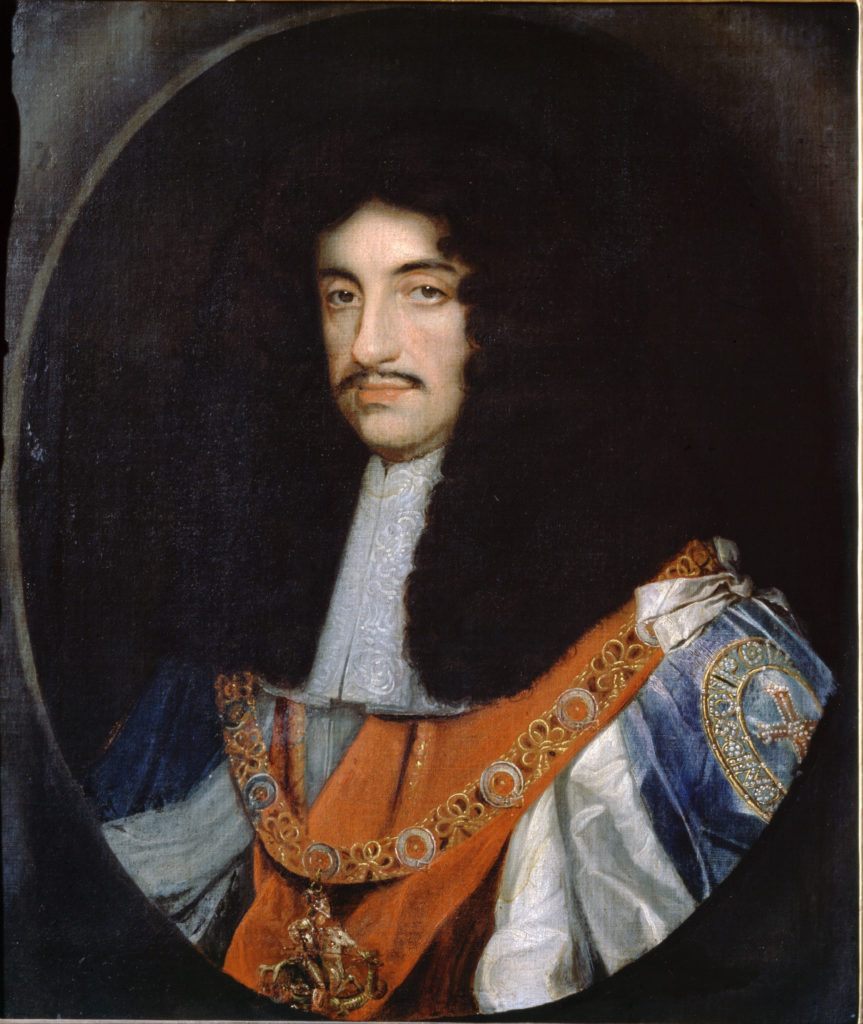
Charles II: The Great Fire of London’s Forgotten Hero


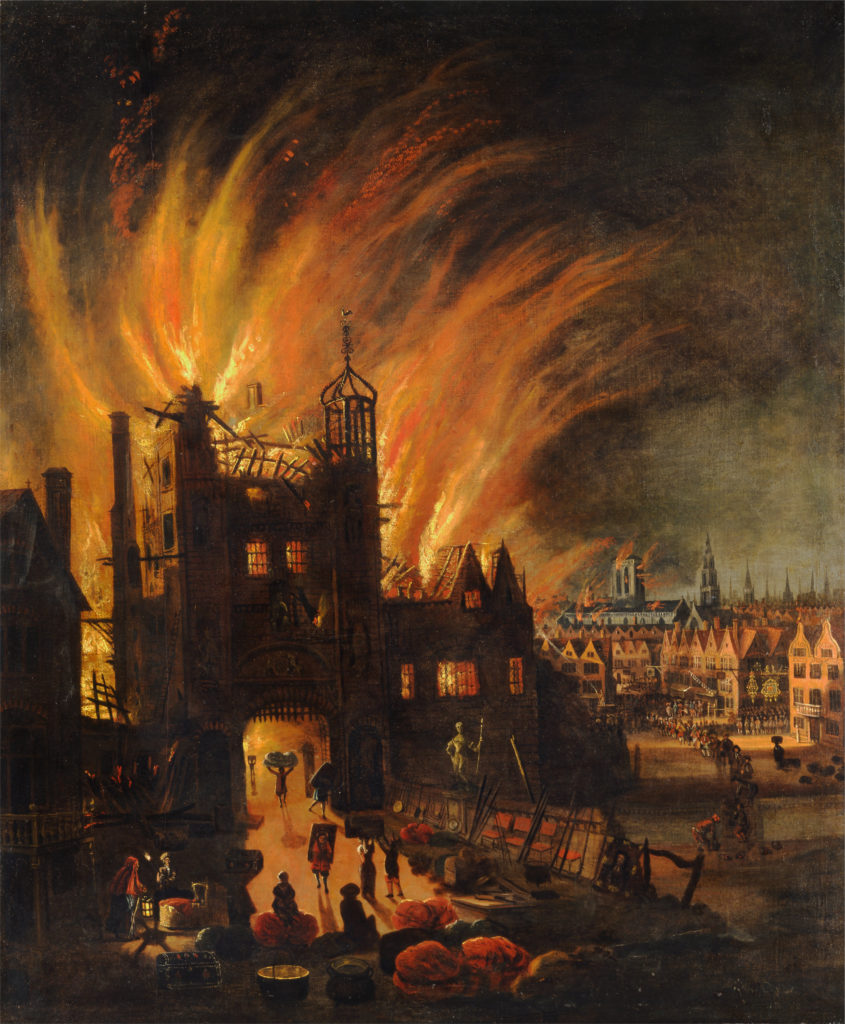
In the small hours of Sunday 2 September 1666, Samuel Pepys, Secretary to the Navy, was roused from his bed with news of a fire burning several streets away. He went to a window of his house close by London’s east wall and looked out over the city. There was, indeed, a conflagration over towards Billingsgate, but these outbreaks were quite common in the narrow streets and timber-framed houses of the capital. Pepys decided that there was nothing to worry about and returned to bed. He needed his sleep. He – and England – had enough problems to worry about without a little fire in overcrowded London city. 
After all, the nation was divided and discontented and the existing government was highly unpopular. More than six years had passed since the return of Charles II from exile in Europe and the restoration of the monarchy after the republican rule of Oliver Cromwell. The myth of England being delivered from gloomy, oppressive Puritan rule by the ‘Merry Monarch’ is well ensconced in popular perception but it is a myth. It did not take long for the mood of the capital and the country to change as the policies of the new government were implemented. 
If a week is a long time in politics, six years may seem like an eternity. Throughout the country people had seen royalist landowners settling scores with neighbours and tenants who had sided with the parliamentarians in the Civil War. The bishops, now installed or re-installed in their dioceses, rigorously enforced the new religious settlement and, as a result, 2,000 clergy who could not accept the ‘high church’ doctrines and ceremonies of the new regime were turfed out of office. Charles, who had learned his politics the hard way, was not totally behind the policies of the Restoration Parliament. He knew the importance of toleration. The French, among whom he spent most of his adult life, had a saying: ‘ne reveillez pas le chien qui dort’ – ‘don’t rouse the sleeping dog’ – and it expressed a philosophy close to Charles’ heart. However, too many of his followers were set on revenge. (Read more.)
Share

The European Death Wish

 From The New English Catholic:

There is a particular kind of death a civilisation can choose for itself — not conquest, not plague, but a quiet, voluntary letting go.

Europe is in the grip of it now. You can see it in the birth rate, in the open border, in the bishop who will not speak, in the historian who will not defend. This is not, at root, a crisis of policy. It is a crisis of the soul. And it begins with a simple, uncomfortable fact: there seems to be no capacity left for saving our society, for valuing our society as it is. Instead, it's being overcome by a whole series of different forces and different people.

We were in immense shock when we saw the way in which 60,000 Moroccans invaded Spain. Now, the word invasion is hugely contested. The left hate it because, of course, it is so powerful and so descriptive, and we could find some more sophisticated words — mass incursion.

But the fact is that governments exist in order to defend their people. And the kind of incursion that we’ve been experiencing, both in Spain and above all in the UK, means that there are demographic changes taking place in which the people the government are elected to defend become somebody else’s people. In other words, they’re demographically replaced.

But let’s not slip into what will appear to some people to be non-left-wing rhetoric — Let’s try to avoid the trap of right versus left. (Why should we use a political structure that grew out of which side of the French king you sat on in the 1770s in order to describe our politics?) It;s hard to know what ‘right’ is when there is nothing left to conserve.

Our politics are effectively of what we call the left, which are progressive, revolutionary, utopian: based on the fallacy that human beings are perfectible, and conformity can be enforced when refused.

What is then the non-left? Does non-left just mean everything else? There is no right or far right, as the left-leaning commentators insist, as they create a kind of opposing ‘extremist’ bogeyman fictionally in order to justify their struggle against anybody who questions their progressive values. So: left, utopian left, and non-left.

What is the real diagnosis of where we have been brought to? (Read more.)

Share

Tuesday, August 4, 2026

What the Midterms Are Actually About

 From Batya Ungar-Sargon:

It’s less than a hundred days until the midterm elections decide who controls the House and the Senate—and whether President Trump and his Cabinet spend the next two years enacting his agenda or fighting impeachment, which will certainly be the Democrats’ first order of business.

But this week gave us a number of stark visuals representing what your choices actually are when you go into the voting booth in November.

One of them came by way of Spain, which was invaded this week by tens of thousands of men from Morocco, who streamed across the border after the border “totally collapsed” as one official told the AP.

The border collapse comes after Spain gave amnesty to more than a million illegal migrants, the largest migrant amnesty in European history. Naturally, when news about the amnesty program spread, thousands more decided to take their chances at achieving European residency.

Because that’s what amnesty for people who cross your border illegally does: It incentivizes people to cross your border illegally, because it is a reward for crossing your border illegally.

But if you think this can only happen in Europe, I urge you to think back to 2022. Remember these scenes? This isn’t Spain. This is Texas. (Read more.)

Share

Tuesday, July 28, 2026

Has Hitler’s Order for the Holocaust Been Discovered?

 From It Can Always Get Worse:

To summarise briefly: why the Holocaust happened is straightforward—because Adolf Hitler wished it to—but how and when the decision was taken is debated. The debate turns largely on whether there was a Führer Order for the Holocaust. While no such document has ever been found, this is not surprising. There was extensive destruction of Nazi documentation, and Hitler routinely conveyed orders verbally anyway, so, if there was a Führer Order, it was almost certainly never written down in the first place. Accentuating the difficulties, the surviving records are written according to a euphemistic official Nazi discourse that leaves room for interpretation, and Hitler—like Lenin—deliberately cultivated uncertainty within the regime about his role in the worst crimes.1

Historians are broadly divided into two camps, those who argue for a moment between July and December 1941 when a Führer Order was issued, and those who argue there was no “moment”, but rather an iterative process between Hitler at the centre and various lower officials in the occupied territories, where the Führer endorsed, rather than originated, the escalatory steps of the Shoah.

In assessing the evidence historians are working with in coming to these divergent conclusions, one aspect I highlighted was:

SS operatives involved in implementing the Final Solution … have uniformly testified that their orders came directly from Hitler. There is no reason to doubt the SS men were substantially correct, that Hitler stood behind the fundamental decision for the Holocaust and every decision of significance as it escalated. But it does not settle the question of a Führer Order because none of the SS officials heard Hitler’s verbal instruction(s) personally; they all heard of Hitler’s will through [Heinrich] Himmler. And Himmler did not specify to his subordinates whether, during his increasingly frequent face-to-face meetings with Hitler from the summer of 1941 onwards, the Führer had approved or initiated genocidal measures. (Read more.)


Will there be another genocide? From Welcome to Absurdistan:

Fourteen years ago I published a book one chapter of which entirely dealt with the forests fires curently raging across Canada choking the lungs of Americans from Maine to Chicago. It was published by Harper Collins in New York, and received a good old fashioned push by their PR department.

I woke up at 4 am to get on drive time in Texas and Atlanta. I must have spoken to 30 million people - in theory - the PR kept me up on the numbers each radio host had, I spoke to the big names, including the sainted Dennis Prager which pleased HC no end. In each interview I hit the major highlight of the book - the most shocking crime against people and nature - outlining how “natural regulation” installed by the UN FAO (Food and Agriculture Organization) had made the forests thick, desiccated: visualize a whole bunch of unthinned little trees leaching all the water from the soil, fire ladders growing up the trees, just waiting for a lightning strike or stupid “activist” kid to trigger conflagration.

All over the world, these policies, these regulations had been forced in a series of iniquitous meetings where entire nations were placed under the rule of weedy, stupid, vicious idiots who called themselves “scientists” employed in Turtle Bay, who had, courtesy of the Rockefellers and a bunch of other malignant families - basically the ones holding the debt of the New York Federal Reserve - crowned themselves Lords of Nature. And, as I began to understand, planned to take it all from us. (Read more.)

Share

Friday, July 24, 2026

Awaiting the Birth of the Silicon Antichrist

 From Chronicles:

“Technology,” we are often told, “is neither good nor bad, but merely what we make of it.” But what if technology is taking advantage of our complacency to make something of us?

What if, in fact, there really is a “ghost in the machine”? The phrase was coined by British philosopher Gilbert Ryle in 1949 as part of a critique of Cartesian dualism. While Ryle would no doubt have scoffed at the notion that our increasingly complex machines might come to embody autonomous minds, the idea has begun to proliferate in the age of AI and is frequently embraced by our Silicon Valley savants.

Already in the 1960s, media guru Marshall McLuhan popularized the idea that electronic technology was quickly becoming an extension of human consciousness, radically realigning our self-awareness and reshaping the social order. If McLuhan sometimes expressed mild reservations about the long-term implications of electronic media, the French thinker Jacques Ellul, a contemporary of McLuhan, was a trenchant critic of what he called “the technological illusion.” As Ellul wrote in The Technological Society (1954), “Technique has become autonomous, it has its own laws, its own evolution, and its own demands.”

Paul Kingsnorth’s latest book explores the implications of Ellul’s assertion, especially in light of the emergence of a world in which the internet has become the dominant political and social reality. In Kingsnorth’s analysis, the “Machine” (always capitalized) becomes an all-encompassing term describing the malign evolution of modernity under the influence of technological change. Artificial Intelligence, in his view, is simply the endgame in a development that began with the Industrial Revolution, though its roots in Western thought date back to Duns Scotus and the late Middle Ages. The era of the great revolutions, the rise of Progressivism, the emergence of the nation-state, capitalism, Marxism, feminism, the sexual revolution—Kingsnorth believes all of these and more are profoundly implicated as carriers of, or as products of, the tyranny of the Machine. In short, technology, which has been with us since the invention of the wheel, has in the modern era become what philosopher Eric Voegelin might have termed a “second reality” that threatens to devour our very humanity. (Read more.)

Share

Wednesday, July 1, 2026

"Enchanted with Life"

Chateaubriand remembers Marie-Antoinette, Queen of France.
After his presentation to Louis XVI, Chateaubriand passed through the gallery to meet the Queen returning from chapel. “She soon came in sight,” he says, “surrounded by a large and brilliant suite; she made a dignified courtesy, appearing enchanted with life. And those fair hands, which then held so gracefully the scepter of so many kings, were, before they were tied by the executioner, to patch the rags of the widow, the prisoner of the Conciergerie.” (Read entire post.)
Share

Saturday, June 20, 2026

The Christology of the Stairs: Medieval Raised Sanctuaries vs. Modern "Worship Spaces"

 From Hilary White at The Sacred Images Project:

Visitors to the medieval churches of Umbria and Tuscany are often surprised by an architectural feature that is found surviving in great abundance in our area; raised or elevated sanctuaries in our most ancient churches. That is, the place where the liturgical actions happen, that we are used to seeing conducted right in front of us, is set on a high platform, sometimes as much as 15 feet above the level of the nave, and mostly impossible to see.

We’re used to the sanctuary part of the church being raised at least a few feet above the level of the nave, often with the altar raised again on a stepped platform, but several meters? So high the congregation can’t see anything?

Architecture always catechizes. We all know that Catholic church architecture is used to express particular beliefs about the nature of reality, Christology, man’s relationship with God and his proper place in creation. Most Catholic churches, until the middle of the twentieth century, were built on a cruciform floor plan. The church itself is the image of the crucified Christ; the faithful literally enter into the symbol. Medieval builders extended this symbolic language far beyond the floor plan. Every aspect of the building could be made to communicate theological truths. These ancient stone churches emerge from a worldview that understands reality itself as hierarchical, which the designers of the elevated sanctuaries took very literally.

 Why are so many ancient churches in Umbria and Tuscany built with sanctuaries raised high above the congregation, sometimes so high that much of the liturgy would have been difficult to see? It has very little to do with practicality and a great deal to do with how medieval Christians understood Christ, the Mass, heaven, earth and the structure of reality itself. (Read more.)


Share

Wednesday, June 10, 2026

The UN, Slavery, and History’s Selective Amnesia

 From The European Conservative:

In March 25th, the United Nations General Assembly adopted a resolution describing the transatlantic slave trade and the enslavement of Africans as “the gravest crime against humanity.” The text was adopted by 123 votes to 3, with 52 states abstaining, including France, Portugal, Spain, the United Kingdom, and most European countries. The United States, Israel, and Argentina voted against.

The symbolic significance of this resolution is considerable. No one would dispute that the transatlantic slave trade constitutes one of the greatest tragedies in human history. For several centuries, millions of Africans were deported to the Americas under appalling conditions, reduced to the status of commodities, and integrated into an economic system based on their dehumanisation. The memory of this crime deserves to be acknowledged and passed on.

But it is precisely because the history of slavery is too grave to be exploited that we must question the ideological assumptions underlying this resolution. For the controversial nature of the text does not lie in its condemnation of the transatlantic slave trade but in what it omits.

By designating the transatlantic slave trade as ‘the gravest’ of crimes against humanity, the UN appears to be establishing a moral hierarchy among historical atrocities—as if certain sufferings could be considered superior to others and as if one could objectively measure the horror and declare that one crime surpasses all others. This wording partly explains the numerous European abstentions, for whom, for many years, the Holocaust has been held up as the ultimate benchmark of human barbarity. Regardless of the comparison with the Second World War, the motivations for which may be suspicious, several states argued that it was not for the UN to establish a hierarchy among crimes against humanity. Should we place Auschwitz and Kolyma, the Armenian genocide and the genocide of the Tutsis in Rwanda on a graduated scale, as if ranking the competitors in a macabre contest?

But the main difficulty lies elsewhere. This resolution completely ignores the existence of other slave systems which have nevertheless shaped the history of Africa and the world for over a millennium. (Read more.)


Share

Sunday, May 31, 2026

Why Constantinople’s Fall Was Not Inevitable

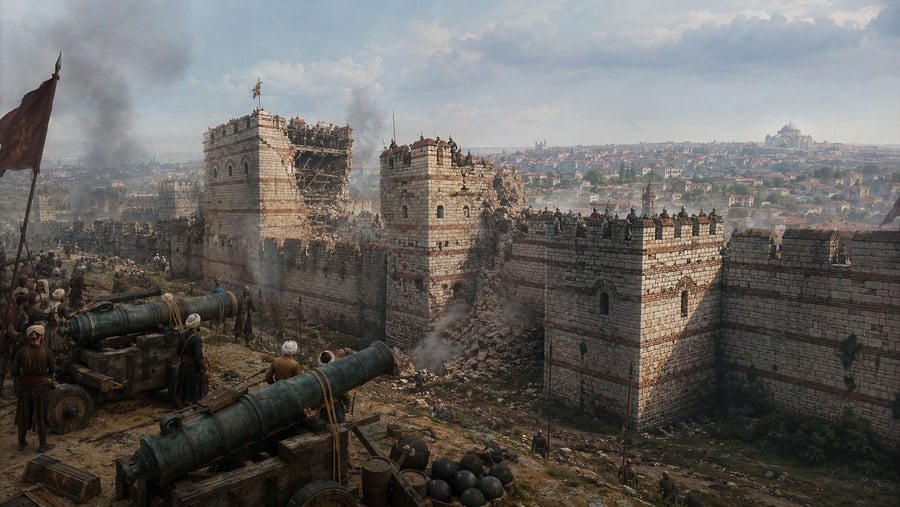
Illustration of the 1453 siege of Constantinople, showing Ottoman artillery attacking the Theodosian Walls 

From The Greek Reporter:

Historian Anthony Kaldellis, Professor of Classics at the University of Chicago, challenges the long-held idea that the Fall of Constantinople in 1453 was inevitable, arguing that the siege should be understood through the specific military and tactical factors that shaped its outcome.

Speaking to Greek Reporter about his new book, 1453: The Conquest and Tragedy of Constantinople, Kaldellis explains that historians cannot prove that an event was inevitable because they have only one historical timeline to go by. “In a sense, nothing in history is inevitable,” Kaldellis tells Greek Reporter. “We can’t go back and run experiments to see if we change certain variables what would happen.”

His argument is directed against the idea that Constantinople’s fall was inevitable, a view he noted appears across scholarship, novels, journalism, and online commentary. Rather than reading 1453 backward from its outcome, Kaldellis argues that the event should be examined through the variables that determined the result “one way or another.” (Read more.)

More HERE, HERE, and HERE.

Share

Wednesday, May 27, 2026

The Man, the Ox, the Lion and the Eagle


From Hilary White at the Sacred Images Project:

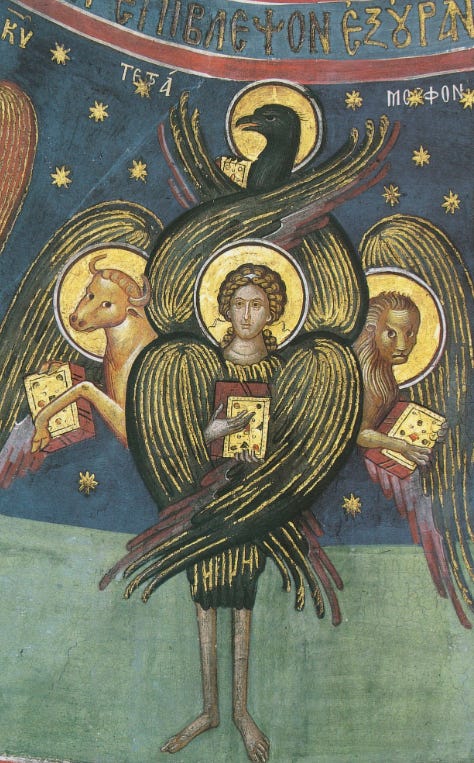
There is a running internet joke going around about “biblically accurate angels” that usually involves sticking googly eyes and extra wings onto random objects until they become progressively more horrifying. Like most jokes, it exists because there is a grain of truth behind it. The heavenly beings described in Scripture are often deeply strange, covered with eyes, multiple wings and composite forms, sometimes not even remotely anthropomorphised and seem designed less to comfort than to overwhelm the human imagination.

We’re going to take a brief look today at the background for these images, and we’ll learn how Christian artists traditionally rendered as symbols some of the strangest passages in Scripture.

You’ve seen them hundreds of times if you’ve ever looked at medieval art, even if you never noticed them consciously. Whenever you see an image of Christ enthroned, surrounded by the mandorla - the “Christ in Majesty” prototype we’ve discussed, you also see these four strange beings: a winged man who looks like an angel, a lion, an ox and an eagle, usually all with wings and halos. And it’s in nearly every single depiction of it, from illuminated manuscripts and book covers to Romanesque frescoes and carved Gothic tympana over church doors. (Read more.)

Share

Thursday, May 14, 2026

Is God Using Communism to Punish Us?

 From Mark Judge at Hot Air:

 In his 1948 book Communism and the Conscience of the West, Bishop Fulton Sheen argues that Christianity and communism have similar world views. Christianity contains the truth about our lives, teaching us that love of God and neighbor, respecting the natural law, and the anticipation that we will have to battle real evil in this world. It is bluntly realistic. Communism is a distortion of Christianity. It makes the individual, in Sheen’s phrase, “a robot,” a slave to unstoppable historical and economic forces, which will result in utopia - if only after a lot of violence.

     Yet both Christianity and Communism see the world as the spiritual battleground that it is. Sheen respects Communism more than he does liberalism, which seeks comfort and virtue without any real battle.“Thought utopian and violent,” Sheen wrote, “Marxism reveals a better insight into the historical process than liberalism, which saw peace coming without a struggle and which denied that even a relative Easter of economic order would come without the Good Friday of self-sacrifice and effort.”

 Sheen goes on to argue that “the Gospel for the last Sunday of Pentecost and the Gospel for the first Sunday of Advent are gospels of catastrophe, they proclaim that the final era of peace will not be ushered in until the final conflict between good and evil, when God shall come to judge the living and the dead and the new city of Peace will be descending from the heavens.”

    Sheen also points out that the Russians learned Marxism from German intellectuals:

As many a parent who educated his child in an extremely progressive school, where the child equated freedom with doing what he pleased, is now the parent who wants to know what to do with his recalcitrant, alcoholic, neurotic son, so the Western world that taught Russia some bad ideas may soon want to know how it can be saved from a country which learned is lesson all too well. A Freudian psychoanalyst cannot help the son, so neither politics nor economics can help the Western world, for the fault is deeper; the world is under the judgment of God and needs repentance.    

    Sheen writes that “though Babylon fell because it was very wicked, it was nonetheless God’s instrument for disciplining the people of Judah. Assyria was bestial, but to was the ‘rod and staff’ of God’s anger against the people of Israel.” In the West, “communism may be the instrument for the liquidation of a bourgeois civilization that has forgotten God.” (Read more.)

Share

Thursday, April 16, 2026

Pope Leo XIII and the St. Michael Prayer

From Unveiling the Apocalypse:
I would like to recommend an excellent book by Kevin Symonds, titled Pope Leo XIII and the Prayer to St. Michael.  This recently published book, which examines the history behind the composition of the Prayer to St. Michael, presents a wealth of scholarly evidence which attests to the authenticity of the vision of Pope Leo XIII.  The author has obviously undertaken a painstaking amount of research for this book, and has translated several key documents which were previously unavailable in English.  A fresh batch of information is brought to light here, including additional material emanating from the eyewitness testimony provided by Fr. Pechenino, and a homily on Pope Leo's vision attributed to Cardinal Pedro Segura y Saenz. Among these new findings we find the surprising fact that the earliest accounts of this vision records that Satan had actually requested a period of 50-60 years in which to destroy the Church, rather than 75-100 years. 

While these documents which Symonds has unearthed are undoubtedly the earliest of their kind, and therefore possess the strongest claim to the full truth on this matter, we cannot fail to notice that this contradicts the common perception that Pope Leo's prophetic vision comprised the entirety of the 20th century, rather than just the first half of it.  On the surface, this discovery appears to indicate that the period of Satan's greater power ended around the middle of the 20th century, at the close of the Second World War. Once again, such a scenario appears to contradict the actual sequence of historical events, and it is plainly evident that the true grip of Satan's greater power only seemed to really take hold in the latter half of the 20th century, after the events of the Second World War, when the Sexual Revolution which took place in the 1960's coincided with a massive decline in the Church - paving the way for current apostasy we are still enduring today. (Read more.)
Share

Wednesday, April 15, 2026

The Fiery Sword of the Prophet Elias

 Picture 

From TFP:

In the words of Saint Bernard to Pope Eugene III, by vindicating the rights of God, Elias was the model of justice, mirror of holiness, example of piety, champion of truth, defender of the faith, doctor of Israel, teacher of the uneducated, refuge of the oppressed, advocate of the poor, an arm of widows, eye of the blind, the tongue of the dumb, avenger of crimes, dread of the wicked, glory of the righteous, rod of the mighty, hammer of tyrants, father of kings, salt of the earth, the light of the world, the prophet of the Most High, forerunner of Christ, the anointed of the Lord, terror of the Baalites and thunderbolt of idolaters.3

Elias fulfilled the threefold mission God had entrusted to him at Horeb. The time was approaching for him to leave the earth. For an ordinary person, this necessarily means passing through the threshold of death. However, divine Providence had other plans for Elias, the prophet of great exceptions. Some scholars believe the angels took him on a chariot of fire4 to an unknown place on earth; others, that he went to the earthly paradise. As he was taken up to heaven, he threw down his cloak to Elisha, his disciple and successor.

Thus, from his place, “consumed with zeal for the Lord God of hosts,” the prophet Elias follows the unfolding history of salvation.5 He contemplates the extreme decadence of modern times, when the laws of the Lord God are trampled upon like never before. He despises the idols which twenty-first century men have erected to Moloch, the God associated with child sacrifice, through the unspeakable sin of abortion; or to idols of sensuality with the increasing number of sexual immoralities added and accepted by society at large; finally, he can scarcely hold back his fiery sword when he witnesses the corruption and betrayal of members of the One True Church of Christ.

We pray to Saint Elias for the grace of perseverance and fidelity to the Lord of Hosts in these challenging times and we join our supplications to Ecclesiasticus . . .

“And who can glory like to thee? Who raisedst up a dead man from below, from the lot of death, by the word of the Lord God. Who broughtest down kings to destruction, and brokest easily their power in pieces, and the glorious from their bed. Who heardest judgment in Sina, and in Horeb the judgments of vengeance. Who anointedst kings to penance, and madest prophets successors after thee. Who wast taken up in a whirlwind of fire, in a chariot of fiery horses. Who art registered in the judgments of times to appease the wrath of the Lord, to reconcile the heart of the father to the son, and to restore the tribes of Jacob. Blessed are they that saw thee, and were honoured with thy friendship” (Ecclus. 48:4—11). (Read more.)


Share

Saturday, April 11, 2026

Twelver Doomsday Cult

 From Tierney's Real News:

We all know the danger of Iran getting a nuclear weapon—it’s a nightmare scenario that could change the world overnight. A detonation would not just endanger Israel, but could rain radioactive fallout across Jordan, Saudi Arabia, Egypt, and beyond. Prevailing winds would carry lethal poison across the Middle East, crippling the region and reshaping civilization as we know it.

Iran is no longer just a regional menace — it’s a global one. Advances in its missile program now give Tehran the ability to mount a nuclear warhead on an intercontinental ballistic missile capable of reaching Europe — and, in time, even the eastern United States. A single launch could erase cities and usher in a new dark age.

Yet Iran stands out as uniquely dangerous in the region and the world - not because of its ancient Persian heritage or the Iranian people themselves, who once thrived under the Shah. Under the Shah, Iran was a prosperous ally of America and Israel. Women were free and the nation’s oil wealth funded growth.

What replaced that modern Persian confidence was something horrifying: Ayatollah Khomeini’s fusion of apocalyptic Twelver Shia Islam and atheist Soviet-style Communism. He combined them together in what is known as the Twelver Shia version of Islamo-Communism. It’s this “red‑green” hybrid — part cleric, part commissar — that makes Iran uniquely dangerous in the 21st century. (Read more.)

Share

Thursday, April 9, 2026

Understanding Iran’s Apocalyptic Threat

 From Tierney's Real News:

We all know the danger of Iran getting a nuclear weapon—it’s a nightmare scenario that could change the world overnight. A detonation would not just endanger Israel, but could rain radioactive fallout across Jordan, Saudi Arabia, Egypt, and beyond. Prevailing winds would carry lethal poison across the Middle East, crippling the region and reshaping civilization as we know it.

Iran is no longer just a regional menace — it’s a global one. Advances in its missile program now give Tehran the ability to mount a nuclear warhead on an intercontinental ballistic missile capable of reaching Europe — and, in time, even the eastern United States. A single launch could erase cities and usher in a new dark age.

Yet Iran stands out as uniquely dangerous in the region and the world - not because of its ancient Persian heritage or the Iranian people themselves, who once thrived under the Shah. Under the Shah, Iran was a prosperous ally of America and Israel. Women were free and the nation’s oil wealth funded growth.

What replaced that modern Persian confidence was something horrifying: Ayatollah Khomeini’s fusion of apocalyptic Twelver Shia Islam and atheist Soviet-style Communism. He combined them together in what is known as the Twelver Shia version of Islamo-Communism. It’s this “red‑green” hybrid — part cleric, part commissar — that makes Iran uniquely dangerous in the 21st century. (Read more.)


Share