Showing posts with label Bonnie Prince Charlie. Show all posts

Wednesday, September 23, 2026

Queen Victoria, the Stuarts and Scotland

Victoria and Albert as Catherine of Braganza and Charles II by Winterhalter


Gown worn by Victoria at her Stuart Ball

Tartan dress of Queen Victoria

Royal Family in Highlands

Scotch air, Scotch people, Scotch hills, Scotch rivers, Scotch woods, are all far preferable to those of any other nation in or out of this world.~Queen Victoria, ca. 1849. 

 In the mid-18th century, in an uprising known as "The 45" Prince Charles Edward Stuart tried to reconquer the thrones of England and Scotland for his father James III, known as the "Old Pretender." The thrones had been usurped by the German and Protestant House of Hanover in spite of the fact that the legal Catholic sovereign was alive and well. The Scots in particular did not take well to their rightful sovereign being disinherited because of the English preference for German Protestants. The uprising failed miserably, bringing more hardship and tragedy to the Scottish people for the remainder of the century. Meanwhile many songs, tales and legends of that time imprinted themselves upon the land and the people. Many of those tales and legends found their way into the writings of Sir Walter Scott, one of the first historical novelists, whose Waverley novels of the early 19th century brought the lost Stuart rebellions and their heroes to life for a new generation. The prince Regent, the future George IV, rebelled against his Hanoverian patrimony after reading the Scott novels, and headed for Scotland.

From Peter Harrington:

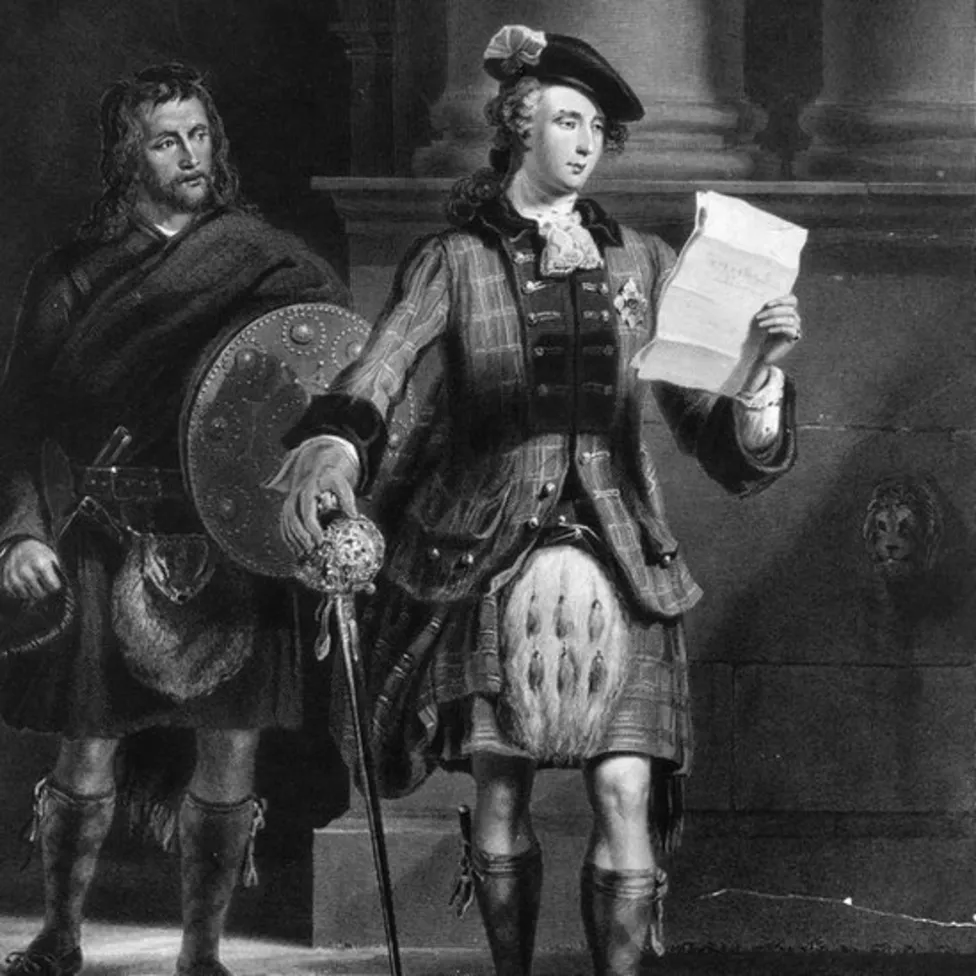
The romanticisation of Scotland can be most definitively linked in literature with the Waverley novels of Sir Walter Scott. The first of the Waverley novels was published in 1814 and was set during the Jacobite uprising which took place almost a century earlier. The novels were so popular that Scott was propelled to fame, and was invited to dine with King George IV, (then Prince Regent). When, several years later, the Scottish ‘Radical War’ of 1820, inspired by the American and French Revolutions, caused King George to plan the first royal visit to Scotland in over two hundred years in an effort to quell unrest, it was Scott he called on to carefully stage manage the visit. By now a baronet with numerous valuable connections to Scottish nobility, Scott saw the opportunity both to avert an uprising and to promote highland culture. He reasoned that, because of George’s lineage, the king could legitimately claim as much Stuart heritage as Bonnie Prince Charlie and could thus present himself as a Jacobite prince, properly accoutred Royal Stuart tartan. Kilts at this time were no longer generally worn, having been banned by the Dress Act of 1746, which made the wearing of ‘Highland dress’ illegal. Though the act was repealed in 1782, kilts had only come back into fashion with the Scottish gentry, a number of whom set up ‘Highland Societies’.... For the king to appear so attired was not only an attempt to appeal to the heritage of the Scottish people but also to gloss over old wrongs.

George’s visit sparked an interest in Scottish dress, and, in its wake, the demand for kilts grew so high that Scottish weaving mills were unable to cope with the demand. It was in this period that (contrary to the generally assumed belief that individualised tartans are a much older tradition) many of the clan tartans were designated. (Read more.)

 George IV died and was succeeded by his brother William IV, who in turn left the throne to their niece Victoria in 1837. It was the Romantic Era, and Queen Victoria also loved the Waverley novels. In general she found the Stuarts far more romantic than her own Hanoverians and decided to fill her life with tokens of the Stuart homeland of Scotland. Her beloved husband Prince Albert shared her predilection, in spite of being German himself and in the 1840's they began spending as much time as possible in their northern kingdom.

From Quartermile Blog:

The first land to capture the Queen’s heart wasn’t Scotland, but Ireland. Early in her reign, Victoria spent her holidays in. Yet after the potato famine of 1845 irreparable damage was done to the relationship between the British government and the people of Ireland. Despite Victoria’s personal donation of £5,000 to the cause (nearly £600,000 in today’s money) and her visit to the country in 1849, the relationship never recovered....Scotland fared much better in Victoria’s eyes. In fact, Victoria made frequent visits north of the border during her reign despite the fact that Scotland had only been visited twice by reigning monarchs in the previous two centuries.

Victoria and Albert’s love for Scotland drove them to take out a long-term lease on the stunning Balmoral Castle in Deeside in 1848. Later, in 1852, the royal couple permanently purchased the property for £31,500 (£4million today) and had it significantly extended. From this point on, Victoria and Albert spent a section of each summer in Balmoral, thanks to the advances in British rail travel....Victoria’s ever growing affection for Scotland didn’t just stretch to the land itself, but to the culture and fashion too. Through their experience of Scotland, Victoria and Albert both became big fans of tartan, and helped to elevate the status and reputation of the pattern south of the border.

According to accounts from the time, Victoria and Albert enthusiastically redecorated Balmoral Castle with reams of “Balmoral tartan, in red and grey” furnishings. They even included “innumerable stags’ antlers” in their décor. For Victoria, the use of tartan was an outward sign of being connected to her favourite part of the world. (Read more.)

Victoria showed that she not only loved Scotland but cherished the memory of the Stuarts, masquerading as Catherine of Braganza, consort of Charles II, at a ball. She had an Italian sculptor create a marble statue of Princess Elizabeth Stuart, the daughter of Charles I who died in prison at age thirteen, reputedly with her head on her murdered father's Bible. She passed the interest on to her children, as can be seen from a water color of Mary Queen of Scots by the Princess Royal. The Stuarts must have fulfilled Victoria's vision of a monarchy in which the kings and queens did not only reign but ruled, had adventures, tragedies, romances and died for love.

Princess Elizabeth Stuart: "Go ... And see the tomb of Charles's child wet with Victoria's tears"

Carl Haag’s "Luncheon at Cairn Lochan" depicts the royal family picnicking in Scotland.

Balmoral today with flock wallpaper ordered by Queen Victoria

Painting of Mary Queen of Scots by Queen Victoria's daughter the Princess Royal


Share

Sunday, August 30, 2026

Mary of Modena: James II's Dazzling Queen

 The Writing Desk: Book review: Mary of Modena: James II's Dazzling Queen,  by Justine Brown

There are several cases throughout history of arranged royal marriages in which it was as if God had chosen to favor a particular country by sending a bride who possessed not only virtue but great physical beauty to be the wife of the ruler and the mother of the heir. A few of those alliances ended catastrophically when, for certain reasons, the bride in question was rejected by her adopted people, even when loved by her husband. I am thinking in particular of Henrietta Maria of France, despised for her attachment to her Catholic faith. There is also Marie-Antoinette, hated for her Austrian heritage, made worse by a campaign of vicious slander. The tragic Empress Alexandra, whom Tsar Nicholas married for love, was falsely accused of betraying Russia to her German relatives. Among such consorts, noble and fair to behold, shines Mary Beatrice of Modena, the second wife of James II. Justine Brown, author of The Private Life of James II, has surpassed herself in this comprehensive biography of the last Catholic Queen of England, Scotland and Ireland. I found it engrossing for the detailed descriptions of the pageantry of the final years of the Stuart dynasty before the so-called "Glorious Revolution" in which the true monarch was overthrown by his own daughters. The evidence is compiled to show that James II was driven from his throne not for any tyranny, as is claimed by Whiggish historians, but because his wife had give birth to a Catholic heir. It was hatred of the Faith that disrupted the royal line and led to the weakening of the royal authority, so that in time British sovereigns reigned but no longer ruled.

From the Amazon page:

Mary Beatrice learns governance, defies scandal, and becomes a steadfast beacon for Jacobite resilience amid a turbulent Restoration era.

The 1688 “Glorious Revolution” that toppled James II and VII also veiled his consort in propaganda. Mary of Modena: James II’s Dazzling Queen reveals the extraordinary woman beneath. Lovely and spirited, Mary Beatrice Isabella d’Este is also England’s sole Italian queen. Her father came from an ancient line, while her mother was one of Cardinal Mazarin’s seven famed nieces (the “Mazarinettes”).

Mary Beatrice learned the rudiments of governance at her widowed mother’s knee, and would one day act as regent of the Stuart court-in-exile—first for King James, then for their son, James Francis Edward. “The Queen over the Water” would shine as a beacon for the Jacobite cause.

Once, Mary Beatrice longed to be a nun. Instead, the young woman had to accept a different mission—marriage to James Duke of York, heir to the thrones of England, Scotland, and Ireland. Although James’s conversion to Catholicism made their marriage possible, it set off a firestorm of controversy in the mysterious northern realm.

The story of the British Isles was romantic, but the reality was jarring. Thrown into the frenzy of Restoration politics, Mary Beatrice met each fresh episode courageously. Charles II adored his sister-in-law, but MPs strove to annul the “Italian match” before it could be consummated. She and James fell in love, but his philandering nearly broke her.

Building on Este tradition, Mary Beatrice won over the common folk, inspired poets and painters, introduced Italian opera, and drew talented ladies to court. She also attracted her flamboyant Mazarinette cousin Hortense Mancini to England, where she joined King Charles’s harem.

Ultimately, James and Mary Beatrice were coronated with great ceremony, but their troubles were only just beginning. For the first time in English history, it looked like the birth of a healthy prince might actually destroy the monarchy instead of strengthening it…
(Read more.)
In Justine's account, I found Mary of Modena to be inspiring not only as a brave and steadfast Queen but as a Catholic wife and mother dealing with adversity. As a teenage bride she was shattered to discover that the handsome husband she had fallen in love with was a chronic adulterer with a growing number of illegitimate offspring. And while the children of James' mistresses grew and thrived, Mary's children miscarried, or were stillborn or died young. But Mary, who had originally wanted to be a Visitandine nun, followed the teaching of the founder of the Visitation order, St. Francis de Sales. St. Francis de Sales emphasized a loving acceptance of trials as well as complete trust and confidence in God. Queen Mary's spiritual director was the Jesuit St. Claude La Colombière who brought to England the devotion to the Sacred Heart of Jesus, for he had been the confessor of  the Visitation nun who claimed to have visions of the Savior, known to history as St. Margaret Mary. Mary of Modena would help spread the devotion to the Heart of God throughout Europe in her later years of exile. Meanwhile, James II, whose childhood had been disrupted by war, imprisonment and exile, came to learn to live a devout life from his much younger wife, so that he gave up his transgressive lifestyle. I was particularly struck by the happiness of James and Mary when they had lost everything, but had each other and their children. I recommend this biography of a Queen of England who experienced a white martyrdom, yet the more she was diminished, the greater she became.
Share

Wednesday, March 19, 2025

Irish Jacobites in the 45

 From The Mad Monarchist:

One of those who helped Prince Charles actually get to Scotland was Lord Charles O’Brien, Viscount Clare. A Jacobite with a long record of service in the French army he would eventually attain the rank of Marshal of France and be made a knight of the Holy Spirit. It was Lord Clare who put Prince Charles in touch with the Irish shipping magnates who helped arranged the gathering of the men, material and funds the Prince would need to launch his expedition. At the time, Lord Clare was the commander of the Irish Brigade in the army of His Most Christian Majesty King Louis XV. This was a unit originally formed for French service in exchange for a larger contingent of French troops that were sent to Ireland to fight for King James II. When Prince Charles finally set out for Scotland he was accompanied by the “Seven Men of Moidart” of whom four were Irishmen; Sir Thomas Sheridan, Parson George Kelly, Sir John Macdonald and Sir John William O’Sullivan. Sheridan had been the tutor of Prince Charles and was over seventy when the expedition launched. His age would have made campaigning difficult and he was soon sent back to Rome to keep Prince James informed of the progress of the uprising. Parson George Kelly, likewise, did not remain too long in Scotland as he was sent back to France after the battle of Prestonpans to spread the word of the stunning Jacobite victory. (Read more.)

Share

Saturday, August 26, 2023

Bonnie Prince Charlie - a New Facial Reconstruction


From Once I Was a Clever Boy:

Dr William King was Principal of St Mary’s Hall in Oxford, which was owned and eventually absorbed by Oriel College. Wikipedia has a biography of him at William King (St Mary Hall) In addition to agreeing to let me quote from his e-mail Roderick also sent me the following additional information, for which I am most grateful:
 I found … descriptions of how Charles looked as he entered Holyroodhouse in September 1745.

Two of these were written by Whigs and they are worth quoting as you would expect them to be the least flattering. The first is from Dr Alexander Carlyle who wrote:

''I had the good fortune to see him, as I was close by him when he walked through the guard. He was a good-looking man of about five feet ten inches. his hair was dark red, and his eyes black. His features were regular, his visage long, much sunburnt, and freckled, and his countenance thoughtful and melancholy''.

The other was by Henderson who's description is as follows:

''He is a slender young man, about five feet ten inches high, of a ruddy complection, high nosed, large rolling brown eyes, long visage; his chin was pointed and mouth small, in proportion to his features: his hair red, but at that time he wore a pale Peruke: he was in Highland dress, with a blue sash wrought with gold coming over the shoulder, red velvet breaches, a green velvet bonnet with gold Lace round it, and a white cockade which was the cross of St Andrew. He likewise had a silver-hilted broadsword, was booted, and had a Pair of Pistols before him''.

No mention of blotches, open pores or unkempt hair.

(Read more.)


Also from Once I Was a Clever Boy:

Today is the 278th anniversary of the raising of the Jacobite standard at Glenfinnan in 1745 and by a fortunate coincidence that coincides with publicity for a facial reconstruction of the central figure on that day, Prince Charles Edward. Several news sites have reported about a project done by a masters student from Dundee University to reconstruct the appearance of the face of Prince Charles Edward as it was in 1745-6. The existing death masks from 1788 were scanned and then adjusted to allow both for the stroke which ended his life and for the intervening forty and more years of aging. Other features such as skin tone and hair were based on descriptions and paintings.

The BBC News website reports on the work at Death masks recreate face of Bonnie Prince Charlie.

The Daily Telegraph has an article about the result at Not so Bonnie Prince Charlie? 3D mapping reveals true face of 'handsome' Jacobite leader.

The Scottish Daily Express also covers the story at Prince Charlie was not as Bonnie as we thought as Jacobite's face recreated.

A previous facial reconstruction made in 2019 of the King-in-exile based on the death masks and other contemporary sources can be seen at New facial depiction created of Bonnie Prince Charlie. The effect created by the resulting portrait bust is rather of someone with a hangover or perhaps what the Prince might have looked like whilst on the run after Culloden, although for part of that time he let his beard grow. (Read more.)
Share

Monday, March 21, 2022

Lost Portrait of Prince Charles Edward Stuart

 From Wikipedia:

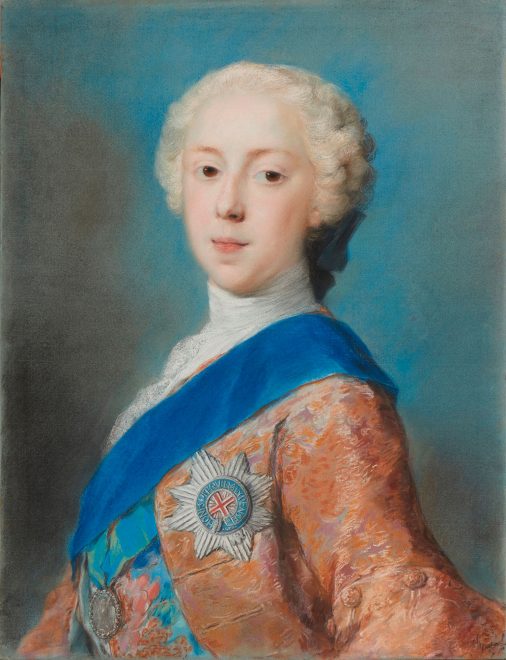
In 2009, Grosvenor revealed that the subject of the best-known portrait of Charles Edward Stuart,[3] the 5-foot (1.5-metre) pastel by the French artist Maurice Quentin de La Tour that had been hanging in the Scottish National Portrait Gallery since 1994,[4][5] was in fact of Charles's younger brother Henry Benedict Stuart.[1] This portrait had until then been widely reproduced and was "immortalised on countless tins of shortbread",[3] as well as appearing in the entry for Charles in the Dictionary of National Biography and numerous book covers, postcards and souvenirs.[3] Grosvenor said: "Bonnie Prince Charlie is one of my heroes, and I always felt bad about debunking what used to be his most famous portrait. So I'm delighted to have found the best possible replacement – a portrait painted from life on the eve of his invasion of England."[6] Whilst attempting to find this replacement – an authentic painting of Charles from the period of the Jacobite rising of 1745 – Grosvenor discovered a letter in the Royal Archives from John Stuart, the valet to Charles, that instructed Ramsay to go to Holyrood Palace in Edinburgh to paint Charles's portrait:[3][5]

Sir, you are desired to come to the Palace of Holyroodhouse as soon as possible in order to take his Royal Highness’ picture. So I expect you’ll wait no further call. I am, your most humble servant, John Stuart, Holyrood House 26th of October 1745.[7]

He also found a black and white photograph of the Ramsay portrait in the records of the National Portrait Gallery in London, although the artist was not given as Ramsay.[5] This painting was at Gosford House, the home of the Earl of Wemyss, where it had hung in increasing obscurity for 250 years in a gloomy corridor on the ground floor.[3] The painting was known to be of Charles but it was not known that Ramsay was the artist.[7] Ramsay authority Duncan Thomson, former director of the Scottish National Portrait Gallery, authenticated it as a work by Ramsay and said: "This portrait brings the prince back to life in a way I'd never thought imaginable. It's hard to overstate the importance of finding a portrait of the prince painted in Scotland, by a Scottish artist."[5]

On 30 March 2016, the Scottish National Portrait Gallery announced that the painting had been acquired for the nation through the acceptance in lieu scheme, with the painting being valued at greater than £1.1 million.[2] It was placed on display at the Scottish National Portrait Gallery just before the 270th anniversary of the Battle of Culloden.[2] (Read more.)

Share