Showing posts with label Princesses. Show all posts

Monday, September 28, 2026

The Pope in France

Pope Leo XIV in Notre Dame Cathedral
Pope Leo at Notre Dame with the statue of Our Lady of Charles X

 From Vatican News:

Light inundated Notre-Dame as Pope Leo XIV celebrated vespers in Paris' beloved Cathedral. It felt like a fitting celebration for the restored and renewed basilica, a place of worship and iconic symbol of the “Ville Lumière“, badly damaged by fire on 15 April 2019.

On that day, dramatic images and videos of the cathedral engulfed in flames, and of people praying in the streets as the fire consumed the building, spread around the world through social media and news outlets.

Today, the French Church has come together again. This time to rejoice, as the Pope visited the Cathedral and celebrated Vespers, almost two years after its reopening in December 2024, following a long and meticulous restoration process.

As the sun shone through the stained-glass windows, colorful patterns moved slowly across the walls. Meanwhile, an organ played and the choir sang while the bishops, priests, consecrated men and women, seminarians, and other members of the French Church solemnly prayed together with the Successor of Peter.

Before the Vespers, Pope Leo venerated a relic of the crown of thorns, which was placed on Christ’s head during his Passion. A symbol of his suffering and sacrifice before his Resurrection.

“We are gathered for Evening Prayer in this place which, more than any other, has invited the people of Paris for centuries to lift their eyes towards heaven,” Pope Leo said in his homily. (Read more.)

Mass at the Place de la Concorde, where thousands were guillotined (Via Daily Mail)

I wish instead of Robespierre the article had mentioned Madame Elisabeth. From Rome Reports:

The Place de la Concorde in Paris is a site marked by some of the darkest moments in French history.

During the Revolution, the guillotine stood here, and more than a thousand people were executed. Louis XVI, Marie Antoinette and Robespierre were among them.

Two centuries later, Pope Leo XIV celebrates the Eucharist here before nearly 600,000 people. A turnout that marks a new chapter in the Church in France.

The pope is using this celebration to call for a secular society.

LEO XIV

Seeing you gathered here, brothers and sisters, heirs to a long and beautiful history of holiness in France, I say to you: in turn, drink deeply from this spring that is the pierced Heart of Jesus. Yes, you thirst for God, for life, for truth, for unity, for peace, for communion, for happiness. You long to rediscover a radiant horizon, to build a renewed nation rooted in a faith that nourishes its very foundations.

But the pope does not stop with France’s religious identity. He goes straight to the individual and a much more universal question: what does a Catholic drink from when he or she thirsts for life?

LEO XIV

Brothers and sisters, we must acknowledge that here on earth, nothing can fully satisfy us. Just when we think our search is finally over and our efforts have been rewarded, that inner emptiness often resurfaces, even more profound than before.

Are we content with material possessions, immediate gratification, and the countless little idols that promise the world but leave our hearts empty?

And while, in 2008, Benedict XVI came to France asking how faith could survive in a secularized society, today, Pope Leo XIV is not talking about survival.

He is talking about renewing the country from its roots: building a renewed nation through a faith that can once again nourish society.

This is not about rebuilding a blood-soaked square, but renewing a society that, according to the pope, thirsts for truth, peace and happiness. (Read more.)

Pope Leo XIV visits the Sanctuary of Our Lady of Lourdes, a Marian shrine and pilgrimage site dedicated to Our Lady of Lourdes, on Sept. 27, 2026. | Credit: Vatican Media
Pope Leo in Lourdes

From EWTN:

Leo met Sept. 27 with staff and sick guests of the Accueil Notre-Dame (Notre Dame Home), a residential accommodation classified as a healthcare facility, which hosts sick, disabled, and frail pilgrims to Lourdes.

The Catholic shrine is one of the most visited in the world, drawing more than 3 million people every year, many in search of miraculous physical healing.

The 136-acre property includes the Grotto of Massabielle, where a young St. Bernadette Soubirous saw 18 apparitions of the Virgin Mary starting on Feb. 11, 1858. Today, pilgrims to the sanctuary bathe themselves in the freshwater spring Mary revealed to Bernadette.

Visitors have reported 7,000 healings since the apparitions; after lengthy investigations, the Church has declared that 72 of the recoveries were miraculous, meaning unexplainable by science. (Read more.)


 From CWR:

The Sanctuary of Our Lady of Lourdes is among the most popular Catholic shrines in the world, built on the site of Mary’s apparitions to St. Bernadette in 1858. It is particularly visited by the sick, who come to bathe in or drink its healing spring water.

In his homily, Pope Leo noted that a “call to conversion, both tender and urgent,” was a central part of the message the Virgin Mary entrusted to Bernadette, and that “it is today, not tomorrow, that we must repent.”

He said Jesus is quite direct about the call to repentance: “As St. Luke tells us, ‘Unless you repent, you will all perish.’ But he also extends our horizon beyond this earthly life to the horizon of eternal life.”

“Did not the Virgin Mary say to St. Bernadette, ‘I do not promise to make you happy in this world but in the next’?” Leo said.

The pope noted that we can often forget this in an age and society focused on progress and material wellbeing.

Eternal life is already won for us by Jesus’ sacrifice, he continued, but “the obstacle to grace and eternal life — the only obstacle to this love — is sin.” (Read more.)


 From OSV:

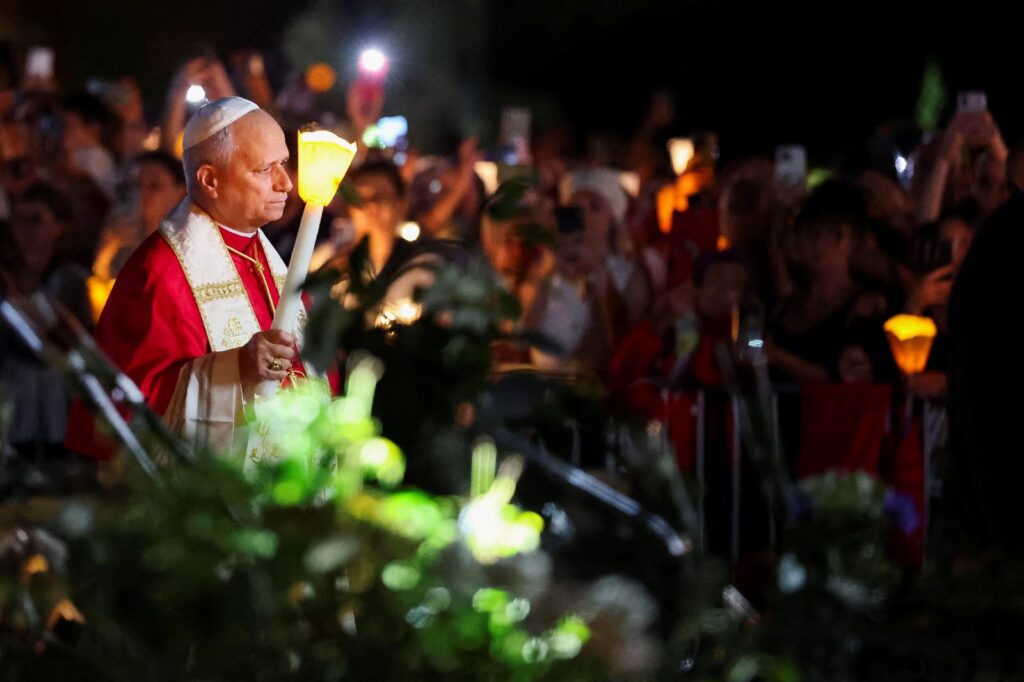
Holding a large candle in his right hand and a rosary in his left, Pope Leo processed slowly behind an illuminated statue of the Virgin Mary through the crowd of pilgrims holding candles, as the five decades of the glorious mysteries of rosary were prayed in multiple languages.

As the “Ave Maria” Lourdes hymn was sung between mysteries, all of the pilgrims in the square in front of the Basilica of Our Lady of the Rosary lifted their candles high in the air, creating a sea of lights.

“The light that guides us and draws us onward is the light of hope, which never abandons us even as we journey through this life — a life often marked by trials, yet already filled with the joy of knowing ourselves to be children of God, loved and saved by Jesus,” the pope said.

“Those who are sick are privileged witnesses to this transfiguration of our lives through faith and love of God and neighbor.” (Read more.)
Share

Wednesday, September 23, 2026

Queen Victoria, the Stuarts and Scotland

Victoria and Albert as Catherine of Braganza and Charles II by Winterhalter


Gown worn by Victoria at her Stuart Ball

Tartan dress of Queen Victoria

Royal Family in Highlands

Scotch air, Scotch people, Scotch hills, Scotch rivers, Scotch woods, are all far preferable to those of any other nation in or out of this world.~Queen Victoria, ca. 1849. 

 In the mid-18th century, in an uprising known as "The 45" Prince Charles Edward Stuart tried to reconquer the thrones of England and Scotland for his father James III, known as the "Old Pretender." The thrones had been usurped by the German and Protestant House of Hanover in spite of the fact that the legal Catholic sovereign was alive and well. The Scots in particular did not take well to their rightful sovereign being disinherited because of the English preference for German Protestants. The uprising failed miserably, bringing more hardship and tragedy to the Scottish people for the remainder of the century. Meanwhile many songs, tales and legends of that time imprinted themselves upon the land and the people. Many of those tales and legends found their way into the writings of Sir Walter Scott, one of the first historical novelists, whose Waverley novels of the early 19th century brought the lost Stuart rebellions and their heroes to life for a new generation. The prince Regent, the future George IV, rebelled against his Hanoverian patrimony after reading the Scott novels, and headed for Scotland.

From Peter Harrington:

The romanticisation of Scotland can be most definitively linked in literature with the Waverley novels of Sir Walter Scott. The first of the Waverley novels was published in 1814 and was set during the Jacobite uprising which took place almost a century earlier. The novels were so popular that Scott was propelled to fame, and was invited to dine with King George IV, (then Prince Regent). When, several years later, the Scottish ‘Radical War’ of 1820, inspired by the American and French Revolutions, caused King George to plan the first royal visit to Scotland in over two hundred years in an effort to quell unrest, it was Scott he called on to carefully stage manage the visit. By now a baronet with numerous valuable connections to Scottish nobility, Scott saw the opportunity both to avert an uprising and to promote highland culture. He reasoned that, because of George’s lineage, the king could legitimately claim as much Stuart heritage as Bonnie Prince Charlie and could thus present himself as a Jacobite prince, properly accoutred Royal Stuart tartan. Kilts at this time were no longer generally worn, having been banned by the Dress Act of 1746, which made the wearing of ‘Highland dress’ illegal. Though the act was repealed in 1782, kilts had only come back into fashion with the Scottish gentry, a number of whom set up ‘Highland Societies’.... For the king to appear so attired was not only an attempt to appeal to the heritage of the Scottish people but also to gloss over old wrongs.

George’s visit sparked an interest in Scottish dress, and, in its wake, the demand for kilts grew so high that Scottish weaving mills were unable to cope with the demand. It was in this period that (contrary to the generally assumed belief that individualised tartans are a much older tradition) many of the clan tartans were designated. (Read more.)
 George IV died and was succeeded by his brother William IV, who in turn left the throne to their niece Victoria in 1837. It was the Romantic Era, and Queen Victoria also loved the Waverley novels. In general she found the Stuarts far more romantic than her own Hanoverians and decided to fill her life with tokens of the Stuart homeland of Scotland. Her beloved husband Prince Albert shared her predilection, in spite of being German himself and in the 1840's they began spending as much time as possible in their northern kingdom.

From Quartermile Blog:

The first land to capture the Queen’s heart wasn’t Scotland, but Ireland. Early in her reign, Victoria spent her holidays in. Yet after the potato famine of 1845 irreparable damage was done to the relationship between the British government and the people of Ireland. Despite Victoria’s personal donation of £5,000 to the cause (nearly £600,000 in today’s money) and her visit to the country in 1849, the relationship never recovered....Scotland fared much better in Victoria’s eyes. In fact, Victoria made frequent visits north of the border during her reign despite the fact that Scotland had only been visited twice by reigning monarchs in the previous two centuries.

Victoria and Albert’s love for Scotland drove them to take out a long-term lease on the stunning Balmoral Castle in Deeside in 1848. Later, in 1852, the royal couple permanently purchased the property for £31,500 (£4million today) and had it significantly extended. From this point on, Victoria and Albert spent a section of each summer in Balmoral, thanks to the advances in British rail travel....Victoria’s ever growing affection for Scotland didn’t just stretch to the land itself, but to the culture and fashion too. Through their experience of Scotland, Victoria and Albert both became big fans of tartan, and helped to elevate the status and reputation of the pattern south of the border.

According to accounts from the time, Victoria and Albert enthusiastically redecorated Balmoral Castle with reams of “Balmoral tartan, in red and grey” furnishings. They even included “innumerable stags’ antlers” in their décor. For Victoria, the use of tartan was an outward sign of being connected to her favourite part of the world. (Read more.)

Victoria showed that she not only loved Scotland but cherished the memory of the Stuarts, masquerading as Catherine of Braganza, consort of Charles II, at a ball. She had an Italian sculptor create a marble statue of Princess Elizabeth Stuart, the daughter of Charles I who died in prison at age thirteen, reputedly with her head on her murdered father's Bible. She passed the interest on to her children, as can be seen from a water color of Mary Queen of Scots by the Princess Royal. The Stuarts must have fulfilled Victoria's vision of a monarchy in which the kings and queens did not only reign but ruled, had adventures, tragedies, romances and died for love.

Princess Elizabeth Stuart: "Go ... And see the tomb of Charles's child wet with Victoria's tears"

Carl Haag’s "Luncheon at Cairn Lochan" depicts the royal family picnicking in Scotland.

Balmoral today with flock wallpaper ordered by Queen Victoria

Painting of Mary Queen of Scots by Queen Victoria's daughter the Princess Royal


Share

Sunday, September 20, 2026

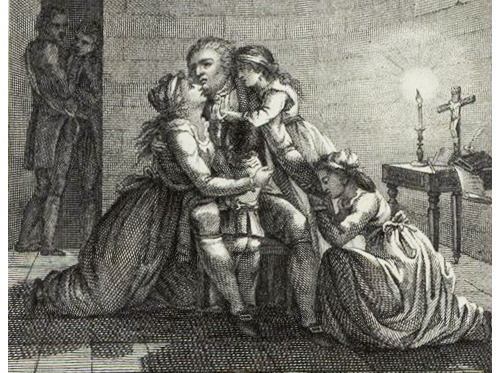
Louis XVI's Last Meeting with His Family

From Vive la Reine:
At half-past eight the door opened; the queen appeared first, holding her son by the hand; then Madame Royale and Madame Élisabeth; they ran to the arms of the king. A gloomy silence reigned for several minutes, interrupted only by sobs.
… The king sat down, the queen on his left, Madame Élisabeth on his right, Madame Royale nearly opposite to him, and the little prince between his knees.
All were bending towards him and held him half embraced. This scene of sorrow lasted seven quarters of an hour, during which it was impossible to hear anything; we could see only that after each sentence of the king the sobs of the princesses redoubled, lasting some minutes; then the king would resume what he was saying.—the journal of Jean-Baptiste Cléry

Share

Saturday, September 19, 2026

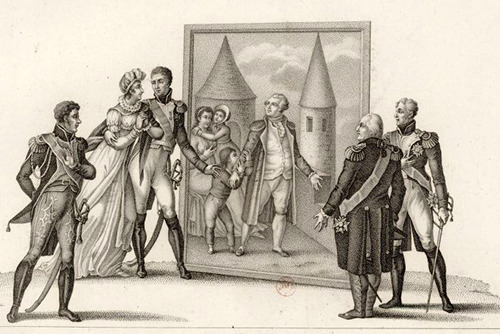
Marie-Thérèse Viewing a Portrait of Her Family at the Temple

Notice how her husband Louis-Antoine is very attentive. He knew how such things upset her.  Berry stands alone off to the side on the left. And then there are Artois and Louis XVIII on the right. One wonders what passed through their minds when seeing their doomed brother and his family. Via Vive la Reine. Share

Friday, September 18, 2026

Charity of the Dauphine

Before becoming Queen of France, Marie-Antoinette was known for her mercy and sweetness. From Vive la Reine:
Mme la Dauphine, who had returned, got out of her carriage, ran toward the woman, and held out some perfume to her nose, which made her come out of her faint. Mme la Dauphine gave her all the money she had with her, but what was even more admirable was the kind and consoling way in which HRH talked to the poor woman. Finally, Mme l'Archiduchesse, who was touched, shed tears and, at that moment, caused more than a hundred spectators to do the same….

Then, having called for her carriage, Mme la Dauphine gave orders that the peasant woman be taken in it back to her cottage which was in a neighboring hamlet.* Her Royal Highness waited right there for her carriage to return; she asked about the care of the wounded man … I cannot describe to Your Majesty the greatness or intensity of the sensation caused by the event, not only among the courtiers, but even more among the people of Fontainebleau….

The public in Paris [seems very moved;] whenever Mme la Dauphine’s name comes up, it evokes a universal cry of joy and admiration.
–Ambassador Mercy to Maria Theresa, 12 November 1773
(Read more.)
Share

Monday, September 14, 2026

Henrietta Maria and Her Mother, Marie de’ Medici


 My guest post for Tony Riches.

First of all, I would like to thank Tony Riches for opening his popular blog to other historical writers so that we may share our research. I am the author of a biography of Marie-Antoinette as well as six historical novels. The latest two novels are about Queen Henrietta Maria, wife of Charles I and they are entitled My Queen, My Love and Generalissima. They are part of an unfinished trilogy; the third installment Avalon will be out sometime in 2027 or 28. 

In my readings about Henrietta of France, I have found that her mother Marie de’ Medici played an enormous role not only in her upbringing but in her ongoing political decisions, as well as shaping her faith, her love of the arts, of music, theater, and architecture. Queen Marie has ended up playing a much larger role in my novels than I originally would ever have imagined, due to the sheer force of her personality as much as to her real adventures, which included leading rebellions against her son, climbing out of windows to escape the royal guards, and hiding with her entourage of dwarves in a German brewery. All of this followed a glittering career of being Queen Mother Regent of France. Most of the Queen’s life is captured in the spectacular series of twenty-four huge paintings by Rubens, now at the Louvre. (Read more.)


Books available HERE.

Share

Saturday, September 12, 2026

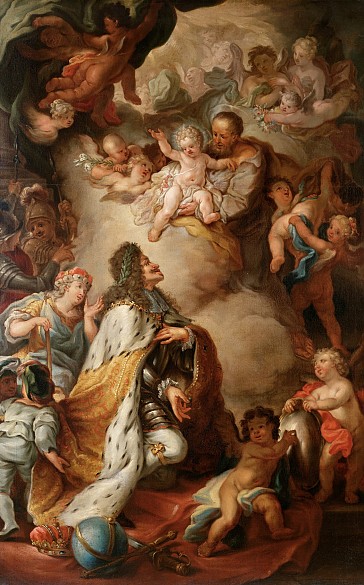
St. Joseph and Emperor Leopold I


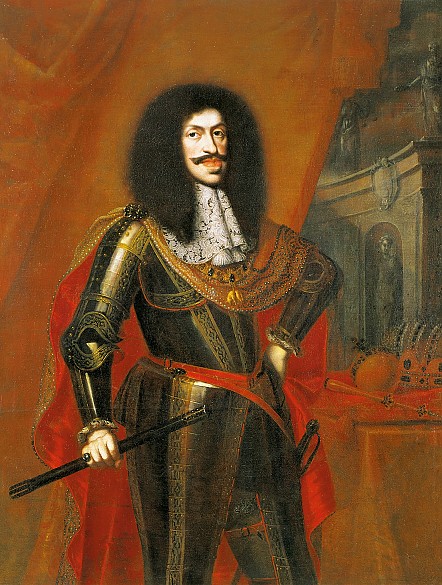
Holy Roman Emperor Leopold I is shown kneeling before the Child Jesus, Who blesses him from the arms of His foster-father St. Joseph. (Via The World of the Habsburgs.) Leopold is known as the "Baroque Emperor" and was a first cousin of Louis XIV of France, as their mothers were sisters. He was also a former brother-in-law of Louis' Queen, Maria Teresa of Austria (Spain), for he had been married to her younger sister, the Infanta Margarita, painted by Velasquez. Also from The World of the Habsburgs:

Leopold I was a defining figure in the history of the Habsburg dynasty. His reign saw the consolidation of the Monarchy after the Thirty Years’ War and the decisive victories against the Ottoman Empire that enabled the Habsburg Monarchy to become one of the leading Great Powers in Europe.

Leopold himself was however a shy, indecisive character who effaced himself behind his imperial persona. He was not a ‘radiant’ monarch, being almost grotesquely ugly and afflicted with an extreme example of the Habsburg jaw. It is said that he had his physical deficits emphasized in portraits of himself out of humility. The emperor compensated for his personal shortcomings with the nimbus of his sublime office. Leopold’s adversary Louis XIV once remarked that it was not the emperor in person that he feared but his ‘miracle’.

Leopold was steeped in the majesty of imperial office, emphasizing its religious aspect above all else. The victory over the Ottoman Empire which had put a stop to its westward expansion served pro-Habsburg propaganda as an ideal instrument to stylize Emperor Leopold as the protector of Christendom. Thus as the donor of the Plague Column on the Graben in Vienna, Leopold is represented kneeling in humility as he recommends his realm to the heavenly powers. On another occasion the emperor referred to himself as the ‘least and most unworthy servant of the Holy Virgin Mary’.

[...]

One positive aspect of his personality was his pronounced artistic gifts, in particular for music. He was himself an enthusiastic musician and the author of several compositions, the quality of which should not be underestimated. Opera was his great passion. Important occasions at court were staged as allegorical Baroque spectacles with no expense spared. (Read more.)

More on Emperor Leopold's wives and children, HERE.

Marriage of Leopold I to his third wife Eleonore Magdalene of Neuburg

Eleonore Magdalene of Neuburg, Emperor Leopold's third wife, was very devout and had wanted to be a Carmelite nun. Instead she became the mother of seven children and a wife who helped her husband rule a great empire. She had her sons educated by the Jesuits. She was the grandmother of Empress Maria Theresa and great-grandmother of Marie-Antoinette. More about Empress Eleonore, HERE.

Eleonore and Leopold


Here is my book, in which I discuss the Habsburg patrimony in the life of Marie-Antoinette.

Share

Wednesday, September 9, 2026

Madame Elisabeth: A Consoling Angel

From Detroit Catholic:

Called a "consoling angel," the sister of King Louis XVI decided to stay on the side of her family even when death was imminent for doing so in the midst of the horrors of the French Revolution. On the 230th anniversary of her death under the guillotine on May 10, 1794, "Madame Elisabeth" is one step closer to beatification as the historical commission for her sainthood cause wrapped up its work May 2. The diocesan phase of her sainthood cause was reopened in 2017. Since then, Fr. Xavier Snoëk, the postulator, has spared no effort to raise awareness of the noble lady.

She was "an original and very modern young woman … pious and exuberant at the same time," Father Snoëk told OSV News. "She read a lot while being passionate about science and mathematics. She was also very athletic. She loved the outdoors and was an excellent horseback rider." (Read more.)

Share

Tuesday, September 8, 2026

A Guide to the Children of James VI and I and Anne of Denmark

The first Prince of Wales from the House of Stuart was named for his grandfather, Lord Darnley. (Yes, the Lord Darnley.) To quote author Linda Root:
Many historians wrongly refer to Henry Frederick Stuart as the Prince of Wales from the time he arrived in England in 1603.  This is incorrect.  He was not invested with that title until 1610.  His predecessor was Edward Tudor, the boy king Edward VI (1537-1553)  Upon Henry Frederick's  birth in Scotland he was given the customary title of a male Scottish heir apparent, Duke of Rothesay, as well as several lesser grants appropriate to the Scottish heir. However, when he arrived in England he was also conferred the English title Duke of Cornwall.  He had to wait seven more years to become Prince of Wales.  Referring to him as Prince of Wales during his early childhood should be a cause of embarrassment to a any historian or historical novelist who refers to him as Wales prior to 1610 and yet, it is a common mistake.  It is the way he is most often remembered although he only lived two years to enjoy the title. (Read more.)
Share

Sunday, September 6, 2026

Five Great-grandchildren of King Edward VII

 From Tatler:

Following the death of King Harald V on 28 August at the age of 89, the sprawling family tree of King Edward VII and Queen Alexandra has grown a little smaller. The late Norwegian monarch was a great-grandson of the British King and Queen, who reigned between 1901 and 1910. Now, just five of their great-grandchildren remain. Scattered across Britain and Norway, they are the last living members of a royal generation. So, who exactly are Edward VII’s surviving great-grandchildren? (Read more.)

Share

Friday, September 4, 2026

Murder of the Princesse de Lamballe


Among the thousands murdered during the French Revolution, one of the most notorious cases was that of the death of the Princesse de Lamballe, friend of Queen Marie-Antoinette. The fury of the new order of Liberty, Equality, and Fraternity vented itself upon her frail form in a manner of extreme violence. This was as strange as it was hideous, because other than being a confidante of the queen's, Madame de Lamballe could be counted among the more liberal, "enlightened" aristocrats, devoted to works of charity and civil improvements.

Contrary to the standard depiction of Lamballe as a lovely but simpering idiot, the princess was intelligent as well as cultured. She was the Grande Maitresse of all the French masonic ladies' lodges, for she saw freemasonry as a tool for creating a better world, as did many of her contemporaries. Her liberal politics were one of the reasons, according to scholar Bernard Fay, that King Louis XVI encouraged his wife towards the Polignacs, and away from Lamballe and her Orleanist salon. Madame de Lamballe discovered before the end that utopian politics that seek to create an earthly paradise inevitably lead to social chaos.

Marie-Therese-Louise de Savoie-Carignan was born in Turin on September 8, 1749. In 1767 she was married to the Prince de Lamballe, son of the Duc de Penthievre, relatives of the French royal family. Her husband died soon afterwards, and the young Marie-Antoinette pitied her and took her sleigh-riding. According to Madame Campan, the queen's chambermaid:
It was at the time of the sleighing-parties that the Queen became intimately acquainted with the Princesse de Lamballe, who made her appearance in them wrapped in fur, with all the brilliancy and freshness of the age of twenty,–the emblem of spring, peeping from under sable and ermine. Her situation, moreover, rendered her peculiarly interesting; married, when she was scarcely past childhood, to a young prince, who ruined himself by the contagious example of the Duc d’Orleans, she had had nothing to do from the time of her arrival in France but to weep. A widow at eighteen, and childless, she lived with the Duc de Penthievre as an adopted daughter. She had the tenderest respect and attachment for that venerable Prince; but the Queen, though doing justice to his virtues, saw that the Duc de Penthievre’s way of life, whether at Paris or at his country-seat, could neither afford his young daughter-in-law the amusements suited to her time of life, nor ensure her in the future an establishment such as she was deprived of by her widowhood.
Marie-Antoinette made Madame de Lamballe, known for her virtue and kindness, the Superintendent of her household, which was controversial at the time since there were other courtiers who felt the position was due to them. The two women became good friends. The queen was always trying to recapture the home she had left in Austria, where she had been inseparable from her older sister Maria Carolina, who had mothered her a great deal. Madame de Lamballe and Madame de Polignac were both roughly the same age as Carolina. However, Lamballe was a bit too intellectual for Antoinette and so the queen, with Louis' approval, eventually became closer to the Polignacs. She always remained friends with Lamballe, however.

When the Revolution erupted in 1789, Madame de Lamballe returned to France from the safety of England in order to be share the troubles of the royal family. She became closer than ever to the king's devout sister, Madame Elisabeth of France, and was horrified at how the masonic principles she had thought to be so constructive had led to such a violent revolution. When the royal family was arrested and sent to the Temple prison in August 1792, Lamballe was separated from them and sent to the prison of La Force. When the September Massacres broke out, in which thousands were killed and the streets ran with blood, Madame de Lamballe was asked to renounce her loyalty to the king and the queen. She refused, and was delivered over to the mob. She was bludgeoned and stabbed to death, and by some accounts raped and mutilated. She was definitely decapitated, and the valet of Louis XVI, Hanet Clery, gave an account of how the mob brought her head on a pike to the Temple prison for the queen to kiss.
We were hardly seated before a head at the end of a pike was presented at the window. Tison's wife screamed loudly; the murderers thought it was the queen's voice, and we heard the frantic laughs of those barbarians. Thinking that Her Majesty was still at table, they had raised the victim's head so that it could not escape her sight; it was that of the Princesse de Lamballe. Though bloody, it was not disfigured; her blond hair, still curling, floated around the pike.
Such excesses became typical of the French Revolution, stirred up by propaganda which played upon the fears of many. The Princesse de Lamballe was a bit misguided but ultimately heroic and loyal, and the grisly death to which she was subjected exemplified not only the misogyny of the new order but a hatred of all that was beautiful and good.
 
 File:Death-of-the-Princess-De-Lamballe-by-Leon-Maxime-Faivre.jpg
Share

Wednesday, September 2, 2026

The Forgotten Prince of Versailles, Part II


From Philip Diaz-Lewis at Rationis Fines:

In 1763, two years before his death, Louis-Ferdinand helped make a book for lay people, to help them fit devotion around their duties according to their state’. The translation of the Psalms was taken from Jean-Joseph Languet de Gergy, while the Dauphin added his own composed meditations (or hymnes). The work was published by the Cardinal de Luynes, as Office divin abrégé pour tous les temps à l’usage des personnes pieuses.2 As the opening quote should show, the meditations could be quite weighty given the stated intention of the book. It is noteworthy that a prince would care so much to insert such passages into something whose stated aim is speed.

In part one, I introduced the obscure figure of Louis-Ferdinand, son of Louis XV, father of Louis XVI, and Dauphin of France until his premature death in 1765. Using the standard modern scholarly study on his life, La vertu et le secret by Bernard Hours (2006),3 he emerged as a devout, conservative, and anti-radical figure, yet not a mindless zealot. He was widely-read, well-educated, and a writer of maxims and reflections in the ancient Stoic style. Now I turn to the question: was he not merely a thinker, but a coherent one?

Hours flags that quite a number of the sayings recorded by the Dauphin’s posthumous biographers contain commonplaces typical of hagiographical writing.4 This does not by itself invalidate them, for a Christian prince could well have thought in these stock ideas gotten from devout literature. But it does make them less secure as primary sources, since his biographers may have shaped or embellished what they remembered, perhaps without meaning to. Thus, in what follows I will focus only on those maxims and sayings that Hours thinks most likely came from the man himself. (Read more.)

Share

Sunday, August 30, 2026

Mary of Modena: James II's Dazzling Queen

 The Writing Desk: Book review: Mary of Modena: James II's Dazzling Queen,  by Justine Brown

There are several cases throughout history of arranged royal marriages in which it was as if God had chosen to favor a particular country by sending a bride who possessed not only virtue but great physical beauty to be the wife of the ruler and the mother of the heir. A few of those alliances ended catastrophically when, for certain reasons, the bride in question was rejected by her adopted people, even when loved by her husband. I am thinking in particular of Henrietta Maria of France, despised for her attachment to her Catholic faith. There is also Marie-Antoinette, hated for her Austrian heritage, made worse by a campaign of vicious slander. The tragic Empress Alexandra, whom Tsar Nicholas married for love, was falsely accused of betraying Russia to her German relatives. Among such consorts, noble and fair to behold, shines Mary Beatrice of Modena, the second wife of James II. Justine Brown, author of The Private Life of James II, has surpassed herself in this comprehensive biography of the last Catholic Queen of England, Scotland and Ireland. I found it engrossing for the detailed descriptions of the pageantry of the final years of the Stuart dynasty before the so-called "Glorious Revolution" in which the true monarch was overthrown by his own daughters. The evidence is compiled to show that James II was driven from his throne not for any tyranny, as is claimed by Whiggish historians, but because his wife had give birth to a Catholic heir. It was hatred of the Faith that disrupted the royal line and led to the weakening of the royal authority, so that in time British sovereigns reigned but no longer ruled.

From the Amazon page:

Mary Beatrice learns governance, defies scandal, and becomes a steadfast beacon for Jacobite resilience amid a turbulent Restoration era.

The 1688 “Glorious Revolution” that toppled James II and VII also veiled his consort in propaganda. Mary of Modena: James II’s Dazzling Queen reveals the extraordinary woman beneath. Lovely and spirited, Mary Beatrice Isabella d’Este is also England’s sole Italian queen. Her father came from an ancient line, while her mother was one of Cardinal Mazarin’s seven famed nieces (the “Mazarinettes”).

Mary Beatrice learned the rudiments of governance at her widowed mother’s knee, and would one day act as regent of the Stuart court-in-exile—first for King James, then for their son, James Francis Edward. “The Queen over the Water” would shine as a beacon for the Jacobite cause.

Once, Mary Beatrice longed to be a nun. Instead, the young woman had to accept a different mission—marriage to James Duke of York, heir to the thrones of England, Scotland, and Ireland. Although James’s conversion to Catholicism made their marriage possible, it set off a firestorm of controversy in the mysterious northern realm.

The story of the British Isles was romantic, but the reality was jarring. Thrown into the frenzy of Restoration politics, Mary Beatrice met each fresh episode courageously. Charles II adored his sister-in-law, but MPs strove to annul the “Italian match” before it could be consummated. She and James fell in love, but his philandering nearly broke her.

Building on Este tradition, Mary Beatrice won over the common folk, inspired poets and painters, introduced Italian opera, and drew talented ladies to court. She also attracted her flamboyant Mazarinette cousin Hortense Mancini to England, where she joined King Charles’s harem.

Ultimately, James and Mary Beatrice were coronated with great ceremony, but their troubles were only just beginning. For the first time in English history, it looked like the birth of a healthy prince might actually destroy the monarchy instead of strengthening it…
(Read more.)
In Justine's account, I found Mary of Modena to be inspiring not only as a brave and steadfast Queen but as a Catholic wife and mother dealing with adversity. As a teenage bride she was shattered to discover that the handsome husband she had fallen in love with was a chronic adulterer with a growing number of illegitimate offspring. And while the children of James' mistresses grew and thrived, Mary's children miscarried, or were stillborn or died young. But Mary, who had originally wanted to be a Visitandine nun, followed the teaching of the founder of the Visitation order, St. Francis de Sales. St. Francis de Sales emphasized a loving acceptance of trials as well as complete trust and confidence in God. Queen Mary's spiritual director was the Jesuit St. Claude La Colombière who brought to England the devotion to the Sacred Heart of Jesus, for he had been the confessor of  the Visitation nun who claimed to have visions of the Savior, known to history as St. Margaret Mary. Mary of Modena would help spread the devotion to the Heart of God throughout Europe in her later years of exile. Meanwhile, James II, whose childhood had been disrupted by war, imprisonment and exile, came to learn to live a devout life from his much younger wife, so that he gave up his transgressive lifestyle. I was particularly struck by the happiness of James and Mary when they had lost everything, but had each other and their children. I recommend this biography of a Queen of England who experienced a white martyrdom, yet the more she was diminished, the greater she became.
Share

Monday, August 24, 2026

La Reine Margot and the St. Bartholomew's Day Massacre

A first hand account from a notorious lady, who nevertheless saved the life of her husband Henri de Navarre, the future Henri IV. Henri IV, through his second marriage to Marie de' Medici, was the father of Queen Henrietta Maria.
Five or six days afterwards, those who were engaged in this plot, considering that it was incomplete whilst the King my husband and the Prince de Conde remained alive, as their design was not only to dispose of the Huguenots, but of the Princes of the blood likewise; and knowing that no attempt could be made on my husband whilst I continued to be his wife, devised a scheme which they suggested to the Queen my mother for divorcing me from him. Accordingly, one holiday, when I waited upon her to chapel, she charged me to declare to her, upon my oath, whether I believed my husband to be like other men. "Because," said she, "if he is not, I can easily procure you a divorce from him." I begged her to believe that I was not sufficiently competent to answer such a question, and could only reply, as the Roman lady did to her husband, when he chid her for not informing him of his stinking breath, that, never having approached any other man near enough to know a difference, she thought all men had been alike in that respect. "But," said I, "Madame, since you have put the question to me, I can only declare I am content to remain as I am;" and this I said because I suspected the design of separating me from my husband was in order to work some mischief against him....(Read more.)
Share

Saturday, August 22, 2026

The Death of Richard III

From Medievalists:
On 22 August 1485 Richard III, the last Plantagenet king of England was killed at the Battle of Bosworth. Exactly how and who carried out the killing remains shrouded in mystery. Having seen his battle line collapsing under the French flank attack, Richard charged Henry Tudor and his bodyguard. He immediately killed William Brandon, Henry’s standard bearer. The standard crashed to the ground only to be picked up, according to Welsh tradition, by Rhys ap Maredudd (Rhys Fawr).

Henry must have been close, because we are told by Vergil that next in Richard’s path was the 6 foot 8 inch John Cheyney. with great force drove him to the ground. Vergil tells us that at this moment ‘Henry abode the brunt longer than ever his owne soldiers wold have wenyd, who wer now almost owt of hope of victory.’ Holinshed says that Richard was no more than a sword point away from Henry, and Michael Drayton in his poem says they were ‘scarce a lance length’ apart. Victory was now within Richard’s grasp. (Read more.)

 More on Richard III: HERE, HERE, HERE, and HERE.

Share

Thursday, August 20, 2026

What Does Marie-Antoinette Mean to Us Now?


Posthumous portrait of the Queen by Madame Lebrun
Many people are disgusted by the depiction of Marie-Antoinette in the BBC series. My piece for Catholic Answers:

I first visited Marie-Antoinette’s private retreat at Petit Trianon when I was seventeen years old. It was January, but the birds were singing in the gardens. Then and on successive trips, I experienced a strong sense of timelessness. Others have confided to me a similar feeling of enchantment when wandering through the gardens of Trianon.

People frequently ask me why I write about Marie-Antoinette. One of the reasons is that I keep encountering educated people who really think she said, “Let them eat cake.” I continue to encounter Christians who think Marie-Antoinette was killed as punishment for some egregious wickedness or, at least, for unforgivable stupidity. Having read books about her since childhood, I knew she was misunderstood; it was only after a great deal more research that I came to see how completely false are the common beliefs about her.

But the demonization of Marie-Antoinette in the popular mind is necessary to justify the excesses of the French Revolution. When people have a false and distorted view of history, it is difficult for them to grasp the present, and almost impossible to meet the future with any kind of preparedness.

The French Revolution was not necessary, simply because it is never necessary to murder tens of thousands of people. Reform certainly was needed, but reform can happen without mass murder.

Louis XVI was an intrepid reformer. He was not afraid to break with the past and abolish outdated customs while introducing new ways of doing things. Louis was not resistant to change, although that is how he is usually portrayed. The changes were slow but over time might have been effective, had the violent upheavals not swept everything away.

Too often, the violence is represented as a sad but unavoidable means of achieving freedom and democracy. But it is not only that the French Revolution overturned the social order; it was ultimately an attack on the Catholic Church. Many Catholics were killed, especially those peasants who did not want their religion taken away.

The French Revolution has been the blueprint for every totalitarian regime that has followed and has continued to be the model for those wishing not only to destroy the Catholic Church, but all Christian society. (Read more.)


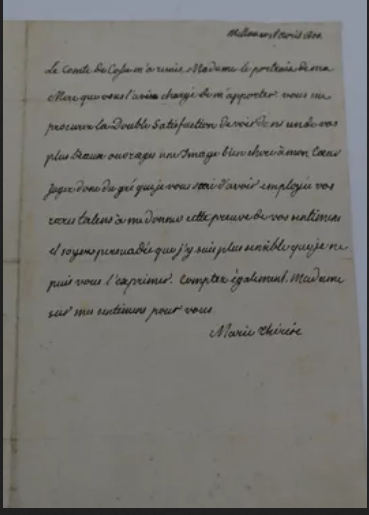
The portrait above was painted posthumously by Madame Lebrun. Here is a letter from Marie-Thérèse Charlotte to the artist, who was a friend of the family:


 A letter written by Marie-Thérèse Charlotte to Elisabeth Vigee-Lebrun on April 15th, 1800, regarding a portrait of Marie Antoinette, which was given to Marie-Thérèse by the comte de Cossé. The duchesse wrote that he gave her…

“…the portrait of my Mother that you had charged him to bring me. You give me the double satisfaction of seeing in a more beautiful work an image very dear to my heart. Judge therefore how grateful I am to you for having used your rare talents to give me this proof of your feelings and be convinced that I am more sensitive to it than I can express to you. You can count equally, Madame, on my feelings for you.”

Share

Tuesday, August 18, 2026

The Remarkable Rise of Empress Theodora

 From Risto Gjorgjiev:

 Born around 500 AD in the vibrant city of Constantinople, Theodora’s early life was far from royal. Her father, Acacius, was a bear trainer for the city’s grand Hippodrome, a colossal stadium renowned for its chariot races and theatrical spectacles. After his untimely death, Theodora’s mother, a dancer and actress, found herself struggling to provide for her three daughters. To make ends meet, young Theodora was thrust into the world of entertainment, becoming an actress and dancer in the very Hippodrome her father had worked.

 The Hippodrome was not just a place of entertainment; it was the beating heart of Byzantine social life. Here, factions clashed, politics played out, and the mood of the populace was gauged. Theodora, with her keen observation, learned to read the crowd’s behavior, understanding their passions, grievances, and loyalties. This knowledge would later prove invaluable.

However, life in the limelight was not without its challenges. Theodora faced societal disdain due to her profession, which was often associated with promiscuity. Her travels across the Eastern Mediterranean exposed her to various cultures and experiences, including a tumultuous relationship with a Syrian official that left her stranded in North Africa.

In a twist of fate, Theodora’s return to Constantinople marked a new chapter in her life. Embracing Christianity, she left behind the world of entertainment and joined a community of devout women. It was during this period of reflection that destiny played its card: she caught the eye of Justinian, the nephew of the reigning emperor and the empire’s most eligible bachelor. (Read more.)

 The Mad Monarchist has a post about one of the most colorful women who ever lived, the Empress Theodora.

Together with her husband Empress Theodora oversaw the rebuilding of Constantinople into one of the most spectacular cities in history. She helped in the building of hospices, churches and refuges for the poor. She is also credited with influencing new laws to protect women, making rape and kidnapping capital offenses, no matter if the woman was noble or common born. Women could not be forced into the entertainment industry or prostitution and could not be put in prison for debts. Instead they were to be placed under the supervision of religious women to work off their debt. This was necessary because of the rape and abuse women often suffered in prison. She cracked down hard on prostitution, buying the freedom of many girls herself, meting out harsh punishment to their captors and setting up establishments to help them get back on their feet in legitimate ways. (Read more.)

Empress Theodora did much to protect women during her husband's reign. From The Collector:

The origins of women’s rights can be attributed to Empress Theodora. Probably her experience as a young woman marginalized by the institutional system of that time pushed her to work on the improvement of women’s rights in the Empire. She elaborated on The Corpus Juris Civilis, a series of juridical reforms included in Roman law, and laid the foundation for a framework for Western legal heritage for women’s rights, including the English Common Law, the American Constitution, and even contemporary international public law. Additionally, under Empress Theodora, rape became punishable by death. No matter their position or status, everyone present during the rape was affected by this rule, and the rapist’s property was handed over to the victim. (Read more.)

Share

Monday, August 17, 2026

Queenship and Revolution in Early Modern Europe: Henrietta Maria and Marie-Antoinette

Marie-Antoinette de Lorraine d'Autriche

Henriette-Marie de France
Queen Marie-Antoinette, wife of King Louis XVI of France and Queen Henrietta Maria, wife of King Charles I of England were two of the most notorious queens in European history. They both faced accusations that they had transgressed social, gender and regional norms, and attempted to defend themselves against negative reactions to their behaviour. Each queen engaged with the debates of her time concerning the place of women within their families, religion, politics, the public sphere and court culture and attempted to counter criticism of her foreign origins and political influence. The impeachment of Henrietta Maria in 1643 and trial and execution of Marie Antoinette in 1793 were also trials of monarchical government that shaped the English Civil Wars and French Revolution.
I was lucky enough to receive a copy from Palgrave Macmillan of Queenship and Revolution in Early Modern Europe: Henrietta Maria and Marie Antoinette by Carolyn Harris, which is a part of their Queenship and Power series. Marie-Antoinette has had much written about her, while Henrietta Maria seems to have been quite forgotten. I only recently received a new biography about her.
The comparison between Marie-Antoinette and Henrietta Maria is perhaps not one that immediately comes to mind, but both women lived in a time of civil unrest, albeit over 100 years apart. Both women were childless for the first part of their marriage and suffered for it. It’s a rather interesting comparison, and I especially enjoyed reading about Henrietta Maria’s impeachment, about which so little appears to have been written. Henrietta Maria managed to escape to France, but without her husband who was eventually executed in 1649. Marie-Antoinette and her family also attempted to escaped, but they were caught, and both Marie-Antoinette and her husband were executed by guillotine. (Read more.)
  My books on the two Queens available HERE. Share

Sunday, August 16, 2026

The Forgotten Prince of Versailles, Part I


From Philip Diaz-Lewis at Rationis Fines:

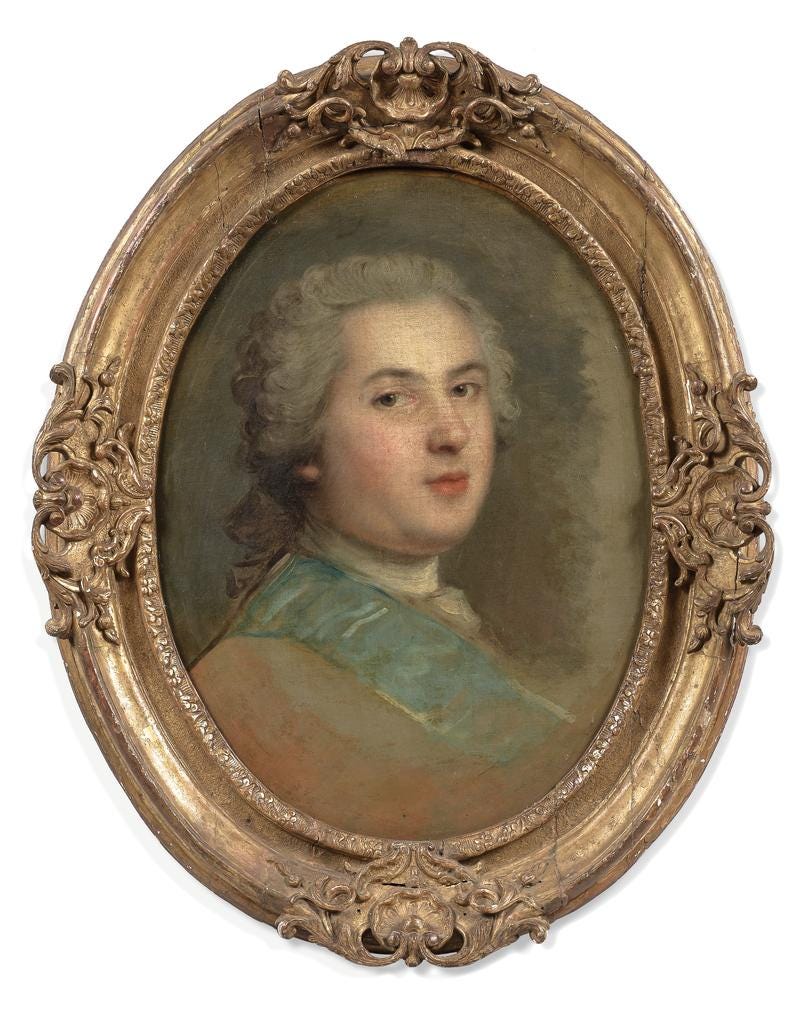
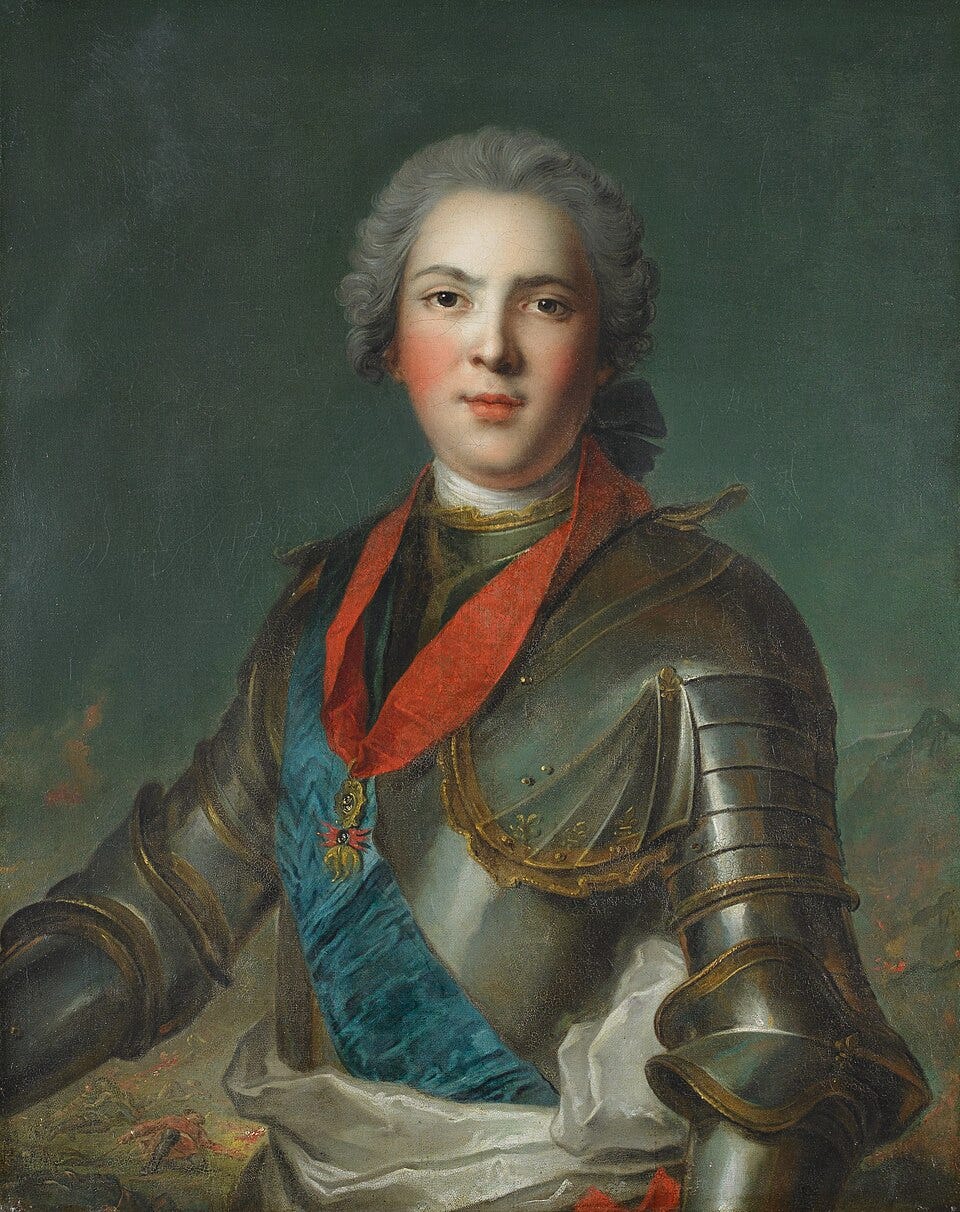
In December 1765 the heir to the French throne died at Fontainebleau, aged thirty-six. Louis-Ferdinand, Dauphin of France, had been trained from childhood for kingship and had spent fifteen years attending the councils of his father Louis XV. He would never reign. Three of his sons eventually did. The (in)famous career of his son, Louis-August, the future Louis XVI, would overshadow the memory of his father.

The funeral preaching at once made him into the exemplary figure of an ideal Christian prince. First the Jesuits, then the bishop Loménie de Brienne, then the abbé de Boismont, lined up to preach orations. In their eyes Louis-Ferdinand was a model of rational religion (religion eclairée), and piety (pieté).1 His former confessor, the abbé Soldini, then composed in 1766 the work Essai sur la vie de Mgr Louis Dauphin. He set Louis-Ferdinand against the sensualism and materialism that had come to characterise the radical French Enlightenment of the philosophes.2

Scarcely had his body been laid to rest, however, that his legacy would be contested. For the poet and literary critic Antoine-Léonard Thomas had written a great elegy in his praise, likening the prince to ancient Roman heroes and sages like the general Germanicus, and the emperor Marcus Aurelius. Catholic admirers complained that he was turning the late Dauphin into a virtuous pagan instead of a Christian.3 (Read more.)


Share