Showing posts with label Martyrs. Show all posts

Wednesday, July 15, 2026

Augustinian Traces in Louis XVI

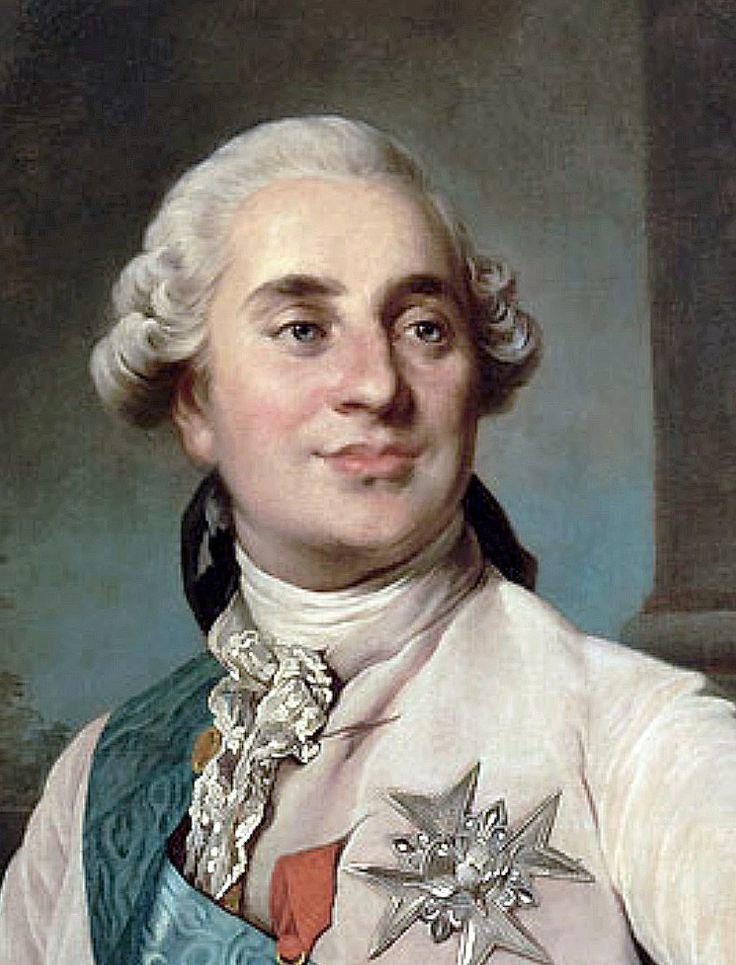
Louis XVI of France - Alchetron, The Free Social Encyclopedia 

There is some amazing new scholarship about Louis XVI. Here is a paper about Louis XVI's spirituality as formed by his education, which influenced his future actions. From Dr. Philip Diaz-Lewis via the History of European Ideas:

This article argues that Louis XVI’s student notes, the Réflexions sur mes Entretiens avec M. le duc de la Vauguyon reveal a coherent Augustinian Platonist ethics derived from Fénelon, in which humanité functions as a divine exemplar idea through which moral principles are known and royal virtues specified. Against existing interpretations that oppose Louis’s reformism to his attachment to sacral monarchy, it proposes that the same philosophical framework can be used to interpret both his constitutional initiatives and his maintenance of traditional court ritual. The argument proceeds by reconstructing the Dauphin’s formation under La Vauguyon, Moreau, and Berthier, then by a close reading of key Réflexions passages on God, natural law and humanité, interpreted with the aid of the Dictionnaire de Trévoux lexicon. (Read more.)

Share

Sunday, July 12, 2026

The Power of Francis Poulenc’s “Dialogues of the Carmelites”

The nuns were martyred on July 17, 1794. From The Voegelin View:

The 1957 opera is based on the true story of the Martyrs of Compiègne, a community of sixteen Carmelite nuns who were guillotined during the French Revolution’s Reign of Terror. The libretto is the work of Georges Bernanos, the French Catholic author best known for his novel The Diary of a Country Priest.
Dialogues balances the sweep of historical events with the inner spiritual journey of Blanche de la Force, a young woman from an aristocratic family who fears the oncoming Revolution. Blanche’s fear impels her to join the Carmelite order, but in doing so she goes straight into the target of the revolutionary mob. Arrested and cast out of their convent, the nuns take a vow of martyrdom rather than renounce their vocation. Blanche initially panics and runs away, but at the last moment she finds her courage, steps out from the crowd, and joins her sisters at the guillotine. Many hold Dialogues in high esteem as one of the twentieth century’s greatest operas, even for its subject alone. The intolerant repression of religion by the architects of the French Revolution—ironically carried out in the name of “liberty,” “fraternity,” and “equality”—is a story that must be told, with heroic themes befitting grand opera.
If I have reservations about the piece, it is largely because its first half is filled with abstract spiritual discussions that are poorly suited to musical treatment. This portion of the opera feels static and verbose—not to mention overlong—with Poulenc having little to do but spin exquisite filigree around the text, between increasingly powerful orchestral interludes. The opera’s second half livens up considerably, though, as the revolutionary forces close in on the convent and the nuns take their vow of martyrdom. This is a spiritual, even intellectual opera, one that examines themes of fear and grace—particularly what Poulenc termed “transfer of grace” by which one human death can redeem another. (Read more.)
Share

Monday, June 29, 2026

Why the Blood-Red Cross of St. George Terrifies Britain’s Elite — and Muslims

The entire article is available to subscribers only but it is still interesting. From Raymond Ibrahim:

As Britain enters yet another moment of political upheaval following the announced resignation of Prime Minister Keir Starmer, a deeper question remains unresolved: what exactly is England’s national identity — and who gets to define it?

Take England’s oldest national flag: the red cross of St. George on a white field. It has become the center of controversy in recent years and is seen as one of Britain’s most contested symbols.

For those raising the flag through campaigns like Raise the Colours, it represents pride in England’s heritage, unity, and unapologetic patriotism. Critics, however, brand it a symbol of “far-right” extremism, racism, and hostility toward migrants (the vast majority of whom are Muslim).

Indeed, just a few days ago, a Liberal Democrat-led Oxfordshire County Council sought a High Court injunction to ban the flying of St. George’s Cross and Union flags on or near public roads — claiming they “intimidate residents,” create safety risks, and cause “fear and division.” Many Britons see this as the latest front in a broader effort to suppress English identity amid the nation’s ongoing migrant crisis.

Yet the St. George flag’s true origins reveal a deeper irony largely forgotten by both sides.

Born in the crucible of the crusades, it originated as an emblem of holy war.

The Knights Templar, founded in the early twelfth century, were the first to adopt its colors. As monks, their white mantles symbolized purity; as warriors sworn to fight Muslims to the death in defense of Christendom, the blood-red cross symbolized their readiness for martyrdom (which many experienced). (Read more.)


Share

Friday, June 12, 2026

Vow of Louis XVI

Here is an English translation of the Vow of Louis XVI made in the Tuileries palace in the spring of 1791:
Well dost Thou see, O my God, the great sadness that oppresses my heart, the grief that wounds it and the depth of the abyss into which I have been cast. I am assailed by countless evils from all sides. To the oppression of my soul, the horrible tragedies that have befallen me and my family add up to those that cover the whole extension of the realm. The clamoring of all the misfortunate and the moans of our oppressed religion reaches my ears, and an inner voice suggests to me that perhaps Thy justice holds me accountable for all these calamities for not having restrained, during the days of my power, their main causes, which are the people’s licentiousness and the spirit of irreligion, and for supplied heresy, now triumphant, its weapons by favoring it by laws that gave it redoubled strength and enough boldness to dare anything.
 
O Jesus-Christ! Divine Redeemer of all our iniquities, today I come to find relief for my soul in Thy Adorable Heart. I call to my aid the tender Heart of Mary, my august protectress and Mother, and the assistance of Saint Louis, my advocate and the most illustrious of my ancestors. Open Thyself, adorable Heart, through the most pure hands of my powerful intercessors, receive benignantly the vows of which confidence inspires me and that I offer Thee as the frank expression of my sentiments. If, as a consequence of Divine goodness, I were to recover my liberty, my crown and royal power, I solemnly promise:

1. To revoke at once all the laws that will be indicated to me by the Pope, or a Council, or by four of the more learned and virtuous bishops of my realm, as contrary to the purity and the integrity of the Faith, and contrary to the discipline and the special jurisdiction of the Holy, Roman, Catholic, and Apostolic Church; and especially to revoke the Civil Constitution of the Clergy.

2. To take, within a year, all the necessary measures to establish, with the approval of the Pope and the episcopate of my realm, and in accordance with canonical standards, a solemn feast in honor of the Sacred Heart of Jesus to be celebrated forevermore throughout all France on the first Friday immediately after the eight days following the Feast of Corpus Christi and to be always followed by a general procession. This feast will be celebrated in reparation for the outrages and desecrations perpetrated in our holy temples by schismatics, heretics and the bad Christians in these times of so great turmoil.

3. To go in person on a Sunday or a holy day within three months of the day of my deliverance to the Church of Notre Dame of Paris, or to any other principal church in the place where I will be at that time, to pronounce a solemn act of consecration of my person, my family and my realm to the Sacred Heart of Jesus next to the main altar after the Offertory of the Mass and through the hands of the priest, promising to give to all my vassals an example of the worship and the devotion due that adorable Heart.
4. To erect and adorn within a year of my release and at my own expense, in the church that I will choose, a chapel or an altar to be dedicated to the Sacred Heart, which will stand as a lasting monument of my recognition and limitless confidence in the infinite merits and inexhaustible treasures of grace that this Divine Heart contains. 

5. Finally, to renew every year, wherever I might be on the Feast of the Sacred Heart, the act of consecration stated in the third point and to participate in the general procession that will take place right after that day’s Mass.

 Now I cannot pronounce this pact except in secret, but I would sign it with my own blood if necessary; and the most beautiful day of my life will be when I will be able to proclaim it aloud in the Temple.

  O Adorable Heart of my Savior, may I neglect my right hand and my own being if I were to ignore Thy benefits these my promises, if I were to cease to love Thee and place all my trust and comfort in Thee! Amen.”
  
Louis XVI, King of France

 (Read more,)
 The original French version is HERE. In the spring of 1791, after signing the Civil Constitution of the Clergy a few months earlier, King Louis XVI fell ill at the Tuileries, where the royal family were living under house arrest. His illness was undoubtedly the result of the stress of the upheavals which he had tried to prevent, as well as the fact that his conscience was troubling him about signing the Catholic Church in France over to the revolutionary government, severing the ties with Rome. Louis had signed it under duress but deeply regretted his decision immediately.

According to biographer Bernard Fay, Louis made the Vow under the guidance of his non-juring confessor, a Eudist priest Fr. Hebert. In the 1600's a Visitation nun, Saint Margaret Mary, had claimed that Jesus had requested that the King of France consecrate France to His Sacred Heart. The consecration had never been performed. So, with the help of Fr. Hebert, Louis drafted the following Vow, which he sealed in the walls of his apartments.

The Vow was not found until the palace had been partially burned by the Commune and was being torn down in 1871. It was discovered still sealed in the wall of the king's room. Louis was a locksmith and was fascinated with construction, so building a hiding place for his papers would not have been beyond him. He was known for his penchant for secrecy and his hiding of private papers from prying eyes. The fact that the Vow was not discovered until the 1870's demolishes the claim of some that it was merely a product of pious forgery during the 1814-1830 Restoration. The methodical legality of the document is typical of Louis XVI, who as an amateur cartographer was characterized by his precision and attention to detail.
Share

Saturday, June 6, 2026

"Your Virtues and Your Kindness"

Our Lady (or perhaps the virtue of Faith, since she carries the cross) and Marie-Antoinette hold the Gospels for Louis XVI as he makes his coronation oath. The picture is accompanied by the following verse:
The hands of Divinity
Louis, sends you the crown
The scepter, the sword, the law gives to you
But it is your virtues and your kindness
Which assures you the throne in our hearts.
Share

Tuesday, May 26, 2026

'Viva la Vida'


One of my sisters insisted to me that I listen to the Coldplay song 'Viva la Vida'. She said it was about Louis XVI. I doubted that anything with a Spanish title, written by a liberal like Chris Martin, with Delacroix's painting honoring the 1830 Revolution on the cover, could have anything to do with my beloved Martyr-King. But I listened to humor her. And then listened again and again and again. I am now convinced that, in spite of the title and revolutionary imagery, the song is an ode honoring the immolation of His Most Christian Majesty Louis XVI. I have pondered the lyrics and what they express about his life, his passion and his death. At my sister's request, I have jotted down my thoughts here. The lyrics are from the Coldplay website. The comments in bold are mine.

I used to rule the world

At his coronation on June 11, 1775, Trinity Sunday, Louis XVI was anointed with the holy oils, including the miraculous chrism from the Holy Ampulla. He was invested in the ancient royal regalia, including the sword of Charlemagne. As the Most Christian King, Louis was first among the rulers of the world.

Seas would rise when I gave the word

Louis XVI rebuilt the French navy, which defeated the British in the American War for Independence.

Now in the morning I sleep alone
Sweep the streets I used to own

During his trial in late 1792 and early 1793, Louis XVI was separated from his wife and family and was in solitary confinement in the Temple prison even on Christmas Day, when he wrote his Will. I am not sure what the reference to sweeping the streets means, except that Louis was treated by the Temple guards with insults and disrespect.

I used to roll the dice
Feel the fear in my enemy’s eyes

 Louis hated gambling, although it was rife at court. He did gamble when he chose to help the Americans, which was a successful gamble, and when he summoned the Estates-General in 1789, an unsuccessful gamble, which was used to overthrow him.

Listened as the crowd would sing
Now the old king is dead long live the king

Louis XVI was exceedingly popular when he came to the throne at 20 years old in 1774 at the death of his grandfather Louis XV.

One minute I held the key
Next the walls were closed on me

Louis was given the keys of the city of Paris when he formally visited in 1774 as Dauphin with his wife Marie-Antoinette, the city where he would eventually become a prisoner in October 1789.

And I discovered that my castles stand
Upon pillars of salt and pillars of sand

The "pillars of salt" I am guessing refers to the refusal of the court to let go of the past, and the resistance, even in the royal family, to the reforms of Louis and Antoinette. The "pillars of sand" must refer to the bankruptcy inherited by Louis XVI from the last two monarchs, which he had to deal with from day one, in spite of the demands of the people for a glamorous court.

I hear Jerusalem bells a-ringing

Perhaps a reference to the heritage of crusader kings Louis VII and St. Louis IX. Louis XVI was named for the latter, with the saint's exact name of "Louis-Auguste."

Roman cavalry choirs are singing

The French monarchy was long regarded as a defender of the papacy and was thus given the title of Eldest Daughter of the Church.

Be my mirror, my sword and shield

Louis was gradually deprived of the splendor of his palace, his armed forces and his public worship of God. The "mirror" might refer to the famous Hall of Mirrors. Louis' "sword" I think represents the army he built up, and the "shield" means his Catholic faith, all of which were materially stripped from him. What did he have left until the last few months? His children, his sister and his wife. Marie-Antoinette was his mirror, sword and shield when all else was gone. And she defended him until the moment of her own death.

Missionaries in a foreign field

The Jesuit martyrs of North America are famous but people forget that Louis XVI sent out his own missionaries in the Lapérouse expedition.

For some reason I can’t explain
Once you’d gone there was never
Never an honest word
And that was when I ruled the world

Louis XVI was plunged into an acute depression when his oldest son Louis-Joseph died after a painful illness in June of 1789, just as Louis had to deal with the Estates-General and the chaos that followed.

It was a wicked and wild wind
Blew down the doors to let me in

Louis XVI would never have been king except that his older brother died of tuberculosis, a slow suffocation which people believed was caused by "bad" air. His son died of the same illness a few months before the mob broke into the palace and captured the Royal Family as prisoners.

Shattered windows and the sound of drums
People couldn’t believe what I’d become

This appears to refer to the raids upon the Palace of the Tuileries in June and August of 1792, in which much damage was done. On August 10, 1792, the Royal Family fled the mob to take refuge with the National Assembly, where they were arrested. The Swiss Guards were massacred.

Revolutionaries wait
For my head on a silver plate

A reference to the martyrdom of St. John the Baptist, beheaded by King Herod for taking a stand against sexual immorality. There were those who early on sought the death of the entire Royal Family. Louis, his wife and his sister, were guillotined.

Just a puppet on a lonely string
Oh who would ever want to be king?

When Louis was under house arrest at the Tuileries he was basically a puppet. In his Will he lamented the misfortune of being king.

I hear Jerusalem bells a-ringing
Roman cavalry choirs are singing
Be my mirror, my sword and shield
My missionaries in a foreign field
For some reason I can’t explain
I know St Peter won’t call my name
Never an honest word
But that was when I ruled the world

Oh oh oh oh oh oh oh

Hear Jerusalem bells a-ringing
Roman cavalry choirs are singing
Be my mirror, my sword and shield
My missionaries in a foreign field
For some reason I can’t explain
I know St Peter won’t call my name
Never an honest word
But that was when I ruled the world

  "For some reason I can’t explain/ I know St Peter won’t call my name." This verse breaks my heart because I think it is a reference to how Louis XVI was originally advised by clerics to sign the Civil Constitution of the Clergy, which created a church independent of the papal supremacy. Louis felt so guilty he became ill, and when he eventually received guidance from the Pope on the matter he did everything he could to work against the document he had signed. Refusing to receive his Easter Communion in 1791 from a priest who had taken the oath to the government, he attempted to flee Paris with his family, to be captured at Varennes on the Feast of Corpus Christi. From the beginning of the ordeal, Marie-Antoinette refused to take the oath to the Civil Constitution and she and Madame Elisabeth, Louis' sister, arranged for secret Masses with priests who had not betrayed the papacy. Nevertheless, Louis' earlier perceived betrayal is the reason that has been given for why the Catholic Church, which he loved, has never beatified him.

"Never an honest word/ But that was when I ruled the world." Louis as ruler often had to go against his feelings and preferences. Although he was known to be blunt and forthright he had learned as a child to keep his thoughts to himself. Lies were told about him during his life: that he was an impotent imbecile under the thumb of his foreign wife. Lies are told about him to this day.

Anyway, this song captures the majesty of all that was great about the patrimony of the French monarchy, and how Louis had to take upon his shoulders the satanic rage of the fall of Christendom, while embodying in himself all the past courage, faith and mercy.

Share

Sunday, May 24, 2026

Did the Apostle Thomas Travel All the Way to India?

 From The Collector:

The New Testament’s depiction of Jesus’s disciple Thomas has given him the nickname “Doubting Thomas.” Yet, ironically, according to church tradition Thomas’s faith in the risen Christ drove him to evangelize a greater distance from Palestine than even the Apostle Paul reached in his storied missionary journeys in Anatolia and Europe. Thomas may have gone as far as South India with the Christian gospel, establishing multiple churches along the way and eventually dying as a martyr on Indian soil.

When reconstructing the histories of ancient Christian figures like Thomas, historians often must rely on sources that contain legendary material. This is partly why it is customary to qualify historical claims with phrases like “according to tradition.” 

A key source for the life of Thomas is an early third-century work entitled The Acts of Thomas. This work is counted among the many pseudepigraphical narratives about the infancy years of Christianity, which tend to contain accounts deemed unreliable by modern historiographical standards. While The Acts of Thomas’s historical value is compromised as a result, the fact that a document about Thomas’s activities in India was being read in the third century suggests that both Thomas’s ministry and the backstory of the church in India were of interest to Christians in the early church. Ancient Christian writers from diverse areas also wrote of Thomas’s ministry in India. (Read more.)

Share

Monday, May 11, 2026

Madame Elisabeth on the Way to Execution

This is Versailles: Execution of Madame Élisabeth

Madame Élisabeth of France and her companions leave the Conciergerie for the final journey to the guillotine on May 10, 1794. Madame Élisabeth was the last to die, which means she had to watch all the others decapitated before her. They each begged for her blessing before approaching the scaffold. From This is Versailles:

Once the condemned were removed, Madame Élisabeth once again exerted herself to the comfort of her fellow-condemned. She had always been a fervently religious woman and now she encouraged those who were to die with her. She chose to rejoice in the fact that the Tribunal had not asked them to renounce their faith "only their miserable lives".

There appears to be some conjecture about when Madame Élisabeth was definitely informed of the death of Marie Antoinette. Later, Marie Thérèse would recall that they had heard her mother's sentence being cried out from the people walking beneath their windows but that they had refused to believe it. One account claims that Élisabeth had asked to see her sister-in-law after her sentencing only to be told that she had suffered the same fate. Another claims that it was only at the foot of the guillotine that she overheard a callous remark. Once it was noticed that the condemned bowed to her before their deaths, a spectator allegedly remarked that that they could "make their salaams to her all they wanted, she will share the fate of the Austrian". (Read more.)


From European Royal History:

She reportedly successfully comforted and strengthened the morale of her fellow prisoners before their impending execution with religious arguments, and by her own example of calmness.

Élisabeth was executed along with the 23 men and women who had been tried and condemned at the same time as she, and reportedly conversed with Mme de Senozan and Mme de Crussol on the way. In the cart taking them to their execution, and while waiting her turn, she helped several of them through the ordeal, encouraging them and reciting the De profundis until her time came. Near the Pont Neuf, the white kerchief which covered her head was blown off, and thus being the only person with bare head, she attracted special attention by the spectators, and witnesses attested that she was calm during the whole process.

 At the foot of the guillotine, there was a bench for the condemned who were to depart the cart and wait on the bench before their execution. Élisabeth departed the cart first, refusing the help of the executioner, but was to be the last to be called upon, which resulted in her witnessing the death of all the others.

Reportedly, she considerably strengthened the morale of her fellow prisoners, who all behaved with courage. When the last person before her, a man, gave her his bow, she said, “courage, and faith in the mercy of God!” and then rose to be ready for her own turn. While she was being strapped to the board, her fichu (a sort of shawl) fell off, exposing her shoulders, and she cried to the executioner “Au nom de votre mère, monsieur, couvrez-moi. (In the name of your mother, sir, cover me)”

Reportedly, her execution caused some emotion by the bystanders, who did not cry “Vive la Republique” at this occasion, which was otherwise common. The respect Élisabeth had enjoyed among the public caused concern with Robespierre, who had never wished to have her executed and who “dreaded the effect” of her death.

Her body was buried in a common grave at the Errancis Cemetery in Paris. At the time of the Restoration, her brother, Louis-Stanislas, Comte de Provence, now King Louis XVIII of France and Navarre, searched for her remains, only to discover that the bodies interred there had decomposed to a state where they could no longer be identified. Élisabeth’s remains, with that of other victims of the guillotine (including Robespierre, also buried at the Errancis Cemetery) were later placed in the Catacombs of Paris. A medallion represents her at the Basilica of Saint Denis.

Beatification

The Cause of Beatification of Élisabeth was introduced in 1924, but has not yet been completed. In 1953, she was declared a Servant of God, and in 2016, her Cause was re-opened. (Read more.)

Share

Thursday, April 23, 2026

Saint George and King Charles I

But the knight, turning him about, bade her remain where she was, and went out to meet the dragon.
When it observed him approach, the beast was struck with amazement, and, having paused for but a moment, it ran toward the knight with a great swiftness, and beating its dark wings upon the ground as it ran.
 
When it drew near to him, it puffed out from its nostrils a smoke so dense that the knight was enveloped in it as in a cloud; and darted hot flames from its eyes. Rearing its horrid body, it beat against the knight, dealing him fearful blows; but he, bending, thrust his spear against it, and caught the blows upon his shield. 
~ Legend of St. George and the Dragon

St. George's Day is on April 23. St. George is the patron saint of England as well as the patron of the Royal Order of the Garter, the order of chivalry cherished by King Charles I. The legend of St. George and the dragon was one of the most popular stories in the Middle Ages. St. George is generally believed to have lived in Asia Minor and to have suffered under the Emperor Diocletian. Ascalon, the sword of St. George, was celebrated by knights who took the martyred warrior as the patron of chivalry. While his name became the battle-cry of Merry Old England, St. George  was universally venerated in both the East and the West; in the Roman Church he was one of the Fourteen Holy Helpers.

While we know there was indeed a martyr named George, how true is the account of his battle with the dragon? According to New Advent:
This episode of the dragon is in fact a very late development, which cannot be traced further back than the twelfth or thirteenth century. It is found in the Golden Legend (Historia Lombardic of James de Voragine and to this circumstance it probably owes its wide diffusion. It may have been derived from an allegorization of the tyrant Diocletian or Dadianus, who is sometimes called a dragon (ho bythios drakon) in the older text, but despite the researches of Vetter (Reinbot von Durne, pp.lxxv-cix) the origin of the dragon story remains very obscure. In any case the late occurrence of this development refutes the attempts made to derive it from pagan sources....

The best known form of the legend of St. George and the Dragon is that made popular by the "Legenda Aurea", and translated into English by Caxton. According to this, a terrible dragon had ravaged all the country round a city of Libya, called Selena, making its lair in a marshy swamp. Its breath caused pestilence whenever it approached the town, so the people gave the monster two sheep every day to satisfy its hunger, but, when the sheep failed, a human victim was necessary and lots were drawn to determine the victim.

On one occasion the lot fell to the king's little daughter. The king offered all his wealth to purchase a substitute, but the people had pledged themselves that no substitutes should be allowed, and so the maiden, dressed as a bride, was led to the marsh. There St. George chanced to ride by, and asked the maiden what she did, but she bade him leave her lest he also might perish. The good knight stayed, however, and, when the dragon appeared, St. George, making the sign of the cross, bravely attacked it and transfixed it with his lance. Then asking the maiden for her girdle (an incident in the story which may possibly have something to do with St. George's selection as patron of the Order of the Garter), he bound it round the neck of the monster, and thereupon the princess was able to lead it like a lamb.

They then returned to the city, where St. George bade the people have no fear but only be baptized, after which he cut off the dragon's head and the townsfolk were all converted. The king would have given George half his kingdom, but the saint replied that he must ride on, bidding the king meanwhile take good care of God's churches, honour the clergy, and have pity on the poor. The earliest reference to any such episode in art is probably to be found in an old Roman tombstone at Conisborough in Yorkshire, considered to belong to the first half of the twelfth century. Here the princess is depicted as already in the dragon's clutches, while an abbot stands by and blesses the rescuer.
The key to the legend of St. George is that it epitomizes the spiritual combat in which all Christians are engaged, on one level or another. As Fr. Blake explains:
I love saints like St George, whose true story is lost in myth. In both stories George becomes a Christian "everyman". The first legend reminds us that despite every attempt to overcome him by God's grace George endures and survives all, and even in death is victorious.
The second story draws on apocalyptic imagery, the dragon is the symbol of evil, the power of sin, but here it is to be contrasted with the pure virgin. I am reminded of St Athanasius' struggle for twenty years in the tomb against demons. In all of us there is the pure virgin and the dragon. George, here takes on the attributes of St Michael (Michael means "Who is like God"), in his struggle he overcomes evil which then becomes subject to purity.
King Charles I was greatly devoted to the chivalric mission of the English Order of the Garter, founded by Edward III on Saint George's Day, 1348. Charles I had the Garter Star embroidered on the cloaks of all the knights, as a "testimony to the World." From The Victoria and Albert:
This form of the Order of the Garter (the highest order of English knighthood) as a star was introduced by Charles I (ruled 1625-1649) in 1627. It was to be worn by Knights of the Garter 'upon the left part of their cloaks, coats and riding cassocks, at all times when they shall not wear their robes, and in all places and assemblies...a testimony to the World, of the honour they hold...the Order Instituted and Ordained for persons of the highest honour and greatest worth'. (Read more.)
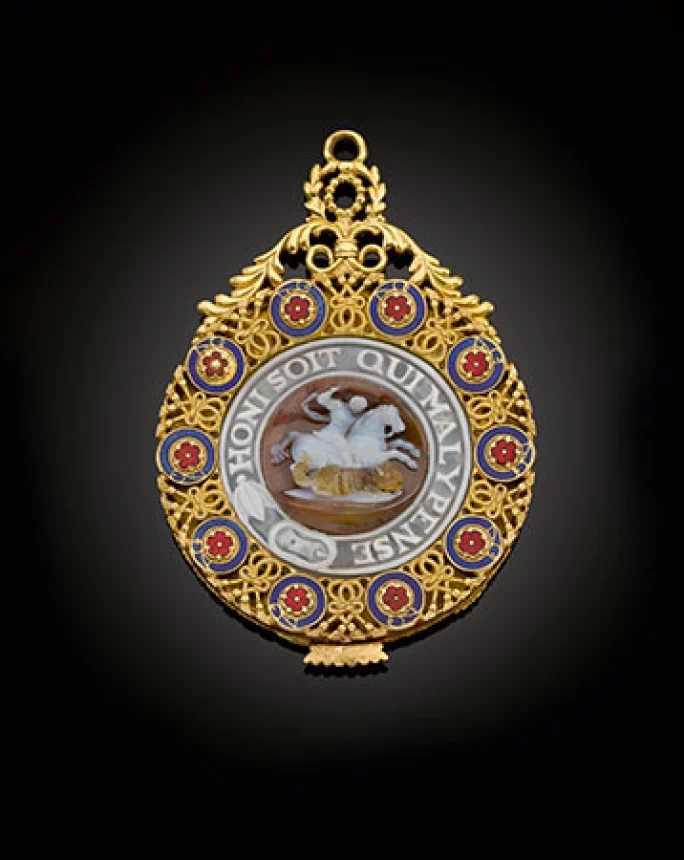
A pendant of Saint George slaying the dragon was also worn. From Sotheby's:

By the end of the fifteenth century a collar had been added to the regalia, possibly as a result of the influence of foreign Orders where a collar was worn to form a badge. The collar design has changed very little since its introduction being composed of a series of gold heraldic knots and roses encircled by the Garter, with a hanging pendant of St George slaying a dragon, known as the Great George.  As for other British chivalric orders, the collar is worn on ceremonial occasions and designated Collar Days throughout the year.

Over time the collar came to be regarded as an encumbrance during ordinary activities and by the early sixteenth century the first reference can be found to the Lesser George [Lots 24; 28], an image of St George encircled with the Garter worn as a separate badge. Lesser Georges were originally hung from a blue ribbon around the neck so as to be worn upon the breast. But by the late seventeenth century it had become practice to sling the Lesser George under the right arm, a contemporary chronicler explaining that this was for ‘conveniency of riding and action’. (Read more.)

From the Royal Collection Trust:

A length of blue silk attached to a book in the Royal Collection may in fact be the Garter ribbon worn by Charles I as he sat for Sir Anthony van Dyck’s famous triple portrait, scientific analysis has revealed. The portrait and the ribbon will be brought together for the first time for In Fine Style: The Art of Tudor and Stuart Fashion, which opens on 10 May, 2013, at The Queen’s Gallery, Buckingham Palace.  The exhibition explores the changing fashions of the rich and powerful of the Tudor and Stuart era through paintings, drawings and prints, as well as rare surviving examples of clothing and accessories.

Charles I placed great importance on the Order of the Garter, the oldest and highest order of chivalry in England – even wearing a Garter badge to his execution in 1649.  Fourteen years earlier, in Van Dyck’s portrait, the monarch is shown wearing a pale blue Garter ribbon around his neck. 

The inclusion of Van Dyck’s painting in the exhibition prompted Royal Collection Trust curators to take a closer look at four lengths of blue silk ribbon attached to the binding of a copy of the Eikon Basilike (‘The Royal Portrait’), now in the Royal Library, Windsor Castle.  The book was first published just ten days after the monarch’s execution on 30 January 1649 and quickly became one of the biggest-selling books of the 17th century, fuelling the image of Charles I as a martyr. (Read more.)

Charles I never converted to Catholicism, in spite of his wife Queen Henrietta Maria's efforts and prayers. He continued to collect recusancy fines from practicing Catholics throughout his personal rule. However, he frequently showed  leniency to Catholics who had been arrested. Charles insisted that the Church of England be hierarchical and appointed bishops who were in favor of a majestic and dignified liturgy. His mentor and Archbishop of Canterbury, William Laud, upset the Puritans when he said that the Church of Rome was not the "Whore of Babylon." (In spite of that, Henrietta Maria never liked him.) From The Amish Catholic on the life and death of Charles I:

A few years ago, Fr. Hunwicke produced a very good argument as to why, canonically and liturgically, a soul who died in schism could be recognized as a saint (taking the precedent of various Eastern saints like Palamas and Gregory of Narek). He has argued for a favorable reading of Charles’s Catholicizing tendencies before.

I would add my voice to Fr. Hunwicke’s. Charles was, on the whole, a boon to the Catholic Church. Charles’s marriage to a formidable Catholic princess, Henrietta Maria of France, saw the arrival at court of Roman Catholic priests, a first since the days of Mary Tudor. He allowed the ambassadors of foreign courts to hold their own chaplains, notably at St. James’s, Spanish Place. Charles even opened up diplomatic talks with the Pope for the first time in decades, receiving more than one papal legate during his personal reign. High-level talks about reunion between the two churches were carried on in secret. He wrote to the Pope, in a letter of 1623 preserved and collected for publication by Sir Charles Petrie (1935),

Be your holiness persuaded that I am, and ever shall be, of such moderation as to keep aloof, as far as possible, from every undertaking which may testify any hatred towards the Roman Catholic religion. Nay, rather I will seize all opportunities, by a gentle and generous mode of conduct, to remove all sinister suspicions entirely; so that, as we all confess one undivided Trinity and one Christ crucified, we may be banded together unanimously into one faith. (See Petrie, The Letters…of King Charles I, pg. 16).

Of course, Charles was inconstant in these measures of good will. He was harsher on Recusants when it came to fines, but significantly lowered priest-hunting efforts. I believe I will not err in saying that, among the many martyrs of the English Reformation, none came during the King’s personal reign in the 1630’s. I only count four overall, of which we can probably acquit Charles from the burden of guilt. The two Catholics executed in 1628 – St. Edmund Arrowsmith, a Jesuit, and Blessed Richard Herst, a layman – seem to have fallen victim to the prejudices of lower officials rather than to any especially anti-Catholic venom emanating from the Crown. And once trouble with the Scots and Parliament began, Charles attempted to hold the situation together by, among other things, clamping down on priests. But even those martyrs which followed in the wake of these efforts owe their deaths more to the actions of local and middling anti-Papist forces than to the intentions of a harried crown. Only two seem to have died in 1641, the last year the King had any discernible control over what was going on in London. Realistically, it would be more appropriate to blame parliament for those deaths. In his church appointments, Charles always preferred those clerics who showed a marked sympathy to the doctrine of Rome. William Laud is only one among several examples that could be cited. (Read more.)

This triple portrait by Van Dyck was for the purpose of making a sculpture of the King
 
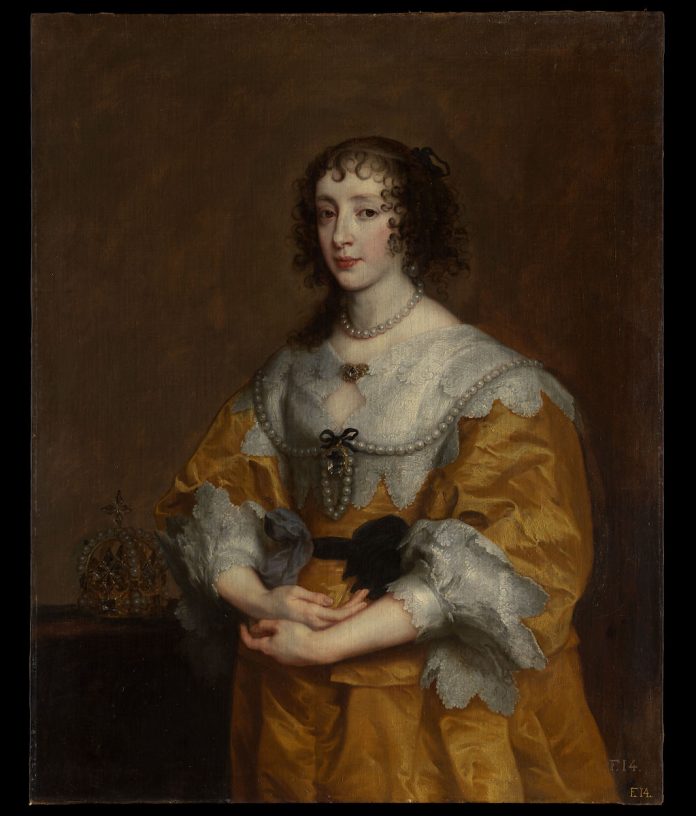
Henrietta Maria holding a butterfly


Share

Friday, March 27, 2026

Under House Arrest

From Paul Gilbert:

On this day – 22nd March (O.S. 9th March) 1917 – the Provisional Government decreed that Emperor Nicholas II, his wife and five children should be held under house arrest in the Alexander Palace at Tsarskoye Selo.

At eleven in the morning, the Imperial Train pulled into the Imperial Railway Pavilion at Tsarskoye Selo. Nicholas emerged wearing a Caucasian fur cap and soldier’s greatcoat. Behind him the members of his suite began to jump off the train – like rats abandoning a sinking ship – and run down the platform. Not looking back – they fled.

According to Count Paul Benckendorff (1853-1921), the Emperor’s motorcar arrived at the gate of the Alexander Palace and was stopped by the sentry, who summoned the Commandant. The Commandant went down the steps and asked in a loud voice who was there. The sentry cried out, ‘Nicholas Romanov’. ‘Let him pass,’ said the officer.

During his captivity, the Tsar was subject to constant harassment and humiliation from the soldiers – most of whom were thugs – stationed in and around the Alexander Palace.

According to Pierre Gilliard: “The Emperor accepted all these restraints with extraordinary serenity and moral grandeur. No word of reproach ever passed his lips.” (Read more.)

Share

Sunday, March 22, 2026

Remembering the Past in Restoration France: An Expiatory Chapel for Marie-Antoinette

The recreated prison cell of the Queen
The actual prison cell of the Queen
 From Nineteenth-Century Art Worldwide:
After its restoration, the Conciergerie in Paris w­­­­­as reopened to the public in 1989, the year of the "Bicentenaire" celebrating the 200th anniversary of the French Revolution.[1] The new historical museum of the Conciergerie, formerly the most famous prison in France, offers visitors an almost authentic look at the conditions of living—or rather dying—during the revolutionary Terreur, the period of violence and mass executions that started in September 1793 and ended in July 1794 with the "Thermidorian Reaction." Visiting the Conciergerie today, one enters the gloomy atmosphere of 18th-century crime, grim with punishment and death, reminiscent of Madame Tussaud's Chamber of Horrors. Visitors are faced with life-sized figures of incarcerated men in small dark cells recalling some well-known and, in addition, thousands of nameless victims of the Terror. The representation of one of the most famous inmates of the Conciergerie is especially striking. Marie-Antoinette, Queen of France, spent the final two months of her life in this prison, before her execution on October 16th, 1793. Her figure, which can only be seen from behind, is shown sitting in a cell at a small wooden desk, guarded by a member of the National Guard (fig. 1). Contrary to its appearance, this scene is not set in the cell in which the queen was actually imprisoned, but is only meant to be an accurate reconstruction.[2] The cell in which Marie-Antoinette was imprisoned still exists, but not as a cell. In 1816, during the French Restoration era, it was transformed into a chapelle expiatoire—expiatory chapel (fig. 2). Unchanged during the Conciergerie's restoration before its reopening in 1989, it can still be visited within the prison complex. This small chapel that the newly restored Bourbon monarchy built in honor of Marie-Antoinette confronts the visitor with a staging of history that differs considerably from that of the reconstructed cell. Marie-Antoinette's chapelle expiatoire is in fact a true chapel. It consists of a very small room painted entirely in dark blue, a colored glass window reminding one of ordinary church windows, a cenotaph on one side of the room, and an altar on the other. Here we see the queen again, this time not "in person," but appearing on three paintings representing memorable events of her last days.

In the Conciergerie, the fate of Marie-Antoinette is therefore recalled in two very different ways. On the one hand, we are confronted with a setting that seems to be authentic when in fact it is not; on the other hand, the original queen's cell has been so radically changed that it no longer appears as an authentic historical site. The commemoration of the queen within the prison complex of the Conciergerie is hence somewhat contradictory: the lines between authenticity and historical falsity, between fact and fiction are not as clear as they seem to be at first glance. This deliberate delusion especially draws one's attention to the queen's expiatory chapel of 1816, which is the main subject of this article. This slightly kitsch memorial raises questions that not only concern the construction, political context, and iconography of the chapel, but also consider the notion of authenticity and the ways in which history has been staged and commemorated throughout the ages. Therefore, the focus of my article is twofold: first, I will put the queen's expiatory chapel in the political and cultural context of its creation and discuss its iconography and propaganda content. In doing so, I will also consider some other expiatory monuments of the Restoration era. Then, I will focus on the queen's chapel as a memorial and historical site. I will especially raise the question as to whether notions of authenticity had been accounted for by the authorities and artists who were involved in the chapel's construction. With this twofold approach I particularly want to broaden the art-history research perspective which until now has been focused on the iconography and political relevance of the Restoration's expiatory monuments.[3] (Read more.)


Share

Friday, February 27, 2026

Gone for a Soldier

 
If you don a scarlet coat at the price of your conscience, the color will only remind you of the wound in your own soul! If you sign away the faith of your fathers, all lesser goods will be forfeited too! ~from Gone for a Soldier by Avellina Balestri

From Amazon:

Young Edmund Southworth could not have foreseen the path his life would take upon befriending Gentleman Johnny Burgoyne, British military veteran and parliamentarian. As Catholic recusants from the north of England, Edmund’s once noble family has struggled to survive for centuries in the shadow of the Anglican ascendancy. But General Burgoyne offers him the chance to put past humiliations behind him by joining the Church of England and donning a scarlet coat as an officer of King George III. Although his conscience is uneasy, Edmund embarks upon Burgoyne’s March to subdue the American revolutionaries by splitting the colonies in two. He finds unexpected love in the arms of Abby Vanderkamp, a supporter of American independence, who will do anything to free her father from a British prison hulk or, failing that, strike a blow for the hard-pressed rebel cause. As the British advance through the New York wilderness devolves into increasing brutality and instability, Edmund will have his already divided loyalties tested to the breaking point under the influence of this hostile land which presents him with new challenges and opportunities alike.


Gone for a Soldier is the first volume of a trilogy called All Ye That Pass By about the War for American Independence from the point of view of the young British soldier, Edmund Southworth. Edmund is from a devout Catholic recusant family in England, "recusant" being the name given to those who paid the exorbitant fines levied on all who refused participation in the Church of England. His father having died, Edmund is the head of his household, comprised of his bitter mother, his saintly sister and a few servants. Forbidden because of his Faith from any profession but that of country gentleman, Edmund's family struggles with poverty, while valiantly determined to fulfill their duties to their tenants and to the poor. Miss Balestri quite authentically depicts the hardships Catholics faced in eighteenth-century England, weaving into the narrative stories of saints, martyrs, Jacobites and highwaymen, so that the reader receives a glimpse of the larger picture.

Then the vibrant, unforgettable character of "Gentleman Johnny" Burgoyne sweeps into the story, taking Edmund under his wing. A womanizer and bon vivant, Burgoyne is nevertheless a loyal friend and a brave general. With a dollop of bullying and an ocean of charm, Burgoyne convinces Edmund that he needs to join Burgoyne in North America in the fight against the colonists by becoming a soldier. The problem is that military careers are only available to Protestants, so Burgoyne talks Edmund into renouncing his Catholic Faith and receiving the bread and wine in a midnight act of apostasy. Burgoyne dismisses it is as a small matter but Edmund is tormented by his betrayal of the Faith of his fathers, The author explores the anguish of violating one's conscience, making the reader pray and hope  never to be in Edmund's circumstances. It is, however, but the beginning of his adventures in America, where he and Burgoyne are joined by quite the colorful cast of characters. Miss Balestri once again proves her mastery of history, and her ability to bring it alive in intriguing storytelling.

About the author:

Avellina Balestri is a Catholic author and editor based in the historic borderlands of Maryland and Pennsylvania. Her stories, poems, and essays have been featured in over thirty print and online publications. She has published two books: "Saplings of Sherwood", the first book in a Robin Hood retelling series, and "Pendragon's Shield", a collection of poetry. She is the Editor-in-Chief of Fellowship & Fairydust, a magazine inspiring faith & creativity and exploring the arts through a spiritual lens. Under its auspices, she hosted a literary conference at Lady Margaret Hall in Oxford, England, commemorating the legacy of J.R.R. Tolkien. She also has the honor of representing the state of Maryland at The Sons of the American Revolution National Orations Contest. Avellina believes that the Trinitarian divine dance and Incarnational indwelling mystery are reflected in all things good, true, and beautiful, and that the image of God is wondrously woven into every human heart. These themes are at the forefront of the stories she chooses to tell.

For more information about the author and her various projects, please visit the following websites:

www.fellowshipandfairydust.com 

www.avellinabalestri.com

Share

Sunday, February 8, 2026

The Execution of Mary Queen of Scots


February 8 is the anniversary of the execution of Mary Stuart in 1587. The Queen of Scots, having been unjustly imprisoned by her cousin Queen Elizabeth of England for twenty years, was beheaded after a sham trial. According to an eye-witness account:
Then she, being stripped of all her apparel saving her petticoat and kirtle, her two women beholding her made great lamentation, and crying and crossing themselves prayed in Latin. She, turning herself to them, embracing them, said these words in French, 'Ne crie vous, j'ay prome pour vous', and so crossing and kissing them, bad them pray for her and rejoice and not weep, for that now they should see an end of all their mistress's troubles.

Then she, with a smiling countenance, turning to her men servants, as Melvin and the rest, standing upon a bench nigh the scaffold, who sometime weeping, sometime crying out aloud, and continually crossing themselves, prayed in Latin, crossing them with her hand bade them farewell, and wishing them to pray for her even until the last hour.

This done, one of the women have a Corpus Christi cloth lapped up three-corner-ways, kissing it, put it over the Queen of Scots' face, and pinned it fast to the caule of her head. Then the two women departed from her, and she kneeling down upon the cushion most resolutely, and without any token or fear of death, she spake aloud this Psalm in Latin, In Te Domine confido, non confundar in eternam, etc. Then, groping for the block, she laid down her head, putting her chin over the block with both her hands, which, holding there still, had been cut off had they not been espied. Then lying upon the block most quietly, and stretching out her arms cried, In manus tuas, Domine, etc., three or four times. Then she, lying very still upon the block, one of the executioners holding her slightly with one of his hands, she endured two strokes of the other executioner with an axe, she making very small noise or none at all, and not stirring any part of her from the place where she lay: and so the executioner cut off her head, saving one little gristle, which being cut asunder, he lift up her head to the view of all the assembly and bade God save the Queen. Then, her dress of lawn [i.e. wig] from off her head, it appeared as grey as one of threescore and ten years old, polled very short, her face in a moment being so much altered from the form she had when she was alive, as few could remember her by her dead face. Her lips stirred up and a down a quarter of an hour after her head was cut off.
There is a great deal of similarity between Mary of Scotland and her descendant, Marie-Antoinette. Both possessed immense beauty, charm, and joie de vivre, along with the ability of inspiring either great love or great hatred. Both are icons of romance and passion, when, in all probability, they had very little actual romance or passion in their personal lives, especially when compared to the sorrows they had to bear. Mary and her first husband, Francis II of France, seemed to have a deep and genuine affection for each other, in spite of the fact that he was afflicted with health problems (like many of the Valois.) Her other two husbands, however, were total and complete wretches, who made Mary's life a living hell. Antonia Fraser, in her stellar biography of Mary, conjectures that the Scottish queen fell in love with her cousin Darnley, before she found out what he was. Other biographers, such as Alison Weir and John Guy, believe that she married Darnley not out of love but to solidify her claim to the English throne, since Henry Stewart was also an heir. At any rate, Darnley was abusive in every way, and unfaithful. He plotted against her, threatening to declare her child illegitimate, telling the Pope and the King of France that she was a bad Catholic, while participating in the murder of her secretary David Rizzio before her eyes. (I might have been tempted to put gun powder under his bed, too.) However, there is overwhelming proof that Mary had nothing to do with Darnley's death, as Fraser, Guy, and Weir all describe in detail. I would especially recommend Alison Weir's excellent Mary Queen of Scots and the Murder of Lord Darnley, in which the events of Kirk o'Field are retraced with precision, exonerating Mary beyond all doubt. Weir shows how Mary was planning to reconcile with Darnley and live with him again, for their son's sake, when the Scottish lords had Darnley strangled, before blowing up his house. As for the marriage with Bothwell, all three biographers mentioned above believe that Mary was kidnapped and raped by him; when she discovered that she was pregnant she assented to a wedding. There was no great romance. She later tried to have the marriage annulled. 
 
 Mary should have returned to France after the defeat at Carberry Hill and her subsequent escape from her initial captivity. In France, she had lands as Dowager Queen, and her grandmother was still alive. Instead, she chose England and throwing herself upon Elizabeth's mercy. Big mistake. But I think she did not want to be too far from her infant son James, with whom she hoped to be reunited, as only a mother can hope. Mary, like Marie-Antoinette, is often dismissed as being stupid. She did make some imprudent choices, that's for certain. John Guy's biography carefully offers proofs that, in spite of everything, Mary often showed herself to be an astute politician, who successfully played her enemies against each other, avoiding some potential disasters early in her rule. The fact that her personal reign lasted as long as it did, in the turbulent era of the Scottish Reformation, when she was surrounded by those who believed she was Jezebel just because she was Catholic, is remarkable. She would have had to have been more ruthless and cruel, less merciful and tolerant, to have been a successful monarch in that particular time and place. Her abdication, and many of the disastrous decisions she made in those fateful months, happened when she was recovering from assault and a miscarriage/stillbirth. She was obviously going through some kind of breakdown. Almost half of Mary's life was spent as a prisoner, separated from her only surviving child, who was taught to despise his mother as a harlot. When accused of plotting Elizabeth's murder, forged letters were used against her, and she was deprived of counsel. As she declared at her trial:
I do not recognize the laws of England nor do I understand them, as I have often asserted. I am alone without counsel or anyone to speak on my behalf. My papers and notes have been taken from me, so that I am destitute of all aid, taken at a disadvantage.
Before her execution, Mary was told that her life would be the death of the Protestant religion, but her death would be its life. The ultimate reason for her demise was the fact that she was a Catholic queen. With that in mind, she approached the scaffold.
Share

Saturday, February 7, 2026

Nicholas and Alexandra (1971)

 Nothing is Written: Nicholas and Alexandra 

The portrayal of the chief murderer of the Imperial Family, Yakov Yurovsky, as a reluctant and humane executioner, has always disgusted me. From Paul Gilbert:

The year 2021 marked the 50th anniversary of the release of the film adaptation of Robert K. Massie’s (1929-2019) classic book Nicholas and Alexandra. Published in 1967, it remained on the New York Times Bestseller List for 46 weeks, and has never gone out of print! Selling more than 4.5 million copies, it is regarded as one of the most popular historical studies ever published. Praised in The New York Times as a “long-needed and balanced account” of the last tsar and his family. In Massie’s study, Nicholas comes across not as the “stupid, weak or bloodthirsty” monarch, as he is often been portrayed by his Western counterparts.

The film version was released on 13th December 1971, and nominated for numerous awards. At the 44th Academy Awards (1972), Nicholas and Alexandra won two awards of six nominations; at the 25th British Academy Film Awards (1972), Nicholas and Alexandra received three nominations; at the 29th Golden Globe Awards (1972), Nicholas and Alexandra received three nominations; and at the 15th Annual Grammy Awards (1973), Richard Rodney Bennett was nominated for Best Original Score Written for a Motion Picture or a Television Special.

The film featured a star-studded cast of notable British actors and actresses: Michael Jayston (1935-2024) as Nicholas II; Janet Suzman [b. 1939] as Alexandra Feodorovna; Irene Worth [1916-2022] as the Dowager Empress Maria Feodorovna; Tom Baker [b. 1934] as Grigori Rasputin; Jack Hawkins [1910-1973] as Count Vladimir Frederiks, the Minister of the Imperial Court; Timothy West [1934-2024] as Dr. Botkin, the court physician; Jean-Claude Drouot [b. 1938] as Pierre Gilliard, the children’s Swiss tutor; Laurence Olivier [1907-1989] as Count Witte, the Prime Minister; Michael Redgrave [1908-1985] as Sazonov, the Foreign Minister; Eric Porter [1928-1995] as Pyotr Stolypin, the Prime Minister after Witte; John McEnery [1943-2019] as Kerensky, leader of the Russian Provisional Government; Michael Bryant [1928-2002] as Lenin; Martin Potter [b. 1944] as Prince Felix Yusupov; Richard Warwick [1945-1997] as Grand Duke Dmitri Pavlovich; among many others.

Personally, I greatly disliked this film for a number of reasons. It is due to the popularity and cult-like status of this film which compelled me to address some of the many factual errors of this film, and that it will serve as a resource for those who have viewed it for the first time. (Read more.)


Share

Friday, January 30, 2026

Execution of Charles I


He conducted himself with composure and gave his cloak to Dr Juxon, the Bishop of London, saying,“I go from to corruptible to an incorruptible crown where no disturbance can be.” He lay full length, placed his head on a low block and with one strike the executioner severed his head from his body.When he died a great groan went through the crowd.“Such a groan by thousands then present, as I never heard before and I desire I may never hear again.” (Read more.)


More HERE

On Charles' widow, HERE. My novel on the royal couple, HERE. Share