Showing posts with label The Stuarts. Show all posts

Friday, September 25, 2026

She Almost Won


 Henrietta Maria came very close to helping her husband and Prince Rupert win the English Civil Wars. From Atlas Obscura:

Around midday on July 4, 1643, in the countryside just north of Birmingham, Queen Henrietta Maria was in her battle tent. Outside, shells exploded. Musket balls* zoomed past. Anxiously, the Queen of England waited. Taking Burton-Upon-Trent, a strategic town with a river crossing connecting northern and southern England, was her army’s first real challenge. Defeat was not an option. But the fighting had already raged for five hours—how much longer would it take to deliver a victory? Three hours later, the queen got her answer. Her royalist army had finally broken through the town’s defenses. Victory was secured.

Eighteen years earlier, the queen had arrived on English shores as a 15-year-old French bride. And now, at 34, she was a warrior queen. The queen would jokingly call herself “she-majesty generalissima.” Lines from a contemporary poem, its author unknown, portrayed her as not just defeating but unmanning Parliament’s forces, literally: “Tis here a woman leads; but one would swear, the armies did consist of women there.” Her skill garnered wide respect from diplomatic elites; the Venetian ambassador observed, “Without [the queen’s] encouragement and aid the king would never have put himself into a position to resist.” During the English Civil War, Queen Henrietta Maria was, it seems, all that stood between King Charles’s sure defeat at the hands of Parliament. (Read more.)

Henrietta Maria and her household hiding in a ditch during the bombardments at Bridlington in 1643

Henrietta Maria hiding from Parliamentarians during her escape to France in 1644


The novel Generalissima is available HERE.

Share

Thursday, September 24, 2026

The Mystery of the ‘Real’ Milady de Winter


Yet another descendant of Mary Boleyn. From History Extra:

In the preface to The Three Musketeers, Dumas claims that he was researching Louis XIV in the Bibliothéque nationale de France when he happened upon the first volume of The Memoirs of M. d’Artagnan. This is not entirely true: he found the book in the public library in Marseilles, borrowed it and never returned it.

The Memoirs of M. d’Artagnan is a first-person pseudo memoir written by a former soldier, Gatien de Courtilz de Sandras, and first published in 1700. It tells the story of d’Artagnan, a young man setting out on his journey to become a musketeer. As well as d’Artagnan, Dumas discovered Athos, Porthos and Aramis, who would eventually become major characters in The Three Musketeers. He also found Milady de Winter. Courtilz never gives Milady’s name. Instead, she is referred to simply as ‘Milady’ followed by a dash or asterisks where her name should be. She is introduced as a maid of honour to Henrietta Maria, queen to the executed Charles I of England, whose exile in France Milady shares.
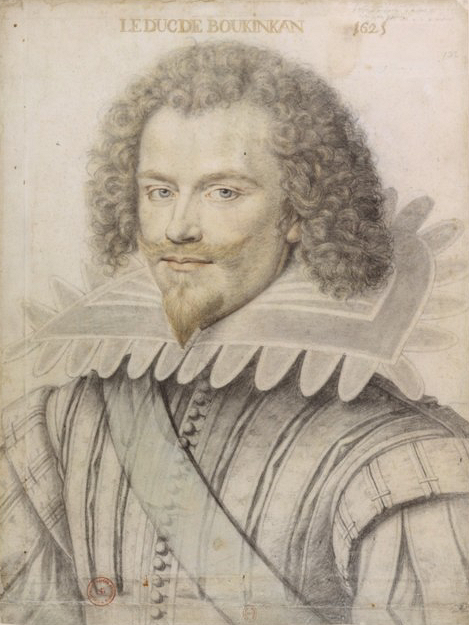
The daughter of an English peer, Milady has as much wit as beauty, and d’Artagnan thinks her the most beautiful woman he has ever seen. He promptly falls in love with her. There then follows a complicated sexual intrigue, one of several for Courtilz’s d’Artagnan. Once it is over, Milady is never heard from again. This is the episode that Dumas adapted for The Three Musketeers. The affair of the queen’s diamonds is absent from Courtilz, but at least part of the story as Dumas told it is supported by several contemporary memoirs. Those of Françoise Bertaut de Motteville, Pierre de La Porte and Henri-Auguste de Loménie, Comte de Brienne – all of whom served at the royal court of France – each provide an account of the Duke of Buckingham’s visit to France in 1625. Buckingham had been sent to escort Henrietta Maria, then Charles I’s new queen, to England. While in France, he ostentatiously courted the queen, Anne of Austria.
None of these memoirs, however, mention the diamonds that Anne was said to have given to the duke. For this part of the story, it is necessary to consult the memoirs of Henri-Auguste's son, an obscure publication known as Recueil A, and the memoirs of François de La Rochefoucauld. Louis-Henri de Loménie, Comte de Brienne served Louis XIV as secretary of state, a position he inherited from his father. He left a memoir, which was published in the early 19th century. Certain editions, particularly that edited by Jean François Barrière, include an account of the queen’s diamonds.

It does not form part of Brienne’s original narrative – he was not even born at the time of the alleged diamond affair. Instead, it is mentioned in an introductory essay, written by the editor, explaining the manners and customs of 17th-century France. It is then related in full in an appendix, Éclaircissements historiques, or ‘historical clarifications’. In this version, the diamond thief is named as Lady Clarik. However, the story was lifted word-for-word from Recueil A, and inserted into the memoir. Recueil A is the first volume of a large collection published in the 18th century. It comprises an assortment of documents, including extracts of memoirs, concerning the history of France. The author of the account of the diamond affair is enigmatically identified as ‘M. le M. de T’. Behind these initials, according to the anonymous editor of the Recueil, is René de Froulay, Comte de Tessé.

The Comte de Tessé was a real person. Born in 1651, he was a military man, diplomat and courtier. He did indeed leave a memoir, but the diamond affair does not appear in it. The story as found in Recueil A and later inserted into the memoir by Brienne is, therefore, unreliable. What then of La Rochefoucauld? In his memoir, the lady who stole the diamonds was not Lady Clarik but the countess of Carlisle. In fact, Lady Clarik did not exist – but Lady Carlisle certainly did. (Read more.)


Read about the Countess of Carlisle in my Henrietta Maria novels, HERE and HERE.

Share

Wednesday, September 23, 2026

Queen Victoria, the Stuarts and Scotland

Victoria and Albert as Catherine of Braganza and Charles II by Winterhalter


Gown worn by Victoria at her Stuart Ball

Tartan dress of Queen Victoria

Royal Family in Highlands

Scotch air, Scotch people, Scotch hills, Scotch rivers, Scotch woods, are all far preferable to those of any other nation in or out of this world.~Queen Victoria, ca. 1849. 

 In the mid-18th century, in an uprising known as "The 45" Prince Charles Edward Stuart tried to reconquer the thrones of England and Scotland for his father James III, known as the "Old Pretender." The thrones had been usurped by the German and Protestant House of Hanover in spite of the fact that the legal Catholic sovereign was alive and well. The Scots in particular did not take well to their rightful sovereign being disinherited because of the English preference for German Protestants. The uprising failed miserably, bringing more hardship and tragedy to the Scottish people for the remainder of the century. Meanwhile many songs, tales and legends of that time imprinted themselves upon the land and the people. Many of those tales and legends found their way into the writings of Sir Walter Scott, one of the first historical novelists, whose Waverley novels of the early 19th century brought the lost Stuart rebellions and their heroes to life for a new generation. The prince Regent, the future George IV, rebelled against his Hanoverian patrimony after reading the Scott novels, and headed for Scotland.

From Peter Harrington:

The romanticisation of Scotland can be most definitively linked in literature with the Waverley novels of Sir Walter Scott. The first of the Waverley novels was published in 1814 and was set during the Jacobite uprising which took place almost a century earlier. The novels were so popular that Scott was propelled to fame, and was invited to dine with King George IV, (then Prince Regent). When, several years later, the Scottish ‘Radical War’ of 1820, inspired by the American and French Revolutions, caused King George to plan the first royal visit to Scotland in over two hundred years in an effort to quell unrest, it was Scott he called on to carefully stage manage the visit. By now a baronet with numerous valuable connections to Scottish nobility, Scott saw the opportunity both to avert an uprising and to promote highland culture. He reasoned that, because of George’s lineage, the king could legitimately claim as much Stuart heritage as Bonnie Prince Charlie and could thus present himself as a Jacobite prince, properly accoutred Royal Stuart tartan. Kilts at this time were no longer generally worn, having been banned by the Dress Act of 1746, which made the wearing of ‘Highland dress’ illegal. Though the act was repealed in 1782, kilts had only come back into fashion with the Scottish gentry, a number of whom set up ‘Highland Societies’.... For the king to appear so attired was not only an attempt to appeal to the heritage of the Scottish people but also to gloss over old wrongs.

George’s visit sparked an interest in Scottish dress, and, in its wake, the demand for kilts grew so high that Scottish weaving mills were unable to cope with the demand. It was in this period that (contrary to the generally assumed belief that individualised tartans are a much older tradition) many of the clan tartans were designated. (Read more.)

 George IV died and was succeeded by his brother William IV, who in turn left the throne to their niece Victoria in 1837. It was the Romantic Era, and Queen Victoria also loved the Waverley novels. In general she found the Stuarts far more romantic than her own Hanoverians and decided to fill her life with tokens of the Stuart homeland of Scotland. Her beloved husband Prince Albert shared her predilection, in spite of being German himself and in the 1840's they began spending as much time as possible in their northern kingdom.

From Quartermile Blog:

The first land to capture the Queen’s heart wasn’t Scotland, but Ireland. Early in her reign, Victoria spent her holidays in. Yet after the potato famine of 1845 irreparable damage was done to the relationship between the British government and the people of Ireland. Despite Victoria’s personal donation of £5,000 to the cause (nearly £600,000 in today’s money) and her visit to the country in 1849, the relationship never recovered....Scotland fared much better in Victoria’s eyes. In fact, Victoria made frequent visits north of the border during her reign despite the fact that Scotland had only been visited twice by reigning monarchs in the previous two centuries.

Victoria and Albert’s love for Scotland drove them to take out a long-term lease on the stunning Balmoral Castle in Deeside in 1848. Later, in 1852, the royal couple permanently purchased the property for £31,500 (£4million today) and had it significantly extended. From this point on, Victoria and Albert spent a section of each summer in Balmoral, thanks to the advances in British rail travel....Victoria’s ever growing affection for Scotland didn’t just stretch to the land itself, but to the culture and fashion too. Through their experience of Scotland, Victoria and Albert both became big fans of tartan, and helped to elevate the status and reputation of the pattern south of the border.

According to accounts from the time, Victoria and Albert enthusiastically redecorated Balmoral Castle with reams of “Balmoral tartan, in red and grey” furnishings. They even included “innumerable stags’ antlers” in their décor. For Victoria, the use of tartan was an outward sign of being connected to her favourite part of the world. (Read more.)

Victoria showed that she not only loved Scotland but cherished the memory of the Stuarts, masquerading as Catherine of Braganza, consort of Charles II, at a ball. She had an Italian sculptor create a marble statue of Princess Elizabeth Stuart, the daughter of Charles I who died in prison at age thirteen, reputedly with her head on her murdered father's Bible. She passed the interest on to her children, as can be seen from a water color of Mary Queen of Scots by the Princess Royal. The Stuarts must have fulfilled Victoria's vision of a monarchy in which the kings and queens did not only reign but ruled, had adventures, tragedies, romances and died for love.

Princess Elizabeth Stuart: "Go ... And see the tomb of Charles's child wet with Victoria's tears"

Carl Haag’s "Luncheon at Cairn Lochan" depicts the royal family picnicking in Scotland.

Balmoral today with flock wallpaper ordered by Queen Victoria

Painting of Mary Queen of Scots by Queen Victoria's daughter the Princess Royal


Share

Monday, September 14, 2026

Henrietta Maria and Her Mother, Marie de’ Medici


 My guest post for Tony Riches.

First of all, I would like to thank Tony Riches for opening his popular blog to other historical writers so that we may share our research. I am the author of a biography of Marie-Antoinette as well as six historical novels. The latest two novels are about Queen Henrietta Maria, wife of Charles I and they are entitled My Queen, My Love and Generalissima. They are part of an unfinished trilogy; the third installment Avalon will be out sometime in 2027 or 28. 

In my readings about Henrietta of France, I have found that her mother Marie de’ Medici played an enormous role not only in her upbringing but in her ongoing political decisions, as well as shaping her faith, her love of the arts, of music, theater, and architecture. Queen Marie has ended up playing a much larger role in my novels than I originally would ever have imagined, due to the sheer force of her personality as much as to her real adventures, which included leading rebellions against her son, climbing out of windows to escape the royal guards, and hiding with her entourage of dwarves in a German brewery. All of this followed a glittering career of being Queen Mother Regent of France. Most of the Queen’s life is captured in the spectacular series of twenty-four huge paintings by Rubens, now at the Louvre. (Read more.)


Books available HERE.

Share

Sunday, August 30, 2026

Mary of Modena: James II's Dazzling Queen

 The Writing Desk: Book review: Mary of Modena: James II's Dazzling Queen,  by Justine Brown

There are several cases throughout history of arranged royal marriages in which it was as if God had chosen to favor a particular country by sending a bride who possessed not only virtue but great physical beauty to be the wife of the ruler and the mother of the heir. A few of those alliances ended catastrophically when, for certain reasons, the bride in question was rejected by her adopted people, even when loved by her husband. I am thinking in particular of Henrietta Maria of France, despised for her attachment to her Catholic faith. There is also Marie-Antoinette, hated for her Austrian heritage, made worse by a campaign of vicious slander. The tragic Empress Alexandra, whom Tsar Nicholas married for love, was falsely accused of betraying Russia to her German relatives. Among such consorts, noble and fair to behold, shines Mary Beatrice of Modena, the second wife of James II. Justine Brown, author of The Private Life of James II, has surpassed herself in this comprehensive biography of the last Catholic Queen of England, Scotland and Ireland. I found it engrossing for the detailed descriptions of the pageantry of the final years of the Stuart dynasty before the so-called "Glorious Revolution" in which the true monarch was overthrown by his own daughters. The evidence is compiled to show that James II was driven from his throne not for any tyranny, as is claimed by Whiggish historians, but because his wife had give birth to a Catholic heir. It was hatred of the Faith that disrupted the royal line and led to the weakening of the royal authority, so that in time British sovereigns reigned but no longer ruled.

From the Amazon page:

Mary Beatrice learns governance, defies scandal, and becomes a steadfast beacon for Jacobite resilience amid a turbulent Restoration era.

The 1688 “Glorious Revolution” that toppled James II and VII also veiled his consort in propaganda. Mary of Modena: James II’s Dazzling Queen reveals the extraordinary woman beneath. Lovely and spirited, Mary Beatrice Isabella d’Este is also England’s sole Italian queen. Her father came from an ancient line, while her mother was one of Cardinal Mazarin’s seven famed nieces (the “Mazarinettes”).

Mary Beatrice learned the rudiments of governance at her widowed mother’s knee, and would one day act as regent of the Stuart court-in-exile—first for King James, then for their son, James Francis Edward. “The Queen over the Water” would shine as a beacon for the Jacobite cause.

Once, Mary Beatrice longed to be a nun. Instead, the young woman had to accept a different mission—marriage to James Duke of York, heir to the thrones of England, Scotland, and Ireland. Although James’s conversion to Catholicism made their marriage possible, it set off a firestorm of controversy in the mysterious northern realm.

The story of the British Isles was romantic, but the reality was jarring. Thrown into the frenzy of Restoration politics, Mary Beatrice met each fresh episode courageously. Charles II adored his sister-in-law, but MPs strove to annul the “Italian match” before it could be consummated. She and James fell in love, but his philandering nearly broke her.

Building on Este tradition, Mary Beatrice won over the common folk, inspired poets and painters, introduced Italian opera, and drew talented ladies to court. She also attracted her flamboyant Mazarinette cousin Hortense Mancini to England, where she joined King Charles’s harem.

Ultimately, James and Mary Beatrice were coronated with great ceremony, but their troubles were only just beginning. For the first time in English history, it looked like the birth of a healthy prince might actually destroy the monarchy instead of strengthening it…
(Read more.)
In Justine's account, I found Mary of Modena to be inspiring not only as a brave and steadfast Queen but as a Catholic wife and mother dealing with adversity. As a teenage bride she was shattered to discover that the handsome husband she had fallen in love with was a chronic adulterer with a growing number of illegitimate offspring. And while the children of James' mistresses grew and thrived, Mary's children miscarried, or were stillborn or died young. But Mary, who had originally wanted to be a Visitandine nun, followed the teaching of the founder of the Visitation order, St. Francis de Sales. St. Francis de Sales emphasized a loving acceptance of trials as well as complete trust and confidence in God. Queen Mary's spiritual director was the Jesuit St. Claude La Colombière who brought to England the devotion to the Sacred Heart of Jesus, for he had been the confessor of  the Visitation nun who claimed to have visions of the Savior, known to history as St. Margaret Mary. Mary of Modena would help spread the devotion to the Heart of God throughout Europe in her later years of exile. Meanwhile, James II, whose childhood had been disrupted by war, imprisonment and exile, came to learn to live a devout life from his much younger wife, so that he gave up his transgressive lifestyle. I was particularly struck by the happiness of James and Mary when they had lost everything, but had each other and their children. I recommend this biography of a Queen of England who experienced a white martyrdom, yet the more she was diminished, the greater she became.
Share

Friday, August 28, 2026

"Engrossing and Beautiful"

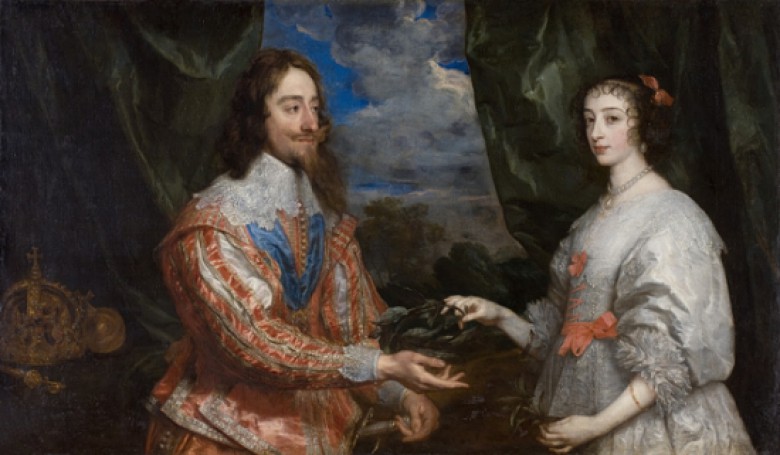
 Charles I and Henriette-Marie de France
   
George Villiers, Duke of Buckingham

 A most eloquent review of My Queen, My Love.

If you read this book, be prepared to obsess over the characters like you would with any engrossing fictional story . . . only to be reminded that they are, in fact, real.  After doing so, you may just scour the Internet for photos of your new "friends."  Be prepared also to lie awake wondering what REALLY happened regarding a matter of court intrigue, asking your husband when you should be sleeping if he thinks that so-and-so poisoned so-and-so before the story started. While you're at it, you should also expect to wonder whether or not you should really google the villain and behold his countenance.

But, of course, you will. After all, you HAVE to know if he really, truly existed.

Then, once you know that he WAS, in fact, real, you will fervently wish for a time machine so that you can go back to warn everyone about him.

. . . or maybe that's just me. ;)  After all, I was crying over Giuliano de' Medici a few months ago.

MY QUEEN, MY LOVE: A NOVEL OF HENRIETTA MARIA by Elena Maria Vidal reminded me of why I love history (and even revitalized that love): that is to say, it is not a simple list of dates and facts, but, rather, a compelling story, alive with rich "characters" that have the power to stay with you. Vidal masterfully wove together a literary tapestry that tapped into real-life events in a way that inspired the reader to keep turning the page. There was beauty, there was tragedy, there was romance . . . and, much to my surprise, the plot was also layered with key characteristics of a mystery novel. Since I didn't know much about this particular "story" going in, it truly was similar to reading a completely fictional work where there still exists uncertainty and suspense.

Yet, despite the strong elements of intrigue and mystery, at the center of the entire narrative is a love story: that of a king and his queen and the Love that transcends their world.

From early on in the novel, I fell in love with the love story of Henrietta Maria and King Charles I. Rather than compose more coherent sentences, I have decided to instead include my "freak-out" gushing below. Unprofessional or not, it accurately reflects my state of mind when delving into the story and may perhaps best inform potential readers:
------------------------------------------------
HE FELL IN LOVE WITH HER WHEN SHE WAS DANCING---NOT ATTRACTION, BUT REAL LOVE AT FIRST SIGHT WHERE HE SAW THE DEPTHS OF WHO SHE TRULY WAS.
 
BUT SHE DIDN'T KNOW HE WAS THERE AS HE WATCHED FROM AFAR.

And then she fell in love with HIM through his letters, which is SO BEAUTIFUL AND ROMANTIC, too!!! AHHHH. Because she has SUCH a pure heart, like Cinderella and her prince when they first meet in the live action movie.

AND THEN THERE IS THIS EMOTIONAL BUILD-UP OF STORY TENSION because they have to still MEET. And the reader just needs it to happen asap!

And then they meet . . . and it is a Moment with a capital M!

But there be villainy afoot. ;) 
------------------------------------------------
Vidal's writing skill shone through once again in her brilliant introduction of the villain of the story through the eyes of one who regarded him as a close friend. Without going into detail, he could have been mistaken as a flawed comic relief, before his true nature became clear. Not only did this make the story-line more compelling and unpredictable, but it served as a rather profound commentary on evil relevant to today. In the presence of some, evil masquerades as Cool Guy, charming everyone with his jokes. But, when only some are watching, the mask just might come off.

As a Catholic, I was particularly drawn to the historical depiction of events as concerns the persecution those of my faith faced in England at the time. It was important for me to learn more about their plight, and my heart broke for those who suffered, much like that of Henriette, just as it rejoiced at moments when they received better treatment.  Yet the pain and suffering is balanced also with Light, the reason for which they are fighting.  Through vivid and sometimes ethereal descriptions, as well as profound reflections, Vidal was able to illustrate what we love so dearly.

The writing style in general is both detailed and engaging, rich with beautiful imagery that is, at times, quite lyrical. I found a kindred spirit in the romantic way that Vidal chose to describe figures, scenery, and events and likewise enjoyed the sprinkling of Arthurian legend in the novel. It was lovely to see Henrietta and Charles share a mutual love of these old stories, which not only added depth to their relationship and to them as individuals, but also seamlessly tied into the plot and foreshadowing of future events.

In terms of the characters on an individual level, I found myself bonding quite a lot with Henrietta, between her innocent romanticism, deep love of her faith, and moments of wit and humor.  But, on another level, I wondered at times if she were a saint and found her on the whole to be an inspiring figure. While there were moments in which the reader was called to be frustrated with Charles for being blinded as to certain individuals, I came to care a great deal for him and deeply admire his nobility of heart and desire to do what was right. The reader may also sympathize with the long-seated pain that he experienced, which is slowly revealed within this man of a pure and childlike nature yet confident, regal bearing.

While there were difficult moments to read throughout the novel, beginning with the tragic backstory of Henriette's mother, Marie de' Medici, the beauty of the center characters continued to illuminate the pages. Without going into detail, I will say that the intrigue of the novel also remains until the very end. Just like with a true mystery story, there are revelations at the conclusion that truly took me by surprise.  At the same time, the final pages served as a "bookend" in more than one way.  I'll leave it at that.

The reader should bear in mind that there may be occasional phrasings or actions with which he or she may not agree, even concerning supporting characters with a great deal of good.  However, such may also be found in real life, and it is likely that Vidal wished to present people and events with as much historical accuracy as possible while simultaneously putting forth a compelling narrative.  The meticulous research conducted for this book is abundantly clear from the detailed historical facts imbued into the text (as well as the lengthy works cited), although the novel format also allows for some speculation and presumably fleshing out of characters and situations.
(Read more.)

Share

Wednesday, August 12, 2026

Charles I and Henrietta Maria Departing for the Chase

File:Daniel Mytens (c. 1590-1647) - Charles I and Henrietta Maria Departing for the Chase - RCIN 404771 - Royal Collection.jpg
 From The Royal Collection Trust:

 In this ambitious large scale double portrait by Daniel Mytens the King and Queen are depicted on a terrace as they prepare to depart on a hunting excursion. Surrounded by lively dogs, they are attended by the court dwarf, Jeffrey Hudson and an African servant who brings their horses. The unusual composition, in which the two main figures are set off to the left hand side serves to emphasise the informality of the image. The couple are depicted in fashionable dress rather than court regalia and the strength of their loving relationship is commemorated through their intimate pose - they are shown holding hands - while a winged cherub showers flowers upon them. (Read more.)


More HERE.


Share

Sunday, August 9, 2026

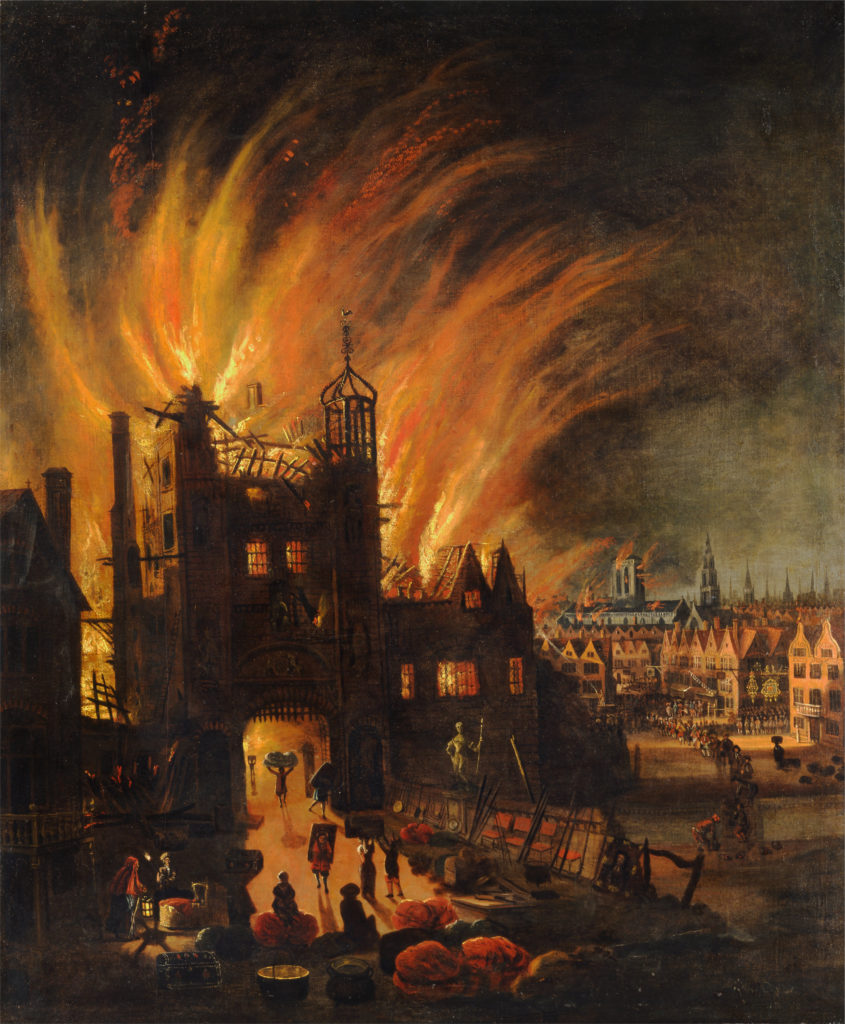
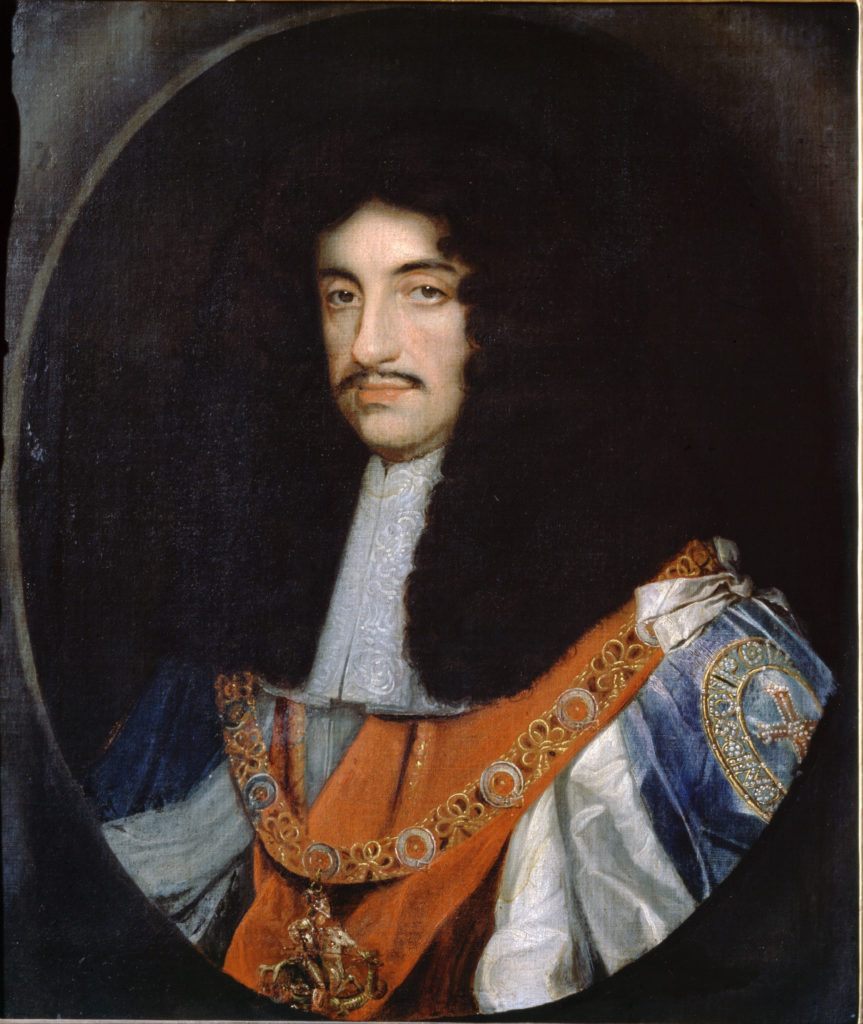
Charles II: The Great Fire of London’s Forgotten Hero


In the small hours of Sunday 2 September 1666, Samuel Pepys, Secretary to the Navy, was roused from his bed with news of a fire burning several streets away. He went to a window of his house close by London’s east wall and looked out over the city. There was, indeed, a conflagration over towards Billingsgate, but these outbreaks were quite common in the narrow streets and timber-framed houses of the capital. Pepys decided that there was nothing to worry about and returned to bed. He needed his sleep. He – and England – had enough problems to worry about without a little fire in overcrowded London city. 
After all, the nation was divided and discontented and the existing government was highly unpopular. More than six years had passed since the return of Charles II from exile in Europe and the restoration of the monarchy after the republican rule of Oliver Cromwell. The myth of England being delivered from gloomy, oppressive Puritan rule by the ‘Merry Monarch’ is well ensconced in popular perception but it is a myth. It did not take long for the mood of the capital and the country to change as the policies of the new government were implemented. 
If a week is a long time in politics, six years may seem like an eternity. Throughout the country people had seen royalist landowners settling scores with neighbours and tenants who had sided with the parliamentarians in the Civil War. The bishops, now installed or re-installed in their dioceses, rigorously enforced the new religious settlement and, as a result, 2,000 clergy who could not accept the ‘high church’ doctrines and ceremonies of the new regime were turfed out of office. Charles, who had learned his politics the hard way, was not totally behind the policies of the Restoration Parliament. He knew the importance of toleration. The French, among whom he spent most of his adult life, had a saying: ‘ne reveillez pas le chien qui dort’ – ‘don’t rouse the sleeping dog’ – and it expressed a philosophy close to Charles’ heart. However, too many of his followers were set on revenge. (Read more.)
Share

Wednesday, August 5, 2026

The Private Life of James II

 I have posted about Justine Brown's biography of James II, HERE and HERE; I am happy to say that I have at last been able to read it for myself. It really is the best book I have ever read about James. For one thing it does not trash everyone else in his family as some biographies do. And it explores the walking contradiction that was James II, second son of Charles I and Henrietta Maria, whose very real virtues were overshadowed by his principal vice, that of lust, leading to several torrid extramarital love affairs and a handful of illegitimate offspring. I have often wondered if the obvious sex addictions which ruled Charles II and James II were a result of the traumas suffered when they were young and witnessed the bloodshed of war, resulting in the judicial murder of one beloved parent with long separations from the other beloved parent. Or maybe it was just that they took after their grandfather Henri IV, le vert galant. Their first cousin Louis XIV resembled le bon roi Henri as well, when it came to women, without the excuse of having witnessed the horrors of war as a child, although he came close enough. While James was handsomer than his brother Charles, he possessed neither his earthy charm nor his uncanny ability for double-dealing. James, a military man, was forthright and blunt, seeing the world in black and white, which some have characterized as bigotry, although his ideas of freedom of conscience as applied to the law were revolutionary for his time. Ironically, James is seen as a tyrant and absolutist, when all he wanted was for Catholics and non-conformist Protestants to enjoy the same religious liberties as Anglicans. He had the makings of a great king but was betrayed by his own flesh and blood, changing the course of history and plunging Ireland and Scotland into another century of persecution.

People have mocked James for throwing the Great Seal of England into the Thames before fleeing his kingdom. However, after reading Justine's book it becomes clear why he did so. He was emotionally devastated by the betrayal of his beloved daughters, as well as by his sons-in-law, one of whom was also his nephew, only child of his beloved sister Mary, the Princess Royal. In all the upheavals of the English Civil Wars, James' immediate family had always remained loyal to his father Charles I and to each other. While they had been sundered by miles, illness, imprisonment and death, they never betrayed each other. For James to have his throne stolen by his own children, with the help of the Churchills, to whom he had given everything, was like a knife in the heart. I think he also knew that the ancient monarchy was over and that kings and queens would no longer rule but merely reign.

Perhaps James' main mistake was, other than underestimating the ruthlessness of his daughters Mary and Anne, was underestimating the hatred of Catholicism that the Whig party was intent upon keeping alive in England. During his exile and army career, James had visited Catholic countries; he was married to an Italian and his sister-in-law was Portuguese. He thought that seeing the open practice of Catholicism would wean the populace from their worn-out prejudices. But the fear of popery that erupted into violence, forcing his Queen and his newborn son to escape to France, showed him that he had miscalculated.

James II emerges from the book as a tragic but fascinating personality. He was one of the last Kings of England to have had personal experience of warfare. As Duke of York he built up the British navy, preparing it to be the mega-force which was to rule the seas in the next century. He was a patron of the lively Restoration theater and of all the arts. He was a patron of Catholic shrines, reopening defunct Catholic places of pilgrimage during his short reign. He possessed basic familiarity with his Celtic realms, having lived for several years in Scotland as Duke of Albany. He is patriarch of a European dynasty, the Fitz-James Stuarts, and also has many descendants in the United Kingdom to this day, including the current Prince of Wales. In his last years, exiled in France, the founder of the Trappists, Abbot Armand Jean le Bouthillier de Rancé was his father-confessor. For anyone interested in English history The Private Life of James II by Justine Brown is a must-read.

The biography may be purchased, HERE. An interview with the author is HERE. My novel about James' mother, Queen Henrietta Maria, is HERE.

Share

Friday, July 31, 2026

"Beautiful Love Story"

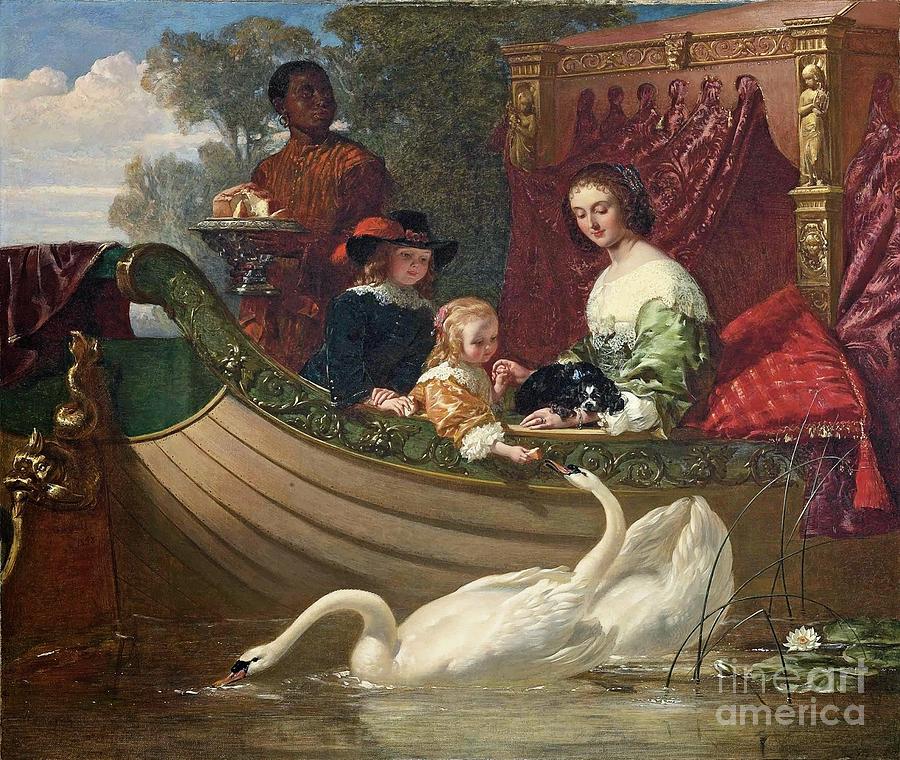
Henrietta Maria with two of her Children

Charles I and Henrietta Maria with Charles Prince of Wales and Mary the Princess Royal

The Queen doing Penance at Tyburn

A glowing review from Pursuing Stacie:
I have a huge love for classics. Little Women, Jane Eyre, Anne of Green of Gables…I will reach for these novels again and again, and then sigh happily about 3, 428 times throughout the story. This was exactly my experience while reading My Queen, My Love: A Novel of Henrietta Maria. It just has that rare classic, cozy, wholesome feel. Mind you, there’s plenty of suspense and intrigue. But the story is just so good!

The author skillfully fleshes out the characters and story of Charles and Henrietta, allowing her readers to sink into the novel. When I was about three chapters in, I realized with a start that I had not only completely missed my bedtime, but had forgotten altogether that I was reading a book, so engrossed was I in the story. (Have you ever read a book that feels like a movie?) (You’re about to.)

While the author set a scene masterfully, she also brought these historical characters to life in rich detail. (Might I suggest Googling their names as you meet them, by the way? So fun to put a face to the new friend that you’ve just made.) I adored Henrietta and will carry her with me always. But truly, each character was dynamic and real. From the beautiful love story to the suspense that only villainy can bring, this novel is perfect from beginning to end. (Read more.)

Because the two of them worked hard to make their marriage work, they ended up deeply in love with each other which made it satisfying. There is plenty of drama, politics, and courtly intrigue that will engage the reader to keep turning the page! I can’t wait to read the next book in the series to learn what comes next for Queen Henrietta Maria of England! I recommend this for fans of Jean Plaidy, Alison Weir, and Philippa Gregory! My Queen, My Love is a promising start to an enthralling series on one of England’s most tragic queens! (Read more.)

My Queen, My Love and Generalissima are available from Amazon.
Share

Monday, July 27, 2026

The Six Loves of James I


In the last few decades some really amazing authors have begun writing about the Stuart dynasty. The abundance of Tudor biographies and novels have led to an interest in the family which succeeded them on the throne of England. While the Tudors were wily politicians, they were continually challenged when it came to male heirs. Because Margaret, the oldest daughter of Henry VII and Elizabeth of York, married James IV of Scotland, her Stuart descendants became the heirs of the Three Kingdoms of England, Scotland and Ireland and of the principality of Wales. James VI of Scotland, son of the murdered Mary Stuart, was de facto heir of the last Tudor, Elizabeth I. He became James I of England. Gareth Russell's fascinating biography of this brilliant and complicated man is a must-read for anyone venturing into the upheavals and achievements of the seventeenth century. Mr. Russell is known for his painstaking research of primary sources as well as for his witty and entertaining prose. This must be at least the tenth work among his several books and plays that I have read.

James I was a series of contradictions. A peaceful man, he was haunted by violence from the womb, when a Scottish lord held a pistol to his mother's pregnant stomach during a palace coup. He survived the violent deaths of both his parents as well as attempts upon his own life, in addition to kidnappings. Yet what damaged him most was the harsh, unloving and even brutal treatment he received as a motherless child from those entrusted with his upbringing. When he finally had a his own wife and family, he loved his Anna, and saw to the thorough education of his children. He was nevertheless constantly becoming infatuated with a series of handsome young men. 

A scholar of Hebrew and Greek, James presided over the translation of the Bible into the English, known as the "King James version." Famous for writing works of theology, he was also notorious for rowdy and boisterous banquets at which he became drunk, while making and laughing at coarse oaths. A persecutor of Catholics, he also insisted on the Anglican liturgy being uniform and dignified, with vestments and candles, which the Calvinists saw as papist. A prosecutor of witches, as a matter of conscience, he would then scandalize the court by showing public affection for his boyfriend of the moment. It was James I's elevation of his favorite, George Villiers, as Duke of Buckingham, while treating him practically as a member of the Royal Family, that prepared the way for Buckingham to be a fixture at the court of James' son, Charles I. Unfortunately, the role Buckingham played in the government of Charles, particularly as perceived by the people, weakened the royal authority.

From Folger Shakespeare Library:

“Elizabeth was king, now James is queen.” So went the joke circulating around London in the 17th century. While Elizabeth I became an icon for transgressing traditional gender roles, her successor is all too often overlooked or even mocked for the same reasons. Yet James I was a multifaceted ruler who led a fascinating life—and his personal relationships only add to that complexity.

For generations, historians avoided labeling the intimate relationships between James and his “favorites” as romantic. But after combing through James’s personal correspondence, historian and author Gareth Russell has uncovered compelling evidence of five significant love affairs with men. His award-winning book, The Six Loves of James I, reveals how these relationships—and his marriage to Queen Anna of Denmark*—guided the course of his life and reign.

James I’s story is a turbulent one, filled with assassination attempts, kidnapping, and witch hunts. It’s also a story of a man who loved “indiscreetly and obstinately,” for better or for worse. In this episode, Gareth Russell explores the untold history of a complicated king through the lens of the great loves of his life. (Read more.)


The Six Loves is available HERE.

Share

Sunday, July 19, 2026

My Guest Post for Tony Riches


 My thanks to Tony for such a wonderful opportunity! From The Writing Desk:

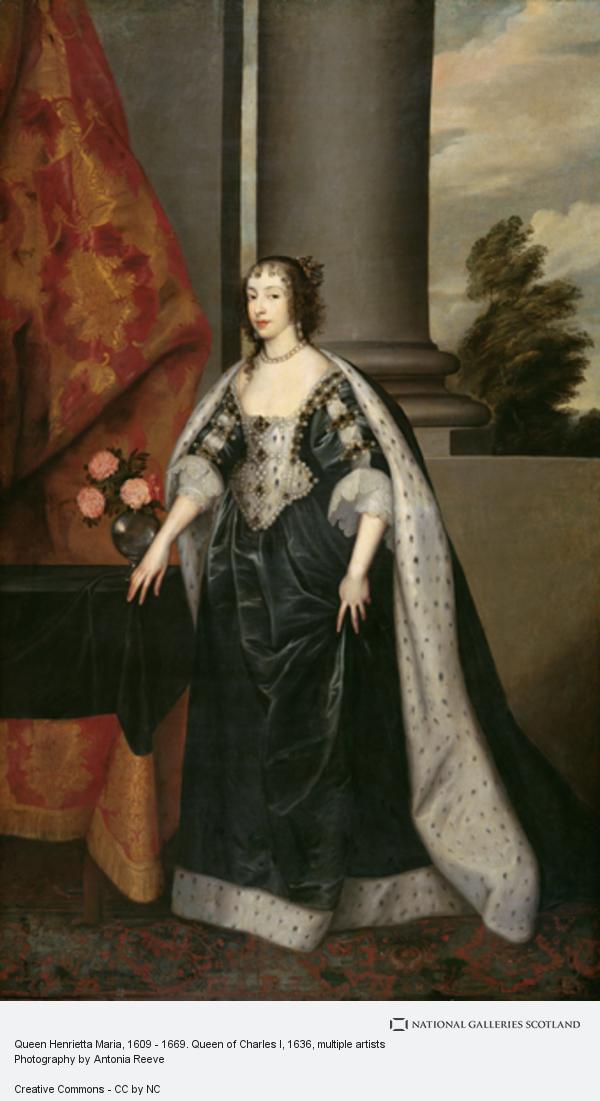
Wife of the ill-fated Charles I, the colony named for her was intended to be a refuge for Roman Catholics, the Catholic religion being forbidden in the Three Kingdoms. In my room as a teenager there was a print of the Van Dyck portrait of Henrietta Maria, the original of which is in the National Gallery of Art in Washington, D.C. Called “Mary” by her subjects, the second Stuart queen of England peers down from the portrait with her black eyes, which contemporaries described as large, sparkling and beautiful. Her dark curls with auburn highlights contrast against the deep marine blue shimmer of a silk dress, with the salmon-pink bows and elaborate white cuffs and high starched collar. A wide-brimmed plumed black hat was of the type made famous by the cavaliers who later fought for her husband in the English Civil Wars. 

The white plumes are reminiscent of the one made famous by her father Henri IV of France, which he wore into battle so that his men could always find him. Like her father, Henrietta Maria was not afraid to stand out, remaining a devoted Catholic in a land where her faith was banned, becoming the number one lawbreaker, while also striving to be a traditionally obedient wife, as was expected. But the expectations placed upon her made her life a tightrope walk which almost broke her.

The life of Henrietta Maria of France (1609-1669) was turbulent from the beginning. Half-Bourbon and half-Medici, her father, the famous Henri IV, was assassinated when she was an infant. Brought up by her mother, the Queen Regent Marie de’ Medici, to be a devout Catholic, she also mastered ballet, singing, and acting, skills which she would use in masques to entertain the Bourbon Court and later the Stuart Court. At fifteen she was sent to marry Charles Stuart, grandson of Mary Queen of Scots, who had just succeeded his father James I to the throne of the Three Kingdoms. 

While Charles I never converted to Catholicism, as had been hoped by many, his relationship with his wife was profoundly spiritual, enhancing the intense physical passion between them. After the initial clashing of cultures and personalities, theirs became one of the most devoted in the history of royal marriages, and was blessed with nine children. During the troubles which led to the English Civil War, Henrietta Maria became a liability to Charles because of her religion and her meddling, both perceived and actual. But her courage and her devotion fuelled the royalist cause, as she sold her jewels to raise money for arms and led soldiers to aid her husband. 

The challenges the royal couple faced in their early years of marriage are told in Book 1 of the Henrietta of France trilogy, My Queen, My Love. Book 2 will deal with the Civil Wars and Book 3 will be about the Queen’s widowhood as well as the adventures of her surviving children.

My view of historical fiction is that the author attempts to paint a portrait of the past with words. A historical novel is like a portrait come to life, allowing the reader to step into the past. Authenticity is vital, and that comes only from thorough research. While it is not always possible to visit the historical places that play a part in the novel, it helps. 

The internet has been a gift to historical fiction writers, making accessible old documents, manuscripts, pictures and books that one once had to travel far to find. I found the original program of the 1623 masque performed by Anne of Austria and Henrietta of France at the Louvre during Shrovetide. It was at the rehearsal of the masque that Charles Stuart first saw Henrietta during his incognito visit to Paris. Such primary sources, like the Queen’s letters, are indispensable for creating a living portrait.

So much of what people think they know about Henrietta Maria has been filtered secondhand through multiple writers, some of whom view her as a frothy but tiresome fanatic who led her husband into ruin. This is often accompanied by the perception of the Queen as a dangerous seductress, who used her French wiles in the boudoir to subject Charles to her will. 

And others decide that Charles was not enough for her but she had lovers such as Henry Jermyn who actually told her what to do, while fathering her children. Just as her enemies called her the “popish brat of France,” she has been portrayed erroneously either as a sex fiend soaked with crazed religiosity, or as a shy, pious pawn. (Read more.)

Novel available HERE.

Share

Saturday, July 11, 2026

"A Lush, Passionate Portrait"


  From BookLife:

In the first of her Henrietta of France trilogy, Vidal (Marie-Antoinette, Daughter of the Caesars) paints a lush, passionate portrait of the life of Henriette-Marie, a seventeenth century French princess descended from the Bourbons and Medicis. Wed to King Charles I of England at the tender age of fifteen, Henriette is determined to bring Catholicism back to England, despite her Protestant husband and the country’s “hatred of Catholicism.” Often buffeted by political and social forces beyond her control, Henriette, known in England as Queen Mary, faces the challenges she encounters with the courage and resolve that she draws from her deep Catholic faith.

Firmly grounded in real historical events and settings, Vidal breathes life into Henriette’s era through extensive, evocative descriptions of its clothing, food, and palaces. This attention to detail offers a tantalizing immersion in this royal world, from the elaborately-costumed “masques” she and courtiers create to entertain the King at holiday celebrations to her beloved spaniel, Hebe. Vidal also illustrates the complexity of royal life through her careful elaboration of the complicated web of marriages, kinships, and associations. Some readers will be overwhelmed by the many branches of the royal family tree, but the text’s clear exposition and strong narrative arc offer clarity and guidance.

Vidal highlights the most important characters through her vivid depiction of their personalities and motivations. Antagonist George Villiers, the Duke of Buckingham, creates a true sense of menace as he threatens Henriette and works to disempower her. Although she is pure and steadfast in her intentions, Henriette’s struggles to balance her devotion to her husband and to her faith will earn readers’ respect and sympathy, even if they do not share her allegiance to the Catholic church. Offering insight into the passions behind the protocols, My Queen, My Love infuses these historical figures with humanity.

Takeaway: Readers of historical fiction will appreciate the depth and nuance Vidal brings to this often overlooked historical figure. (Read more.)


"Elena Maria Vidal brings history to life again with the story of Queen Henriette Marie, complete with an unlikely but true love story of the Queen and King Charles I of England, a formidable personal enemy in the menacing Duke of Buckingham, lots of well-researched period details, and the matters of Christian faith behind many of the conflicts. An antidote to the Whiggish story that is often passed off as history in America, with its anti-monarchical bias. Though Henriette Marie is not nearly as well known as another maligned consort, Marie Antoinette, Americans should learn her story because, coming after Jamestown's founding, she was their queen." —John Beeler, A Conservative Blog for Peace


Available HERE.

Share

Monday, July 6, 2026

The King's Spy (The Rebellion Series, Book 1)


When I asked Mark Turnbull to write the forward of my novel Generalissima, I was impressed by his credentials as both a novelist and biographer, as well as his vast knowledge of the period known as the Wars of the Three Kingdoms aka the English Civil Wars. As an American who grew up near a battlefield of our own Civil War, I have friends who know the details of every conflict, of every regiment, of who died where and how, and so on. Mark Turnbull is similarly familiar with the highly complicated warfare amid shifting alliances that comprised the English Civil Wars. He also has the ability to tell a riveting story while building fascinating characters. The King's Spy, a thriller of a novella, is the first of a trilogy about the Wars of the Three Kingdoms, The Rebellion Series. Mark is also author of the award-winning novel Allegiance of Blood, likewise about the English Civil Wars. I enjoyed and reviewed his biography of Charles I and look forward to the new biography of Prince Rupert.
 

14th June 1645. The Battle of Naseby is set to decide the outcome of the civil war in England.

The armies of King Charles I face those of Parliament and its untested New Model Army. Yet amidst the carnage, an intensely personal battle takes place between two men.

Captain Maxwell Walker is a royalist cavalry officer, widower and father. Loyal and brave, but haunted by his grief, Maxwell thirsts for revenge. His life has never been the same since his encounter with the parliamentarian Gervase Harper, a man whose ruthless streak sees him prosecute the war with vigour. Harper cuts down anyone who gets in his way. Maxwell’s wife was no exception.

The outcome of Naseby causes Maxwell to be tasked with a royal rescue mission. The King’s most personal possession must be retrieved. His cypher would allow Parliament to decode captured royal correspondence and that would deal a major blow in the propaganda war.

The soldier must play the spy.

His actions, however, earn him the enmity of both sides. The hunter becomes the hunted.

Facing a murder charge, as well as a great siege, Maxwell makes a discovery that might just save himself and the King’s remaining cavalry.

However, all of this rests upon his next encounter with Gervase Harper. (Read more.)
A most moving scene is of an aged Anglican pastor after he and his church have been attacked by the Puritan army. The Puritans hated altars, vestments and stained glass, all the things Charles I insisted upon having in his churches. Such vignettes convey the religious upheavals which seared the souls of the populace, along with the other atrocities.
 
Since The King's Spy begins with a description of Naseby and the immediate fallout after the battle, I waited to read it until now when I am researching the final volume in the Henrietta of France Trilogy. It is an excellent book for young readers as a politically incorrect, non-woke introduction into the Wars of the Three Kingdoms. Because, as I have found, well-researched historical fiction tends to challenge our contemporary preconceptions, giving us a glimpse into a lost world. Share

Monday, June 8, 2026

Writing Seventeenth-century Fiction

 From The Seventeenth Century Lady:

Not a Chronos title, but reviewing Gerard Fitzgibbon’s Kingdom Overthrown: Ireland and the Battle for Europe 1688–1691 for the Irish Examiner also profoundly broadened my understanding of the 1600s, revealing it as an era of international conflict, sectarian violence, and colonial ambition. Through accounts of the Williamite-Jacobite wars in Ireland, one witnesses how Catholic and Protestant divisions were not theological disagreements at all, but a means to determine land ownership, political rights, loyalty, and often life itself. To a budding novelist, the story created a rich framework for writing about conflict. Accounts of the battles of the Boyne, Aughrim, and Limerick reveal not heroic romantic warfare but exhaustion, famine, mud, terror, and brutality. Fitzgibbon’s descriptions of soldiers dying slowly from musket wounds, starvation spreading after scorched-earth campaigns, and divided leadership among the Jacobites all help strip away modern romanticism about war which I strive to bring to the novel.

Recurring truths about the 17th century kept popping up. Reputation could destroy lives. Religion shaped identity and loyalty. War was brutal and constant. Empire displaced entire populations. Survival depended on adaptability. People feared God, plague, famine, and political betrayal. Honour mattered. Bloodlines mattered. Religious identity mattered. Death was common and often sudden.

Having been provided with the building blocks of a believable historical world, dynastic ambition, war, exile, colonial expansion, and survival inside brutally unstable political systems, slowly my novel started taking shape. The sensory details contained within works I’d read were equally valuable to help me write about the texture of daily life… velvet gowns, sweat beneath brocade, banquets, candle wax. (Read more.)


Share

Sunday, June 7, 2026

Charles I and Henrietta Maria at Oxford

 From Merton College:

The assassination of Buckingham in 1628 saved the marriage. Charles and Henrietta Maria found solace together and eight children were born between 1629 and 1644, a family famously celebrated in the portraits of Van Dyck. She developed into a discerning patron of the arts, an enthusiastic developer of houses and gardens, a confident participant in court politics and a committed patron of the Catholic cause in England. King and queen commissioned and participated in court masques that held up their mutual love as a model for the harmony of a wise king and his ordered realm. As tensions grew over Charles’s religious and fiscal policies across his three kingdoms, tensions that would lead in 1637 into a revolt in Scotland, his more anxious subjects saw in such productions evidence not of harmony, but of papist conspiracy at the heart of the court and of the queen at its head. Her elaborate baroque chapel, built by Inigo Jones at Somerset House, her cultivation of continental sacred music, her squad of French Capuchin priests, her encouragement of noble lady converts to Rome and her welcome to papal agents at court all fitted the picture.

As Charles turned reluctantly to his English Parliament to resolve the deepening crisis, criticism of the queen mounted. It was in part fear for her safety that led them to leave London in January 1642 and soon afterwards she crossed to Holland. She was both escorting her daughter to a marriage into the House of Orange and looking for support for her husband’s cause. Early in 1643, she sailed to Bridlington and set herself up at York, helping to direct the royal armies in the north, but her aim was always to re-join the king, who had made Oxford his base and Christ Church his home. Already in February she was writing to him, ‘I am in the greatest impatience in the world to join you’.

By mid-March 1643, rooms at Merton were being prepared for the queen and a route cleared between their host colleges so that king and queen could readily meet. She finally arrived on 14 July, entering the city by coach. There were speeches of welcome and the university authorities presented the queen with gloves and books of poems. Then she walked with Charles from Christ Church through one of the Canon’s gardens and ‘Corpus Christi backeside’ to Merton, where she settled into the Warden’s Lodgings at the junction of Front Quad and Fellows’ Quad. These were conveniently vacant as the Warden, Nathaniel Brent, had fled to London and sided with Parliament, which was by then busy trying to impeach the queen as well as to besiege her husband.

Henrietta Maria already knew Oxford. When she and Charles visited in August 1636, four-year-old Anthony Wood, the great chronicler of 17th-century Oxford who grew up in Postmasters Hall, saw them and remembered it for the rest of his life. Indeed, she already knew Merton, for Warden Brent had entertained the royal couple in 1629. Welcomed to the College with an oration by James Marsh, a long-serving fellow, they spent an hour in the long gallery that stretched from Brent’s lodgings along the top of Fellows’ Quad, enjoying afternoon sweetmeats.

She made her bedroom in Brent’s dining room, now the Breakfast Room, accessible from the stately carved staircase that Brent had just had built, while her entourage occupied the Queen’s Room over the Fitzjames Arch and adjoining areas. They included several servants who died at Oxford and were buried in the College Chapel – Richard North, Ellis Roberts, Mary Skevington – and the widows of aristocratic royalist captains, such as Lady Cobham and the Countess of Northampton. The Chapel hosted her Catholic services and at least one fellow, Dr John Greaves, the Savilian Professor of Astronomy, was later accused of spending far too much time with her Capuchin confessors. (Read more.)


From the BBC:

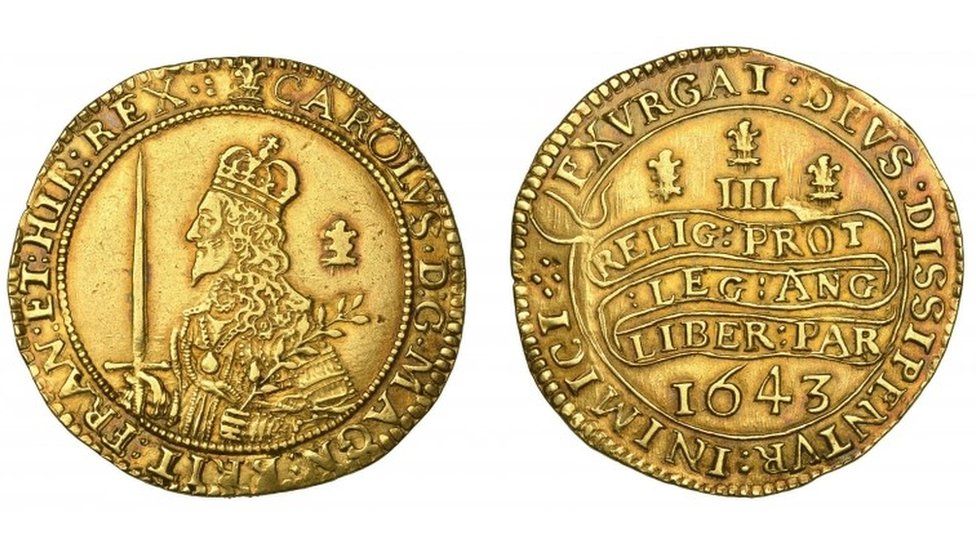
A rare large gold coin from the reign of Charles I has fetched £54,560 at auction. The coin, known as the Triple Unite, was minted in Oxford in 1643 during the English Civil War and had the value of 60 shillings, or three pounds. It depicts the King holding a sword and an olive branch, possibly signifying his desire for peace. It sold earlier at auction house Dix Noonan Webb as part of the Micheal Gietzelt Collection. (Read more.)

Share