Friday, October 31, 2025

An Irish Halloween

The picture above was painted by Irish artist Daniel Maclise in 1833, inspired by a typical Irish Halloween party. (Click on picture for details.) It was called "snap-apple night." Here is the caption which accompanied the painting:
There Peggy was dancing with Dan/While Maureen the lead was melting,/To prove how their fortunes ran/With the Cards ould Nancy dealt in;/There was Kate, and her sweet-heart Will,/In nuts their true-love burning,/And poor Norah, though smiling still/She'd missed the snap-apple turning.
For the ancient Celts, November 1 was Samhain, their New Year's day. It is not necessary to detail some of the more gruesome pagan customs which accompanied the festivities in pre-Christian times, customs which eventually disappeared as the Faith spread and took hold. Nevertheless, on a more positive note, the Celts believed that on the day in question the veil between the worlds grew thin, and one could easily pass from world to world, from time into eternity.

As Christians, in celebrating the Solemnity of All Saints, the sacred liturgy permits us to glimpse the place where the blessed ones dwell in light. We are led to think of all the dead, of the awe-inspiring realties of death, judgment, heaven and hell. On All Souls' Day we recall those who are still undergoing purgation in the realm beyond time. We, too, through the Mass and through prayer, pass from world to world, for all are present to God.

Here is an article (via A Conservative Blog for Peace) which elucidates on the history of All Hallows' Eve, the pagan versus Christian aspects and how the Irish, French, Germans, and English brought it all to North America. To quote:
Halloween can still serve the purpose of reminding us about Hell and how to avoid it. Halloween is also a day to prepare us to remember those who have gone before us in Faith, those already in Heaven and those still suffering in Purgatory. The next time someone claims Halloween is a cruel trick to lure our children into devil worship, I suggest you tell them the real origin of Halloween and let them know about its Catholic roots and significance. (By Fr Scott Archer)
 More on Irish Halloween traditions HERE.

Share

Why Biden’s Autopen Actions Are Null and Void

 From Amuse on X:

Every executive order, pardon, or proclamation carries the force of law only because it represents the president’s own act of decision. The Framers understood this link between consent and command as the essence of executive accountability. The president may consult, deliberate, or delegate preparation of documents, but he alone must decide and affirm. His signature is not a mere formality; it is the constitutional manifestation of his will. To remove the president’s mind from the moment of authorization is to sever the act from its legitimacy.

This is precisely what the Oversight Committee’s investigation has revealed. In case after case, Biden’s aides employed an autopen to sign executive actions without any documented, written, or digital evidence showing the president’s contemporaneous consent. No secure log of approvals, no voice confirmation, no physical presence. The White House’s own counsel could not demonstrate that the president had even been briefed before some of these documents were executed. Such practices do not merely stretch the boundaries of legality, they obliterate them.

The Constitution’s Article II vests “the executive Power” in the president, not in his aides, surrogates, or a pen operated by staff. The personal nature of this power is reinforced by the presidential oath, in which the president swears to “faithfully execute the Office of President.” That oath binds the office to the individual. No device can stand in for deliberation, and no staffer can channel another man’s judgment. When the act of execution becomes automated, government itself slides toward automation, unaccountable, impersonal, and dangerously opaque. (Read more.)

Share

Halloween and Catholicism

May 13, which is the feast of Our Lady, Queen of All Martyrs, was the original All Saints Day. So the origins of All Saints and Halloween had nothing to do with Samhain, as some people seem to think. Later, the Pope changed All Saints from May to November because after the harvest there was more food in Rome to feed the pilgrimsAnd for other reasons, as told in the article. From uCatholic:
The practice of a festival day to honor the whole communion of Saints, rather than that just a single saint, seems to happen for the first time in the Catholic Church with the consecration of the Pantheon as a public place for the Church’s worship. This happened in the year 609 (or 610) on May 13th. The Pantheon had been originally dedicated for the use of Roman religion as a place where all the gods would be honored. Boniface displaced the images of the gods from their shrines and gave the building over to the Saints of the Church, particularly the Martyrs. This was a kind of “in your face” to pagan culture. Boniface was saying that the old gods had been defeated and were defeated by the faith of the Church’s Martyrs. 
Also, May 13th was a day associated in Roman religion with what was called the festival of the Lemurs or ancestral spirits. It is likely that Boniface’s choice of this day to claim the Pantheon for Christian worship was intentional and it was a way of saying that the Martyrs are the great ancestors of all the baptized and it is their memory and witness that is rightly honored on the day that Romans recalled their ancestors. 
How we get from May 13th to November 1st is interesting. The festival of All Saints seems to emerge from the dedication of another Roman church that was consecrated by Pope Gregory III. The church is named St. Peter and all the Saints. It was a subsequent pope, Gregory IV, who extended the annual festival that commemorates this church dedication to the whole Church as All Saints Day. The extension of festivals specific to the Church of Rome is an part and parcel of how the Catholic Faith becomes the underlying cultural matrix from which a new kind of European civilization would emerge. (Read more.)
Share

Thursday, October 30, 2025

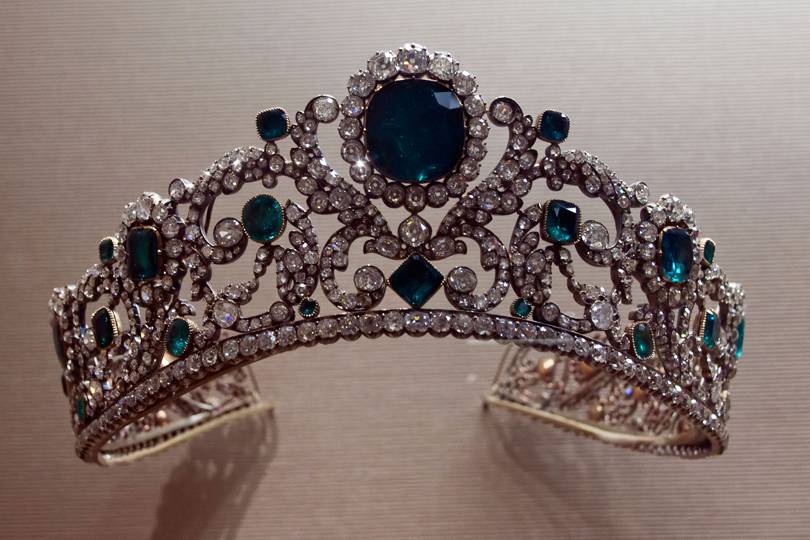
The Angoulême Emerald Tiara


Duchesse d'Angoulême

The tiara that was not stolen. The legitimate line of the French Monarchy was abolished in 1830, not 1848. From Tatler:
The French king and queen at the time, Louis XVI and his wife, Marie Antoinette, had attempted to escape Versailles during the uprising but were captured, imprisoned and eventually guillotined. When they had married in 1770 Louis and Marie-Antoinette were 15 and 14 years old respectively, and it was eight years later that their long-awaited first child, Princess Marie-Thérèse, was born. Despite having three more biological children, Marie-Thérèse was the only surviving family member of the Revolution and was imprisoned until she was nearly 17.

Upon her release, she was surrounded by throne enthusiasts keen to use her to regain monarchic power, and was quickly married off to her first cousin Louis Antoine, Duke of Angoulême in 1799, who was living in the Baltics while Napoleon held power back in France. Napoleon’s defeat at the Battle of Waterloo in 1815, however, finally saw King Louis XVIII and the House of Bourbon reinstated – with the added bonus of allowing Marie-Thérèse full access to the state jewels. In 1819, crown jeweller Maison Bapst was commissioned by the duke to use 14 emeralds from the royal collection, along with over 1,000 additional emeralds and diamonds, to make the Angoulême Emerald Tiara for his wife. However, Marie-Thérèse faced upheaval once again with the outright abolishment of the monarchy in 1848, theoretically becoming `Queen of France’ for about 20 minutes (which was the time between her father-in-law and husband signing their abdication papers). She left France and her beloved tiara for the final time and sought exile once more. (Read more.)
Share

Bill Gates Walks Away from the Climate Cult

 From MxM News:

Billionaire Bill Gates — long one of the loudest voices warning of climate catastrophe — now says the world has bigger problems to worry about. In a 17-page memo released Tuesday, the Microsoft co-founder called for a “strategic pivot” away from the obsessive focus on reducing global temperatures, urging leaders instead to prioritize fighting poverty and eradicating disease in the developing world. “Climate change is a serious problem, but it’s not the end of humanity,” Gates wrote.

Gates, 70, argued that global leaders have lost perspective by treating climate change as an existential crisis while millions continue to suffer from preventable diseases like malaria. “If I had to choose between eradicating malaria and preventing a tenth of a degree of warming, I’d let the temperature go up 0.1 degree,” he told reporters ahead of next month’s U.N. climate conference in Brazil. “People don’t understand the suffering that exists today.”

For decades, Gates has positioned himself as a leading advocate for global climate initiatives, investing billions in green energy projects and warning of the dangers of rising emissions. Yet his latest comments mark a striking reversal — and a rare admission that the world’s climate panic may have gone too far. “If you think climate is not important, you won’t agree with the memo,” Gates told journalists. “If you think climate is the only cause and apocalyptic, you won’t agree with the memo. It’s a pragmatic view from someone trying to maximize the money and innovation that helps poor countries.” (Read more.)

Share

Soviet Propaganda Cartoons

 From Mark Judge at Hot Air:

 Most of the cartoons criticize America for racism and greed. The Politburo called America oppressive while ignoring our constitution, civil rights movement, and freedom of speech. They mocked Western wealth while censoring our charity and basic decency. Like the Nazis, they rejected jazz in favor of "traditional" songs. Many of these cartoons are inspired works of art  - not surprisingly, some of the best were made not by true believers but by animators who feared for their family’s safety if they didn’t toe the line. 1972's anti-war "Ave Maria” is like the darkest parts of Fantasia and Guernica - although it should be said that some of the other films are pure Disney or Warner Brothers. 

Yet even a society as closed as the former Soviet Union couldn’t keep all Western influence at bay. In 1979's trippy, anti-gun "Shooting Gallery," artist-director Vladimir Tarasov gave the main character a red hat with a huge front brim. Tarasov had gotten the idea from a character named Holden Caulfield, who wore a hunting cap in a book called The Catcher in the Rye.

    It is striking how much the modern Western left has come to reflect old Soviet ideology. The essay by Igor Kokarev that accompanies the DVD set has 8 points that characterize the Soviet system. Many of them, like restricting travel and prizing modesty to the point of violence towards those who dress differently, are common among Islamic immigrants to the West, and are being adopted by their leftist defenders, who are self-admitted Marxists. (Read more.)


Share

Wednesday, October 29, 2025

Juarez (1939)


 Juarez (1939)

The 1939 film Juarez depicts the debacle of the French attempt to establish hegemony in Mexico under the auspices of Maximilian von Habsburg. The unlikely combination of characters involved in the fiasco shows that once again truth is stranger than fiction. Louis-Napoleon Bonaparte, styling himself as Emperor of the French, was the master manipulator of the affair which sent the Austrian Archduke Maximilian to his doom. Maximilian's consort was the intelligent and mercurial Charlotte (Carlota) of Belgium, a granddaughter of Louis-Philippe, the Citizen-King. Although Juarez is a simplification of an extremely complicated series of events, it brings to life the historical reality of such fascinating personalities coming together.


I personally think that the film was misnamed; it should have been called Carlota, since Bette Davis turned her supporting role as the Empress of Mexico into the heart and soul of the drama. In typical Bette fashion, she upstages everyone else, including the great Paul Muni as Benito Juarez. Brian Aherne is perfection as the noble, charming and romantic Maximilian, the most hapless of Habsburgs, and one of the most liberal, too. The film does not show his marital infidelities, but it does play up the irony that Maximilian's reforms were similar to those proposed by Juarez. This did not endear the Emperor to the wealthy landowners and he lost their support. The real struggles of Maximilian and Carlota with their childlessness is poignantly portrayed, as is their genuine horror when they realize that they have been duped by Napoleon III. Maximilian perceives that the imperial Mexico of his dreams is nothing but a cruel charade, and that the original plebiscite that brought him there had been rigged. Nevertheless, he and Carlota have fallen in love with their new country and have come to identify so deeply with Mexico's agonies that there is no turning back.

The gradual disintegration of Carlota's sanity is perhaps one of Bette's greatest achievements as an actress. Carlota's breakdown at the Tuileries is a heartrending scene, with Bette authentically capturing the mannerisms of a person descending into mental illness. In actuality, Carlota's complete psychological collapse occurred not at the Tuileries but in Rome, where Pope Pius IX sighed:
Nothing is spared me in this life, now a woman has to go mad in the Vatican." The Empress never saw her husband again; he was shot by order of Juarez, while Carlota spent the next sixty years secluded in a Belgian castle. As for Mexico, in years to come the Church would be persecuted there; many of the faithful would be martyred.

The scene of the most stunning beauty is one earlier in Juarez where Carlota in black is praying at the foot of the statue of Our Lady. The prostrate Empress begs to have a child, and for the success of the Mexican enterprise, surrounded by the votive candles, with darkness hovering beyond the small sphere of light. Her faith in the face of insurmountable difficulties is all the more radiant if the viewer knows that her prayers will not be answered according to her heart's desires. Her posture of supplication communicates a total oblation of self to the will of God. Once again it is demonstrated that sometimes God chooses not to save a people or a nation through political means. Rather, He intends to sanctify in the crucible of sacrifice.
 
Share

Mamdani In Charge – Time To Face The Future

 From AND Magazine:

The Islamic Circle of North America (ICNA): Identified by terrorism experts as the North American branch of Jamaat-e-Islami, a violent South Asian Islamist group. Ashraffuzzaman Khan, who used to head ICNA’s New York chapter, was convicted by a Bangladeshi war crimes tribunal and sentenced to death in absentia for his role in the torture and murder of 18 Bangladeshi intellectuals.

The Council on American Islamic Relations (CAIR): CAIR was listed as an unindicted conspirator in a scheme to finance Hamas, a trial that ended in a 65-year sentence for a CAIR board member.

The Illinois Muslim Political Action Committee: Members include Ousamma Jamal and Zaher Sahloul. Both have served as presidents of the Mosque Foundation, an organization with links to Hamas that has funded at least four charities that were subsequently shut down for financing terrorism.

Donations from such groups ought to be especially concerning, given Mamdani’s background and prior activities. Mamdani himself regularly accuses Israel of genocide. His father, a professor at Columbia University, teaches that Israel should not exist as a state and glorifies Palestinian terror attacks on Israel.

Mamdani once wrote and sang a rap song giving his “love” to the Holy Land Five, American Hamas financiers convicted and sent to prison for up to 65 years. Mamdani is a friend of broadcaster Hasan Piker, who believes that “America deserved 9/11.” (Read more.)

Share

The Death and Hope of Fall

 From El Antiguo:

Michaelmas felt like a door to autumn; the golden fatness of pecans starting to turn, the heat-baked smells of hay, harvest in the heat and the coolness of lemonade in the shade. Now I watch the first blue norther come in from my porch, smell the petrichor and hear the murmuring trees creak their branches. Now—as we enter the Hallowtide Triduum—something more final has breathed across the land.

It is Death.

On the coming of Fall, it is fitting to meditate upon death. The ancient pagans knew that this was a time of thinness, where the veil between life and death was gauze-scant. And they feared the dead. The Church, which baptizes all things good and true and beautiful, and re-orients them to God, took this awareness and the traditions that surrounded it and married them to Allhallowtide. The Natural, Agricultural, Psychological, and Cultural were married to and perfected in the Liturgical, which above all, turned the fear of death and demons, veils torn and veils thin, into a triumphant Hope. Death and Haunts aren’t what they used to be; in Christ (Firstborn of the Dead, not a Ghost but Flesh) Death is a door and Spirits are souls.

It is fitting indeed. We meditate upon death, and how it is no longer the End. We pray for the souls of the Church Penitent, undergoing the sanctification in Purgatory. We pray with the Church Triumphant, worshipping and interceding for us before the very throne of the Father. And we pray as the Church Militant, who fights here on Earth, armed to the teeth against the powers of darkness.

There’s a dignity and a triumph in Hallowtide, despite the quiet presence of Death… or rather, because of the presence of Death. (Read more.)

Share

Tuesday, October 28, 2025

Mermaids

I would be a mermaid fair...
From under my starry sea-bud crown
Low adown and around,
And I should look like a fountain of gold....
~from Tennyson's "The Mermaid"

(Artwork from Hermes)
The idea of mermaids has fascinated people for a long time, the first recorded tales being those from Assyria in 1000 BC. Later, the ancient Greeks and the cultures that followed had their own unique renditions of the myth. According to one article:
In Greek mythology, the merpeople existed in the form of Triton and his offspring....

Greek geographer and writer, Pausanias claimed to have seen two Tritons. He wrote this of them in his Description of Greece. "Their bodies are bristling with very fine scales. They have gills behind the ears and a human nose, but a very big mouth and the teeth of a wild beast . . . from the breast and belly down they have a dolphin tail instead of feet."

In 1608, English navigator, Henry Hudson described something two of his crewmen saw in his journal. He wrote this of their account. "From the naval upward, her back and breasts were like a woman's . . . her body as big as one of us; her skin very white and long hair hanging down behind,of the color black; in her going down they saw her tail, which was the tail of a porpoise, and speckled like a mackerel."

Mermaid sightings have continued throughout history, one of the most famous being off the coast of Wales in 1603:

The creature was first seen by Thomas Raynold, a yeoman from Pendine, who then summoned others to keep watch for three hours. William Saunders of Pendine later examined Raynold and some of the other witnesses. Stories of mermaids were fairly common during the fifteenth, sixteenth and seventeenth centuries, and there is even reference to a sighting in the journal of Christopher Columbus (1451-1506) for 9 January 1493. It was believed that mermaids could save sailors from drowning but could also lure ships to their doom. Belief in mermaids, fairies and other mythical creatures persisted in many areas of Britain until the eighteenth century and sometimes even later. Gradually, however, opposition by the Protestant Church, greater levels of literacy, and industrialisation led to a demise of the belief in such creatures, although many stories have survived.
The Romantics and Victorians enshrined their interest in legends about mermaids in art and poetry, one of the famous stories being The Little Mermaid by Hans Christian Andersen. Showmen such as P.T. Barnum made a great deal of money by charging people to view his hoax of a mermaid. But in spite of the hoax, as well as the scientific expeditions which claimed that mermaids were none other than manatees, merpeople have never quite gone away. Beneath it all perhaps lies a mystification with the otherness of the sea and the creatures, both real and imaginary, that dwell therein.

Share

The Horrifying Attacks on African Christians

 From Fox News:

When noted religious skeptic and TV host Bill Maher highlighted the plight of Christians in Nigeria in September during a conversation with South Carolina Republican Rep. Nancy Mace, he raised a conversation that’s been an ongoing tension for many of us in the humanitarian space: the conflicts that cause the greatest suffering don’t always correlate to the greatest attention.

Reflecting on the atrocities taking place in Nigeria, Maher bemoaned on the show: "This is so much more of a genocide attempt than what’s going on in Gaza. They are literally attempting to wipe out the Christian population of an entire country. Where are the kids protesting this?"

Here’s the thing: Gazans' suffering is legitimate. Just as Israel’s suffering on Oct. 7, 2023, and beyond was legitimate. And also, so is the suffering in Sudan and Yemen and Syria and Nigeria. What differs is the attention we bestow and our willingness to sit in the complexities and discomfort necessary to come to lasting solutions.

 I grew up in Niger. I spent my childhood in the Sahel region in a time when a Christian in a Muslim-majority region could expect to live in relative peace and optimism. Growing up, I knew many mixed-faith Nigerian families that lived in harmony. As a nation and as a region, we had hope. The promises of the green revolution, trade and the West African economic community caused us to anticipate a trajectory of growth. (Read more.)

Share

At the End of the Postwar World

 From Victor Davis Hanson at Freedom Frequency:

When fighting in Europe ends with the Nazi surrender on May 9, the continent is left in shambles, impoverished, and immediately threatened with both internal and external communist takeovers. Some 70 million to 85 million lives have been lost in this war. Perhaps 35 million died in Europe, on the Eastern Front, and in the Mediterranean. The traditional European economic powerhouse of Germany is flattened, occupied, and divided, with 30 percent of its territory under the control of the Soviet Union.

Many of the borders in Eastern Europe and the Balkans are radically altered, and these vast territorial changes will lead to some 20 million refugees. Perhaps up to 2 million displaced persons will have died of starvation, disease, or exposure by 1950. The vast majority of them are Germans expelled from Silesia, Prussia, and Pomerania to make way for the restoration of Poland. A quarter-million Jews who survived the Holocaust are homeless.

When the war ends, more than half of some 500 Soviet rifle divisions are occupying both Eastern Europe and East Germany—even as a broke Britain and a tired America are planning to collectively demobilize more than 3 million expeditionary troops eager to leave for home as quickly as possible.

The economies and infrastructure of the losing Axis-associated powers of Germany, Italy, Austria, Hungary, Romania, Bulgaria, and Slovakia are ruined. Their political systems are near-nonexistent. Neutrals like Spain, Portugal, Sweden, and Switzerland are still in the economic doldrums. The lands of formerly German-occupied Europe—especially the Netherlands and France—have seen their economies absorbed by Nazi mercantilism and are busy hunting down former internal collaborators.

Yet the ascendant Soviet Union is even more impoverished. Its western territories are ravaged. And it has suffered 26 million civilian and military deaths. (Read more.)

Share

Monday, October 27, 2025

A Medieval Castle in England Has 800 Years of Stories


From Mansion Global:

“There are gargoyles all the way around the parapet, so we suspect that if there are any ghosts, they have seen them off,” David said.

Despite the apparent lack of paranormal activity, Bishop’s Court has had plenty of other notable visitors in its near 800-year history. Nina Simone and Van Morrison stayed in the eight-bedroom mansion in the early 2000s when they performed at Bishopstock, a blues festival that ran on the estate for several years not long before the current owners bought the place.

Built in the 1200s, it was originally a country palace for Exeter’s bishops. Much of the medieval fabric of the building survives, including a tithe barn—used to store the local produce farmers paid to the church—and a stable block, thought to be one of the oldest in England. There is also a well within the main building that still supplies the couple with water today. “It goes down about 60 feet underground and the water is fantastic,” David said.

The story of Bishop’s Court reflects key moments in the history of British politics, the monarchy and the church, which is part of what made it so appealing. “The bishops were the real movers and shakers of their time,” David said. “Owning a house where a lot of very interesting people have lived over a long period of time, they become part of the ambience and environment.”

One of the bishops to live there was Walter de Stapledon, the treasurer in charge of England’s finances. Unpopular for raising taxes to support King Edward II, Stapledon was pulled from his horse and beheaded by a mob in the London uprising of 1326. His severed head was, reportedly, sent to the queen.

But in 1546, Henry VIII kicked the bishops off the estate as part of his dissolution of the monasteries, during which he seized land belonging to the Catholic church. The king gave Bishop’s Court to one of his trusted allies, the first Earl of Bedford, John Russell, as a reward for his help suppressing rebellions. (Read more.)


Share

Islamic State Wants to Use Libya as a Launchpad for Terrorism

 From Kyle Orton at It Can Always Get Worse:

The Naba 512 editorial seeks to legitimise IS grabbing territory in Libya by presenting it as a modern manifestation of the original Arab conquest that ultimately brought the Roman Christian province to Islam. The article is larded with theological argumentation drawn from the Qur’an and Tradition on this front, and these citations are intended as much as a roadmap for the future as they are justifications for the past. It is notable—and consistent with IS’s approach since its beginnings—that the enemies IS rails against most in the ideological portion of the article are not the “Crusader” West, but its Islamist rivals, the Muslim Brotherhood and Al-Qaeda.

When Al-Naba 512 shifts to more temporal analysis, there is an unmistakeable confession that IS shares the view of its Libyan “province” (wilaya) as being in a state of considerable disrepair at the present time—there is reference to a “prolonged stagnation and inertia”—coupled with a conviction that it need not remain so.

Libya effectively has two governments, one in the west and one in the east; both of these mutually-hostile polities are quite weak and predatory, the worst combination of all. As Al-Naba correctly notes, the failure of the Libyan political elites that emerged after Colonel Muammar al-Qaddafi’s downfall in 2011 has made them unpopular, and Libya has historically been a hotbed of jihadism, a trend IS hopes to give new life to by offering jihadism as the only viable alternative to the current malaise. If IS sees hope in the Libyan political landscape, it sees even more in the operational situation of general instability, especially the vast ungoverned deserts in which IS thrives, and porous borders. The strategic value of an IS revival in Libya is spelled out: the country is situated in a crucial geographical nexus that can support IS’s jihad to the south, in West Africa and the Sahel, and to the north, in Europe.

IS concludes the Naba 512 editorial by goading its loyalists to be as brave as the asylum seekers who brave the Mediterranean to get to Europe, and once there IS instructs its legions to carry out terrorism on a scale sufficient at least to consume European attentional resources, the implicit idea being that if Europe is focused on domestic security threats from IS, Europe—and by extension the West as a whole—will cause less trouble for IS at the Centre, in Iraq and Syria, and in the other theatres where it operates, from Africa to Afghanistan. (Read more.)

Share

Hellbrew of Hate

From Mark Judge at Hot Air:

In his book The Red and the Black: American Film Noir in the 1950s, Ohio University professor Robert Miklitsch argues that some of the criticism of anti-communist films is not about quality, but politics. Films like I Was a Communist for the F.B.I. (1951), The Whip Hand (1951), Big Jim McLain (1952), and Walk East on Beacon! (1952) “tended to be made ‘on the cheap,’ [and] have been derogated by critics for their aesthetic quality. Since they appeared to promote a right-wing agenda unlike left, progressive pre-1948 noir, they have also been excoriated for their politics. In a word, these anticommunist films are—to invoke Daniel Leab’s verdict on I Married a Communist— ‘awful.’” Miklitsch notes that critic Arthur Lev was quite savage towards I Married a Communist. Miklitsch posits this: “Question: is it possible that Lev’s categorical judgment of I Married a Communist is an alibi for his real criticism—that the film is visually ‘undistinguished’ because it is politically reprehensible?”

 Of course it is. Many of these great pro-freedom films were blacklisted because they argued against “the new world coming” of communism. It’s still going on. Look how hard the media has been promoting  Paul Thomas Anderson’s One Battle After Another, about a leftist “revolutionary” who wages a guerrilla war against conservatives. The film will lose $100 million, but don't tell Hollywood that.

    The best book about communism in Hollywood is still Hollywood Traitors: Blacklisted Screenwriters—Agents of Stalin, Allies of Hitler, by Allan H. Riskind. Riskind reveals how many communists were in Hollywood in the postwar years. One of them was director Abraham Polonsky, who once described a meeting for the founding of the Committee for the First Amendment (CFA) this way: “You could not get into the place. The excitement was intense. Every star was there.” He went on: “We Communists had not created the organization, but we believed in its usefulness and helped to organize its activities.” (Read more.)


Share

Sunday, October 26, 2025

The Queen, the Dwarf, and the Orange Tree


 I had a small print of this painting in my room at home. From The National Gallery of Art:

Henrietta Maria, daughter of King Henri IV of France and sister of King Louis XIII, exerted a strong influence on court fashion and protocol, and introduced continental fashions and Italianate gardens to England. Van Dyck portrayed her dressed for the hunt in a brilliant blue satin riding costume with a delicate lace collar instead of the stiff and formal Elizabethan ruff still widely in use. Whereas the queen's graceful pose and demure expression are at once regal and endearing, her stylish wide-brim feathered black hat and shimmering dress create a sense of vibrancy and vitality.

The queen's love of entertainment is symbolized by the presence of 14-year-old Sir Jeffrey Hudson and Pug the monkey, both royal favorites. Hudson's services had been offered to the queen when he was a young boy. He possessed a ready wit and became one of the queen's trusted advisors, even joining her in exile in France in the early years of the English Civil Wars (1642–1651).

This portrait superbly demonstrates Van Dyck's working methods and the reasons for his phenomenal success. Even though the portrait shows a tall woman with an oval face, pointed chin, and long nose, the queen was reportedly petite, with a round head and delicate features. Van Dyck greatly idealized her in the portrait—and this artistic flattery must have pleased her. To further accentuate her status Van Dyck revisited a compositional idea he first developed in Genoa during the early 1620s with his portrait of Marchesa Elena Grimaldi Cattaneo: he has portrayed the queen standing just beyond the portico of an imposing architectural structure. The fluted column emphasizes her already exaggerated height, and the crown and cloth of gold emphasize her royalty. In preparation for the portrait, Van Dyck must have done a careful study of Henrietta Maria's head, but as she probably posed only briefly for a sketch of the overall composition, he likely painted the actual portrait from a model or mannequin dressed in the queen's costume.

The orange tree behind Henrietta Maria, who was named after both her father, Henri IV of France, and her mother, Maria de' Medici, pays visual homage to her powerful Florentine ancestors. The Medici crest contains five gold balls, thought to represent oranges from the family's renowned citrus tree collection. A symbol of purity, chastity, and generosity, the orange tree was also associated with the Virgin Mary, Henrietta Maria's patron saint. (Read more.)


My novels on Queen Henrietta Maria are HERE and HERE.

Share

King Charles Receives Royal Confrater Title

 From Vatican News:

Ut unum sint – “That they may they one.” A horizon of “hope” for the future characterized the atmosphere in the Papal Basilica of Saint Paul Outside the Walls, during the ceremony conferring the title of Royal Confrater on King Charles III of England took place at the Basilica of Saint Paul Outside the Walls, during his state visit to the Vatican alongside Queen Camilla. The ecumenical celebration was presided over by Abbot Donato Ogliari, in the presence of Cardinal Archpriest of the Papal Basilica James Michael Harvey; the Archbishop of York and Primate of England, Stephen Cottrell; and the Moderator of the General Assembly of the Church of Scotland, Rosie Frew.

The Royals entered the basilica through the Holy Door, then were accompanied down the aisle by Cardinal Harvey, Abbot Ogliari, Archbishop Cottrell, and Moderator Frew while the congregation sang Hosanna to the Son of David in the version of Orlando Gibbons, Gentleman of the Chapel Royal from 1605 to 1625. The music was performed by the Schola of the Abbey of Saint Paul Outside the Walls, the lay clerks of St. George’s Chapel at Windsor Castle, and the children of St. James’s Royal Chapel in London; at the organ was Christian Almada, Titular Organist of the Papal Basilica.

After a brief stop in front of the altar, Cardinal Harvey and Abbot Ogliari led the monarchs in a moment of prayer at the tomb of the Apostle Paul. Here, Archbishop Cottrell prayed that the congregation may bear witness to the Gospel “in the darkness of our time.” King Charles and Queen Camilla then took their seats as the choir sang Sing Joyfully by William Byrd, also a Gentleman of the Chapel Royal in the late 16th and early 17th centuries. (Read more.)

Share

It’s Time to Recover Emotion in Religion

It should be pointed out that part of the spiritual journey of serious Christians involves periods of aridity and dryness in which they feel little or no devotion and yet continue to pray and fulfill their temporal duties. Also, we live in an Anglo-Saxon culture in which my Irish ancestors were scolded for public displays of emotion. From Word on Fire:

It strikes me as ironic that oftentimes—especially among the crowd that champions an almost ecstatic, at times emotional, love of good academia—there exists an attitude of disregard for the role of emotion in religious expression. Being moved to tears while reading Dante is fine, but being moved to tears in prayer is immature. If we want to make a gesture of gratitude at a supra feast, accompanied by tears or raucous laughter, then raising our glass with gusto is commended. But if we dare to raise our hands in praise during the eucharistic feast, we are called at worst irreverent and at best poorly formed. Either way, we are made to feel that we ought to be ashamed for our spontaneous acts of love toward God. There is a place for the heights and depths of human emotion in academia, it seems, but when it comes to the thing that academia points to—Christ—we are told to sober up, to put our emotions in a box and shelve them. This seems not only logically fallacious but also dangerous. 

One way to reveal this double standard is to look again at the example of teaching. Imagine if a student shared that they had cried while reading a passage of Shakespeare. In response, the teacher looked at them with a sober expression and replied, “Well, that’s fine. Most people have that experience when they are still young in their literary life. But just remember, the important thing isn’t to feel like you love it. The important thing is just to read it.” Any teacher would (rightly so) laugh at the idiocy of such a response. A good teacher would be thrilled to hear that a student was profoundly touched by an assigned book! More importantly, they would look at the emotional response as valid proof of a genuine encounter with beauty. They wouldn’t disparage or discourage it. So why is it seen as acceptable to disparage or discourage emotions in the realm of religious experience? (Read more.)


Share

Saturday, October 25, 2025

The Enchanted Cottage (1945)


Mrs. Abigail Minnett: Do you know what loneliness is, real loneliness?
Laura Pennington: [Heavy with sadness] Yes.
Mrs. Abigail Minnett: I thought you would.
~from The Enchanted Cottage (1945)
The Enchanted Cottage debuted towards the end of World War II, when men often came home to their families with severe injuries. It is one of the best films I have seen about the mystery of the sacrament of matrimony, and how authentic love overwhelms the transience of surface things. The wind that blows around the cottage, the crashing of the waves on the beach blend with the score to create a sense of the timelessness. According to Turner Classic Movies:
Robert Young plays a disfigured WWII veteran who is unable to cope with an ugliness that repels everyone. Seeking to retreat from the world, he travels to a New England cottage which he once visited with his fiancee at the time - before he was sent to war and disfigured. The cottage is all that remains of a vast estate on the Atlantic coast. The rest burned down long ago, and the owner of the cottage (Mildred Natwick), recognizing the magic spell the cottage seems to cast on young lovers, rents it out to couples on their honeymoons. She lets Young stay there, and he isolates himself from his family and friends. The only person he can talk to is Dorothy McGuire, a homely girl who helps Natwick run the place.

Young and McGuire marry, more out of convenience than love, but on their honeymoon night, a "miracle" occurs. They now look beautiful to each other. His disfigurement vanishes, and her dowdiness dissolves. Overjoyed at their newfound happiness, they explain what has happened to their blind neighbor Herbert Marshall, who encourages them to believe the miracle and to treasure it. But when Young's superficial parents come to visit and still see the two as they really are, the spell is broken - until the couple come to realize that it was their love, not the cottage, that made them see each other as beautiful in the first place.
Herbert Marshall plays the blind composer who, as he narrates the story, conveys to the viewer aspects of his own life, in which he has been able to draw immense benefits out of crushing losses. As it says on Classic Movie Review:
The two unfortunates are joined by Herbert Marshall as blind composer and piano player Major John Hillgrove. It’s through his metaphorical eyes that we’re given clues on how to view the film, and maybe even life itself. When his character explains how he only truly learned to see after he lost his actual sight, you begin to understand the depth of the story.

Hillgrove’s blindness isn’t the only reference to sight in the movie. In fact, the idea that sight is relative is at the heart of the story. Although they retain their physical sight, Oliver and Laura begin to see each other through new eyes, which is a revelation for both of them. This new vision — created by love — is then challenged by the outside world. Oliver and Laura almost succumb to other people’s vision of them, but in the end, they decide that the only view of life that matters to them is their own.

Anyone who enjoys romantic movies will relish The Enchanted Cottage. If I could design a dream house it would be just like the cottage in the film, complete with diamond-paned windows and an orchard garden, not far from the sea. Unlike many modern films, it is able to explore the essence of human passion through the music, screenplay and fine acting, without indulging in any gratuitous sensuality. The following commentary from Another Old Movie Blog sums it up:

We live in a world, several decades after this film was made, where being different is not so damning as it once was, but still comes at a cost. Perhaps this is what today’s old movie buffs see in this film, when it is taken as an allegory for all the outcasts among us. The possibility of being loved for who you are remains as irresistible as ever.

Warner Archive's 'The Citadel, 'Enchanted Cottage' Revive Classics

Share

For More Affordable Housing: ‘Build Baby Build’

 From Direct Line News:

Let’s start with facts, not fear. Institutional investors own roughly 2 percent of single-family homes in America.¹ Meanwhile, local governments and zoning boards control 100 percent of what can or cannot be built.

If you’re wondering why home prices and rents keep climbing, don’t look to Wall Street. Look to City Hall. Decades of red tape, arbitrary height restrictions, and “not-in-my-backyard” politics have strangled supply. When you outlaw density, you guarantee scarcity. And when you guarantee scarcity, you guarantee higher prices.

Republicans used to say it plainly: you can’t tax or regulate your way into prosperity. Well, you can’t regulate your way into affordable housing either.

Remember 2008? Neighborhoods were filled with foreclosed and abandoned homes. Ordinary families walked away. Government bailouts went to the banks, not the blocks.

Who stepped in? Investors-many of them private-equity firms, who bought distressed homes, fixed them, and turned them into livable rentals. They didn’t just flip properties; they restored neighborhoods. Crime dropped. Property values recovered.

That wasn’t predation. That was capitalism doing what it does best: seeing value where others see decay.

Today, these investors provide stable, professionally managed rentals for millions of Americans who can’t-or don’t want to-own right now. That’s not exploitation. That’s housing choice. (Read more.)

Share

Why the New Leisure Class Enjoys Activism and Philanthropy

 From The Palladium Letter:

When we talk about “the leisure class” today, we do not mean people who spend all day watching TikTok or playing video games or listening to true crime podcasts. We are talking about people who engage in conspicuous leisure. By conspicuous, we mean that they show off their exemption from unworthy labor through accomplishments which those without leisure cannot match, for want of time or money or energy. They spend their time and effort in “honorific” pursuits which place them above the base necessity of directly producing wealth.

A meatpacker illegally working twelve-hour shifts can watch Breaking Bad when he comes home, so watching Breaking Bad is just ordinary leisure, and having opinions about Breaking Bad does not demonstrate conspicuous leisure. But only a man of means and distinction can take three-week vacations to go scuba diving in exotic locations—and upload the selfies to social media—so this becomes a mark of honor. In the language of today’s economists, what Veblen calls “conspicuous” might be phrased as “suitable for costly signaling.” Conspicuous leisure often includes mastery of subtle and exacting speech codes, and adherence to precise forms of manners, carriage, and behavior, all of which requires careful study and training within the social milieu of the reputable elites.

This is why class expression is not the same thing as wealth. Many anthropologists of the modern United States, including Paul Fussell in his masterful Class: A Guide Through the American Status System, have observed that there is a large class of wealthy businessmen who own and operate valuable companies, yet do not code as part of the upper class. This is because they make their money through base production. They own and operate farms, or car dealerships, or construction businesses, or the like. They spend their energy in the work of creating wealth—not “creating wealth” in the sense of amassing dollars and stock options and intangible claims on other people’s labor, but “creating wealth” in the sense of manipulating physical objects, the food and cars and houses that people want to acquire with their dollars at the end of all the negotiating and fundraising and politicking about how the dollars will be distributed. In popular perception, perhaps even instinctively, this work of creating tangible wealth is considered inherently base. The entire point of conspicuous leisure is to prove that one is above such concerns, so no matter how much money a physical business operator may make this way, he cannot fully become one of the rarefied gentlemen. (
Read more.)


Share

Friday, October 24, 2025

The Glittering Royal History Behind the Louvre’s Stolen Jewels

Marie-Louise poses beside an imperial crown, wearing an embroidered white gown with swan-carved throne behind.
Marie-Louise of Lorraine-Austria

  From Artnet:

When Napoleon married his second wife, the Austrian Archduchess Marie Louise, in 1811, he ordered two dazzling sets of jewelry from Etienne Nitot and sons, his favored jeweler. One was made in opals and diamonds, and the other in emeralds and diamonds, with both intended to remain part of the empress’s personal jewel case. This would become significant amid the political turbulence of the 1810s, when she would be forced to hand over the crown diamonds to the Bourbons, but not her personal sets.

The eldest daughter of Francis II, the Holy Roman emperor, and Maria Theresa of Naples-Sicily, Marie Louise provided Napoleon with the royal pedigree he desired and, in time, an heir. The emerald and diamond set was made by second-generation jeweler François-Régnault Nitot, with the necklace and earrings including 32 intricately cut emeralds and more than 1,000 diamonds. When Marie Louise bequeathed the set to her cousin Leopold II of Habsburg, it included a tiara, but after being sold by his descendants to the jeweler Van Cleef & Arpels more than a century later, its emerald stones were gradually sold off and replaced with turquoise ones (it’s now in the Smithsonian collection). The Louvre acquired the necklace and earring in 2004 for an estimated $4 million. (Read more.)


A secret history. From Town and Country:

 It began life as a suite created by a husband for his new wife. Napoleon commissioned the emerald and diamond crown, necklace, and earrings for his second wife Marie Louise. Some believe they were a wedding gift, others a push present to the woman who bore him his long awaited heir. The necklace and earrings are among the eight pieces stolen from the Louvre in a brazen heist that took place the morning of Sunday, October 19. They had been on display in the Galerie d’Apollon, a testament to the efforts of the Friends of the Louvre society to reassemble the collection that had been sold at auction in 1887 in an attempt by the third republic to rid the country of any evidence of its imperial past. These particular pieces had, for many years, stayed within Marie Louise’s family. She had been spared Naopoleon’s exile and by treaty was allowed to keep the jewels deemed to be part of her personal collection, including these emeralds. Documentation becomes difficult to trace accurately, but at some point the emerald necklace and earrings become part of the collection of Liliane de Rothschild, a woman known for her penchant for passion for 18th century history and Marie Antoinette memorabilia. When she died in 2003, the obituary in Le Figaro lauded her taste and generosity: “She was a patron as generous as she was discreet,” said Maurice Druon, an academic and member of the Académie Française.

“How many national collections have benefited from her donations, how many important works did she put in our most beautiful galleries, how many institutions did she support with an active and constant attention,” Druon said. The New York Times obituary also noted her deep knowledge of Rothschild family history, her wit and composure, and a friendship with Greta Garbo. (Read more.)


Share

Assimilation, Not Diversity, Built America

 From Amuse on X:

Consider language. English is not a tribal mark. It is the tool that makes a single public square. It binds courts and contracts, newspapers and classrooms, congregations and campaigns. When immigrants learn English quickly and their children learn it almost at once, they gain access to the full economy and to the nation’s conversation. They also gain a share in the country’s memory. Without a common tongue, there can be no shared history and no consistent ways of resolving dispute. The early republic knew this. Schools taught in English, even when communities spoke other languages at home. McGuffey readers and similar texts formed vocabulary and virtue together. The goal was not cultural erasure. It was civic unity.

Turn to law and institutions. American law grew from English common law and from Protestant ideas about human dignity and responsibility. Jurors judge peers because each person carries moral agency. Rights are secured under a written constitution because rulers must answer to higher law. Federalism allows local self government because communities are morally significant. The Anglo Protestant world taught that men are equal in worth and fallen in character. It therefore divided power, protected property, and upheld conscience. One need not be Anglo or Protestant to accept these premises. Millions of Catholic, Jewish, Orthodox, Muslim, Hindu, and secular Americans have done exactly that. The test is adoption, not ancestry.

Education carried the culture. New England’s Old Deluder Satan Act taught children to read so that they could resist ignorance and tyranny. The common school movement in the nineteenth century Americanized immigrant youth by teaching the national history and the civic catechism. Civic ritual, from naturalization ceremonies to Memorial Day observances, mapped private gratitude onto public loyalty. By the mid twentieth century the assimilation model had proven itself. Ethnic neighborhoods retained food, faith, and festivals. At the same time, the children took oaths as soldiers, voted in elections, and married across lines that once seemed high walls. The melting pot never promised uniformity. It promised unity. (Read more.)

Share

How To...Update Your Everyday White Dishes

 From Lane Scott at Matriarch:

Chances are if you have your own household and you live in America, you have some of that trendy and ubiquitous white dinnerware.

You know the kind I’m talking about: It’s white. And it is innocuous in every possible way. The pattern’s curves and shapes render it impossible to place in any one time or setting; it offends no one and projects nothing other than a kind of chic awareness of “timeless pieces” and “non-fussy silhouettes.”

ou likely bought it because it “can be dressed up or down” and is “so versatile.”

If you’re happy with your white dinnerware and it’s performing well for you; that’s awesome.

If, however, you’re looking to upgrade your tablescape for the mid-2020s and have something more sophisticated for the upcoming holiday season, I have a few suggestions.

I think maybe people pick dishes thinking ok. this has got to hold up for years and years, so let’s get something really strong that will last. And for some reason that means chunky pottery or earthenware.

And so they go and buy dishes roughly from Luke Skywalker’s Home Planet. Because nice or fancy = not durable in their minds. (Read more.)

Share

Thursday, October 23, 2025

East of the Sun, West of the Moon


Next Thursday evening the White Bear came to fetch her. She seated herself on his back with her bundle, and thus they departed. When they had gone a great part of the way, the White Bear said: "Are you afraid?" ~ from "East of the Sun, West of the Moon"
"East of the Sun, West of the Moon" seems to be a favorite tale of many of the readers of this blog; it certainly is one of mine. It is a Scandinavian version of the myth of "Cupid and Psyche" from which many other tales flowed, including "Beauty and the Beast." According to SurLaLune:
The tale of Cupid and Psyche is considered by many scholars to be one of the first literary fairy tales. Written by Lucius Apuleius in the second century A.D.... the tale features many characters from Greek/Roman mythology, although earlier records of this tale are not known. Cupid and Psyche was translated into English in 1566 by William Adlington and was well-known throughout Europe. For example, John Milton refers to the story in his Comus, first performed in 1634 and published in 1637....The tale is a direct ancestor of the French Beauty and the Beast tale. However, it bears even closer resemblance to East of the Sun and West of the Moon.

Many such stories involve a prince who has been changed into an animal and whom only sacrificial love can restore to human form. It also has many resemblances to "Snow White and Rose Red," in that a bear shows up at the door of a humble cottage one night. The peasant family pities the bear, who is really a prince in disguise. In "East of the Sun, West of the Moon" the parents entrust their daughter to the bear and she goes off with him. Instead of coming to a predictably dreadful end, the girl finds wealth and love, which she comes close to losing forever through giving in to curiosity. I never understood why the girl should be blamed for wanting to see what the prince looks like. Fairy tales, however, are not always reasonable; this particular one is latent with symbolism.

 Artist Kay Nielsen illustrated the story quite magnificently.

Share

How Immigration Broke NYC and Delivered It to an Islamic Marxist

 From Amuse on X:

Begin with scale, because scale governs possibility. Nearly two fifths of New Yorkers are foreign born, a share that would challenge even a well aligned integration system. The dominant origins today are the Dominican Republic, China, and Jamaica, which is a different profile from earlier European heavy waves. Those facts alone do not indict immigration, they do, however, heighten the importance of a firm common language and shared civic norms. On that front the city is slipping. Roughly one in five residents has limited English proficiency, and New York’s public schools now educate children who, taken together, speak 156 different languages at home. Teachers cannot conjure qualified bilingual staff in dozens of tongues, administrators cannot translate every service into scores of dialects without diluting other priorities, and students cannot reach grade level when the medium of instruction is constantly fragmented. In an earlier era, public schools were engines of Americanization. Today, they are being asked to sustain islands of language alongside the curriculum, which is a very different task.

The second constraint is fiscal. New York has spent billions in a short period to house, feed, and service recent arrivals, including large outlays for emergency shelters and purpose built relief centers. Hospitals expanded taxpayer supported programs so that uninsured newcomers could obtain primary and emergency care. Agencies layered on translation, transportation, technology, and navigation services. None of this is free. City and state watchdogs document multibillion dollar annual costs while warning about overlapping contracts, poor data sharing, and weak accountability. New York has grown a humanitarian bureaucracy inside city government, one that now commands a permanent claim on the budget. Supporters say this is moral leadership. But budgets require tradeoffs. Every dollar that sustains a newcomer in a hotel room is a dollar not spent fixing a boiler in the New York City Housing Authority or putting another cop on the beat. When leadership says there is no money for infrastructure or for restoring police headcount, ordinary citizens notice the contrast.

There is also the matter of what the aid buys. The old integration bargain asked much of newcomers. The new model asks little. City policy cushions extended unemployment among migrants and recent arrivals while guaranteeing shelter, food, and extensive services regardless of status. The point is not to deny emergency aid, the point is to note what prolonged substitution does to human capital formation. If you subsidize non work you entrench non work. The city’s own labor force snapshots show large pools of non employment among immigrant groups, not evenly distributed, and a long queue for work authorization. Advocates insist that work permits will solve everything. Permits help, but they do not supply English, education, or networks, and they do not erase the incentives created by a local welfare architecture that treats new entrants as permanent program clients (literally) rather than temporary beneficiaries aiming for independence. (Read more.)

Share

New Research Rewrites the Origins of Egypt’s Greatest Temple

 From SciTechDaily:

An international team of researchers led by Uppsala University has completed the most extensive geoarchaeological investigation of Egypt’s Karnak Temple complex to date. Situated within modern Luxor, Karnak is among the largest religious sites of the ancient world and forms part of a UNESCO World Heritage area.

Published in Antiquity, the study provides new evidence about the temple’s origins, its possible connections to ancient Egyptian creation myths, and how its surrounding river landscape shaped the site’s establishment, occupation, and growth over three millennia.

“Our research presents the clearest understanding of the landscape upon which the ancient Egyptians founded their temple at Karnak approximately 4000 years ago,” says Dr. Angus Graham, Uppsala University, who led the team. (Read more.)

Share

Wednesday, October 22, 2025

The Counterfeit Traitor (1962)

The Counterfeit Traitor (Film, Spy): Reviews, Ratings, Cast and Crew - Rate  Your Music
Eric Erickson: When other people hate you it's unfortunate. But when you hate yourself, it's unbearable. ~ The Counterfeit Trader (1962)
The Counterfeit Traitor is a film that intrigued me long before I ever saw it. In the days before home video and cable television, it was difficult to see some of the old classics as often as one might like. One of my mother's favorite films was The Counterfeit Traitor. Since there was no way for us to see it, she would tell us the story so vividly that when I finally did see the film I felt it was for the second time. I had already envisioned the scene in which Lilli Palmer, almost fifty but more beautiful than ever, is being led to her execution, and does not hear Bill Holden calling to her from his prison cell, until he shatters the glass. I already knew how she makes the sign of the cross before the shots ring out. Even before I saw the film I was horrified at how the Gestapo have one of their own masquerade as a priest in order to violate the sanctity of the confessional.

The Counterfeit Traitor is a thriller about a Swedish businessman (Holden) who reluctantly becomes a spy for the Allies. A man with no faith and little principle, he is stunned to find in his fellow spy, Marianna (Palmer), a person of true nobility and heroism. Marianna spies on the Nazis because her conscience tells her she must work against the forces of Antichrist. She finds herself, however, in a moral quandary, concerning both her work and her feelings for Holden. The inner tension magnifies the overall impact of the movie in which the viewer is placed in the middle of a global conflict where good seems destined to be overwhelmed by evil. It was the efforts of those who fought in the hidden arena of espionage who helped to turn the tide.

To quote from DVD Review:
The intelligence community tends to play by their own rules, usually out of necessity. Granted, the environment in which they work does not lend itself to hard and fast rules—it's a dynamic, ever-changing climate. They are expected to complete tasks without considering the repercussions, but certain officials in the field must resort to measures that may not be entirely moral. Sadly, that's the nature of war, and neither side of a conflict is immune to such situations. Does that make it right? This is where utilitarianism comes into the picture; how much wrong can be justified to achieve a good end result?

This is a question that comes to haunt Eric Erickson (William Holden). American born, he has made a comfortable life for himself as a prominent oil magnate in Sweden during WWII. He has resided in Stockholm for years, far before Hitler's rise. Thanks to Sweden's neutrality, he has seen good business from both sides of the war, and has enjoyed a sterile distance provided by such a political position. What he is doing is not illegal, and he seems to have a lack of American loyalty that may stem from years of absence from his country of birth.

When his name appears on a list of Nazi collaborators, his position is suddenly made precarious. Being blacklisted for no good reason may be unsettling enough, but he is met by a British intelligence agent (Hugh Griffith) with a proposition: Help the allies spy, and his name will be taken off. He agrees, and is recorded without his knowledge as insurance in case he changes his mind. An anonymous delivery of the wax cylinder to the Swedish authorities would surely land him in jail. Between a rock and a hard place, Eric is forced to spy. His reasons are initially selfish, but events will change his motivations.

Up until now, he has acted as an opportunist, looking out for his own interests. Change comes with a series of frequent meetings with another agent: The beautiful Marianne (Lilli Palmer), who fights for very different reasons. She is a devout Catholic, and to her, Hitler is the Antichrist. She feels it is her moral duty to risk her life to end his tyranny. Eric does not understand this at first, but after witnessing the brutality of the Nazis firsthand, his information-gathering missions become personal. And so it goes as Eric travels back and forth, gathering intelligence and dodging Gestapo suspicion, until tragedy strikes, and he embarks on a daring, final mission to help those who helped him, at his own risk.

This is a stunning, plot-driven under-the-radar film. Beautifully shot in cities such as Stockholm, Berlin, and Copenhagen (they picked some fine locales), the story is set in the authentic locations. George Seaton's script, adapted from the book by Alexander Klein, is intelligent and manages to capture the many shades of European relations with Nazi Germany from the neutrality of Sweden, to the passive resistance of occupied Denmark, seen through a powerful civilian rebellion when Eric most desperately needs it. Things are by no means black and white here. Seaton makes it clear who the true enemy is, but he does not forget the moral violations of those on the right side, including Eric's intelligence "betters," who enjoy a steady diet of fine cheese and lobster while others risk their lives.
Once again it is shown how one soul who takes a stand can influence others for the better. Marianna is by no means a flawless heroine but through her Eric becomes the hero he is meant to be. Share

Leftists Call to ‘Kill Nazis’ Days After Charlie Kirk’s Death and They Mean Republicans

 From Direct Line News:

The No Kings rallies hit city after city. And what did we see? Posters screaming “I WANT TO KILL NAZIS.” When reporters asked, “Who do you mean by Nazis?” they didn’t hesitate, “Republicans.”

I wish I were kidding.

This wasn’t a one-off. The footage is everywhere. Protesters in masks, waving handmade signs that look straight out of some dystopian satire, shouting about killing ICE agents and conservatives. These aren’t trolls on the internet. These are people in the streets, on camera, saying violence is justified if the target votes differently from they do.

And here’s the irony: this was supposed to be the weekend of reflection.

Even The Atlantic’s David Brooks, their “center-right” mascot, went on MSNBC to play philosopher. Brooks said the No Kings protests are “a spontaneous expression of democratic passion.” He called it “messy but necessary.” Great. So was the French Revolution. That didn’t exactly end well either.

Meanwhile, Robert De Niro jumped on MSNBC to remind everyone why he’s become the left’s favorite angry uncle. He called Trump a “bully,” compared Stephen Miller to Goebbels, and dropped a few F-bombs for emphasis. De Niro says he’s just “fighting for democracy.” But let’s be real, this wasn’t about democracy. It was about feeding a mob.

De Niro’s interview poured gasoline on a fire that was already burning hot. You could see the crowd’s energy shift in the coverage that followed. “We have to fight!” he shouted, and they did. Only their definition of “fight” keeps getting broader. It’s not just Trump anymore. It’s Republicans. It’s ICE agents. It’s anyone who doesn’t sign on to the latest protest slogan.

Charlie Kirk’s death should have been a turning point, a moment to ask what all this rage is doing to our country. He was a controversial guy, sure. But even the left admitted he didn’t deserve the hate he got. For a brief second, people talked about grace. Then the weekend came, and grace went right out the window.

Let’s not sugarcoat this: the No Kings protests aren’t about civil discourse anymore. They’ve turned into emotional rallies where violence gets romanticized as resistance. Brooks calls it a “distributed movement.” That’s a polite way of saying chaos without accountability. (Read more.)

Share