Showing posts with label Liturgy. Show all posts

Monday, September 28, 2026

The Gaze That Tells Us Who We Are

 From Dominique Seraphin:

“God does not love us because we are valuable. We are valuable because God loves us.”

I have read those words many times. Each time, they seem to reach a little deeper.

It is easy to admire Fulton Sheen for what he accomplished. He was a brilliant scholar, a gifted preacher, a bishop, an author, and a pioneer who used radio and television to bring the Gospel into people’s homes. He knew how to speak about eternal things in a way that made people stop and listen.

But the part of his life that moves me most happened away from the cameras.

At his priestly ordination, Sheen promised to spend a Holy Hour each day before the Blessed Sacrament. He kept that promise for the rest of his life. Before he spoke publicly about Christ, he went to be with Christ. Before he asked others to listen, he listened. He brought his work, his questions, his gifts, and his need before Jesus in the Eucharist.

I wonder how many of his most powerful words began in that silence.

There is something beautiful about a man whose voice reached millions choosing, day after day, to be quiet before the Lord. The world knew Sheen for what he could say and do. In the chapel, he could simply be a beloved son in the presence of his Father.

Maybe that is why his words about our value carry such weight.

We hear “Jesus loves you” so often that we can forget how astonishing it is. We may readily believe that God loves humanity, the Church, our families, and the people we pray for. Yet when His love becomes personal—when we have to say, Jesus loves me, knowing everything about me—we sometimes hesitate.

We know the parts of ourselves we would rather hide. We remember the harsh words we said yesterday, the resentment we keep revisiting, the prayer we promised to make time for and didn’t. We know how quickly we compare ourselves with someone who seems more patient, more generous, more joyful, or more holy. (Read more.)

Share

Tuesday, August 25, 2026

Traditions: The Chapel Veil

 From Catholic 365:

The chapel veil is also called a mantilla, and is worn by Catholic women to honor the Lord as truly present in the Eucharist. This is a very old tradition and is also a symbol of imitation of Mary, the Mother of God. The wearing of the Mantilla is an act of veiling a woman's physical beauty, so that the beauty of God may be glorified instead. It is also a way of emulating Mary, our mother, who is the archetype of purity and humility.  Moreover, the mantilla, or chapel veil, signifies the role of women as a life-bearing vessel.  The chalice holding the blood of Christ is veiled until the Preparation of the Gifts, and the tabernacle is veiled between Masses. Both of these vessels hold the Eucharist – the very life of Christ. (Read more.)

Share

Monday, July 6, 2026

The King's Spy (The Rebellion Series, Book 1)


When I asked Mark Turnbull to write the forward of my novel Generalissima, I was impressed by his credentials as both a novelist and biographer, as well as his vast knowledge of the period known as the Wars of the Three Kingdoms aka the English Civil Wars. As an American who grew up near a battlefield of our own Civil War, I have friends who know the details of every conflict, of every regiment, of who died where and how, and so on. Mark Turnbull is similarly familiar with the highly complicated warfare amid shifting alliances that comprised the English Civil Wars. He also has the ability to tell a riveting story while building fascinating characters. The King's Spy, a thriller of a novella, is the first of a trilogy about the Wars of the Three Kingdoms, The Rebellion Series. Mark is also author of the award-winning novel Allegiance of Blood, likewise about the English Civil Wars. I enjoyed and reviewed his biography of Charles I and look forward to the new biography of Prince Rupert.
 

14th June 1645. The Battle of Naseby is set to decide the outcome of the civil war in England.

The armies of King Charles I face those of Parliament and its untested New Model Army. Yet amidst the carnage, an intensely personal battle takes place between two men.

Captain Maxwell Walker is a royalist cavalry officer, widower and father. Loyal and brave, but haunted by his grief, Maxwell thirsts for revenge. His life has never been the same since his encounter with the parliamentarian Gervase Harper, a man whose ruthless streak sees him prosecute the war with vigour. Harper cuts down anyone who gets in his way. Maxwell’s wife was no exception.

The outcome of Naseby causes Maxwell to be tasked with a royal rescue mission. The King’s most personal possession must be retrieved. His cypher would allow Parliament to decode captured royal correspondence and that would deal a major blow in the propaganda war.

The soldier must play the spy.

His actions, however, earn him the enmity of both sides. The hunter becomes the hunted.

Facing a murder charge, as well as a great siege, Maxwell makes a discovery that might just save himself and the King’s remaining cavalry.

However, all of this rests upon his next encounter with Gervase Harper. (Read more.)
A most moving scene is of an aged Anglican pastor after he and his church have been attacked by the Puritan army. The Puritans hated altars, vestments and stained glass, all the things Charles I insisted upon having in his churches. Such vignettes convey the religious upheavals which seared the souls of the populace, along with the other atrocities.
 
Since The King's Spy begins with a description of Naseby and the immediate fallout after the battle, I waited to read it until now when I am researching the final volume in the Henrietta of France Trilogy. It is an excellent book for young readers as a politically incorrect, non-woke introduction into the Wars of the Three Kingdoms. Because, as I have found, well-researched historical fiction tends to challenge our contemporary preconceptions, giving us a glimpse into a lost world. Share

Wednesday, July 1, 2026

The Challenge of the Eucharistic Heart of Jesus

 From Charles Coulombe at 1P5:

But as with everything Catholic in the Americas, devotion to the Sacred Heart long predates the United States.  Although Spain opened up the Evangelisation of the Western Hemisphere, it was in New France that this devotion took root, with the arrival of St. Marie de l’Incarnation, who founded the Ursuline Order in Canada in 1632, half a century before Our Lord began appearing to St. Margaret Mary Alacoque.  Nine years later, Catherine Symon de Longpré, Mother Catherine of Saint Augustine in religion, brought devotion to the Sacred Hearts of Jesus and Mary to Canada, along with her veneration for Marie des Vallées, with whom she was in contact.

On March 17, 1727, King Philip V of Spain, grandson of Louis XIV, wrote to Benedict XIII, asking him to approve the Office and Mass of the Sacred Heart for the kingdoms and states of the Spanish  Crown – the bulk of these were of course Spanish America and the Philippines; from this time on, the cultus of the Sacred Heart had official approbation in the Viceroyalties of the Americas.

In the newly independent United States, the Jesuit Mission at Conewago, Pennsylvania was renamed in honour of the Sacred Heart in 1787, when a new church was built.  A minor Basilica to-day, it was the first parish church named after the Sacred Heart in the United States – and possibly in the Western Hemisphere.

Inspired by the French Voeu Nationale, Gabriel García Moreno (1821-1875), President of the Republic of Ecuador, consecrated his country to the Sacred Heart of Jesus.  He was assassinated two years later, as he left the cathedral of Quito where he had just completed his customary adoration.  But he established what became the template for National Consecrations to the Sacred Heart across the globe.  In keeping with St. Margaret Mary Alacoque’s request to Louis XIV, it was done by both the Head of State, the Legislature, and the Bishops of the Country.  This emphasises that the Faith ought to encompass both Church and State.  Following Ecuador’s example, several Central and South American countries undertook this national consecration in the following years – the first being the Republic of El Salvador in 1874. (Read more.)

Share

Tuesday, June 30, 2026

History of the Christian Altar


From Shawn Tribe at The Liturgical Arts Journal:

Altars are (or ought to be at least), architecturally and liturgically, the central focal point of the interior of our churches. Given their evident importance, it is no surprise that there can be much in the way of disagreement as to what the ideal form of the altar is. Debates rage about free-standing altars versus altars with grand reredoses attached to them.

It was through the consideration of the different forms of the altar, particularly through the pursuits of the Liturgical Movement, that the idea arose of taking a brief look at the history and development of its forms. I. Early Christian Antiquity If we look to the earliest time of Christian antiquity, there are two early forms of altar that can be identified. One is those of the house-churches, which were wooden and in table form. Some of the Eucharistic frescoes of the Roman catacombs may give some sense of this form:
The "Fractio Panis" fresco in the Capella Greca of the Roman catacomb of St. Priscilla
The second form was the use of the stone tombs of the martyrs as altars. This custom is thought to trace to the first quarter of the 2nd century. Marble tops were placed upon the tombs for the Mass to be celebrated upon.
The Fractio Panis fresco of the Capella Greca, which belongs to this period is located in the apse directly above a small cavity which Wilpert supposes to have contained the relics of a martyr, and it is highly probable that the stone covering this tomb served as an altar. (The Catholic Encyclopedia)

(Read more.)

At San Clemente in Rome, although the church was built facing west, Mass was offered facing east. The congregation would face east as well. From Shawn Tribe at The Liturgical Arts Journal:

I cannot definitively explain why the church was laid out this way as a glance at the property would suggest that it could easily have been orientated, which is to say, designed so that one's movement through the church was from west to east, toward the rising sun. All the churches built by Constantine in Rome were laid out "backwards" this way (except Santa Croce in Gerusalemme, which was built into an existing building), and I can only guess that this was done in part to imitate the Temple at Jerusalem.

There are other possibilities as well. The priest offering the Holy Sacrifice is facing east, of course--the design of the altar makes it impossible for Mass to be offered any other way. It is thought that in antiquity the assembly would actually turn around and face east with the celebrant, putting the Sanctuary behind them. This is not as strange as it might at first sound. A shepherd is always behind his flock. This is why the celebrant always comes last in procession. Furthermore, the church building symbolizes the Barque of Peter. In fact, the word nave derives from the Latin navis, which means boat. So the Sanctuary is where the helm in an ancient ship would be--at the back.

We have a dual movement, then. We move into the church building toward the west, and then we turn around at a certain point in the liturgy and proceed east. Now consider for a moment St. Germanus' text. He says that the Sanctuary is an image of the tomb in which Christ was buried; the Altar is "the spot in the tomb where Christ was placed"; and the apse corresponds to the cave in which He was buried. So perhaps our movement from east to west toward the Sanctuary, toward the setting sun, is actually a representation of our burial with Christ. And turning around and proceeding east, toward the rising sun, represents our sharing in His Resurrection. (Read more.)

Share

Tuesday, June 23, 2026

The Lost Basilica of Saint John at Ephesus

 From Liturgical Arts Journal:

This basilica was constructed by the Emperor Justinian in the sixth century over what was said to be the site of tomb of the apostle John. It replaced another, even earlier church founded on this same site, a church that was already ancient and worn down by Justinian's time. This new church was constructed in a typical Eastern Roman, Byzantine style and, according to the Greek historian Procopius, it took its design inspiration from the Church of the Holy Apostles in Constantinople. The actual dates for its construction are A.D. 548-565 and the construction was overseen by the local bishop of Epheuus, Hypatius. 

This basilica was cruciform in shape and included typical features such as a long, columned nave; a sanctuary surrounded by a balustrade, a ciborium covering the altar and tomb of St. John, and a synthronon located behind. There was also an octagonal baptistery attached to the basilica, as well as a forecourt. 

The interior walls of the basilica were covered in polychrome marbles, as were the columns and there was a decorative stone pavement for the basilica's floor. Mosaic work ornamented the ceiling and at some point following the main construction of the church, iconographic paintings were also added, a few of which are still extant.  

In short, it sounds like both familiar and noble, and between the basilica's imperial patronage and its connection with the Apostle John, it would go on to become one of the most important Christian sites in the region -- though one which, sadly, history would not be as generous toward. (Read more.)

Share

Wednesday, June 10, 2026

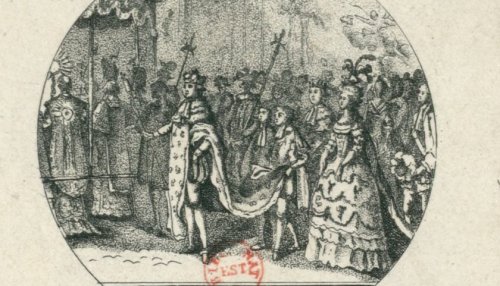
Louis XVI and Marie-Antoinette in a Eucharistic Procession

Louis XVI and Marie-Antoinette in the Eucharistic procession that opened the Estates-General in the spring of 1789. (From Vive la Reine.)
On May 4, 1789, she put Louis-Joseph and his sister with Madame de Polignac on a balcony above the stables so they could watch the magnificent Eucharistic procession which marked the opening of the Estates-General. The procession wound from the Royal Chapel, across the vast courtyard of the palace, through the streets of the town of Versailles, to the Church of Saint Louis. The monstrance, in the hands of a bishop, was under a rich canopy carried by Provence, Artois, Berry, and Angoulême. Everyone held a candle, except for the standard bearers, with the fluttering silken banners, and the royal falconers, with falcons on their wrists, looking both noble and fierce. The King, with a lighted taper, walked directly behind the monstrance. He wore a cloth of gold mantle and a plumed hat with the famous Regent diamond. He was wildly applauded by the crowds that lined the route. But when Antoinette, who with her ladies followed the King’s household, passed by in her gown of gold and silver tissue, every tongue fell silent. She could almost taste the hatred. It frightened her. 
When passing beneath the balcony where her sick boy was lying, she glanced up to blow him a kiss. The cry “Long live Orléans!” resounded in her ears. The extent of the malice overwhelmed her. That someone could hate her so much that they would use her child’s suffering as an opportunity to humiliate her; that they would praise her known enemy at a moment when as a mother she was most vulnerable, within the hearing of her pain-wracked Dauphin, stunned her as much as if she had been whipped or burnt. She halted, dizzily, then turned to see who had insulted her. In doing so, she staggered, but before she lost her balance, Princesse de Lamballe took her arm and steadied her.
 ~ from Trianon by Elena Maria Vidal
Share

Saturday, June 6, 2026

"Your Virtues and Your Kindness"

Our Lady (or perhaps the virtue of Faith, since she carries the cross) and Marie-Antoinette hold the Gospels for Louis XVI as he makes his coronation oath. The picture is accompanied by the following verse:
The hands of Divinity
Louis, sends you the crown
The scepter, the sword, the law gives to you
But it is your virtues and your kindness
Which assures you the throne in our hearts.
Share

Thursday, June 4, 2026

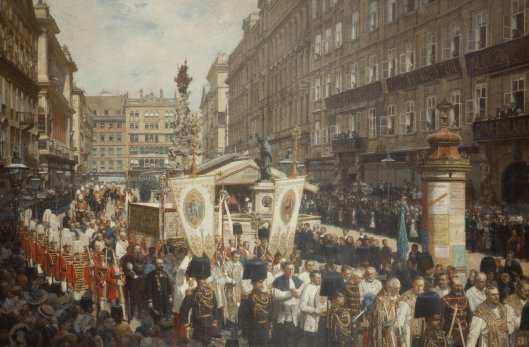
The Great Feast: The Hapsburgs And Corpus Christi

Hapsburgs Corpus Christi 

From The War for Christendom:

 In 1264, Pope Urban IV issued the Papal Bull Transiturus de Hoc Mundo, promulgating to the Latin Rite the Solemn Feast of the Body and Blood of Christ, to be celebrated on the first Thursday after Trinity Sunday. Around this same time, Rudolf the eighth Count of Hapsburg aided and protected a priest bringing the Viaticum to a dying farmer, giving the priest his horse and guiding him across a raging torrent, walking bareheaded. The priest then prophesied that the humble Count and his descendents would receive the Imperium of the Holy Roman Empire.

This veneration of the Holy Eucharist was continued by all the descendants of the Noble House, and the Feast of Corpus Christi in the Hapsburg realms became second only to the Solemn Feasts of Easter and Christmas. The Family indeed owed all to Rudolf’s great devotion to the Holy Eucharist, and the special Eucharist blessing bestowed on him, thus it was most fitting that the Feast of Christ’s Body should become the greatest feast of the Empire. So long as the Family remained devoted to the Cross and the Eucharist, God would bless and protect them (and He still does, even though they have been cast from the throne).

First in the great procession in the Imperial City of Vienna came three priests in splendid vestments like heralds to the city. Then came the Court officials in full Court dress, and the Court Clergy vested in gold and white vestments, followed by dignitaries of every rank. Before the gilded canopy marched the Archdukes of the House, carrying candles, and the acolytes carrying forward the Cross, the golden banners swaying in the wind, the swinging thuribles sending into the air clouds of incense, and the ever ringing bells. The great canopy itself was carried by four noble chamberlains in Imperial livery, upheld over the Hofburg Parish Priest who held up in benediction the golden Monstrance with radiating rays like the sun, in which resided the truly present Most Sacred Body of the Son of God, while the Emperor of Christendom walked behind bareheaded and flanked by the Imperial Guard, humbly worshiping his Divine King. (Read more.)


Share

Saturday, May 30, 2026

Henrietta Maria: Number One Lawbreaker

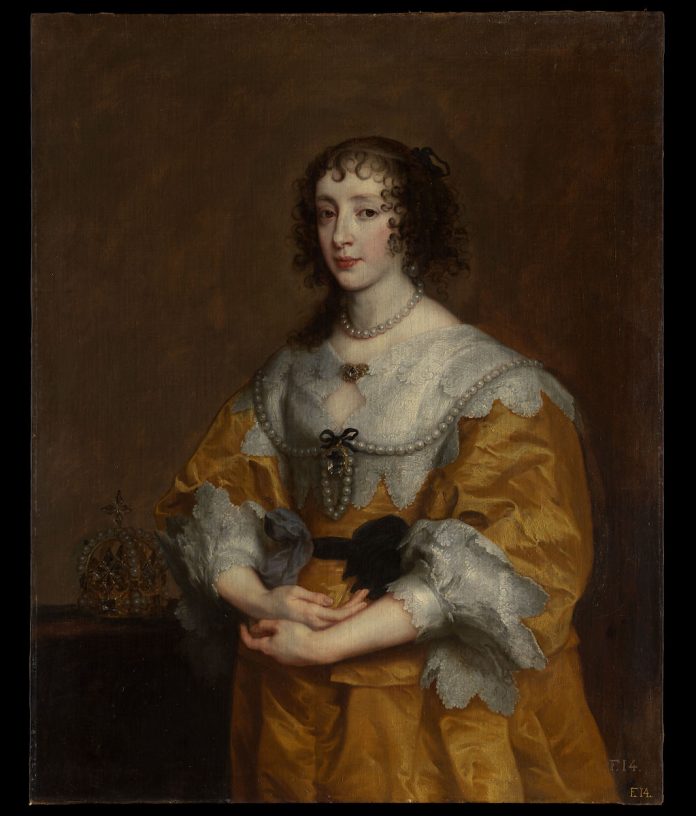
Henrietta Maria holding a butterfly

 My guest post at an amazing site called Novels Alive
.

In the lone tent, waiting for victory,
She stands with eyes marred by the mists of pain,
Like some wan lily overdrenched with rain:
The clamorous clang of arms, the ensanguined sky,
War’s ruin, and the wreck of chivalry
To her proud soul no common fear can bring:
Bravely she tarrieth for her Lord the King,
Her soul a-flame with passionate ecstasy.
~from “Henrietta Maria” by Oscar Wilde

Henriette-Marie of France, or “Henrietta Maria,” is the protagonist of my new novel My Queen, My Love (Mayapple Books, November 25, 2021), the first of the Henrietta of France Trilogy. It is the story of the fifteen-year-old princess Henriette-Marie who is mandated by the Pope and by her brother the King of France to convert the English back to Catholicism by marrying their King, Charles I. Meanwhile, the Catholic Faith is outlawed in the British Isles, so as Queen she becomes the number one lawbreaker. The powerful Duke of Buckingham tries to thwart her growing influence with her husband. And England has become known as a place where queens lose their heads. 

[...]

As Regent, Queen Marie chose to avoid war by making peace with the other Catholic powers of Spain and the Holy Roman Empire. She believed that Catholic monarchies should unite to keep Protestantism at bay. She sent her youngest daughter Henriette to marry in England because she believed there was a chance of bringing Charles I into Catholicism. So at fifteen years old Henriette-Marie aka Henrietta Maria was sent to marry Charles Stuart, who was a decade or so older. The royal couple initially clashed over culture and religion. They quarreled whenever together and so avoided each other for weeks at a time. When they finally did fall in love, theirs became one of the most devoted in the history of royal marriages, and was blessed with nine children. (Read more.)

A review from Gwendalyn's Books:

Henrietta is one to root for as we see the very young bride overcome so many obstacles. Particularly because she is a devout Catholic, and by the actions of the villainess character, George Villiers.

The author take great care to include a vast amount of characters, which made for a more rewarding read for me. A book to catapult its readers into the turbulent era of England in the 1600’s. From the beginning I was hooked and read this one in a day.

Historical fiction at its finest. This was an exceptional portrait of a the wife of Charles I. Brought stunningly to life, with seamless narration and three dimensional characters, a true treasure piece of historical fiction.

E.M. Vidal meticulous research and descriptive writing, has brought one of England’s most tragic queens, Henrietta Maria, vividly to life. (Read more.)

Share

Monday, May 25, 2026

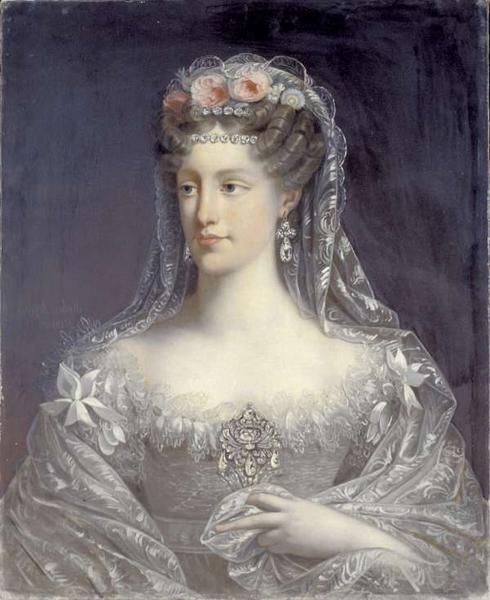
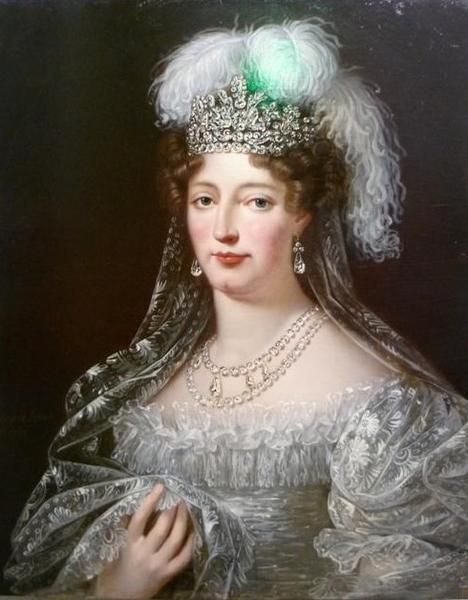
Marie-Antoinette's Mantilla

Here is the veil the Queen wore at Mass, particularly on feast days when she received Holy Communion. It is kept at the shrine of Notre-Dame de Bétharram near Lourdes. 

Is the Duchesse de Berry wearing it, here?

And is Marie-Antoinette's daughter wear the same veil, here?


This may contain: an old black and white photo of a woman in a wedding dress sitting on a chair

Here is a picture of the last Tsar's niece Princess Iryna Alexandrovna in her wedding dress. It is said her veil belonged to Marie-Antoinette. Share

Thursday, May 14, 2026

Highest of All Kings

 From A Clerk of Oxford:

The idea that gods dwell in the heights, in the sky and on the mountains, is one of the most ancient religious impulses. It's hardly difficult to see a connection between that and Christ's Ascension, and going on about 'rockets, haha!' feels like a deliberate attempt not to see it. Those silly people of the olden days found poetry in the feast rather more easily than their clever modern descendants do: in Ascension Day folklore there was 'a strong connection between the day and all things pertaining to the sky, such as clouds, rain, and birds' (Roud). Rain which fell on Ascension Day was said to be blessed - 'neither eaves' drip nor tree-drip, but straight from the sky'. The day was connected with holy water in other ways, including the custom of well-dressing and visiting sacred springs. This expresses a sense that the heavens and the earth are interconnected at the most essential level - as of course they are, whether you think of that power as physical or spiritual or both. The kind of preacher who apologises for Ascension Day is likely to call that faith superstitious, but it's infinitely grander, really, than a worldview which finds no wonder in the heavens. We are earthbound, tied to this sublunary world and its many sorrows - but this is one day when the imagination can soar to the sky. (Read more.)


More HERE. 

(Image source.) 

Share

Monday, May 4, 2026

The Daily Life of a Medieval King


The great Charles V of France. From Medievalists:

A medieval king’s day was carefully structured, balancing prayer, governance, and moments of rest. Thanks to Christine de Pizan, we can follow the daily routine of Charles V of France in remarkable detail, offering a rare glimpse into how a ruler lived and worked in the late Middle Ages.

Around the year 1404 Christine de Pizan finished her work, Livre des faits et bonnes mœurs du sage roy Charles V, which was both a biography of the French king who reigned from 1364 to 1380, and a guide to how an ideal monarch should live and rule. Christine had a good vantage point to tell this story, as her father, Tommaso di Pizano, was a personal physician and astrologer at Charles’ court, so one can assume that she was sometimes at the court herself. Moreover, in later years she was able to consult other men and women who served the king, including his chamberlain and valet.

Her section on the daily life of Charles V begins with him rising from bed in the morning, typically between six and seven o’clock. After saying a prayer, the king would chat and joke with his servants. Christine writes:

 When he had been combed, dressed, and outfitted according to the demands of the day’s program, his chaplain, a distinguished person and honourable priest, brought him his breviary and helped him to say his hours, according to the canonical day of the calendar. Around eight o’clock he would go to mass, which was celebrated each day with glorious, solemn singing.

(Read more.)


Share

Thursday, April 9, 2026

An Illuminated Year


From Daily Art Magazine:

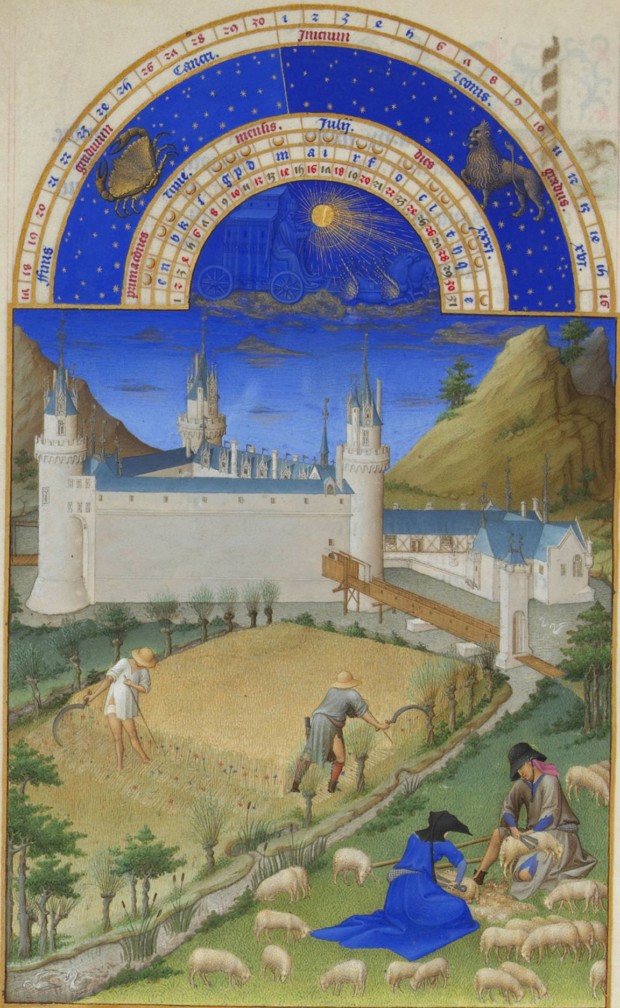
The Très Riches Heures is the name of probably the most famous book of hours in the world. A book of hours is a prayer book with texts for each liturgical hour of the day. It often contains psalms, masses and calendars, as we can see here. Twelve pages dedicated to each month show the usual activities and customs of the month, as well as the zodiac signs of the month. The illuminations are a clear example of late International Gothic style, we can see it in typically elongated figures, little or mistaken spatial depth, and elaborated ornamentation and attention to detail. Check out the lavish costumes from the January page: the Duke is sitting on the right, he is wearing a furry hat and a blue robe, coloured with the most expensive pigment made from crushed Middle Eastern stone lapis-lazuli. (Read more.)
Share

Saturday, April 4, 2026

Anastasis and Transfiguration


From Hilary White:

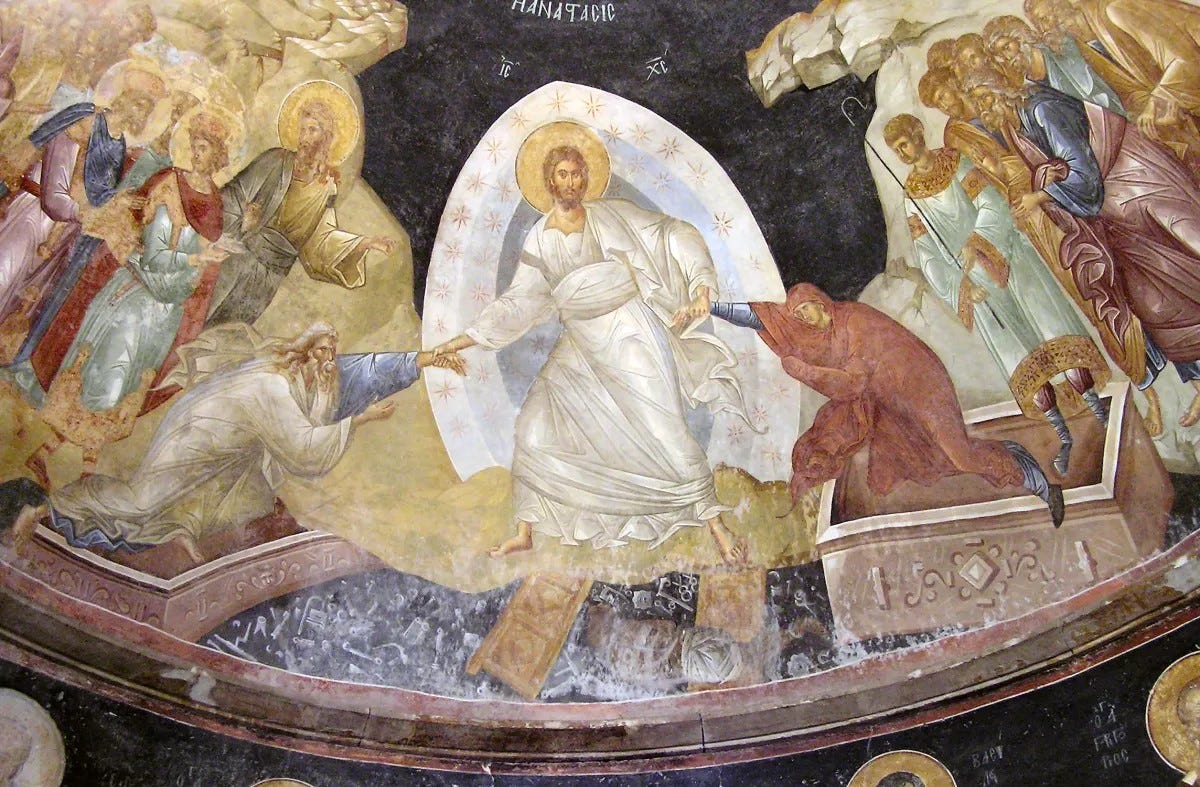
The Anastasis, literally “a rising up” or “standing up again in Greek. It is the icon that shows us what happened beyond the view of living men after the Crucifixion. Christ has descended not as a lifeless corpse but as a radiant figure, full of divine power, bursting with the Uncreated Light, reaching down into death itself to rescue Adam, Eve and all the righteous held captive since the beginning of time. In this image, Holy Saturday is not a pause. It is an explosion.

The Anastasis is one of the most commonly repeated of all iconographic prototypes in the Eastern tradition. It is not merely a depiction of an event but a visual proclamation of victory, a theological image so central that it appears again and again in apses, narthexes, chapels and manuscripts across centuries and empires. (Read more.)


Share

Friday, April 3, 2026

Good Friday


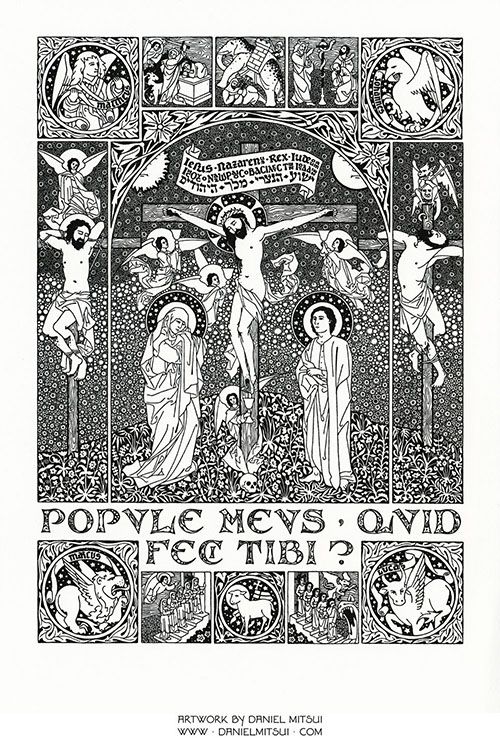
From Daniel Mitsui.

The Reproaches (Improperia)
I.
1 and 2: My people, what have I done to you
How have I offended you? Answer me!
1: I led you out of Egypt,
from slavery to freedom,
but you led your Savior to the cross.
2: My people, what have I done to you?
How have I offended you? Answer me!

1: Holy is God!
2: Holy and strong!
1: Holy immortal One, have mercy on us!
1 and 2: For forty years I led you
safely through the desert.
I fed you with manna from heaven,
and brought you to a land of plenty; but you led your Savior to the cross.
Repeat "Holy is God..."
1 and 2: What more could I have done for you.
I planted you as my fairest vine,
but you yielded only bitterness:
when I was thirsty you gave me vinegar to drink,
and you pierced your Savior with a lance.
Repeat "Holy is God..." 
II.
1: For your sake I scourged your captors
and their firstborn sons,
but you brought your scourges down on me.
(Repeated throughout by Choir 2)
2: My people, what have I done to you?
How have I offended you? Answer me!
1: I led you from slavery to freedom
and drowned your captors in the sea,
but you handed me over to your high priests.
2: "My people...."
1: I opened the sea before you,
but you opened my side with a spear.
2: "My people...."
1: I led you on your way in a pillar of cloud,
but you led me to Pilate's court.
2: "My people...."
1: I bore you up with manna in the desert,
but you struck me down and scourged me.
2: "My people...."
1: I gave you saving water from the rock,
but you gave me gall and vinegar to drink.
2: "My people...."
1: For you I struck down the kings of Canaan.
but you struck my head with a reed.
2: "My people...."
1: I gave you a royal scepter,
but you gave me a crown of thorns.
2: "My people...."
1: I raised you to the height of majesty,
but you have raised me high on a cross.
2: "My people...."
Share

Queen Mary Prays over the Sick on Good Friday

From Nobility. It is always bittersweet for me to read about how much potential for being a great ruler Mary Tudor had. To quote from a contemporary report:
On [Good] Friday morning the offertory was performed according to custom in the Church of the Franciscan Friars, which is contiguous to the palace. After the Passion, the Queen came down from her oratory for the adoration of the Cross, accompanied by my lord the right reverend Legate, and kneeling at a short distance from the Cross moved towards It on her knees, praying before It thrice, and then she drew nigh and kissed It, performing this act with such devotion as greatly to edify all those who were present.
Her Majesty next gave her benediction to the rings, the mode of doing so being as follows: An inclosure (un riparo) was formed for her Majesty to the right of the high altar by means of four benches placed so as to form a square, into the center of which she again came down from her oratory, and placing herself on her knees within this inclosure, two large covered basins were brought to her, filled with rings of gold and silver, one of these basins containing rings of her own, whilst the other held those of private individuals (particolari), labelled with their owners’ names. On their being uncovered she commenced reciting a certain prayer and psalms, and then taking them in her two hands (pigliandoli a mano per mano), she passed them again and again from one hand to the other, saying another prayer, which commenced thus:—
“Sanctifica, Domine, annulos istos.”

This being terminated, her Majesty went to bless the scrofulous, but she chose to perform this act privately in a gallery, where there were not above 20 persons; and an altar being raised there she knelt and recited the confession, on the conclusion of which her Majesty turned towards my Right Reverend Lord the Legate, who gave her absolution; whereupon a priest read from the Gospel according to St. Mark, and on his coming to the words— “Super ægros manus imponet et bene habebunt,” she caused one of those infirm women to be brought to her, and kneeling the whole time she commenced pressing, with her hands in the form of a cross, on the spot where the sore was, with such compassion and devotion as to be a marvel, and whilst she continued doing this to a man and to three women, the priest kept ever repeating these words:
“Super ægros manus imponet et bene habebunt.”
Then on terminating the Gospel, after the words—
“In principio erat verbum,”
and on coming to the following, namely,—
“Erat lux vera quæ illuminat omnem hominem in hunc mundum,”
then the Queen made the sick people again approach her, and taking a golden coin called an angel, she touched the place where the evil showed itself, and signed it with this coin in the form of the cross; and having done this, she passed a ribbon through a hole which had been pierced in the coin, and placed one of these round the neck of each of the patients, making them promise never to part with that coin, which was hallowed, save in case of extreme need; and then, having washed her hands, the towel being presented to her by my Lord the Right Reverend the Legate, she returned to her oratory. (Read entire article.)
Share

Thursday, April 2, 2026

Franz Joseph Washing the Feet of the Poor

In accord with the ancient custom.
In 1850, Franz Joseph participated for the first time as emperor in the second of the traditional Habsburg expressions of dynastic piety: the Holy Thursday foot-washing ceremony, part of the four-day court observance of Easter. The master of the staff and the court prelates chose twelve poor elderly men, transported them to the Hofburg, and positioned them in the ceremonial hall on a raised dais. There, before an invited audience observing the scene from tribunes, the emperor served the men a symbolic meal and archdukes cleared the dishes. As a priest read aloud in Latin the words of the New Testament (John 3:15), “And he began to wash the feet of the disciples,” Franz Joseph knelt and, without rising from his knees, washed the feet of the twelve old men in imitation of Christ. Finally, the emperor placed a bag of twenty silver coins around the necks of each before the men were led away and returned to their homes in imperial coaches.(Read more.)
Share

Blessed Karl, Clericalism and Lay Church Governance

 From Charles Coulombe at One Peter 5:

In many ways, Austro-Hungarian Emperor-King Franz Joseph epitomised the traditional relationship between the lay and clerical powers of the Church. As with the other Crowned Heads of Europe, he had inherited a particular style of Catholic devotion peculiar to his own dynasty – the Pietas Austriaca. Bound up with a veneration of the True Cross and the Passion, the Blessed Sacrament and the Sacred Heart, the Blessed Virgin and St. Joseph (the family patron), this religiosity had led to the tremendous collection of relics at the Hofburg, the Imperial Palace in Vienna. The Maundy Thursday Footwashing and the Corpus Christi procession were highlights of court life in Vienna, and in 1898 Franz Joseph led the Imperial Family in observing the Consecration of All Mankind to the Sacred Heart, led by Leo XIII in Rome. In the canon of the Mass, the Good Friday Collects, and the Holy Saturday Exsultet, the Emperor was prayed for by name.

Franz Joseph was crowned and anointed King of Hungary in 1867. As Emperor-King he appointed the Cardinals, Archbishops, and Bishops, subject to Papal approval. Exempt from this were Salzburg and Olomouc, their metropolitans being elected by the cathedral chapters, and the former ‘Salzburg dioceses’ of Seckau, Lavant, and Gurk. The Archbishop of Salzburg had the right of appointment for Seckau and Lavant, the occupation of Gurk was regulated in a mixed manner, that is, the Emperor proposed two candidates, the subsequent nomination was made by the Archbishop of Salzburg. The Nuncio had to be consulted to make sure that the choice was not obnoxious to the Pope – either disapproval would derail the process; the separate Austrian and Hungarian ministries of Worship and Education would do the research, but it was Franz Joseph who had to approve the choices, both for Latin and Eastern Rite Catholic Bishops. Moreover, he had to bear in mind that some of his appointees would sit in one or more legislatures within the Monarchy.

There were three national parliaments. In the Upper House – House of Lords (Herrenhaus) of the Austrian Parliament could be found the prince-archbishops of Vienna, Prague, Salzburg, Görz, and Olmütz, the archbishops of Lemberg and Zara, the Byzantine Catholic archbishop of Lemberg, the Armenian Catholic archbishop of Lemberg, and the Greek Orthodox archbishop of Czernowitz, as well as the prince-bishops of Brixen, Breslau (although located in what was then Germany, for the diocesan territory in Austrian Silesia), Krakau, Seckau, Trient, Laibach, Lavant, and Gurk. In the Hungarian Upper House, the Főrendiház or “House of Magnates,” had an even higher proportion of ecclesiastical members – although it was also more interfaith than Austria’s: forty-two dignitaries of the Catholic and Orthodox Churches, including the Primate, Archbishops, Bishops, Abbots, and various other high officials, and thirteen representatives of the Protestant confessions. The annexation of Bosnia in 1908 presented a challenge in creating representative institutions for a region that had never known them. But while Bosnian diet (Sabor) would only one have one house, it would also have religious representatives appointed by the Monarch. These were, in deference to the Muslim majority, the Reis, who was the principal of Muslims’ granted lands, and the Muslims’ regional leader from Mostar; four Metropolitans and the president of the Orthodox community; the Catholic archbishop and two province members of Franciscan order of Bosnia and Herzegovina; and the Sephardic rabbi of the higher order. The various provincial diets in the Austrian half of the Monarchy also numbered the local Catholic bishops in their number.

Another religious duty that Franz Joseph took very seriously was that of funding missions – even though Austria-Hungary had no colonies. The Catholic Church in Scandinavia, Albania, and Bulgaria (Latin and Byzantine in that case) was heavily funded by the Emperor, as was the Church in the Holy Land and Egypt (the Coptic Catholic Church was funded from its beginning thereby, and Franz Joseph paid for the building of the Latin Catholic Cathedral of St. Catherine in Alexandria, where, ironically, the remains of  his wartime enemy King Victor Emmanuel III would rest until their recent repatriation to Italy). But since 1826, very largely out of funds given by both Franz Joseph and his two immediate predecessors, a large amount of this largesse went to the Church in the United States. Through an organisation called the Leopoldinenstiftung – the “Leopoldine Foundation” – the Habsburgs and many of their subjects poured millions of dollars into the American Church, founding 400 parishes, subsidising wholly or partly 300 missionaries (such as St. John Neumann and Ven. Bishop Baraga), and sending an endless flow of vestments, statues, stained glass, liturgical implements, and the like. A great deal of dynastic money went to Eastern Rite churches in the United States as well. Unfortunately, the outbreak of war in 1914 ended the flow of generosity – which, of course, would be repaid by Woodrow Wilson’s insistence of the deposition of Franz Jospeh’s successor, his exile, and the partition of his domains. (Read more.)

Share

Wednesday, March 25, 2026

Lady Day


 From A Clerk of Oxford:
Today is the feast of the Annunciation, 'Lady Day'. As I explored last year, the medieval church considered 25 March to be the single most important date in history, at once the beginning and the end of Christ's life on earth: it was the date of the Annunciation, the Crucifixion, the eighth day of Creation, the crossing of the Red Sea, and the sacrifice of Isaac, all profoundly meaningful events in the carefully-crafted divine story of salvation history. Its resonances reached even unto Middle Earth, as Tolkien aligned the downfall of the Ring to this most auspicious of dates. (Read more.)
Share