


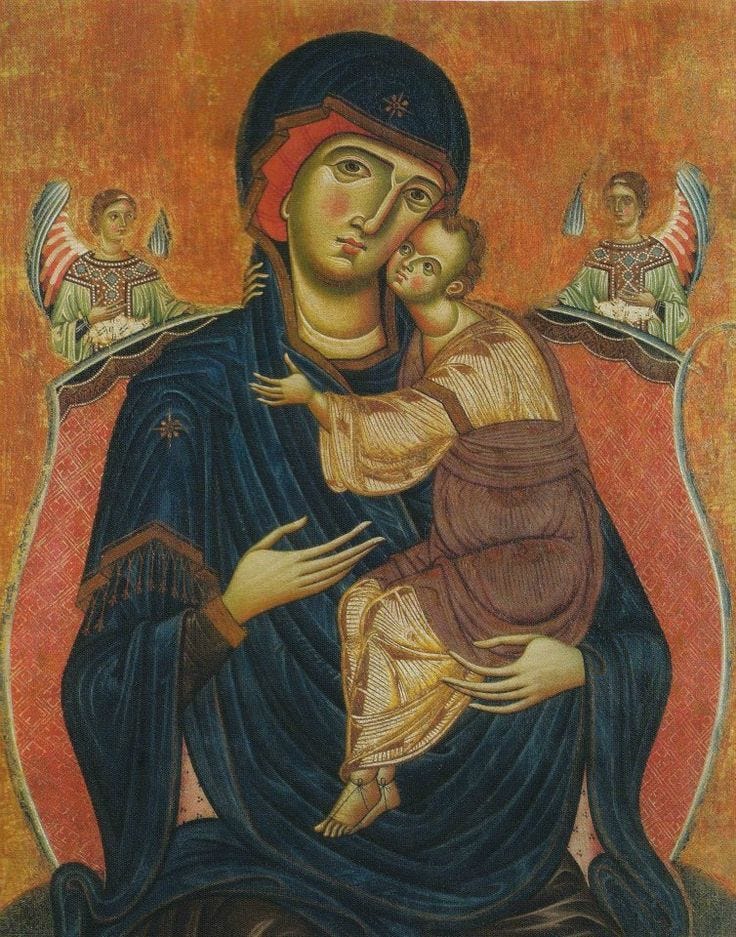
Brilliant. From Hilary White at The Sacred Images Project:
ShareIcons to the eastern Christian to this day, are not “illustrations of the faith” intended to “teach illiterates Bible stories,” but points of immediate contact with the reality of the Incarnation, rendered in a symbolic style meant to invite prayer and communion, not analysis. The Carolingian north, however, increasingly favoured legibility, narrative story telling, hierarchy and natural form in service of a more didactic, rationalised approach to religion and governance. In one sense, these two ways of thinking about sacred art represent the theological divergence that was already unfolding between East and West. Rome’s was consolidating power around a Latin, imperial western Christendom on the one hand, and Constantinople maintaining the ancient mystical, liturgical cosmology on the other.
These two streams would sometimes clash and sometimes blend and finally the resulting hybrid would see unique new expressions in art, architecture and monastic life, which we’ll eventually see more fully in the Norman period, with the Italo-Byzantine and early Romanesque. But in the 9th and 10th centuries, they still stood largely apart, like two rival visions of what Christian civilisation could be. (Read more.)











No comments:
Post a Comment