


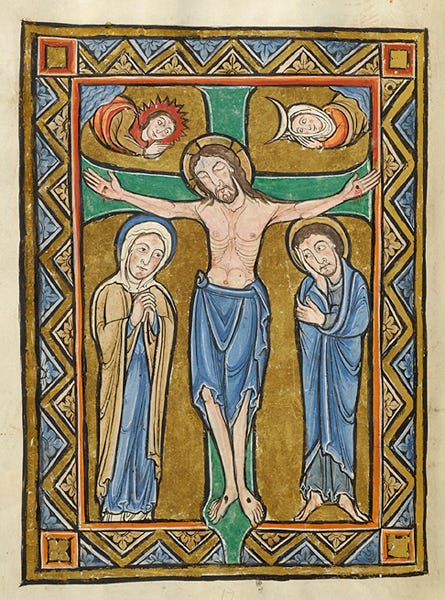
From The Way of Beauty:
ShareFrom around the 4th century AD, when public Christian sacred art became possible in the Roman Empire, the image of Christ as a bearded man emerged as the dominant prototype (along with the first distinctive Christian style of art, the iconographic tradition). This was not an arbitrary choice but a deliberate one, rooted in the need to portray Christ’s humanity in a way that the faithful could recognise. (It is interesting that this has remained the dominant prototype to this day and also corresponds to images coming from other sources, such as the Shroud of Turin.) A painting of Christ must reflect what we know of Him as a man, including his physical attributes. Yet, this portrayal ought never be merely naturalistic. The artist’s task is to transcend the material, to suggest the spiritual soul that animates the human person.
As described above, there is a focus on conveying the inner life through facial expressions and gestures. The eyes, often referred to as the “windows of the soul,” are frequently depicted with meticulous care, conveying thought, feeling, and presence. A subtle gesture, a carefully rendered expression—these draw us into the mystery of the person. Even in the restrained iconographic style, where emotional extravagance is avoided, the viewer senses a living, breathing soul behind the image.
Aside from the expression and gesture, this is also achieved through what I call ‘partial abstraction’—a deliberate departure from strict realism to evoke the inner life of the subject. Whether in the serene stillness of an icon, the emotive intensity of a gothic crucifix, or the dramatic naturalism of a baroque painting, artists employ conventions of partial abstraction - some obvious and some far more subtly applied - that characterise their tradition and lend to it a symbolic, otherworldly quality.
For those who wish to explore this further, my book *The Way of Beauty* delves into how these artistic conventions developed to communicate spiritual truths through visual form. (Read more.)








No comments:
Post a Comment