
Connor interviews author Kristen van Uden on Plotlines.


St. Dominic and the Triumph of Grace
5 days ago


From Aleteia:
ShareTo be declared a martyr, someone must either die for the faith directly, or die in defense of a Christian virtue. In the case of Vivian and other “martyrs of purity,” the faith isn’t being attacked directly. These martyrs’ deaths are a reflection of their lives. Living virtuously developed in them the “habit of excellence” that Aristotle described. Though young, they had an abhorrence of sin so deeply developed that when confronted with impurity, even though the sin was not theirs, they fled from it.
The virtue of chastity does not require that a person choose death over rape. The Church does not value virginity over life. If these young women had been unable to get away from the attackers, or if they had submitted in fear for their lives, the sin would have belonged only to the rapist, and would not have touched their own chastity. But neither are they morally required to submit to a rapist.
In the moment of trauma, the martyrs of purity do not have time to philosophize regarding the greater good, of life or chastity. They respond as they can, moved by grace. (Read more.)
.png/800px-The_Princes_in_the_Tower_by_John_Everett_Millais_(1878).png) |
| Edward V and Richard Duke of York by Millais |
For more than 500 years, history has judged that the Princes in the Tower were murdered on the orders of their uncle Richard III. Until now there has been very little proof - it is quite simply history’s greatest cold case. But this episode of Gone Medieval reveals new and compelling evidence about what happened to King Edward V and his brother Richard, Duke of York in 1483.
Philippa Langley - best known for her role in finding and exhuming the remains of Richard III in 2012 - talks to Gone Medieval's Matt Lewis about her painstaking investigative research and the astonishing new archival discoveries that may forever change what we know about the fate of the Princes in the Tower. (Read more.)
From The Daily Mail:
The historian - whose findings are also outlined in her new book, The Princes in the Tower - has discovered key contemporaneous documents which indicate that Edward V and Prince Richard were Warbeck and Simnel. One is an alleged witness statement from Prince Richard, which describes how he was smuggled from the Tower of London by Henry and Thomas Percy.
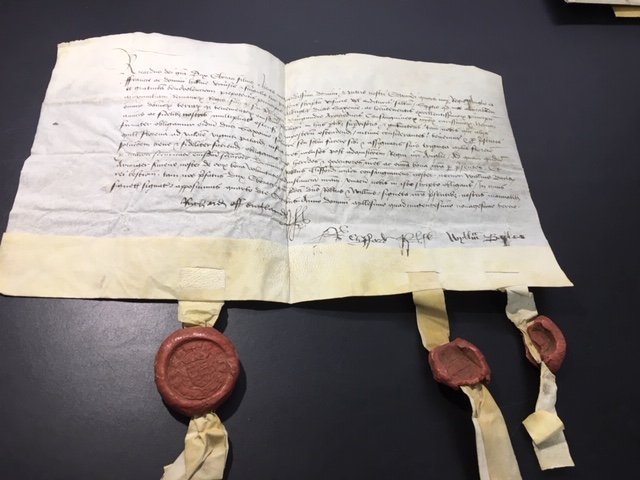
Experts have authenticated it as being written during that period. The account reads: 'They shaved my hair and put a poor and drab shirt on me and we went to St Katharine's [dock].' It goes on to say that he was taken by boat to France before travelling to Portugal. Another is a document from Holland, dated 1483, which appears to bear a royal seal and a signature of a 'Richard, Duke of York'. It promises that Richard will pay 30,000 florins to Duke Albert of Saxony after gaining the English throne.
A man claiming to be Richard landed in England with a small army in the hope of gaining the throne. When an initial attempt failed, he fled to Scotland and then launched another bid in 1497. Having been captured, he signed a confession where he declared that he was really Warbeck, a boatman's son, but Ms Langley believes it was likely Prince Richard. Author Anne Wroe expanded on a similar theory about Warbeck being Prince Richard in her 2003 book Perkin: A Story of Deception.
A third document identified by Ms Langley is a receipt for weapons given by German king Maximilian I to the 'son of King Edward IV', ahead of Simnel's failed rebellion in 1487. The dominant belief about Simnel is that he claimed to be or actually was Edward, Earl of Warwick. But Ms Langley suggest that Simnel really was the young King Edward. (Read more.)
UPDATE: Another podcast, with the BBC, HERE.
An article on Plantagenet family likenesses, HERE. More theories, HERE.
From Dr. George Simon:
ShareWe live in an increasingly violent world. In fact, violence is so prevalent in our lives that we’re largely desenitized to it. Everyone wants what they want and lacks compunction about the viciousness with which they go after it. Sometimes it seems like you take your life in your hands just making a trip to the grocery store in your car.
There are so many ways to be violent. And most of our violent behavior is not physical. Sometimes, the violence is in our words: hateful, spiteful, heart-crushing words. And it can be in our actions, too, even subtle, hurtful actions that aren’t clearly physically violent. Exploiting one another, crossing major boundaries, taking advantage – all of these things are forms of violence. And while many times this violence is in the open, sometimes it’s covert. (See also: Aggression and Covert-Aggression and In Sheep’s Clothing.) But whatever the case, violence in one form or another has been the destroyer of relationships and families. And it’s become the destroyer of communities and societies, too. (Read more.)
From History Extra:
ShareEngland's Elizabethan Catholics were public enemy number one. Their Masses were banned and their priests were executed. Jessie Childs reveals what life was like for 'recusants' and 'church papists' in a hostile Protestant state. In 1828, builders removing a lintel over a doorway at Rushton Hall in Northamptonshire were surprised to see an old, beautifully bound book come down with the rubble. They decided to investigate and knocked through a thick partition wall, exposing a recess, about 5 feet long and 15 inches wide. Inside, wrapped up in a large sheet, was an enormous bundle of papers and books that had once belonged to Sir Thomas Tresham, a Catholic gentleman in the reign of Elizabeth I.
The very first revolution of 1848 testified to that faith. In Palermo, Sicily, printed notices appeared at the start of the year announcing that an uprising—and an era of “universal regeneration”—would begin on January 12. As Clark notes, it might have seemed a silly idea for the conspirators to announce their plans ahead of time—but there was no conspiracy. The author of the notices, a veteran of radical politics named Francesco Bagnasco, thought “the announcement of a revolt would suffice to bring one about,” and he was right. Long-standing resentment of the king of Naples’s heavy-handed rule, exacerbated by severe economic inequality, led crowds to pour into the streets on the appointed day to fulfill—if only for a short time—the dream of Sicilian independence.Share
Revolution soon spread to mainland Europe, driven by social conflict. Europeans were not, in the aggregate, poorer than they had been in the past, but the economic disruptions of the industrial revolution had created a newly mobile labor force living a starkly precarious existence, especially in the cities. Nor were reform-minded Europeans as ready as they once had been to accept social misery as inevitable. As emerging socialist movements insisted, impoverishment was a human phenomenon, and human action—political action—could relieve it. In region after region, precarity and the hope for a more secure life fueled popular support for political movements struggling against corrupt, despotic, and foreign rulers (the working classes generally did not start the revolutions, but revolutions could not succeed without them). And in region after region, the news of uprisings elsewhere fell on the dry timber of troubled societies like a shower of sparks.
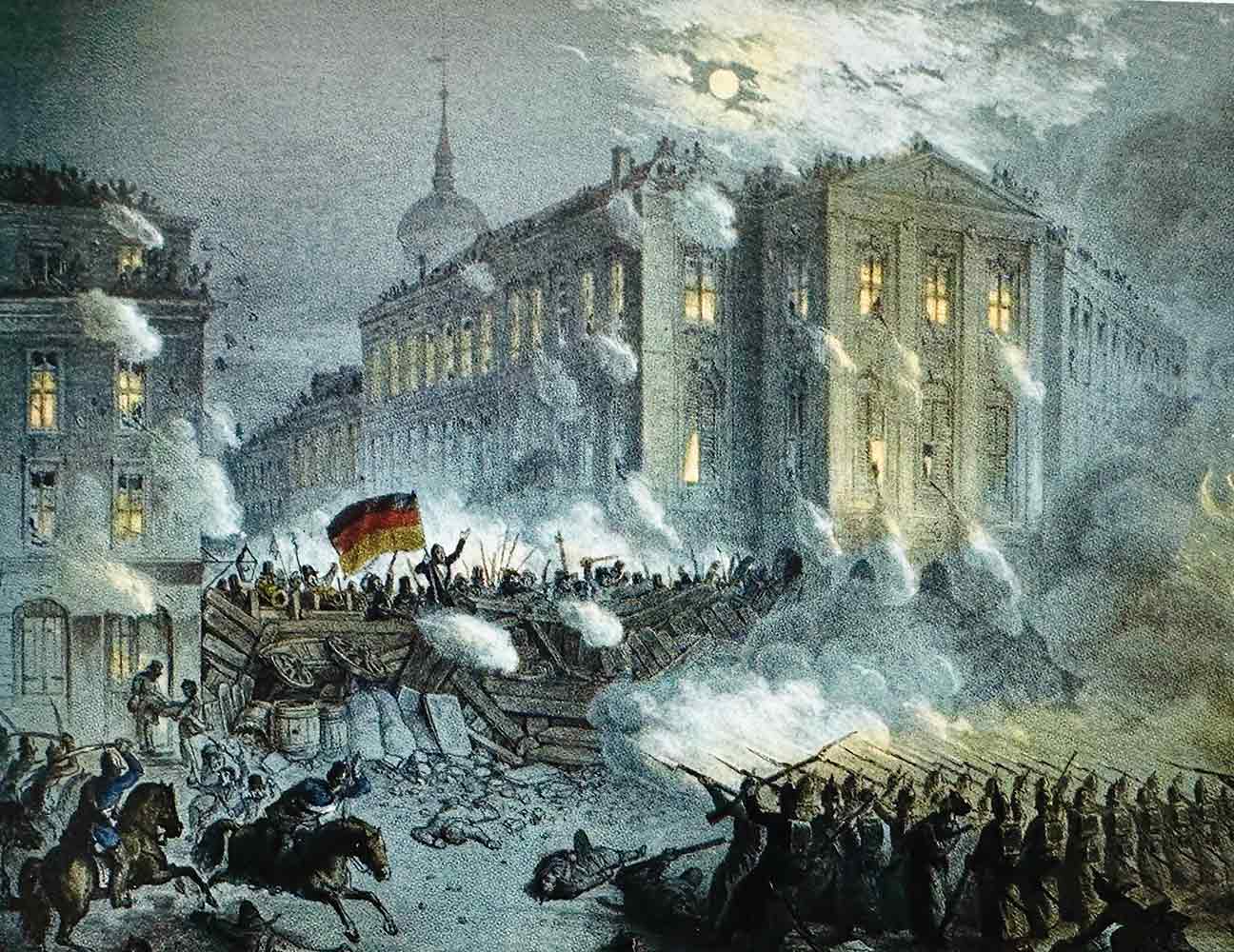
In February, the French overthrew King Louis-Philippe and proclaimed the Second Republic (Napoleon Bonaparte had overthrown the first one 49 years earlier). The next month, revolution spread to the German states, with many rulers, notably in Austria and Prussia, compelled to promise liberal reforms. They granted constitutions and guaranteed rights. Delegates from the German territories assembled in Frankfurt to start planning for German unification. And from there, uprisings spread across Central Europe and Italy. National minorities throughout the Austrian, Ottoman, and Russian empires called for autonomy or independence. The 1848 revolutions extended as far east as the Balkans and the Ionian Islands and led rulers in many places to make anxious, preemptive concessions to the reformers.
The 1848 revolutions also had consequences beyond Europe, notably in France’s overseas colonies, where enslaved people seized freedom for themselves in anticipation of legal emancipation—which the Second Republic duly enacted. Clark gives far more attention to 1848’s global ramifications than earlier historians, and also to the role of women—although feminists who hoped the revolutions would bring women expanded rights were everywhere met with bitter disappointment. France’s Jeanne Deroin, who called for female suffrage, tried to run for a seat in Parliament herself, and campaigned for the creation of workers’ cooperatives, ended up in prison during a wave of postrevolutionary repression.
Surprisingly, Clark writes, self-conscious revolutionaries like Deroin “tended to play a very marginal role in the events of 1848.” Instead, most often, uncoordinated spontaneous uprisings led to a sudden and unexpected collapse of authority, followed by frantic efforts to cobble together a new political order. The pattern repeated itself in place after place, with a virtually identical vocabulary. “The same words rang out everywhere: constitution, liberty, freedom of the press, association and assembly, civil (or national) guard, franchise reform.” Clark also points to a similar “euphoria” that gripped revolutionary crowds throughout Europe, especially in the cities. He writes of “the sense of immersion in a collective self, the presence of an emotion so intense that it is almost painful.”(Read more.)
From The Collector:
What do we know about Marx’s relationship to literature? Nobody studies literature for no reason, and it is often worth trying to situate an abstract, theoretical approach in the more subjective, personal reasons for developing said approach in the first place. In short, Marx was an exceptionally voracious reader whose reading habits were as omnivorous and multi-lingual as they were quantitatively extensive.Share
Marx made several early attempts at literary writing as a young man, including an unfinished novel and a fair amount of poetry. He also left several proposed projects on literary or literary-adjacent subjects unfinished at the time of his death: one on the theory of art and culture and another one on Balzac’s novels. Yet, as Terry Eagleton (whose work this article owes a great debt to) puts it, the direct engagement with literary topics in the work of Marx and his main intellectual collaborator, Friedrich Engels, is fairly thin on the ground.[...]It is particularly important in the context of an artwork that it is seen as the product of work. It is the culmination of a productive process, and just as a certain kind of historical situation gives rise to certain industries, certain patterns of labor, and resource distribution, a certain kind of historical situation gives rise to certain kinds of art.
One of the ways this manifests is in the so-called ‘sociology’ of literature, which includes an attempt to study the social conditions that go into the production of a work. These include, but are not limited to, the social demographics of both writers and readers, literacy, the economic and social constraints on publishers, and determinations of taste. It is important to distinguish this discipline from Marxist criticism, which tends to attempt to understand works of art themselves in light of these insights about society. (Read more.)
From History...the Interesting Bits:
Joan Beaufort was the youngest child and only daughter of John of Gaunt and his mistress, Katherine Swynford. Her father, Gaunt, was the third surviving son of Edward III and his queen, Philippa of Hainault. He had married Blanche of Lancaster in 1359 – a marriage which eventually brought him the title of Duke of Lancaster. With Blanche he had 3 surviving legitimate children: Elizabeth, Philippa and Henry – the future king, Henry IV.Share
Joan’s mother, Katherine Swynford, was a member of Blanche’s household and had been married to a Lincolnshire knight, Sir Hugh Swynford, in 1367. They had 3 children together; Blanche, Thomas and Margaret. Sir Hugh was a tenant of John of Gaunt and served on the continent with him in 1366 and 1370. John of Gaunt was widowed in 1368, when Blanche died in childbirth. Katherine had been governess to the Lancaster children for a number of years when Hugh died in November 1371, leaving her a young widow with 3 children to feed.
John and Katherine may have begun their relationship shortly after Hugh’s death, despite John having married again, to Constance of Castile, in September 1371. John and Katherine’s first child, John, was probably born in 1372, with 3 more children, Henry, Thomas and Joan, born before 1379. They would be given the surname of Beaufort, though no one seems to know quite where the name came from. Although the children were illegitimate, the boys enjoyed successful careers during the reign of their half-brother, Henry IV; with John in politics, Henry rising to the rank of cardinal in the church and Thomas pursuing a military career.
Joan was the youngest of the Beaufort children, born sometime between 1377 and 1379. She was close to her family. She joined the household of her sister-in-law, Mary de Bohun, wife of her half-brother, the future Henry IV, in 1386. It seems that she was accompanied by her mum, Katherine Swynford, possibly because Katherine and John of Gaunt had separated and John was reconciled with his second wife, Constance of Castile. Joan was about 7-years-old and was continuing her education and being prepared for her first marriage – she had just been betrothed to 10-year-old Robert Ferrers of Oversley, Warwickshire. Robert would become one of her father’s retainers and, through his mother, heir to the estates of the Botelers of Wem, Shropshire. They were married in 1392, when Joan was 13 or 14 and 2 daughters were born in quick succession; Elizabeth in 1393 and Mary the following year. The marriage was cut short, however, when Robert died in 1395 or 1396, leaving Joan – still only in her mid-teens – a widow with young children.(Read more.)
 |
| Charles I as Prince of Wales |
In the tumultuous year of 1605, the Gunpowder Plot unravelled, and a plan to blow up the Protestant establishment was foiled. It had involved killing Prince Charles, the 4-year-old second son of King James VI/I. The year was not all bad news for the young prince, however, because 41-year-old Thomas Murray was appointed as his tutor, a role the man would carry out with ‘diligence and energy’. Murray would go on to become the prince’s secretary, as well as a father-figure. Yet, despite shaping Charles’s character over the next 16 years, the devoted Murray barely gets a mention in history books. His influence hasn’t been fully recognised or appreciated and this is partly down to an unassuming nature and aversion to court politics. What was clear whilst researching ‘Charles I’s Private Life’ was that Murray had a profound effect upon his pupil, which led one contemporary to remark that he had ‘brought up’ the prince.
Murray, a Scotsman from a well-heeled family, was a highly intelligent poet and author. From the beginning he saw potential in Charles, telling the king that his son was capable of all things ‘which his art or industry may afford’. Murray sourced books for the prince, put him in contact with artists and diplomats and encouraged an awareness of foreign affairs. The tutor drafted all official correspondence, acted as Charles’s interpreter, and became a cornerstone of the influential Scottish network surrounding the Royal Family. Murray’s own family were woven into the various royal households; his wife, Jean, was a cousin to one of Queen Anna’s ladies, his daughter was married to Prince Henry’s tutor, and a nephew, William Murray, was young Charles’s playmate.
In 1612, Murray, like the rest of Britain, lamented the sudden death of Henry, Prince of Wales, describing it as a ‘great wound’. But he retained a confidence in the future – a confidence in Charles. At this moment, many looked to cultivate the new heir’s tutor, and Isaac Wake, an English Ambassador, judged that Murray’s ‘honesty’ made him ‘well-esteemed’. In the bawdy and cut-throat Jacobean court, this is indeed a meaningful observation. Charles, who shared Murray’s love of learning, was seen as equally above the ‘den of vice’ with his chaplain described his temperament as ‘sober, grave, swete’. His tutor’s character, therefore, was one that Charles must have easily related to, and perhaps emulated. They certainly shared a quiet diligence. As king, Charles would draw inspiration and strength from chivalric beliefs, even to the point of self-delusion, and this was instilled during his formative years with Murray.
The meteoric rise of George Villiers, later Duke of Buckingham, incinerated many influential courtiers in his path. Murray recognised Buckingham’s power and counselled people not to ignore it. But his own place about Charles was not threatened by Buckingham; instead, it was religion that would lead to his downfall. This was the one big difference between Murray and Charles. The former was of Presbyterian (some also say Puritan) persuasion – described as pious without superstition and wise without pomp – while Charles was ‘high church’ and later a follower of Arminianism. King James had long desired a Catholic wife for his heir and when a Spanish bride was foisted upon Charles, opposition mounted from many quarters, even within Charles’s own household. The prince himself could also be reticent about the prospect. Charles’s Puritan chaplain, Dr Hakewill, wrote a book against the Spanish match, but went too far when he personally presented it to the prince. When it transpired that Murray had known about the book, and had not opposed the presentation – but not actively prevented it – Charles’s household imploded. (Read more.)
Share











