Wednesday, February 15, 2023

The Emergence of Celebrity Culture in the Regency Era

 From History Hit:

Historians disagree, but many think a recognisably modern celebrity culture emerged in the late 18th century, with London as its birthplace. The first truly capitalist economy, rural-urban migration, democratic ideas and improved education smudged class boundaries and opened new avenues to merit.

A free press full of personal matter and gossip allowed canny individuals to use self-promotion and bribery to forge a good public image. More polished advertising and the advent of branded goods ushered in a trend for high-profile endorsements. The growth in painted and engraved portraits and satirical prints offered a range of positive and negative representation of well-known persons. The audience’s constitutive role was clear, with celebrities actively courting public opinion, paying for visibility with loss of private life, vulnerable to brutal denigration for their missteps but often given the chance to redeem themselves. (Read more.)


Share

Tuesday, February 14, 2023

Sweets for the Sweet

 
From Victoria:

A delicate shade of blush adds signature charm to Coconut Ice, a British specialty made with confectioners’ sugar, desiccated coconut, and sweetened condensed milk. Cut into hearts and crowned with rosebuds in honor of Valentine’s Day, our version includes aromatic notes in the additions of Meyer lemon zest and almond extract. Flavorings of lemon, elderflower, and rose water create unique varieties of Rock Candy, which can be used as playful swizzle sticks for Champagne. (Read more.)

https://scontent-iad3-2.xx.fbcdn.net/v/t39.30808-6/329182196_582395960435376_1382160882194963818_n.jpg?_nc_cat=100&ccb=1-7&_nc_sid=9267fe&_nc_ohc=RAXqgvx7BN0AX8Qf0Pu&_nc_ht=scontent-iad3-2.xx&oh=00_AfCcfjpnpvoqf2A4kqIOX_rxJrK9z3P55xIxACWKRKmBXg&oe=63EF5BAD


Share

Who Wants the Metaverse?

 From JSTOR Daily:

Let’s start at the beginning. In her 2010 article “Capsules and Nodes and Ruptures and Flows: Circulating Subjectivity in Neal Stephenson’s Snow Crash,” Lisa Swanstrom described Stephenson’s metaverse as, “an expansive and seemingly borderless ‘place,’” which “allows for sensory expansion in spite of any bodily or financial limitations.” This is Stephenson’s conception in its most hopeful iteration. Zuckerberg and other advocates including Epic Games CEO Tim Sweeney and Microsoft CEO Satya Nadella speak of the metaverse in similarly rosy terms. Last summer, Zuckerberg called the metaverse an “embodied internet” that would ideally be interoperable.
“It’ll actually feel like we’re in the same place, even if we’re in different states or hundreds of miles apart,” he explained, adding that “when you’re building social systems primarily, you want everyone to be able to be a part of the same systems. So we want to make them as affordable as possible, we want to make them as unified as possible.” And way back in 2016, Sweeney opined optimistically that, “this metaverse is going to be far more pervasive and powerful than anything else. If one central company gains control of this, they will become more powerful than any government and be a god on Earth.” (Read more.)
Share

Pope Benedict’s Passion for Patristics

 From Angelus:

No one in the history of the Church has done more to bring the early Church Fathers to a vast public than Pope Benedict XVI. To do this, he took full advantage of the bully pulpit that is the papacy. In March 2007 — after completing a series of audience talks on the great figures of the New Testament — he launched a new series on the Fathers. He would continue this series, with weekly installments, for more than two years.

In each talk he gave an overview of the life and work of one of the Fathers. Most of the Fathers were in the spotlight just once. Some, however, required longer treatment and occupied the pontiff’s attention for several successive weeks. St. Augustine got five weeks! The content was obviously well prepared, but what delighted the crowds at these Wednesday assemblies was Benedict’s delight in talking about the Fathers. His voice was animated. He sometimes seemed about to rise out of his chair. And he rarely looked down at his prepared text.

In 2008, the Vaticanologist Sandro Magister took the trouble to compare the prepared texts with film of the talks actually delivered by Benedict. He noticed that there were significant differences — not mere discrepancies, but long digressions added spontaneously and delivered with passion. Afterward, the Vatican delayed publication until they could square the text as it had been prepared with the text as it was delivered. The pope’s enthusiasm was visible, and it was infectious. Publishers throughout the world collected his reflections on the Fathers into books. In the United States, these editions came out from both Catholic and Protestant publishers. (Read more.)

Share

Monday, February 13, 2023

Vases for a King and Queen

 From Apollo:

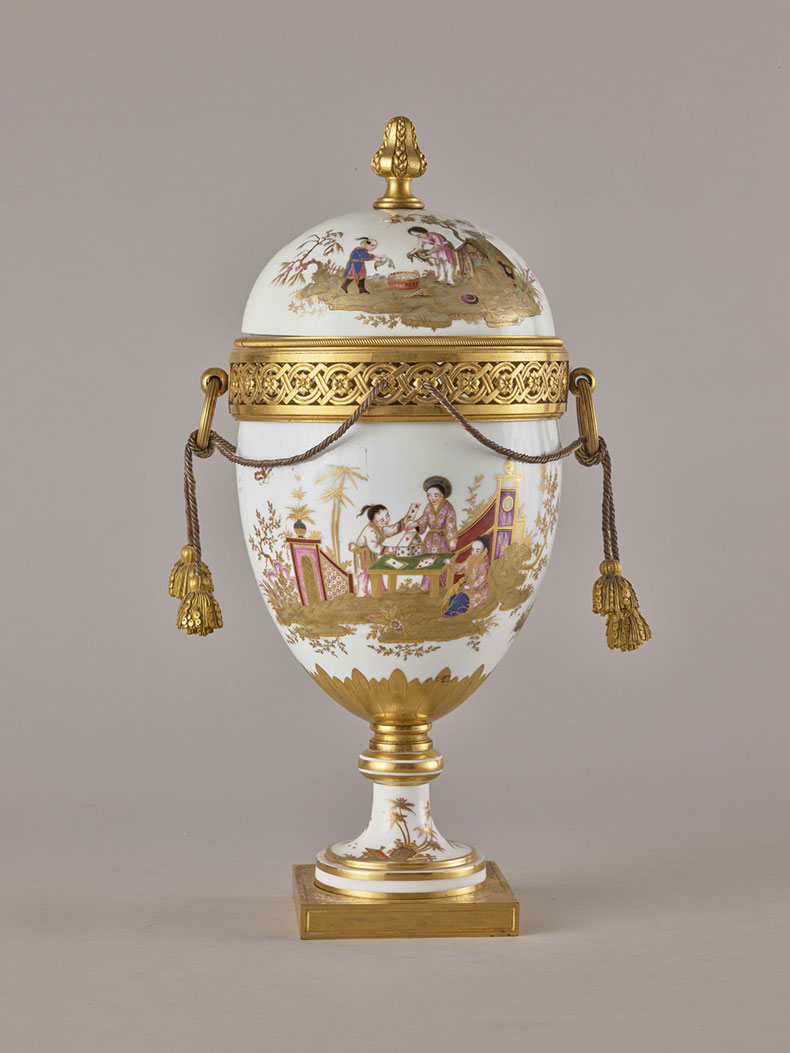
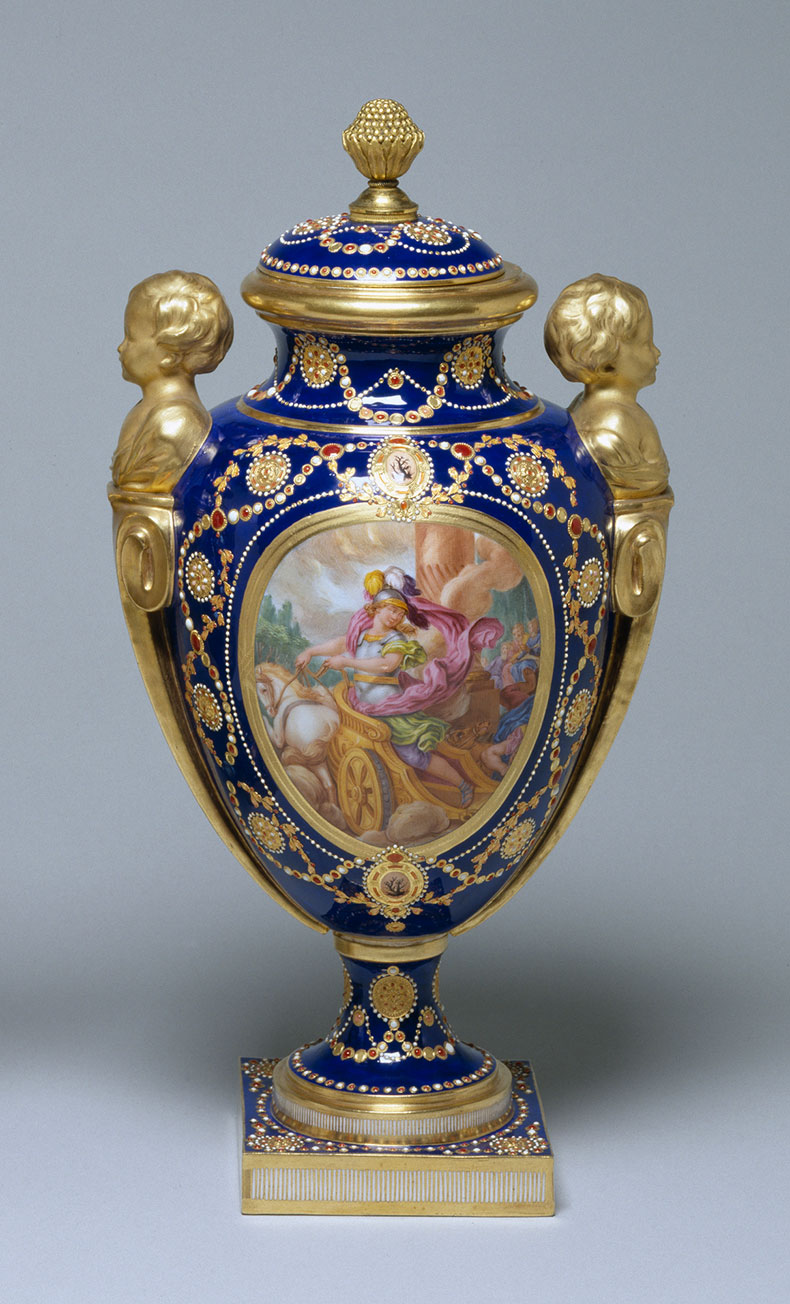
This exhibition at the Getty Center in Los Angeles (14 February–3 March 2024) brings together two ornamental sets of vases owned by Louis XVI and Marie-Antoinette of France. The vases are prime examples of the production at the Sèvres porcelain manufactory before the French Revolution and were personal treasures of the royal family. Beginning in 1778, the manufactory produced garnitures of vases to a design known as vases des âges (vases of the ages), which were typically made in three sizes with a large central vase and two pairs of smaller vases. Louis XVI bought one of these garnitures for his library at the palace of Versailles; the scenes painted on the front show episodes from François Fénelon’s Adventures of Telemachus, one of the king’s favourite books. The gilt-bronze mounts of another set of chinoiserie vases on show at the Getty are attributed to Jean-Claude Duplessis, who was appointed orfèvre du roi (goldsmith to the King) in 1758 and produced many designs for Sèvres. Find out more on the Getty’s website. (Read more.)


There are also a pair of the "jeweled" Sèvres vases at the Walters Gallery in Baltimore, MD. More on Sèvres, HERE and HERE.


Share

The Post-Covid States of America

 From City-Journal:

As Covid-19 struck America, governors, whether Democrat or Republican, initially followed the Trump administration’s public-health advice to break off human physical contact and, thus, turn off much of the economy. “Effective at 8 PM on Sunday, March 22, all nonessential businesses statewide will be closed,” New York’s then-governor, Democrat Andrew M. Cuomo, decreed. Down in Florida, the response from Republican governor Ron DeSantis was the same. “All persons in Florida shall limit their movements and personal interactions outside of their home to only those necessary to obtain or provide essential services,” DeSantis ruled in early April.

Beyond its devastating impact on human life, Covid-19 was also a jobs crisis. As offices, restaurants, theaters, and construction sites closed from coast to coast, 19.4 million Americans had lost their private-sector jobs by late April. With the unemployment rate blasting from 3.5 percent to 14.7 percent within just days, this abrupt mass layoff was incomparable with any other sudden unemployment spike in history, even the Great Depression. Notwithstanding trillions of dollars in aid from President Donald Trump and the Democratic Congress to replace (and even surpass) unemployed workers’ lost income, the goal, from the perspective not just of ending the unsustainable federal largesse but also of protecting mental health and social cohesion, had to be to get people back to their normal routines, including work, as fast as possible. (Read more.)
Share

Cleopatra's Daughter

 From History Extra:

Born in 40 BC and raised in the Royal Palace at Alexandria, Cleopatra Selene was around 10 years old when her parents killed themselves. She and her fraternal twin brother, Alexander Helios, and their younger brother, Ptolemy Philadelphos, were taken back to Rome with Octavian and deposited in the household of his sister – and their father’s former wife – Octavia, on the Palatine Hill. While Octavian’s biographer Suetonius claimed that the (future) emperor was a kindly father-figure to the children, insisting that they be cared for as if they were his own offspring, there was undoubtedly a political dimension to this decision. Retaining control of the children meant that any potential threat to Rome’s power over Egypt was neutralised. This control was first expressed at Octavian’s Triple Triumph – an event staged to celebrate his military successes – in the summer of 29 BC. The third and final day of the triumph commemorated his conquest of Egypt, and in the absence of their mother, the children walked alongside an effigy of her entwined with the snakes that had supposedly ended her life. Cleopatra Selene was dressed as the moon and Alexander Helios as the sun, in reference to the celestial names that Antony had bestowed upon them, so as to ensure the crowds lining the processional route would recognise them. Luckily for them, unlike other enemies of Rome such as Vercingetorix of Gaul, their participation in a military triumph did not culminate in their ritual execution. (Read more.)

Share

Sunday, February 12, 2023

The Midcentury-Modern Colored Tile Bathroom Is Back

 From Dwell:

"Midcentury-modern [architecture] was popular all across the nation, but it was especially popular in California," says Alan Hess, an architect and authority on Southern California Modernism who works with the Los Angeles Conservancy. And at this time, "colorful tiled bathrooms were a major selling point in midcentury houses." In the decades before WWII, says Hess, "the prevailing style of bathrooms in new homes was black and white, like a hospital." Home buyers in this era prioritized a clean, rigorous, "scientific" aesthetic. But after 1945, luxurious bathrooms came in flashy, coordinated colors. And then, in later decades, Los Angelans were less itchy to gut these bathrooms than people in other cities. "Midcentury-modern architecture is more widely appreciated—and so preserved—today in LA than any other major city," Hess claims.

Katie E. Horak, the principal of the Architectural Resources Group, adds "we also had a lot of tile manufacturers here in Southern California (Pomona Tile, B&W Tile, and many others)." Of course, it’s not just Los Angeles—Southern California’s postwar housing boom meant more monochromatic bathrooms. Though "other cities with similar postwar economic prosperity have great tile bathrooms too," Horak explains, mentioning that she’s seen amazing bathrooms in Detroit and Minneapolis.

The second house I sublet in Los Angeles was even better than the first. A bright orange tub-shower combination made of long vertical tiles took the place of soft greens. The bathroom was tomato orange-red, "atomic orange" as my stylist roommate called it. The tiles paraded up, from the bottom of the tub all the way to the ceiling. It felt like bathing inside a slippery orange envelope. This bathroom—my favorite truly of my life I think—also had secret compartments by the sink. If you tapped these metal pieces, a little unit with a toothbrush holder would fling out. No contemporary, chubby toothbrush handle could fit inside, but you know what? It was there to provide a delightful surprise and it did. (Read more.)


Vintage colors from Kohler at House Beautiful:

You don’t have to be a design expert to know that Kohler has been a kitchen and bath industry leader for over a century—150 years, to be exact. This year, the company is celebrating its sesquicentennial anniversary with a series of celebrations (dubbed Come All Creators) and, in exciting news for vintage-lovers everywhere, a limited-edition product line featuring two beloved colors from days gone by: Peachblow and Spring Green. (Read more.) 


Other vintage designs from House Beautiful:
Vintage bathrooms often take a charming cottage turn. This one features a pretty vanity built from a repurposed dresser, a surf-and-sky palette, and crisp white surfaces. Gilded touches add chic shimmer, which underscores the room's collected appeal. (Read more.)

Share

So Controversial

 Ad orientem. From Catholic World Report:

Until the 1960s, Catholics worshipped ad orientem, with priest and congregation facing the East during Mass. Originally Christians celebrated Mass before daybreak Sunday morning with the rising sun serving as a symbol of Christ’s resurrection (testified by Pliny the Younger’s letter to the Emperor Trajan in 112 A.D.). The common liturgical direction toward the East honored the resurrection and anticipated the Lord’s coming in glory.

The oldest Christian church discovered in the world (without a later structure built over it), the house church at Dura-Europos in Syria, dating from the early 200s, was found with its altar touching the wall, facing East. Churches were constructed throughout history in this same fashion, with the altar (whether against the wall or not) oriented toward the East.

Even though there were more exceptions to a strict interpretation of this geographical direction in recent times, priest and people still worshipped facing the Lord together throughout the entire history of Catholic worship. Services facing the people arose during the Reformation, because ministers were focused on speaking to and leading the congregation. The priest during Catholic worship, however, acts in the person of Christ and leads the members of the Body in a common approach to the Father. The Mass does not focus on the people but seeks to give glory to the Father through Christ and in the Holy Spirit. The Mass is not about us ultimately but about coming into communion with God, worshipping him and being drawn into his life.

Why, then, did we change the direction of Catholic worship to face the people, called ad populum, in contrast to ad orientem?

The Second Vatican Council did not mention this change and there is no official liturgical document from the 1960s that directed it. The thought following Vatican II’s constitution on the liturgy, Sacrosanctum Concilium, was that the Mass, which had been celebrated in an oft-inaudible Latin, should be more accessible to the people. In the experimental period between the constitution in 1963 and the promulgation of the reformed Mass of Pope Paul VI in 1969, the posture of facing the people had already become standard as a kind of spontaneous reaction to the liturgical mood of greater transparency and accessibility.

It is truly amazing that a timeless practice of Christian worship, such as the posture of ad orientem, would be abandoned without the directives of a Council or even any deliberation from authoritative bodies. Over the last 50 years, it has become the absolute norm.

At the same time, works such as Pope Benedict XVI’s Spirit of the Liturgy and Uwe Michael Lang’s Turning Towards the Lord (both published by Ignatius Press) have pointed to the implications of this change for the way Catholics perceive the meaning of liturgy. It appears to have become more human-centered rather than God-centered, indicating more of an enclosed circle than a transcendent action that draws us beyond the confines of the church. Inspired by these reflections, some priests have been seeking to recover the ad orientem posture. (Read more.)


From Pints with Aquinas:

We in the West live in possibly the most consumeristic age in history. We accumulate things that have little worth. We gorge ourselves on unhealthy food. We spend hours mindlessly scrolling on social media. Limitless porn is only a few clicks away.

We have everything we need to “satisfy” our appetites, but we’re starving for authentic truth, goodness, and beauty. The Traditional Latin Mass shocks those who first attend it with a radiance not of this world. The beautiful gestures, prayers, silence, and chants lift us up to a higher spiritual plane.

Not that there can’t be a beautiful Novus Ordo Mass. Priests need to follow Vatican II’s guidance on the liturgy and bring back a sense of the sacred to this form of the Mass. For example, Vatican II called for Gregorian chant and sacred polyphony. But we rarely find these in parishes that supposedly follow Vatican II.

[...]

This is an uncomfortable truth for those still convinced that the Mass needs to be radically modernized. If you go to many “modern” parishes today, you’ll often see a sea of older people. Young adults are noticeably absent.

But young people are flocking to the Traditional Latin Mass, and are wondering why this treasure was denied to them. They don’t want “fashionable” liturgy; they want something that is eternally relevant.

So if you’re still not convinced of the Latin Mass’s intrinsic worth, there’s also a practical aspect: the Catholic Church today is losing young people like crazy. Without them, many parishes will close in the future. (Read more.)
Share