Sunday, May 22, 2022

Flawed Kingdom

 From The Imaginative Conservative:

The recent disclosures of the overt sexualization of Disney cartoons have outraged many American families. Disney executives have openly stated that they have increasingly injected LGBT content, characters, and themes into their films and that they do, in fact, have a “gay agenda.” They have spent millions to promote left-leaning political causes against the interests of their main customers.

While upset families are right to cut off Disney from their children’s imaginative formation, they should have been doing this a long time ago. The now-blatant sexual agenda of the corporation is only the final manifestation of a distorted and perverse view of reality that has pervaded the “Disney” brand for quite a long time—even from the earliest of its feature-film cartoons. While the original films may not have presented a dysfunctional view of human sexuality, they did present a distorted view of the world and of the family. Most never were what we might call “age-appropriate.”

Step back a moment and consider the original Disney feature-films for children, Snow White and the Seven Dwarves, Fantasia, and Pinocchio, and then ask yourself: Is this the imaginative world of an innocent child or of a wounded adult? Do these films introduce nightmare images to a child’s mind, or do they offer a way out of nightmares inherent to the child’s mind?

J.R.R. Tolkien’s excellent essay, “On Fairy Stories,” addresses the very problem that Disney had from its inception: the notion that fairy stories are exclusively children’s stories. They are not. They are stories allowing adults to examine the world from a new perspective to find a better way to live. Tolkien asserts that people connect “the minds of children and fairy- stories,” but “this is an error; at best an error of false sentiment, and one that is therefore most often made by those who, for whatever private reason (such as childlessness), tend to think of children as a special kind of creature, almost a different race, rather than as normal, if immature, members of a particular family, and of the human family at large.”

The Brothers Grimm collection of fairy stories are not meant for bedtime reading to young children. Yet Walt Disney and his original production team chose a Grimm story, Snow White, as their first feature film in 1937 for families with young children. Most readers will recall the basic plot of the story, so let me briefly analyze the problems in this film as I argue that it does not properly form a child’s moral imagination.

First, Disney combines nightmarish images with buffoonery. Once her life has been spared, Snow White runs screaming into a chaotic forest whose darkness is cut by stabs of light illuminating demonic faces and silhouettes—an intense, unsettling scene of garish light and noise. She (along with the four-year old audience member!) passes out from fear but then awakens to a gentle scene filled with loving animals who lead her to the house of the bumbling seven dwarves. The scene radically shifts from its preceding one, and the viewer sees now only Snow White’s peaceful life with goofy, bumbling, appropriately-named dwarves. A flash of fury interrupts these pastoral scenes when the evil queen realizes Snow White still lives. The “fairest of them all” then radically shape-changes into a frightening-looking beggar woman who finds Snow White’s forest home and interjects her ugly face into the window, breaking the beauty and harmony of the refuge.

This shifting of the sands of safety undermines a keen sense of what is real. Is the nightmare-state reality? Is the pastoral? The two cannot be blended but must be determined clearly in the mind first of the adult and then the child. To present the nightmare in such serious terms and the pastoral realm with such buffoonery suggests that the more “real” of the two is the first, the nightmare. This is a significant problem if you want your child to have a firm foundation in the powerful assurance of the true, good, and beautiful. If this triad becomes associated with the farcical, the absurd, and the humorous but ultimately impotent world of the seven dwarves, then the child loses the power and majesty of these three realities. The peaceful world of nature is ineffectual as a guard against the serious presentation of evil’s invasion. (Read more.)

Share

More on Spygate and the Russia Hoax

 From The Federalist:

Last month, The Federalist first reported that Special Counsel John Durham’s team asked lead Georgia Tech researcher Manos Antonakakis: “‘Do you believe that DARPA should be instructing you to investigate the origins of a hacker (Guccifer_2.0) that hacked a political entity (DNC)?’” Antonakakis responded that that was a question for the DARPA director, an implied acknowledgment that yes, DARPA had asked him to investigate the hack.

In response, DARPA’s chief of communications denied any involvement “in efforts to attribute the DNC hack.” “Dr. Antonakakis worked on DARPA’s Enhanced Attribution program, which did not involve analysis of the DNC hack,” DARPA spokesman Jared Adams told the Washington Examiner. Adams further told the Washington Examiner that “DARPA was not involved in efforts to attribute the Guccifer 2.0 persona, nor any involvement in efforts to attribute the origin of leaked emails provided to Wikileaks.”

But now an email obtained by The Federalist indicates Georgia Tech researchers drafted a series of white papers for DARPA, including on the “DNC attack attribution,” and on what they called a “Mueller List” of “domains and indicators related” to DNC hackers.

The email dated July 23, 2021 followed Durham dropping a second subpoena on Georgia Tech for more documents related to its investigation of the Alfa Bank hoax and other related issues. (More on that subpoena below). In that email, a lawyer representing David Dagon, the second Georgia Tech researcher involved in the Alfa Bank hoax who also worked on the DARPA Enhanced Attribution program, shared a list of “documents/data sources” Dagon believed would be responsive to the subpoena of Georgia Tech documents.

Listed under the heading of “DARPA whitepapers” were four documents, including “Whitepaper on DNC attack attribution”; Analysis of attacks of EOP (Executive Office of the President) networks”; “Whitepaper for DOJ on APT-29 related hackers, crypto coin transactions, and analysis that includes Yota-related domains”; and “‘Mueller List’—list of domains and indicator related to APT-28.”

Of these DARPA whitepapers, the first and fourth both relate to the DNC hack, with the final paper also connecting to the Mueller investigation. APT-28 is the more formal name for the Russian intelligence group of hackers known colloquially as Fancy Bear. As part of his investigation, Mueller charged 12 Russian intelligence agents allegedly working as Fancy Bear with crimes related to the DNC hack. (Read more.)


From The Post-Millennial:

Mook testified that Clinton had "agreed" to disseminating the data to the media. Mook later added that he "can't recall the exact sequence of events," when asked if he shared the "idea to give the Trump-Alfa Bank allegations to the media with Clinton before or after the decision was made," Fox News reported.

"All I remember is that she agreed with the decision," Mook testified. "I don’t remember the substance of the conversation, but notionally, the discussion was, hey, we have this and we want to share it with a reporter," Mook said.

Sussmann is currently on trial for allegedly lying to the FBi in regards to the Russia collusion story. Sussmann has been charged with one count of lying to the FBI in regards to stating that when he brought forth the information, he was not doing work "for any client."

On Thursday, Former FBI General Counsel James Baker, who Sussmann had brought forth the allegations to, testified that the bureau had investigated the data alleging the connection, and found that "there was nothing there." (Read more.)


Share

Love Letters of St. Gianna

 From National Catholic Register:

She was a doctor who drove to Mass in her Fiat 500 and searched endlessly for the will of God. He was a humble, morally resolute engineer full of enthusiasm for the richness of life. They met in the town of Mesero, Italy, and the day before their wedding, Pietro Molla gave Gianna Beretta a watch, a pearl necklace and a note. 

“Let these crown the wonder and the brightness of your beauty and your virtues on our wedding day,” he wrote. “May the watch always mark the loveliness and most peaceful times of our life, and may this pearl necklace be a sign of the enchanting light of our love. They are given to you ... by your Pietro with the greatest love.”

The couple documented their love story in years of letters to each other. Love Letters to My Husband and The Journey of Our Love are books that contain dozens of letters between the two of them. While their deep affection for each other has only captured the hearts of readers in print since 2002 and 2014, respectively, Gianna was beatified in 1994 and canonized in 2004.

Their wise words induce reflection on holy and mighty expectations for romantic relationships, from dating, to engagement, to marriage, and on love itself. In the book The Journey of Our Love, the introduction author Elio Guerriero wrote:

“Better than a theological treatise, these letters are a convincing proof that the way of holiness does not necessarily pass through religious life or the priestly ministry,” he wrote, “but can unfold in the midst of the world, living one’s own vocation as a Christian called to holiness with Christ in married life.”

The couple exchanged the honest and affectionate desires of their hearts with each other and responded with kindness and shared enthusiasm for their upcoming life together. 

Gianna: “I really want to make you happy and be what you desire: good, understanding and ready for the sacrifices that life will require of us. I haven’t told you yet that I have always been very sensitive and eager for affection.”

Pietro: “A new life is beginning for me: the life of your great (and greatly desired) affection and of your radiant goodness. ... I too want to make you happy and understand you well.”  (Read more.)


Share

Saturday, May 21, 2022

Playing the Lute

A Lady And A Gentleman Playing Lutes by Louis de Caullery

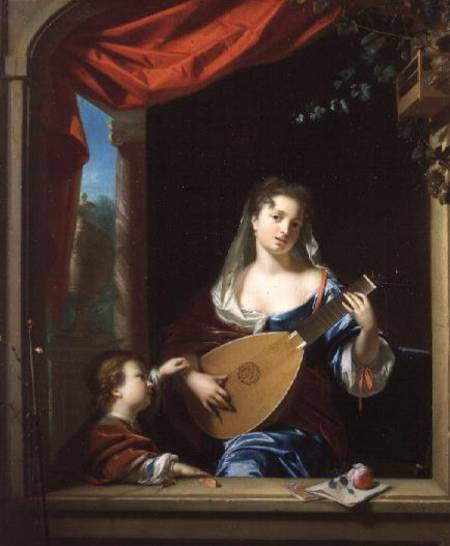
Elegant Lady Playing the Lute at a Window by Philip van Dyck

The Lute Player by Sir Peter Lely

As a teenage queen, Henrietta Maria learned to play the lute. From Toni Mount at History...the Interesting Bits:

I learned the correct terminology: they’re not called ‘strings’, they’re ‘courses’ and come in pairs except for the single course at the bottom, known as the ‘chanterelle’, yes, just like the mushroom. Basic lutes have 6 or sometimes 8 courses but some can have quite a few more, may be up to 12. For Seb, I thought 6 was enough. The main body of the lute, the sound-box, is known as the ‘bowl’ and it should rest on your right thigh. The bowl has a central cut-out design, the ‘rose’, to let the sound out and this can be ornate and beautiful. The thin part is the ‘neck’ with frets for fingering, ending in the ‘peg-box’ with pegs to tune the courses. (Read more.)

Share

The Commoditization of Man

 From Crisis:

When one becomes a commodity, one becomes a means to an end, a container of goods that are to be extracted by hook or by crook. Ever since the fall, man has been drawn to things like greed, corruption, and empire building in various attempts at making life more comfortable. In the past, people who fit this mold might have consisted of the slick salesman, or the corrupt government official, or the mobster, or the local warlord. While all of these still exist in one way or another, technology has brought our ability to devalue others to a whole other level, making us numbers rather than people to some.  

Much can be said today about the effects of big data on our lives. Any material thing can be bought and sold given the right buyer and seller. While in the past this might have consisted of an ad in a newspaper or in a window, now big tech companies count and track clicks, and at times use AIs like Alexa to listen in on our conversations, giving us targeted adds in an attempt to sway us in one way or another. (Read more.)

Share

The Painted People

 From Historic Mysteries:

The Roman Imperial period saw one of the most aggressively expansionist policies ever adopted on a large scale. The Romans launched themselves into an all-or-nothing attempt to conquer the entirely of western Europe, leaving the stamp of Roman architecture and Roman culture on lands as far apart as Turkey and Scotland.During their centuries of growth the Romans encountered many other cultures whom they dismissively referred to as “barbarians” (as in “blah blah, we don’t understand what they are saying”). Many of these were exotic, but almost all of those weaker than the mighty armies of Rome were ultimately conquered, subsumed and absorbed into the empire.

However, this is not to say that the Romans did not encounter “problematic” barbarians who did not relish the opportunity to become Roman. Britain, protected by treacherous seas and full of hairy natives, was a particular problem.

Although Britain did eventually fall to the Romans, in the far north was Scotland, full of an enigmatic and even hairier people. And here the Romans finally met their match. Despairing of ever dealing with these strange peoples, the Romans were forced instead to build a huge wall across northern England to keep them out. (Read more.)

Share

Friday, May 20, 2022

The Northman (2022)

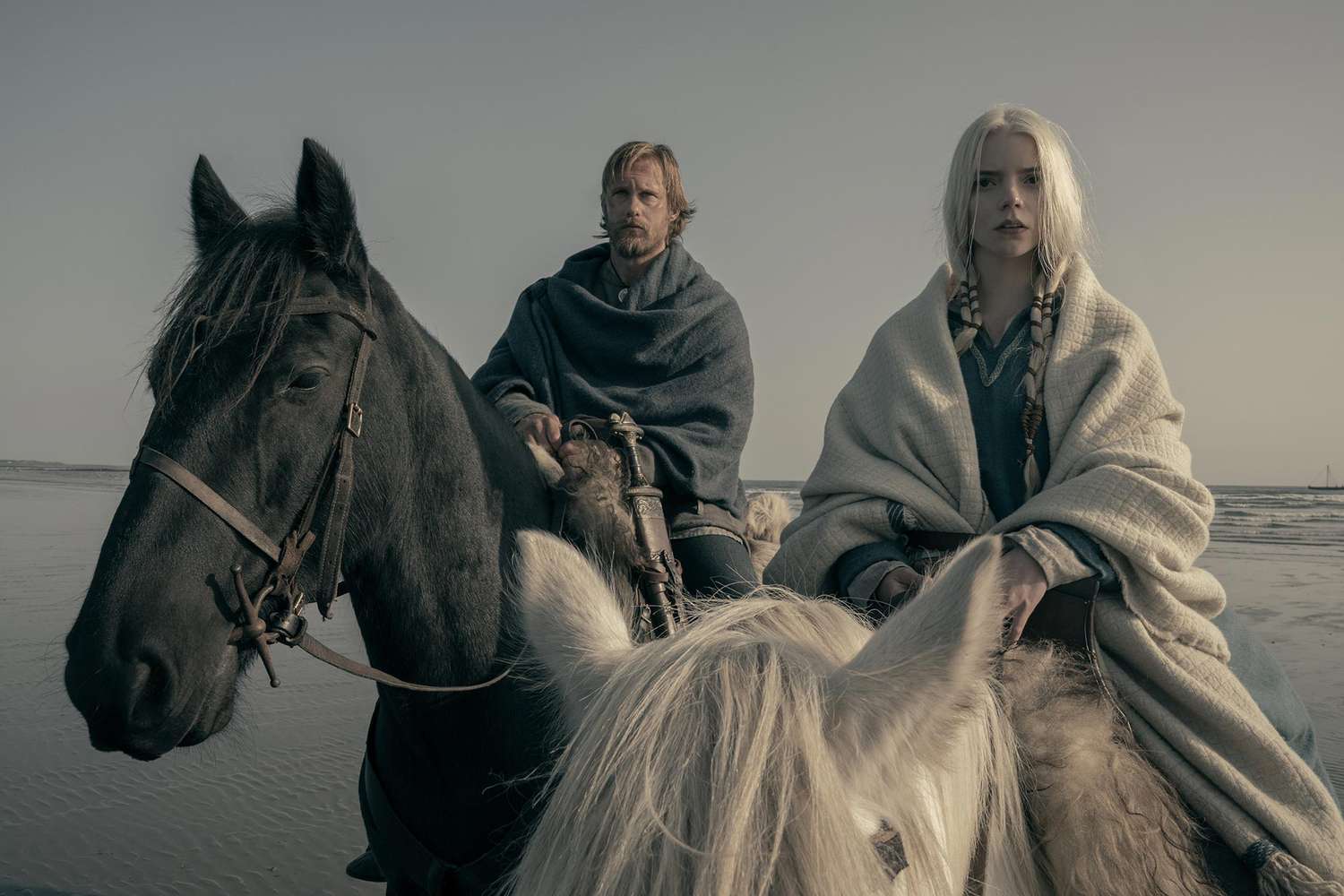
 I have no idea how anyone could see The Northman as a white supremacist film, but it seems some people do. If anything, it makes white people, especially Vikings, look really bad. Yet it is probably one of the most accurate depictions of pagan Norsemen ever filmed. The violence and superstition of life at that time and place are set in the magnificence of Iceland. It is well-acted but painful to watch, at least for me. From Vox:

In the 12th century or thereabouts, a fellow we know today as Saxo Grammaticus sat down to write a history of Denmark, a chronicle of its mythology, history, and conquests. I doubt he knew that his work would inspire generations of adaptations. But, as fate would have it, two of his 16 books told a rollicking tale of Amleth, grandson of a king. Amleth’s father was murdered by his brother, Amleth’s uncle, who then married Amleth’s mother. Amleth feigned madness to escape his uncle’s sword, but eventually, he took his revenge.

Historians believe Saxo Grammaticus’s account of Amleth was itself an adaptation, based on older Icelandic poems. But it would be far from the final retelling of the tale. Most famously, a few centuries later, an English playwright used Amleth’s tale as the inspiration for the story of a Danish prince who avenged his own father’s death at the hand of his uncle-cum-stepfather. He titled it The Tragedy of Hamlet, Prince of Denmark

And now — in a time when medieval legends seem to be increasingly sparking filmmakers’ imaginations — The Northman, a bone-crunching Viking epic from detail-obsessed director Robert Eggers, is based on Amleth’s legend as well. (To put it another way: if you feel while watching The Northman like you’re watching a Shakespeare adaptation, you are wrong, but only kind of.)  (Read more.)


From Den of Geek:

When we spoke to Eggers about the film, he noted the story of Amleth was a larger inspiration for him to chase his own Berserker ghosts. The filmmaker wanted to use that basic framework of familiarity to keep the audience keyed in to what is happening, even when weird things like Bjork as a supernatural Seer appears, compelling Amleth to stop his raiding ways and seek a righteous revenge instead.

Even so, there are more than a few elements of The Northman lifted directly from Shakespeare’s Hamlet (and not Amleth), only now with a modern subtext.

For instance, in Hamlet, the Danish prince discovers a gravedigger excavating a burial site, only to find the skull of his father’s court jester. The Danish prince becomes melancholic recalling poor Yorick and the merry memories of kissing his lips and laughing at his japes. Well, that court jester is a major character in The Northman, played here by Willem Dafoe. As Heimir the Fool, Dafoe portrays perhaps the one person Hawke’s King Aurvandil shows genuine affection toward. He is allowed to tease what he sees to be the wandering eye of Queen Gudrún (Nicole Kidman), and he is shown indoctrinating young Amleth into the Viking customs and superstitions of his father.

When Amleth infiltrates Iceland some decades later, feigning to be a Slavic slave, a He-Witch (Ingvar Sigurdsson) manifests to reveal the decapitated remains of Dafoe’s fool. Apparently after Claes Bang’s Uncle Fjölnir assumed the throne he stole, one of his first acts was to torture and behead Heimir. “Alas,” says the He-Witch to Amleth. Yet after the new king’s torturers removed the fool’s tongue and eyes, and later his head, a pagan witch retrieved the remains, restoring the skull to ghastly shape. And now it’s been brought to Iceland in order for Amleth to commune with the dead… much as Hamlet wished to do with poor, poor Yorick. (Read more.)


From The Wrap:

 Kidman rarely gets the credit she deserves for going out on a limb and seeking opportunities to work with envelope-pushing directors. Like Catherine Deneuve, Kidman embraces eccentric characterizations guided by filmmakers working outside the mainstream, and she often reaps the benefits with indelible supporting roles like this one that enhance her reputation as an unpredictable and engrossing performer, a movie star who’s always a character actress at heart.

“The Northman” is the best kind of multi-quadrant movie. Without abandoning his arthouse credentials, Eggers has made a rousingly rough, extreme action saga that has the potential of attracting the kind of viewers who might have found his previous work impenetrable. It’s a vision of futility and fury, of a clash between nature and humanity where violence is both the means and the consequence, and an ancient revenge fantasy that speaks with terrible truth to this moment and to the historical lessons we never seem to learn. (Read more.)

Share

Why European Children Are Less Noisy Than American Children

 From Intellectual Takeout:

European parents’ discipline about not shouting at their kids was all the more impressive since they also almost never followed their children from apparatus to apparatus, as is the habit of most of us hovering American parents. These parents sat at the edges of the sprawling playground, reading books, drinking coffee, and letting their tots explore on their own. When they had to talk to their kids, they got up and walked close enough that they could use a normal voice.

I was baffled at first, and I’d snicker with my fellow expats about the harsh disciplinary measures and lack of spirit that must explain the bizarre quiet. Yet now, nearly eight years later, I’ve come to see a logic behind our different cultures, and understand why Americans’ reputation for being loud and boorish and the continental Europeans’ reputation for being cold and standoffish exist, but are ultimately incomplete.

A root cause, it seems to me, is the very different roles that public spaces play in our lives and communities. Americans are less likely to live in apartments and generally have bigger homes and yards than Europeans do. That means American children typically play in backyards and parents enjoy quiet and a bit of nature on their own properties. So when Americans seek out a playground, we are looking for company. Our children go to find other kids, and we parents are often also looking for conversation, rather than just an opportunity to sit peacefully under a tree. For city dwelling Europeans, the parks and playgrounds are their backyards. They go there to let their kids run around, but also to enjoy a natural setting themselves.

The differences in the use of public spaces explain behaviors outside of the playground too. Americans find it jarring when they are sitting at a European café or restaurant and someone takes the empty seat at their table. If someone is sharing our space, we assume we have to interact. Europeans presume that they and others will enjoy privacy even in close quarters. Just as American parents teach their children to look people in the eye and politely greet them, European children are taught how to interact quietly to avoid bothering people around them.

We learn these skills from a young age. My daughter’s 5th grade class (at a public school in Berlin, Germany) practices what they call their “one meter” voices: students are expected to sit with a partner and engage in quiet conversation. They are supposed to be able to hear each other, but not be heard more than one meter away. This allows other conversations to take place around them, creating an expectation of privacy and personal space in a crowded room.

Americans often hear about how much more sophisticated Europe is: women nurse their babies openly, and people change their clothes in public parks or by swimming pools because they don’t have our hang-ups about nudity. It may be that Europeans are just more comfortable with nudity, but this different relationship with public spaces also comes into play. In Europe, I may be in a public setting but the space around me is mine. I know that my neighbors at the playground, café, beach, or bus stop are going to do their best to ignore me entirely and give me whatever privacy I may want or need.

At first, I mistook these customs—the failure to make eye contact or smile while passing on the street, the utter lack of chit-chat that’s the background buzz of American waiting rooms and checkout lines—as evidence of a core coldness. Yet I’ve come to see it not as a lack of friendliness or compassion, but an outgrowth of the Europeans’ respect for privacy in the public sphere. (Read more.)

Share

Finding a Lost Chinese-Norse Civilization in Canada

 From Ancient Origins:

The considerable skepticism about the Chinese voyages seemed to be primarily because the idea of massive Chinese ships, as suggested by Menzies and Hudson was thoroughly doubted. Unfortunately, one could not appeal to China because that country has retained no information as to the design of such massive ships - no models, no sketches, no descriptions. Curious genetic and ancestral stories of the Beothuck People led to an informal survey that revealed mtDNA of Celtic, Norse, and other Scandinavian/Baltic origin, leading to speculation that all of the people were descendants of the Norse from the time of the Viking Sagas. However, that speculation was disabused by research reports to the effect that (a) Newfoundland Island had had several waves of occupation, and (b) there is a genetic discontinuity between the maternal lineages of the various occupation groups. Moreover, historical reports indicate that whoever was on the island were substantially, or completely, killed off by some blight or combination thereof (plague, typhus, smallpox) between 1402 and 1404, which meant that as of that later date the island was effectively empty. If that were true, then it meant that the Norse ancestors of the contemporary Beothuck must have colonized at least part of the island sometime after 1404 AD. That led to a consideration of the story of the disappearance of the people of Greenland in the early 15th Century. There is no record of the people of Greenland going east, as some experts have speculated. According to Catholic Church records, there had been as many as 5000 people in Greenland circa 1409. That's a lot of people to account for. (Read more.)

Share