Wednesday, October 24, 2018

Vampire Burial

The myths about vampires and zombies overlap a great deal. From Ars Technica:
Archaeologists have discovered the skeleton of a 10-year-old child at an ancient Roman site in Italy with a rock carefully placed in its mouth. This suggests those who buried the child—who probably died of malaria during a deadly fifth century outbreak—feared it might rise from the dead and spread the disease to those who survived. Locals are calling it the "Vampire of Lugnano."

"This is a very unusual mortuary treatment that you see in various forms in different cultures, especially in the Roman world," says Jordan Wilson, a graduate student in bio-archaeology at the University of Arizona who studied the remains. He added that this could "indicate a fear that this person might come back from the dead and try to spread disease to the living."

Pretty much every culture on Earth has some version of a vampire (or proto-vampire) myth. Chinese folklore has the Jiang shi, [corrected] which are reanimated corpses that rise from the grave to prey on the living; one type has sharp fangs, the better to bite into the neck of said prey. Russian, Albanian, Indian, and Greek folklore have similar undead monsters. Russian villagers in the Middle Ages often drove stakes into the bodies of suspected vampires upon burial to keep them from rising again. (Read more.)
Share

Tuesday, October 23, 2018

Castleknock Hotel Afternoon Tea

From The Taste:
Some hotels claim to be family friendly venues, but you’d sometimes be hard pressed to find a little one strolling through reception. Castleknock Hotel, located in Dublin’s suburbs and very close to Phoenix Park, is a family hotel through and through, something that especially shines through when the hotel is hosting a number of events.

On the day myself and my good friend Niamh were enjoying Afternoon Tea, the hotel’s staff were handling not one, but two elaborate celebrations. From the quiet and chilled out christening crowd, obviously aware of the sleeping star of their do, to the more raucous wedding celebrations in the adjoining area of Earth Vine, as well as us regular customers enjoying a spot of afternoon tea, there was a lot going on. Something I noticed throughout the entire two and a half hours I was there was that a smile never left the faces of staff members and they effortlessly managed the entire room like the pros that they are – from the tiniest guest in its pram to the more senior attendees. (Read more.)
Share

#PostcardsForMacron

From The Catholic Herald:
Following a comment by President Emmanuel Macron, in which he expressed skepticism that any well-educated woman would decide to have many children, women with large families have been using the “#PostcardsForMacron” hashtag to send the French president pictures of their happy families.

Speaking about high fertility rates in Africa during a Gates Foundation “Goalkeepers” event held in New York City Sept. 25-26, Macron compared having a large family with forcing a girl to be married as a child. Macron stated that when women are educated, they do not have many children. “I always say: ‘Present me the woman who decided, being perfectly educated, to have seven, eight or nine children,” said Macron. “Please present me with the young girl who decided to leave school at 10 in order to be married at 12.’”

In response, many women took issue with the French president’s apparent disbelief that academically successful women would choose to be mothers of several children. Dr. Catherine R. Pakaluk, a professor of social research and economics at the Catholic University of America, started the hashtag by sharing a photo of herself and six of her eight children. (Read more.)
Share

Rejecting Euthanasia

From The Catholic Weekly:
Nearly a month ago Anna Corry was given just days to live. The 50-year-old former nursing educator has endured an aggressive type of breast cancer since her diagnosis in January last year. This January she and her husband Martin and their sons Michael, 17, Dominic, 14, and Andrew, 11, received the news that although chemotherapy had shrunk the 10cm tumour near her heart, the cancer had spread through her body. Apart from a miracle, there is no hope for a cure.

The parishioner of St Bernadette’s, Castle Hill, wants to share her thoughts on euthanasia and assisted suicide – as a voluntary assisted dying law comes into force in Victoria next year, and a parliamentary committee investigates the issue in Western Australia. She is opposed to both and believes opting to shorten her own life would have robbed herself, and her family and friends of “an incredible amount of joy” over recent weeks. Some say that churches should stay out of the debate around dying and the law, but Anna says she has discovered through her own experience arguments against legalising euthanasia which are quite apart from her Catholic faith. (Read more.)
Share

Monday, October 22, 2018

A New Film About King Robert the Bruce

Florence Pugh as Elizabeth de Burgh and Chris Pine as Robert Bruce in Outlaw King
Chris Pine as The Outlaw King
Josie O'Brien as Marjorie Bruce
A film I have been waiting for all my life. It had better be good. Judging from the trailer, it looks historically accurate. From Entertainment Weekly:
As 14th-century Gaelic nobleman Robert the Bruce, the sunny Los Angeles native manages to look surprisingly right in chain mail, hiding his California jawline beneath a tangled beard and adopting a convincing-enough Scottish burr. He’ll need at least some of that wooly gravitas to inspire his countrymen to rise up against King Edward I (a great, casually imperious Stephen Dillane) and take back their land and pride from the English.

Bruce finds his loyal tribe, including Aaron Taylor-Johnson’s fiercely endearing Lord of Douglas and a lovely, independent-minded bride (Lady Macbeth‘s Florence Pugh). He also has a mortal enemy in Edward (Billy Howle of Dunkirk and On Chesil Beach), a mad-eyed prince with a bowl cut to match his psychopathic tendencies. (William Wallace also appears briefly as secondary character, though he’s made of something much darker and more feral than Mel Gibson’s imagining).
Mackenzie falls a little too in love with his battle scenes; by the fourth clash of blood and swords it all starts to feel like déjà vu, with different horses. At nearly two and a half hours, there’s clearly room to trim (though one chaotic escape scene near the end may be the best river nightmare since Revenant). But he also films it beautifully in the natural light of candles, torches, and overcast skies, and there’s a solidness to the old-fashioned conventions of his storytelling. Unlike Bruce’s scrappy band of rebels, Outlaw never really has the element of surprise: It just comes in blazing, like a king. (Read more.)
Trailer, HERE. Scottish reaction on film, HERE. Another review, HERE. Share

The Kelvin Cochran Religious Liberty Case

From The National Review:
A good man’s legal ordeal is at an end. Yesterday, my friends and former colleagues at the Alliance Defending Freedom announced that former Atlanta fire chief Kelvin Cochran had reached a $1.2 million settlement, ending a case he brought after the city fired him for writing — and distributing to a select few city employees — a self-published book that articulated an entirely orthodox Christian view of sex and marriage.

The facts of the case were egregious from the beginning. Cochran was a pioneer — born in Confederate Memorial Hospital in Shreveport, La., he grew up to become one of the first black firefighters hired by his hometown fire department. He ultimately became the first black fire chief of Shreveport. He continued to ascend the ranks of firefighters, becoming Atlanta’s fire chief, and then, in 2009, Barack Obama appointed him to run the Fire Administration, a division of the Federal Emergency Management Agency.

After Cochran left Atlanta, the fire department struggled. So Atlanta’s mayor recruited him back, and Cochran turned the department around so thoroughly that it for the first time received the nation’s highest fire-protection rating. The cornerstone of his effort to transform the department’s morale was a “participatory management structure” that solicited input from “every rank, race, shift, and gender.” He consciously included LGBT employees, granting — in his words — “every group a voice.” (Read more.)
Share

Searching for Joseph in Egypt

An interesting article from 2014. From The Times of Israel:
Prof Manfred Bietak has been digging at Tell el-Dab’a in Egypt for over 40 years. He has identified it as “Avaris”, the ancient Hyksos capital. Avaris is smack dab in the middle of the area the Bible calls “Goshen” i.e., the area that the Israelites lived in prior to the Exodus. The word “Avaris” means nothing in Egyptian. But, in the Torah, Joseph is repeatedly called a “Hebrew”; “Ivri” in the Hebrew language. He is also repeatedly and curiously called “Ha Ish”; “The Man”. In other words, the word “Avaris” may very well be related to Joseph, the “Ish Ivri”, or the “Hebrew Man” (Genesis 39:14). All this is lost in translation when Joseph is simply called a “Hebrew”. Put differently, the so-called Hyksos capital seems to be named after Joseph the “Ish Ivri” i.e., Avar-Ish.

Between 1986 and 1988, Prof. Bietak found the remains of a monumental statue that seems to have belonged to a non-Egyptian ruler of Avaris. Although only fragments remain, the archeologists estimate the original size of the seated figure to be 2 meters high and 1.5 meters in depth i.e., about one and a half times life size. Over the statue’s right shoulder you can still see his “throw stick” i.e., the symbol of his rule. On the back – remarkably, as with the Biblical Joseph – you can still see evidence that this ruler was wearing a striped garment, made up of at least three colors: black, red and white. He was found in a tomb. The tomb was empty. This may be as a result of looting, but one can’t help but recall that the Biblical narrative explicitly tells us that when the Israelites left on the Exodus, they took Joseph’s bones with them (Exodus 13:19). In other words, in order to fit with the Biblical narrative, any tomb of Joseph in Egypt would have to be empty. (Read more.)

And HERE is a helpful guide for young people about Egyptian crowns. Share

Sunday, October 21, 2018

Chandelier Earrings

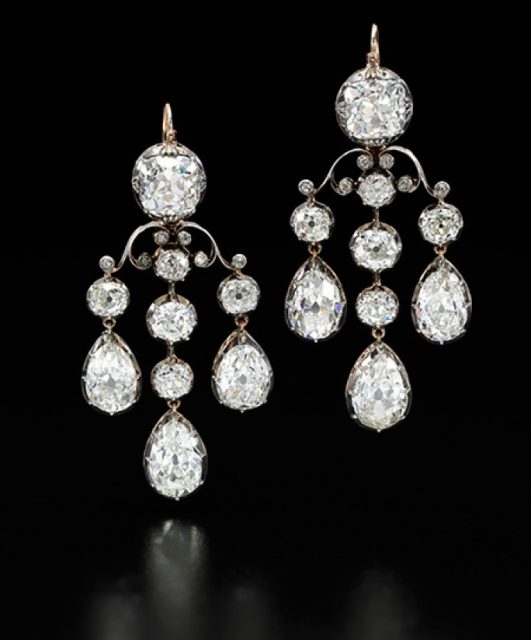
Diamond earrings of the Bourbon-Parma collection that is being auctioned by Sotheby's. Many of the pieces were not originally the Queen's but are made of jewels that belonged to the her or other members of the Habsburg and Bourbon families. The Queen did have diamond chandelier earrings but I doubt they are the same pair. From Nancy Bilyeau at Vintage News:
In an auction being described as historic, the jewelry of the last Queen of France, unseen in public for two centuries, will go on sale next month. Before being sold, the jewels can be viewed in New York City and then London at Sotheby’s headquarters. “The romance, magic, and universality of her name is because she represents that sophistication of l’ancien regime. She is it,” Andres White Correal, Sotheby’s senior director of jewellery, told AFP.

“It is the sale of the 21st century. Because how do you top Marie Antoinette? Also because it’s so scarce. There isn’t much left.” The treasures were smuggled out of Paris in 1791 and have been privately owned by the family’s relatives ever since. The collection that includes her diamonds and pearls, held by the Italian royal House of Bourbon-Parma, is being sold by Sotheby’s auction house in Geneva on November 14th, Yahoo reported.

Sotheby’s says that the collection, “which spans centuries of European history, from the reign of Louis XVI to the fall of the Austro-Hungarian Empire, will offer a fascinating insight into the splendor of one of Europe’s most important royal dynasties.” Among the stars of the collection is a stunning diamond pendant, supporting a natural pearl of exceptional size (26 mm x 18 mm), as well as a pair of natural pearl drops and a necklace featuring 119 natural pearls. The jewelry was whisked out of France due to the courageous efforts of Count Mercy Argenteau, a retainer to the queen.* As King Louis XVI, Marie-Antoinette, and their family prepared their escape in March 1791, the queen placed all her diamonds, rubies, and pearls in a wooden chest, which made its way to Vienna by way of Brussels in the care of Count Argenteau.

[...]

The Bourbon-Parma sale also contains jewelry belonging to Charles X, the last monarch styled king of France, including a diamond tiara; jewels from Empress Marie Therese of Austria, Marie Antoinette’s mother; and from Austrian emperor Franz Joseph I, who died in 1916. The fleur de lys design tiara, made in 1912, contains diamonds from the collection of Charles X, Marie Antoinette’s brother-in-law, who died in 1836.** (Read more.)
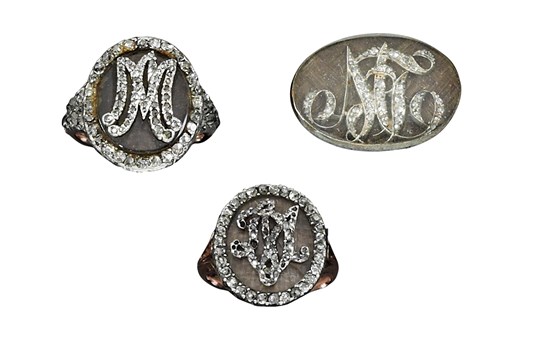
Two diamond and woven hair rings, and a diamond and woven hair jewel
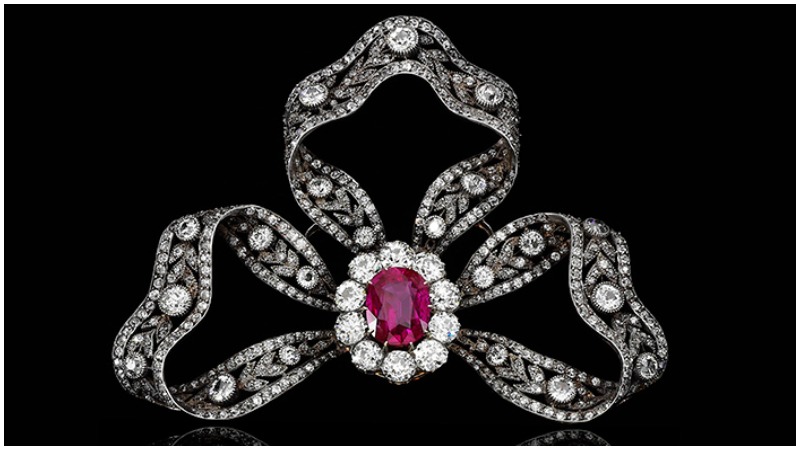
Ruby and diamond brooch (not Marie-Antoinette's)
*Count Mercy-Argenteau was the Imperial Ambassador at the court of France.

** The granddaughter of Charles X, Louise d'Artois, married into the House of Bourbon-Parma. Her granddaughter was Zita, Empress of Austria.

Share

Voter Fraud

From The Federalist:
In Texas, authorities are investigating criminals who are using the technique of “vote harvesting” to illegally procure votes for their candidates. “Harvesting” is the practice of illegally obtaining the signatures of valid voters in order to vote in their name without their consent for the candidate(s) the criminal supports. These are just some instances of voter fraud we know about. It would be silly to assume cases that have been discovered are the only cases of fraud. Indeed according to a Pew Charitable Trust report from February 2012, one in eight voter registrations are “significantly inaccurate or no longer valid.” Since there are 146 million Americans registered to vote, this translates to a stunning 18 million invalid voter registrations on the books. Further, “More than 1.8 million deceased individuals are listed as voters, and approximately 2.75 million people have registrations in more than one state.” Numbers of this scale obviously provide ripe opportunity for fraud. (Read more.)
Share