Saturday, November 19, 2016

On Being Over-Fond of Pets

From Dance's Historical Miscellany:
I was recently rather amused by a chapter in an 18th-century advice manual for women, entitled ‘On being over-fond of animals’. This anti-pet diatribe comes from a 1756 publication called The Wife, which also features charmingly-named chapters such as ‘The danger of living in the same house with any Relation of the Husband’s’, ‘Sleeping in different Beds’, and ‘The great indiscretion of taking too much notice of the unmeaning, or transient gallantries of a Husband’. (Read more.)
Share

The Sign of Jonah

Some interesting reflections from Unveiling the Apocalypse:
There has been a long-standing association between the Prophet Jonah and the mythological figure of Oannes, not only because the two names are so similar from an etymological point of view, but chiefly because this deity was depicted as a man adorning fish-like garments, almost as if he is emerging out the fish itself. The Babylonian historian Berossus describes Oannes as a half man, half fish creature below:
“A man, or rather a monster, Half man and half fish, coming from the sea, appeared near Babylon; he had two heads; one, which was the highest, resembled that of man, the other that of a fish. He had the feet of a man, and the tail of a fish; and his speech and voice resembled that of a man: a representation of him is still preserved. This monster dwelt by day with men, but took no food; he gave them knowledge of letters, arts, and sciences; he taught them to build towers and temples; and to establish laws; he instructed them in the principles of geometry; taught them to sow, and to gather the fruits of the earth; in short, whatever could contribute to polish and civilize their manners. At sun set he retired to the sea, in which he passed the night. There appeared likewise others of the same species.”

According to Mesopotamian mythology, Adapa/Oannes was a mortal man and a son of the god Ea, and was instrumental in bringing the arts of civilisation to humanity. In a further parallel to the story of Jonah and the fish, we are told that while Adapa was out fishing one day, his boat was overturned by Ninlil, the personification of the South Wind. Indeed, the similarities between the story of Jonah and the figure of Oannes run so deep, that many commentators have erroneously proposed that these legends were originally inspired by the events surrounding the Prophet Jonah himself. This misconception is recounted in the Wikipedia article concerning Jonah:

Biblical scholars have speculated that Jonah may have been in part the inspiration behind the figure of Hannes in late Babylonian mythology. The deity name "Oannes" first occurs in texts from the Library of Ashurbanipal (more than a century after the time of Jonah) as Uanna or Uan but is assimilated to Adapa, a deity first mentioned on fragments of tablets from the 15th or 14th century BC found in Amarna in Egypt. Oannes is described as dwelling in the Persian Gulf, and rising out of the waters in the daytime and furnishing humanity instruction in writing, the arts and the various sciences. Berossus describes Oannes as having the body of a fish but underneath the figure of a man—a detail that, some biblical scholars suggest, is not derived from Adapa but is perhaps based on a misinterpretation of images of Jonah emerging from the fish. (See here)

However the various myths concerning the figure of Adapa predate the ministry of Jonah by several centuries, and can be traced as far back as the 14th century BC. Although the connection between the events behind the story of Jonah and the figure of Oannes would not have went unnoticed by the Assyrians themselves, and it is quite probable that the ancient Ninevites would have associated the appearance of the prophet emerging from the fish with the myth of Adapa. It is even possible that the later name "Oannes" used for Adapa is itself derived from Jonah, because of this close association.

Given the fact that the engraving found in Kizkapan Cave is based upon earlier imagery associated with Adapa/Oannes, it makes it more likely that this relief depicts events which took place during the Bur-Sagle Eclipse of 763BC, rather than the Eclipse of Thales. As such, the two figures laying down weapons may represent a cessation in hostilities during the revolts that were unfolding in Nineveh, which were recorded as taking place around this time by the Assyrian Eponym Canon. Actions which were prompted by the appearance of the eclipse itself, and a prophet who emerged out of a fish to announce the destruction of Nineveh.

Given the possibility that the repentance of the Ninevites at the preaching of Jonah can be attributed to the Bur-Sagle Eclipse, we have some grounds to suggest that the original "sign of Jonah" consisted of the appearance of a total solar eclipse over the site of ancient Nineveh. When we look to Christ's statement concerning the appearance of the "sign of Jonah" to a wicked and perverse generation, we find that these words were made immediately after His discourse on the binding of the strong man - which according to St. Augustine of Hippo, is an integral component of the prophecy of the unbinding of Satan at the end of the "thousand years" mentioned in Rev 20:

The Lord Jesus Christ Himself says, No man can enter into a strong man's house, and spoil his goods, except he first bind the strong man — meaning by the strong man the devil, because he had power to take captive the human race; and meaning by his goods which he was to take, those who had been held by the devil in various sins and iniquities, but were to become believers in Himself. It was then for the binding of this strong one that the apostle saw in the Apocalypse an angel coming down from heaven, having the key of the abyss, and a chain in his hand. And he laid hold, he says, on the dragon, that old serpent, which is called the devil and Satan, and bound him a thousand years,— that is, bridled and restrained his power so that he could not seduce and gain possession of those who were to be freed. (St. Augustine of Hippo, City of God XX:7)

So in relation to the sacrificial death of Jesus and His resurrection on the third day, the "sign of Jonah" harks back to the three days the prophet spent in the belly of the fish. An event which foreshadowed the crucifixion, burial and resurrection of Christ - which in turn brought about the binding of Satan. (Read more.)
Share

The Eighth Degree of Humility

From Vultus Christi:
The brother who nourishes a secret belief in his own superiority will always find opportunities to stand out, to stand apart, to preserve the little difference that reinforces this belief. The brother who cannot give up his personal way of doing things fears that, if he starts doing everything as others do, he will cease being special, and this he finds terrifying. To such a brother the abbot must repeat Saint Benedict’s injunction again and again, firmly, and with patience: “Do nothing except what is authorised by the common rule of the monastery, or the example of the seniors”.

In a newly founded monastery where the common rule is not yet entirely consolidated, and where there are few seniors, these few seniors must give the example of a quiet regularity, shunning anything that smacks of the spectacular or the exotic. One cannot overestimate the importance of fostering regularity; by this, I do not mean a harsh regime that brooks no exceptions. I refer rather to the steady rhythm that can admit of the occasional exception and, without conceding to idiosyncrasies, accommodate the dispensations required by fluctuations in health, by changing circumstances, and by particular needs. (Read more.)
Share

Friday, November 18, 2016

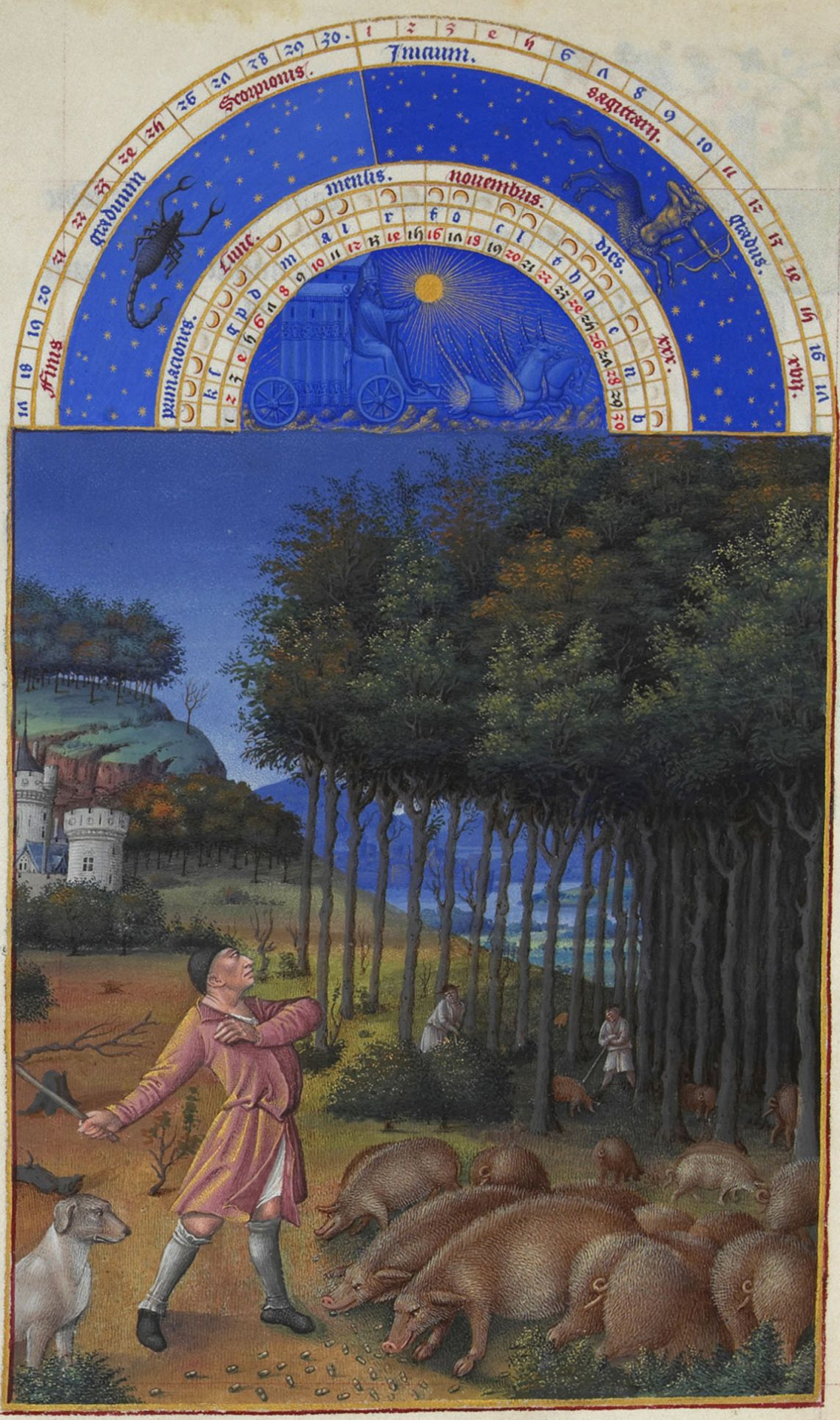
November

Тhe calendar page for November of Les Trés Riches Heures du Duc de Berry. It is the harvest of acorns, in order to feed the pigs.
Share

Worn By Royalty

From Christie's:
‘Jewels play numerous and diverse roles in our lives,’ writes Francois Curiel, who joined the Jewellery department at Christie’s in 1969, in the foreword to Vincent Meylan’s meticulously researched new book. ‘But, above all, jewels are the embodiment of beauty,’ Curiel states. ‘They have been coveted by the most memorable names in history, heroes and villains, famous lovers, glamorous stars, distinguished families, commanding dynasties.’

Meylan's book, Christie’s: The Jewellery Archives Revealed (ACC Art Books), is filled with fascinating stories about royalty and leading figures whose jewels have passed through Christie’s salerooms over the last 250 years. Here, we present a series of extracts on important auctions with a royal theme. (Read more.)
Share

Cowslips

From Catherine Curzon:
 With their simple but undeniable beauty, cowslips are a fitting symbol for our Elizabeth. The cowslip is a common flower, sweet-smelling and low-growing but vibrantly colored and impressive in its profusion. They have been admired and used for centuries for their culinary, medicinal, and even magical qualities.

The flowers and leaves are mildly narcotic, which is why they have been used for making both a delicate wine and a calming sedative tea. I expect Darcy would attest to Elizabeth having an intoxicating effect on him!

Aside from medicinal purposes, the beauty of the cowslip has inspired some belief that the flower can imbue this quality on others. Nicholas Culpepper, a renowned 17th century English botanist, claimed that women could make themselves more beautiful by using a distillation or ointment made from the perennial. Indeed, it would not be an unusual ingredient to find in modern skincare due to the cowslip’s cleansing properties.

Cowslips were often associated with the faeries in England. Some say the faeries used the cowslips to become invisible, or that the presence of cowslips indicated the presence of faeries. In Midsummer Night’s Dream, Shakespeare invoked the cowslip as a favorite of the Fairy Queen, Titania:

And I serve the fairy queen
To dew her orbs upon the green.
The cowslips tall her pensioners be.
In their gold coats spots you see.
Those be rubies, fairy favors.
In those freckles live their savors.
I must go seek some dewdrops here
And hang a pearl in every cowslip’s ear

Conversely, cowslips also were used to protect one’s home and cows from faeries. Even as belief in faeries died away, rural folk would keep cowslips by their door to prevent unwanted visitors. (Read more.)


Share

Thursday, November 17, 2016

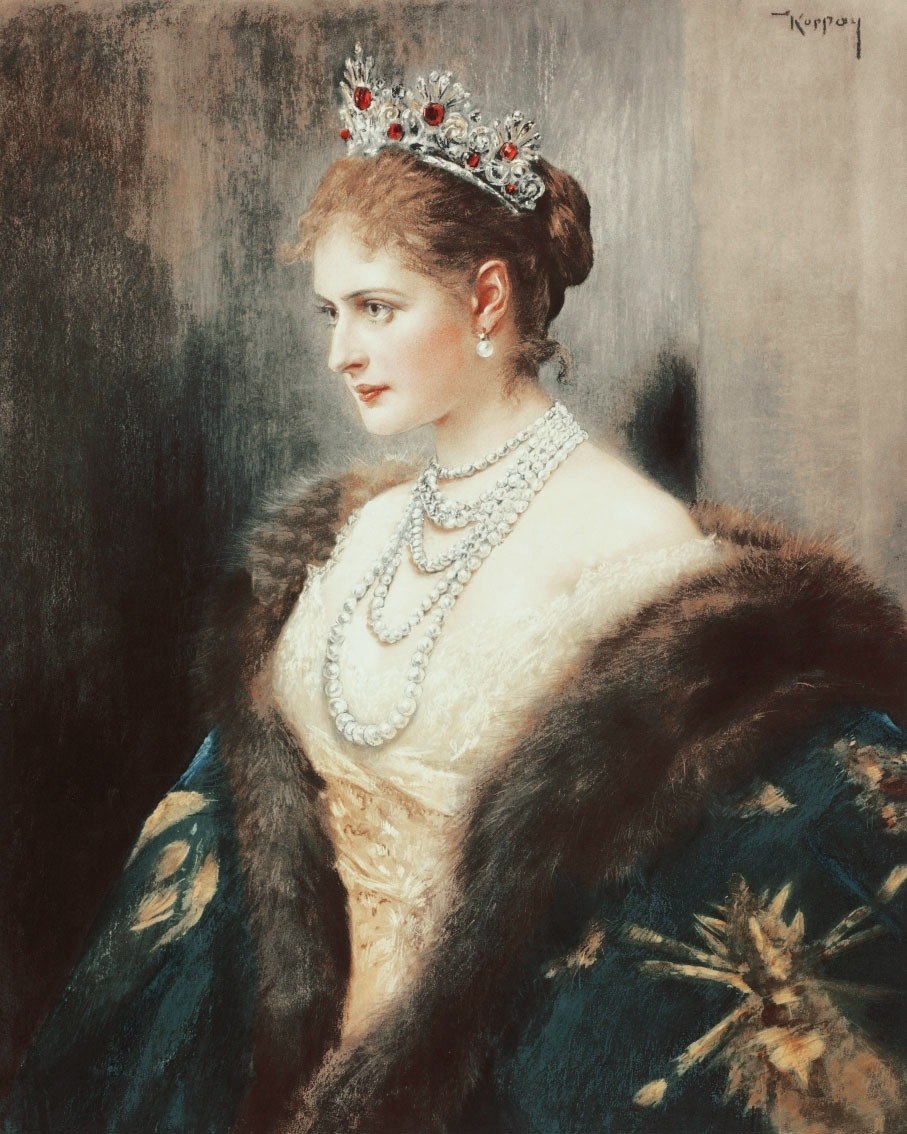
Alexandra Feodorovna by Josef Arpád Koppay

I have long heard that Alix was more beautiful in real life than any of her portraits or photos can capture but I think this portrait comes close. Share

Domestic Abuse

From Catholic News Agency:
7 percent of women in the U.S. have suffered intimate partner violence at some point, along with 12 percent of men, the CDC has reported. There are many physical and psychological effects of domestic violence on victims – physical injuries and disabilities and bodily effects of stress, but also anxiety, depression, and trust issues. Children witnessing violence in the home may grow up with emotional problems like anger, or may even become abusers themselves when they are adults.

In his apostolic exhortation on the family, Amoris laetitia, Pope Francis wrote of the problem of domestic abuse: “Unacceptable customs still need to be eliminated. I think particularly of the shameful ill-treatment to which women are sometimes subjected, domestic violence and various forms of enslavement which, rather than a show of masculine power, are craven acts of cowardice. The verbal, physical, and sexual violence that women endure in some marriages contradicts the very nature of the conjugal union.”

He also insisted upon the need for parishes and priests to be ready to deal properly with these problems: “Good pastoral training is important ‘especially in light of particular emergency situations arising from cases of domestic violence and sexual abuse’,” he added, citing the final document from the 2015 Synod on the Family. Catholics are responding to this dire need, organizing a prayer campaign for domestic abuse victims while trying to spread awareness of the problem and educate clergy on how to properly deal with instances of abuse.

A symposium on domestic abuse took place in July at the Catholic University of America in Washington, D.C., hosted by the university’s School of Social Service. (Read more.)
Share

How Emotionalism is Slowly Replacing Rationalism

From Intelletual Takeout:
Been offended? Proclaim it from the housetops… or at least from Facebook and Twitter. Feeling marginalized at college? Demand a safe space. Need some way to express your anger at police violence? Loot a store or riot in the streets. It would seem that the repeated commands we’ve been fed in recent years to “let it all hang out,” or “express what you’re feeling” have been taken to heart.

But considering that self-command over one’s emotions was believed to be the wiser course for years, we should ask ourselves whether our full blown embrace of emotions is a good thing. Is it possible that we have embraced the emotional outpouring in life because it is one of the few weapons with which we have left to work? Have we marginalized rational thinking and reasonable discourse to such an extent that the only way we can get our point across is to yell, scream, cry, or rant? Although it’s never stated outright, Jane Austen’s Elinor is clearly portrayed as the stronger sister because of the control she exhibits over her emotions. Perhaps Americans would be stronger as a nation if more of her citizens stopped playing up their emotions and instead practiced greater self-command. (Read more.)
Share