Tuesday, February 10, 2015

Church Ladies

From Dynamic Women of Faith:
There was a terrible fire at the parish.  Most of the church was damaged or destroyed.  I went to Adoration (held in the gym of the school) the next morning in the frigid cold, wondering what I would find.

I shouldn’t have wondered at all… there they were, the warriors wearing veils, winter coats and thick boots.  Warriors holding rosaries, and praying in earnest.  They didn’t fret, or cry, they just hunkered down to fight the good fight.  They were, as they always are, the church ladies.

Some people think of the Blessed Virgin Mary as timid, but not me.  I see her following her Son, heart breaking, body aching and fighting her way up to Calvary.  Others turn away in grief or fear, but Our Dear Mother looks upon her Son, sharing in His suffering.  She never gives in to fear, but fights on. (Read more.)
Share

Monday, February 9, 2015

Son of Louis XV

Portrait of Louis, Grand Dauphin of France by Louis Tocqué. 1739.Via Vive la Reine. He was also the father of Louis XVI. Share

Africans in Tudor and Stuart England by Conor Byrne

From The Tudor Society:
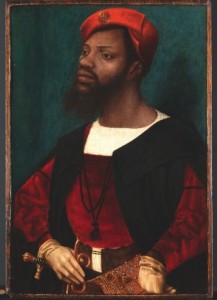
The Tudor period was significant for black settlement in England. Katherine of Aragon arrived at Plymouth in October 1501 with a multinational entourage that included Moors, Muslims and Jews. The Iberian Moor Catalina de Cardones was one member of Katherine’s entourage, and served her for twenty-six years as Lady of the Bedchamber. She eventually married ‘Hace Ballestas’, a crossbowman who was also of Moorish origin. Alongside the arrival of ‘Black Moors’ from Spain and North Africa, this period witnessed the arrival of black people on a major scale as a result of the burgeoning slave trade. The National Archives at Kew contains a wealth of fascinating resources concerning Tudor Africans. Albeit from a slightly later date, during Stuart rule, on 29 September 1687 a Moor was granted the freedom of the city of York, and is listed in the freemen’s roll as ‘John Moore – blacke’, although he is occasionally referred to as ‘Johannes Moore’. Freedom of the city could be obtained through earning it (through serving an apprenticeship, for example); inheriting it from a parent who was a freeman; purchasing it; or receiving it as a reward for services rendered to the city. In this case, John Moore bought the freedom of the city. He paid two amounts: 20 nobles (equivalent to 13s 6d) to the Common Chamber of the city of York, and £4 to the city council, for his honour. It has been conjectured that John Moore was a wealthy member of the York community, since he was in a position to pay the requisite amount of money to the mayor of York to enjoy all the privileges of freedom of the city. He was able to bear arms and enjoyed the right to fish in the city’s rivers and was also able to graze his animals on the meadows by virtue of his freemen status. While Moore’s experiences seem to have been exceptional – no other black man or woman has been, to date, found in the York rolls – this example compellingly demonstrates the visibility, importance and potential for power of black people in England at this time. (Read more.)
Share

The Tournament World

From Henry the Young King:
The 12th century saw the rise of tournament as one of the main features of aristocratic life. One reason the aristocrates and knights were fascinated by the tournament was because they could parade their skills and thus win fame. The other was the sheer joy of participating. Of course they could also reap profit on it, especially landless knights such as William Marshal. Theologian and canon of Cirencester Alexander Nequam gives yet one more reason for organising and participating in that knightly game, namely that 'they [the knights] engage seriously in war games and occupy themselves in the image of war, in order to becomemore adept in military conflict". However, he did express his disapproval, too, writing that knights "desire to barter their lives for praise and, careless of their own souls, expose themselves to mortal danger in pursuit of vainglorious reputation". Even if that was Henry the Young King's chief motif, and he indeed sought the "vainglorious reputation' we understand why he was doing that. Bieng king only in name, he had to find some other way to win fame. Often accused of "playing at war” and participating in "mock battles”, he, as most of the young aristocrats of the 12th century, found participating in tournaments a way to make himself a "man of account”. When he was forced to spend a year in England at his father's side, learning the bisuness of kingship, he did not try to hide his impatience and discontent. He was to say:

"It should be a source of much harm to me to stay idle for so long, and I am extremely vexed by it. I am no bird to be mewed up; a young man who does not travel around could never aspire to any worthwhile thing, and he should be regarded as of no account” (The History of William Marshal)

Note what the Young King takes for "idleness”. Do not forget that taking part in tournaments was the matter of views and attitude of the entire generation of the young aristocracy, not only the Young King's fancy.
(Read more.)
Share

Sunday, February 8, 2015

Those Bad Christians

St.Louis IX lands in Egypt
As ISIS burns an innocent prisoner alive, the American people are lectured by their President about all the ways in the past millennium that Christians have shown themselves to be as bad or worse than the murderers in the Middle East. Mr. Obama said:
And lest we get on our high horse and think this is unique to some other place, remember that during the Crusades and the Inquisition, people committed terrible deeds in the name of Christ. In our home country, slavery and Jim Crow all too often was justified in the name of Christ.
Dr. Charles Krauthammer responded with wise words:
I was stunned that the president could say something so, I mean, at once, banal and offensive. Here we are from an act shocking barbarism, the burning alive of a prisoner of war, and Obama’s message is that we should remember the Crusades and the Inquisition. I mean, for him to say that all of us have sinned, all religions have transgressed — it was adolescent stuff. Everyone knows that. What’s important is what’s happening now. Christianity no longer goes on Crusades. It gave up the Inquisition a while ago. The Book of Joshua is knee deep in blood. That story is over too. 
 
The story of today, of our generation, is the fact that the overwhelming volume of the violence and the barbarism that we are seeing in the world from Nigeria to Paris all the way to Pakistan and even to the Philippines, the island of Mindanao in the Philippines is coming from one source, and that’s from inside Islam. It is not the prevalent idea of Islam. But it is coming from Islam. As many Islamic leaders including the President of Egypt and many others have admitted. And there needs to be a change in Islam. It is not a coincidence that all of these attacks on other religions are happening. All over the world, in a dozen countries, two dozen countries, all in the name of one religion. It’s not a coincidence. And for the president to be lecturing us and to say we shouldn’t get on our high horse and to not remember our own path is ridiculous. The present issue is Muslim radicalism and how to attack it. A lot of people are dying.

From Obama’s first speech at West Point in December 2009, ironically announcing the surge in Afghanistan, you could tell that his heart has never been in this fight. Never. He’s the Commander-In-Chief and yet he announces one sentence after he talks about the surge, he talks about the day to withdraw. Everyone in the region knows that. Everyone in the Middle East knows that he took on the fight on ISIS only because of the public reaction to the video of the beheading of the two Americans. He never would have lifted a finger otherwise. He hasn’t helped the rebels in Syria. He has not given the weapons that Jordan needs. The Kurds who are actually able, courageous and well and committed to the fight against ISIS still cannot get direct arms from the United States. The world knows this. Our enemies know it, an our friends know it.
 Dr. Krauthammer is correct. Everyone knows, and each sincere Christian knows most of all, that being a Christian does not exempt one from sin, and that as sinners Christians have committed crimes throughout history. But that has nothing to do with the current crisis which has imploded in the Middle East and threatens our own citizens as well as our national security. As for Obama blaming Christians for slavery and Jim Crow, it was Christians who led the abolitionist movement, who organized the Underground Railroad (Harriet Tubman was a devout Christian), and who participated in the Civil Rights movement (such as Reverend Martin Luther King.) One tires of the twisting of historical facts to fit political agendas.

When we speak of the Crusades we speak of several different campaigns ranging over the course of several hundred years; it is not accurate to lump them together as if they were a single entity.  Yes, there were wicked Crusaders but there were also holy ones. They were responding to the manner in which Christian pilgrims to the Holy Land were repeatedly kidnapped and sold into slavery by the Muslims. Women and girls would be placed in harems and men and boys would be castrated and made into slaves called eunuchs. Also, the fact that the major Christian shrines, such as the Holy Sepulcher, were in Muslim hands was another reason the popes called for Crusades. Each Crusade was different and had different players, motives, and results. They began as a defensive war against the violence of Islam. St. Louis of France went on crusade twice and was greatly admired by the Muslims for his courage and courtesy. The Carmelite Order was founded as a result of the Crusades, and spices and trade routes were introduced to Western Europe, as well as advances in medicine. There were great triumphs, great courage and heroism, as well as the most vicious barbarism. For instance, the sack of Constantinople by the Venetians during the Fourth Crusade was one of the most disgusting events in history. Usually when people such as Obama refer to the Crusades as crimes against humanity, it is principally the horrors of the Fourth Crusade that they are thinking of, acts which the pope at the time condemned.

In the meantime, here is another reaction to the President's speech, from Breitbart:
Stunned and horrified Americans, and indeed Christians around the world, not to mention victims of Islamist horror from every religious background, will be trying to process Obama’s idiotic words for days to come.

Yes, folks, the President of the United States just told the civilized world it has no moral standing to criticize the head-choppers, child-crucifiers, slave-takers, and auto-da-fe enthusiasts of the modern world, because the Crusades happened a thousand years ago.

The basic concept here is nothing new. Lazy, arrogant liberals have been babbling about the Crusades and Inquisition ever since Islamist terrorism became a big problem for the Western world. I’m sure some of these tools whined about the Crusades while one of the World Trade Center towers was still standing. It’s the sloppiest intellectual dodge imaginable, a cheap and easy way to sound impartial and high-minded: hey, all of those knuckle-dragging religious types are prone to violent outbursts.

It’s also a way that an arrogant leftist such as Barack Obama positions his own religion, the glory of the State, above all others. Obama’s world-view holds that everything prior to his own enlightened reign was a time of darkness and ignorance. Notice how he goes out of his way in these comments to bash not just the Crusades, but also Christianity’s alleged defeat at the dawn of tolerant New Leftism: “In our own home country, slavery and Jim Crow were all too often justified in the name of Christ.” So was everything Dr. Martin Luther King Jr. said and did, you callow fool. Try looking up William Wilberforce and digesting what motivated him.

To say that every strong belief system, religious or otherwise, can be abused by those hungry for power, or eager to justify their worst impulses, is such a banal observation as to be unworthy of utterance at any significant event, let alone the President speaking at the National Prayer Breakfast. The issue on the table is whether there are particularly dangerous belief systems at work in the world right now.  Not only is Obama obscuring that issue, he’s actually saying Christianity is worse than Islam, because he accepts at face value the notion that Islamist atrocities have absolutely nothing to do with the religion cited to authorize them, but he holds Christianity totally and perpetually responsible for the Crusades.

It would be a frustrating waste of time to try educating someone like Obama on the actual origin of the Crusades as a defensive war against aggression; he’s probably at least dimly aware of that, but it’s an inconvenient fact of no use to his ideology, so he casts it aside. The story he wants to tell is of benighted, ignorant, crude humanity raised up by the glorious wisdom of the secular State and the moral colossi who command it, among whom Barack Obama stands as the greatest titan of all. He came to the National Prayer Breakfast to call for worship of himself. (Read more.)
Share

The New First Lady of Maryland

Yumi Hogan, our lovely new First Lady of Maryland
From The Washington Post:
The love story of Larry and Yumi Hogan received scant attention during last year’s contentious race for Maryland’s governorship. But as they ease into their new roles — Yumi will hold her first official event Sunday — their late-in-life relationship will continue to help shape their public image and personal lives.
For Yumi, Larry’s insistence that she finally chase her own ambitions led her to art school and a job teaching painting — a role she intends to keep while making the arts a priority as first lady. For Larry, Yumi’s devotion to family rounded out the rough edges of a climb-the-ladder life, softening him and giving him an instant family.

“She helped me appreciate the important things in life,” the 58-year-old governor said in an interview. “I would not be the governor without the love and support of my wife and my daughters. They’ve been an incredible inspiration.”

The couple is moving into the mansion as empty nesters, bringing along Yumi’s special kimchi refrigerator; the family dog, Lexi; and the multicultural values of an extended family they say represents Maryland’s present and future. Two daughters are Democrats. One is a war veteran. And two of the three married men who aren’t Asian, including one of Puerto Rican descent.

The food and conversation around the holiday dinner table is a spirited smorgasbord.

“Like most Marylanders, we’re pretty much right in the middle,” said Jaymi Sterling, the middle daughter, a St. Mary’s County prosecutor who appeared in a campaign ad defending her stepfather on women’s issues. “Our family is like a microcosm of Maryland. In so many ways, it’s so diverse, just like Maryland is.”

(Photos from the inauguration)
 
In many ways, because of Yumi, it is also historic. She is believed to be the first Korean first lady in the United States. And her background in the arts sets her apart from Katie O’Malley and Kendel Ehrlich, the previous two first ladies, whose backgrounds were in law. Some of her paintings will hang on the mansion’s 145-year-old walls. (Read more.)
Share

The Art of Non-Fiction

Author Joan Didion is interviewed by The Paris Review:
Writing fiction is for me a fraught business, an occasion of daily dread for at least the first half of the novel, and sometimes all the way through. The work process is totally different from writing nonfiction. You have to sit down every day and make it up. You have no notes—or sometimes you do, I made extensive notes for A Book of Common Prayer—but the notes give you only the background, not the novel itself. In nonfiction the notes give you the piece. Writing nonfiction is more like sculpture, a matter of shaping the research into the finished thing. Novels are like paintings, specifically watercolors. Every stroke you put down you have to go with. Of course you can rewrite, but the original strokes are still there in the texture of the thing. (Read more.)
Share

Saturday, February 7, 2015

Pastel Portraits of the Archduchesses

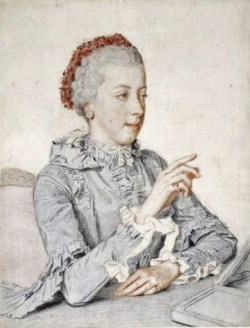
Via Tiny-Librarian: "A series of pastel portraits done around 1762 by Jean-Étienne Liotard. They depict the eight daughters of Maria Theresa and Francis I to survive childhood...." (Read more.)

Share

Mary I and Religion

From author Conor Byrne:
Contrary to the popular legend of Queen Mary as a bloodthirsty and tyrannical monarch who forced the unpopular Catholic religion upon her unwilling subjects, she initially demonstrated, in the words of Ann Weikel, 'flexibility and political sensitivity'. The Catholic religion was not immediately reintroduced until several months into the queen's reign. Mary may have been unsure of her subjects' attitudes and clearly desired to proceed carefully and hesitantly in so delicate and controversial a matter. On 18 August 1553, the queen issued a proclamation promising that she would not coerce any of her subjects into practising Catholicism until parliament was called, an announcement which mirrored Queen Elizabeth I's promise not to 'open windows into men's souls'. Mary faced a dilemma, however. The situation in England, both religious and political, was not the same as it had been in her youth, over twenty years earlier, when Roman Catholicism was still the state's religion as it had been for hundreds of years. The dissolution of the monasteries in the reign of her father, Henry VIII, had profited the upper and middle orders, who understandably were reluctant to renounce the wealth they had acquired from dissolved abbeys and religious houses. The queen was cautioned by Bishop Gardiner that enforcing the restoration of church lands would fatally undermine the Catholic cause, and wisely she chose not to follow that path. In October, the reforms of Edward's reign were repealed during the first session of Mary's parliament. The queen legislated that her parents' marriage had been good and lawful, and rejected the Supremacy of the Church. On 30 November 1554, England was absolved by Cardinal Pole, and two months later, the Royal Supremacy was formally repealed. Leading Protestant churchmen, including Archbishop Thomas Cranmer, John Bradford, John Rogers, John Hooper and Hugh Latimer were imprisoned. Mary disliked Cranmer, in particular, for she held him responsible for the annulment of her parents' marriage. (Read more.)
Share