Thursday, October 16, 2014

Morning on the Seine

From the Metropolitan Museum of Art:
Begun in 1896, Monet’s Mornings on the Seine series was not completed until 1897 because of inclement weather. Having patiently scouted out views along the river, Monet then painted the pictures from a boat that he had converted into a floating studio. For an extended period he rose by dawn in order to paint the changing effects of light as the sun came up. He then lined up the canvases on easels in his studio to complete them together as a series. Fifteen were shown at the Galerie Georges Petit in 1898. (Read more.)
Monet's boats, via La Chartreuse et Cie.
Share

Wednesday, October 15, 2014

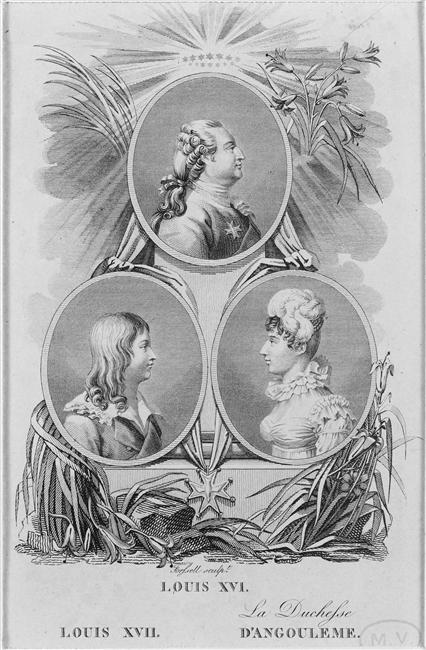
Louis XVI and His Children

The king his children are surrounded by palms for martyrdom and the lilies of France. Share

The Art of Contemplative and Mystical Prayer

From Fr. Romano Guardini:
Contemplative prayer has the tendency to become ever simpler and more silent. As we gain experience in this form of prayer we need fewer and fewer thoughts, until finally one single thought may be sufficient to find the way to truth and God. Fewer thoughts demand fewer words. St. Francis used the phrase “My God and my all” as his theme of contemplation for a whole night.

In contemplation our mode of thinking changes. From its usual restlessness it becomes a quiet beholding and a comprehending, a watching and a witnessing. Our voice changes: it becomes softer and lower. Finally, speech dies down and its place is taken by a silent regarding and longing between the soul and God. If we should reach this stage in contemplation, we should not force ourselves back into the diversity of thought. When simplicity contains the essence, there is no need for diversity; when silence is eloquent, it is greater than words.

There are people to whom a profusion of thought and words are alien. With them, the state of quietude, which others take consid­erable time to establish, is very quickly reached. They require only very few words; anything beyond it would merely confuse them. They may not even need any words or thoughts in order to establish the state of mind in which they experience the presence of God. If that is so, they need not search any farther. They should, however, not take this for granted. It may happen that on another occasion they need a proper subject for contemplation and must have recourse to a proper text. (Read more.)
Share

Tuesday, October 14, 2014

A Celtic Lady Review

The Paradise Tree is reviewed by Kathleen Kelly:
This is a story full of love, laughter and sadness. This is a  telling of a great Irish story of a virtuous man who became the patriarch of the O'Connors. I love to read any stories of Irish immigrants, I often wish I knew more about mine, and this story was no exception. This is not only the story of the O'Connor family but of every person, man, woman or child that immigrated in these tough times.

Did you know that 
  • Under the Penal Laws the Irish Catholic was forbidden the exercise of their religion.  It.....
  •   was forbidden to receive education.
  •   was forbidden to enter a profession.
  •   was forbidden to hold public office.
  •   was forbidden to engage in trade or commerce.
  •   was forbidden to live in a corporate town or within five miles thereof.
  •   was forbidden to own a horse of greater value than five pounds.
  •   was forbidden to own land.
  •   was forbidden to lease land.
  •   was forbidden to accept a mortgage on land in security for a loan.
  •   was forbidden to vote.
  •   was forbidden to keep any arms for his protection.
  •   was forbidden to hold a life annuity.
  •   was forbidden to buy land from a Protestant.
  •   was forbidden to receive a gift of land from a Protestant.
  •   was forbidden to inherit land from a Protestant.
  •   was forbidden to inherit anything from a Protestant.
  •   was forbidden to rent any land that was worth more than 30 shillings a year.
  •   was forbidden to reap from his land any profit exceeding a third of the rent.
  •   could not be guardian to a child.
  •   could not, when dying, leave his infant children under Catholic guardianship.
  •   could not attend Catholic worship.
  •   was compelled by law to attend Protestant worship.
  •   could not himself educate his child.
  •   could not send his child to a Catholic teacher.
  •   could not employ a Catholic teacher to come to his child.
  •   could not send his child abroad to receive education. ..source.. Irish Memorial Stones
(Read more.)
The Paradise Tree is available internationally from Amazon. Share

Elizabeth of Valois and the Black Legend

Elizabeth of Valois, Queen of Spain, daughter of Henri II and Catherine de Medici. Sister-in-law of Mary Stuart.
From Stephanie Mann:
Philip II of Spain married four times: his third wife, Elizabeth of Valois, one of Henri II of France's daughters, was to marry his son Don Carlos. Instead, since Philip's second wife, Mary I of England, had died, Philip married Elizabeth of Valois, who died on October 3, 1568. Elizabeth died in childbirth after delivering a baby girl, who also died. Two of her children survived, the Infanta Isabella who would rule the Spanish Netherlands and Catherine Michelle who would marry the Duke of Savoy.

Philip II then married one more time, to Anna of Austria, who was to have married Don Carlos, who had died just a few months before Elizabeth of Valois after being imprisoned by his father.

The imprisonment and death of Don Carlos is part of the Black Legend of Spain, depicted romantically in Verdi's opera, Don Carlo(s)--Italian or French--based on Schiller's play. The Spanish Inquisition influences Philip II, ordering the murder of Don Carlos' friend Rodrigo and countenancing the murder of Don Carlos himself if Philip II deems necessary...In reality, Philip II and Elizabeth of Valois were a loving husband and wife, Don Carlos was mentally unbalanced and dangerous because of the usual Spanish inbreeding and a blow to the head, and the Inquisition was never that powerful an influence on the king. (Read more.)
Share

Napoleon and the Grimaldis

From The Independent:
Historical treasures are to be sold to the highest bidder in November when Monaco’s royal family parts with much of its unique collection of Napoleon’s possessions.

One thousand lots are to go under the hammer after the Grimaldi family decided to dispense with the French imperial relics to make room for a museum celebrating its own ruling dynasty.

But because of the exceptional nature of the auction, which is to take place in Fontainebleau, south of Paris, the French state could invoke an arsenal of measures at its disposal until the very last minute. It can either pre-empt a sale after the hammer has fallen, confiscate lots or take the exceptional measure of declaring an item a national treasure in order to prevent it leaving the country.

“The French Defence Ministry has a very bellicose approach to historical items, particularly manuscripts,” said Paris auctioneer Alexandre Giquello, who is co-hosting the sale with Jean-Pierre Osenat, a specialist of the Napoleonic era. Mr Giquello said that because of the risk that the Defence Ministry would confiscate some lots without paying the vendor, he had advised the Grimaldi family to withdraw 30 manuscripts from the auction. (Read more.)
Share

Monday, October 13, 2014

French Indochina: Then and Now

 Municipal State Theater, 1955
From Christine Niles:
This period of colonial rule saw the greatest flourishing of the Catholic faith in the entire history of Indochina. Catholicism held favored status, and around the turn of the century the average number of converts per year numbered a stunning 50,000. Native clergy were more numerous than in any other missionary country in the world.

Evil never rests, however, and this time of good fortune would see a swift end in the mid-twentieth century, when Ho Chi Minh declared himself president of the Democratic National Republic in the North, taking over the South some years later. French rule would cease completely in 1954.

Under the communist regime, the Faith was placed under interdict, and the Catholic population quickly dwindled, until it is now only a fraction of the populace.

But France’s presence is everywhere felt, whether in the faith, language, architecture, dance, or food. It was Fr. Rhodes who latinized the Vietnamese tongue, transcribing the tonal language into the Western characters used by all Vietnamese today. And Saigon, the former capital of Indochina, evidences France’s influence in its European architecture, tree-lined streets, and public gardens. Ballroom dancing, a popular pastime among the Vietnamese, is a French import. And the French contributions to Vietnamese food are too numerous to recount, whether in their coffee, cheese, pastries, or main dishes.

The Eldest Daughter of the Church once had a cherished daughter in Indochina, who has now cast her off—even so, France’s spirit remains. (Read more.)
Share

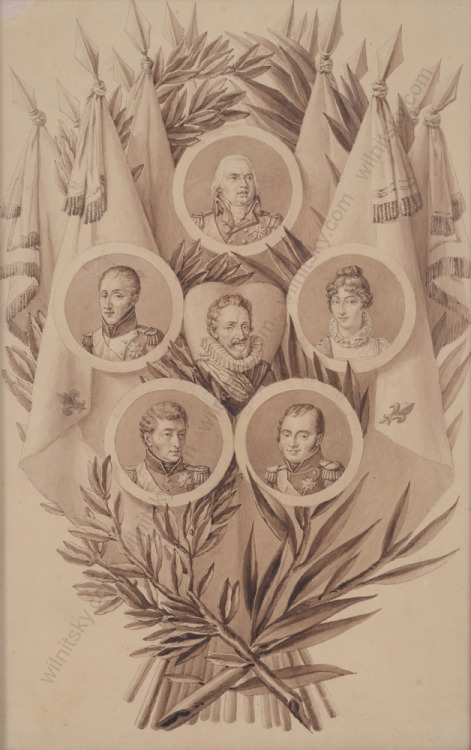
The Bourbons Triumphant

A picture of the Royal Family with Henri IV around the time of the first Restoration in 1814. Share

HeforShe

Oh, spare us. I wish movie stars would focus on their acting and stay out of politics. Or if Emma Watson was going to say something on the behalf of women, I wish she would have begged for help for the women and girls kidnapped by ISIS. To quote:
Watson's speech was out of place, as she apparently recognized: “You might be thinking, 'Who is this Harry Potter girl, and what is she doing speaking at the UN?' And, it’s a really good question. I’ve been asking myself the same thing.” A sweet, unassuming delivery from a brave, polished young actress is not enough to hide the unoriginal and problematic themes for both women and men within the address. Since it was delivered as if these themes had never been discussed before, and since it is given so much credence by U.N. Officials, Youtube watchers, and pundits, it is worthwhile to examine it against long-standing discussions on the matter.

“A real conversation must let men talk not only about feminist-approved topics," Young demands. Bringing this theme to the table as if it were revolutionary, without referencing any historic male efforts, suggests that it has not yet been done, or that it has been done ineffectively until Emma Watson and the U.N. did so. Extending “a formal invitation,” to men to join the discussion is not only trite and a bit patronizing, it is also unnecessary.

Men don’t need an invitation. Let’s extend that much to both their intelligence and their history.
One man, for example, already presented the idea to the U.N. nearly a decade ago: “My word of thanks to women thus becomes a heartfelt appeal that everyone, and in a special way States and international institutions, should make every effort to ensure that women regain full respect for their dignity and role.” That man was Pope St. John Paul II, in his June 29, 1995 “Letter to Women,” issued prior to the United Nations Fourth International Conference on Women, held in Beijing.

Institutions which have endured the test of time and the purification of fire have something to say on the matter. “In this vast domain of service, the Church's two-thousand-year history,” said the late pontiff, “for all its historical conditioning, has truly experienced the 'genius of woman.'”

Complementarity might be at the root of Watson’s speech, but we wouldn’t know it, and neither would she. Her lack of deference to older, wiser contributors to the discussion makes a truly new contribution impossible. Several good points are hinted at in the brief speech, but lines of logic are ambiguously glazed over, nullifying and ignoring the gravity of their potential fruition and ultimate importance. In fact, she ends up on a different path than the one on which she started. And then doesn’t tell us how she got there. (Read more.)
Share