Thursday, November 14, 2013

The Courtesy of God

From Vultus Christi:
At the same time this Thrice–Holy God, enthroned in glory and adored by angelic choirs, “shall not cry, nor have respect to person, neither shall his voice be heard abroad. The bruised reed He shall not break, and smoking flax He shall not quench” (Isaias 42:2–3). When you go to adoration, do not expect to be pressured by God. Be certain, rather, of encountering a God who is infinitely gentle. He is humble, courteous, willing to wait, and unwilling to impose Himself on the one who approaches Him. Who is there upon the altar if not the Lamb who, in meekness and silence, went to His most bitter Passion? (Read more.)
Share

Wednesday, November 13, 2013

Mules

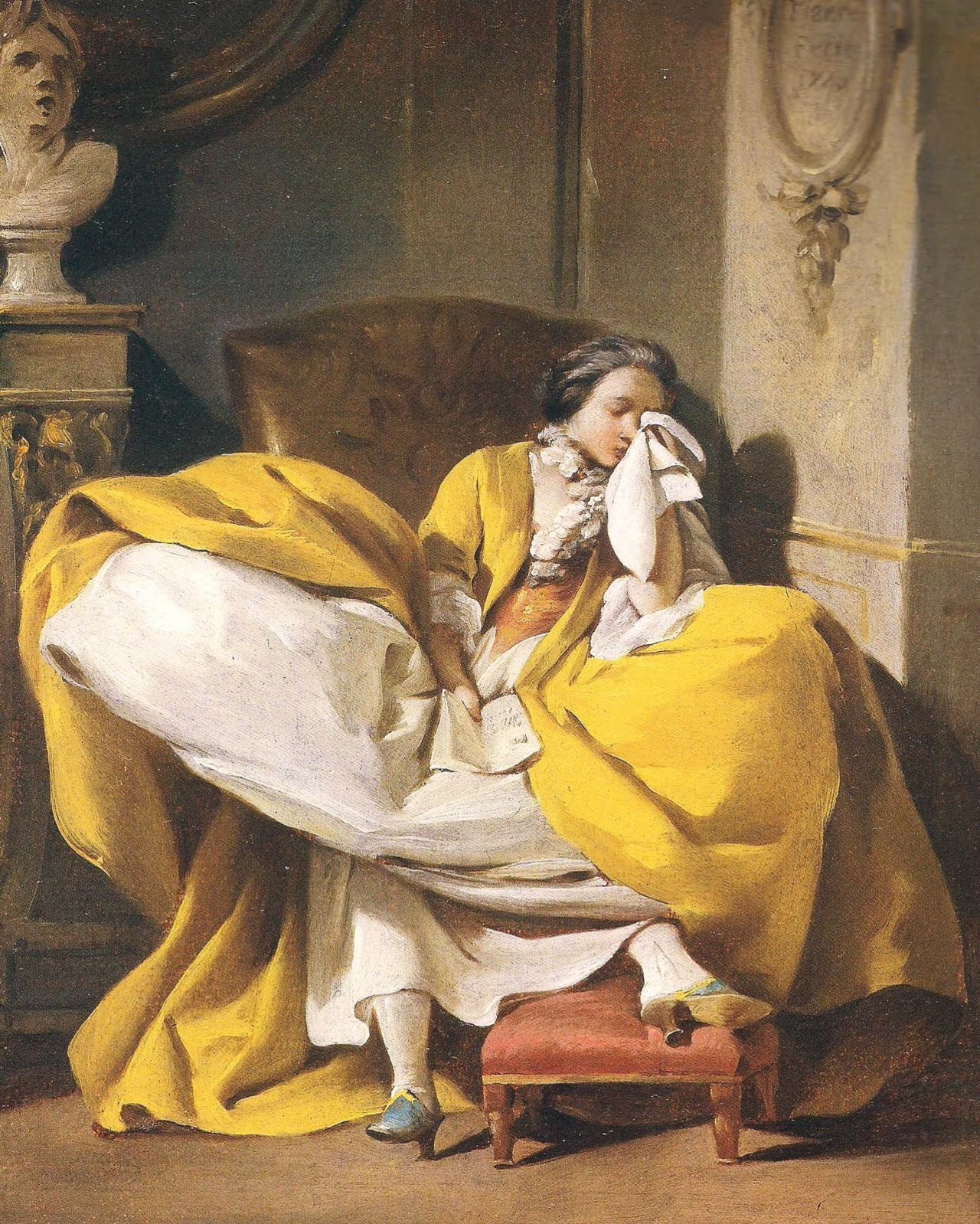
Here are some eighteenth-century paintings with women wearing mules. To quote:
Some of you may be wondering how, when, and where to wear the new "Antoinette" 18th century mules, thinking they look oh-so delicate, and not at all practical for anything.  To answer the question, let's take a look at some primary source material - depictions of 18th century women wearing this type of shoe.  When did they wear it, and how?
Share

What's in a Name?

Fr. Rutler speaks. To quote:
The term “Redskin” was a translation of the Peau-Rouge neologism of the benign and longsuffering French Jesuit missionaries. It was also self-referential, and the chief of the Sauks, Quashquame, was recorded in 1825 as referring to his “Red Skin nation.” James Fenimore Cooper popularized the term in allusion to native people he thought “comely” and never as an insult. Not infrequently did various sachems refer to Europeans as “red men” because of how they were sunburned by an unfamiliar outdoor life.

If we want to play social engineers with the names of sports teams, we shall catch a host of problems worldwide. Consider some of the names of teams:  Albania—Kuqezinjte (Reds and Blacks); Rwanda—Amavubi (Wasps); Poland—Bialo-Czerwoni (White and Reds). It may be that there is not a majority of Irishmen now among Notre Dame’s “Fighting Irish” but that is a stereotype if ever there was one. No team calls itself the “Fighting Anglo-Saxons.” Then there are the “Ragin’ Cajuns” at the University of Louisiana at Lafayette, and the prospect of the Minnesota “Vikings” ever taking on the Hawaiian “Rainbows” conjures overwhelming carnage. Worse would be the Penn “Quakers” up against Yeshiva University’s “Maccabees.” Christendom College has the “Crusaders” which would please King Louis IX, if not President Obama, who has suggested whitewashing the Washington Redskins, although he subsequently welcomed to the White House the NHL champions, the Chicago Blackhawks. It is nice to know that the cerebral New Jersey Institute of Technology manages to field a team called the “Scots Highlanders.” There loom the problematic Gordons again.

We have not yet reached the nadir of the Nika Riots in Justinian’s Constantinople in 532. The city was as sports crazy as we are, which is always a sign of decadence, and the Hippodrome was right next to the royal palace so that the emperor could watch the races at home before the days of television.  His wife Theodora was a sports fan even more fanatical than Justinian and helped stoke the violence that destroyed much of the city including that greatest of churches, Hagia Sophia. The teams were harmlessly named the Blue and the Green, but they came to represent political parties and, worse, theological parties, for the Blues were orthodox believers while the Greens were Monophysite heretics. Politics and religion played out in the circus was a volatile combination, and about thirty thousand were killed in one of the worst riots in history. (Read more.)
Share

Inns and Taverns of Early America

From It's About Time:
During the colonial period it was a commonly held belief, that drinking ground water in the British American colonies could possibly make one sick.  To combat this real or imagined danger, colonists of every rank, age, race, & gender drank alcohol often - from fermented, homemade, aged cider to distilled liquors.  Generally, families drank with every meal, while at work, and at every social & public gathering except church. Almost everyone was something of a tippler.  (In the 14th century, a tippler was a seller of liquor rather than an avid consumer.  It came to mean a habitual drinker 200 years later. Tipsy was used to describe the slightly intoxicated as early as 1577.)

And colonials gathered together to drink.  Indoor & garden taverns became the scene for political debate, business transactions, gossip, and even romance, because women were more often allowed in garden taverns than in indoor taverns.  (First appearing in print in 1286, the word tavern initially meant a wine shop.  It didn’t become a proper place to drink until around 1440.) (Read more.)
Share

Tuesday, November 12, 2013

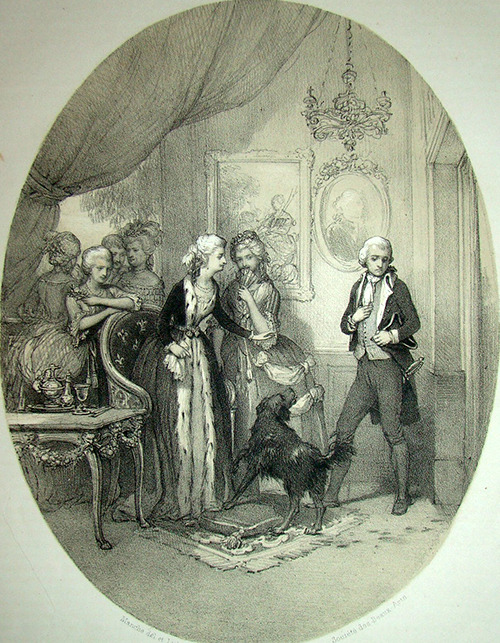
Marie-Antoinette at Trianon

Via Anna Gibson. Someone's naughty dog leaves muddy footprints on the carpet, but the Queen is not upset. Share

The War on Women

From The National Review:
In the early days of the HHS mandate forcing even religious objectors to provide free coverage for contraceptive and abortion-inducing drugs, our NRO post titled “Three Things Everyone Should Know about the HHS Mandate” pointed to evidence establishing that the mandated contraceptive drugs are carcinogenic. And now, the most prestigious federal appeals court has taken judicial notice of this fact as well.
Citing Bioethics Defense Fund’s amicus brief, the U.S. Court of Appeals for the District of Columbia is the first court to recognize that the World Health Organization classifies certain contraceptives required by the HHS mandate as carcinogenic. This completely undermines the government’s claims that the drugs “promote women’s health” and must therefore be provided by all employers, regardless of religious objection.
As stated in the decision written by Judge Janice Rogers Brown, ruling in favor of the Gilardi brothers, owners of Freshway Foods:
Equally unconvincing is the government’s assertion that the mandate averts “negative health consequences for both the woman and the developing fetus.” From the outset, we note the science is debatable and may actually undermine the government’s cause. For the potential mother, as one amicus notes, the World Health Organization classifies certain oral contraceptives as carcinogens, marked by an increased risk for breast, cervical, and liver cancers. Br. of the Breast Cancer Prevention Institute, at 8–9.
BDF’s amicus brief on behalf of the Breast Cancer Prevention Institute, the Coalition for Abortion Breast Cancer, and the Polycarp Research Institute surveys the most recent peer-reviewed medical studies showing the alarmingly increased health risks of oral contraceptives, injections, implants, and IUDs. (Read more.)
Share

Harriet Tubman: There and Back Again

Here are some facts about the extraordinary Harriet Tubman, a fellow Marylander.
Many slaves had never ventured far from their owners’ property. Slave owners deliberately kept them close so they wouldn’t know how to escape. As a result, runaways needed Tubman to do the navigating. She led groups along dirt roads and paths by night. If no safe house was available during the day, Tubman hid her passengers in dense forests, swamps, or other places no one would think to look. When it was safer to split up—a decision she sometimes made when she knew the group was being hunted—Tubman gave simple, easy-to-follow advice for reaching a meeting point, like “follow the drinking gourd” (the Big Dipper, which points north). (Read more.)
Share

Monday, November 11, 2013

Behind the Shattered Glass

The English countryside is the setting of Tasha Alexander’s latest Lady Emily mystery, set in Victorian times. Lady Emily, the eccentric heroine of the series, has settled into domestic bliss with her husband Colin, their twin baby boys and their infant ward at Colin’s ancestral estate. Emily’s only problem is her mother, whose traditional ideas are in constant war with Colin’s Socialist convictions.

Suddenly, the local philandering marquess walks into Emily and Colin’s drawing room and drops dead. Finding themselves with a corpse on their hands, they undertake to investigate the fate of the unfortunate marquess, who, naturally, turns out to have been murdered. There are several suspects, the victim having wreaked havoc with the virtue of many young women, leaving a web of seductions and lies in his wake. As Colin and Emily make inquiries near and far, there is drama close to home, as a previously unknown heir arrives to claim the deceased’s estate as his inheritance. In spite of their love of new trends and ideas, both hero and heroine embody the best of noblesse oblige, and the wit and insight they use in solving the crime make for an entertaining read.

This review originally appeared in the November 2013 edition of the Historical Novels Review.

(*NOTE: This book was sent to me by the Historical Novels Society in exchange for my honest opinion.)


Share

The Last Civil War Veterans

From Smithsonian:
By the start of the 1950s, about 65 of the blue and gray veterans were left; by 1955, just a half dozen. As their numbers dwindled they became artifacts of a shuttered era, curiosities of an ancient time, sepia-toned figures still inhabiting a modern world from their rocking chairs and oxygen tents. They had gone to war with rifles and sabers and in horse-mounted patrols. They had lived off hardtack and beans. Now they seemed lost in a new American century that had endured two devastating world wars fought with armored tank divisions, deadly mustard gas, and atomic bombs that fell from the sky.

Bruce Catton, long a chronicler of the Civil War, could recall his boyhood in the “pre-automobile age” of rural Michigan and how a group of old Union veterans in white whiskers and blue greatcoats had delighted his young eyes. He remembered one selling summer berries from a pail he hooked over the stub of his forearm, an arm he had lost in the Battle of the Wilderness. A church deacon had fought with the 2nd Ohio Cavalry in Virginia’s Shenandoah Valley, burning barns and killing livestock. Another had returned to Gettysburg for the 50th anniversary there, and when he arrived back by train and his buggy was late, the 70-year-old simply hoisted his bag and walked the five miles home. “They were grave, dignified, and thoughtful,” Catton would write of his hometown heroes. “For the most part they had never been 50 miles away from the farm or the dusty village streets; yet once, ages ago, they had been everywhere and had seen everything. . . . All that was real had taken place when they were young; everything after that had simply been a process of waiting for death.” Eventually, one by one the old men were carried up a small hilltop to the town cemetery. “As they departed,” Catton wrote, “we began to lose more than we knew we were losing.” (Read more.)
Share