Sunday, July 14, 2013

Anne-Marie d'Orléans, Queen of Sardinia

She was niece of both Charles II and Louis XIV and grandmother of Louis XV. From the Mad Monarchist:
In one of those odd twists that history often presents, this marriage was arranged in part by a countess who had been the mistress of Victor Amadeus II for about four years and who had given him two illegitimate children. Whether Anne Marie knew about this or cared she had little say in the matter with such royal marriages being a matter of state policy rather than personal preference. The Princess said her goodbyes, her father escorted her to the frontier and she finally met her husband at Chambery on May 6, 1684. The two were married in person by the Archbishop of Grenoble and later made their grand entrance into the Savoy citadel of Turin. She seemed a lovely but delicate girl, her fragility no doubt emphasized when next to a veteran soldier like Victor Amadeus II. Nonetheless, despite having a couple of years pass before she did her part for the succession and became pregnant, her first childbirth was a traumatic ordeal. She was only sixteen-years-old when she gave birth to her first child, Princess Maria Adelaide (later Dauphine of France) but it was so difficult that for a time she seemed close to death and even received the last rites before finally recovering from the ordeal. Ever dutiful though, she would go on to have five more children, a future queen and king among them. She was a good mother and also a devoted wife, patiently nursing Victor Amadeus II when he came down with smallpox, attending to every detail of his care. (Read entire post.)
Share

Was Henry VIII a Psychopath?

He certainly seems like one to me. Nancy Bilyeau weighs in, saying:
A carefully argued article published in 1972 by Miles F. Shore in The Journal of Interdisciplinary History (The MIT Press) found, after examining Henry VIII's behavior with a psychoanalyst's view, that the king exhibited "distinct behavior changes, and at least one depressive episode." The author blames a childhood swinging between "extravagant adulation and brutal discipline," as "exciting ceremonials and pageantry" came and went, replaced by "boredom and loneliness." This produced an adult who seemed confident, accomplished and flamboyant but beneath the surface was insecure, dependent and anxious.

According to the journal article:
"For Henry VIII, the first seventeen years of his reign had seen the acting-out of a series of grandiose narcissistic fantasies. His crisis came when these had to be modified in the face of real events: his injuries, his military and political disappointments, and his inability to have a legitimate male heir. Biological factors and the erosive effect of real events on his grandiose fantasies were the major precipitants of his crisis....compulsive attempts to remain young with hypochondriachal concerns, sexual promiscuity and possible real character deterioration."
Such analyses have deepened since the 1970s. In her excellent new book The Creation of Anne Boleyn, author Susan Bordo probes the mind of Henry VIII to try to figure out how, after such an all-consuming and passionate love for Anne, he could callously sign her death warrant after three years of marriage. It's a question that bedeviled people in Henry's time and every century since. "In 2012, this kind of personality would probably he diagnosed as borderline or narcissistic," Bordo writes. (Read entire post.)
Via Stephanie Mann. Share

Saturday, July 13, 2013

Sleeves are Back

Wedding gowns for Autumn 2013. Share

How Clutter Affects the Brain

From LifeHacker:
Whether it be your closet or office desk, excess things in your surroundings can have a negative impact on your ability to focus and process information. That’s exactly what neuroscientists at Princeton University found when they looked at people’s task performance in an organized versus disorganized environment. The results of the study showed that physical clutter in your surroundings competes for your attention, resulting in decreased performance and increased stress.

A team of UCLA researchers recently observed 32 Los Angeles families and found that all of the mothers’ stress hormones spiked during the time they spent dealing with their belongings. Similar to what multitasking does to your brain, physical clutter overloads your senses, making you feel stressed, and impairs your ability to think creatively. (Read entire article.)
Share

Friday, July 12, 2013

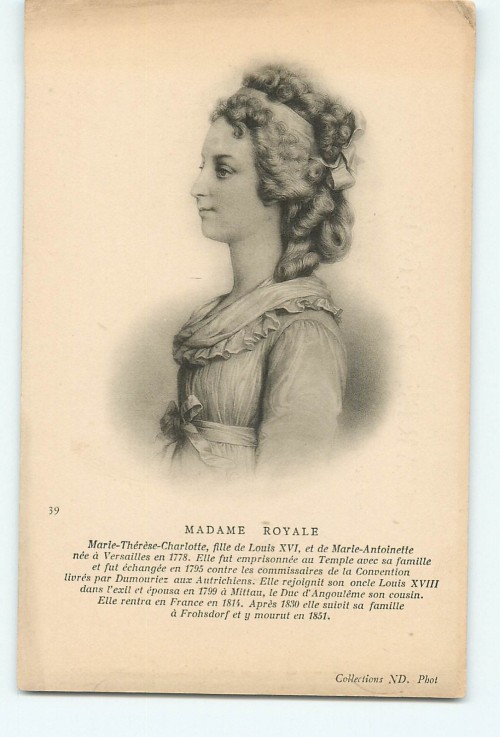
Madame Royale

A vintage postcard of the Orphan of the Temple. Share

Devotion (1946)

Stephanie Mann reviews the classic film about the Brontë sisters. To quote:
Last night, I watched Devotion, the 1946 Warner Brothers biopic of the Bronte sisters, Charlotte, Emily, and Anne--and their brother Branwell, and their father's curate, Mr. Arthur Nichols. The names and the setting of the movie are mostly accurate, but much of the biography is not, of course. I still found it an interesting movie, however, mostly because of the performances of Olivia de Havilland as Charlotte and of Ida Lupino as Emily. The actress (Nancy Coleman) who played Anne Bronte resembled the portrait painted by Branwell, but she is a secondary character.

Charlotte, as portrayed by de Havilland, is almost wilfully unaware of her errors and follies: forcing Emily to go to Brussels; falling in love with Monsieur Heger, the married headmaster of that school; her ambitious drive for literary fame is overwhelming; she consistently errs in interpreting the actions of her father's curate, Mr. Arthur Nicholls (Paul Henreid)--and generally, she does not know what is really going on! De Havilland plays this unself-aware heroine so well that the viewer wants to read her the riot act!

Emily is the real lead in the movie, at least as the trailer, linked above, indicates--she is the real genius, the true lover, the one devoted to her brother's best interests (knowing that London will be too tempting for him), in love with the curate, misunderstood by Charlotte; able to see Charlotte's folly--drawn to the moors, dreaming of death (or Heathcliff?).

In typical Hollywood fashion, the accents vary wildly. Lupino was born in England and de Havilland in Japan of British parents, but Paul Henreid's Austro-Hungarian accent is unremarked and unexplained. As the Reverend Mr. Patrick Bronte's curate, he seems very well off, with an elegant wardrobe--he is depicted as doing good works in the parish, visiting the poor and the sick, but one of his most constant efforts is getting the drunken Branwell home from the pub or the party. Those efforts earn him only animosity from Charlotte--and from Emily at first. The Reverend Mr. Patrick Bronte, played by Montagu Love, is always in his study, preparing a sermon. We never see the inside of Reverend Bronte's church. (Read entire post.)
Share
Thursday, July 11, 2013

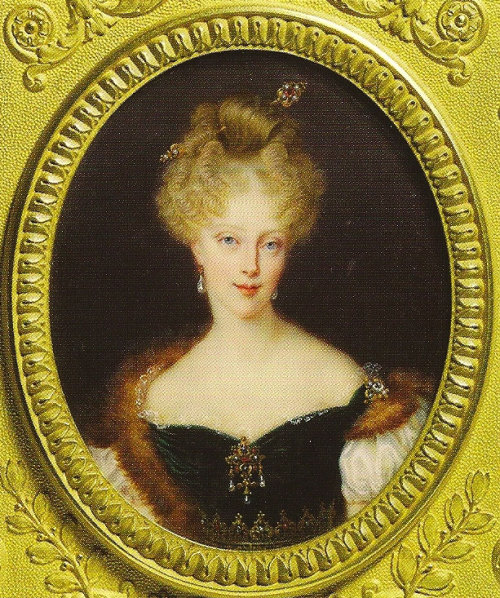
Caroline of Naples in Furs

The Duchesse de Berry was the great niece of Marie-Antoinette and the sister-in-law and cousin of Madame Royale. Share

Snowden and the British Press

From The Atlantic:
Of the three English-language newspaper websites with the highest readerships, two are British.
The number one spot has been occupied since last January by the Mail Online, an industrial-sized feedbag of celebrity titillation and gossip, with a ComScore rating of 50.2 million monthly unique visitors worldwide for May. Currently in at number two is The New York Times, with 46.2 million. Then comes The Guardian, which had 40.9 million last month.

That was before Edward Snowden arrived on the scene. According to internal analytics The Guardian provided to me -- June 10, the day after Snowden revealed his identity on The Guardian's website, was the biggest traffic day in their history, with an astonishing 6.97 million unique browsers. Within a week of publishing the NSA files, The Guardian website has seen a 41-percent increase in U.S. desktop unique visitors (IP addresses loading the desktop site) and a 66-percent rise in mobile traffic. On June 10, for the first time in the paper's history, their U.S. traffic was higher than their UK traffic.

The publication of the NSA documents represented the first time since the publication of the Pentagon Papers in 1971 that "top secret" classified documents were made public - nothing in the files leaked by Bradley Manning to WikiLeaks in 2010 rated higher than "secret." They were leaked by former CIA employee Edward Snowden to The Guardian's Glenn Greenwald, and a veteran team of reporters led by Editor-in-Chief of Guardian US Janine Gibson was convened to shape the raw data into the story. I met Gibson for an interview in The Guardian's airy SoHo loft office on Wednesday. It is furnished identically to the paper's London headquarters in Kings Cross, where I worked during 2009-11; white walls, shiny new iMacs and orthopaedic chairs. The staff is comparatively small -- Guardian US employs just 57 people, 29 of them journalists.

Gibson offers me a cup of Yorkshire Gold tea brought over from England. "Glenn got [the story] first, and called me up," she tells me. "But a lot of this is difficult to talk about over open communications. You're like, 'hang on a minute. ... I'm not sure that Skype is a very very good idea.' So we talked in broad terms, and then very quickly got to the next stage where a certain amount of bona fides were being established, and then to: 'Right. I think you just -- get on a plane. Get on a plane.' So he came up here and we talked, and he showed me a very small amount of establishing material, and [we] got very very excited very fast."

Gibson sent Greenwald, along with Ewan McAskill, The Guardian's former diplomatic editor and D.C. bureau chief and a reporter of some 30 years standing, on a plane to Hong Kong to meet Snowden the following morning, at the same time bringing some investigative reporters out to New York from the London office to help process the story. By June 5 they were ready to publish the first story: the FISA order requisitioning Verizon phone data. From Wednesday to Saturday The Guardian published a new scoop each day, and on Sunday June 10 Snowden revealed himself as the whistleblower, explaining his rationale for the leak in a video interview with Greenwald hosted on the Guardian US site.

Greenwald had been working for The Guardian for less than a year, coming from Salon.com in August 2012, but he was already a well-known figure; a trained lawyer, a strident campaigner against the Patriot Act, and an award-winning journalist and author with three books in The New York Times bestseller list. The pedigree, however, does not appear to have impressed The New York Times, which in its coverage of the leak uncharitably referred to The Guardian as a "British news-site" and Greenwald as a "blogger." (Read entire article.)
Share

Wednesday, July 10, 2013

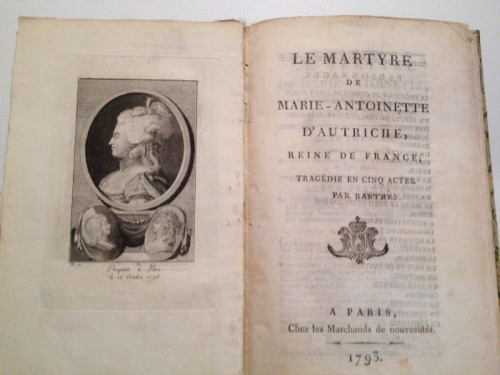
Le Martyre de Marie-Antoinette d'Autriche

Some rare finds from Tiny-Librarian. Here is a book which appears to be a drama about Marie-Antoinette and there is one about Louis XVI as well. It is interesting that the Queen's tragedy is specifically referred to as "martyrdom." The books were published in 1793, the year the royal couple were executed. Share