Friday, March 9, 2012

Fayetteville

The Lafayette Society in Fayetteville, NC recently entertained a delegation from France.
A French delegation from Fayetteville's sister city wraps up a weeklong visit with a tour of Fort Bragg today. The three-member delegation from St. Avold, France, watched Saturday's Duke-Carolina game on television, went to a hockey game at the Crown Coliseum and attended a banquet Sunday hosted by the Lafayette Society at the Holiday Inn Bordeaux & Conference Center.

The French entourage participated a public panel discussion Tuesday night at the downtown Headquarters Library on King Louis XVI's role in the American Revolution. Pascal Flaus, a St. Avold historian and archivist touring with the French delegation, talked about how the French king was an unappreciated monarch.

Fayetteville and St. Avold have been sister cities since 1993. The city's relationship with France goes back to 1825 when the Marquis de Lafayette visited his namesake American city. A bronze bust of the French war hero is in City Hall's lobby.(Read entire article.)
Share

Thursday, March 8, 2012

Amalasuntha

Queen of the Ostrogoths. Never heard of her until now....
Amalasuntha, born around 495, was the only daughter of Theodoric the Great, king of the Ostrogoths, and his wife Audofleda. Amalasuntha was both beautiful and smart. She grew up in Ravenna, which was a political and cultural centre at the time, and received an extraordinary education. She spoke both Latin and Italian fluently, in addition to her native language of course, and was very erudite and knowledgeable.

In 1515, she married Eutharic, a Visigoth prince from Iberia (modern day Spain). Their marriage was supposed to unite their kingdoms after Theodoric's death, but he died before that could happen, leaving Amalasuntha with two children, a boy named Athalaric and a daughter called Matasuentha. In 1526, Theodoric died too and the crown passed to Athalaric, while Amalasuntha became regent. Amalasuntha decided her son should have the best Roman education available, but this didn't go down well with the Goths. They wanted their king to be a warrior, not a scholar and interpreted Amalasuntha's plan as an attack on their values and culture. Soon, three noblemen plotted to do away with her, but their plans were discovered. They were executed. (Read entire post.)
Share

The Dark Side of Facebook

The very dark side. Not that any of this surprises me. I have never experienced so many misunderstandings that lead to the sundering of relationships as I have since being on Facebook. There is something about the immediacy of Facebook that triggers emotions. I find it very disturbing. On the brighter side, I have made so many wonderful friends through Facebook and it is a great way to keep in touch with long lost friends and relatives. To quote The Telegraph:
Some four billion pieces of content are shared every day by 845 million users. And while most are harmless, it has recently come to light that the site is brimming with paedophilia, pornography, racism and violence – all moderated by outsourced, poorly vetted workers in third world countries paid just $1 an hour.
In addition to the questionable morality of a company that is about to create 1,000 millionaires when it floats paying such paltry sums, there are significant privacy concerns for the rest of us. Although this invisible army of moderators receive basic training, they work from home, do not appear to undergo criminal checks, and have worrying access to users’ personal details. In a week in which there has been an outcry over Google’s privacy policies, can we expect a wider backlash over the extent to which we trust companies with our intimate information? (Read entire post.)
Share

Wednesday, March 7, 2012

The Lady's Maid

What a life.
A lady’s maid’s day, unlike that of her peers, starts as soon as her mistress wakes.  The hour is variable, depending on the individual mistress and whether the household resides in the city or the country, but generally, a lady’s maid begins her official work later than the rest of the servants.
Attending to her mistress’s person comprises the first task of the morning.  After ablutions are taken care of and her mistress’s hair and body are dressed, a lady’s maid is responsible for tidying her mistress’s rooms.  This may not be the case with experienced ladies’ maids, but in households where there are few servants or a lady’s maid is relatively new, learning the finer details of upkeep are an important part of her position.  Even after a lady’s maid has graduated from general housemaid duty, washing hair combs, removing stains from soiled garments, and starching muslins number among the many exigencies of personal attendance that must be addressed on a regular basis. (Read entire post.)
Share

Nuns on the Run

English nuns in exile.
In 1598, the first English convent was established in Brussels and was to be followed by a further 21 establishments across Flanders and France with more than 4,000 women entering them over 200 years. Most were enclosed convents, in theory cut off from the outside world. However, in practice the nuns were not isolated and their contacts and networks spread widely. Here, these substantial communities of women found outlets for female expression often unavailable to their secular counterparts, until the French Revolution and its associated violence forced the convents back to England. (Read entire post.)
Share

Tuesday, March 6, 2012

Lady Artists

Of the Old Regime.
During much of the 18th century in France, female painters defied the usual constraints on their gender and thrived among the kings, queens and nobles soon to lose their heads. This is the surprising subject of an exhibition at Washington's National Museum of Women in the Arts. "Royalists to Romantics: Women Artists from the Louvre, Versailles and other French National Collections" focuses on 35 female artists with some 77 paintings, prints and sculptures dating from 1750 to 1850, many of which have never been on display in the U.S. The exhibition ends July 29.

"We tend to think of revolutions as being universally good and opening all boundaries all the time," says Laura Auricchio, chairwoman of humanities and associate professor of art history at the New School in New York. But in this case, it was the monarchy that gave women more of a chance to have professional careers, NMWA chief curator Jordana Pomeroy adds. (Read entire article.)
Share

A Lost Letter of Marie-Antoinette

From the Vatican Secret Archive.
EMC Corporation (NYSE: EMC) today announced that it is the main sponsor of the 'Lux in Arcana' exhibition, taking place at the Musei Capitolini from 1st March to September 2012. The exhibition will reveal for the first time codes, files, scrolls, records and manuscripts of great historical value, preserved for 400 years in the Vatican Secret Archive.

As main sponsor, EMC revealed that one of the documents included in the exhibition is a letter by Marie Antoinette, written in 1793 while she was in prison to someone thought to be Louis XVI's brother Charles Philippe, Count of Artois, who in 1824 became Charles X, King of France. The letter, which is only ten lines in length, is handwritten on a sheet of ordinary paper folded in two. It reads, "The sentiments of those who share my pain, my dear brother-in-law, are the only consolation I can receive in this sad circumstance." The letter is then signed, "Your loving Sister-in-Law and Cousin Marie Antoinette." The clear and regular handwriting confirms that it was penned by Maria Antonia of Habsburg-Lorraine, daughter of Maria Theresa of Austria, who in 1770 had married the future King Louis XVI of France, and from then on was always called Marie Antoinette.

Other documents which visitors to the exhibition will be able to view date from the eighth century through to the twentieth century. These include:
  • A letter from the British Parliament to Pope Clement VII about King Henry VIII's impending divorce
  • A silk cloth from the Empress Helena of China on her conversion to Catholicism dated 4 November 1650
  • A letter from Michelangelo to Monsignor Christopher Spirits, Bishop of Cesena and the future patriarch of Jerusalem
  • The acts from the trial of Galileo Galilei
  • A letter written on birch bark by American Indians to Pope Leo XIII

Read more here: http://www.sacbee.com/2012/02/29/4300161/emc-sponsors-lux-in-arcana-the.html#storylink=cpy
(Read entire post.)

More at Vive la Reine.


Share

Monday, March 5, 2012

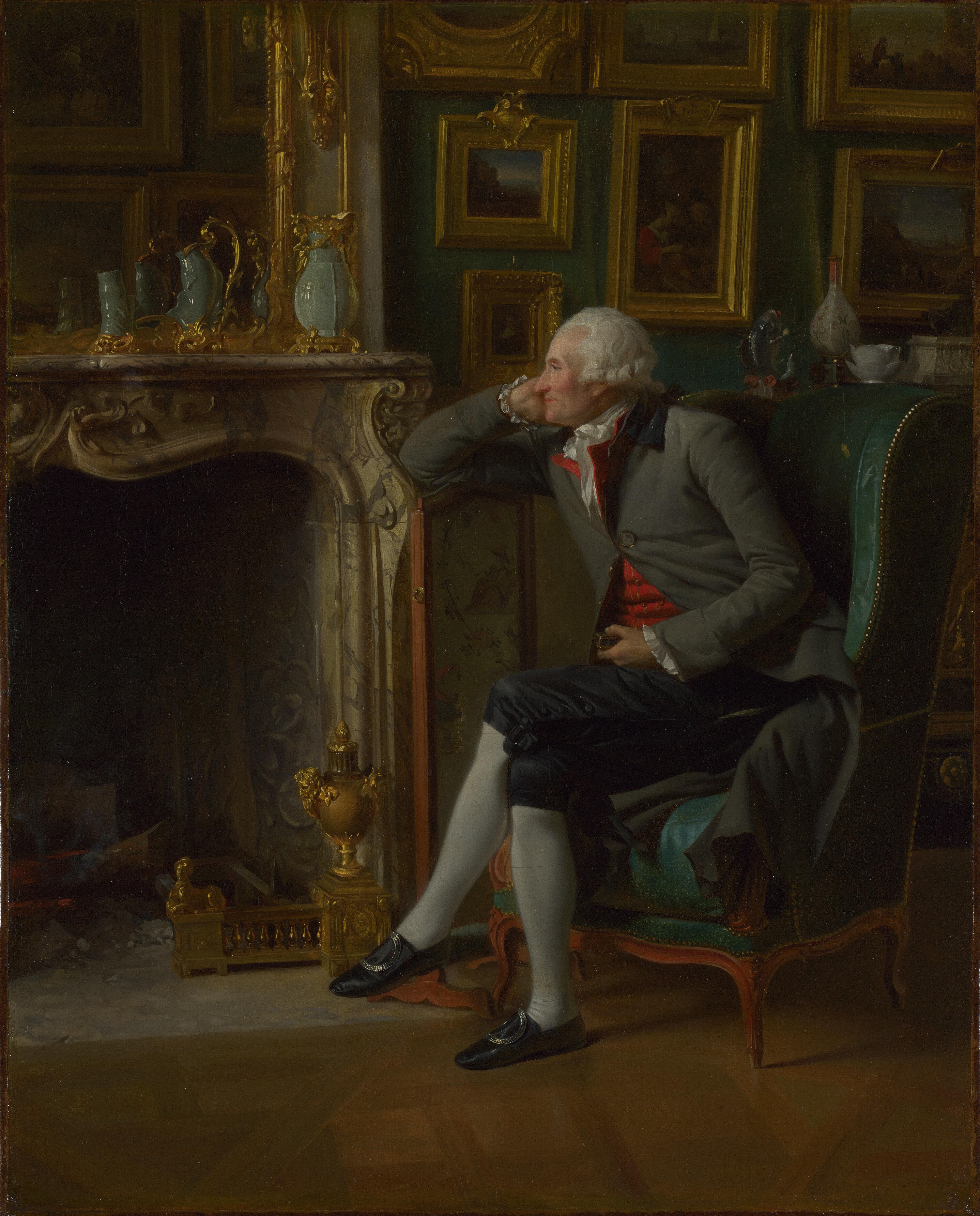
Le Baron de Besenval

Pierre Victor, baron de Besenval de Brünstatt (1722–1791), the last commander of the Swiss Guards in France, belonged to the Polignac circle and was thus one of Marie-Antoinette's friends. According to Madame Campan:
The Baron de Besenval added to the bluntness of the Swiss all the adroitness of a French courtier. His fifty years and gray hairs made him enjoy among women the confidence inspired by mature age, although he had not given up the thought of love affairs. He talked of his native mountains with enthusiasm. He would at any time sing the “Ranz des Vaches” with tears in his eyes, and was the best story-teller in the Comtesse Jules’s circle.
To quote from Andrew Haggard's biography of Louis XVI and Marie-Antoinette:
The Duchesse de Polignac and her usual circle would also be often at the Petit Trianon. These comprised the intriguing Comtesse Diane, Mesdames d'Andlau and de Chalon; Messieurs de Guignes, de Coigny, de Vaudreuil, de Guiche, de Polignac, and the Swiss Baron de Besenval, Lieutenant-Colonel Commandant of all the Swiss. Also the Prince de Ligne and the Duke of Dorset formed part of this society, of which the Baron de Besenval is remarkable for two reasons. These are, first, that, although a man of fifty, he was most attractive, a regular coxcomb who sang Swiss songs, yodelled, and made a violent declaration of love to the Queen when alone with her, for which she forgave him; and secondly, for the Memoirs he left behind him. These Memoirs have been largely used by Carlyle in the compilation of his " French Revolution." They were so well written that the enemies of the Baron de Besenval declared that they were written for him, which is quite possible.  (Louis XVI and Marie-Antoinette by Andrew Haggard, p.148.)
It was the yodeling Swiss who described the Queen as having "a wonderful elegance in everything." Unfortunately, his infatuation with her caused her much harm, due to his careless vanity and romantic fantasies. Madame Campan describes a time when Marie-Antoinette was trying to stop a duel between the Comte d'Artois and a courtier, she had Monsieur Campan escort the Baron into a small room attached to her private chambers so she could relay him a message from the King to pass on to Artois. The Baron later exaggerated his descriptions of the encounter, making it sound as if the Queen had invited him into some private love nest. As Madame Campan later wrote:
I read with infinite pain the manner in which that simple fact is perverted in M. de Besenval's memoirs. He is right in saying that M. Campan led him through the upper corridors of the chateau, and introduced him into an apartment unknown to him; but the air of romance given to the interview is equally culpable and ridiculous. M. de Besenval says that he found himself, without knowing how he came there, in a plain apartment, but very conveniently furnished, of the existence of which he was till then utterly ignorant. He was astonished, he adds, not that the Queen should have so many facilities, but that she should have ventured to procure them. Ten printed sheets of the woman Lamott's impure libels contain nothing so injurious to the character of Marie Antoinette as these lines, written by a man whom she honoured by kindness thus undeserved. He could not possibly have had any opportunity of knowing the existence of these apartments, which consisted of a very small ante-chamber, a bedchamber and a closet. Ever since the Queen had occupied her own apartment this had been appropriated to Her Majesty's lady of honour in cases of confinement or sickness, and was actually in such use when the Queen was confined. It was so important that it should not be known the Queen had spoken to the Baron before the duel that she had determined to go through her inner room into this little apartment to which M. Campan was to conduct him. When men write upon times still in remembrance they should be scrupulously exact, and not indulge in any exaggerations or constructions of their own. (Memoirs of Marie-Antoinette by Madame Campan, p.104.)
Perhaps the best summation of the Queen's acquaintance with Besenval is in the Tytler biography of Marie-Antoinette:
The Baron de Besenval was a man of fifty, whose whitened hair did not interfere with his pretensions to youthful gallantry. His family, though in the last generation Swiss, came from Savoy originally, and his mother was a Pole, a kinswoman of Maria Leczinska's. Besenval was lieutenant-colonel of the Swiss Guards, and so brought into close contact with the Court. He was a rich bachelor, throwing away money upon beautiful things—pictures, statues, bronzes, Bacchantes in white marble. He was a man of the camp as well as of the court, believing in his star, irascible, violent, but knowing when to command himself. He assumed bonhomie and the bluntness of a Helvetic Cincinnati, while he preserved the perfect elegance of a man of the world, and the irreproachable politeness of a grand seigneur. Besenval had a fine marked profile, a well-shaped nose, a small mouth. He was full of insolent grace, stood disdainfully, his hands in his pockets, content with himself, ready to laugh at others.
The Baron de Besenval wrote his memoirs, self-sufficient and unscrupulous as the man himself. His tone in reference to Marie Antoinette is aigredonce. He lets fall a cowardly, base insinuation on the slightest grounds. It was known that his Court favour had suddenly diminished, and only sustained a modified revival. Madame Campan gives an explanation. On a solitary occasion, when the two, Marie Antoinette and the officer, were alone together, the Baron de Besenval was guilty of the insolence of making love to the Queen, who grew furious, and ordered him out of her presence. But certain that he would not dare to repeat the offence, and unwilling to cause an esclandre, she refrained from telling the King, as she had threatened to do, and permitted Besenval, in appearance, to regain something of the old friendly footing, since his position in the Swiss Guards brought him constantly to Court.

Besenval did not survive to perish with his regiment. He died in Paris in 1791. (Marie-Antoinette: the woman and the queen by Sarah Tytler, pp.93-94)
The young Baron de Besenval by Nattier

Share

Six Wives

A synopsis.
Anyway, being married six times is and was extraordinary and in the years since, people have argued quite a lot about why one of the most powerful men in British history had such a messy private life. Debates in books and on the Internet between "fans" of the various wives often get quite vicious and part of the reason is that Henry VIII's romantic adventures helped radically change the face of history. As Dr. David Starkey wrote in his 2003 book on Henry's marriages, "The Six Wives of Henry VIII is one of the world's great stories ... It is more far-fetched than any soap opera; as sexy and violent as any tabloid; and darker and more disturbing than the legend of Bluebeard. It is both a great love story and a supreme political thriller .... What is strangest of all, it is true. And being true, it is supremely important."

There are few stories in History I love more than those of Henry VIII and his six very unlucky wives. As Starkey says, you can't make this stuff up!
(Read entire post.)
Share