Saturday, January 7, 2012

More Photos from the New Flick

Les Adieux de la Reine is premiering in Europe on February 9 at the Berlin Film Festival. I do think Diane Kruger is well-cast as Marie-Antoinette, although I wonder about the production in general. The book itself is a bit slow and not the book about Marie-Antoinette that I would have chosen to make a film out of (naturally.)
 The picture is one we've been keeping an eye on for a while now. An adaptation of Chantal Thomas’ novel, the film sees Diane Kruger taking on the role Marie Antoinette with the beauitful Lea Seydoux (recently spied in "Mission: Impossible - Ghost Protocol") as Sidonie Laborde, a reader to her royal majesty, in the story that is set during the final days of the French Revolution. The cast is rounded out by Virginie Ledoyen who stars as Marie's BFF, the Duchesse de Polignac. Last summer, some behind the scenes video gave us a first glimpse of the cast, but Belgian distributor Lumiere have the first official stills. And as you might expect, this looks promisingly sumptuous. (Read more.)
Share

The Parisienne Farmgirl Magazine

Angela of the lovely Parisienne Farmgirl blog is starting an online magazine. I am looking forward to being one of the contributors. It is a magazine for ladies who love both French style and country living. The first issue arrives April 1. More information, HERE. Share

Friday, January 6, 2012

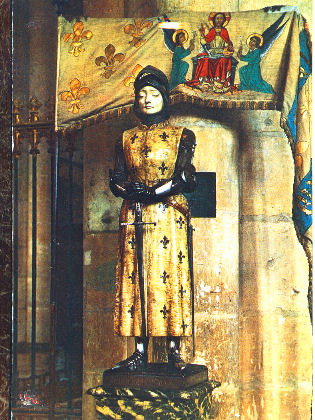
Birthday of the Maid of Lorraine

It is 600 years since the birth of St. Joan.
Jacques d’Arc, Joan’s father, was a small peasant farmer, poor but not needy. Joan seems to have been the youngest of a family of five. She never learned to read or write but was skilled in sewing and spinning, and the popular idea that she spent the days of her childhood in the pastures, alone with the sheep and cattle, is quite unfounded. All the witnesses in the process of rehabilitation spoke of her as a singularly pious child, grave beyond her years, who often knelt in the church absorbed in prayer, and loved the poor tenderly. Great attempts were made at Joan’s trial to connect her with some superstitious practices supposed to have been performed round a certain tree, popularly known as the “Fairy Tree” (l’Arbre des Dames), but the sincerity of her answers baffled her judges. She had sung and danced there with the other children, and had woven wreaths for Our Lady’s statue, but since she was twelve years old she had held aloof from such diversions. (Read entire post.)
Share

Noveritis

The Epiphany Proclamation of movable feasts for 2012:
Know, dearly beloved Brethren, that by the mercy of God, as we have been rejoicing in the Nativity of our Lord Jesus Christ, so also do we announce unto you the joy of the Resurrection of the same our Saviour. Septuagesima Sunday will be on the 5th day of February. Ash Wednesday and the beginning of the fast of most holy Lent will be on the 22th of the same month. On the 8th of April we shall celebrate with joy the holy Pasch of our Lord Jesus Christ. The Ascension of our Lord Jesus Christ will be on the 17th of May. The Feast of Pentecost on the 27th of the same month. The Feast of Corpus Christi on the 7th of June. On the 2th of December will occur the first Sunday of the Advent of our Lord Jesus Christ, to whom are honour and glory for ever and ever. Amen.
(Read entire post.) Share

Thursday, January 5, 2012

Baroque Opera for Today

The Wall Street Journal reports.
The theory behind "The Enchanted Island," which had its world premiere at the Metropolitan Opera on New Year's Eve, is that modern audiences don't have the patience for actual Baroque opera, but that the great tunes—and the terrific singers who specialize in the repertory—of the era should be heard at the Met. So Jeremy Sams, a director and writer, was commissioned to put together a faster-paced "new" Baroque opera, a pastiche of music by Handel, Vivaldi, Rameau and others, with an original story and an English-language libretto. It was a clever idea. But the lavishly cast and produced result was a hot mess, a sprawling stew of Baroque elements minus the wit, depth and dramatic structure that make the originals, however long, work. (Read entire post.)
Share

Reunion

Here is an utterly heartrending story a friend sent to me about how a mother lost a baby conceived in rape and found her again 77 years later.
For most of her 100 years, Minka Disbrow tried to find out what became of the precious baby girl she gave up for adoption after being raped as a teen. She hoped, but never imagined, she'd see her Betty Jane again. The cruel act of violence bore in Disbrow an enduring love for the child. She kept a black and white photograph of the baby bundled in blankets and tucked inside a basket. It was the last she saw of the girl — until the phone rang in her California apartment in 2006 with the voice of an Alabama man and a story she could have only dreamed. (Read entire post.)
Share

Wednesday, January 4, 2012

Madame du Cayla

Zoé Victoire Talon, Comtesse du Cayla (1785-1852), was the favorite of Louis XVIII in his declining years, as is mentioned in the novel Madame Royale. Madame du Cayla had been educated by Madame Campan with the Bonaparte princesses. She became a lively young matron who suffered in an unhappy marriage. In 1815, she sought the King's protection and his help in keeping the custody of her children. Their friendship grew over the years and by 1820, after the assassination of the Duc de Berry, Louis XVIII kept Madame du Cayla as close to him as possible. By all accounts the relationship was platonic, Louis-Stanislaus being more susceptible to the delights of the mind than those of the flesh. As Lamartine is quoted as saying by Imbert de Saint Amand:
The king's sentiment for this attractive woman had from the first the character of a love which hides from itself, under the name of friendship, what the age of the King and the reserve of the woman did not permit to be to be avowed; he felt an affection for her which he styled paternal, and he called her his daughter, not daring through respect for himself and respect for her, to call her by any other name. (The Duchess de Berry and the Court of Louis XVIII)
Louis XVIII reserved his Wednesdays for keeping company with Madame du Cayla, in which they enjoyed games of backgammon peppered with a great deal of witty repartee. He bestowed upon her the Château de Saint-Ouen as her own, as well as jewels and porcelain. When not in her company he wrote her several letters a day. She was, it seems, the last and greatest love of a man otherwise known for his conniving. According to Hugh Noel Williams in A Princess of Adventure:
Gradually, Madame du Cayla succeeded in establishing almost as complete an ascendency over the mind of Louis XVIII. as she had over his heart, and used it without scruple in the interests of the ultra-Royalist party. 'From the day,' writes Pasquier, 'when M. Decazes had been taken from him by proceedings which had wounded his heart, his self-esteem, and his regard for the royal dignity, the King had only occupied himself with business so that it should not be said that he had given it up.' 2 Weighed down beneath the burden of his infirmities, he had begun to fall into a state of apathy which put him at the mercy of those who resolutely applied themselves to the task of governing him. Occasionally, a flicker of the old spirit would reveal itself, but it was speedily quenched; all he desired now was peace and quiet, and Madame du Cayla would give him none until he had surrendered to her will. To her influence may be traced the fall of the high-minded and patriotic Duc de Richelieu, who had refused to lend himself to the plans of Monsieur [Artois] and his friends ;8 the nomination of Villele as Prime Minister; the ignominious dismissal of Chateaubriand from the Ministry of Foreign Affairs, and the acceptance by the King of the Septennial Bill of 1824 and other reactionary measures.
The attitude of the different members of the Royal Family towards the favourite is interesting. Monsieur, although he does not appear to have been a party to the plot woven around his helpless brother, at any rate in its early stages, did not scruple to take advantage of it, and repeatedly urged Madame du Cayla to 'ignore the things which spite and folly might say against her, and to enjoy in peace the noble use which she was making of the confidence and affection of the King.'4 The Duchesse d'Angouleme, on the other hand, could not bring herself to countenance a lady to whom gossip had attributed in her youth at least one unorthodox connection, and not only treated her with coldness, but expressed her displeasure at the intimacy which existed between her dame d'atours, Madame de Choisy, and the favourite. At the same time, we may venture to doubt if, at heart, Madame altogether regretted an intrigue which, however unworthy it may have been, had put an end to the dissensions in the Royal Family and was doing so much to promote the interests of the party whom she honoured by her protection.
As for the Duchesse de Berry, less fastidious in her choice of friends than her sister-in-law, she appears to have been on very good terms with the favourite, though she did not at all approve of the King's habit of referring to Madame du Cayla, even in the presence of his family, as 'his third daughter,' which seemed to place that lady on a footing of equality with the Duchesse d'Angouleme and herself; and, on one occasion, she expressed her sentiments upon the matter rather pointedly. However, the relations between the two ladies were, on the whole, excellent; indeed, Madame du Cayla appears to have entertained a real affection for the princess, since she remained faithful to her cause after the Revolution of 1830, corresponded with her frequently, and even intrigued on her behalf.
In spite of everything, it was Madame du Cayla who persuaded Louis XVIII to receive the Last Rites when he was mortally ill. As is related in The Living Age:
Nothing so perplexed and annoyed the Duchess d'AngouIeme and the Count d'Artois, in the last mouths of Louis the Eighteenth's life, as his obstinacy in refusing to receive the archbishop and to submit to the ceremonies which the Catholic Church imposes upon dying moments. He refused, as a condemned man would the visit of the executioner. At length Madame Du Cayla induced him to consent, and in so doing closed the door of the king's apartment against her for the rest of her days. Louis, grateful, made a will in her favor and left it on his desk. But Charles the Tenth entered his brother's cabinet, carried off all the papers, burnt the will, and made a beggarly compensation to Madame Du Cayla of a thousand a year for her life.
Madame de Cayla ended her days at her little palace of Saint Ouen in 1852. While some saw her as a schemer, others saw her as the last vehicle of grace for the ruthless Louis XVIII. Share

Reflections from a Night Club

The Crescat ponders drunkenness and debauchery on New Year's Eve.

Share

Tuesday, January 3, 2012

Madame de Balbi

Revolutionary caricature of Mme. de Balbi (1791)
Mme. de Balbi
While Louis XVI broke with tradition and refused to take a mistress, it was not so with his brothers. When the Comtesse de Provence became inordinately attached to one of her ladies-in-waiting, Madame de Gourbillon, the Comte de Provence, the future Louis XVIII, sought the company of a certain Madame de Balbi. Anne Jacobé Nompar de Caumont La Force, Comtesse de Balbi, born in 1758, was not a beauty but her biting wit kept Provence entertained. She soon gained ascendancy over his circle, known for its political intrigue. According to The Nation:
The Countess de Balbi, who first became the favorite of the Count de Provence, was the daughter of Bertrand de Caumont La Force and of Madeleine de Galard de Brassac de Beam. M. de Caumont was one of the Count's gentlemen, and his daughter was appointed 'dame pour accompagner' and afterwards 'dame d'atours' of the Countess, who was called Madame. M. de Balbi, her husband, was of a Genoese family and served as Colonel in the regiment of Bourbon. Madame de Balbi was tolerably pretty, was a great coquette, and was feared for her wit, which spared nothing and nobody. She pleased the Count de Provence by her conversation more than by her charms. The Count de Balbi was a jealous husband (a rare being at that time), but he was exiled to Senlis; he afterwards emigrated and returned to France at the beginning of the Consulate. Madame de Balbi became the great power in the house of the Count de Provence. 'She was a sort of Dubarry, but well born.'
 Some historians have claimed the relationship between Provence and Madame de Balbi was strictly platonic; others claim the contrary. Whatever it was that went on between them, other than conniving at late night suppers and having lively games of backgammon, Provence installed Madame de Balbi in apartments at both the Petit Luxembourg and at Versailles. He also named some gardens after her. She no longer lived with her husband but remained a fixture in the household of Provence until the emigration. She was ridiculed by the Revolutionary pamphleteers (see above) for her influence over a prince who was politically liberal but who clung to his royal dignity in hopes for someday gaining the throne. It was Madame de Balbi who, quite ironically, counseled Provence on certain matters of conscience in regards to receiving Holy Communion from constitutional priests. In Essays on the Early Part of the French Revolution, John Wilson Croker remarks:
In stating the motives that induced him to quit France he mentions his reluctance to accept the services of the revolutionized clergy:—
 'I was convinced,' he says, 'that I had no choice between apostasy and martyrdom; the former revolted me, and I will own I felt no great vocation for the latter. I talked a great deal with Madame de Balbi on this subject, and we agreed that there was a third course open to me, which was to abandon a country where the usual exercise of our religious duties was about to be proscribed.'
 Now Madame de Balbi (nee Caumont de la Force) was a lady separated from her husband, and supposed to be higher in Monsieur's favour than she ought to be; and we wish we could only smile at the simplicity with which the Prince makes a public confession that, though he would not accept the ministration of a Constitutional priest, he consulted Madame de Balbi on the spiritual concerns of his conscience!
 I suppose we should be edified that Provence thought of such deep things as the possibility of martyrdom, in light of some of his other behaviors. His own account of events dwells a great deal on what he had to eat and drink in the inns at which he stayed during his escape. He was a Bourbon, after all; the Bourbons appreciated good food, Provence perhaps more than the others. As for Madame de Balbi, they parted during Louis XVIII's years of exile, when he had to endure poverty and humiliation, which he expected his wife and family (including the daughter of Louis XVI and Marie-Antoinette) to share with him but not his mistress. Besides, Madame de Balbi gave birth to twins who were not fathered by Louis XVIII. She returned to France during Napoleon's reign and lived in the provinces. She died in 1842, long after the Bourbons had been restored and exiled again.


Share