Sunday, September 11, 2011

Roger Scruton — A Deep Philosopher for the General Reader

Our friend Eric Hester, a retired Head Master in England, especially recommends Roger Scruton's books on beauty and wine in the following guest post:
Writing from England, I must say how much I delight in the Tea at Trianon blog.  I never miss a day and always find it vivifying and edifying. Therefore, I am very pleased to be able to share with readers of the blog my good news about the English philosopher, Roger Scruton. He graduated from Cambridge University, Peterhouse (that home of the most egregious dons) in 1965, then pursued an academic career in philosophy, first at Peterhouse, and then at London University until 1990. He currently holds two academic positions: visiting professor at Oxford University, where he is also a Fellow at Blackfriars Hall a Dominican Hall; and visiting scholar at the American Enterprise Institute in Washington DC, where he is pursuing a project on the cultural impact of neuroscience. He has written for several journals and periodicals in Britain and America and was, for a glorious period, editor of The Salisbury Review. Left wingers in Britain call him right-wing which means he is not a socialist, thinks for himself, and ridicules the politically correct. He combines, unusually, great erudition with the ability to write in a way that is not merely comprehensible but actually enjoyable. He has been called a "popularist" but I think that is wrong: he is popular because he writes well and thinks of the reader. Scruton is not  a Catholic but, as well as being at Blackfriars, writes with insight and sympathy about matters Catholic and has known as friends, inter alios, the late and great Cambridge chaplain, Monsignor Gilbey, and Professor Emeritus of the History of Architecture at Cambridge, David Watkin, a  Catholic convert. I recommend all of his books but am going to write about two relatively-recent ones.
Beauty was published in Britain in 2009 (and obtainable from Amazon for £6.15) -  a bargain.  As a philosopher, Scruton specialises in aesthetics and he knocks on the head the ideas that all things are relative, anything goes and there is no such thing as beauty. He explores the timeless concept of beauty, asking what makes an object - either in art, in nature, or the human form - beautiful.  Scruton insists that beauty is a real and universal value, one anchored in our rational nature, and that the sense of beauty has an indispensable part to play in shaping the human world. The book is pocket-sized but has some 14 illustrations, themselves worth the price of the book. Scruton writes about beauty in the visual arts, painting and sculpture, but also in architecture, film, music and nature as well as what he calls "the aesthetics of everyday life." This is a book on philosophy for those who do not normally read books about philosophy. At a time when so much is nihilistic, here is a book that affirms the beautiful and the sublime. I especially recommend it as a present for young people just going up to university. It is a book to read, re-read, to keep and to treasure.
I Drink Therefore I am – a Philosopher’s Guide to Wine (2009 £9.95)  The witty title of this book gives expectations that are not disappointed.  When one has a leading philosopher, who is also fluent and witty, writing about his love of wine then the book is one for all lovers of wine. It is not a handbook - so there is not too much about vintages and certainly it is not a catalogue.  Scruton tells something of his own encounters with various wines, at Peterhouse and in various other places throughout the world. So some interesting people are also mentioned.  But the focus is always on the wine and its delights. He gives useful dicta such as "Never drink any fluid that has been kept in plastic." In an amusing final section, Scruton makes suggestions about which wines to drink while reading various philosophers. I have picked up from this book much fascinating knowledge about wine, the sort of things that the ordinary wine books do not mention. Best of all, I have tried different wines and had great joy since Scruton’s recommendation are always of the soundest. I have a reasonable library of books on wine and on philosophy and this book has pride of place in both. In fact, I immediately bought a second copy since the first one I gave away to another wine-lover as a present.  It is now my favourite book on wine and is the book I should recommend for all wine lovers except those requiring a very basic guide. Scruton dwells on the terroir,  the land from which the wine springs.  He is concerned not just with the “body” of a wine but also of its soul. 

                                                        Share

Smiling Victoria

The queen was often amused.
According to her granddaughter, Princess Alice of Albany (Countess of Athlone), Queen Victoria insisted that she never said, “We are not amused” but that four-word phrase – alongside the perpetual mourning for ‘angel Albert’ - has seeped into the popular imagination and created a totally false picture of the Queen as a very sombre and dreary woman.

In fact, Queen Victoria was often highly amused. Lady Longford, in her wonderful ‘Victoria R.I.’ recounts a humorous story of a meal at which the Queen sitting next to an elderly admiral who was very hard of hearing. The Queen asked about the progress of repairs to a wrecked ship but the admiral did not catch her words. Out of the politeness, the Queen tried a different conversation, “How is your sister?”

“Ah,” said the admiral, suddenly realising what had first been said, “She’ll be fine, ma’am, when we turn her over and scrape the barnacles off her bottom!” The Queen was so overcome with laughter that she had to hide her face in her handkerchief. (Read entire post.)
Share

Saturday, September 10, 2011

The Forgotten Children

Author Christina Croft discusses the lives of children during the Industrial Revolution.
In a cemetery close to a local hospital, which was built as a workhouse, there are rows of unmarked graves of pauper children. These children surely deserve a ‘blue plaque’ like those which mark the homes of philanthropists and businessmen who built this city. It was on the backs of these children that the British Empire was built. Pauper apprentices, whose names are long-forgotten, were the workhouse children whom factory owners bought like slaves. The official version was that they would be fed and clothed and taught a useful trade but many simply provided free labour. In the mills, their job was to clean the fluff from the looms since they were small enough to hurry in and out while the machine kept working. Exhausted and malnourished, many of them stumbled and were caught up in the machinery and lost limbs or even their lives. In the pauper apprentice house, many children shared one bed and often the children worked shifts so that the day shift would sleep then vacate the bed for the night shift to collapse into. The relentless machines never stopped working. The children were expendable and, being orphans or unwanted, no one missed them or noticed when they disappeared and now they lie in unmarked graves in city cemeteries. In mines, in potteries, in match and paint factories, children were employed in this way. (Read entire post.)
Share

Friday, September 9, 2011

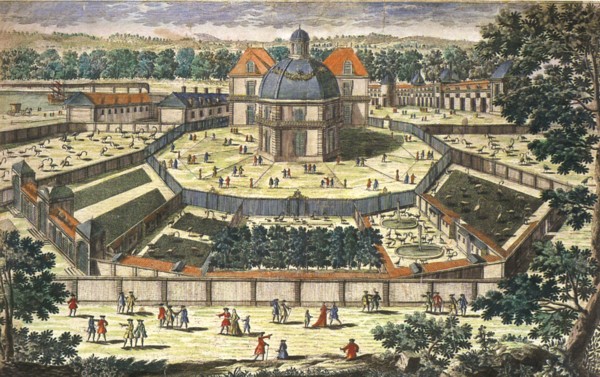
The Royal Menagerie

Culture and Stuff writes of the Versailles zoo and what became of the animals during the Revolution.
The popularity of the menagerie was also boosted by great vogue for the study of nature that flowered during Louis XVI’s reign. Naturalists had grown tired of studying the dusty tombs of Cabinets of Curiosity, where brown pickled fish bobbed in vinegar and faded birds stood stuffed in a peculiar imitation of life that seemed to startle the thought of death into everyone who looked at them. There was now, prompted by the bestselling work of Buffon, a desire to observe living animals. Now then, the animals of the menagerie had a new torment, as fashionable men and women toured the menagerie, staring deep into the eyes of monkeys and, with a pained expression, wondered aloud “What is it to be human?”. Nobody ever seemed to wonder what it is to be monkey. (Read entire article.)
Unfortunately, the people of Paris turned on the lion:
In the middle of all this comes the tale of an old grey lion, once the pride of the menagerie at Versailles, and now caged in the Jardin des Plantes. This was a beautiful botanical garden, marred only, Hesdin tells us, by the presence of strolling flower girls paid by the government to keep a spying eye and keen ear trained on visitors. In this small zoo (which, along with the park, still exists today) lived the Lion, ‘covered with sores and infested with vermin’, a pitiful sight – more mange than mane. For a small fee visitors would be allowed in to see him, and consequently, says Hesdin, he was ‘tormented by the Parisian sans-cullotes because he was king’. This sad image seems to encapsulate both the deep fears and growing frustrations of the people of Paris at this time. The King and Queen were both dead and the revolution had brought immense change, but as people screamed at the lion and tugged his hair, it is tempting to believe they were expressing a powerful sense that the revolution was not yet complete, that it had not done what it was meant to. Its leaders had sought to stoke an ever-burning fear of enemies both within and without, and even the idea of royalty was something that had still to be not only ridiculed but also actively and continuously attacked.

It’s best not to get too romantic about the case of one old Lion, but I’m always searching for moments like this in history, where in one seemingly trivial anecdote everything seems to crystalise, and petty actions have the capacity to reveal what otherwise goes unspoken; ideas and emotions so powerful and complicated that perhaps only unconscious action can express them. (More here.)
Share

Edmund Burke and Civil Liberties

Burke protested against the oppression of Catholics. ( Via Joshua Snyder.)
Edmund Burke was never more eloquent than when denouncing the Penal Laws that circumscribed the liberties of Ireland’s Catholics. That system, he wrote in 1792, was “as well fitted for the oppression, impoverishment and degradation of a people, and the debasement, in them, of human nature itself, as ever proceeded from the perverted ingenuity of man.” This was Burke’s opinion at a time when Catholics were synonymous with subversion—didn’t they owe highest allegiance to the pope? To fearful Englishmen, “papists” were “the apex of all evil” above “all Pagans, all Mussulmen.”

Burke demanded civil liberty—“a liberal and honourable condition”—for them anyway. He was not oblivious to minority dangers, nor indifferent to public orthodoxy. But who can imagine him alongside such Islam-baiters as Herman Cain or Pamela Geller, shouting about Sharia or boasting of plans to exclude an unpopular minority from public office?
Share

Thursday, September 8, 2011

Dairy Queens

A review from Vive la Reine.
Meredith Martin delves into more than two centuries of French history in her book Dairy Queens: The Politics of Pastoral Architecture from Catherine de Medici to Marie Antoinette, which seeks to place the French pleasure dairy back in its historical context, shattering the myths and assumptions about the role of pleasure dairies in elite society.

The assumption that pleasure dairies were built by royal women as a way to pretend at being peasants while not actually living like one has permeated books, films and pop culture for years. Marie Antoinette is still accused of pretending to be a peasant while drinking dairy from porcelain cups and milking perfumed cows — a true example of a “Let them eat cake” (which no, she never said) state of mind. However, Martin puts the pleasure dairy of Marie Antoinette (along with several other prominent French women such as Madame de Pompadour and Catherine de Medici) in their historical context, dismissing the notion that the dairies were there for the frivolous play of the elite class.

Martin explores the political, social and gender politics behind the pleasure dairies, revealing a surprising role in the lives of the women or men who built and enjoyed them. Pleasure dairies were often ways for aristocratic or royal women to exercise a form of political power, while still working within their gender role by promoting their status as nurturing mothers and worthy estate managers. They were also a way to improve health, employing Rosseau’s notion that aristocratic women should retreat to countryside estates and reap the benefits of fresh milk and air. The catch, of course, is that most pleasure dairies were not built in the true countryside but on the outskirts or even within cities, so that a woman could enjoy the benefits of the countryside without giving up her social obligations. However, the female influence on the pleasure dairy was, particularly by the 1780s, often criticized and made suspect. (Read entire review.)                                                                                                                                
Share

Bookstore Magic

Will it fade?
What has happened to the American bookstore? The cozy yet slightly musty place where a reader could wander among the great storytellers of our time and faintly hear them calling from the shelves, “Read me! I’m a heartbreaking love story! Read me, I’ll tell you the history of the Great War! ...”

It grew from a dimly lit space to a high-ceilinged warehouse to a coffee-smelling, couch-laden superstore to a multipurpose entertainment outlet. The old bookstores were swallowed by chains. Packaging, bundling, synergizing and the tantalization of profits became the principles. Actual books in these places seemed to be an afterthought, nudged aside by videos, calendars, music and electronics.

But Borders? Surely Borders was safe, right? Didn’t we have a soft spot for them? Anyone who ever made that pilgrimage to Ann Arbor on a Sunday afternoon, anyone who ever lost track of the hours while cooing at the sheer enormity of the written word, would insist, absolutely and without hesitation, that Borders, like mankind, would somehow survive.

Instead, we are once again reminded that no matter how lovely the casing, how beautiful the print, how fetching the binding or how stunning the cover, business is still business.

And books are a tough business.(Read entire article.)
Share

Wednesday, September 7, 2011

Frankfurt Kaiserdom

If you have ever read Heidi then you have heard of Frankfurt Cathedral. Here are some pictures of the venerable house of worship in the city where for centuries the Holy Roman Emperors were elected.
From the issue of the Golden Bull by the Emperor Charles IV in 1356 it was the site of the election of the Holy Roman Emperors, and in the Wahlkapelle (Election Chapel) the seven Electors (nine from the seventeenth century) gathered here to elect a new Emperor. 16 out of the total 23 German emperors were elected in this small vaulted room on the south side of the church. (Read entire post.)
Share

Hell and the Cathars

One of the things that make heresies so attractive is that they tend to play down the aspects of Christianity that are unpleasant, such as the doctrine of Hell.
The Cathars, a Christian sect that sprung up in France and other parts of Europe, were dualists. They believed that earthly existence, including the human body, is evil, created not by the Christian God but by an evil god. The God whom they worshipped was a being of pure spirit who would never have stooped so low as to take on evil flesh. Thus they de­nied that Jesus could become incarnate and still be the son of God. They denied, too, the Christian understanding of the crucifixion and the cross as saving things. The Catholic Church saw the Cathars as dangerous heretics and persecuted them ruthlessly, even launching a crusade against them (the “Albigensian crusade”).

Not surprisingly, the Cathars also re­jected the traditional Christian doctrine of hell. For the Cathars, this world was the only hell (and it was hell enough, giv­en the persecution they suffered). There was nothing to fear after death, except maybe a sort of reincarnation that some of their sect taught. Their objective was to escape from the cycle of reincarnation, to earn the right to go to heaven and avoid another term of imprisonment here in hell on earth. (Read entire article.)
Share