Saturday, April 12, 2008

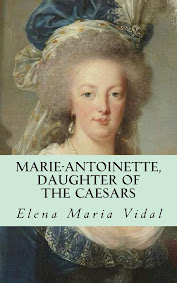
Marie-Antoinette's Gambling Addiction

I have many times been accused of making Marie-Antoinette into a saint. Just because I believe, as most of the evidence indicates, that Marie-Antoinette was faithful to her husband, does not mean I think she was the Little Flower. Endeavoring to observe the sixth commandment is a basic duty which does not mean automatic sanctity. We all know many faithful spouses who are not saints (at least, not yet.) The New Advent article presents a fairly balanced view of Marie-Antoinette:

In her private life, Marie Antoinette may justly be blamed for her prodigality, for having, between 1774 and 1777 -- by certain notorious escapades (sleigh racing, opera balls, hunting in the Bois de Boulogne, gambling) and by her amusements at the Trianon -- given occasion for calumnious reports. But she confessed to Mercy that she indulged in this dissipation to console herself for having no children; and the tales of Besenval, Lauzun, and Soulavie, about the amours of Marie Antoinette, cannot stand against the testimony of the Prince de Ligne: "Her pretended gallantry was never any more than a very deep friendship for one or two individuals, and the ordinary coquetry of a woman, or a queen, trying to please everyone." De Goltz, the Prussian minister, also wrote that though a malicious person might interpret the queen's conduct unfavourably there was nothing in it beyond a desire to please everybody. Besides, the queen continued to give edification by her regular practice of her religious duties....

Her historian, M. de la Rocheterie, says of her: "She was not a guilty woman, neither was she a saint; she was an upright, charming woman, a little frivolous, somewhat impulsive, but always pure; she was a queen, at times ardent in her fancies for her favourites and thoughtless in her policy, but proud and full of energy; a thorough woman in her winsome ways and tenderness of heart, until she became a martyr."
The "notorious" escapades of sleigh-riding, going incognito to the opera ball, hunting and watching the horse races in the Bois de Boulogne, were fairly innocent past-times for a twenty year old queen. The gambling, however, became an addiction. It must be kept in mind, however, that she was not the not the only one. Gambling was an entrenched part of court life from the days of Louis XIV. As scholar Ross Hamilton describes it:
Gambling obsessed all levels of French society during the Enlightenment. Louis XIV held appartements du roi given over to gambling three times a week at Versailles, the queen hosted a nightly game, and courtiers scheduled additional occasions for play. Hosts so frequently acted as bankers for games to entertain their guests that satirists, chroniclers, and moralists complained that compulsive gambling had destroyed other forms of social entertainment. In Paris ten authorized maisons de jeux operated games involving some degree of skill (jeux de commerce) but essentially they served as fronts for more lucrative chance-driven games (jeux de hasard). Gambling also took place at the two great Paris fairs during almost four months of the year, all year long at foreign embassies, and eventually at gambling houses at the Hotel de Gesvres and later at the Hotel de Soissons. In addition to these legal venues, the large number of clandestine Parisian gaming rooms, lighted by tripots, made one visitor comment that "flaming pots set Paris ablaze," and gambling was by no means restricted to Paris. (2) The "Age des Lumieres" was lighted by gambling. Although official prohibitions referred to both religious and sociological dangers from gambling, within the context of the period, risking large sums at play became an analogy for risking one's life in battle. Having the courage to risk and winning or losing with equal equanimity demonstrated indifference to material gain and thus served as a means of displaying hereditary status.
Author Lisa Hilton in the biography Athenais (Back Bay, 2004) explains how gambling was one of the only "honorable" ways in which the often cash-strapped aristocrats, who were forbidden to engage in trade, could make money. It also replaced the thrill of war. As Hilton says:
Psychologically, gambling can be seen as a rebellion against logic, intelligence, moderation and renunciation, amorally appealing to those who in some way feel their lives constricted, and yet containing its own penance from the guilt it provokes from the losses it entails.
It required a certain amount of discipline to gamble well; one had to have mastery over facial expressions so as not to reveal one's thoughts about winning or losing, or one's strategy. A noble had to be able to lose with grace and promptly pay debts.

Marie-Antoinette had been taught as a child by her own mother to gamble, because the Empress knew that a princess who could not play well would soon be separated from her money. Futhermore, the stakes at the court of Austria were much higher than at the court of France, which made Antoinette an intrepid player. As a teenager, she became inordinately attached to the practice. As she began to have gambling debts, Louis XVI, who was trying to save the government finances and give an example of thrift, forbade her to play anymore games of chance. She begged her husband to let her have one last game. He gave permission, and naughty Antoinette made sure the game went on for three days. Louis was disgusted.

Gambling in France did not disappear with the fall of the monarchy. The revolutionaries who replaced Louis and Antoinette had their own share of gambling debts. According to historian Russell T. Barnhart:
The mania for gambling had been transferred from defunct, monarchical Versailles to the thriving, bourgeois Palais Royal, where the five main gaming clubs throbbed from noon till midnight. During the Revolution, Prince Talleyrand won 30,000 francs at one club, and after Waterloo in 1815, Marshal Blucher lost 1,500,000 francs in one night at another. To bring the situation under control and raise taxes for the state, in 1806 Napoleon legalized the main clubs, which from 1819 to 1837 grossed an enormous 137 million francs.
Gambling took up only a short period of Marie-Antoinette's life, and yet it is something for which she is remembered, even before her numerous charities. In order for the excesses of the Revolution to be justified, the failings of a teenage queen are held up for posterity. Share

A Revolutionary Creed

Cousin John Laughland writes from Brussels on the shifting terms and allegiances of the right and left.
Even more profoundly, I am convinced that the neo-conservatism which unites both Bush and Clinton (including Hillary) is a revolutionary creed which has nothing whatever to do with conservatism. I have argued this view at length in The Spectator and The American Conservative. To put it briefly, neo-conservatism is a profoundly revolutionary ideology which betrays all the characteristics I, as a Catholic and a conservative, hate most. It is militaristic and millenarian; it is moralistic and Manichean; it is revolutionary and ruthless. Not only does it have its roots in Trostkyism (Irving Kristol boasted in 1983 that he was still proud of having joined the Fourth International, two years after Trotsky founded it); it remains an overtly revolutionary force with all the potential for wreaking havoc which many other revolutionary movements in history have displayed. Until that ideology is destroyed, until the stranglehold which the military-industrial complex has over the political class in America, and until a counter-weight to American hegemony emerges which permits the re-emergence of a multi-polar world order and the balance of power, the world will never be at peace.
Share

Friday, April 11, 2008

Parish Life in late Eighteenth Century England

Fr. Nicholas examines the life of Catholics in England after they were once again given the freedom to openly practice their faith. Share

St. John Damascene and the "Ishmaelites"

When I first came upon this post, I wondered at first glance which ultramontane rabble-rouser had authored it, before realizing that it was from the writings of St. John Damascene. He was the last of the Greek Fathers and lived at a time when the ancient Christian communities were falling into Moslem hands. St. John did not mince words.
They furthermore accuse us of being idolaters, because we venerate the cross, which they abominate. And we answer them: ‘How is it, then, that you rub yourselves against a stone in your Ka’ba [107] and kiss and embrace it?’ Then some of them say that Abraham had relations with Agar upon it, but others say that he tied the camel to it, when he was going to sacrifice Isaac. And we answer them: ‘Since Scripture says that the mountain was wooded and had trees from which Abraham cut wood for the holocaust and laid it upon Isaac, [108] and then he left the asses behind with the two young men, why talk nonsense? For in that place neither is it thick with trees nor is there passage for asses.’ And they are embarrassed, but they still assert that the stone is Abraham’s. Then we say: ‘Let it be Abraham’s, as you so foolishly say. Then, just because Abraham had relations with a woman on it or tied a camel to it, you are not ashamed to kiss it, yet you blame us for venerating the cross of Christ by which the power of the demons and the deceit of the Devil was destroyed.’ This stone that they talk about is a head of that Aphrodite whom they used to worship and whom they called Khabár. Even to the present day, traces of the carving are visible on it to careful observers.
Share

Zora Neale Hurston


Lew Rockwell an article about the dynamic Florida author, Zora Neale Hurston.

Here is a post about her from my friend Linda. Hurston's approach to writing about African-American womanhood stands in stark contrast to Toni Morrison and Alice Walker. To quote:

Hurston is flying in the face of the power of the matriarchy in African American society. In this, she stands in opposition to Toni Morrison as well as to Alice Walker. (Interestingly, Dorothy West, whose own mother exemplified this matriarchy as West describes it in her book Living Is Easy, was a close friend of Hurston's in Harlem.) That Hurston is celebrating the joys of loving the other is the interpretation that is in keeping with the work of Hurston's entire life. She did not apologize for being black, for being a woman, for being a human being, but sought to discover the rich lode of African Americans' iron grip on life and humanity and present it as a gift to America and to the world.

Share

Thursday, April 10, 2008

Marguerite d'Angoulême


Historical fiction writer Julianne Douglas has an interesting post on the sister of François I, Marguerite d'Angoulême, whom Henry VIII almost married. Share

Another Meme

Alexandra tagged me.

What I was doing 10 years ago:
The first edition of Trianon had just been published, so I was going to book signings and speaking at ladies' clubs. I was also writing and researching Madame Royale.

Five Snacks I enjoy:
I don't really snack.

Things I would do if I were a billionaire:
Donate to my favorite charities and help some people who have serious debt. Then buy a house in the country, one with room for all of our books.

Five jobs that I have had:
Babysitting, teaching, helping the elderly, retail, writing.

Three of my bad habits:
1. Accumulating clutter.
2.Staying up too late.
3. Reading too many books at once.

Five places I have lived:
Maryland, New York, Pennsylvania, Germany, France
Share

Making a Visit

Some inspiring reflections from Vultus Christi on making a visit to the Blessed Sacrament, and how important this is for small children.
It was not uncommon for children to visit the Blessed Sacrament after school. Yes, it is true that the teaching Sisters encouraged visits, but it was something that children did freely. In the context of a family neighbourhood where nearly everyone walked to the bank, the Post Office, and the market, visits to the Blessed Sacrament were simply part of the fabric of Catholic life. Rarely were our neighbourhood churches empty. Nearly always there was someone kneeling in prayer, lighting candles, stopping at Our Lady's altar, or making the Way of the Cross. Then came the so-called "urban renewal," the destruction of so many family neighbourhoods, and the so-called "post-conciliar renewal," of which enough has been said elsewhere in the blogosphere.
Share

Wednesday, April 9, 2008

The Carmelite Rite


Many of the religious orders which were founded in the Middle Ages had their own unique customs and rituals. The Carmelites were no exception, and the "Carmelite rite" or "Rite of the Holy Sepulchre" was used in monasteries of the ancient observance until 1972. The Carmelites were founded in the Holy Land and so their rite contained some elements of the eastern liturgies. It also had a great deal of emphasis on the Resurrection of Christ and on the Blessed Virgin. As one article explains:
The rite in use among the Carmelites since about the middle of the twelfth century is known by the name of the Rite of the Holy Sepulchre, the Carmelite Rule, which was written about the year 1210, ordering the hermits of Mount Carmel to follow the approved custom of the Church, which in this instance meant the Patriarchal Church of Jerusalem: "Hi qui litteras noverunt et legere psalmos, per singulas horas eos dicant qui ex institutione sanctorum patrum et ecelesi� approbata consuetudine ad horas singulas sunt deputati." This Rite of the Holy Sepulchre belonged to the Gallican family of the Roman Rite; it appears to have descended directly from the Parisian Rite, but to have undergone some modifications pointing to other sources. For, in the Sanctorale we find influences of Angers, in the proses traces of meridional sources, while the lessons and prayers on Holy Saturday are purely Roman. The fact is that most of the clerics who accompanied the Crusaders were of French nationality; some even belonged to the Chapter of Paris, as is proved by documentary evidence. Local influence, too, played an important part. The Temple itself, the Holy Sepulchre, the vicinity of the Mount of Olives, of Bethany, of Bethlehem, gave rise to magnificent ceremonies, connecting the principal events of the ecclesiastical year with the very localities where the various episodes of the work of Redemption has taken place.
The Carmelite rite is still used by a few religious communities. Share