Friday, August 20, 2021

A Mysterious Monument

 From A Medieval Potpourri:

The fullest account of Edward’s short life, as far as I am aware , can be found in Peter Hammond’s book The Children of Richard III while Professor Pollard devoted a chapter with the the poignant title of Last Summer at Middleham in his book The Worlds of Richard III. Both give details of expenditures covering the last months of Edward’s life some of which are quite charming including ’12d for Martyn the fole’.

Returning to Edward’s unknown place of burial, various locations have been suggested including Coverham , Jervaulx, Sheriff Hutton, York and Middleham. I personally would plump on Middleham. Rous, who would have been in a position to know states quite clearly Edward was buried at Middleham which would make perfect sense. In his Latin version of his Roll, Rous states

‘Edward, illustrious Prince of Wales, only son and heir to King Richard the third and his honourable consort Anne , Queen of England, but in fact heir to Heaven; his sacred soul was never infected by the blemish of guilt and he died a child before his parents and was taken with honour to a grave at Middleham.’ (1)

If this were the case Edward would be lying at rest undisturbed in the church of St Mary and St Akelda, Middleham. Lets hope it stays that way. (Read more.)
Share

Thursday, August 19, 2021

The Indecipherable Rohonc Codex

From Ancient Origins:
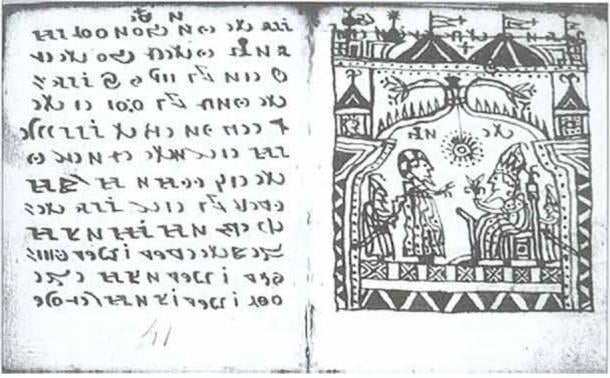
In total, the Rohonc Codex contains 448 pages of indecipherable text, which is similar to Old Hungarian script, as they are both written with a right-to-left orientation, and have similar combinations of straight and rounded characters. Scholars have asserted that in reality, the writing could be anything from Hindi to Old Hungarian, although it lacks features from each of those written languages. The number of different symbols used is considered to be extremely high, with ten times more symbols than are found in any known alphabet.

The paper within the Codex has the unique characteristic of being watermarked. Each page contains the watermark, which has the appearance of an anchor, which is within a circle, which is within a six-rayed star. The watermark itself appears to date to 1529-1540 AD, although the actual Codex appears to have been written much earlier than that. This discrepancy makes it difficult to determine exactly when the text was written, although it is possible that the book was transcribed after its initial creation.

The Codex contains more than just written text – it is also accompanied by 87 illustrations depicting military battles, landscapes, and religious icons, which are said to hint at several different religions, including Christianity, Hinduism, and Islam. Some have interpreted this to show thawhichever culture was responsible for creating the text was one within which the three religions co-existed. (Read more.)

Share

Survival After Slavery

 An old article but worth reading again. From Anti-slavery:

One of the pillars of our work to end slavery around the world is not only helping people in slavery to escape and but also supporting them to establish independent lives in freedom. This is crucial for people who experienced slavery, as they are extremely vulnerable to getting trapped in it again. They are usually among the most socially marginalised and economically deprived people in society. Even if they manage to escape, they may find themselves without food, shelter or social connections.

Although securing the most basic living needs for survivors is usually prioritised, an increasing body of evidence points to the importance of addressing people’s psychological needs as well in order to really break the cycle of slavery. Indeed, it is flawed to think of survivors’ mental health as something of a ‘luxury’, that can only be considered after their more pressing economic needs are addressed.

Mental health can be fundamental to survival after slavery. It should be taken into account at all levels, because very often the psychological damage of slavery can prevent people not only from building their lives in freedom, but also from accessing support they might need to do that.

For example, a survivor of traditional slavery in West Africa, someone who had been enslaved from birth, receiving micro-credit would face enormous challenges in using that credit effectively, compared to a more typical West African person on a low income. The latter would probably have extensive family networks and local friendships, a good level of self-esteem, some level of education, an ease with money and the marketplace, a sense of her own agency and an ability to express it. A person emerging from a lifetime of slavery would have none of those things, and might be struggling with a great deal of stress, anxiety and trauma as a result of their experiences. (Read more.)


From Allen West at West4Texas:

 I spent two and a half years in Afghanistan — based out of Kandahar Airfield (KAF) — as a civilian/military advisor to the Afghanistan National Army 205th Corps. What warmed my heart the most during my time there was watching the little girls heading off to school in their uniforms. We all knew that we were providing freedom, liberty, and things we take for granted in America, that would lead to better opportunities in the future.

When I think of the Taliban, I am reminded of their savage, barbaric nature, one that would shoot a young Pakistani girl named Malala Yousafzi in the head, on a bus, because she spoke up for girls getting an education.

For the past 20 years, America has enabled little girls — and women — an opportunity. They had an opportunity to learn, to drive cars, to create their own small businesses. Now, that opportunity, that window, is coming to a close. Those girls and women will once again be subjected to the brutal reality of the most misogynistic ideology we know, Islamic jihadism, fundamentalism. These women will be forced back into burqas and relegated to being viewed as property, and in many cases, sex slaves.

As I went for a nice long run this past Saturday in Victoria, Texas, I pondered this fact. It appears that the progressive socialist left has a penchant, an infatuation, with facilitating modern-day sex slavery.

Consider the Biden administration policies that have unconstitutionally created open borders here in Texas. We all read and know about the stories of the rape of young girls and women by the transnational narco-criminal terrorist organizations called the cartels. Yet, this current leftist administration does nothing to negate this abhorrent occurrence. As well, Texas has become a leading state in America for human, and sex, trafficking. There is nothing moral about the situation the Biden administration has allowed.

The current “Border Czar” Kamala Harris says and does nothing about the issue of sex slavery here in Texas, and across these United States. How can it be that the first female VP does not address this issue? Did Harris even attempt to advise Biden against abandoning women in Afghanistan? One can only surmise, based upon the flippant comments of the White House mouthpiece, Jen Psaki, that care and concern for the girls and women are of no consequence to the progressive socialist left, including leftist women. (Read more.) 

Share

The French Revolutionary Myth

 Genocidal atrocity. From Reaction:

Europe had experienced mass atrocities before, notably during the Thirty Years War, but the French Revolution was something novel. In response to the royalist and Catholic uprising in the Vendée, on 1 August 1793, the Convention decreed the systematic destruction of the province, the razing of farms and dwellings, the extermination of the inhabitants and all domestic animals, the burning of crops and forests. This was the first systematic attempt by a government to exterminate its own people. It was the first genocide.

“Not one is to be left alive…” “Women are reproductive furrows who must be ploughed under…” “Fire, blood, death are needed to preserve liberty…” Such was the discourse of the Convention. Estimates of the numbers killed in the Vendean genocide range from 117,000 to 400,000. Babies were killed in front of their mothers who were then murdered, girls were raped and drowned, children were baked in ovens. The man whose Twelve Infernal Columns executed these atrocities, General Louis-Marie Turreau, is commemorated on the Arc de Triomphe, along with other scoundrels.

A tannery for human skin (prefiguring Nazi industry) was established at Angers. There was already one operating at Étampes and another at Meudon; among its customers was Louis de Saint-Just, Robespierre’s chief lieutenant, who wrote: “The skin that comes from men is of a consistency and richness superior to that of the chamois. That of the female subjects is more supple, but provides less solidity.” Saint-Just wore breeches made of human skin, as did Philippe Égalité, the renegade Duc d’Orléans, cousin of Louis XVI, and other deputies at the Festival of the Supreme Being.

When the historian Reynald Secher revealed the truth about the Republic’s genocide, it cost him his academic career. French historiography is the exclusive province of admirers of Robespierre; they are as fanatical in defending the Republic’s foundation myth as any Terrorist in 1793. That is the root of the problem. France has a constitutional order built upon a lie, that the French Revolution was “a good thing”. The effect on its culture is necessarily toxic.

All the kitsch cult of “Marianne”, the cockerel emblem replacing the fleur-de-lis, the stark, geometric tricolour unconsciously expressing the vacuity of the republican myth and its role as a barrier to embracing the rich pre-1789 heritage of France – all that amounts to a cultural straitjacket. One could not ask for a better illustration of the banality of the post-Revolution concept of France than to listen to Emmanuel Macron expounding the republican dogma of “laïcité” – a euphemism for anticlericalism.

Since the Revolution there have been two embodiments of France: one the legacy of the deluded ideologues of the National Convention, based on Liberty, Equality and Fraternity; the other the patrimony of St Louis, Catholic and living its traditions to a different pulse. Pope Leo XIII foolishly tried to bridge that gulf by promoting the Ralliement and the Church was rewarded for his pains by the ousting of religious orders from education and, in 1905, by the Republic’s confiscation of all cathedrals and churches.

The scandal known as “l’affaire des fiches” exposed how the government, assisted by the Masonic lodges, prevented the promotion of Catholic army officers. In 1914 the same elements ensured that units from the most Catholic regions of France were the first to be herded towards the German machine-guns. That fissure remains today. Republican ideologues have done France no favour by shackling its identity to one of the most evil episodes in European history: it is as if Germany perversely looked back to National Socialism – of which French Jacobinism was the ideological inspiration –as its foundation myth. The false cult of the Revolution means that modern France is built upon a sewer.

This malign legacy has resonances far beyond France. The French Revolution is also mythologised in Britain. The mythological narrative of Ancien Régime tyranny, revolutionary virtue and reform creating liberty needs to be expunged from a public imagination whose impression of the Revolution is largely derived from Charles Dickens’ portrayal of homicidal nobles driving over children in Parisian streets.

Above all, the fiction of Bourbon “absolutism” must be discredited. Louis XVI summoned the Estates General because he needed to raise taxes. Had he enjoyed absolute power, he would not have needed to call a parliament. So far from being absolute, if the King of France created someone a duke – the ennobling prerogative being the most fundamental right of royalty – the dukedom would remain invalid, except as a courtesy title at court, if the local parlement arbitrarily refused to register it. (Read more.)

Share

Wednesday, August 18, 2021

The Albigensian Crusade


 From Information and Analysis on the Life of the Church:

It is unnecessary to dwell at length on the antisocial consequences of such a doctrine. It aimed at nothing less than the suppression of the essential element of all society, the family, by making of the whole of humanity a vast religious congregation without recruitment and without a future.

While awaiting the advent of this state of affairs, which was to emerge from the triumph of the Cathar ideas, the Perfects gradually broke, as a result of the progress of their apostolate, the family ties already formed.

Whoever wanted to be saved, before submitting to the law of rigorous chastity, the husband must left the wife, the wife the husband, the parents must abandon the children, fleeing a domestic hearth which inspired them only with horror, because the heresy taught them “that no one can save himself by staying with his father and mother.” And so all domestic morality disappeared, along with the family which was its raison d'être.

This hatred of the family was, moreover, among the Albigensians only a particular form of their aversion to anything foreign to their sect. They refrained from any relationship with anyone who did not think like them, except when they deemed it possible to win them over to their own doctrines, and they made the same recommendation to their Believers.

On the day of the examination of conscience or apparelhamentum, which presented itself every month, they demanded from the Believers a severe account of the relations which they had had with the infidels. And this is understandable: they considered their fellow man only he who, like them, had become by consolamentum, a son of God.

As for the others who had remained in the evil world, they somehow belonged to another race and were strangers not to say enemies. (Read more.)
Share

The Vanishing Legacy of Barack Obama

I always knew Obama was a big phony. In the tradition of Napoleon, revolutionaries end up as tyrants. (Warning: bad language.) From TK News:

Obviously, getting rich and not giving a shit anymore is the birthright of every American. But this wasn’t supposed to be in the script for Obama, whose remarkable heel turn has been obscured by the Trump years, which incidentally were at least partly his fault. The history books and the still-starstruck press will let him skate on this, but they shouldn’t.

Obama was set up to be the greatest of American heroes, but proved to be a common swindler and one of the great political liars of all time — he fooled us all. Moreover, his remarkably vacuous post-presidency is proving true everything Trump said in 2016 about the grasping Washington politicians whose only motives are personal enrichment, and who’d do anything, even attend his wedding, for a buck. Trump’s point was that he, Trump, was already swinishly rich, while politicians have only one thing to sell to get the upper class status they crave: us.

Obama did that. He sold us out, and it’s time to start talking about the role he played in bringing about the hopeless cynical mess that is modern America. (Read more.)


Share

Source of the Nile

 From Discover:

The quest to discover the source of the Nile River was one of the most important scientific questions of the 19th century in Europe. While it’s difficult to envision such conundrum in the era of Google Maps, the search was nearly as gripping as the race to put a man on the moon, as it was wrapped up in heroics and intrigue.

Expeditions led to the glorification of figures like David Livingstone, Henry Morton Stanley and Richard Francis Burton — but at the cost of injury, illness and even death in Livingstone’s case. At the same time, the geographic quest, in some ways, sparked European colonial interest in Africa, the legacy of which lives on today. “The mystery of the source of the Nile has been a challenge for three millennia,” says Christopher Ondaatje, an explorer who wrote the book Journey to the Source of the Nile. (Read more.)


Napoleon in Egypt. From France24:

More than 300 French naval ships left the Mediterranean port Toulon for Egypt on May 19, 1798. Nearly 54,000 people, including more than 36,000 soldiers, set sail under General Napoléon Bonaparte’s command. The 29-year-old future emperor launched the campaign at the behest of the Directory controlling revolutionary France with the official objectives of freeing Egypt from the tyranny of the Mamluk ruling warrior class and cuting off Britain’s route to India.  

Napoléon’s well-equipped force enjoyed easy victories initially – notably the capture of Alexandria and the Battle of the Pyramids. But the military operation soon turned into a fiasco as the British Royal Navy, under the command of Horatio Nelson, sunk the French fleet in the Battle of the Nile in August 1798 (a preamble to the 1805 Battle of Trafalgar off the Spanish coast, when the legendary British admiral smashed Napoléon’s navy for good).

The Egyptian campaign culminated in further humiliation with the British and Ottoman victory in May 1799 in the Siege of Acre, now in Israel – compounded by the plague epidemic that struck the massed French soldiers. Napoléon fled back to France on August 22, 1799, managing to evade the Royal Navy but leaving his troops behind to eventually surrender on August 31, 1801. (Read more.)


Share

Tuesday, August 17, 2021

The Defense of Cadiz against the English (1634)


From Art in Space:

This historical painting shows the unsuccessful raid by an English/ Dutch force under George Villiers, 1st Duke of Buckingham, and Edward Cecil, 1st Viscount Wimbledon, against Cadiz on 1–7 November 1625. The main objective of the attack were the Spanish treasure ships but the voyage was plagued with difficulties that they entirely missed the treasure ships. Instead they decided to land their militia army up the coast and attack Cadiz. The English forces were ill-equipped, ill-disciplined and ill-trained and when they came to a warehouse filled with wine, they simply got drunk. The Spanish army counter-attacked and simply killed the English troops who were to drunk put up a fight. The English commanders called off the attack and returned to England, having lost about 7,000 men and lost 62 of the 105 ships. The failed expedition seriously damaged the status of Charles I, king of England, who dissolved parliament in order to protect his own dignity and his favorite George Villiers, 1st Duke of Buckingham. The painting shows Fernando Girón, marquis of Sofraga and Governor of Cadiz (seated because he was sick during the battle) giving order to his subordinates. In front of Fernando Girón stands Diego Ruiz, serving as Maestro de campo. In the background we can see the English ships and troops being defeated. (Read more.)
George Villiers, Duke of Buckingham

Share

We Have Met the Enemy, Part XVI

 From Steyn Online:

And then one evening, a few months later, everything changed. The heartsick couple happened to catch a TV show featuring a Johns Hopkins expert discussing the brand new science of "sex change". The expert's name? John Money.

Money was good on camera: smooth, supremely confident, clipped accent, and clever. He declared, as though it were a matter of unchallengeable fact, that modern science allowed him and his team to fully transform males into females, and vice versa. He even produced, right then and there, a dazzling blonde transexual named Diane who had once been a man named Richard. Diane purred that she was happier than ever before.

The Reimers watched with cautious hope. Maybe this amazing scientist could help their disfigured son. If he and his team could do surgeries to transform a male into a female, and vice versa, maybe he could help reconstruct their son's genitals. Failing that, if science could turn boys into girls as easily as John Money asserted...and their little boy could grow up to be a woman just as happy as the purring Diane was, and avoid a life of shame and loneliness as a defective male...why not consider that option, too? The professor had just said it was possible, after all—and he sure sounded like he knew what he was talking about. Janet sent a letter off to Professor John Money, Johns Hopkins University, Baltimore, Maryland, the very next day.

Of course, the Reimers didn't know anything about Money other than what they'd just seen on TV. They didn't know that a young teacher named Milton Diamond had obliterated Money's claims about psychosexual malleability only the year before. They didn't know Money had deliberately hidden that fact during his television presentation. They didn't know Money's unflappable public persona masked a hateful, angry megalomaniac who regularly terrorized his underlings by screaming at them, sexually harassing them, throwing tantrums, and issuing credible career threats. They didn't know Money was a sexual psychopath bent on destroying all traditional sexual standards, and replacing them with some of the darkest sexual behaviors imaginable, including pedophilia. (Read more.)


Share