Thursday, May 21, 2020

True or False Obedience

From The Fatima Center:
In the first part of this article, we learned that the virtue of obedience is grouped as one of the virtues which falls under the cardinal virtue of justice. In fact, St. Thomas quoting St. Augustine famously stated, lex injusta non est lex (an unjust law is no law at all). We also explained how there are some situations in which one is not obligated to obey his superior. This, of course, includes unjust laws which do not carry the moral force of true law. Furthermore, there are some situations in which one is obligated not to obey a superior. The most obvious case is when the superior commands something sinful. No one may ever justly command another person to disobey God. And one may never justify his sin before God by claiming ‘I was just being obedient.’ We all recognize this truth in the following simple example. If a father commanded his son to help him steal cars and murder innocent people, the son would actually have to refuse. While he may appear disobedient to his father, the son is actually exercising the true virtue of obedience because he is obeying God and faithfully following the Natural Law. The father might rant and rave, might accuse the son of disobedience, and might even punish him, but the truly obedient son would endure this unjust persecution for the sake of truth, goodness and His love of God. (Read more.)
Share

Wednesday, May 20, 2020

Whittaker Chambers through the Eyes of Rebecca West

From The National Review:
That is not an achievement we associate with her name. Rebecca West is more likely to be recalled for The Return of the Soldier (1918), an innovative psychological novel; or for Black Lamb and Grey Falcon (1941), that grand bio-travelogue of Yugoslavia on the cusp of war. Her reports on the Nuremberg trials, and the post-war trials of British fascists, also continue to find readers, especially among students of journalism. West’s writings on Communism, by contrast, lie unread, unsung. Many of them sparked controversy in her own day, and are well worth revisiting in ours. 
In articles, book chapters, and book reviews spanning six decades, she returned to the allure of Communism for educated Westerners. (Its attraction for militant members of the industrial working class was no real puzzle, she said, not least because Marxism deified the proletariat.) Reviewing the second volume of Solzhenitsyn’s Gulag Archipelago for the Sunday Telegraph, West bitterly recalled that “25 years ago a large part of the Western European and American population of intellectuals were, with disgusting single-mindedness, pimping for Stalin.” 
Decrypting Communism’s appeal, West believed, required paying close attention to the lives of true believers, people such as Julius and Ethel Rosenberg, Klaus Fuchs, and Alan Nunn May, and also to ex-Communist apostates such as Arthur Koestler and Richard Wright. She drew portraits of them all. But no life to her was more fascinating, and perhaps more revealing, than that of Whittaker Chambers (1901–1961), the Communist, later ex-Communist, informer whose testimony sealed the doom of Alger Hiss. It was in the conduct and words of Chambers that West found a source of longing for Communism that transcended Chambers himself. The context of her discovery was a trial and a book that caused a sensation in early Cold War America. (Read more.)
Share

How the Codfish Started the American Revolution

From The New England Historical Society:
Between 1768 and 1772, fish accounted for 35 percent of all the money New England made overseas. Livestock came in a poor second, at 20 percent. When the American Revolution broke out, 10,000 New Englanders worked as fishermen, or eight percent of the adult male working population. In Massachusetts, Marblehead and Gloucester ranked as the top fishing ports, with Salem, Beverly, Cape Cod, Ipswich and Plymouth heavily engaged in fishing.

The fisheries had a multiplier effect, generating income for people engaged in overseas trade, timbering, shipbuilding, ship rigging, sail making and other waterfront industries. But powerful British plantation owners and fish merchants viewed the colonial fishing fleets as a threat to their own business. In 1733, they began to pressure Parliament to crack down on their colonial competitors. Their increasing success inhibited the New England economy and fomented much of the anger that led to revolution. (Read more.)
Share

Tuesday, May 19, 2020

Touch in the Middle Ages

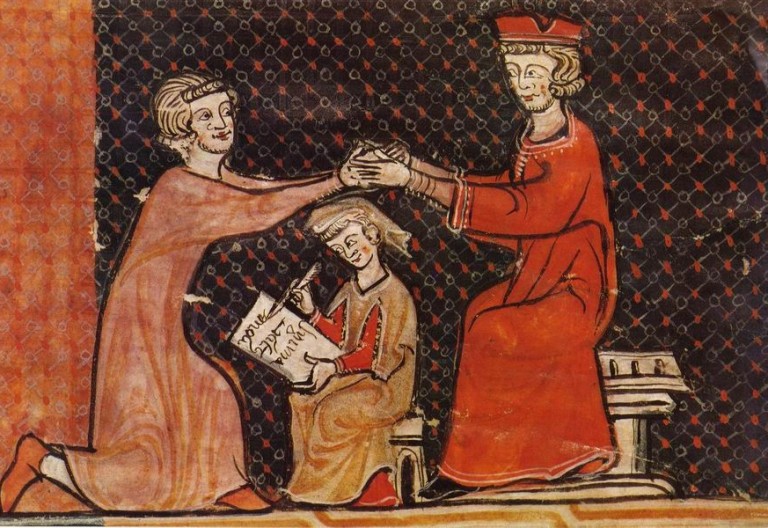
Swearing fealty in the Middle Ages
From Medievalists:
There are many, many other examples of touching in the feudal relationship. The great French historian Marc Bloch discusses in his Feudal Society (first published in French as La Société Féodale, 1939) how part of the ceremony of fealty was placing one’s hands between one’s lord’s, and how the knightly accolade could be an embrace – “welcome to the family.” Bloch’s book The Royal Touch (Rois et Thaumaturges, 1924) discusses how the touch of the kings of England and France was supposed to cure skin diseases and was seen as a sign of divine appointment. Less gently, Bloch also discusses in Feudal Society how children were slapped at memorable events to fix them in their memories. (Read more.)

More HERE. And HERE. Share

Experts Have Jobs

They need to understand those who do not. From The Washington Post:
The covid-19 divide is a class divide. The Bureau of Labor Statistics released a report last year on the “job flexibilities” of U.S. employees. Of the top 25 percent of income earners, more than 60 percent can stay home and still do their jobs. Of the bottom 25 percent, fewer than 10 percent can do the same. Anthony S. Fauci, the director of the National Institute of Allergy and Infectious Diseases, has said he understands that maintaining these guidelines is “inconvenient.” For many people, they are not just inconvenient; they are life-shattering. Not all of those who work on the front lines or work with their hands are Trump voters — but all understand that it is a luxury to be able to work from home. (Read more.)
Share

An Attack on Greek Heritage

Migrants destroy olive groves. From Greek City Times:
It has been a wild few days on the Greek island of Lesvos. The past few days has seen two gangs of Afghani immigrants battle each other and African immigrants ridicule and cough on police in the midst of the coronavirus pandemic, as reported by Greek City Times. However, if these incidences were not enough, 5,000 olives trees were cut from their roots by illegal immigrants from the infamous Moria migrant camp, to the north of Lesvos’ capital city of Mytilene. Olive trees take approximately 65-80 years to reach stable yields, meaning that the destroyed trees are a major blow to the local economy. Olive exports amount to about US$700 million every year to the Greek economy. (Read more.)
Share

Monday, May 18, 2020

The Untold Truth of Mochi Ice Cream

From Mashed:
Mochi ice cream may be a late 20th-century invention, but the idea of pounding sticky rice into flour and then turning that into a sweet or savory pastry case has been around for centuries. Vision Times says Japan's mochi-making tradition could date as far back as 300 BC, when the treat was made with red rice and then served to the Emperor and nobility. Mochi was also made to be presented as a temple offering to the gods.

While mochi is a uniquely Japanese delicacy, it may surprise you to know that the frozen version of the treat is as American as Baskin Robbins. CNN says mochi ice cream was born in a Japanese-American bakery in 1980s Los Angeles. Frances Hashimoto and her husband, Joel Friedman, were running Hashimoto's family business: a fourth-generation family bakery named Mikawaya.

During a trip to Japan, Friedman came across a sweet treat he'd not seen before — a ball of sweet bean paste encased in a glutinous sticky dough. "That treat stuck with me," Friedman told CNN. "I remember thinking it was a cute idea but something wasn't quite right about it. We were already making pastry with mochi, which is rice dough. So we thought, why not make a treat like what I had in Japan. But instead of filling it with bean paste, we'll put in ice cream." (Read more.)
Share

Why We Must Teach Western Civilization

Western civilization, so important to earlier generations, is being ridiculed, abused, and marginalized, often without any coherent response. Of course, today’s non-Western colonizations, such as India’s in Kashmir and China’s in Tibet and Uighurstan, are not included in the sophomores’ concept of imperialism and occupation, which can be done only by the West. The “Amritsar Massacre” only ever refers to the British in the Punjab in 1919, for example, rather than the Indian massacre of ten times the number of people there in 1984. Nor can the positive aspects of the British Empire even be debated any longer, as the closing down of Professor Nigel Biggar’s conferences at Oxford University on the legacy of colonialism eloquently demonstrates. 
We all know the joke that Mahatma Gandhi supposedly made when he was asked what he thought about Western civilization: “I think it might be a good idea.” The gag is apocryphal, in fact, first appearing two decades after his death. But very many people have taken it literally, arguing that there really is no such thing as Western civilization, from ideologues such as Noam Chomsky to the activists of the Rhodes Must Fall movement at Oxford University, who demand the removal from Oriel College of the statue of the benefactor of the Rhodes Scholarships.

Increasingly clamorous demands by African and Asian governments for the restitution of artifacts “stolen” from their countries during colonial periods are another aspect of the attack, an attempt to guilt-shame the West. It also did not help that for eight years before 2016, the United States was led by someone who was constantly searching for aspects of Western behavior for which to apologize. 
This belief that Western civilization is at heart morally defective has recently been exemplified by the New York Times’ inane and wildly historically inaccurate “1619 Project,” which essentially attempts to present the entirety of American history from Plymouth Rock to today solely through the prism of race and slavery. “America Wasn’t a Democracy until Black Americans Made It One” was the headline of one essay in the New York Times Magazine launching the project, alongside “American Capitalism Is Brutal: You Can Trace That to the Plantation” and “How Segregation Caused Your Traffic Jam.” When no fewer than twelve — in the circumstances very brave — American Civil War historians sent a letter itemizing all the myriad factual errors in the project’s founding document, the New York Times refused to print it. Yet the Project plans to create and distribute school curriculums that will “recenter” America’s memory. (Read more.)

From Return to Order:
What is meant by “organic” or “inorganic” can be understood by comparing a living organism, such as a man or an animal, and a machine.
A man and a machine have some things in common. Each is made up of different parts that form a single whole. In both, every part carries out a function which contributes to the common purpose of each. 
Yet, despite these analogies, the differences between the two are so great that one could almost call them unfathomable. The principal difference is that the machine is inert, static and dead; the organism is warm, agile and alive.

We can compare this difference in the following ways:
I – The movements of the organs of a living body come from the life present in them; they spring from the very depths of their being. The parts of a machine are unable to move by themselves. All their movements must come from outside. They do not actually move but are moved. (Read more.) 
Share

Early Humanity’s Toolkit

From Haaretz:
Stone artifacts painstakingly shaped into spheres were part of the daily lives of early humans for more than two million years. They have been unearthed by archaeologists in East Africa, humanity’s ancestral home, and they litter prehistoric sites across Eurasia from the Middle East to China and India. Yet experts have been puzzled by their function since the early days of research into our evolutionary history.
Now, an international team of archaeologists led by Tel Aviv University archaeologist researcher Ella Assaf, has produced evidence that these enigmatic artifacts were used for a very specific purpose: breaking the bones of large animals to extract the nutritious marrow inside. The study, published last week in the journal PLOS ONE, highlights how an elegant technological solution that allowed hominins to increase their calorie intake endured for hundreds of thousands of years and continued to be used even as our ancestors developed new techniques and created more complex societies. (Read more.)
Share