Sunday, January 8, 2017

Churching

From Church Pop:
Churching, officially Benedictio mulieris post partum (The blessing of women after giving birth), is an old Catholic tradition to purify a mother after childbirth. Countless generations of women participated in it as ritual to be accepted back into the pew for Sunday mass.

But far from being a rite to diminish women, Churching is a prayer of thanksgiving for the gift of a new life, a celebration of femininity, and a blessing for mother and child. Let me explain. The tradition of Churching emerged in the early centuries of the Church. Pope Gregory the Great mentions it already in the 6th century. It was meant for the mother to return to church after a time of lying-in, for about 4 to 6 weeks, which matches the 40 days of the Levitical law for purification. For centuries, newborns were baptized within hours or days of their births, which meant their mothers could generally not attend the baptism. Churching was an occasion of thanksgiving for the lives of the mother and the child in a time when maternal and infantile mortality were high.

The time of lying-in before churching was a time of rest for the new mother, since the first few weeks after delivery are critical to the health of the mother for a complete recovery. A network and support system of midwives, neighbors, and family members helped the young mother with the care of her household. Churching then marked the return of the mother to her social life. She resumed her duties to their full extent. The celebration was often followed by a meal (in French, the word for churching, “relevailles,” is also the word for the feast that follows). (Read more.)
Share

Saturday, January 7, 2017

Portraiture in Renaissance and Baroque Europe

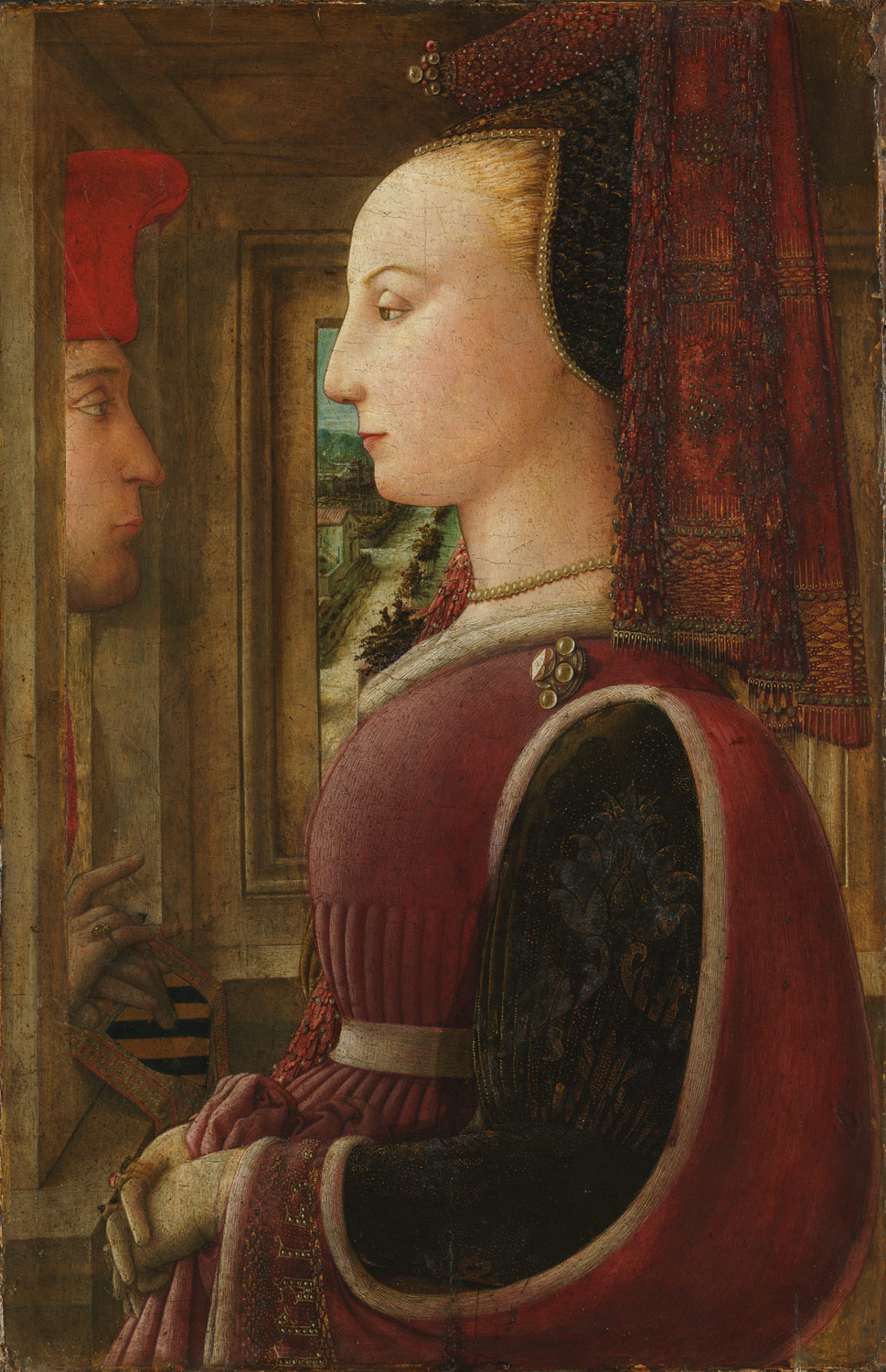
Fra Filippo Lippi:"Portrait of a Woman with a Man at the Casement"
From The Met:
The earliest Renaissance portraits were not paintings in their own right but rather important inclusions in pictures of Christian subjects. In medieval art, donors were frequently portrayed in the altarpieces or wall paintings that they commissioned, and in the fifteenth century painters began to depict such donors with distinctive features presumably studied from life. An example is Robert Campin’s Merode altarpiece (56.70) of about 1425, in which the man and woman in the left wing have the specificity characteristic of portraiture. Hans Memling’s portraits of Tommaso and Maria Portinari (14.40.626-27), painted around 1470, were also probably meant to flank the image of a saint in a small triptych, yet each likeness fills a whole panel and has the emphasis of a portrait in its own right.
One of the hallmarks of European portraiture is a sense of reality, an apparent intention to depict the unique appearance of a particular person. Each portrait is thus meant to express individual identity, but as Erwin Panofsky recognized, it also “seeks to bring out whatever the sitter has in common with the rest of humanity” (quoted in Shearer West, Portraiture [Oxford, 2004], p. 24). This second aspect of portraiture comes across in the considerable conservatism of the genre: most portraits produced in Renaissance and Baroque Europe follow one of a very small range of conventional formats. The profile view, which was favored in ancient coins, was frequently adopted in the fifteenth century, for instance, in Fra Filippo Lippi’s picture of a woman at a window, with a young man peeking in (89.15.19). The three-quarter face, which allows for greater engagement between sitter and viewer, was also widely favored. Petrus Christus used this format in his portrait of a Carthusian monk (49.7.19), which places the sitter in a simply characterized interior, with a horizontal element like a windowsill at the bottom and a glow of light in the left background. Italian painters at the turn of the sixteenth century embraced and refined this formula. Leonardo da Vinci’s celebrated portrait of Mona Lisa (ca. 1503–5; Musée du Louvre, Paris), for instance, increases the sense of connection between sitter and viewer by placing the hands on the window ledge; the enigmatic smile departs from the perfect composure seen elsewhere. Raphael’s widely imitated portrait of Baldassare Castiglione (ca. 1514; Louvre) uses the half-length format seen in the Mona Lisa but tightens the focus on the sitter by highlighting his lively face against a softly lit gray backdrop. (Read more.)
Share

"Champing"

From Atlas Obscura:
Throughout Southeast England, a small batch of modern pilgrims have been traveling to visit and sleep in ancient churches. They’re not necessarily seeking a religious experience—rather, they are part of a modern movement called champing, a portmanteau for church camping. Organized through the Churches Conservation Trust, an organization that oversees the preservation of historic churches throughout the country, champing provides rural villages a way of offsetting the maintenance of these historic buildings, while offering travelers a very unusual place to stay. The Trust’s website promises that “apart from a few weary pilgrims, monks, and a tired vicar or two,” champers will be amongst the first to spend the night in the space. (Read more.)
Share

Self-Marriage?

From Crisis:
In the beginning, modern individualism worked around the complications of human nature that are contrary to its basic premises. It had to deal, for example, with the reality that no one is an entirely autonomous being.

In fact, all individuals are social beings that need other people. People naturally crave society. They tend toward God, their creator. There are certain social bonds and institutions (like marriage) that form and shape the individual and anchor the person to reality. People need those strong ties to religion, tradition, family, custom, or moral law so as to keep society in balance and provide the social capital that makes a nation prosperous.

Modern individualism never fully acknowledged such realities, but rather lived off the rich social institutions from which it sought freedom. It was much more these institutions that helped individuals achieve greatness than the sheer power of the individualist will. America had just enough social capital before the sixties to build a vibrant economy and sturdy social fabric. (Read more.)
Share

Friday, January 6, 2017

A Religion Problem

From Atlantic:
There aren’t many people like Michael Wear in today’s Democratic Party. The former director of Barack Obama’s 2012 faith-outreach efforts is a theologically conservative evangelical Christian. He is opposed to both abortion and same-sex marriage, although he would argue that those are primarily theological positions, and other issues, including poverty and immigration, are also important to his faith.

During his time working for Obama, Wear was often alone in many of his views, he writes in his new book, Reclaiming Hope. He helped with faith-outreach strategies for Obama’s 2008 campaign, but was surprised when some state-level officials decided not to pursue this kind of engagement: “Sometimes—as I came to understand the more I worked in politics—a person’s reaction to religious ideas is not ideological at all, but personal,” he writes.

Several years later, he watched battles over abortion funding and contraception requirements in the Affordable Care Act with chagrin: The administration was unnecessarily antagonistic toward religious conservatives in both of those fights, Wear argues, and it eventually lost, anyway. When Louie Giglio, an evangelical pastor, was pressured to withdraw from giving the 2012 inaugural benediction because of his teachings on homosexuality, Wear almost quit. (Read more.)
Share

The Church of Forced Abortion

From Fr. Frank Pavone:
A&E network just aired its fifth episode of Leah Remini: Scientology and the Aftermath, an eight part documentary exposing the unbelievable institutional abuse of the Church of Scientology. Each episode has featured mind blowing personal accounts by former members of isolation, interrogation, forced captivity, separation from family members, money extortion and fraud. The church’s victims include the cult leader’s own father, Ron Miscavige.

Perhaps the most mind blowing of all, are the reports of frequent use of coercion and intimidation to force couples to abort their children. The church’s Sea Organization, a high ranking level in the hierarchy of Scientology, depends on the heavy labor of its young members. Interestingly, the majority of these accounts happened to married teens- another strange characteristic of Scientology. Any interruptions to grueling work hours are resented and “discouraged”. Since Miscavige came on board, having children has been banned for Sea Org Members. The church has denied this claim.

However, married couple Marc and Claire Headley told a different story. When Claire discovered she was pregnant at 19, she was isolated and separated from her husband. “Auditors” interrogated her for hours until they broke her down mentally. According to Headley, this is typical procedure for members of the elite Sea Organization.  Children and families only get in the way of the mission of Scientology to “clear the planet”- whatever that means.  Uncooperative Scientologists are labeled as “suppressive persons” and cut off from spouses and immediate family forever. Those who escape and are recaptured are assigned to years of hard labor and rationed food. (Read more.)
Share

Thursday, January 5, 2017

Tissot's Study for the Miramon Portrait


 From author Lucy Paquette:
James Tissot executed his oil paintings with meticulous attention to detail, a characteristic of his temperament as well as his academic training in Paris, and he often painted a small preparatory study to work out his composition, palette, and use of light. In fact, when the Wadsworth Atheneum Museum of Art in Hartford, Connecticut acquired a small painting in 1941, thought to be the work of an Impressionist painter, it later was recognized as a study for Tissot’s monumental 1865 family portrait, “The Marquis and the Marquise de Miramon and their Children,” which had remained in the family until 2006.  That year, it was acquired by the Musée d’Orsay, and the first time it was exhibited publicly since 1866 was with the blockbuster exhibition, Impressionism, Fashion & Modernity, which opened at the Musée d’Orsay, Paris, from September 25, 2012 to January 20, 2013, traveled to the Metropolitan Museum of Art, New York from February 26 through May 27 and closed at the Art Institute of Chicago from June 26 to September 22, 2013. Tissot’s study has been displayed by the Wadsworth Atheneum only since the museum’s recent renovation. (Read more.)
Share

Planned Parenthood and Black Genocide

From Life News:
Rapper Nick Cannon has not been shy about his disgust at Planned Parenthood and its eugenic roots. In a recent interview with Vlad TV, Cannon explained why the nation’s largest abortion provider disturbs him and why he has been so vocal about it. “[Planned Parenthood founder] Margaret Sanger and all the people who follow eugenics and all that stuff—it was all about cleansing,” Cannon told Vlad TV. “Margaret Sanger said she wanted to exterminate the negro race and that she was going to use her organization that she founded to do so.”

In November, Cannon also described Planned Parenthood as “modern-day eugenics” for black Americans and described its work as “population control." He mentioned how the abortion group targets blacks and other minorities by placing many of its abortion facilities in minority neighborhoods. Cannon almost was one of them. The rapper said his mother considered aborting him while he was in the womb but chose life instead. (Read more.)
Share

The Necessity of Satire and of Laughter

From Fr. Hunwicke:
Henry Chadwick, the towering Anglican intellectual of the second half of the twentieth century, believed that Blessed John Henry Newman was the most superb writer of Satire and of Irony in the English language. Too true! I wonder if you have read Newman's semi-autobiographical novel Loss and Gain. He exposes to our laughter the absurdities of popular Evangelicalism; of sonorous and dignified Oxford dons who were ... well, actually just plain ridiculous. So were the new religious movements thrown up by the ferment of the 1840s. With exquisite cruelty he analyses the hypocrisies of the comfortable domestic affluence, combined with a dilettante affection for the superficial trappings of Catholicism, enjoyed by a certain type of Establishment, monied, gothic-romanticist Anglican. Clearly, it touched a raw nerve in the Ordinariate's Patron Blessed John Henry Newman, and the Novel was the only way in which he could express the strength of his feelings. And not much more gentle was his ironic mockery of those who believed that the Birmingham Oratory contained oubliettes in which heiresses were tortured to death for their inheritances.

Newman, frankly, took no prisoners. And his mode of attack is, essentially, to laugh at his adversaries. This, surely, is the most merciless sort of put-down imaginable. If someone criticises you in a flat, humdrum, pathetic, terribly earnest style, he doesn't get to you. He is a poor, sad, silly old thing. But if he laughs at you ... ! And the victims of this sort of attack ... to quote the martial figure of Corporal Jones of Dad's Army ... don't like it up 'em. The grander you are, the more surrounded by people who defer to you and treat you with respect and deference, the less you like the satirist. The more you are a bully, an obsessive oppressive, or a control-freak, the more indignant the satirist makes you feel. (Read more.)
Share