A place for friends to meet... with reflections on politics, history, art, music, books, morals, manners, and matters of faith.
A blog by Elena Maria Vidal.
On Jan 21 1793, a Parisian called Maximilien Bourdaloue witnessed Louis's
public decapitation as the... "Terreur" took hold.
Afterwards, he joined many others in dipping a handkerchief in the pool of
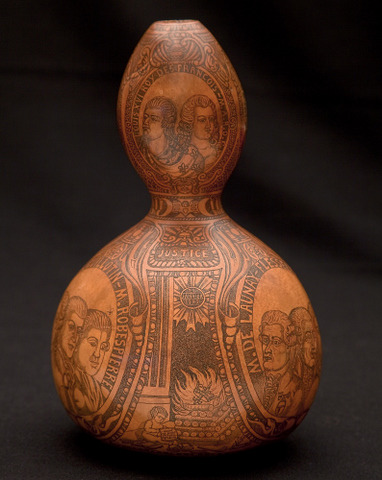
blood left at the foot of the guillotine. Bourdaloue then secreted this garment inside a calabash, now in the possession
of an Italian family. The rag itself has long since decomposed, but the
container still carries crimson stains and an inscription recording how the
souvenir was collected after the king's "decapitation". But there was no conclusive proof that the blood really belonged to Louis. A
DNA sample could not solve the riddle unless it was compared with another
drawn from a relative of the king.
A new study in the current issue of "Forensic Science International"
has filled in the missing link. The breakthrough came when scientists took a
DNA sample from
the mummified head of one of Louis's most illustrious ancestors:
King Henri IV, who ruled France from 1589 until 1610. This analysis established that Henri possessed a rare partial "Y"
chromosome. Louis was one of his direct male-line descendants, separated by
seven generations. The stains on the calabash also contained the "Y"
chromosome, along with other matches, leading experts to conclude that the
container almost certainly holds the blood of the executed king.
"Taking into consideration that the partial Y-chromosome profile is
extremely rare in modern human databases, we concluded that both males could
be paternally related," read the study. "Historically speaking, this forensic DNA data would confirm the identity
of the previous Louis XVI sample." The study found "with 95 per cent confidence" that it was 246 times
more likely that the owner of the mummified head and the provider of the
bloodstain were related than unrelated. Both Henri and Louis came to a
violent end at the hands of their subjects – and relics of both survive to
this day. (Read entire article.)
Do you know the other day on Yahoo an article was written on the blood DNA of King Louis XVI and the article started by calling the King "notorious." I was beyond livid at that description. You certainly can call Danton and Robespierre notorious but Louis XVI?? I really wonder at the qualifications of people who write for Yahoo and other web sites. It is simply outrageous.
Courteous comments are welcome. If a comment is not published, it may be due to a technical error. At any rate, do not take offense; it is nothing personal. Slanderous comments will not be published. Anonymity may be tolerated, but politeness is required.
I would like to respond to every comment but my schedule renders it impossible to do so. Please know that I appreciate those who take the time to share their thoughts.

Do you know the other day on Yahoo an article was written on the blood DNA of King Louis XVI and the article started by calling the King "notorious." I was beyond livid at that description. You certainly can call Danton and Robespierre notorious but Louis XVI?? I really wonder at the qualifications of people who write for Yahoo and other web sites. It is simply outrageous.
ReplyDelete