A place for friends to meet... with reflections on politics, history, art, music, books, morals, manners, and matters of faith.
A blog by Elena Maria Vidal.
At the end of 1455, after a public reconciliation with all his
enemies, Hunyadi began preparations. At his own expense he provisioned
and armed the fortress, and, leaving in it a strong garrison under the
command of his brother-in-law Mihály Szilágyi and his own eldest son
László, he proceeded to form a relief army and a fleet of two hundred
corvettes. As no other baron was willing to help (fearing Hunyadi’s
growing power more than the Ottoman threat), he was left entirely to his
own resources.
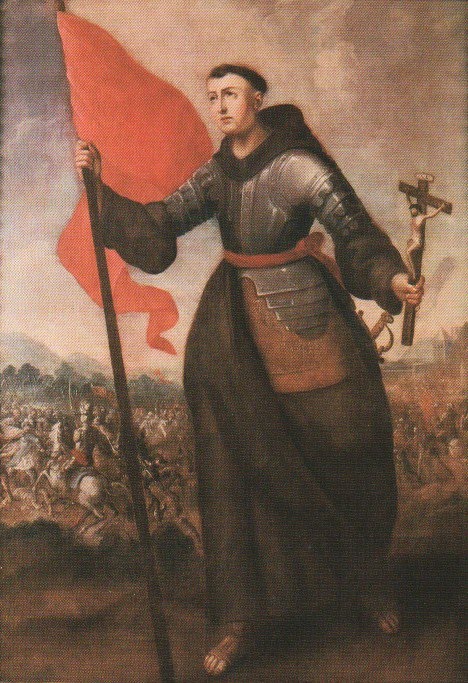
A Franciscan friar allied with Hunyadi, St. John of Capistrano,
preached a crusade to attract peasants and yeomanry to Hunyadi’s cause.
The recruits were ill-armed (many with only slings and scythes) but full
of enthusiasm, and they flocked to the standard of Hunyadi, the core of
which consisted of a small band of seasoned mercenaries and a few
banderia of noble horsemen. All in all, Hunyadi managed to build a force
of 25–30,000 men....
On July 14, 1456 Hunyadi arrived to the completely encircled city
with his flotilla on the Danube while the Ottoman navy lay astride the
Danube River. He broke the naval blockade on July 14, sinking three
large Ottoman galleys and capturing four large vessels and 20 smaller
ones. By destroying the Sultan’s fleet, Hunyadi was able to transport
his troops and much-needed food into the city. The fort’s defense was
also reinforced.
But Mehmed II was not willing to end the siege and after a week of
heavy artillery bombardment, the walls of the fortress were breached in
several places. On July 21 Mehmed II ordered an all-out assault which
began at sundown and continued all night. The besieging army flooded the
city, and then started its assault on the fort. As this was the most
crucial moment of the siege, Hunyadi ordered the defenders to throw
tarred wood, and other flammable material, and then set it afire. Soon a
wall of flames separated the Janissaries fighting in the city from
their comrades trying to breach through the gaps into the upper town.
The fierce battle between the encircled Janissaries and Szilágyi’s
soldiers inside the upper town was turning in favour of the Christians
and the Hungarians managed to beat off the fierce assault from outside
the walls. The Janissaries remaining inside the city were thus massacred
while the Ottoman troops trying to breach the upper town suffered heavy
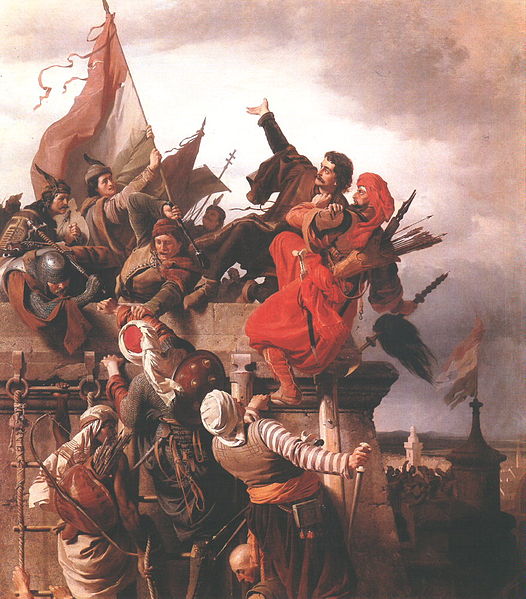
losses. When an Ottoman soldier almost managed to plant the Sultan’s
flag on top of a bastion, a Hungarian knight grabbed him and together
they plunged from the wall. (Read entire post.)
Courteous comments are welcome. If a comment is not published, it may be due to a technical error. At any rate, do not take offense; it is nothing personal. Slanderous comments will not be published. Anonymity may be tolerated, but politeness is required.
I would like to respond to every comment but my schedule renders it impossible to do so. Please know that I appreciate those who take the time to share their thoughts.
The whole thing was miraculous. There is always some reason people create to invade one another, it never seems to end....testosterone I guess.
ReplyDelete